RSS
 

Posts Tagged ‘including’

Voigtlander shows off three new lenses including 65mm F2 Macro for E-mount

06 Oct

$ (document).ready(function() { SampleGalleryV2({“containerId”:”embeddedSampleGallery_9965740614″,”galleryId”:”9965740614″,”isEmbeddedWidget”:true,”standalone”:false,”selectedImageIndex”:0,”startInCommentsView”:false,”isMobile”:false}) });

Lens manufacturer Voigtlander is set to introduce three unusual lenses this autumn and has posted pictures and specifications on its website, but isn’t letting on when they will arrive.

The most interesting, visually at least, is a VM 50mm F3.5 Heliar designed for M-mount bodies. It uses an almost symmetrical configuration of five elements in three groups and forms a conical shape reminiscent of the Tessar 50mm lenses of the Carl Zeiss Jena Werra cameras. The lens will have a minimum aperture of F22 and will use a 10-bladed iris that promises nice circular out-of-focus highlights. Remarkably, the aperture ring will be without click stops.

A more popular lens will be the 65mm F2 Macro Apo-Lanthar for the Sony E-mount system. This will have a closest focusing distance of 0.31m and will be able to transmit EXIF data to the camera as well as trigger manual focus assistance such as automatic magnification and peaking. It will have 10 elements in 8 groups and will offer apertures down to F22. The company has yet to decide whether the aperture ring will feature click stops, but again the iris will use 10 blades.

The third lens on display is a SL ll – S 58mm F1.4 Nokton designed for Nikon AI-S bodies. This new version of the company’s existing SL ll – N lens appears to be optically unchanged but it offers a more retro barrel design that echoes Nikon’s own manual focus lenses, and it has the addition of a meter coupling prong that will allow it to be used with much older bodies.

The company has not given any information on pricing or delivery dates, but you can read more specification on the Voigtlander website.

Articles: Digital Photography Review (dpreview.com)

 
Comments Off on Voigtlander shows off three new lenses including 65mm F2 Macro for E-mount

Posted in Uncategorized


This film camera is 100% 3D-printed, including the lens

13 Sep

3D modeler Amos Dudley has created a 35mm film camera using only 3D-printed parts, including a hand-and-machine polished resin lens. Called SLO, the finished camera is functional and can take photographs, albeit somewhat low in quality, demonstrating the successful construction of a fairly complex device using only 3D-printing technologies.

Dudley has detailed the creation process on his blog, explaining that SLO is made with some basic elements like a shutter, film cartridge, spool gears and an aperture plane among other pieces. In order to support future designs, Dudley made the lens and shutter as removable modules that can be swapped out for different ones. The camera supports 35mm film and uses a two-button shutter system that provides manual speed control based on how faster the user presses the button.

89590009

Once completed, the camera was used with Fujicolor Superia 400 film to take the photos above (click for the full set).


As expected, the lens was one of the harder elements to create, at first involving between 5 and 6 hours of hand polishing followed by polishing with a DIY motorized machine. Neither proved entirely sufficient, so Dudley dipped the resin lens in epoxy instead and cured it using UV lights.

Articles: Digital Photography Review (dpreview.com)

 
Comments Off on This film camera is 100% 3D-printed, including the lens

Posted in Uncategorized


How to Boost Your Creativity by Including Props in Your Photography

31 Jul

Props: are they a blessing or a curse? In photography, props can often make or destroy a photo, and because of this some people try to avoid them, some are afraid to use them, and other people love to use them.

I moved from being afraid to loving props because I found they are amazing tools to unlock creativity.
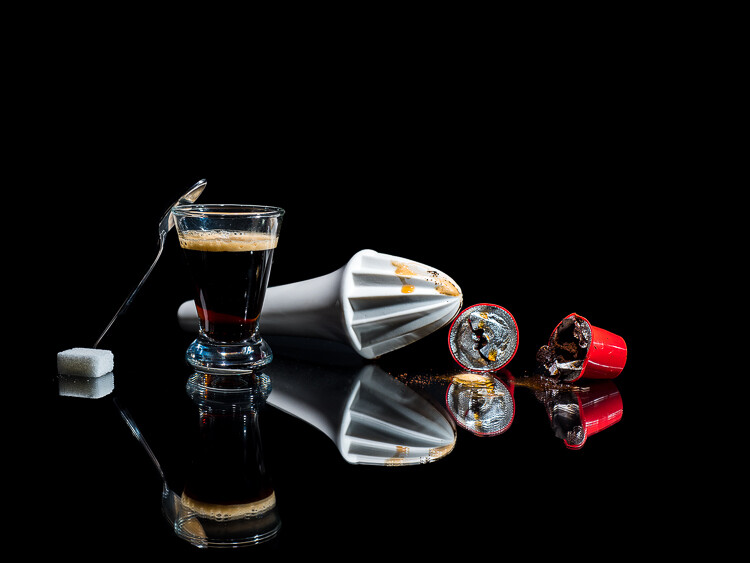
Photo00

Freshly squeezed coffee. A different way to prepare a fresh cup of coffee.

Why use props?

Usually, the role of the props in photography is to help add character and interest to a photo, or to add context to the scene.

Some kinds of photography, such as conceptual photography, cannot exist without props, as they are needed to translate the abstract concept or message into an image.
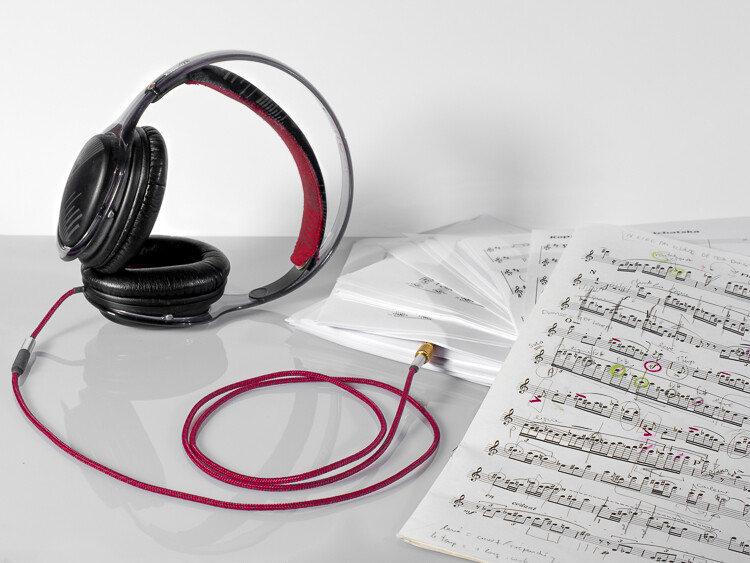
Photo01

Musical scores.

Props in commercial photography

In tabletop photography (product, food photography, and still life), props are used to build the scenography of the photo you are crafting.
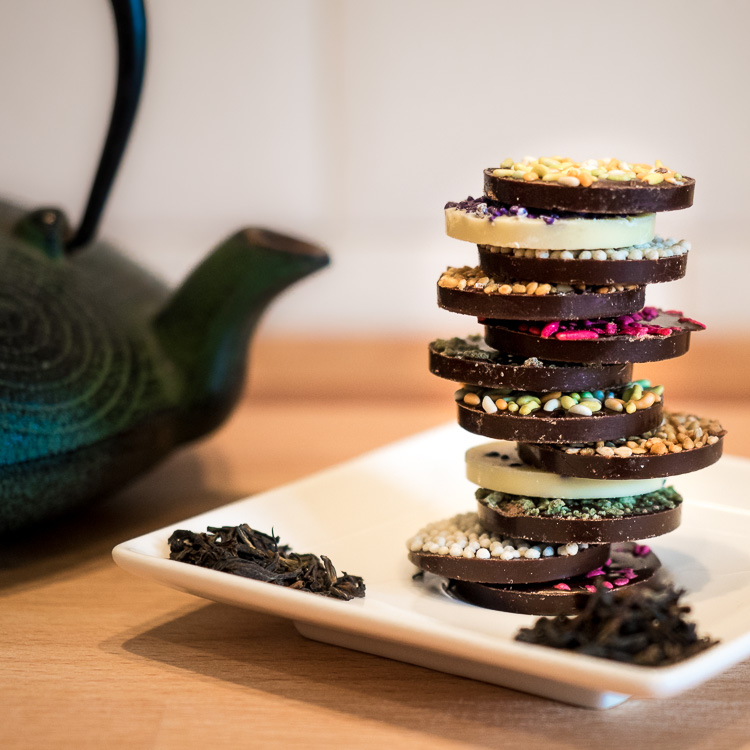
Photo02
The teapot, the plate, and tea leaves are all elements of the scenography used for the pile of chocolate biscuits in this a classic food photograph.

Props in landscape photography

Props are sometimes present even in landscape photography, usually with the task to add interest to the foreground. A classic example would be to photograph a camp site in the wilderness, with a lit tent under a starry sky.
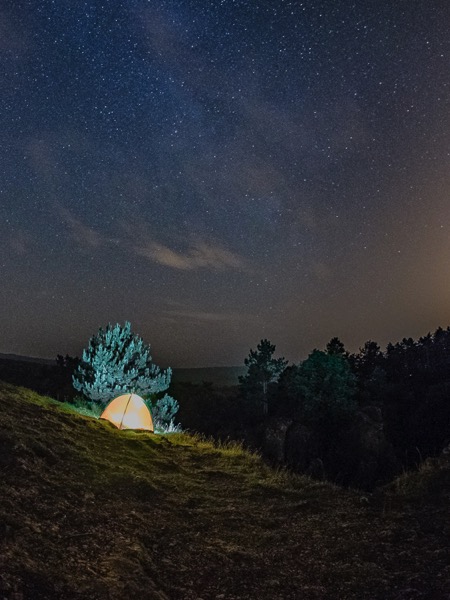
Photo03
This tent is, indeed, just a prop. I brought it along with me solely with the intent to add interest to this nocturnal landscape.

Props and portrait photography

Using props will also help you to create more interesting portraits. Are you into self-portraiture? Cool, but there is only so much you can do with your face, and after a while you will probably feel the need to start using props, The more creatively you can use them, the better and more interesting your portrait will be.
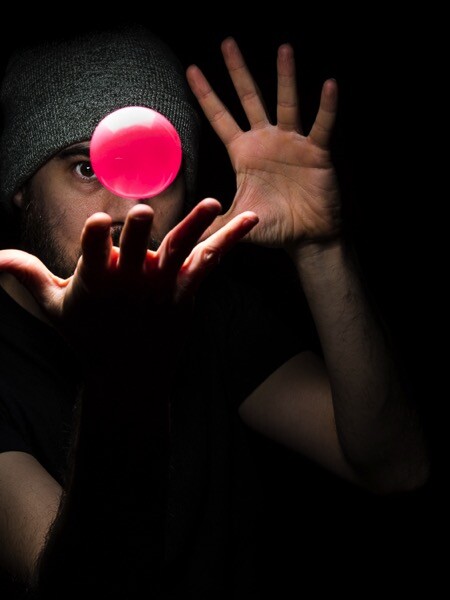
Photo04

A simple ball thrown in the air with a bit of timing can make for a dynamic, “It’s a kind of magic” portrait.

So, props are all those objects that photographers add into the scene they’re photographing that are not the main subject of the image. I don’t consider hats, jewelry, wristwatches, and all those accessories your model wears for a portrait, to be props.

Another plus with props, especially in portraiture, is that they can help your model to be more comfortable in front the camera by giving him/her something to do or to focus on, thus forgetting about you and your camera.
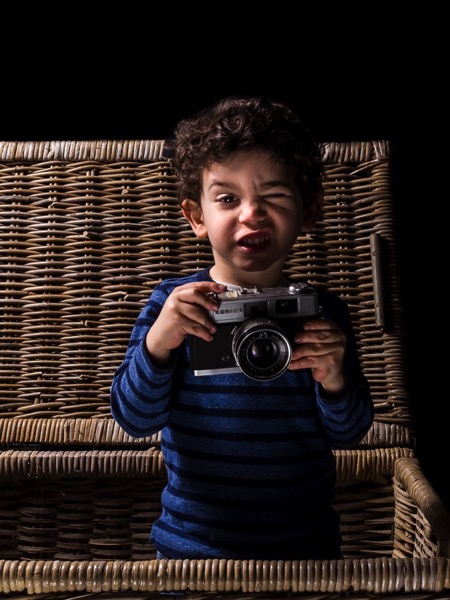
Photo05
A prop in the hands of a 3 year old toddler (my son in this case) can lead to interesting results without making a fuss.

Things to look out for using props

So where is the problem with the use of props? Why people can be negative about them? My guess is because they are so widely used in photography that the risk of fall into photographic clichés is quite high.

Below are five tips to help you be creative with props, instead to fear them.

Before you continue allow me a final word. While it is true that many things can be do inside editing software, to really exercise your creativity don’t be a lazy photographer, craft your images for real as much as possible.

Photo06
I consider the flame and the smoke in this photo of a hot pepper to be props. The fun in crafting the image with real fire and smoke was unbelievable.

Tip #1: Use a classic prop in a fresh way

Old film cameras are classic props in portraiture, and the ways to use them are variations of my son’s portrait you saw above.

Among those cameras, the most photogenic ones are, in my opinion, the TLR (twin lens reflex) cameras, such as Rolleiflex, Rolleicord and Yashica. Because these cameras have a huge focusing screen you have to look into from above, the usual way to use these props is to have your model look down into the camera.

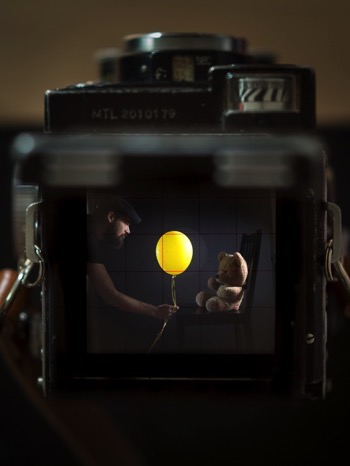
A less common way to use those TLR cameras as props is to take advantage of their massive focusing screen, which is many time larger than any SLR camera viewfinder, and to photograph the scene the TLR camera is seeing.

Once you get the setup right, don’t stop after the first shot, but experiment with poses and props.
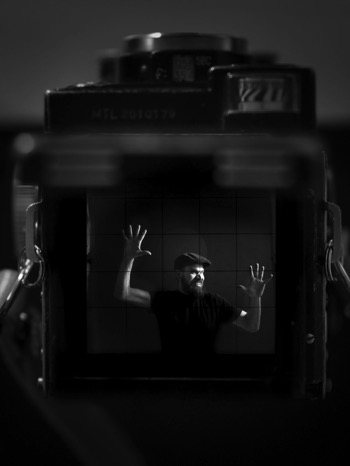
Photo07

Trapped!

Photo08

To reveal the child inside us.

Tip #2: Build your own props

Another way to get creative with props is to craft them yourself. This will not only ensure you have unique props to work with, but the whole process of making the props will make you think more creatively about how to use them.

A one meter long, origami paper boat, and a yellow balloon are good props to make one of my son’s fantasy and childish adventures come to life.
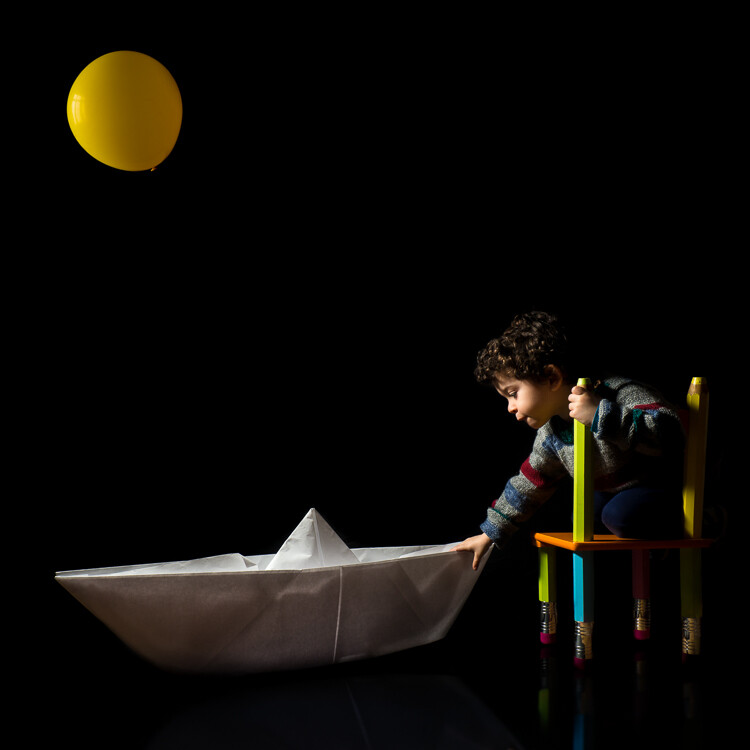
Photo09

A fantasy childhood adventure gets real in this photo.

If you are into origami, and tired of taking the usual portraits of your children, you could try to create adventures for them by folding big paper planes or animals, or whatever you know how to do with a piece of paper. Plus, you can find plenty of origami tutorials waiting for you online.

Once again, it is true you could easily compose the adventurous portrait of your child by adding elements to the photo later in Photoshop. But, again, what fun would that be for both of you?

Tip #3: Break the physical laws and go surreal

One of my favorite prop to work with are helium balloons, those you usually buy for parties. They are colorful, cheap, long lasting and very versatile.

Inspiration for their use is everywhere; have you watch the animation movie Up recently? Cool, wouldn’t it be fun to fly away holding tight to a bunch of balloons?
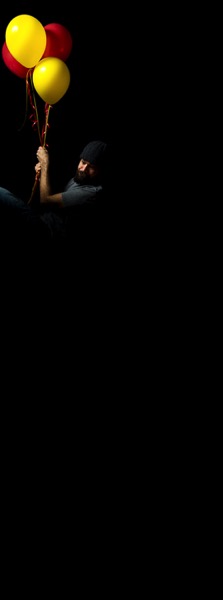
Photo10
Up, up we go. Here the low key really helped a lot to make the pose believable.

What about breaking the physical law by playing “tug of war” with those balloons, instead?
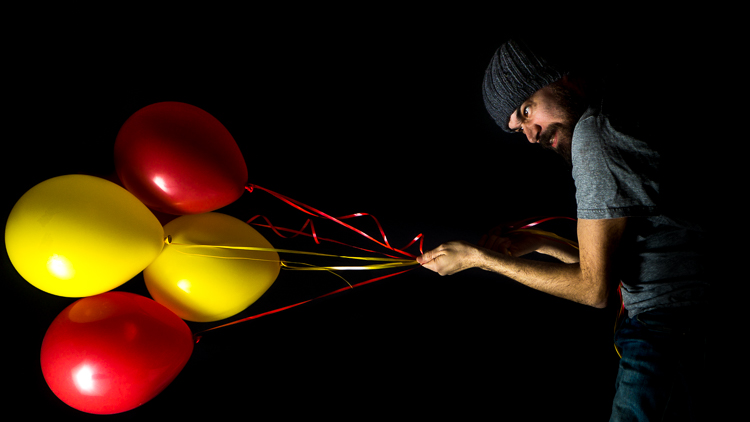
Photo11
Up and Down are quite arbitrary in this kind of photos. Here I was lying down on the floor but I tried to keep my shoulder off the ground, so that once I turned the photo 90 degrees counterclockwise, the pose was still believable. The low key helped by getting rid of the floor.

Tip #4: Prep your props

Sometimes, you can obtain something original just by prepping up a classic prop, such as the omnipresent book. Books are often used to fill a still life scene, or to get more interesting portraits.

Photo12
A funny contrast between the surprised grown up, rude, and bearded man, and the book of one of Winnie the Pooh adventures.

To make things more interesting, dynamic and less cliché, you can prep a book by sprinkling body powder on its pages and then have your model to blow the dust off while you take the photo. Or have him slam the book shut just before you fire the shutter, so to record of white powder flying out the book creating clouds.
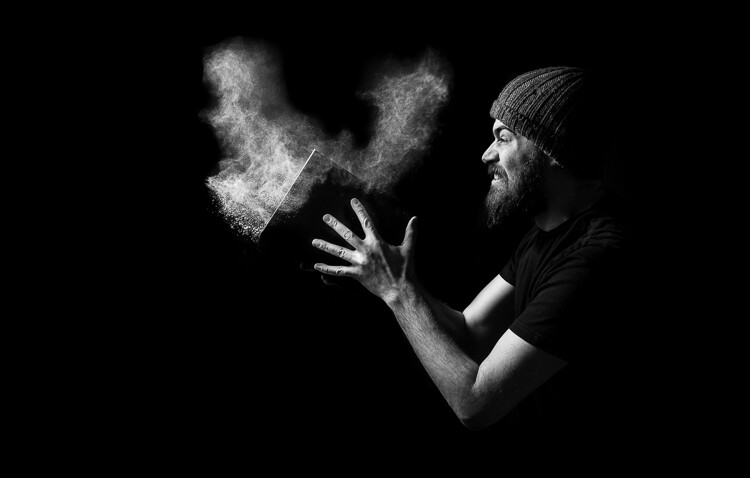
Photo13

By adding body powder to the mix, you can obtain much stronger and dynamic portrait.

Powder makes things much more interesting, and the only limit is your creativity (or the absence of a working vacuum cleaner to clean up after the mess). You can sprinkled some body powder on a ball (another common prop) and make your model hit it with the hands just before taking the photo. You will capture great puffs of powder, helping to convey a feeling of action and power.
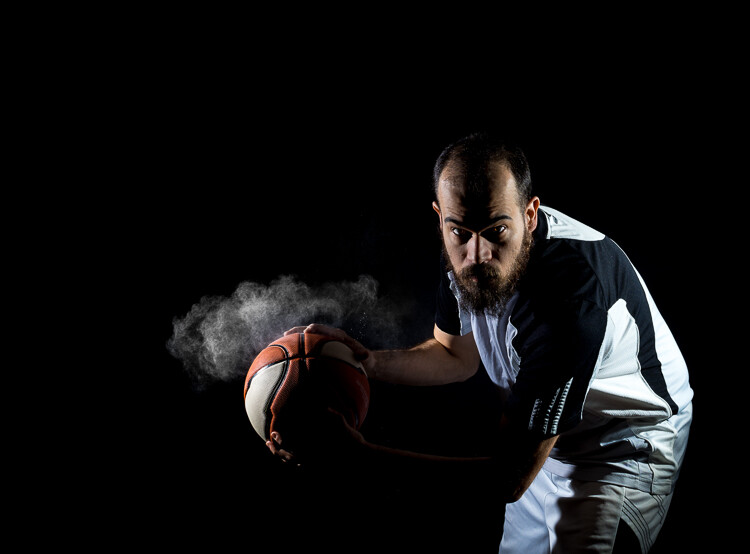
Photo14

Basketball and body powder mix in interesting ways.

Tip #5: Go crazy with conceptual photography

While it is challenging per se, I consider conceptual photography to be the best playground to learn to be creative with props.

When you do conceptual photography, your subject will be a concept, and the challenge is to translate it into an image by using props. At first, keep it easy, and don’t be afraid to get inspired by the work of other photographers.
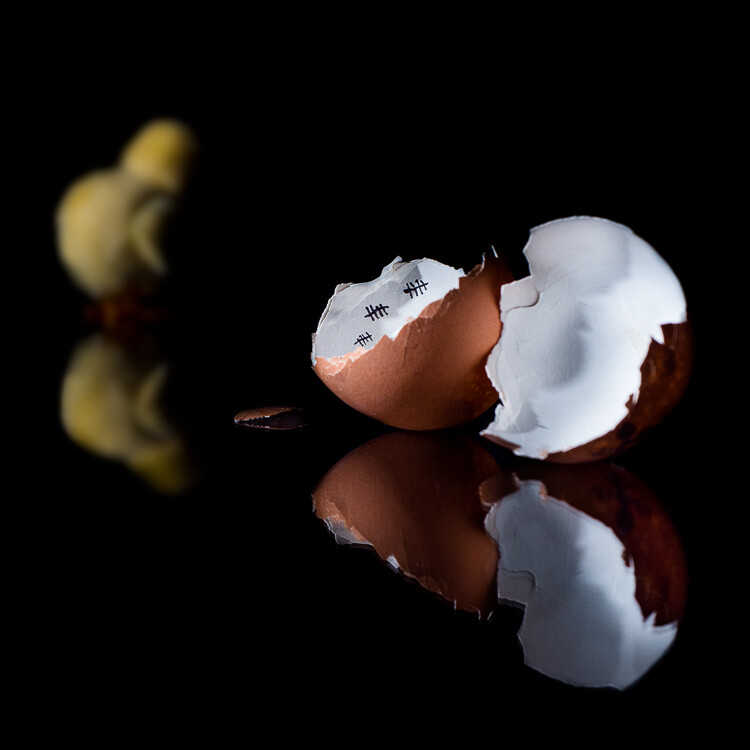
Photo15

The chicken’s great escape, a concept I saw online and I made it mine by using my personal style, and adding the escaping chicken.

Because you want to convey a message, even with the simplest setup, you have to pay attention on how you place your props into the scene.

In the previous photo, the dark, out-of-focus chicken in the background is there to give the idea of the chicken moving away from the egg. While the broken shell with marks on its inside make the viewer think of it as the chicken prison. Had I placed the chicken in the foreground, in-focus and well lit as the egg’s shell, the message would have lost some strength.

When you do conceptual photography, do not focus on the photography aspect at first, but let your ideas and concepts spawn naturally from your everyday life. Are you cooking your favorite food? In that moment the idea that photography is a bit like cooking could strike you.

In photography, as in cooking, you combine what reality puts in front your lens (the ingredients) to create your vision of such reality (the finished food).

This idea struck me once and this was my personal way to translate it into a photo: the ingredients are the colorful paper rolls in front the lens of an old TLR camera, and those ingredients combine in-camera to reveal an origami nocturnal seascape crafted using the paper from the rolls. Photography magic.
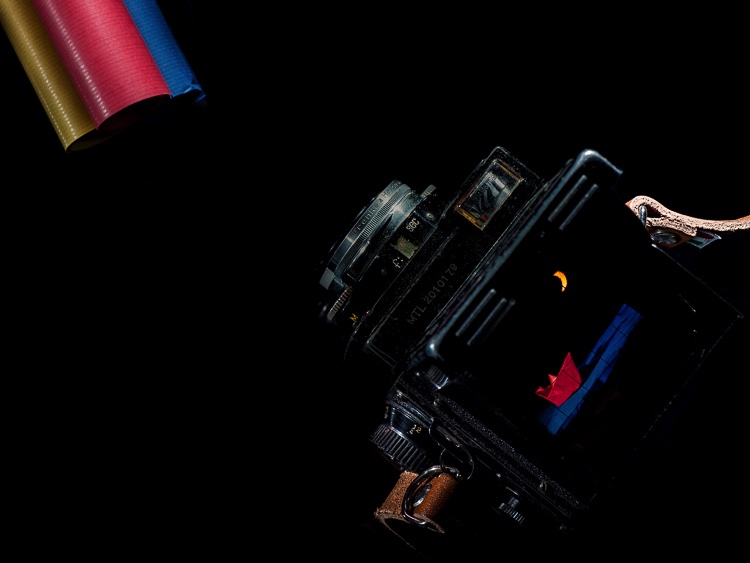
Photo16
The fun of doing the origami seascape for real and the challenge to frame, focus, and light it, so I could photograph the scene through my old TLR camera, was so much more than just use an editing software to copy/paste, move, rotate, resize and bled all the different elements together.

Once you start this game, you can find concepts everywhere; was your Mexican food too spicy even for a chili lover as you are? Something like that could pop in your mind.
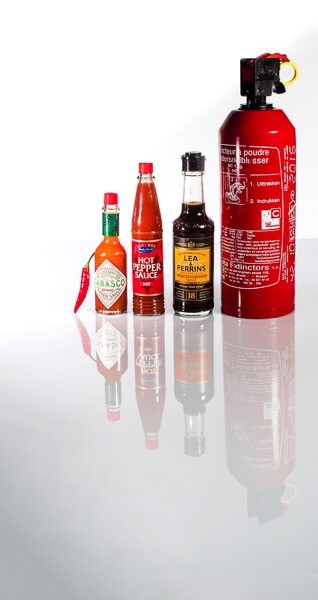
Photo17

The most useful kit for us chili lovers.

Bonus tip: The hunt for props

Now you know how you can get creative with props in many ways, even using common ones, but it is always good to hunt for more interesting ones.

A good way to hunt for unique and weird props is to visit flea markets and shops selling kitchen supplies, vintage clothes, and such. And then, as usual, once you’ve got your props, use them in a fresh and unconventional way.
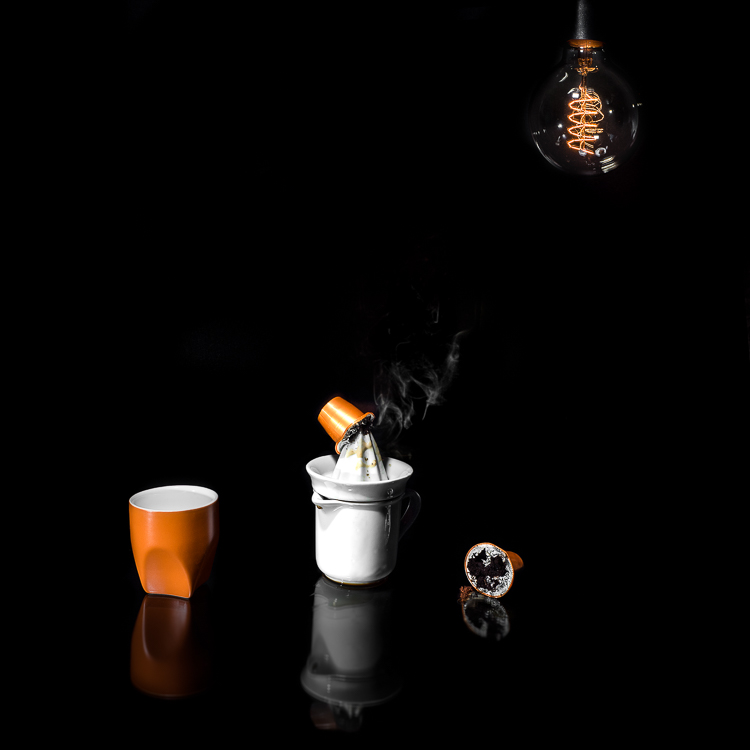
Photo18
A variation of the concept shown in the photo opening this article; the same concept can be photographed in many different and original ways. Creativity is your only limitation.

Once again, the way you use and prep the props is crucial to create a convincing image. The coffee stains on the table and the squeezer, the squashed and broken capsules, and the smoke from a hidden candle, make the viewer understand what the meaning of the photo is, and the reason behind those props.

Conclusions

Don’t be afraid to use props in your photography to add something more. Just remember to use them wisely and creatively to push your photography further, and to avoid falling into photography clichés.

googletag.cmd.push(function() {
tablet_slots.push( googletag.defineSlot( “/1005424/_dPSv4_tab-all-article-bottom_(300×250)”, [300, 250], “pb-ad-78623” ).addService( googletag.pubads() ) ); } );

googletag.cmd.push(function() {
mobile_slots.push( googletag.defineSlot( “/1005424/_dPSv4_mob-all-article-bottom_(300×250)”, [300, 250], “pb-ad-78158” ).addService( googletag.pubads() ) ); } );

The post How to Boost Your Creativity by Including Props in Your Photography by Andrea Minoia appeared first on Digital Photography School.


Digital Photography School

 
Comments Off on How to Boost Your Creativity by Including Props in Your Photography

Posted in Photography


Firmware update enhances Nikon D4s features, including unlimited continuous shooting

22 Apr

Nikon has issued updated firmware for its D4s professional DSLR, altering the way numerous features operate on the camera. Changes include removing the limitation on the number of images that can be captured in a single continuous burst in the manual and shutter priority exposure modes. Firmware version 1.20 replaces versions 1.00 and 1.10, and appears to fix quite a range of glitches as well as adding functionality to the camera’s operation. Read more

Articles: Digital Photography Review (dpreview.com)

 
Comments Off on Firmware update enhances Nikon D4s features, including unlimited continuous shooting

Posted in Uncategorized


London Bridge: 12 Contenders Including ‘Flaming Mouth of Hades’

05 Mar

[ By Steph in Architecture & Cities & Urbanism. ]

london bridge 008

Some of the concepts submitted for the new Nine Elms to Pimlico pedestrian bridge in London are rather – well – pedestrian, while others are so out-there they’ve been nicknamed ‘The Flaming Mouth of Hades.’ Spanning the Thames River, the bridge will link two very different parts of the city, and must be “technically rigorous and beautiful,” cyclist-friendly and well-engineered while providing headroom for river traffic.

london bridge 3

london bridge 4

londonb ridge 5

The competition to design the bridge has drawn dozens of entries from around the world, with a shortlist set to be announced later this month and a winner unveiled in July. The design brief notes that “how the bridge looks from afar, as it bestrides the Thames, what it feels like to cross and how it touches land on either shore – and the places that it creates around each landing point – will be critical to its success.”

london bridge 022

london bridge 003

london bridge 039

london bridge 19

Thus far, there’s only a gallery of images to look at, without any supporting information on each design, so it’s hard to tell just what we’re looking at in some cases. The City Metric called most of the entries ‘ridiculous,’ pointing out “the one which is definitely not a bridge,” “the one like a nightmarish Escher painting” and “the one that’s a spoon.”

londonb ridge 056

london bridge 079

london bridge 012

london bridge hades

It’s clear enough why the word Hades was invoked to describe the strange violet-and-orange creation pictured above, and it’s unclear how this design would actually function as a bridge. You have to wonder whether some of the entrants are just trolling. But some of the designs are actually quite beautiful, like the one featuring a perforated undulating canopy over a network of paths planted with greenery. However will the judges choose?

Share on Facebook


[ By Steph in Architecture & Cities & Urbanism. ]

[ WebUrbanist | Archives | Galleries | Privacy | TOS ]


WebUrbanist

 
Comments Off on London Bridge: 12 Contenders Including ‘Flaming Mouth of Hades’

Posted in Creativity


Marumi introduces fixed and variable neutral density filters, including ND100,000 for solar shooting

19 Feb

Japanese filter brand Marumi has introduced a collection of neutral density filters for its DHG (Digital High Grade) range including fixed density strengths of ND 8, 16, 32 and 64 as well as a variable ND filter with a range of ND 2.5-500. The company has also announced a ND filter for shooting solar eclipses. Read more

Articles: Digital Photography Review (dpreview.com)

 
Comments Off on Marumi introduces fixed and variable neutral density filters, including ND100,000 for solar shooting

Posted in Uncategorized


Photokina 2014: Hands on with new Tamron lenses – including 15-30mm F2.8

19 Sep

We caught up with Tamron at Photokina 2014 to get a peek at the new 15-30mm F2.8 ultra-wide angle zoom. It’s designed to cover a full frame sensor and was shown to us in a late prototype form, though its official launch date is unconfirmed. We also got some hands-on time with the manufacturer’s latest all-in-one zoom lenses as well as the always-impressively-huge 150-600mm F5-6.3. Read more

Articles: Digital Photography Review (dpreview.com)

 
Comments Off on Photokina 2014: Hands on with new Tamron lenses – including 15-30mm F2.8

Posted in Uncategorized


[MODIFIED] Google Chrome – Clear Browsing Data including Cookies, Flash Cookies, Cache, History, and Saved Passwords

07 Apr

For privacy, clear the data Google Chrome stores regarding your browsing history.

Even though Google Chrome supports “Incognito” browsing where history information is not kept and cookies are removed after browsing (press CTRL + SHIFT + N to open an “Incognito” window), you might accidentally forget to use this mode. You might also wish to remember cookies for a few hours while checking e-mail, chatting on social networking, or accessing your bank account online, then later decide to clear your tracks for privacy.

Google Chrome supports a feature where without the use of any extensions, you can clear browsing and download histories, the cache, cookies, Flash cookies, saved passwords, saved form data, and/or other details….

Read more at MalekTips.
New Computer and Technology Help and Tips – MalekTips.Com

 
Comments Off on [MODIFIED] Google Chrome – Clear Browsing Data including Cookies, Flash Cookies, Cache, History, and Saved Passwords

Posted in Technology


Ricoh promises ‘reference products’ including CMOS 645D at CP+

06 Feb

Ricoh_Logo.png

Ricoh Imaging has announced it will be showing four ‘reference products’ at the forthcoming CP+ trade show in Yokohama, Japan. The company’s Pentax brand has previously shown early prototypes of future models at the show. This year’s products include a CMOS-based 645D medium format camera with tilting LCD, scheduled for launch in Spring 2014, along with an ultra-wide-angle zoom for the 645 system. Also on show will be a telephoto macro prime lens for the small sensor Q-mount system and a DSLR accessory for making digital captures from slide and negative film.

News: Digital Photography Review (dpreview.com)

 
Comments Off on Ricoh promises ‘reference products’ including CMOS 645D at CP+

Posted in Uncategorized


Fujifilm adds five lenses to X system roadmap, including fast zooms

06 Jan

shared:fujifilm_logo.png

CES 2014: Fujifilm has updated its X-system roadmap for 2014, adding five lenses to its list of upcoming releases. First up is an extended-range zoom, the XF 18-135mm F3.5-5.6 R OIS (28-200mm equivalent). Following this will be two fast zooms, the XF 16-55mm F2.8 R OIS standard zoom, and XF 50-140 F2.8 R OIS (24-83mm and 75-210mm equivalent respectively). All three feature aperture rings and optical stabilisation. They’ll be followed by a ‘high speed wide angle lens’ and ‘super telephoto zoom lens’ in late 2014 / early 2015. 

News: Digital Photography Review (dpreview.com)

 
Comments Off on Fujifilm adds five lenses to X system roadmap, including fast zooms

Posted in Uncategorized