A few nice visual art images I found:
VSP Visual Street Performance 2007 @ Fabrica Braco de Prata, Lisbon, Portugal

Image by Graffiti Land
A few nice visual art images I found:
VSP Visual Street Performance 2007 @ Fabrica Braco de Prata, Lisbon, Portugal
Image by Graffiti Land
A few nice visual art images I found:
VSP Visual Street Performance 2007 @ Fabrica Braco de Prata, Lisbon, Portugal

Image by Graffiti Land
VSP Visual Street Performance 2007 @ Fabrica Braco de Prata, Lisbon, Portugal

Image by Graffiti Land
VSP Visual Street Performance 2007 @ Fabrica Braco de Prata, Lisbon, Portugal

Image by Graffiti Land

This fixed-focal length lens is perfect for portraits and good for the bokeh!!! All pictures shot on a Nikon D3100 with the 35mm f/1.8G lens. Sample images link.. www.flickr.com
First offering from 15 year old singer/songwriter Lily Juniper. Directed and filmed by James Miller around Portobello Market in March 2012. Produced by David Boyd. My debut EP will be out on the 28th January 2013, through the usual digital outlets such as iTunes & Amazon. It contains the tracks ‘Plan B’, ‘Object Of My Affection’ & ‘Not Enough’. Management: David and Yvette Boyd – david@flockmusic.com www.facebook.com www.twitter.com
Check out these visual art images:
VSP Visual Street Performance 2007 @ Fabrica Braco de Prata, Lisbon, Portugal

Image by Graffiti Land
VSP Visual Street Performance 2007 @ Fabrica Braco de Prata, Lisbon, Portugal

Image by Graffiti Land
VSP Visual Street Performance 2007 @ Fabrica Braco de Prata, Lisbon, Portugal

Image by Graffiti Land

Ricoh exhibited a concept camera at CP+ that captures spherical panoramic images and sends them wirelessly to smartphone or tablet. Apparently produced mainly to gauge market reaction, Ricoh released no technical info on the camera apart from the fact that it uses two opposed 180-degree lenses whose images it combines into one spherical panorama. Users can zoom in on the image elements and swipe to look around the sphere; they can also zoom out to a circular image. The company imagines printing images on spheres as a potential product concept, and is considering video capture as well as stills.

Mobile Photography Awards (MPA) have announced the winners, runners up and honorable mentions of their 2013 competition. A record number of entries were received in this year’s competition from participants around the globe, demonstrating increasing interest in mobile photography as an art form. We’ve picked some of our favorites from the 19 categories.
Some cool visual art images:
Mapping Privacy in Public Spaces – Jan 12, 2013

Image by BMW Guggenheim Lab
Mapping Privacy in Public Spaces Project: Findings by KRVIA Design Cell
BMW Guggenheim Lab
January 12, 2013
Dr. Bhau Daji Lad Museum
Mumbai, India
Where do Mumbaikars find privacy in their city? The KRVIA Design Cell talked about their findings from the Mapping Privacy in Public Space research project, conducted through the Lab’s run. They discussed their methodology and their experience in data collection across the Lab’s six sites, and shared the visual imagery and maps they created from their research from over 200 participants.
Photos: UnCommonSense © 2013 Solomon R. Guggenheim Foundation, New York
Mapping Privacy in Public Spaces – Jan 12, 2013
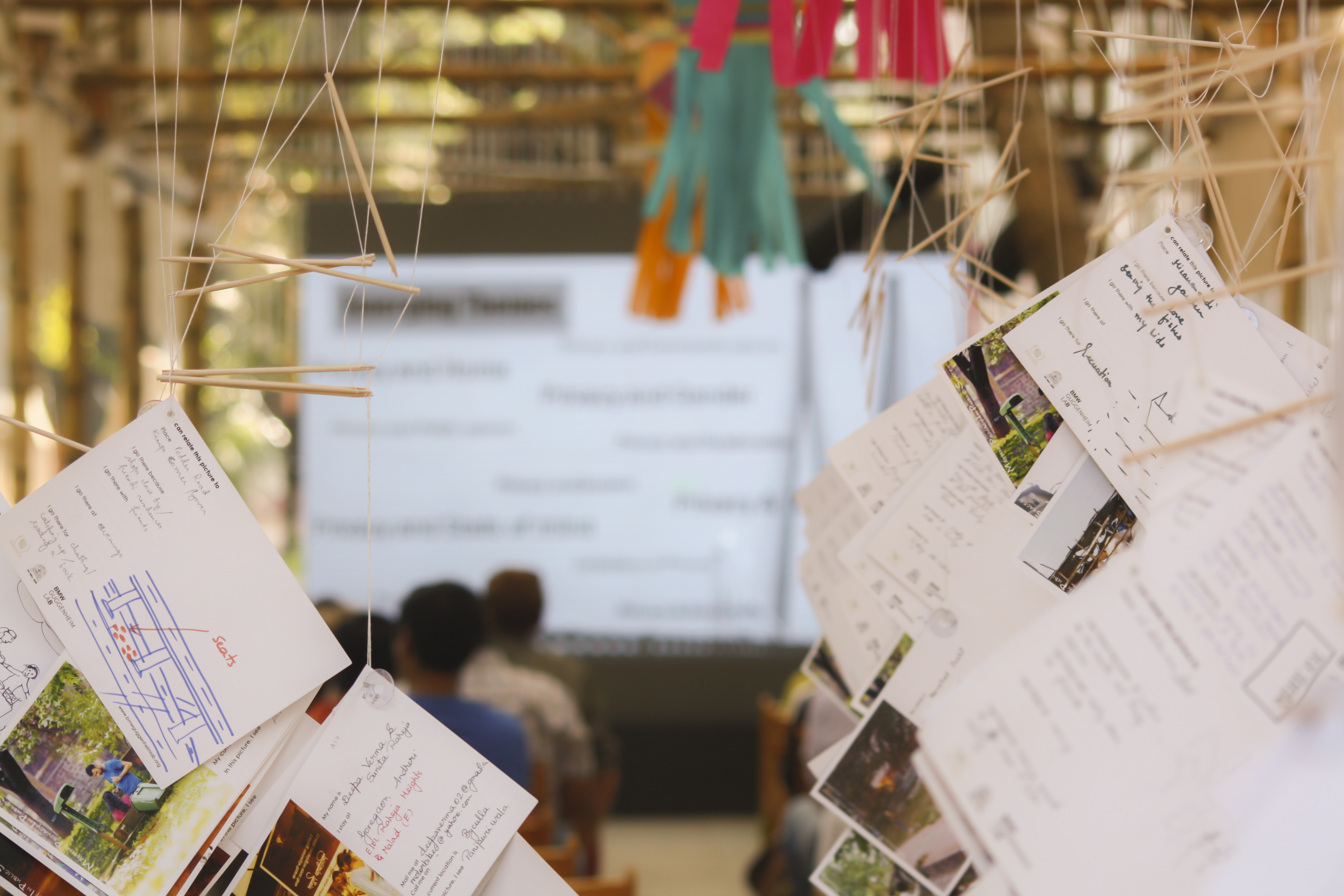
Image by BMW Guggenheim Lab
Mapping Privacy in Public Spaces Project: Findings by KRVIA Design Cell
BMW Guggenheim Lab
January 12, 2013
Dr. Bhau Daji Lad Museum
Mumbai, India
Where do Mumbaikars find privacy in their city? The KRVIA Design Cell talked about their findings from the Mapping Privacy in Public Space research project, conducted through the Lab’s run. They discussed their methodology and their experience in data collection across the Lab’s six sites, and shared the visual imagery and maps they created from their research from over 200 participants.
Photos: UnCommonSense © 2013 Solomon R. Guggenheim Foundation, New York

Greek artist Panos Papanagiotou takes a reflective approach to his photography, using his iPhone and apps that create a mirrored effect. Everyday items are transformed into symmetrical studies that challenge the viewer to look at otherwise mundane details in a fresh way. Click through for more information and images from Papanagiotou’s Mirrors series in our article on connect.dpreview.com.
Check out these visual art images:
excellent review . icp show: Archive Fever

Image by Susan NYC
Please give me credit if you use this picture: susan sermoneta
You may use the picture free of charge for non-commerical purposes. Otherwise, please contact me.
The New York Times
January 18, 2008
Art Review
Well, It Looks Like Truth
By HOLLAND COTTER
After an autumn of large, expert, risk-free museum retrospectives, the time is right for a brain-pincher of a theme show, which is what “Archive Fever: Uses of the Document in Contemporary Art” at the International Center of Photography is.
Organized by Okwui Enwezor, an adjunct curator at the center, it’s an exhibition in a style that’s out of fashion in our pro-luxe, anti-academic time, but that can still produce gems. The tough, somber little show “Manet and the Execution of Maximilian” at the Museum of Modern Art last year mixed grand paintings with throwaway prints and demanded a commitment of time and attention from its audience. The payoff was an exhibition that read like breaking news and had the pull of a good documentary. It was the museum’s proudest offering of the season.
Mr. Enwezor’s “Archive Fever” is up there with it. It has something like the same suspenseful pace, without the focused story line. The archive of the title is less a thing than a concept, an immersive environment: the sum total of documentary images circulating in the culture, on the street, in the media, and finally in what is called the collective memory, the “Where were you when you heard about the World Trade Center?” factor.
Photography, with its extensions in film, video and the digital realm, is the main vehicle for these images. The time was, we thought of photographs as recorders of reality. Now we know they largely invent reality. At one stage or another, whether in shooting, developing, editing or placement, the pictures are manipulated, which means that we are manipulated. We are so used to this that we don’t see it; it’s just a fact of life.
Art, which is in the business of questioning facts, takes manipulation as a subject of investigation. And certain contemporary photographers do so by diving deep into the archive to explore its mechanics and to carve their own clarifying archives from it.
“Archive Fever” puts us deep inside right from the start. The gallery walls have been covered with sheets of plain industrial plywood. The exhibition space looks like the interior of a storage shed or a shipping container packed with images both strange and familiar.
Familiar comes first: Andy Warhol’s early 1960s “Race Riot,” a silk-screened image of a black civil rights marcher attacked by police dogs. Warhol, our pop Proust, was a child of the archive; he lived in it and never left it. He culled his images straight from the public record — in this case Life magazine — and then made them public in a new way, as a new kind of art, the tabloid masterpiece, the cheesy sublime.
In the process he messed up our habit of sweetening truth with beauty, of twisting the base and the awful into the transcendent. He nailed art’s moral ambivalence, pegged it as a guilty party and kept hammering away at this. People who hate the 1960s for the illusions they shattered usually hate Warhol too. He was a slippery spoiler.
The second, far less well-known work that opens the show is a 1987 silk-screen piece by Robert Morris that does what the Warhol does but in a deadlier way. It too is based on an archival image, a 1945 photograph of the corpse of a woman taken in the Bergen-Belsen concentration camp. Although such pictures initially circulated in the popular press, they were soon set aside in an ethically fraught image bank of 20th-century horrors. As if acknowledging prohibitions, Mr. Morris has half-obscured the woman’s figure with old-masterish strokes of paint and encased it, like a relic, in a thick black frame swelling with body parts and weapons in relief.
The series of war-related paintings this piece came from took a lot of critical heat in the 1980s. Mr. Morris was accused of, at best, pandering to a market for neo-Expressionism; at worst, of exploiting the Holocaust. Now that his reputation as an influential artist of probing diversity is becoming more clear, so is the impulse behind this work. When you are looking at great art in museums, it seems to say, you are, whether you know it or not, looking at realities like the one you see here. Art is not merely a universal ornament of civilization. It is a cautionary tale in need of constant translation.
There are many tales in “Archive Fever.” In most, fact and fiction are confused. A group of pictures called “The Fae Richards Photo Archive” (1993-1996), produced by Zoe Leonard in collaboration with the filmmaker Cheryl Dunye, purports to document the life of an African-American actress from her childhood early in the 20th century through her post-civil rights era old age. The substance of the narrative, including a film career sabotaged by racism, rings true; but Fae Richards never existed. Her life was staged for the contemporary camera.
So, in a different way, was the saga suggested in “The Sher-Gil Archive” (1995-97) by Vivan Sundaram, an artist in New Delhi. In this case the people are real, members of Mr. Sundaram’s family as photographed by his great grandfather in colonial India. But Mr. Sundaram has altered the pictures, mixing eras and generations, meticulously splicing an imaginary whole from real archival parts.
Other artists present randomness as the archive’s logic. The casual snapshots that make up Tacita Dean’s salon-style “Floh” may look like a natural grouping. In fact they are all found pictures that the artist, acting as a curator, has sorted into a semblance of unity.
The thousands of images in a looping 36-hour slide projection by Jef Geys would seem to be linked by a firmer thread. They are a visual archive of Mr. Geys’s photographic output of 40 years. Whether they provide evidence of aesthetic development, though, or insight into the artist’s maturing mind and soul, will be known only to the most devoted of viewers.
In any case, the romantic notion that an artist’s work and soul are inevitably of a piece has long been poked at and played with by artists themselves. Sherrie Levine’s photographs of Walker Evans photographs debunk the heroic ideals of personal vision in art. At the same time, because the copies are genuine Sherrie Levines, the ideal is reaffirmed; and another name enters the market, the museums, the history books.
Just as Ms. Levine questions authenticity as a component of art making, some of her contemporaries question its role in writing history. In a video called “The Specialist: Eichmann in Jerusalem” (1999), the Israeli artist Eyal Sivan reordered scenes in videos of the 1961 trial of the Nazi war criminal Adolph Eichmann to create new sequences and, some have said, a less damning portrait of him. In elaborate conceptual projects the artist Walid Raad revisits the Lebanese civil war of the 1980s in minute, graphic detail, through the voices of people who never existed using details he has invented.
For some artists details, or rather the accumulation of them, are the only truth. On large sheets of paper, Felix Gonzalez-Torres (1957-1996) printed photographic portraits of almost 500 people killed by gunfire in American cities in a single week in 1989. Ilán Lieberman’s “Lost Child” series consists of a stream of hand-drawn thumbnail portraits, based on photographs in Mexican newspapers, of missing children.
And in the show’s most startling example of archival accumulation, the German artist Hans-Peter Feldmann has filled a room with the framed front pages of 100 international newspapers — from Paris, Dubai, Sydney, Seoul, New York and elsewhere — printed on Sept. 12, 2001. Questions flood in: Why were certain pictures of the devastated Twin Towers used in certain places? Why does Osama bin Laden’s face appear on some pages and not on others? And how is the story reported in languages we cannot read; Arabic, say, or Persian? And what could readers who didn’t read English know of our reports? To enter this archive is to relive recent history. I was reluctant to go in, but then I couldn’t leave.
Mr. Feldmann’s work, made for this exhibition, is monumental. Fazal Sheikh’s “Victor Weeps: Afghanistan” series (1997) is, in almost every way, not. Each of the four pictures in the show is of a hand holding a passport-size photographic male portrait. Statements by the family members who hold the photos tell us that they are portraits of Afghan mujahedeen fighters who had died or disappeared during battles with occupying Russian forces in the 1980s.
Although the portraits are in each case held loosely, even tenderly, the words they evoke are passionate. These little pictures — routine, unexceptional, of a kind turned out in countless numbers — may be the only visual link between the dead and their survivors. Here the archival is profoundly personal.
But do Mr. Sheikh’s beautiful pictures, or the photographs within them, represent some special, easily approached corner of the great archive that surrounds, shapes and even overwhelms us? Do they convey , for once, some comprehendible truth? No, just the ordinary one: When it comes to full disclosure, art never, ever speaks for itself, as Mr. Enwezor’s eloquent exhibition tells us in many ways.
“Archive Fever: Uses of the Document in Contemporary Art” is at the International Center of Photography through May 4; 1133 Avenue of the Americas, at 43rd Street; (212) 857-0000, icp.org.
Marguerite Zorach, American painter and printmaker, 1887-1968, in her studio

Image by Smithsonian Institution
Description: Marguerite Thompson Zorach was an innovator of the American modernist movement. She helped introduce fauvist and cubist styles to the United States. After traveling extensively in Egypt, Palestine, India and Japan, she returned home to produce brilliantly colored Fauvist landscapes with thick black outlines. Her style developed and included more Cubist structure until she turned to creating embroidered tapestries after the birth of her two children. While she continued to paint and assist her husband, William Zorach, on larger projects, her main focus was on these tapestries. She completed two WPA murals for the Fresno post office.
Creator/Photographer: Peter A. Juley & Son
Medium: Black and white photographic print
Dimensions: 8 in x 10 in
Culture: American
Persistent URL: http://photography.si.edu/SearchImage.aspx?id=5837
Repository: Smithsonian American Art Museum, Photograph Archives
Collection: Peter A. Juley & Son Collection – The Peter A. Juley & Son Collection is comprised of 127,000 black-and-white photographic negatives documenting the works of more than 11,000 American artists. Throughout its long history, from 1896 to 1975, the Juley firm served as the largest and most respected fine arts photography firm in New York. The Juley Collection, acquired by the Smithsonian American Art Museum in 1975, constitutes a unique visual record of American art sometimes providing the only photographic documentation of altered, damaged, or lost works. Included in the collection are over 4,700 photographic portraits of artists.
Accession number: J0029484
Some cool visual art images:
Rohlf_RW_845T

Image by MTAPhotos
On May 11, 2012, we officially opened the newly rebuilt and improved Far Rockaway-Mott Av terminal on the A line. The sparkling, steel and glass, state-of-the art transit facility includes "Respite," a new glass panel artwork by Jason Rohlf made in jewel-toned colors from original paintings. The artwork dramatically diffuses the light inside to create a richly saturated interior space. The work can be seen throughout the station as well as from outside, adding visual impact to the existing architecture. Photo: Metropolitan Transportation Authority / Rob Wilson.