RSS
 

Posts Tagged ‘Hidden’

Trapdoor Secrets: Furniture Hidden Inside Floors & Ceilings

22 Dec

[ By WebUrbanist in Design & Fixtures & Interiors. ]

hidden dining table

This remarkable remodel is full of fun and functional surprises ranging from ceiling-suspended swing sets, hammocks, bookshelves, tables and benches to flip-up, in-floor mirrors and trap-door storage spaces.

hidden ceiling hammock

hidden pulley system

hidden ceiling swing

Designed by Elii in Madrid, Spain, the compartment-centric project takes maximum advantage of high ceilings to add layers of usefulness above, below and ultimately between each of two levels.

hidden floor storage

hidden bathroom mirror

Discrete handles along the walls allow the occupant to deploy each function in piecemeal fashion, calling down an on-demand hammock and fans, for instance, or dining room surface and seating as needed.

hidden panels back forth

Hidden pulleys make it easy to drive each object back up and out of the way when not in use – no laborious reaching, pushing or pulling required.

Next Page – Click Below to Read More:
Trapdoor Secrets Furniture Hidden Inside Floors Ceilings

Share on Facebook


[ By WebUrbanist in Design & Fixtures & Interiors. ]

[ WebUrbanist | Archives | Galleries | Privacy | TOS ]


WebUrbanist

 
Comments Off on Trapdoor Secrets: Furniture Hidden Inside Floors & Ceilings

Posted in Creativity


Trapdoor Secrets: Furniture Hidden Inside Floors & Ceilings

13 Dec

[ By WebUrbanist in Design & Fixtures & Interiors. ]

hidden dining table

This remarkable remodel is full of fun and functional surprises ranging from ceiling-suspended swing sets, hammocks, bookshelves, tables and benches to flip-up, in-floor mirrors and trap-door storage spaces.

hidden ceiling hammock

hidden pulley system

hidden ceiling swing

Designed by Elii in Madrid, Spain, the compartment-centric project takes maximum advantage of high ceilings to add layers of usefulness above, below and ultimately between each of two levels.

hidden floor storage

hidden bathroom mirror

Discrete handles along the walls allow the occupant to deploy each function in piecemeal fashion, calling down an on-demand hammock and fans, for instance, or dining room surface and seating as needed.

hidden panels back forth

Hidden pulleys make it easy to drive each object back up and out of the way when not in use – no laborious reaching, pushing or pulling required.

Next Page – Click Below to Read More:
Trapdoor Secrets Furniture Hidden Inside Floors Ceilings

Share on Facebook


[ By WebUrbanist in Design & Fixtures & Interiors. ]

[ WebUrbanist | Archives | Galleries | Privacy | TOS ]


WebUrbanist

 
Comments Off on Trapdoor Secrets: Furniture Hidden Inside Floors & Ceilings

Posted in Creativity


Magic Cement: Hidden Concrete Patterns Appear with Water

27 Nov

[ By WebUrbanist in Design & Furniture & Decor. ]

water activated concrete decor

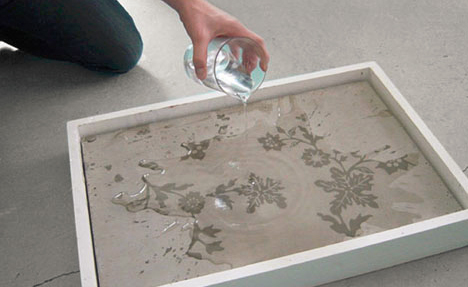
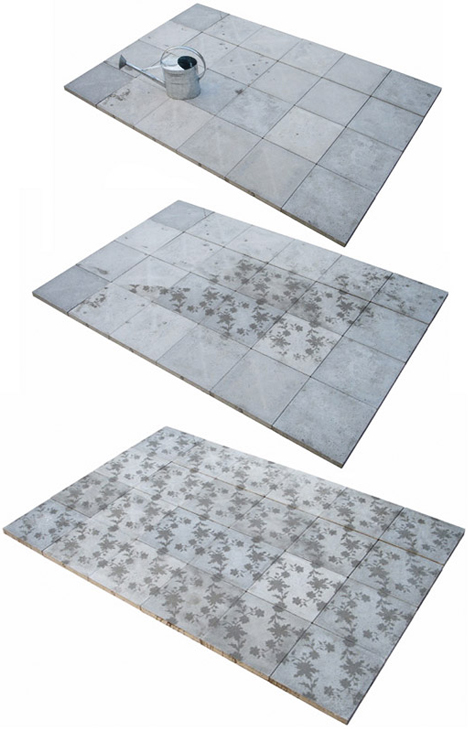
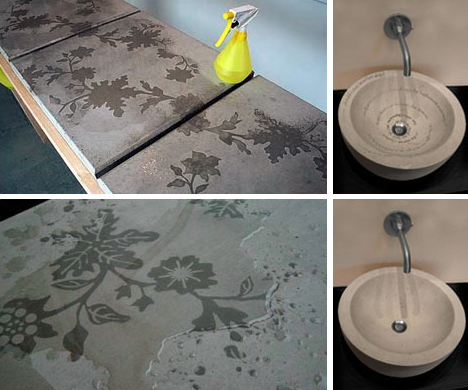
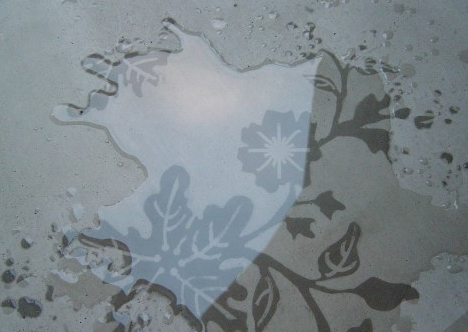
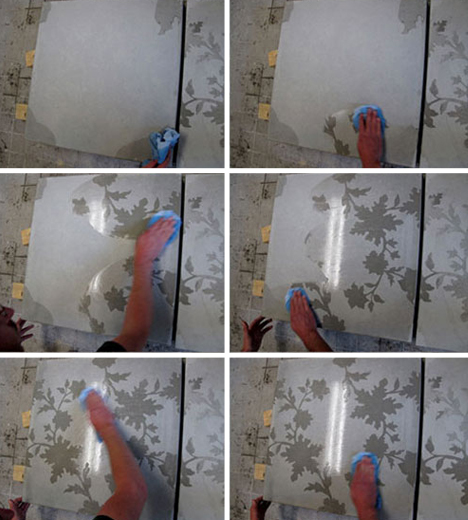
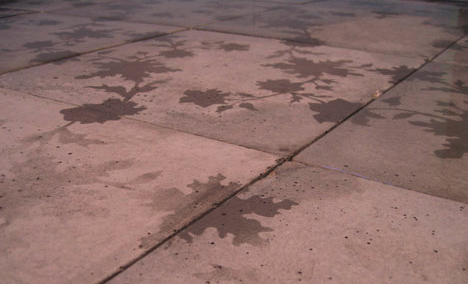
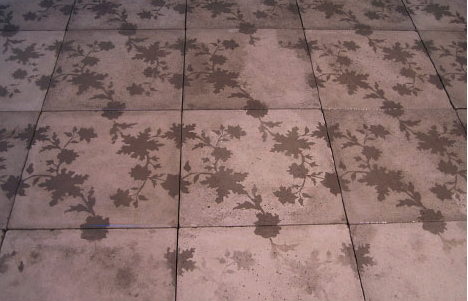
The writing is on the walls, but only when they get wet – that is when the secret messages or hidden designs appear in these seemingly innocuous concrete surfaces, like a durable and built-in version of Neverwet graffiti.

water time lapse reveal

The project is called Silent Poetry and its creators, Frederik Molenschot & Susanne Happle, have started with a high-contrast approach: organic forms hidden in strict geometric slabs, but any other patterns are equally compatible with the approach.

water applications cement design

water hidden cement pattern

The underlying magic-caliber, moisture-sparked trick works whether the material is drizzled on by the rain, doused in running water, touched by steam or impacted by condensation on a hot and humid day, making for innumerable creative possibilities both inside and outdoors.

water reveals secret patterns

Picture a public sidewalk, parking lot or city center on the one hand or a private walkway or concrete-tiled bathroom on the other. But also consider the range of applications from wayfinding in urban settings to domestic decorations on front decks or walkways that appear with the morning dew, using either modular precast tiles or larger poured-in-place slabs.

water pavement art design

water revealing floral repetitive

From the designers: “The possible applications of solid poetry are various: either at home in the bathroom, in the garden, in saunas and dance clubs, where the humidity is high or public spaces like bus stops or pavements. All forms of solid poetry have in common that they change the whole setting; they are surprising and have a life of their own.”

Share on Facebook


[ By WebUrbanist in Design & Furniture & Decor. ]

[ WebUrbanist | Archives | Galleries | Privacy | TOS ]


WebUrbanist

 
Comments Off on Magic Cement: Hidden Concrete Patterns Appear with Water

Posted in Creativity


Secret Cities: Capturing Hidden Abandoned Places on Film

12 Nov

[ By Steph in Abandoned Places & Architecture. ]

Secret Cities Abandoned Places 1
Just beyond all of the noise and activity of daily urban life is a secret world of forgotten spaces which are nearly always dank and dusty, but often surprisingly beautiful. Photographer Andrew Brooks seeks out these spots in Manchester, UK and Sittard-Geleen, The Netherlands, capturing them on film so the less adventurous can experience a small fraction of their crumbling glory.

Secret Cities Abandoned Places 2

Brooks gains entry into grand disused buildings that seem frozen in time, like the Hulme Hippodrome and Manchester’s Albert Hall, as well as subterranean tunnels and decommissioned water towers. At his website, the photographer provides detailed information about each location he shoots, describing what it felt like to experience them firsthand, as well as offering his stunning images.

Secret Cities Abandoned Places 3

Secret Cities Abandoned Places 6

The forgotten spaces just out of view of the average person in virtually any major city around the world start to occupy ‘imaginary spaces,’ says Brooks. It’s easy to envision them as settings for all sorts of fictional intrigue, to let our imaginations run wild with the possibilities of these often complex spaces, yet most of us are too wrapped up in our immediate surroundings to give them much thought.

Secret Cities Abandoned Places 4

Secret Cities Abandoned Places 5

“The familiar space we occupy gradually take on the character of wallpaper in our lives as we hurry from meeting to meeting, commitment to commitment, never stopping to appreciate the places where we live. In our rush we miss both the fantasy and reality of our pace in the world, habitually ignoring even the points where the opportunities for simple adventure encourage us to indulge.”

Share on Facebook


[ By Steph in Abandoned Places & Architecture. ]

[ WebUrbanist | Archives | Galleries | Privacy | TOS ]


WebUrbanist

 
Comments Off on Secret Cities: Capturing Hidden Abandoned Places on Film

Posted in Creativity


The Hidden Secrets of Lightroom 5’s Loupe View

31 Oct

Lightroom 5 Loupe View

Last week I showed you how to use Lightroom’s Grid View. Once you have customised the Grid View to suit your needs, it is time to move on to the Loupe View. Getting there is easy. Just press the letter ‘E’ on your keyboard. This will take you to the Loupe View from anywhere in Lightroom. Alternatively, if you are in the Grid View, you can press the space bar.

On the surface, Loupe View looks simple. But there are a few things I’d like to show you that you may not be aware of. They are the ‘hidden features’ of Lightroom’s Loupe View, and will help you when you view your images, and assess their potential for creative processing.
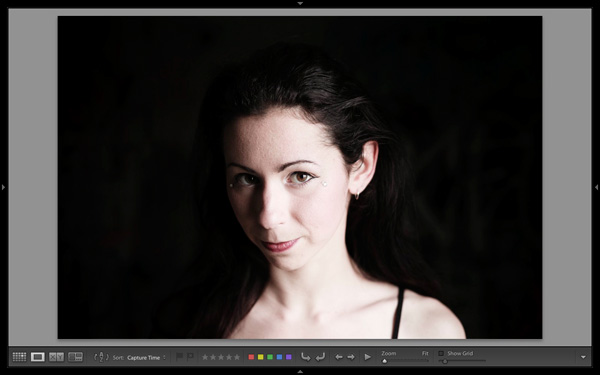
Lightroom 5 Loupe View

This is what the Loupe View looks like, with all four side panels removed (use the Shift+Tab keyboard shortcut to hide them from view).
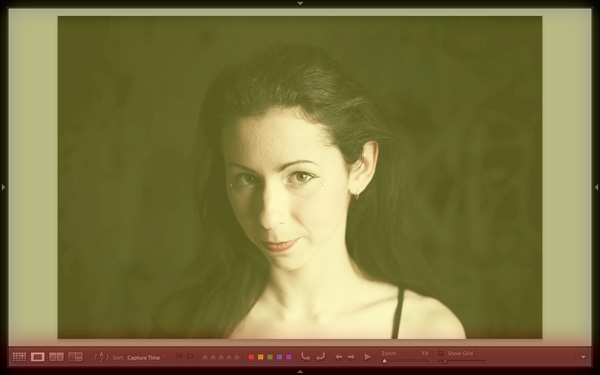
Lightroom 5 Loupe View

The Loupe View is divided into two parts. The Content window (yellow) occupies the main part of the screen. The selected photo is displayed here.

The Toolbar (red) lies along the bottom. Press ‘T’ to reveal it if it isn’t there. The same key hides the Toolbar if you press it again.

The main difference between the Loupe View and the Grid View is that you can only view one image at a time in the Loupe View.

The hidden features

Of course, these features are not really hidden. But if you are not aware of them they may just as well be. They are all useful, so it’s worth taking a few minutes to learn how to use them.

Library view options

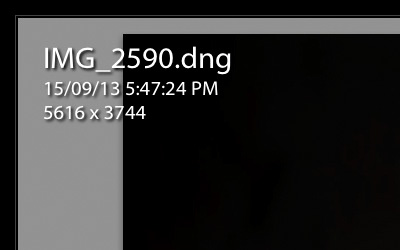
When you press the ‘I’ key on the keyboard Lightroom displays some information about the photo you are looking at in Loupe View. Press the ‘I’ key again and the information changes. Finally, press it once more to hide the information:
Lightroom 5 Loupe View

The first information overlay displays the filename, the time and date the photo was taken, and the image size (in pixels).
Lightroom 5 Loupe View

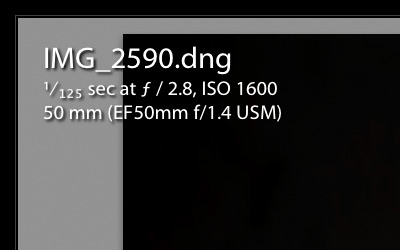
The second overlay shows the filename, the exposure settings (shutter speed, aperture and ISO) and the focal length and lens used. This is handy for checking the camera settings when you are viewing your images.

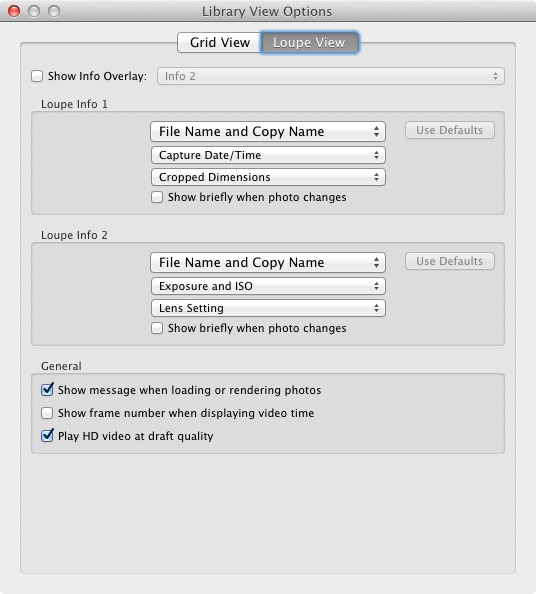
Here’s the hidden feature: Did you know you can customise the information overlays to display the information that you want them to? Go to View > View Options to bring up the Library View Options window. Here you can tell Lightroom which information to display in each information overlay:
Lightroom 5 Loupe View

Mirror image mode

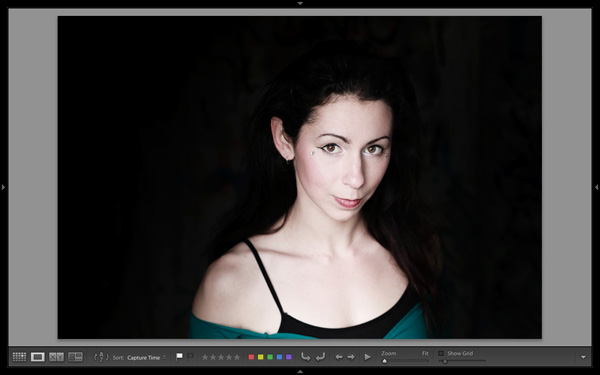
Wondering how your photo would look if it was back to front? Just go to View > Enable Mirror Image Mode to see:
Lightroom 5 Loupe View

Grids and guides

Lightroom 5 Loupe View

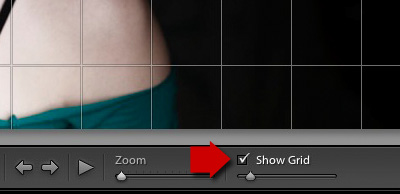
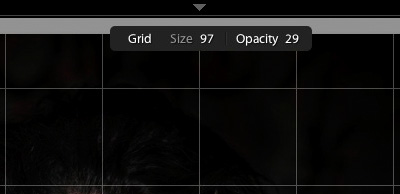
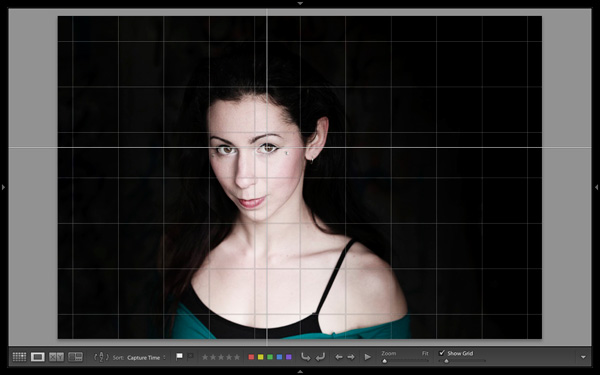
To reveal the grids and guides, tick the Show Grid box in the Toolbar. Use the slider to set the size of the squares. If you hold the Cmd key down (PC owners should use the Ctrl key) you can also alter the size of the grid and the opacity of the lines by mousing over the Size and Opacity settings displayed at the top:
Lightroom 5 Loupe View

Note: If you don’t see the Show Grid box, click on the white arrow on the right hand side of the Toolbar and select Grid Overlay from the menu. Lightroom removes any unticked options in this menu from the Toolbar.
Lightroom 5 Loupe View

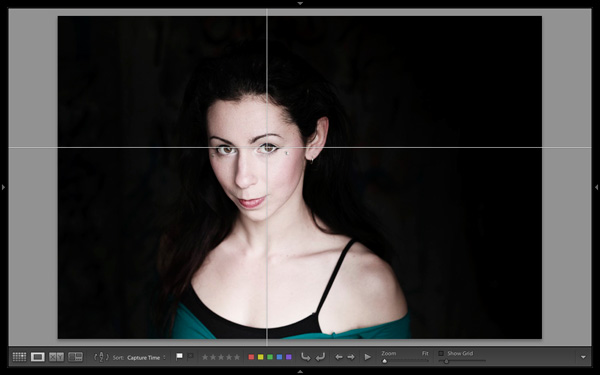
Next, go to View > Loupe Overlay and select the Guides option. This turns the central horizontal and vertical grid lines into guides that you can move by holding down the Cmd (Mac) or Ctrl (PC) keys. They come in useful for checking things like the straightness of horizons and buildings.
Lightroom 5 Loupe View

Untick the Show Grid box to see the Guides by themselves.

The Loupe Overlay

The final hidden feature is something that is more likely to interest professional photographers than hobbyists. But it comes in handy as a creative exercise if you have any interest in submitting images to stock libraries or to magazines.

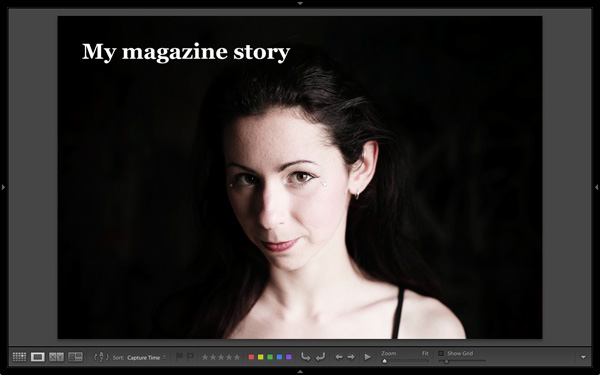
When buying images for editorial use, magazines often look for photos with empty space where they can lay out headings or text. The Loupe Overlay feature lets you display an overlay containing text over the top of your image so you can see whether the composition of your image provides enough space. While pros can obtain an official file from their client, there’s nothing to stop you making up your own.

Go to View > Loupe Overlay > Layout Image. Navigate to the folder containing your overlay and open it. The file must be saved as a PNG file, which supports transparency.
Lightroom 5 Loupe View

In this example, you can see that the portrait isn’t composed in a way that works with the sample text. It would have been better if the model was further to the right in the frame.

Mastering Lightroom Book One: The Library Module
Lightroom 5 Loupe View

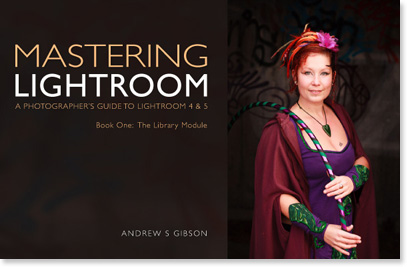
My latest ebook Mastering Lightroom Book One: The Library Module is a complete guide to using Lightroom’s Library module to import, organise and search your photo files. You’ll learn how to tame your growing photo collection using Collections and Collection Sets, and how to save time so you can spend more time in the Develop module processing your photos.

Post originally from: Digital Photography Tips.

Check out our more Photography Tips at Photography Tips for Beginners, Portrait Photography Tips and Wedding Photography Tips.

The Hidden Secrets of Lightroom 5’s Loupe View

The post The Hidden Secrets of Lightroom 5’s Loupe View by Andrew Gibson appeared first on Digital Photography School.


Digital Photography School

 
Comments Off on The Hidden Secrets of Lightroom 5’s Loupe View

Posted in Photography


Edgy Art: Fore-Edge Paintings Hidden in Historical Books
11 Oct

[ By WebUrbanist in Art & Drawing & Digital. ]

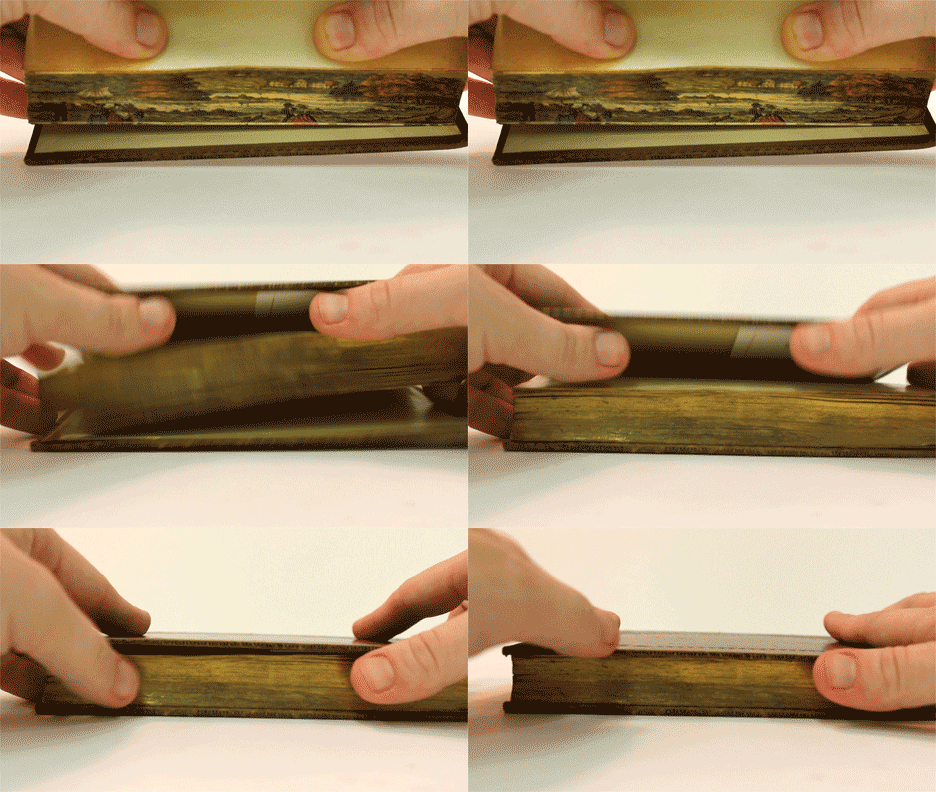
book-edge-autumn

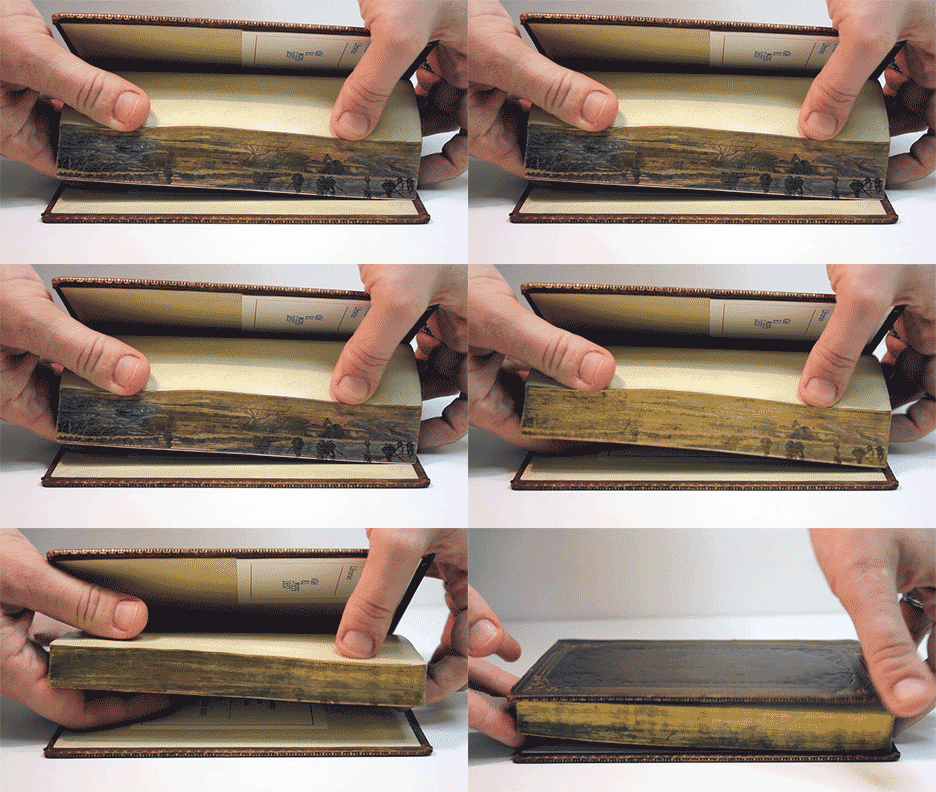
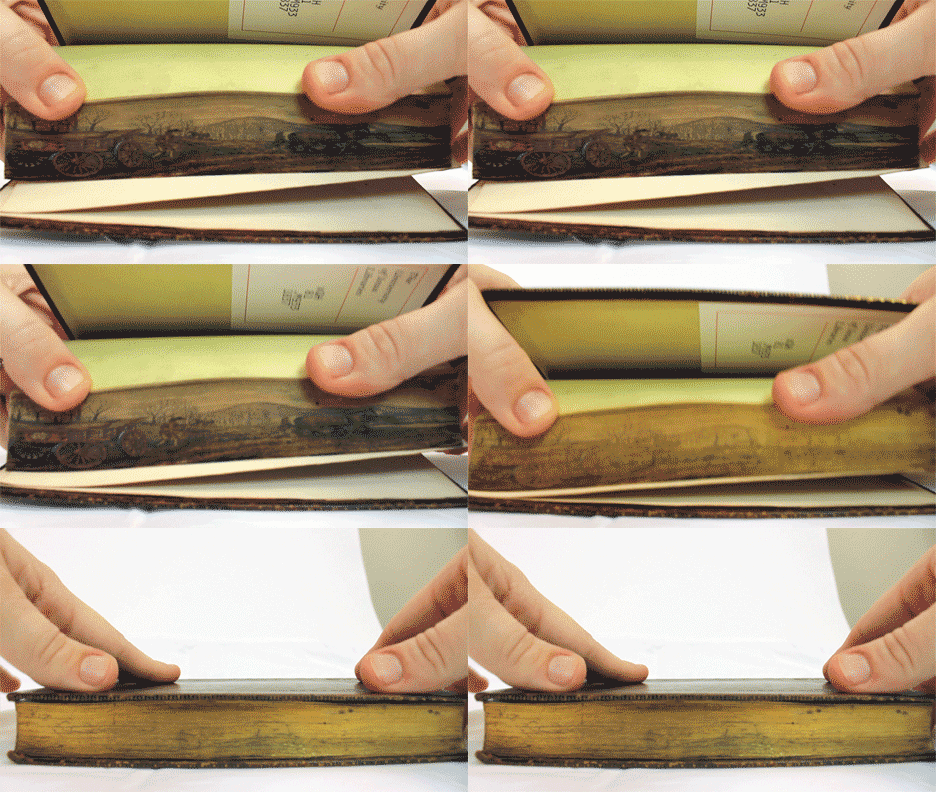
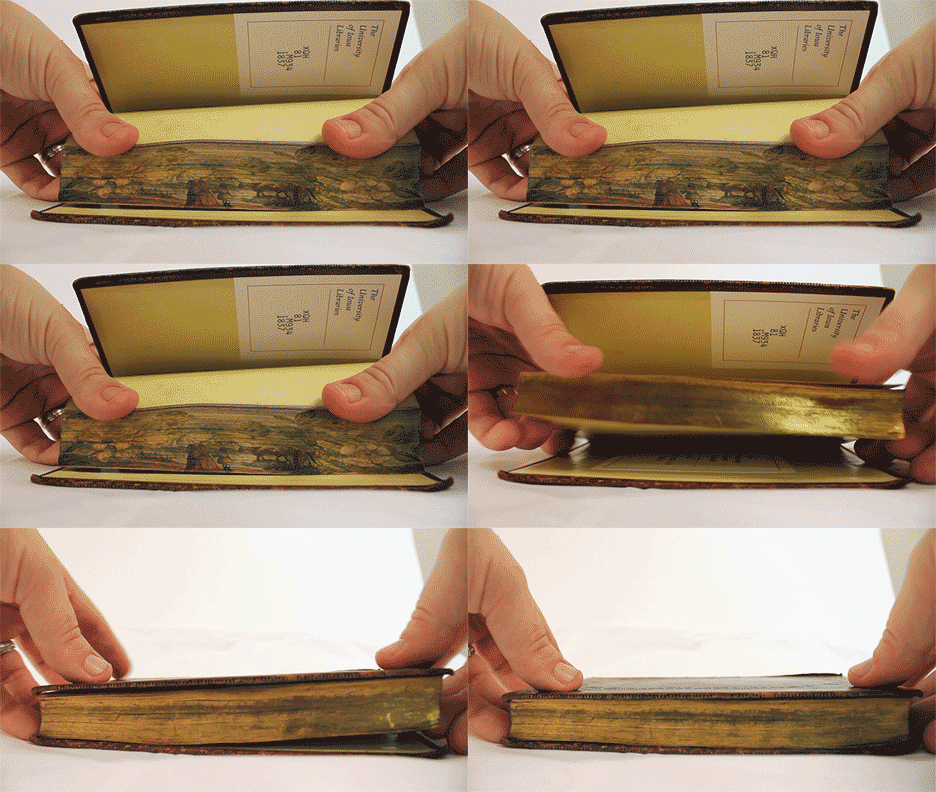
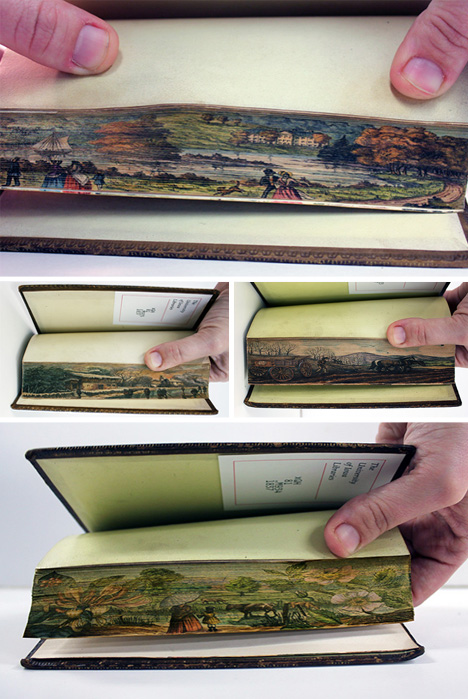
Invisible at a glance, artists have long hidden fore-edge artwork in plain sight, resulting in works that are sometimes first spotted decades or even centuries after their creation. What looks like a plain gold-gilt surface on the shelf can unfold to reveal a rich and colorful surprise.

book-edge-art-winter

book-edge-art-spring

book-edge-art-summer

Via Colossal, the above examples come from Colleen Theisen and the Special Collections & University Archives  at the University of Iowa. They are from a series of four books titled after the seasons (Autumn, Winter, Spring and Summer shown sequentially above) published in the 1800s by Robert Mudie.

autumn winter summer spring

The art of disappearing fore-edge painting dates back hundreds of years, but (visible) edge painting on closed books goes back over a thousand years. Sometimes the scenes are made to match content, contexts and characters from within the book. In other cases, they are more broadly relevant, meant to set the stage or tone for the reader.

fore edge art

The fore-edge (found on the opposite side of a book’s spine) can be painted directly on the closed book to create a drawing that is immediately visible. Alternatively, the pages can be splayed out and painted on the front or back  of the edge. In some cases, both sides are painted to create a double fore-edge works that are entirely different depending on which way you splay the sheets. Triple fore-edge variants are also possible, with two patterns or scenes that disappear and a third that is visible when the book is closed.

Share on Facebook


[ By WebUrbanist in Art & Drawing & Digital. ]

[ WebUrbanist | Archives | Galleries | Privacy | TOS ]


WebUrbanist

 
Comments Off on Edgy Art: Fore-Edge Paintings Hidden in Historical Books

Posted in Creativity


Edgy Art: Fore-Edge Paintings Hidden in Historical Books

08 Oct

[ By WebUrbanist in Art & Drawing & Digital. ]

book-edge-autumn

Invisible at a glance, artists have long hidden fore-edge artwork in plain sight, resulting in works that are sometimes first spotted decades or even centuries after their creation. What looks like a plain gold-gilt surface on the shelf can unfold to reveal a rich and colorful surprise.

book-edge-art-winter

book-edge-art-spring

book-edge-art-summer

Via Colossal, the above examples come from Colleen Theisen and the Special Collections & University Archives  at the University of Iowa. They are from a series of four books titled after the seasons (Autumn, Winter, Spring and Summer shown sequentially above) published in the 1800s by Robert Mudie.

autumn winter summer spring

The art of disappearing fore-edge painting dates back hundreds of years, but (visible) edge painting on closed books goes back over a thousand years. Sometimes the scenes are made to match content, contexts and characters from within the book. In other cases, they are more broadly relevant, meant to set the stage or tone for the reader.

fore edge art

The fore-edge (found on the opposite side of a book’s spine) can be painted directly on the closed book to create a drawing that is immediately visible. Alternatively, the pages can be splayed out and painted on the front or back  of the edge. In some cases, both sides are painted to create a double fore-edge works that are entirely different depending on which way you splay the sheets. Triple fore-edge variants are also possible, with two patterns or scenes that disappear and a third that is visible when the book is closed.

Share on Facebook


[ By WebUrbanist in Art & Drawing & Digital. ]

[ WebUrbanist | Archives | Galleries | Privacy | TOS ]


WebUrbanist

 
Comments Off on Edgy Art: Fore-Edge Paintings Hidden in Historical Books

Posted in Creativity


Secret Museum Hidden in an Abandoned Freight Elevator

23 Jul

[ By Steph in Architecture & Cities & Urbanism. ]

Abandoned Freight Car Museum 1

Unlike all of New York City’s flashy and well-known museums, this particular exhibition space is grungy, quirky and easy to miss. Located in an abandoned freight elevator on the edge of the Tribeca neighborhood in Manhattan, Museum measures just 80 square feet and is covered by a pair of unmarked, heavy iron doors when it’s closed. It contains collections of objects just as unconventional as the space itself.

Abandoned Freight Car Museum 2

Abandoned Freight Car Museum 3

As stark and unfussy as its name, Museum is intentionally hard to find. It’s only open to visitors on the weekend, but you can peer through a series of viewing windows to get a look at the contents 24 hours a day, 7 days a week. Photographer Garrett Ziegler captured these images of the space and its humorous, oddball display pieces.

Abandoned Freight Car Museum 4

The Museum exhibits consist of urban curiosities, found objects and funny vintage items in addition to art pieces. Want to know more about a particular piece? You can call a toll-free hotline (888-763-8839) and enter the item’s identification number (the exhibits change frequently, and are currently different than those pictured).

Abandoned Freight Car Museum 5

“Life exists all around us, and the proof of our existence is both beautiful and absurd. Our footprint, which is often overlooked, dismissed, or ignored, is intriguing, and always worth exploring.”

Share on Facebook


[ By Steph in Architecture & Cities & Urbanism. ]

[ WebUrbanist | Archives | Galleries | Privacy | TOS ]


WebUrbanist

 
Comments Off on Secret Museum Hidden in an Abandoned Freight Elevator

Posted in Creativity


Hidden Depths: Architectural Illusion Unfolds Underground

14 May

[ By WebUrbanist in Design & Guerilla Ads & Marketing. ]

russian underground

Facade or fantasm, this series of images presents an alluring picture of the layers – perhaps even literal  levels – of  history that lies beneath aged and famous buildings.

russian architecture kremlin photoshop

Blending physical fact and historical fantasy, these advertisements (for titled “Discover the Full Story”) extend three archetypal works of Soviet architecture to new subterranean depths. They seem a fitting set to promote the Shchusev State Museum of Architecture in Moscow, Russia.

russian architecture museum advertisement

russian architecture kremlin ad

The Kremlin, with its recognizably colorful onion towers, reveals even more (and larger) turrets below – what is on the surface turns out to be just the uppermost peaks. Neo-Classical and Gothic Revival play their parts as well, turning what looks like an old Greek tempt into the top of an edifice, and a stately structure into a skyscraper.

russian architecture underground drawings

russian building underground sketch

And for those who enjoy process as much as product, it is interesting to see the stages these illustrations went through to get to their final form – sketched figures and pillars, hand-drafted architectural elements, and then finishing touches.

Share on Facebook


[ By WebUrbanist in Design & Guerilla Ads & Marketing. ]

[ WebUrbanist | Archives | Galleries | Privacy | TOS ]


WebUrbanist

 
Comments Off on Hidden Depths: Architectural Illusion Unfolds Underground

Posted in Creativity


Hidden Hotline: Only Kids Can See this Lenticular Message

09 May

[ By WebUrbanist in Design & Guerilla Ads & Marketing. ]

lenticular poster

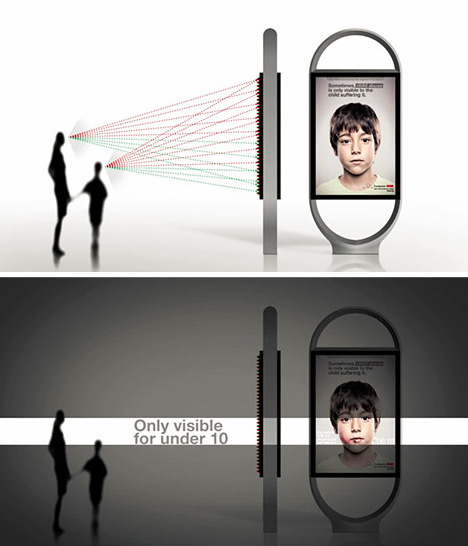
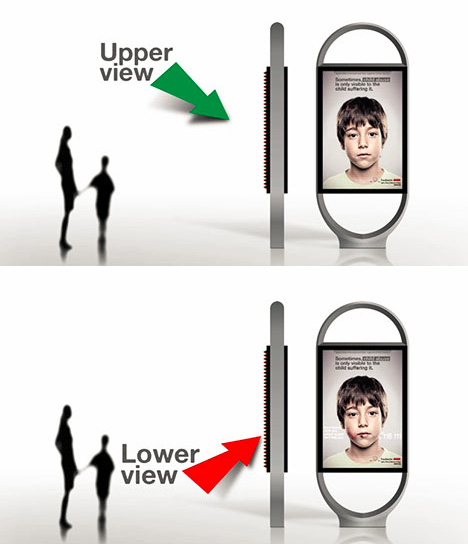
Children already at risk may also risk further abuse if they are seen to be seeking help, hence this twist on lenticular printing – a message that reads one way to tall adults, and another to small minors.

lenticular help message

The ANAR Foundation needed a way for potential victims to read their communication secretly (including the unspoken visual content – bruises on the portrait), without alerting those accompanying them on the street.

lenticular secret hidden message

Shifting from one perspective to the other slowly reveals an increasingly different image as well as additional text, including the helpline phone number.

Lenticular images are often used to create dynamic billboards that shift as people walk or drive by, but this variant flips the typical format on its side and gives it a higher purpose than mere marketing.

Share on Facebook


[ By WebUrbanist in Design & Guerilla Ads & Marketing. ]

[ WebUrbanist | Archives | Galleries | Privacy | TOS ]


WebUrbanist

 
Comments Off on Hidden Hotline: Only Kids Can See this Lenticular Message

Posted in Creativity