RSS
 

Posts Tagged ‘Going’

Avert Your Canine Going Astray With a Wireless Pet Fence

08 Mar

Each canine owner requires a simple canine fence, wireless or not. These fences makes sure that their precious animals are secure though these are executing one thing else. For that motive,best fence for puppies and dogs these fences are perfect for pet entrepreneurs who generally locate them selves too fast paced to watch in excess of their canine.

Everyone who wants to own the most effective style of pet dog fence, wireless fences ought to be regarded. This kind of fence can safe all canines inside the residence though the proprietor is absent at get the job done or in school. Additionally they help save space and therefore are relatively straightforward to work. Nonetheless, a highly effective canine fence (wi-fi) might be really highly-priced. For that purpose, it truly is critical for each and every puppy owner to create positive that he/she buys just the most effective kind of wi-fi dog fence accessible on the market.

Ahead of picking a wireless dog fence, the puppy proprietor should initial get his/her dog’s breed into consideration. This allows him/her turn out to be more familiar with the character of his/her puppy. Some breeds are more restless than many others. Some breeds are also friendlier and will simply technique strangers or outsiders compared to other breeds that quickly get intimidated. This also helps the individual to determine how far his/her dog is probably going to stray.

The moment the dog’s purely natural habits is becoming acquainted on the owner, then the following thing for being deemed must be the house as well as the backyard’s format and framework. This allows produce a more powerful floor program. Making sure the fence is correctly mounted enhances its effectiveness. Organizing might also decrease the chances of it getting to be a nuisance to the homeowner’s each day existence. Normally, the fence must be installed appropriately to secure all animals in the home.

The options with the fence also really should be deemed. Plainly, many fences come with diverse functions. Some are simple and cheaper than most whilst some tend to be more sophisticated plus more high priced.

You furthermore mght should acquire more safety measures when selecting a wireless puppy fence, as there are actually various styles around that actually don’t give first-class protection for your pets. Some models could possibly be inaccurate and will answer slowly but surely. This suggests your puppy or pet that can cross the border-even prior to the unit reacts.

Provided that the person has adequate price range, then it’s all right to select the greater expensive form. Nevertheless, it’s not likely important to choose the greater expensive varieties especially if the capabilities are seemingly worthless to the consumer. It really is ok to choose the cheaper extra typical sort in the event the individual is just seeking for one thing that keeps his/her pet within when he/she is absent.

The post Avert Your Canine Going Astray With a Wireless Pet Fence appeared first on Photonovice.

Photonovice

 
Comments Off on Avert Your Canine Going Astray With a Wireless Pet Fence

Posted in Equipment


Here’s why your beloved film SLR is never going digital

11 Oct

There may be pent-up demand for a device that’s going to let you dust off your beloved Nikon F-something and shoot digital with it, but that doesn’t mean a crowdfunded project is going to make it possible. Or, at least, not in a way that’s worth the hassle.

Large companies with dedicated engineering departments have worked on the task, yet no such product has yet been produced. That, along with a list of seemingly intractable technical hurdles, lead me to think that it’s not ever going to happen, no matter how desirable it might be.

The wisdom of crowds

The latest crowdfunded attempt to bring digital capability to old Nikon SLRs appears to involve the 1/2.3″-type sensor and lens from an inexpensive action camera and a Raspberry Pi project computer.

“I’m Back” is the latest attempt to bring film cameras into the digital realm and it appears to do a reasonable job of addressing some of the challenges that sank Silicon Film and subsequent crowdfunded attempts to do the same:

  • Syncing the SLR shutter and digital exposure
  • A means of changing the digital settings
  • Keeping the cost reasonable

However, it’s unclear or arguable how well it addresses other potential stumbling blocks:

  • Sensor/film plane alignment
  • Compatibility across the dwindling supply of film SLRs
  • Space for batteries and processing hardware

And, with its use of a compact camera sized sensor fitted behind what looks remarkably like the lens from an inexpensive action cam pointed at a ground glass screen, there’s every chance it fails to clear a fairly significant hurdle:

  • Sufficient image quality to make the whole ordeal worthwhile

A history of failed attempts

Companies with significant backing and extensive engineering resources have failed to solve this problem, which doesn’t make it an obvious candidate for crowd-funded projects.

Nikon itself clearly investigated the problem, since it got as far as patenting a system for adjusting the sensor, relative to the film plane. But it noticeably hasn’t ever released the fruits of this research.

We wrote at the time about why we didn’t think it would lead to a product. We’ve also covered reports of why Silicon Film never delivered.

Do it yourself

If you’re really dedicated, can handle a craft knife with some precision and don’t mind sanding down the delicate components of several hundred dollars-worth of modern ILC, then you too can mount a Sony NEX upside down in the back of your SLR. So long as you remember to fire both shutters in sequence. (Despite my sarcasm at the impracticality, it’s an impressive piece of handiwork).

But, realistically, if you really want to use your old SLR, I’d recommend going out and buying a roll of film. The recently resurrected Ektachrome, perhaps. Or, and I know this is going to sound radical, you could shoot with a camera that’s been designed from the ground up to shoot digital. A ‘D’-SLR if you will.

Articles: Digital Photography Review (dpreview.com)

 
Comments Off on Here’s why your beloved film SLR is never going digital

Posted in Uncategorized


I made a book of pictures of my cat, and I think it’s going to make me a better photographer

29 Jul

Hear me out.

Many years ago I made a Blurb photo book that was beautiful, but required hours and hours of my time to get it all just right. It was an enjoyable process really, but I just don’t find I have that kind of time or patience anymore. But I love a nice photo book – what better way to get photos off your phone or hard drive and make them into something tangible?

Whatever your level of interest and
time commitment, there’s a photo book
service for you

In the years since I made my first book, options for would-be photo book makers have exploded. They range from time-intensive to almost totally automated. Whatever your level of interest and time commitment, there’s a photo book service for you.

The other part of this story is that I’ve been struggling with finding inspiration for my personal photography lately. It’s hard to find a reason to bring a dedicated camera when I know I can get usable snapshots with my phone. Above all, I don’t end up doing anything with the photos I do take. I post the stray photo to Instagram or Facebook, but that’s as far as they go.

But recently, I downloaded Mosaic, an app from Mixbook that creates incredibly simple photo books out of 20 of your photos – no more, no less. You pick the photos from your camera roll, Facebook or Instagram account, put them in an order you like – and that’s about it.

The photos are arranged into a mosaic (see what they did there) for your front cover, which you can ‘shuffle’ to re-organize, but you can’t manually select how the images are arranged. Text can be added to the first page, but none on the following pages.

In trying it out I dove into my camera roll and looked for a story I could tell in 20 photos and by pure coincidence, I happened to have a large number of photos of my cat. I saw a theme emerge and began filling the pages of my book with pictures of him sleeping.

I know, I know. But you wouldn’t believe this cat. He sleeps in the strangest positions, and the photos fell into a neat symmetry as I placed them on opposing pages: two photos of him curled into a donut shape in his bed, two photos of him sprawled on the floor next to his bed, for some God damn reason. The book materialized in front of my eyes, and the temptation of the ‘order now’ button became too great.

See what I mean? He’s ridiculous.

Cats are bona-fide jerks but I’m in the part of the population that finds them irresistible against better judgement. And I know this sounds ridiculous, but my cat really does have a funny personality. One day he’ll be gone, not roaming around my apartment screaming for treats and attention, and I’ll have this silly little book to remember him by.

Mosaic is definitely not designed for professional photographers. For one, it only exists in app form, so it lends itself best to photos taken with your phone. You can source them from your Dropbox or a social media account, but the app certainly lacks the customization features a pro would want.

Creating a book is dead simple, and without the option to add text or captions, all emphasis is on the images and the story they tell

So Mosaic isn’t really intended for ‘serious photography,’ but to me there’s beauty in its limitations. Creating a book is dead simple, and without the option to add text or captions, all emphasis is on the images and the story they tell.

By making this book I may have unlocked a new cat lady achievement, but it also made me think about other stories I could tell in 20 photos. Open-ended photo projects feel too overwhelming to me, but the thought of assembling just 20 photos on a theme and having an easy, yet polished output mechanism for them is very appealing. Suddenly, I’m reconsidering the projects that seemed too onerous to take on. Documenting a trip or a social outing seems doable with a purpose, vision and boundaries for the final product.

Maybe this experience will help nudge me forward on a path I’m currently stalled on

Realistically, I’m not going to be making huge number of $ 25 photo books (plus an extra $ 5 for shipping). But maybe this experience will help nudge me forward on a path I’m currently stalled on. And isn’t that what it’s all about? At the very least, I’ve got one very fancy book of cat photos.

Also read: Ten ways to shake ‘photographer’s block’ for good

Articles: Digital Photography Review (dpreview.com)

 
Comments Off on I made a book of pictures of my cat, and I think it’s going to make me a better photographer

Posted in Uncategorized


Confirmed: Bowens is going out of business

23 Jul

The sad news is now official. PDN has managed to confirm a report initially published by DIY Photography, claiming that UK-based lighting company Bowens had entered liquidation and was going out of business.

The 94-year-old company was scooped up by investment company Aurelius Group last year along with photography retailer Calumet. But while Aurelius commitment to Calumet continues, the company has decided that Bowens will not be able to overcome the challenges the lighting market faces.

In a statement, Aurelius Group told PDN the decision was due to, “the far-reaching changes affecting its market, including new, considerably less expensive products by Chinese manufacturers, product innovations by competitors, and the changed buying behavior of professional photographers, who are now only willing to invest in new equipment if the investment guarantees additional income.”

According to Aurelius’ CEO, Calumet will continue to service Bowens products in Europe, and the company is “working on” figuring out service for Bowens products globally. No word yet what this will look like, but in the US, Bowens products were distributed by Manfrotto.

Articles: Digital Photography Review (dpreview.com)

 
Comments Off on Confirmed: Bowens is going out of business

Posted in Uncategorized


Bye bye Bowens: The 94-year-old lighting company is going into liquidation

17 Jul

Lighting giant Bowens, a company with 94 years of history and millions of customers under its belt, has entered liquidation. The news has not been officially confirmed by Bowens or Aurelius, the investment firm that acquired the company one year ago, but several independent sources have corroborated the story.

Initial reports of Bowens’ downfall appeared on DIYPhotography, who heard from one inside source and confirmed with two others on Friday that the company has indeed entered liquidation. On Sunday, photography blog PetaPixel confirmed the news a fourth time, after they received an email from another “source familiar with the situation.”

“All UK staff (including China factory) were informed that the company is going into liquidation,” the source told PetaPixel. “We were aware the company was facing problems and have all been working long days to pull company through a hard time, but we never thought it would end.”

With pressure from fast-growing lighting brands like Godox, and big-name brands in the photo world going out of business at regular intervals, the disappointing news is not, alas, surprising. But no amount of regularity ever makes this kind of news easier to report on or read. If anything, it only gets harder.


At the time of this writing, Bowens International’s contact form is no longer accepting submissions. We will update this post if and when we are able to reach someone at Bowens for official confirmation.

Articles: Digital Photography Review (dpreview.com)

 
Comments Off on Bye bye Bowens: The 94-year-old lighting company is going into liquidation

Posted in Uncategorized


Time-lapse captures thousands of fireworks going off over LA on July 4th

10 Jul

Photographer and creative director Dylan Schwartz may have shot the viral fireworks time-lapse of the year this July 4th. Over the course of three hours, Schwartz captured thousands of fireworks going off above LA from his vantage point at Mount Wilson Observatory.

Schwartz shared the story behind the timelapse with Time, telling the magazine, “Everything is spread out in L.A. To really see what L.A. does for the Fourth of July, you have to see the whole thing.” Even with this wide shot captured from 5,700+ feet above LA, Schwartz still says he only captured “a slice.”

According to Time, the final time-lapse is a composite of nearly 250GB of stills and video shot with 4 different cameras. Schwartz used a Sony a9 (he’s a Sony ambassador) with a 70-200mm lens to capture both video and stills of the widest perspective, another camera for video exclusively, and two more were shooting stills of various key locations.

Six hours of editing later, the time-lapse above was ready for posting on social media, where it immediately took off. Here’s an even closer crop posted to Schwartz’ Instagram account. Enjoy.

A post shared by Dylan Schwartz (@dylan.schwartz) on


Articles: Digital Photography Review (dpreview.com)

 
Comments Off on Time-lapse captures thousands of fireworks going off over LA on July 4th

Posted in Uncategorized


Going wide on a budget: Nikon AF-P 10-20mm F4.5-5.6 DX sample gallery

04 Jul

Nikon’s AF-P 10-20mm F4.5-5.6 DX is the company’s latest lens specifically designed for its crop-sensor camera bodies. It may have a plastic mount, but with a 35mm-equivalent focal range of 15-30mm, it is a versatile yet affordable lens for those looking for a wider view than the kit lens has to offer without breaking the bank. See how it performs from the inner streets of Seattle to the remote, sandy beaches of Washington’s coast.

See our Nikon AF-P 10-20mm F4.5-5.6
sample gallery

Articles: Digital Photography Review (dpreview.com)

 
Comments Off on Going wide on a budget: Nikon AF-P 10-20mm F4.5-5.6 DX sample gallery

Posted in Uncategorized


How fast were you going? GoPro HERO5 Black videos can now include GPS and telemetry data overlays

19 Nov

GoPro has updated its Quik desktop software with a new feature that enables HERO5 Black camera owners to overlay GPS and telemetry data onto their videos. This data is gathered by the camera’s various sensors during recording, and provides an extra layer of information for viewers, including things like the date and time the video was recorded, the altitude, elevation gain, and distance in miles or kilometers. 

The data overlays are customizable, and include resizable graphs and the ability to choose which data is included in the video. In addition to the aforementioned data, the overlays can also include a compass to show the camera’s orientation, speed, a speed graph with activity spikes, the GPS path and position pinpoints, and G-Force levels.

The Quik desktop editing software is available for 64-bit PCs running Windows 7 or newer and Macs running macOS 10.10.X or later. PCs are advised to have at least an Intel Core i3 processor and Macs should have at least an Intel Dual Core, though Core i7 processors are recommended for both.

Via: GoPro

Articles: Digital Photography Review (dpreview.com)

 
Comments Off on How fast were you going? GoPro HERO5 Black videos can now include GPS and telemetry data overlays

Posted in Uncategorized


Going wide: Irix 15mm F2.4 sample gallery

02 Oct

Swiss company Irix recently released two versions of their 15mm F2.4 prime to the consumer market. The Irix 15mm is offered in two varieties: ‘Blackstone’ and the ‘Firefly.’ The Irix Blackstone features a magnesium and aluminum body able to withstand ‘extreme conditions,’ while the Irix Firefly model is, according to the company, the lightest lens in its class. Both versions of the lens are available in Canon EF-, Nikon F- and Pentax K-mount. 

The lens is composed of 15 elements in 11 groups and produces a really nice sunstar and some, well, very interesting lens flare. Interestingly enough although the lens states its widest aperture is F2.4, the best we could do on the Canon 5DS R was F2.5. In any case we put the lens to the test over a few weeks of shooting and here are the results. 

Irix 15mm F2.4 real-world sample gallery

Articles: Digital Photography Review (dpreview.com)

 
Comments Off on Going wide: Irix 15mm F2.4 sample gallery

Posted in Uncategorized


5 Tips for Going from Pixels to Print Quality

18 May

Whatever level of photographer, you are sure to have gathered a stockpile of pixels.

It’s just the way it is nowadays. Whether you are the kind of person that clogs up their hard drive, gradually slowing your Mac or PC down until you are forced to do something about it. Or perhaps you are already super organized having kept negatives, CDs, DVDs, hard drives, a raid system or even the cloud?

Indeed whatever storage method you choose you need to catalogue the files by name, event, and year, so you may retrieve without having a complete breakdown while searching for your favorite file. After all photography should be fun, not pain.

Many photographers use Lightroom, which is a great program, not only for editing but also for organizing your ever-increasing pile of pixels. But then what? What do you do with them then? I think you would agree we all spend too much time in front of screens? So why would you keep your masterpieces locked away in digital format?

To create that killer slideshow you will amaze your friends with is a lot of fun, especially if you have a large TV or digital projector. However, be careful of the content of your slideshow. Nothing worse than visiting a friend, only to be subjected to look through every snap taken on their holiday. Slideshows really should not be much more than ten minutes long or people generally loose interest. Keep them simple also, not too many whizzy effects, that just makes your viewer feel queasy!
PIC 10 simonjohn co uk

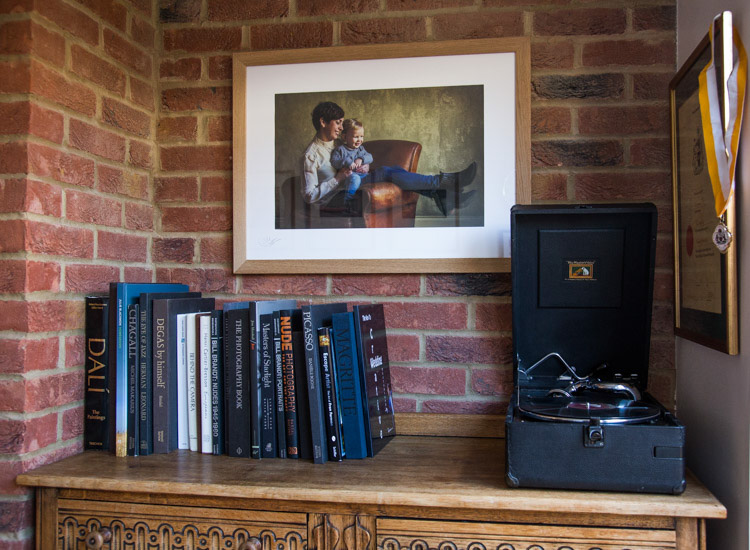
So you have this catalogue full of great images, what next? I would say enjoy them. Have your favorites printed and framed. Photography is personal, just like any other art form. By printing your special images, and hanging them in your home, you are not only enjoying the fruits of your labour, but also creating personalized wall art. This shows friends your talents, without the need for a longwinded slideshow.

You may find as time goes by, the framed photographs mean more or less to you. This is quite natural as we grow, and our taste and habits change also. Not to worry, you can always replace them with fresh images. It’s not like the old days when the portrait your parents had remained in the given spot forevermore. In fact, it is refreshing to change your images from time to time. Just like wallpaper or any other interior design things, move on. Only when you can look back at a photograph you made perhaps 10, 20, or 30 years ago, and still love it, will you know it’s a keeper!

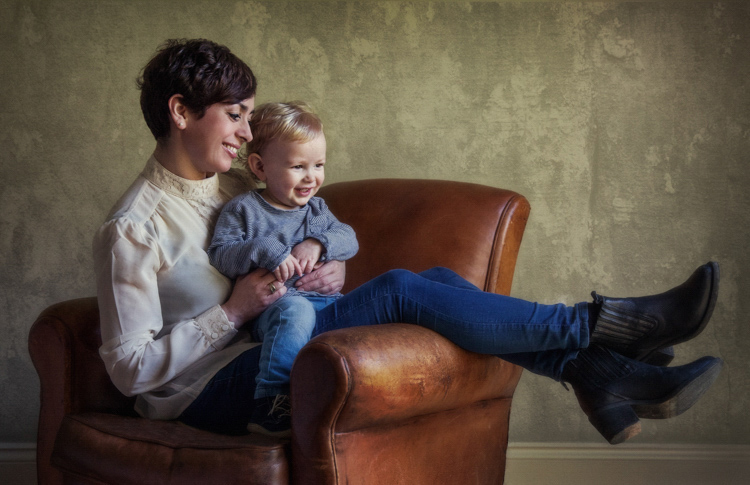
My background is a portrait and wedding specialist. Lets take a look at an image from my portfolio. I will describe the process from capture through editing, and finally the framed piece for the wall (above).

#1 – Get it right in-camera
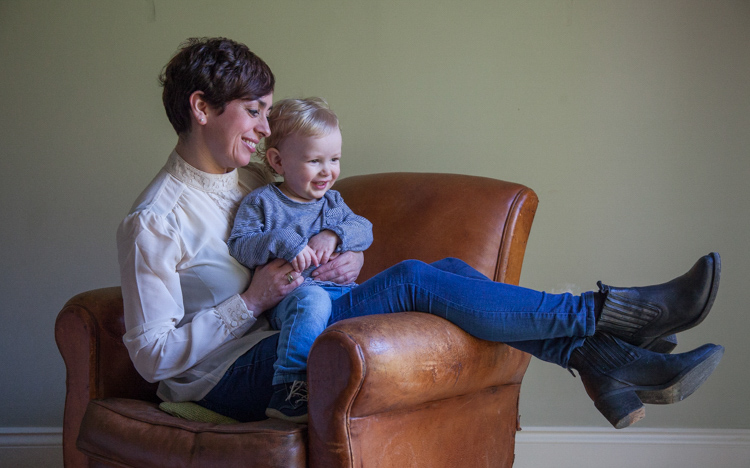
Pic 1 simonjohn co uk

As you can see the old chair, and soft natural light, was perfect for the basis of this portrait. I positioned the mother in the first third of the image, placing her legs over the arm of the chair for a more relaxed contemporary look. My directions to her were simply to get close, and look at your beautiful boy. All I had to do then was to get the toddler to look in the right direction, with the expression to fit. A squeaky toy often saves the day!

The mother is in profile, while the toddler is in three quarter face, adding interest and different angles to the image. The lighting was a large window (not with hard sunlight) off to the right. I also placed a reflector just below the mum’s boots, to bring light back into the eyes and softly wrap around into the shadows. The exposure was 1/250th (freezing the toddler) with an aperture of f/5.6, using a 70mm focal length, as my back was pressed against the far wall of the room.

So to summarize; I feel the expressions are captured well. The lighting is fitting, being soft and directional. The image has style, and is well balanced compositionally. But it just needs something more. The capture stage is so important to get right. Photoshop should not be regarded as a fixer. The great Ansel Adams talked about “printing virtuosity” and just because we now craft our images on a screen, as opposed to in the darkroom, quality and finishing are still paramount.
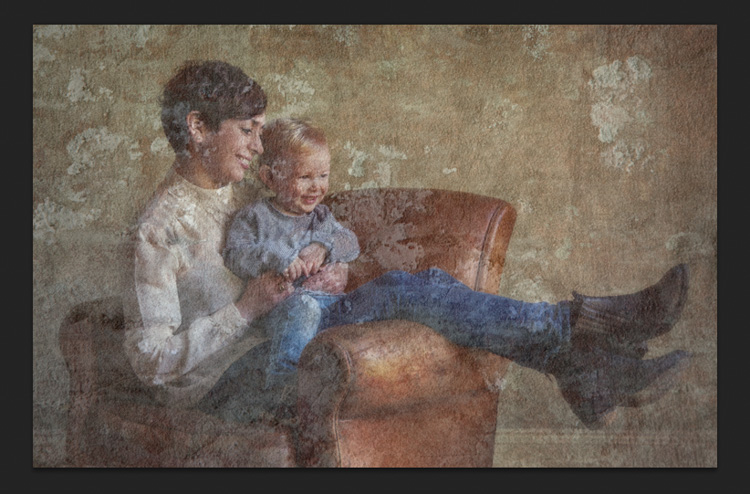
So take a look at the edited image below.
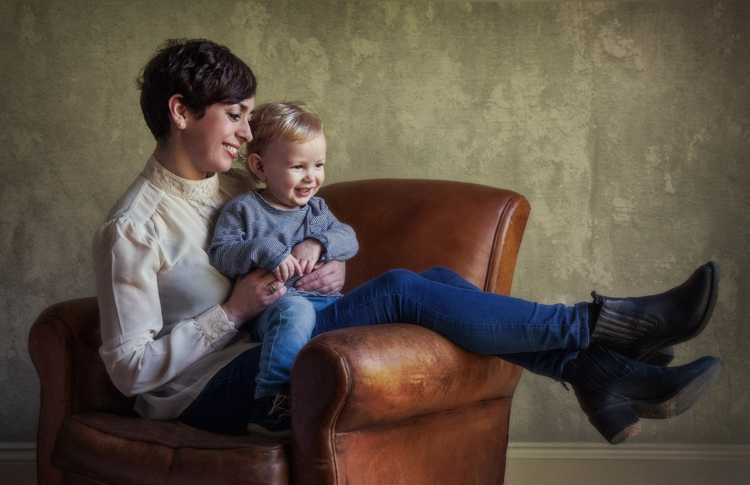
Pic 2 simonjohn co uk

#2 Basic adjustments in Photoshop or Lightroom

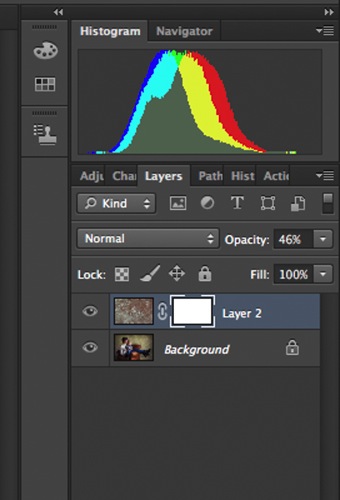
Firstly, you will need to level the image in Photoshop, bringing the sliders in to just clip the histogram at both ends. This ensures depth in the blacks and good clean whites. The mid-tone is really your X factor, but just be aware that you have detail throughout all tones if that is the look you are after. Be careful if you make it too light, the image could appear milky. While if you make the mid-tones too dark the image could appear muddy.
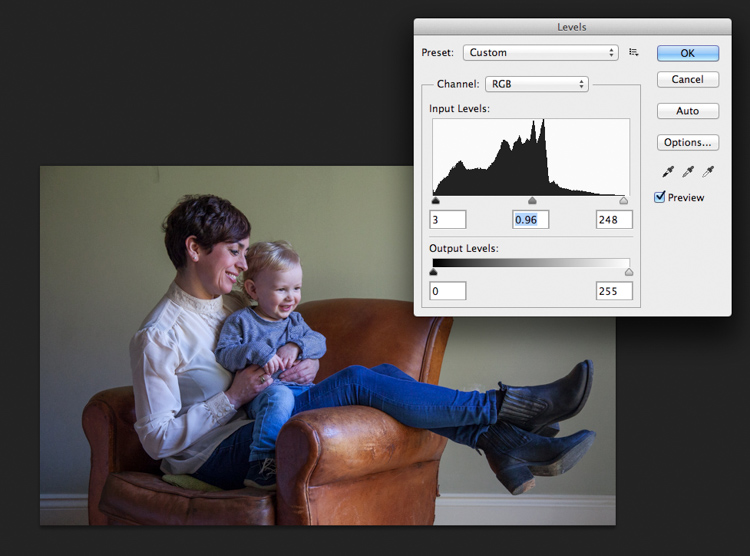
Screen Shot 2016-04-27 at 21.12.41-untitled

Secondly, I have adjusted the Saturation and the hue of the image to achieve the color pallet I require. Often you can go between the levels and saturation, and make small tweaks as the image takes shape.
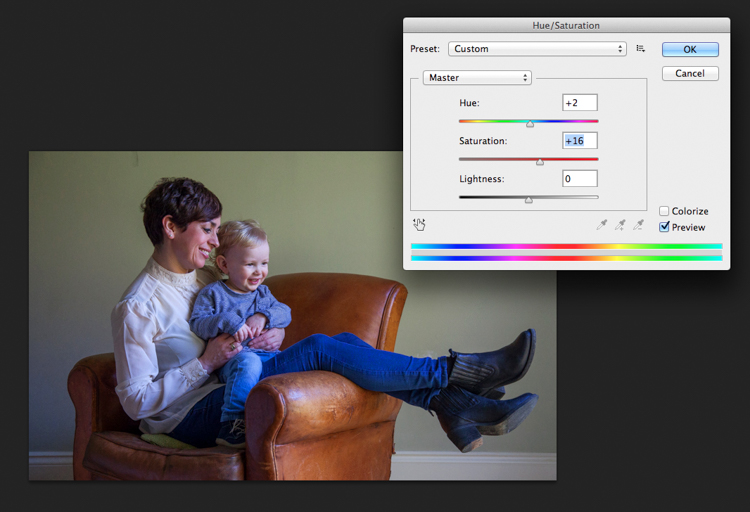
Screen Shot 2016-04-27 at 21.13.20-untitled

#3 – Add a texture overlay (optional)

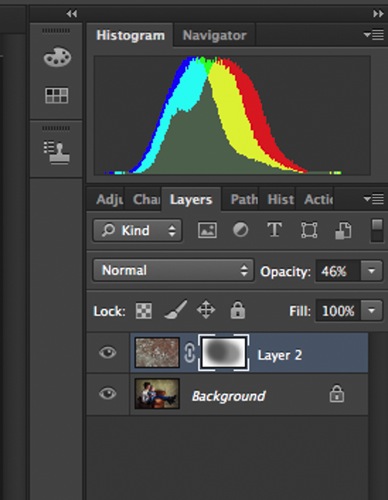
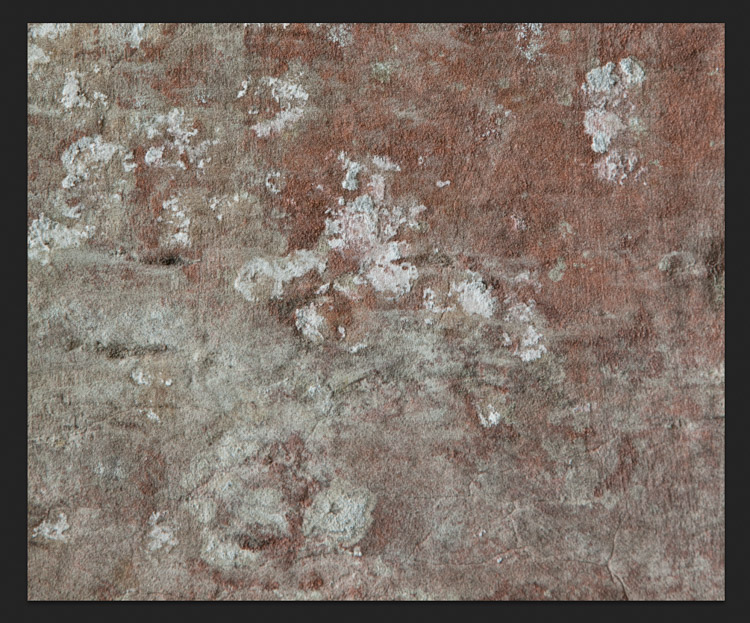
Next you could do as I have here, added a texture overlay. I felt it complimented the chair in its shabby chic style. I photographed a piece of wall, then blended the two images using opacity in the layers pallet. I added a layer mask, then rubbed through with a soft brush to create the subtle look you see here. I then added a soft Gaussian blur from the PS filters, blending the two layers together.
PIC 5 simonjohn co uk

PIC 6 simonjohn co uk

Pic 2-simonjohn.co.uk-untitled

PIC 8 simonjohn co uk PIC 9 simonjohn co uk

#4 – Local tone control

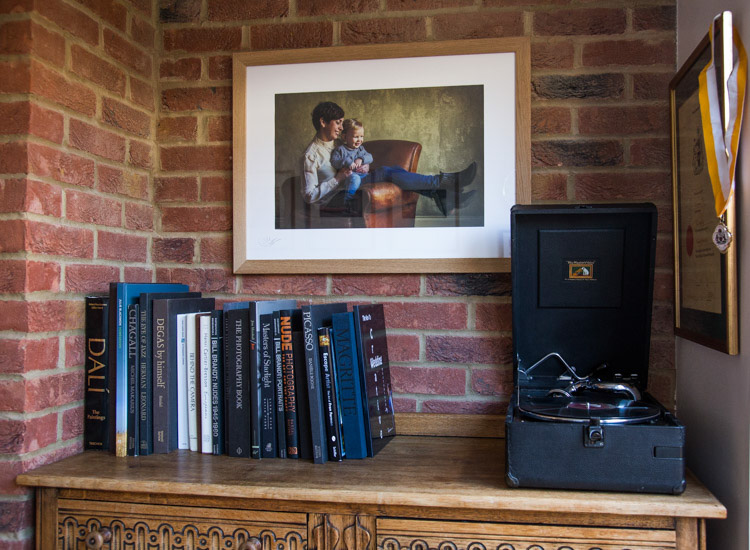
Finally to complete my image I needed to Dodge and Burn. As you can see this really is a subtle finishing skill, and should not be left to a Photoshop filter. In a future article I will explain exactly how to dodge and burn your images like a professional, directing the eye of your viewer to the important parts of the image. But for now, let’s see the final piece as it was hung on my gallery wall.
PIC 10 simonjohn co uk

#5 – Print it

I have printed the image on Fuji fine art 300mgs rough texture paper, which I love. The paper is not only excellent for color rendition but has a wonderful tooth to it, adding texture and depth. I have framed the portrait in a simple natural oak and white acid free mount. I have chosen clear glass. Although there is much talk about non-reflective glass, this simply flattens and dulls the image; I would not recommend it. The finished portrait compliments its surroundings, and fits well into the décor and given space.

As I said at the start of the article, it’s important to display your favorite images rather than hide them away on a computer. I am happy to share with you, that I have done just that here. This is my girlfriend Yvonne and my son Miles.

Some photographers prefer to print their own images. This can be a very good way of speeding up workflow and achieving exactly the right colors you require. In recent years printers have became smaller, and inks and paper more archival. I will perhaps invest this year simply for ease of use, and meeting clients deadlines. Perhaps one issue, according to friends who print their own, is you tend to have a fair amount of wastage profiling papers and inks. If you are not particularly a high volume, large output photographer, ink wells can get clogged up causing spattering of pigment. However I think both these problems are now almost eradicated as technology improves year after year.

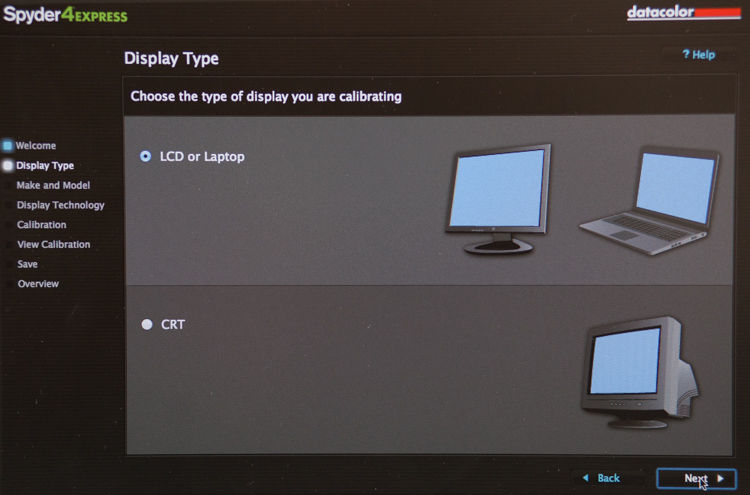
If you choose, as many professional photographers do, to use a pro lab you have to close the color loop from the start. I use a Spyder 4, as seen in the screenshots below, and my lab use the Epson 9900 and 4900 for printing the Giclee fine art papers I require.
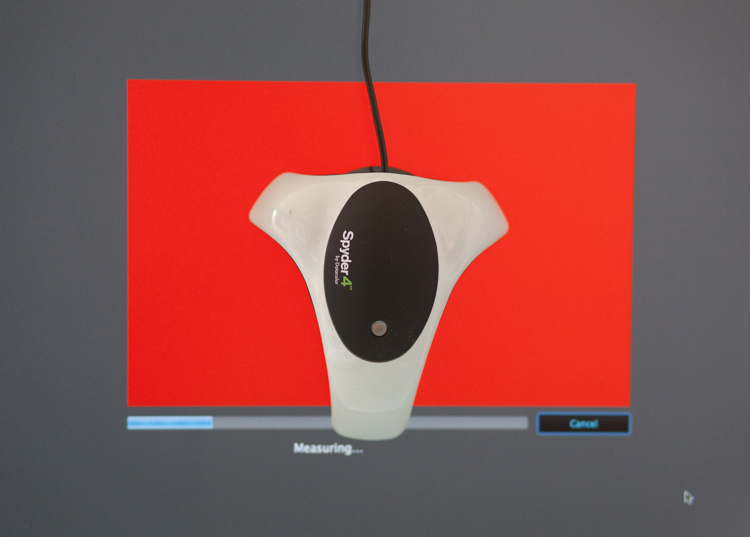
 

2

4
It is attached via USB to your monitor, and simple to follow with onscreen instructions. Basically it brings the colors back in line within the colors space you use. Until recently most labs suggested sRGB, as the colors seen on your screen were pretty much what could be printed. The other often used space is Adobe 98, but not all printing machines can produce such subtleties in color. Progress moves on and there are machines that can print Adobe 98, but my advice for now would be stick with sRGB (ask your lab if you want to know which they use).

Because you are working in a given color space the lab can set its own monitors accordingly, and with a skilled technician the loop should be closed. Sometimes you may find a print is slightly too dark or light. This may be due to the ambient light in yours or your printer’s room being marginally different. A good working relationship is what is needed when using a lab. When asked to reprint an image they should work with you, and offer tips and help if needed; its in everyone’s interest. I rarely have a print that is off, but if I do my lab simply reprints without charge.

So how should you prepare your files? Follow this checklist below for ease of use:

  • Always shoot in raw. Much more detail recorded through highlight to shadow.
  • Save the raw file but create a working tiff.
  • Once you are happy with the finished tiff export as a jpg if sending to a lab.
  • Export or print always at 300dpi for best quality.
  • Check your prints against your monitor and if adjustments are needed, make sure you talk to your lab first.
  • Never compromise composition for print size, i.e. if your image looks better 10×5.5 rather than 10×8, make it that way and drop it on the nearest paper size available. Simply have a mat made to fit your masterpiece.

Do not hang your finished prints in direct sunlight. Like anything that has natural fibers and dyes they will fade. Hung correctly, ink jet prints are now considered very stable, and a alternative to traditional lab chemistry for environmental reasons, but also better quality colors and increased tonal range.

Please share photos of prints you make and hang up on your walls in the comments below. Ask any questions you may have about the process as well and I will try and help you out.

googletag.cmd.push(function() {
tablet_slots.push( googletag.defineSlot( “/1005424/_dPSv4_tab-all-article-bottom_(300×250)”, [300, 250], “pb-ad-78623” ).addService( googletag.pubads() ) ); } );

googletag.cmd.push(function() {
mobile_slots.push( googletag.defineSlot( “/1005424/_dPSv4_mob-all-article-bottom_(300×250)”, [300, 250], “pb-ad-78158” ).addService( googletag.pubads() ) ); } );

The post 5 Tips for Going from Pixels to Print Quality by Simon John appeared first on Digital Photography School.


Digital Photography School

 
Comments Off on 5 Tips for Going from Pixels to Print Quality

Posted in Photography