RSS
 

Posts Tagged ‘Ghost’

Lost & Found: Underwater Ghost Town Resurfaces 30 Years Later

23 Jan

[ By WebUrbanist in Abandoned Places & Architecture. ]
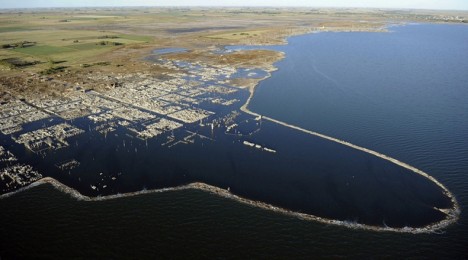
abandoned village from above

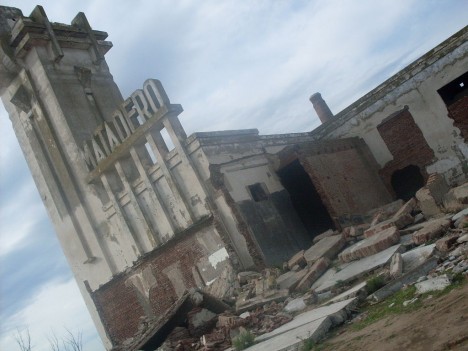
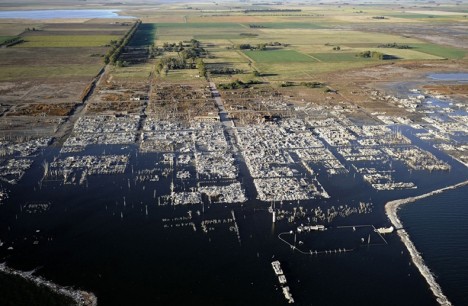
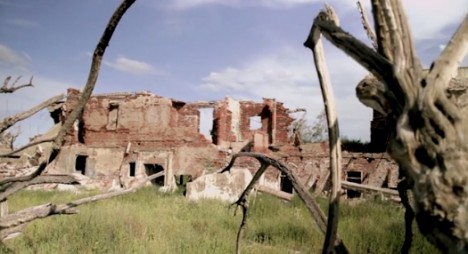
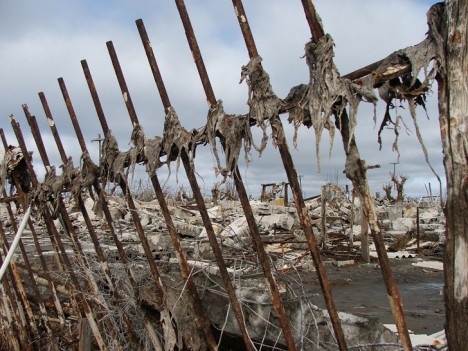
Like a corroded time capsule, this submerged village has risen from the depths after being flooded decades ago when the local lake broke its banks and left Epecuen under dozens of feet of water. In 1985, a rare weather pattern broke a nearby dam first, then the dike protecting the town, quickly making most of it uninhabitable. Today, long-term changes in the regional climate have brought down the overall level of the lake, resurfacing the town.
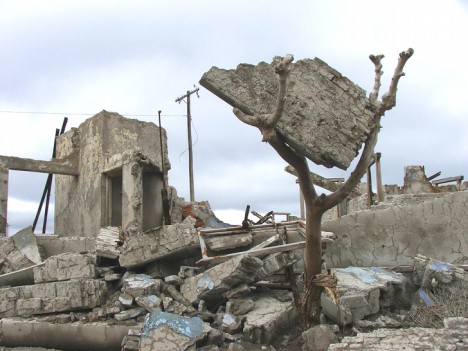
sunken village resurfaced underwater

Giving a tour of his devastated hometown, the man in the award-winning video above , Pablo Novak, claims his father predicted the return of water to the areas of land on which people were building back in the 1980s – at its peak, the place drew in over 25,000 tourists a year. Today, Pablo is the only remaining resident, slowly exploring the remnants now revealed as waters around the lake have lowered.
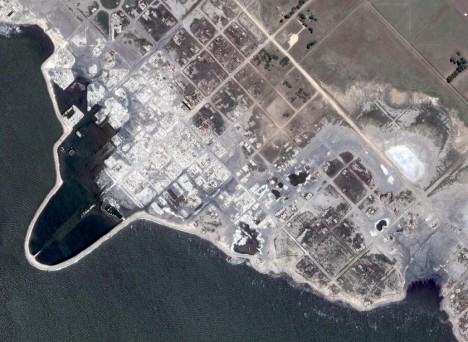
villa epecun from above

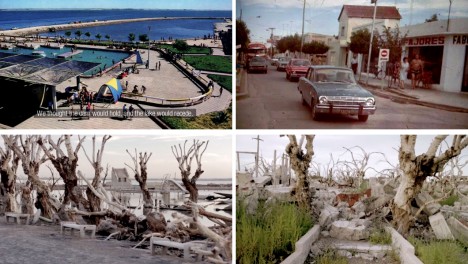
underwater village before after

Located near Buenos Aires, it is hard to imagine that this place – with a permanent population of 5,000  at one point – was once a busy destination from tourists around the country and even the world, renowned for its high-salinity lake in which people came to bathe. This salt content is largely responsible for the high levels of damage done to the town’s buildings and infrastructure during its years underwater.
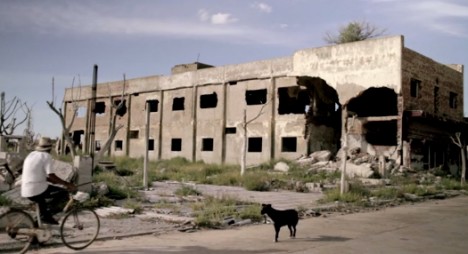
underwater deserted abandoned buildings

underwater village ruins

slaughterhouse abandoned town

First, the fields began to flood, driving our narrator’s cows, horses, pigs sheep and goats back further onto land and forcing Pablo to buy a family home in a neighboring village. Now 85 years old, he always assumed the town would be rebuilt, but that has never come to pass.
sunken town ruins

sunken village washed roots

abandoned underwater town resufraced

Since the waters have receded, Pablo now tries to appreciate the solitude left in its wake and gives tours to those who come these days not to soak but to see the once-sunken village now risen once again to the surface. Images by Sam Verhaert, Jonathan Evans and Pablo Gonzales via Inhabitat.

Share on Facebook


[ By WebUrbanist in Abandoned Places & Architecture. ]

[ WebUrbanist | Archives | Galleries | Privacy | TOS ]

WebUrbanist

 
Comments Off on Lost & Found: Underwater Ghost Town Resurfaces 30 Years Later

Posted in Creativity


From the Dead: Businessman Resurrecting Canadian Ghost Town

24 Dec

[ By WebUrbanist in Abandoned Places & Architecture. ]

ghost town resurrection

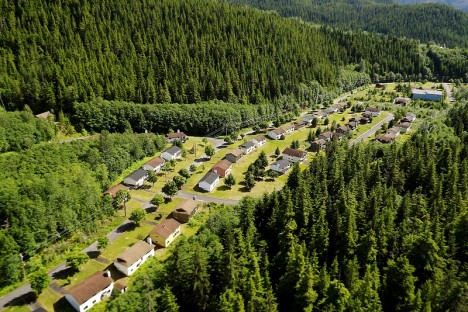
Built in the late 1970s, this mining village housed 1,200 people at its peak and was left effectively intact for over twenty years before being sold as a whole for $ 5,000,000 to an entrepreneur in 2004 who has worked on bring it back to life in the decade since. He has, however, had to adjust his plans to the market along the way – his latest endeavor: to revive it to fit its original purpose once more (image above by Andrea B).

ghost town street

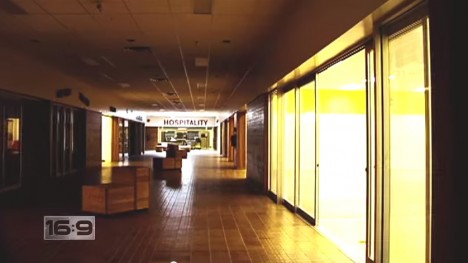
kitsault abandoned mall hall

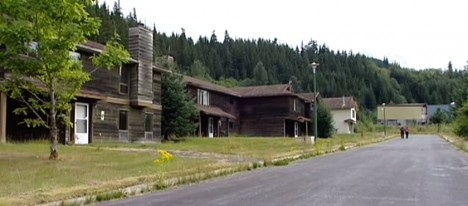
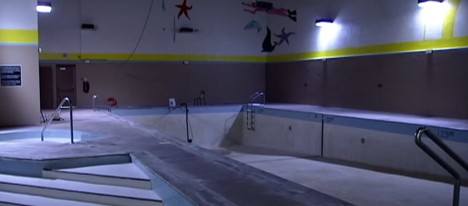
Located in northern British Columbia, Kitsault boasts a remarkable lack of decay, its infrastructure still mostly intact. It has over 100 houses and apartment buildings as well as a movie theater, hospital, shopping mall, recreation center and swimming pool.

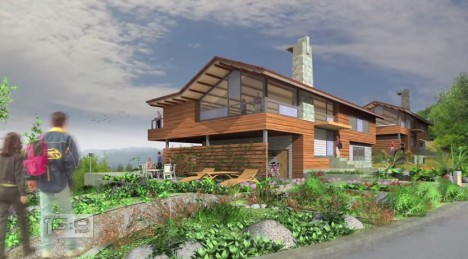
kitsault resort town drawings

Krishnan Suthanthiran purchased the town with visions of turning it into a rural retreat for the creative class and has already spent over $ 10,000,000 repairing landscapes and fixing buildings.

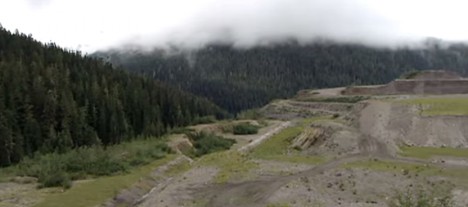
kisault deserted mining area

kitsault swimming pool area

Still, much more work would have been required had the relocation of its previous occupants not been so hasty – they were moved almost overnight in the early 1980s, leaving almost everything intact behind them. Indeed, many of the spaces come complete with vintage furniture and decor dating back to the abandonment of the town.

kitsault deserted library room

kitsault abandoned library stacks

The idea has evolved over time, however, as commodities markets have rebounded – this time liquid natural gas may be the key to the area’s success. In the end, Kitsault could once again become what it was to begin with: a mining town.

Share on Facebook


[ By WebUrbanist in Abandoned Places & Architecture. ]

[ WebUrbanist | Archives | Galleries | Privacy | TOS ]

WebUrbanist

 
Comments Off on From the Dead: Businessman Resurrecting Canadian Ghost Town

Posted in Creativity


Ghost Creeks: Resurfacing Vanished Waterways on City Streets

26 Nov

[ By WebUrbanist in Culture & History & Travel. ]

street painting vanished waterway

Half-forgotten historical urban rivers are set to resurface in San Francisco as part of a civic installation project designed to fill in their historical footprints with a bright blue work of temporary art. The project will stretch across roads, sidewalks and other urban staples with colorful swaths reflecting part the city’s hidden history.

historical waterways city streets

It might seem obvious upon reflection, but few people realize just how many surface waterways ebbed and flowed on the surface of a city like this before development forced their paths into culverts, tunnels and sewers. Set to debut at the Market Street Prototyping Festival (more on that below), this piece explores the intersection of past and present through installation art. Still at a conceptual stage it remains to be decided whether the work will involve physically painting the streets or projecting light down on them from above.

market street festival project

From project creator Emily Schlickman: “Every city has invisible histories embedded within its landscape. Up until the 19th century, ephemeral streams ran through nearly every valley in San Francisco, channeling rainwater to peripheral tidal estuaries. This project, ‘Ghost Arroyos’ seeks to reveal these forgotten waterways of the city through a simple, but powerful intervention. Visitors … will be invited to trace the path of the waterways while listening to a curated recording of hydrological soundscapes and oral histories.”

market street installation art

Emily is a designer living and working in the Bay Area. She is interested in the intersection of landscape processes, art, and systemic design and aims to incorporate these issues into her work. Hers is just one of dozens of crowd-selected projects set to line Market Street during the festival and spanning multiple neighborhoods.

market street prototyping festival

CityLab writes more about the historical waterways of this urban environment: “There was once a time when San Francisco was glistening with creeks and arroyos, or streams that stay dry for part of the year. When Spanish explorers arrived in what’s now the Lower Haight in the late 1700s, they found a healthy brook and named it Fuente de Dolores. Down in the Mission there was a gulch whose water helped sustain cattle and crops. In 1878, the municipal government took another natural channel under modern-day Cesar Chavez Street and turned it into a sewer.”

installation art project series

Some additional information on the festival itself (with a further video introduction above): “Market Street will transform into a public platform, showcasing exciting ideas for improving our famed civic spine and how we use it. Winning entries, as diverse and exciting as the people of San Francisco themselves, will be brought to life for three days along Market Street’s sidewalks, where millions of pedestrians from all walks of life will have the chance to experience, explore, and interact with the prototypes.”

street painting vanished waterways

Like other projects in the mix, Ghost Arroyos is designed to be interactive and community-driven. “The goal of the Prototyping Festival is to unite diverse neighborhoods along Market Street, encouraging these vibrant communities to work with designers, artist and makers to build a more connected, beautiful San Francisco”

Share on Facebook


[ By WebUrbanist in Culture & History & Travel. ]

[ WebUrbanist | Archives | Galleries | Privacy | TOS ]

WebUrbanist

 
Comments Off on Ghost Creeks: Resurfacing Vanished Waterways on City Streets

Posted in Creativity


Favourite Ghost

28 Oct

Ein Beitrag von: Aaron Gutsche

Die Idee für diese Serie kam mir in zwei Teilen. Es gab einen Abend, an dem ich mit meinem besten Freund Paul ausprobierte, was man so bewerkstelligen kann, wenn man im Besitz einer demontierten Straßenlaterne und einer Nebelmaschine ist.

Eine neblige Landschaft, Licht und ein Baum.

Sie schoss mir wieder durch den Kopf, als ich gerade dabei war, meine Schwester Nelly zu portraitieren. Ich hatte bereits meine anderen drei Schwestern, meinen Bruder und meine Eltern in Arten und Weisen gezeigt, mit denen ich zufrieden war, die ihnen gerecht wurden, als Kombination der beiden Kriterien „wer sind sie“ und „wie sehe ich sie“.

Nur Nelly fehlte noch, in ihrer oft wirren, unnachgiebigen und offensiven Art als Ausdruck ihrer geistigen Behinderung, bedingt durch den Drogenkonsum ihrer leiblichen Mutter während der Schwangerschaft.

Wir sehen eine Frau auf Knien hockend mit dem Rücken zu uns.

Etwas liegt unter einem weißen Laken.

Der Name „Favourite Ghost“ ist dem gleichnamigen Song der Band Team Me entliehen. Er handelt von einer vergangenen Liebe, die aber weiterhin als Favourite Ghost im Kopf herum spukt, zunehmend undeutlicher und verschwommener, aber immer da. Das zum einen. Zum anderen die vielen Menschen, denen man begegnet, mit denen man innig eine bestimmte, gemeinsam verbrachte Zeit teilt, die aber an anderen Orten, in anderen Ländern zuhause sind.

Ich bin nicht so der Kontakthalter. Man könnte mein Nicht-Antworten auf elektronischem oder postalischem Weg als Beleidigung ansehen. Ich finde nur, es gibt keinen Ersatz für Anwesenheit. Ich bin stattdessen jederzeit bereit, die Lieben zu beherbergen, die mich besuchen kommen möchten und zu versuchen, mit jedem dort anzuknüpfen, wo wir bei der letzten Begegnung aufgehört haben.

Außerdem bin ich selber viel unterwegs, um wiederzusehen. Und manchmal wird ein Wiedersehen eben nicht stattfinden.

Zwei Geister stehend am Schwimmbeckenrand.Ein Geist geht die Treppe hoch.

Viele Geister unter Bäumen.

Die Bilder könnten ohne Vertrautheit nicht entstehen. Ich sage: „Los, komm(t) mit, ich möchte Dich (Euch) an dem und dem Ort mit einem Laken über dem Kopf fotografieren.“ – „Hä!?“ – „Ja. Vertrau mir mal. Es wird gut!“

Das mit voller Überzeugung jemandem zu sagen, den ich nicht kennen gelernt habe, dafür bin ich nicht der Typ Mensch und mir liegt dann auch einfach nichts daran.

Ein leuchtender Geist im Dunkeln.Zwei Menschen am Rand eines Schwimmbeckens.

Die Bilder sind für mich ein Symbol für die gemeinsam verbrachte Zeit. Natürlich kann man das als persönlichen Aspekt nicht ohne Worte transportieren.

Was aber dann noch bleibt, ist die Ästhetik des Bildes, der gewählte Ort in Kombination mit dem „Geist-Thema“ und vielleicht ruft sie dann – im Ergebnis sicher purer Pop und leicht zu durchdringen – doch noch Assoziationen und Stimmung beim jeweiligen Betrachter hervor.

Zwei Lakengeister rennen in den Wald.

Ein Mensch unter einem Laken leuchtet und Du siehst die Hand.

Ich betreibe die Sache mit den Bildern aus Freude und Schmerz, aus Langeweile und Stress, aus Liebe und sicher auch aus Hass. Vielleicht bin ich unter dem Namen „blaueturnschuhe“ einigen von Euch bereits auf Flickr begegnet. Dort gibt es mittlerweile nichts mehr zu sehen.

Dafür auf Tumblr, das einen viel spezielleren, freieren und chaotischeren Umgang mit Inhalten ermöglicht. Ich lade Euch ein, mal vorbei zu schauen, auch die Serien „Who thought we have no one“ und „Full of Fire“ zu betrachten und mich dann – langsam aber stetig – wieder zu vergessen.


kwerfeldein – Fotografie Magazin | Fotocommunity

 
Comments Off on Favourite Ghost

Posted in Equipment


Ghost Town: Shooting in Kolmanskop

28 Oct

Nature photographer Erez Marom captures a wide range of subjects, from macro shots of insects to some of the world’s most dramatic landscapes. In this article, he shares images from a very unusual location – the ghost town of Kolmanskop, in Namibia. Abandoned over fifty years ago, Kolmanskop was a diamond-mining town, and is currently being reclaimed by the desert. Click through to take a look at Erez Marom’s images and learn about his process

Articles: Digital Photography Review (dpreview.com)

 
Comments Off on Ghost Town: Shooting in Kolmanskop

Posted in Uncategorized


Ghost Estates of Ireland: Symbols of an Economic Collapse

03 Jun

[ By Steph in Abandoned Places & Architecture. ]

Ghost Estates of Ireland 1

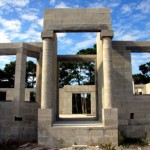
Built with visions of suburban prosperity in more optimistic times, the empty shells of former dream homes dot the countryside among piles of construction rubble and fallen-down fences. Economic highs and lows have led to abandonments of entire villages all over the world, from China to the Mediterranean, but Ireland is among the nations that was particularly hard-hit.

Ghost Estates of Ireland 2

Photographer Valérie Anex captures Ireland’s ‘ghost estates’ in a series of striking images that juxtapose a fading hope for sanitized suburbia with the current reality, which is simply that nobody can afford to live in these houses. The National Institute for Regional and Spacial Analysis defines ‘ghost estates’ as developments of ten houses or more in which fifty percent or less of the homes are occupied or completed.

Ghost Estates of Ireland 3

Ghost Estates of Ireland 4

The latest tally of ghost estates in Ireland, taken in 2013, is 30% less than it was when Anex took these photos in 2011, but that’s still well over ten thousand mostly-empty neighborhoods in a relatively small nation (and just a small percentage of Ireland’s 350,000-some-odd abandoned houses.)

Ghost Estates of Ireland 6

Most of the ghost estates are found in the rural areas of the northern and western parts of the country. Says Anex, “These empty shells are eyesores for the locals in these small towns. The crisis is affecting the country – unemployment, debts, budget cuts, flights of capital investments – but it is also shaping its landscape.”

Ghost Estates of Ireland 7

“Bitter memories left by the spectral and temporary nature of the property boom in Ireland, ghost estates are the symbol of the property market’s collapse, a topology of the economic disintegration of the country.”

The Ghost Estates series will be on display at the Photobookshow in Brighton, England this June.

Share on Facebook


[ By Steph in Abandoned Places & Architecture. ]

[ WebUrbanist | Archives | Galleries | Privacy | TOS ]

WebUrbanist

 
Comments Off on Ghost Estates of Ireland: Symbols of an Economic Collapse

Posted in Creativity


Giving Up the Ghost: Residents of Toxic Town Won’t Leave

10 May

[ By Steph in Abandoned Places & Architecture. ]

Picher Ghost Town 1

Hell no, the last residents of Picher, Oklahoma won’t go – even though their town is officially labeled a hazardous waste site, and there are only 10 of them still clinging to the remains of its past. Picher isn’t even considered a town anymore. It’s just a Superfund site dominated by mountains of mill sand and tailings from the old lead-zinc mining fields, with extensive subsurface excavation putting everything in danger of caving in. Municipal activities stopped in 2009, and the vast majority of its residents vacated the town by 2013.

Picher Ghost Town 2

(top image via randylane; above image via claycountypara)

At its prime in the 1920s, Picher had a population of over 20,000, with 14,000 people working in the mines. Between 1917 and 1947 the town produced over $ 20 billion worth of ore, including more than fifty percent of the lead and zinc used during World War I. But as mining activity slowed down, the population dwindled. Then, the extent of the contamination was discovered.

Picher Ghost Town 3

(image via: wikimedia commons)

Once the mining ceased, Picher essentially became a toxic waste dump for the contaminated water from 14,000 abandoned mine shafts as well as 70 million tons of mine tailings and 36 million tons of mill sand and sludge. At one point, the piles of debris were so high, they looked like mountains dominating the otherwise flat landscape. These piles of mining waste were located right beside neighborhoods, the wind blowing the particles all over everything and everyone. Kids played on those piles of waste, and went swimming in tailings ponds full of toxins. A 1996 study found lead poisoning in 34% of Picher’s children.

Picher Ghost Town 4

(image via: wikimedia commons)

The town was declared the Tar Creek Superfund Site, and in 2006, a mandatory evacuation was announced, with all residents bought out by the State of Oklahoma. The fact that all of that mining had seriously compromised the ground beneath the entire town made it even more dangerous – and then, in 2008, an F4 tornado came along and destroyed 150 homes. Picher is officially uninhabitable, but that hasn’t stopped about ten people from clinging to it anyway.

Picher Ghost Town 5

(image via: marada)

MSNBC reports that six homes and one business remain, even as everything around them is demolished, the final residents insisting that when the Superfund cleanup is complete, Picher will rise again. It’ll take at least thirty years for that to happen, however, since the Tar Creek Superfund Site is just one of four sub-sites within the Tri-State Mining District, all of which continues to contaminate towns throughout Kansas,  Missouri and Oklahoma with toxic runoff.

Picher Ghost Town 6

(image via: marada)

Pharmacist Gary Linderman runs the sole remaining business in Picher, which acts as a social hub for former residents who still travel there to get their medicine despite relocating to other cities. “I think there’s going to be a resurgence in Picher – in time,” says Linderman.

Share on Facebook


[ By Steph in Abandoned Places & Architecture. ]

[ WebUrbanist | Archives | Galleries | Privacy | TOS ]

WebUrbanist

 
Comments Off on Giving Up the Ghost: Residents of Toxic Town Won’t Leave

Posted in Creativity


Drowned Towns: 10 Underwater Ghost Cities & Buildings

10 Mar

[ By Steph in Global & Travel & Places. ]

Drowned Towns Main

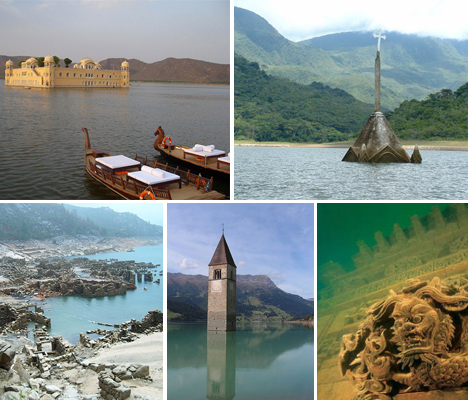
Mildewed crosses, lonely spires, barely-visible stone foundations and rusting bed frames are all that’s left to show for these 10 intentionally submerged towns and structures from India to Massachusetts. When additional water and power is needed to provide for growing populations, small villages often have to be sacrificed, and while some were demolished before their remains were flooded, others can still be seen as ghostly visions wavering beneath the surface.

Potosi, Venezuela

Drowned Towns Potosi 1

Drowned Towns Potosi 2

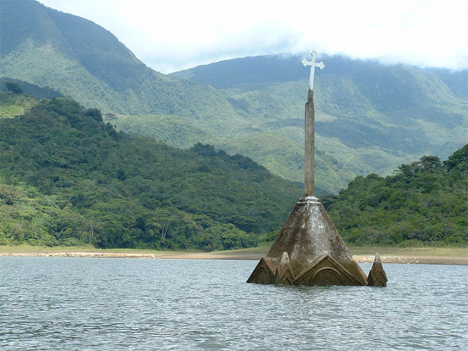
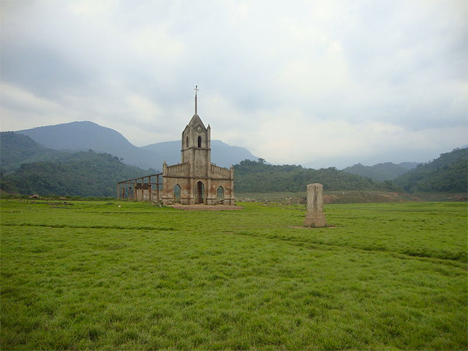
Another town lost to the creation of a hydroelectric dam, Potosi was abandoned in 1985, its residents relocating and leaving their former homes to be filled with water. For 20 years, all that was visible of the Veneuzuelan town was a single mildewed cross topping a drowned church, but by the year 2010, the waters began to recede and the town slowly reappeared. The gothic church that was once submerged is visible again due to droughts and water shortages, erosion and water damage making it appear much older than it really is.

Steeple Tombstone: Curon Venosta, Italy

Drowned Towns Steeple Tomb 1

Drowned Towns Steeple Tomb 2

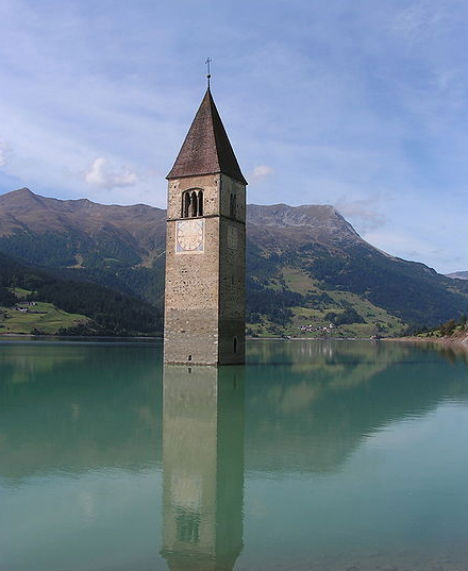
A single spire marks the location of an entire town lost beneath Lago di Resia. The alpine village of Curon Venosta was flooded soon after World War II when officials decided to merge three pre-existing lakes into one to create a hydroelectric dam. Before it was inundated, the town – which included 163 houses and nearly 1,300 acres of land planted with fruit – was filled with sand. The bell tower, which was built in the 14th century, was left intact as a memorial, and can be reached on foot in the winter when the lake freezes over.

Vilarinho da Furna, Portugal

Drowned Towns Vilarinho da Furna

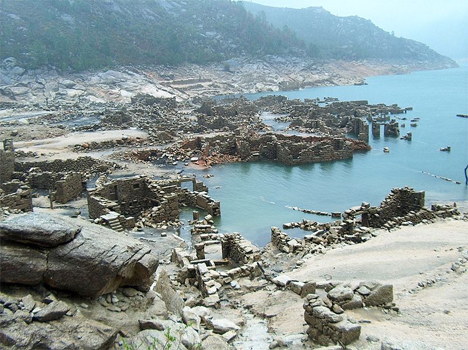
In 1972, the creation of a new dam meant the ancient Vilarinho da Furna was lost beneath the water. The Portuguese village, which dates back to Roman times, was home to almost 300 people inhabiting 80 houses before it was submerged; the property still belongs to their descendants, and reappears every now and then when the reservoir levels fall. The community was unique in that it had a communitarian social system with a council called the Junta made up of a single member from each family, a practice dating back to the Visigoths. When the villagers left they took as much as they could, creating their own road to transport things like rocks and roof tiles to their new homes. Some of those rocks were used to build a museum commemorating Vilarinho da Furna, which contains a collection of clothing, agricultural tools, and paintings depicting daily life in the village.

Jal Mahal, Jaipur, India

Drowned Towns Jal Mahal 1

Drowned Towns Jal Mahal 2

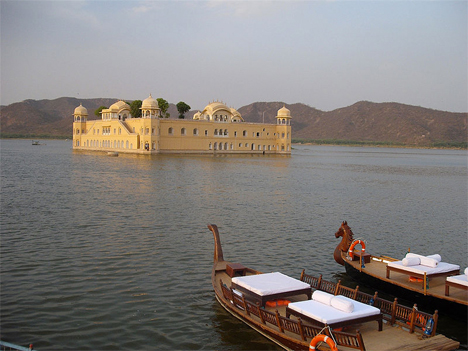
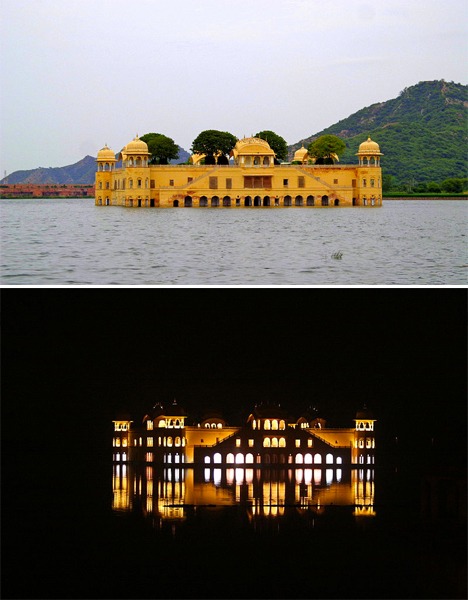
The Water Palace of Jaipur, India sits in the center of Man Sagar Lake. No one knows exactly when it was built, but it’s believed that the red sandstone structure is at least 300 years old and was constructed before damming created the lake, submerging its lower four stories. When the lake is full, only the top level can be reached, and only by boa. At night, the place is illuminated with floodlights like some kind of hallucinatory ghost structure. The palace was recently restored and is now open to visitors.

Next Page – Click Below to Read More:
Drowned Towns 10 Underwater Ghost Cities Buildings

Share on Facebook


[ By Steph in Global & Travel & Places. ]

[ WebUrbanist | Archives | Galleries | Privacy | TOS ]

WebUrbanist

 
Comments Off on Drowned Towns: 10 Underwater Ghost Cities & Buildings

Posted in Creativity


Great Ghost Cities: 7 Eerie Abandoned Wonders of China

20 Dec

[ By Steph in 7 Wonders Series & Global. ]

Abandoned China Main

An ancient city made of intricately carved stone sits silent at the bottom of a lake, a replica of Paris complete with an Eiffel Tower is eerily empty, and a city leveled by disaster has been cordoned off indefinitely as a memorial to those who were lost. China might just be home to more ghost cities than any other nation on earth, and most of them are of the modern variety, as the push for economic progress has led developers to get a bit ahead of themselves constructing vast communities, malls and amusement parks that never caught on with the public.

China’s Atlantis: Lost Underwater City

Abandoned China Underwater Lion City 1

Abandoned China Underwater Lion City 2

Roughly one hundred feet below the surface of Thousand Island Lake (Qiandao Lake) is one of the world’s most stunning submerged historical treasures: Lion City. This ancient city was built during the Eastern Han Dynasty (25-200 CE) and measures about 62 football fields. The city, which is complete with incredibly intricate relief sculptures all over the stone walls of its buildings, was intentionally flooded in the 1950s to create a dam. Evidently, authorities felt that attempting to preserve the city wasn’t worth the trouble. But now that it’s underwater, it has become a diving destination, and various tours have popped up allowing visitors to explore it. Some have even proposed building transparent floating tunnels and other new construction that could make it more accessible to everyone.

Paris of the East: Replica Ghost City

Abandoned China Paris Replica 2

Abandoned China Paris Replica 1

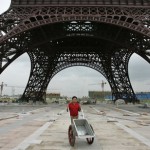
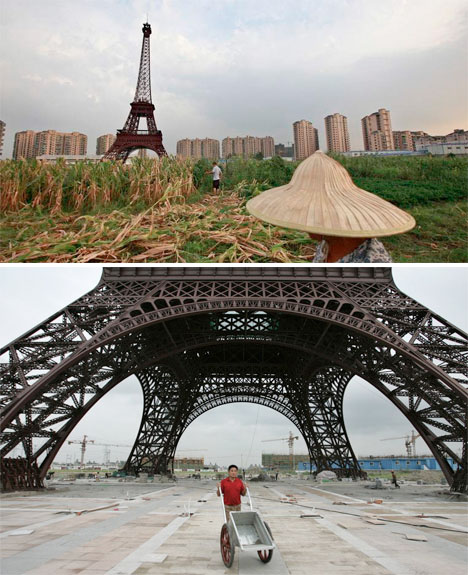
Paris is one of the world’s most vibrant cities, bustling with hundreds of thousands of people. At least, the one in France is. The meticulously built replica city in China – not so much. Tianducheng, in China’s Zhejiang district, was modeled after the real Paris, complete with a 354-foot replica of the Eiffel Tower as well as other landmarks. Intended to be a luxurious gated community that could house 100,000 and draw rural families into a centralized urban location, the city has been a ghost town since its construction in 2007. Only about 2,000 people moved there, and that small number seems to be dwindling by the day. But work is still in progress, and officials are hoping to get more people there before the whole complex is totally complete in 2015.

Ordos: A Modern Ghost Town

Abandoned China Ordos 1

Abandoned China Ordos 2

It seems as if the entire population of a large city simply vanished into thin air. In reality, they were never here in the first place. The Kangbashi New Area of Ordos is a planned community for one million people, envisioned as the Dubai of Northern China – but only about 20,000 people live there, and you’d never even guess there are that many residents based on the eerie photos of deserted streets and empty skyscrapers. It’s close to abundant natural resources and has plenty of public infrastructure, and economic woes aren’t actually a problem. The government just can’t seem to convince people to move here. Some of the architecture, like the Ordos Art Museum, is really quite stunning, and it’s strange to see it accumulating dust as it waits for visitors that might never come. City officials are still hoping that many of the 1.5 million residents of the old section of Ordos, located 15 miles away, will decide to make the move.

Beichuan: Left Behind After a Disaster

Abandoned China Beichuan Disaster City 2

Abandoned China Beichuan Disaster City 1

Imagine an entire city leveled by an earthquake, roped off and left to rot as a sad and rather dangerous tribute to all that was lost. It happened in Christchurch, New Zealand (sort of – they do plan to rebuild, and the process has already begun) and it happened in Beichuan, China. A deadly earthquake killed thousands of residents and displaced tens of thousands more, and the damage is so extensive that reconstructing it would require leveling almost all of the remaining buildings. So, it’s now basically a memorial park that you shouldn’t enter unless you’re keen to get trapped in the rubble and join the other victims.

Next Page – Click Below to Read More:
Ghost Cities Of China 7 Eerie Abandoned Wonders

Share on Facebook


[ By Steph in 7 Wonders Series & Global. ]

[ WebUrbanist | Archives | Galleries | Privacy | TOS ]



WebUrbanist

 
Comments Off on Great Ghost Cities: 7 Eerie Abandoned Wonders of China

Posted in Creativity


Great Ghost Cities of China: 7 Eerie Abandoned Wonders

19 Dec

[ By Steph in 7 Wonders Series & Global. ]

Abandoned China Main

An ancient city made of intricately carved stone sits silent at the bottom of a lake, a replica of Paris complete with an Eiffel Tower is eerily empty, and a city leveled by disaster has been cordoned off indefinitely as a memorial to those who were lost. China might just be home to more ghost cities than any other nation on earth, and most of them are of the modern variety, as the push for economic progress has led developers to get a bit ahead of themselves constructing vast communities, malls and amusement parks that never caught on with the public.

China’s Atlantis: Lost Underwater City

Abandoned China Underwater Lion City 1

Abandoned China Underwater Lion City 2

Roughly one hundred feet below the surface of Thousand Island Lake (Qiandao Lake) is one of the world’s most stunning submerged historical treasures: Lion City. This ancient city was built during the Eastern Han Dynasty (25-200 CE) and measures about 62 football fields. The city, which is complete with incredibly intricate relief sculptures all over the stone walls of its buildings, was intentionally flooded in the 1950s to create a dam. Evidently, authorities felt that attempting to preserve the city wasn’t worth the trouble. But now that it’s underwater, it has become a diving destination, and various tours have popped up allowing visitors to explore it. Some have even proposed building transparent floating tunnels and other new construction that could make it more accessible to everyone.

Paris of the East: Replica Ghost City

Abandoned China Paris Replica 2

Abandoned China Paris Replica 1

Paris is one of the world’s most vibrant cities, bustling with hundreds of thousands of people. At least, the one in France is. The meticulously built replica city in China – not so much. Tianducheng, in China’s Zhejiang district, was modeled after the real Paris, complete with a 354-foot replica of the Eiffel Tower as well as other landmarks. Intended to be a luxurious gated community that could house 100,000 and draw rural families into a centralized urban location, the city has been a ghost town since its construction in 2007. Only about 2,000 people moved there, and that small number seems to be dwindling by the day. But work is still in progress, and officials are hoping to get more people there before the whole complex is totally complete in 2015.

Ordos: A Modern Ghost Town

Abandoned China Ordos 1

Abandoned China Ordos 2

It seems as if the entire population of a large city simply vanished into thin air. In reality, they were never here in the first place. The Kangbashi New Area of Ordos is a planned community for one million people, envisioned as the Dubai of Northern China – but only about 20,000 people live there, and you’d never even guess there are that many residents based on the eerie photos of deserted streets and empty skyscrapers. It’s close to abundant natural resources and has plenty of public infrastructure, and economic woes aren’t actually a problem. The government just can’t seem to convince people to move here. Some of the architecture, like the Ordos Art Museum, is really quite stunning, and it’s strange to see it accumulating dust as it waits for visitors that might never come. City officials are still hoping that many of the 1.5 million residents of the old section of Ordos, located 15 miles away, will decide to make the move.

Beichuan: Left Behind After a Disaster

Abandoned China Beichuan Disaster City 2

Abandoned China Beichuan Disaster City 1

Imagine an entire city leveled by an earthquake, roped off and left to rot as a sad and rather dangerous tribute to all that was lost. It happened in Christchurch, New Zealand (sort of – they do plan to rebuild, and the process has already begun) and it happened in Beichuan, China. A deadly earthquake killed thousands of residents and displaced tens of thousands more, and the damage is so extensive that reconstructing it would require leveling almost all of the remaining buildings. So, it’s now basically a memorial park that you shouldn’t enter unless you’re keen to get trapped in the rubble and join the other victims.

Next Page – Click Below to Read More:
Ghost Cities Of China 7 Eerie Abandoned Wonders

Share on Facebook


[ By Steph in 7 Wonders Series & Global. ]

[ WebUrbanist | Archives | Galleries | Privacy | TOS ]

WebUrbanist

 
Comments Off on Great Ghost Cities of China: 7 Eerie Abandoned Wonders

Posted in Creativity