RSS
 

Posts Tagged ‘Future’

Cardboard printers? Samsung concepts look to cheaper, sustainable future

12 Aug

origami.png

New printer concepts from Samsung look to lower-cost and sustainable materials as a way to reduce prices and environmental impact. Receiving recognition at the 2013 International Design Excellence Awards, these three designs take a page from Ikea’s flat-pack, assemble-it-yourself playbook, using materials like corrugated cardboard and Polyethylene plastic to create printers with exteriors that are easier to manufacture. Will your next printer come with a cardboard shell? Click through and take a look at the concepts.

News: Digital Photography Review (dpreview.com)

 
Comments Off on Cardboard printers? Samsung concepts look to cheaper, sustainable future

Posted in Uncategorized


Future Perfect: 7 Potential Wonders of the World

22 May

[ By Steph in Conceptual & Futuristic & Technology. ]

Future Wonders of Technology Main

One hundred years from now, will we be living on other planets, teleporting from place to place, communicating to each other telepathically, or even becoming immortal by shifting human consciousness from our biological bodies to artificial ones? These predictions for the distant future seem outrageous and virtually impossible to achieve, yet steps are being made toward them at this very moment. The seeds of the potential future wonders of the world have already been planted, and in many cases, it’s not a question of whether they’ll happen, so much as when.

Teleportation

Future Wonders Teleportation 1

Future Wonders Teleportation 2

(images via: physical review focus, ail)

As unlikely as this may sound, teleportation isn’t entirely sci-fi. Physicists have already succeeded in teleporting photons – but right now, it’s not so much about teleporting matter from one location to the next, as it is information. Quantum teleportation is a complex topic involving concepts like ‘entanglement’, the connection that links the quantum states of two particles no matter who far apart they are. Teleporting a single particle is one thing, but what about human beings, Star Trek style?

As PBS’ The Nature of Reality column explains, “Remember that we wouldn’t be moving Kirk’s molecules from one place to another. He would interact with a suite of previously-entangled particles, and when we read the quantum state we would destroy the complex quantum information that makes his molecules into him while instantly providing the information required to recreate his quantum state from other atoms in a distant location. Quantum mechanics doesn’t forbid it. The rules of quantum mechanics still apply whether you’re talking about a system of two particles or human being made of 1027 atoms.”

The verdict? Teleportation is certainly possible, and scientists may soon begin working on attempts to teleport living matter, like viruses. Physicist Michio Kaku believes that the transport of a molecule will happen within the next ten years, followed by DNA, but that teleporting an entire human is probably still centuries away.

Artificial Intelligence Surpassing Human Intelligence

Future Wonders Artificial Intelligence

(images via: mashable)

How long do we have until human-level artificial intelligence is achieved? H+ Magazine surveyed experts, asking when they estimated AI would meet four major milestones: carrying on a conversation well enough to pass as a human, solving problems as well as a third grade student, performing Nobel-quality scientific work, and finally, surpassing human intelligence altogether. Robots can already see, hear, learn, solve problems and respond to questions, and some are even getting senses of smell and taste. The Eccerobot is creepily human in its movements thanks to artificial muscles and bones.

The general consensus was that we’ll have AI at the human level or beyond will happen by the middle of the century, or maybe even sooner – but may not surpass humans for a hundred years, if ever.

Space Settlements

Future Wonders Space Colony

(images via: space.com)

Applications are now open for a one-way ticket to a private space settlement on Mars. The Mars One project intends to land supplies on the red planet in 2016, and get settlers there by 2023; about 78,000 people have already applied. The company responsible, Lansdorp, insists that the technology needed to achieve this lofty goal already exists. And according to a group of astronauts, researchers and space flight firms who met in May 2013 for the first Human to Mars Summit, establishing a permanent, sustainable outpost on another planet might be a matter of saving the human species.

Supplies would be dropped off first, and then a crew of either humans or robots would construct the base. There are a lot of obstacles, not the least of which is the question of transportation between Earth and Mars, and whether Mars inhabitants could maintain their own food source, rather than relying on interplanetary deliveries.

Will it really happen? it’s hard to say. Private companies with an interest in space colonization are working with some of the same companies that have completed commercial cargo missions to the International Space Station. Lansdorp intends to make the technology developed during its mission available for sale, to fund Mars One and help speed up progress for additional colonies.

Body-Embeddable Electronics

Future Wonders Human Body Gadgets

(images via: io9, sync-blog)

In the future, it might be possible to hack other human beings thanks to all manner of body-embeddable gadgets. Many futurists and technology experts believe the trend for future devices isn’t to go smaller, but rather to integrate them into ourselves. Scientists have already developed tiny chips that can translate tiny bodily movements into energy to power gadgets, as well as devices that can be implanted into our bodies. Everyday electronics can already be implanted into human tissue, and medical devices are paving the way for recreational. Ready or not, the bionic human is on the horizon.

Researchers have also developed the first electronic sensor that can be printed directly onto human skin, creating a sort of ‘smart tattoo’ that could theoretically enable people to communicate with each other and our environments with thought commands. The devices, which are thinner than the diameter of a human hair, can detect electrical signals linked with brain waves, communicate wirelessly and receive energy.

Next Page:
Future Perfect 7 Potential Wonders Of The World

Share on Facebook


[ By Steph in Conceptual & Futuristic & Technology. ]

[ WebUrbanist | Archives | Galleries | Privacy | TOS ]


WebUrbanist

 
Comments Off on Future Perfect: 7 Potential Wonders of the World

Posted in Creativity


Future Present: 7 Soon-to-Be Wonders of Technology

15 May

[ By Steph in Conceptual & Futuristic & Technology. ]

Tech Predictions Main

Within five years or less, we could be chatting with the three-dimensional holograms of faraway friends, controlling our computers with mental commands, charging our phones with energy harvested from wasted ambient energy and logging into our bank accounts with facial recognition scans. These are among the technology innovations that computer giant IBM has predicted within the last few years of its annual technology forecast. Here are seven of the most intriguing prospects.

3D Hologram Chat

Tech Predictions Holographic Chat

(image via: Star Wars 20th Century Fox screen capture)

A 3D holographic chat system called “TeleHuman” is the first example of what will likely be a flood of virtual hologram technology that lets us see faraway contacts in three dimensions. TeleHuman creates a life-sized rendering of its subject using six XBox Kinect sensors, a 3D projector and a cylindrical display; the creators say it will be available for $ 5,000 within five years. A similar project called the RGB+D Toolkit is making waves in the indie filmmaking community.

Microsoft is also working on telepresence technology for Skype using holograms to literally bring conference participants to a central table, no matter where in the world they’re located.

Mind-Controlled Devices

Tech Predictions Mind Controlled Gadgets

(image via: forbes)

Wouldn’t it be nice if you didn’t have to type at all? You could simply think a command, an email, or anything else you want to do and it appears on your screen. Maybe we’re not quite there yet, but progress is encouraging. Brain-Computer Interface (BCI) technology is appearing in all kinds of experimental gadgets, from headphones that play music based on your mood to a headband that measures brain activity in real time and displays it on your smartphone or tablet. BCI devices are also being used to allow quadriplegic patients to complete previously impossible tasks.

Of course, there are drawbacks to this inevitably invasive technology. A 2012 study found that connecting minds to machines can allow sensitive private information to ‘leak out’ along with the users’ mental commands. The information revealed included the location of their homes, faces they recognized and even their credit card PINs.

Energy-Scavenging Gadgets That Don’t Need Batteries

Tech Predictions Energy Scavenging Gadgets

(image via: dennis siegel)

Power lines, data centers, televisions and even your coffee maker output waves of ambient energy that typically just dissipate in the air, going to waste. That energy could be used to power all kinds of things, including crucial wireless sensors running on batteries, which keep track of factory machinery or measure environmental pollution. MIT has developed an energy-harvesting microelectromechanical system (MEMs) that translates even tiny vibrations, light and ambient energy into a surprising amount of power, eliminating the need for batteries.

Designer Dennis Siegel shows off some of the possibilities on the consumer side of the spectrum with ‘Energy Parasite,‘ a gadget that gathers energy from home appliances and power plants, stores it in a conventional battery and allows you to use it later for cell phones, mp3 players and other devices.

Multi-Factor Biometrics Eliminate Need for Passwords

Tech Predictions Biometrics Passwords

(image via: siemens)

We’re not far from an era in which passwords are a thing of the past. Fingerprint scanners have been available for a range of devices for quite a while now, but they’re not ideal – burns, cuts, oil and other irregularities can interfere with scanning. In the future, a range of biometrics including voice, retina and face scanners could be used to verify our identities so we can access devices, personal accounts and private data.

Researchers are developing systems that ensure biometric data is secure, like taking a sample of a user’s voice, dividing it into similar samples, and then cryptographically protecting them before performing a comparison on the voice trying to gain access.

Computers That Can Smell, Taste & Replicate Touch Sensations

Tech Predictions Computers Taste Smell Hear

(image via: ntdtv)

IBM predicted that within five years, computers will be able to output and recognize smells and flavors, and even replicate textures, so we can ‘feel’ fabrics before purchasing, for example. Texture data fed into a computer’s drivers can re-create vibrations and temperature on a touch screen, similar to the way some computer game controllers shake to indicate on-screen action. Digitized taste buds breaking down flavors to their molecular components can help compare them, so users can find something that tastes like a favorite food, but is healthier, or get a sense of a recipe before trying it out. Chemical sensors that enable computers to ‘smell’ could guess health problems from changes in your breath or detect environmental toxins.

Changes in the way computers ‘hear’ sound could also lead to some major breakthroughs. Hearing the ‘whole picture’ rather than isolated voices or music could allow computers to learn more about the situations in which the sounds are produced. For example, a computer could analyze the sounds of a baby crying and identify based on past experience whether the cause is need for a diaper change or food, or more serious problem. Japanese researchers are currently integrating smell technology into humanoid robots, as well.

The End of Junk Mail

Tech Predictions No More Junk Mail

(image via: Minority Report 20th Century Fox Screen Capture)

Advances in creepily targeted advertising could mean that junk mail is no longer junk. When the ads that appear in your inbox and physical mailbox are tailored specifically to your tastes and interests, you’re going to be more likely to click on them, which is exactly what marketers want. Information assembled online, through customer loyalty cards and by other means tell advertisers more than ever about your purchasing habits, your household and your income. Of course, we’re trading the annoyance of junk mail for what could be considered a serious invasion of privacy. Many consumers have no idea how much can be learned about their lives from their surfing habits.

Finely tuned junk mail filters will also help combat the constant flood of invitations to buy black market Viagra, enlarge certain body parts and claim inheritances from long-lost relatives in Nigeria.

Harvesting Kinetic Energy

Tech Predictions Kinetic Energy

(image via: pavegen)

Just like all that ambient energy, kinetic energy from movement of all sorts is a potentially rich source of power that currently goes to waste. The movement generated by trains, cars, and our own hands and feet could provide electricity to the venues in which it’s harvested. This technology is already in place at a number of human-powered gyms, dance clubs and subway stations. Treadmills, stationary bikes, roller coasters, sidewalks and handrails absorb the energy from movements and convert it into power for lights and other electrical equipment.

Pavegen floor tiles are one example. These tiles, which capture kinetic energy from footsteps, have been installed at the Westfield Stratford City Shopping Centre in London, and were also used at the 2013 Paris Marathon.

Share on Facebook


[ By Steph in Conceptual & Futuristic & Technology. ]

[ WebUrbanist | Archives | Galleries | Privacy | TOS ]


WebUrbanist

 
Comments Off on Future Present: 7 Soon-to-Be Wonders of Technology

Posted in Creativity


Fighting the Future: 3D-Printed Gun Fired, Blocked by US

13 May

[ By WebUrbanist in Gadgets & Geekery & Technology. ]

3d gun

The story has unfolded fast, and people on both sides are furious. Within days of a successful test firing of the Liberator, this working 3D-printed weapon has attracted the attention of the United States government. 100,000+ downloads in,  the State Department has stepped in to try and stop further distribution.

3d gun in case

Cody Wilson of Defense Distributed and his crew have been harshly criticized, both by those who wanted him to stand up to authority and others who wish he had never created or released the blueprint files in the first place.

3d printed plastic gun

Despite adamantly contending they would not cave to external pressure, Defcad – the site hosting the 3D gun and other illicit-object designs – now has a white-on-red warning at the top of the page summarizing the situation for visitors. None of this, of course, has stopped people from distributing the files in a variety of alternative venues.

3d printer gun component

On the one hand, it is entirely understandable that people would fear a future in which gun control is difficult or impossible thanks to ease of on-demand printing. Further, its parts and breakdown also make it easy to sneak through security checks, making it potentially more dangerous in some ways than a traditional firearm.

3d firearm parts disassembled

On the other hand, people can already make guns with the right shop equipment (better ones than those that can be currently printed), plus history has shown that fighting inevitable shifts in technology is an uphill battle. In tech, much like in war, sophisticated capabilities tend to win in the end, regardless of which side was ‘right’ to begin with. Information, as they say, wants to be free.

Share on Facebook


[ By WebUrbanist in Gadgets & Geekery & Technology. ]

[ WebUrbanist | Archives | Galleries | Privacy | TOS ]


WebUrbanist

 
Comments Off on Fighting the Future: 3D-Printed Gun Fired, Blocked by US

Posted in Creativity


Future Past: 7 Wonders Predicted 100+ Years Ago

08 May

[ By Steph in Technology & Vintage & Retro. ]

Future Past Predictions Main

“These prophecies will seem strange, almost impossible,” reads the intro to a 1900 article printed in the Ladies Home Journal entitled ‘What May Happen in the Next Hundred Years.‘ And over a century later, many of them do. The “wisest and most careful men in our great institutions of science and learning” envisioned that by the year 2001, we humans would have willfully made all wild animals extinct to make room for ourselves, and we’d be eating sterile foods zipped from laboratories to our homes via pneumatic tubes. But some of these ideas are more prescient than others, accurately imagining innovations like factory farming and even the internet.

Wild Animals Don’t Exist Anymore, Except in Zoos

Future Past Predictions Wild Animals

(image via: paleofuture)

“Man’s steadily increasing need for more space will eventually force untamed beasts to pay their way in the scheme of things, or join the species already extinct,” reads a 1926 article in the Galveston Daily News. That attitude was surprisingly common during the early 20th century, despite the fact that the predictions in the Ladies Home Journal article underestimated a century of future population growth by billions. The Ladies Home Journal article predicted that animals wouldn’t exist in the wild anymore at all, and would only be found in zoos, unless they were in use as livestock or service animals.

The article predicts that rats and mice will have been completely exterminated (along with mosquitoes, flies and roaches, which would require filling in all swamplands and chemically treating all still-water streams) and that cows will be so fat, they’ll be as slow as livestock pigs. “Food animals will be bred to expend practically all of their life energy in producing meat, milk, wool and other by-products. Horns, bones, muscles and lungs will have been neglected.” Sounds like modern-day conditions at many of America’s largest factory farms.

Purchases and Pre-Cooked Meals Are Delivered via Pneumatic Tubes

Future Past Predictions Pneumatic Tubes

(image via: machinelake)

In an era when compressed food tablets actually seemed like a great idea, sterile pre-cooked meals made in laboratories rather than kitchens were an appealing concept. The Ladies Home Journal article imagines that ready-cooked meals would zoom from these central labs to private homes via a vast system of pneumatic tubes. Equipped with all manner of electrical gadgets not found in homes, these laboratories would also be able to supply food cheaper than it would cost to cook for yourself, since they’re buying ingredients in such large quantities. You press a button, your food zips to you within minutes, and then you send the packaging and utensils back to be chemically cleaned. Store purchases and mail would be delivered in much the same way.

Furthermore, you’d never have to worry about anyone breathing on your food, or exposing it to the atmosphere of the busy streets. Shopkeepers would be arrested if they dared to store food that wasn’t essentially hermetically sealed, or if they sold “stale or adulterated produce.” The miracle of always-fresh produce would be achieved using liquid-air refrigerators.

The idea of pneumatic delivery hasn’t gone away altogether – some cities use pneumatic tubes to dispose of trash, and a company called the Foodtubes Project aims to reduce greenhouse gas emissions by transferring much of the UK’s deliveries from trucks on the roads to underground tubes.

The Suburb is the Promised Land for Taller, Healthier Americans

Future Past Predictions Broadacre Suburbia

(image via: mediaarchitecture.at)

The suburbs seemed like utopia for people living in clogged, smoggy cities. The predictions of the day envisioned Americans not only living much longer thanks to quiet lives in the peaceful suburbs, but also be one to two inches taller on average thanks to better health “due to vast reforms in medicine, sanitation, food and athletics.” In fact, suburbs would be so amazingly beneficial for mankind, city housing would be practically eliminated, and building in blocks would be illegal.

Americans, and humans in general, are indeed taller than we were in the year 1900, thanks to ample amounts of nutritious foods, though that could very well change with the unhealthy fast-food diets that have become increasingly common over recent decades. The suburban dream hit its peak during the ’50s, however, and is now starting to fizzle, with many young people choosing to live in cities for access to efficient transportation, jobs and culture.

Zero Traffic Noise in Cities as Transit Goes Underground

Future Past Predictions Carless Cities

(image via: wikimedia commons)

The dream of the suburbs would be achieved with quiet, high-speed transportation that was virtually invisible at surface level, with “well-lighted and well-ventilated” underground railways in broad subways or tunnels, as well as monorails and elevated streets. Trains would take passengers from New York to San Francisco in a day and a night (imagine!). It’s easy to see why this seemed so readily achievable in the year 1900; the first underground railway in the world opened in London in 1863 and transportation grew more efficient by the year. People hadn’t yet been seduced by the status and freedom of individual automobiles.

We may have high-speed trains in much of the world (though sadly, still not in most of America), but car-free cities “free from all noises” are far from our current reality. However, at least one city may be able to achieve that ideal: ‘Great City’, a dense carless metropolis being built from scratch in a rural area outside Chengdu, China.

Next Page:
Future Past 7 Wonders Predicted 100 Years Ago

Share on Facebook


[ By Steph in Technology & Vintage & Retro. ]

[ WebUrbanist | Archives | Galleries | Privacy | TOS ]


WebUrbanist

 
Comments Off on Future Past: 7 Wonders Predicted 100+ Years Ago

Posted in Creativity


Looking into the future of mobile photography

08 May

glass1.jpg

As smartphone cameras continuously improve, this dynamic technology has us wondering what’s in store for both the future of such devices and the way we use them as photographers. Will the constant upgrade cycle and users’ desire for new features make for smartphones with super cameras? Or maybe they’ll play more nicely as companion gadgets to dedicated cameras, rather than attempting to do it all themselves. Looking at what’s currently rumored to be in the works, maybe we can wrap our heads around what the future of such connected cameras – and photography – might look like, today on Connect.

News: Digital Photography Review (dpreview.com)

 
Comments Off on Looking into the future of mobile photography

Posted in Uncategorized


Adobe moves to subscription-only future for Photoshop and other creative tools

07 May

shared:AdobeLogo.png

Adobe has said it will no longer be developing its Creative Suite range of software, leaving its subscription and cloud-based Creative Cloud as the only way of accessing the latest version of Photoshop. Adobe has been trying to encourage users away from the traditional one-off payment licenses and on to a monthly payment model, with features such as online storage and syncing between devices. This latest move ups the ante by making it the only option for future versions of the software.

News: Digital Photography Review (dpreview.com)

 
Comments Off on Adobe moves to subscription-only future for Photoshop and other creative tools

Posted in Uncategorized


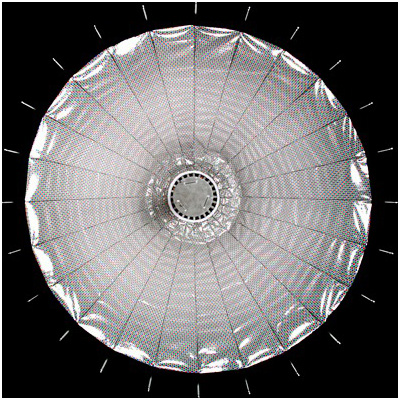
Is This the Future of Umbrellas?

03 May

See this umbrella? It's very different than the typical reflector in one very specific way. And it's being touted as being way better for digital sensors.

Can you tell what's different about it? Probably not without looking at it close-up…

Read more »
Strobist

 
Comments Off on Is This the Future of Umbrellas?

Posted in Photography


Future Architecture: 7 Surreal Award-Winning Skyscrapers

09 Apr

[ By WebUrbanist in Conceptual & Futuristic & Technology. ]

skyscrapers futuristic

The first skyscrapers were impossible drawings at the times they were imagined, yet today glass towers that scale to the skies are everyday structures.  On land, by sea, in the air (or in one case: outer space), these entries are daring and visionary, defying convention, technology and at times even gravity.

skyscraper polar umbrella project

First, the winner of the 2013 Evolo Skyscraper Competition, the Polar Umbrella (by Derek Pirozzi), a buoyant skyscraper that protects and regenerates the polar ice caps. The umbrella helps shade the ice below it, which is, in turn, rebuilt via water frozen by energy generated “through an osmotic (salinity gradient power) power facility housed within the building’s core.”

skyscraper first place award

It can much more than just a remote outpost: “Through its desalinization and power facilities, this arctic skyscraper becomes a floating metropolis equipped with NOAA (National Oceanic and Atmospheric Administration) research laboratories, renewable power stations, dormitory-style housing units, eco-tourist attractions, and ecological habitats for wildlife.”

skyscraper flying light park

From the sea we shift our sights to the sky, where a high-flying design (third-place winner) aims to supplement dense cities with much-needed recreational and green space. Capped with a helium balloon and supported by solar-powered propellers, Light Park (by Ting Xu and Yiming Chen) is a floating skyscraper.

skyscraper sky park diagrams

Lofted greenery helps clean the air above urban centers, and the plan balances program and structure: “Programmatic platforms that host parks, sports fields, green houses, restaurants, and other uses are suspended from the top of the structure by reinforced steel cables; the platforms fan in different directions around the spherical vessel to balance its weight. These slabs are also staggered to allow for maximum exposure to sunlight on each level.”

skyscraper space gravity grid

Before we get to a few back on the ground,  we have covered sea, sky and the next step? Space. That’s where the Stratosphere Network of Skyscrapers comes in – a bold idea by a Chinese team to create a skyscraper grid in space. The Buckminster-Fuller-worthy hex network of globe-spanning architectural infrastructure is mind-boggling in its implications. Independently, these incredible towers are impossible to support, but as a network, they reinforce one another, and are mutually suspended above the Earth.

skyscraper futuristic network diagrams

If is a tall order in practice, but a brilliant concept in theory: “In this case the network of buildings and bridges connected to each other, covering the entire circumference of the earth, will no longer need structural ground support and can be suspended in the air by the effect of the earth gravity. The elevated bridges and buildings that relate the grid can reach any height with out worrying about overturning, earth-quakes, floods and any other natural disasters.”

Next Page:
Future Architecture 7 Surreal Award Winning Skyscrapers

Share on Facebook


[ By WebUrbanist in Conceptual & Futuristic & Technology. ]

[ WebUrbanist | Archives | Galleries | Privacy | TOS ]


WebUrbanist

 
Comments Off on Future Architecture: 7 Surreal Award-Winning Skyscrapers

Posted in Creativity


The Future That Never Was: 12 Funny Gadget Predictions

01 Apr

[ By Steph in Gadgets & Geekery & Technology. ]

Retrofuturistic Technology Main

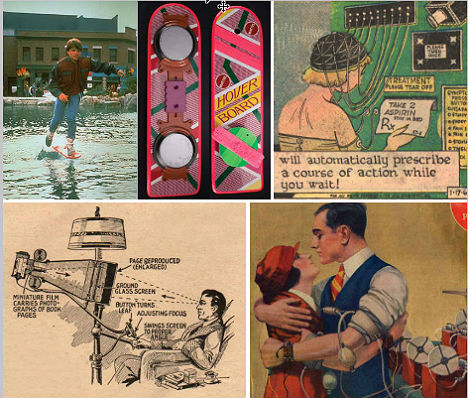
Yesterday’s visions of today were surprisingly accurate in some cases, but in others, they were humorously off-base. We’re not zooming around our moon colony homes in jet packs, confirming our choice in mates with scientific body odor tests, or enjoying our favorite TV shows via implants in our brains. These 12 predicted gadgets and inventions never came to be, and while we’ll never need robotic cargo horses for our milkmen, we’re still eagerly waiting for those hoverboards. See lots more fabulous retro-futurism at the Smithsonian Magazine blog, Paleofuture.

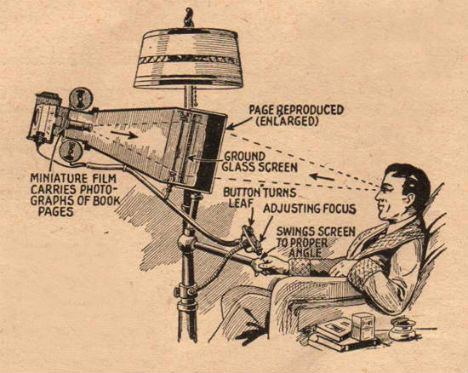
The iPad of 1935

Retrofuturistic Gadgets iPad 1937

In the April 1935 issue of the magazine Everyday Science and Mechanics, the ‘next logical step in the world of publishing’ was envisioned: a mechanical microfilm reader mounted on a large pole that would theoretically allow you to sit back in your armchair and scroll through the pages of a book with the push of a button. Of course, unlike the modern iPad, which offers the same function, it’s not exactly portable – much less so than the book sitting on the table right next to the illustrated man.

Newspaper Printed by Your Home Radio

Retrofuturistic Gadgets Radio Prints Newspaper

As envisioned in the 1930s and 1960s using radio and satellite technology, respectively, the future of newspapers would involve home printing machines that spit out the day’s news automatically each morning and evening. Philco-Ford’s Newspaper Printer, featured in an episode of the CBS show ‘The 21st Century’ entitled ‘At Home, 2001′, “provides a summary of news relayed by satellite from all over the world,” says narrator Walter Cronkite. “Now to get a newspaper copy for permanent reference I just turn this button, and out it comes. When I’ve finished catching up on the news I might check the latest weather. This same screen can give me the latest reports on the stocks I might own.”

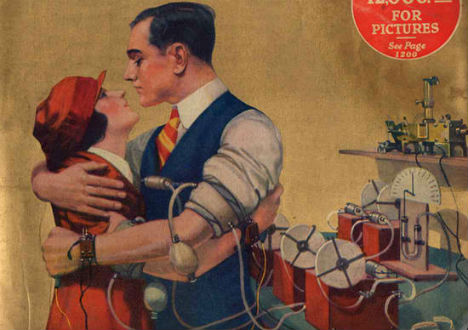
Scientific Mate Tests

Retrofuturistic Gadgets Scientific Mate Test

How can you determine whether you will have a successful marriage? According to an April 1924 issue of Science and Invention magazine about scientific love matching, you simply hook yourself up to a mating machine that measures your physical attraction and sympathy for your chosen partner. Recording the pulses of couples and checking their breathing while they embrace, and making sure they feel ‘sympathetic enough’ while watching their partner undergo an unpleasant procedure like having their blood drawn may not sound all that outrageous, but two other tests were even stranger. In the Body Odor Test, one partner is placed inside a capsule while the other is asked to take a sniff; if they don’t find the smells too objectionable, they’re probably a good match. The Nervous Disorder test aims to find out whether couples are too nervous around each other by testing their reaction to a surprise gunshot in the air.

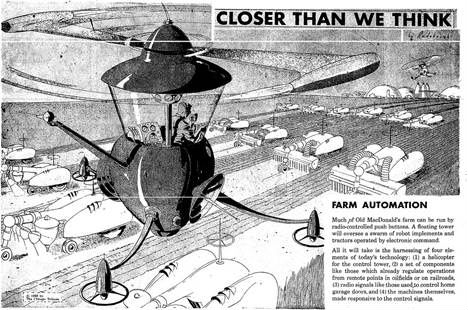
Automated Farms

Retrofuturistic Gadgets Farm Automaton

Retrofuturistic Gadgets Automated Farming

Throughout the 20th century, visions of the future often assumed that our 21st century lives would be full of leisure thanks to machines and automated processes. By the year 2000, they figured we’d only have to work for part of the week, and robots would do all the hardest labor. Radio-controlled farm robots, as envisioned in the syndicated comic strip Closer Than We Think!, would virtually eliminate the need for manual labor in fields. And in the March 1931 issue of Country Gentleman, the ‘farmer of the year 2031′ tends his farm virtually from a large flat-panel television.

Jet Packs for Soldiers and Personal Transport

Retrofuturistic Gadgets Jet Pack

Jet packs (as seen here on James Bond) were a frequent component of futuristic technology, first emerging in the sci-fi of the 1920s and soaring in popularity by the 1960s when they were actually invented (sort of.) While jet packs do exist, they’re definitely nowhere near practical usage as personal transport or military reconnaissance. Aside from a few public demonstrations, they’re most commonly used by astronauts in outer space, where the challenges of Earth’s atmosphere and gravity don’t exist.

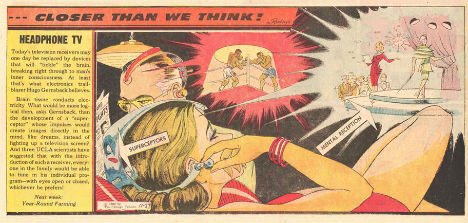
Headphone Television

REtrofuturistic Gadgets Headphone TV

Television represented one of the biggest technological advances of the 20th century that was actually accessible to many average people, making its evolution a major source of speculation, from the first rumors of its existence to the days when it finally became a fixture in most homes. People began to envision long-distance visual communication as soon as the telephone was invented, and some predictions – like video chat, tiny TV sets, flat-panels and interactive programs – were right on the mark. Others, like TVs that emit smells – not so much. One concept from the comic strip Closer Than We Think! imagines television receivers that are implanted right into the brain, creating images directly in the mind, “like dreams.”

Automated Cooking with Plates Made on Demand

Retrofuturistic Gadgets Automated Cooking

Another advancement detailed in the ‘At Home, 2001′ episode of The 21st Century with Walter Cronkite was fully automatic meal preparation in which meals made from ‘frozen or irradiated foods’ are programmed into a menu and prepared by a robotic chef. An entire meal could be chosen and prepared within seconds. But the weirdest part of this speculation has to do with the tableware rather than the food. Instead of getting plates from the cupboard, the robot would instantly mold plastic into plates, cups and bowls for one-time use, and then melt them back down when you’re done. The point? Not having to wash dishes. Although 3D printed plates are nearly possible today, this whole process seems fairly ridiculous and energy-intensive when dishes could simply be loaded into a magical dishwashing machine.

Next Page:
The Future That Never Was 12 Uninvented Gadgets

Share on Facebook


[ By Steph in Gadgets & Geekery & Technology. ]

[ WebUrbanist | Archives | Galleries | Privacy | TOS ]


WebUrbanist

 
Comments Off on The Future That Never Was: 12 Funny Gadget Predictions
Posted in Creativity