RSS
 

Posts Tagged ‘Future’

Mirrorless is ‘probably’ the future: an interview with Hasselblad Product Manager Ove Bengtson

27 Jun

It is quite extraordinary for Hasselblad to produce a mirrorless camera like the X1D for a number of reasons. Firstly is the obvious: it has predominantly produced cameras with very large mirrors since its first consumer camera in 1948 – the 1600F. Second, mirrorless cameras with touch screens and electronic view finders are very modern, and we may not all think of Hasselblad as a manufacturer of entirely up-to-date electronic products.

In the X1D we are looking at a medium-format sensor in a body that can hide behind a standard high-enthusiast 35mm-style DSLR. Okay, so plenty of people will point out that it isn’t ‘full frame’ 645 (the smallest of the 120 film formats), but it’s very similar to 127 film which was considered medium format by the ISO organization. More to the point, it’s much bigger than the ‘full frame’ 35mm format and is essentially the same size as the sensors used in Leica’s S series, the Pentax 645Z, Phase One IQ3 50MP and Hasselblad’s own H6D-50c.

I guess this kind of breakthrough is one we’d expect to come from what we might consider a high-tech company, not a business that has traditionally created a relatively low volume of very high-priced and principally mechanical professional tools.

Of course Hasselblad marked a technological turn around when it introduced the H6D with its new electronic platform, but this new X series camera takes what the H6D did a few steps further. Shortly after the announcement of the X1D in Gothenburg I got some time with Hasselblad product manager Ove Bengtson to discuss some of the technical challenges that had to be overcome to create the X1D and to find out some more detail about how the product will work when it comes to market.

‘…designing a mirrorless system is relatively easy compared to our usual H cameras’

‘The X1D took only between 18 and 20 months to develop from the final concept to where we are today,’ says Ove Bengtson. ‘As it uses the same 50-million-pixel Sony IMX161 sensor, the same electronic platform and same processor as the H6D-50c most of the work was already done – designing a mirrorless system is relatively easy compared to our usual H cameras as there are no moving parts. We started discussing the idea in November 2013 but were still talking about it a year later before we decided to go ahead. The work that we had already done in the development of the H6D saved us a lot of time in research for the X1D.’

As mirrorless cameras are so much easier to make and offer so much more flexibility I wonder if mirrorless is the future for Hasselblad. ‘Yes, it probably is, but not for a while. Mirrorless systems can be smaller and lighter, and because they have no internal movement they are more durable and they create less vibration so there is less to disturb image quality. Electronic viewfinders will need to get better though and the AF systems will need to improve to catch up with phase detection systems.’ 

‘We really do want phase detection but we’ll have to wait for the sensor manufacturer.’

‘It is a great benefit to be able to have AF points all over the screen, as in our H system we are really restricted to the centre of the frame, but phase detection wasn’t even an option for the X1D. We discussed having phase detection AF points built into the sensor, but Sony was already too far down the road with the sensor development at that stage. We really do want phase detection but we’ll have to wait for the sensor manufacturer.

So, while mirrorless has many advantages over mirrored systems there are still just as many reasons to use the H system. The H system has better AF in low light, and a lot of photographers prefer an optical viewfinder. The H system is also modular so you can change the backs and use a waistlevel viewfinder – not to mention a choice of 12 lenses including technical lenses – so it is still a very different experience.’

To allow X1D users access to the existing range of H system lenses Hasselblad will introduce what it describes as a ‘simple adapter’, but in the announcement there wasn’t much more detail than that. ‘Yes, this adapter will allow autofocus to operate with most of the H lenses, but they weren’t designed to work with contrast detection systems. Consequently users will need to update the firmware in their lenses to allow them to work properly. Not all lenses have firmware that can be upgraded as early H lenses in 2002 were fixed, but all more recent lenses will be able to be used.’

‘It is still early days for this camera but when it comes to market it will have touch AF…’

The cameras on display at the announcement event had touch screen controls for working the menus and for making feature selections, but they didn’t allow touch AF controls. ‘It is still early days for this camera but when it comes to market it will have touch AF and the AF points will be spread across the screen. You will press the AF/MF button and an AF point display will appear on the screen and then you can select the point you want to use.’

The X1D’s touch-driven interface. The menu screens and displays are controlled via a series of swiping motions, much as we are used to in smartphones.

Ove said that the company hadn’t directly considered allowing the rear screen to be used as a touch pad while the EVF is in use, but that it would probably be a question of firmware and that they would consider it. ‘The touch experience for the user has been a major consideration for us, and we want the touch sensitivity to be the best there is. Users will all have smart phones and we couldn’t allow the screen of the X1D to present an experience that isn’t as good as people will be used to.’

We also talked about the company’s integration of the Nikon flash system and what the reasons were for not developing a system of their own. ‘We don’t want to have to develop our own flash system, as we’d prefer to concentrate our resources on making cameras and lenses. Any system needs a range of flash units as customers want a choice, so it makes much more sense to work with an existing system that already has that range and choice. When we only had the V system we partnered with Sunpak, and in more recent years we worked with Metz, but Metz discontinued the gun as they didn’t sell enough. Nikon agreed to work with us and we are very happy that they offer excellent flash units that will work well with our X1D.’

‘We have to produce the best that we can and allowing reduced quality just isn’t an option’

The XCD lenses that Hasselblad has developed to go with the X1D use leaf shutters and offer a top shutter speed of 1/2000sec. Leaf shutter systems allow much faster flash synchronization than focal plane shutter systems and, as is the case with the H6D, the X1D can work with full power flash at that shortest shutter opening. ‘In this camera and in the H6D we use a dual shutter system to achieve the top 1/2000sec flash sync speed,’ explains Ove.

‘The new XCD lenses are designed and built to the same specification standards that we use for the H series lenses. We have to produce the best that we can and allowing reduced quality just isn’t an option. In fact these have a short back focus which makes it easier to design them to really excellent standards. The lenses are designed by us and manufactured by Nittoh who have made many great lenses in the past, including the lenses for the X-Pan. These XCD lenses have no crosstalk and the angle of the light as it approaches the sensor is well within the limits. You’ll notice that the exit pupil of the wide angle particularly is set well inside the barrel.’

‘Right now… we have no zooms on the roadmap’

‘To start with we will concentrate on fixed focal length lenses as we can make these small in line with the compact concept of the camera. I expect there will be some demand for zooms but we will wait and see what that demand is and then respond to it. Right now though, we have no zooms on the roadmap. Personally I think they will have to be too big, and I want us to concentrate on the best performance and the highest resolution possible.’

Speaking to Ove and other technicians at the event it is obvious that Hasselblad has built this system around the specific physical dimensions of the 43.8×32.9mm sensor. If there will be a 100MP version of the X camera it will not be one using the current Sony offering that measures 53.4x40mm. ‘The camera isn’t designed to take a larger sensor,’ I was told, ‘and the XCD lenses don’t have the covering circle to work with it. We designed the camera to be small and portable, and a part of that equation is the size of the sensor. If we work with a larger sensor it means we need a bigger body and bigger lenses, and that would defeat the principles of what the X1D is about.’

No one would be drawn on how many lenses the company expects to have in the XDC range in five years’ time, but it is clear there will be more and that they will start coming shortly. The 30mm will be formally announced at Photokina and I think it reasonable to assume there will be hints of other focal lengths at the time, even if the announcements aren’t formal.

The X1D really does mark quite a departure for Hasselblad and a step towards a larger market (though still some way from the mass market) that will allow the company to broaden its user base. The step too though is as much about demonstrating it is a modern company now that can make modern products. It has also drawn an unmistakable line under that period of its life when it rebadged and allowed other brands to have too much of a hand in its manufacturing.

Things are looking up; Hasselblad seems to be back on track, innovating once more and in many ways getting ahead of the game. The X1D is certainly the coolest, most flexible, portable and accessible digital medium format almost on the market.

Articles: Digital Photography Review (dpreview.com)

 
Comments Off on Mirrorless is ‘probably’ the future: an interview with Hasselblad Product Manager Ove Bengtson

Posted in Uncategorized


Patents hint at camera on future Apple Watch

18 Jun

A patent filed by Apple suggests it could include a camera on a future version of the Apple Watch. Patent application number 14774642, filed in 2013, covers a range of ideas, including a camera for selfies or scanning QR codes, and the possibility of fixed focal length and zoom lenses.

The key phrase to note in the patent is: ‘Zero, one, or more cameras can be provided, depending on implementation,’ making clear that the company is casting its net as widely as possible, to allow it to include all, some or none of these ideas in future watches.

The block diagram from the patent clearly shows that Apple has considered including a camera as part of the watch’s user interface. The patent suggests cameras could be included along the sides or on the front of the watch’s face.

The patent covers the idea of a camera mounted on the side or top edge of the device for taking photographs or scanning QR codes. Another implementation suggests a camera that faces towards the user, allowing the shooting of selfies (or, though it’s not mentioned, streaming video for Facetime communication).

The patent is careful to include both the idea of having a fixed focal length lens and of including a zoom lens with autofocus. As always with patents, none of this means Apple will include a camera in the next or future generations of watches, just that they want to protect the idea of doing so and want to protect all the possible implementations it has thought of.

Articles: Digital Photography Review (dpreview.com)

 
Comments Off on Patents hint at camera on future Apple Watch

Posted in Uncategorized


Signal-Free Intersections: Future Streets for Self-Driving Cars

09 Apr

[ By WebUrbanist in Architecture & Cities & Urbanism. ]

driverless car intersection

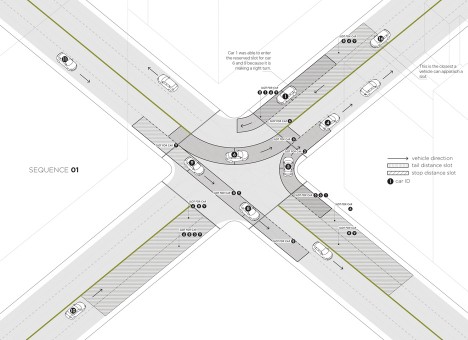
All of our automotive infrastructure is designed around the needs of human drivers, but in a world of driverless cars, a crossroads need not slow anyone down, let alone force someone to stop.

A team of researchers from MIT, Swiss Institute of Technology and the Italian National Research Council developed this Light Traffic concept for maintaining safe distances and speeds, moving vehicles through quickly, efficiently and fairly. Traffic problems are boiled down to a system of sequences, each accommodating different volumes from different directions.

driverless 2

Vehicles approaching the intersection are slotted into a system that slows them down in advance, anticipating the traffic coming from all sides.

driverless 3

By avoiding unnecessary stops, vehicle emissions are reduced, fuel is saved, and annoyance alleviated. Road infrastructure would last longer too, while the lack of lights would reduce costs both upfront and ongoing. In time, such systems could even reduce the need for lanes, giving back space for sidewalks, greenery or other uses.

Share on Facebook


[ By WebUrbanist in Architecture & Cities & Urbanism. ]

[ WebUrbanist | Archives | Galleries | Privacy | TOS ]


WebUrbanist

 
Comments Off on Signal-Free Intersections: Future Streets for Self-Driving Cars

Posted in Creativity


Future NYC: 12 Design Proposals to Reshape the Big Apple

28 Mar

[ By Steph in Architecture & Cities & Urbanism. ]

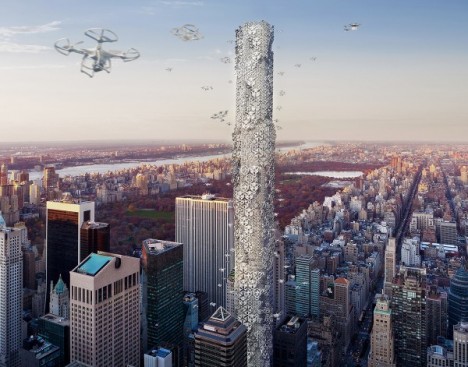
future nyc hive

A half century or into the future, will New York City even still exist as it stands today, or will these fanciful and sometimes bizarre proposals get a chance to become reality? These visions for future Manhattan aim to maximize available space by building new infrastructure right on top of transportation hubs as well as the Hudson River, and adapt to changing needs by creating new drone superhighways and building porous street systems that can absorb floodwaters.

Excavated & Walled Central Park
future nyc central park wall 1

future nyc central park wall 2

future nyc central park wall 3

Considering that the entire city is liable to be flooded at the first sign of a serious storm, let alone rising sea levels, sinking any part of Manhattan doesn’t seem like the greatest idea. Yet, the visuals associated with this crazy concept are too stunning to dismiss. The winner of eVolo’s 2016 Skyscraper Competition, ‘New York Horizon’ excavates the entire park to reveal a mountainous landscape, and wraps it in a 1,000-foot-tall mirrored megastructure. Tenants living inside the megastructure would have unparalleled access to the park, but views of it from any other buildings that aren’t skyscrapers would appear to be limited.

Bizarro Futuristic Coney Island
future nyc coney island

future nyc coney island 2

future nyc coney island 3

The New York CityVision Competition by London-based firm Squint/Opera imagines a dazzling new future for Coney Island Park that could save it from the current threats of being turned into a condominium park. Transporting the defunct ‘Southern Star Big Wheel’ ferris wheel all the way from Melbourne, Australia is crazy enough, but those giant clown heads in the sky are asking a little too much.

The Hive: Drone Hub in Midtown Manhattan
future nyc hive

future nyc hive 2

The modules on the outside of ‘The Hive’ skyscraper are designed to fit nine different types of drones, acting as one big dock and charging station for both personal and commercial usage. Incorporating a ‘vertical highway model’ around the tower, the design regulates drone traffic to prevent the sky from becoming one big buzzing traffic jam of flying robots. “To provide a safe landing environment, the tower projected a new method for drones to dock horizontally onto their corresponding platforms with the fitting shape and scale; the platform with docked drones can be flipped vertically to be in parallel with the tower facade. The facade is constantly animated as the platforms flip outwards and backwards to nest back into it.”

Floating Neighborhood
future nyc hudson 1

future nyc hudson 2

An entire neighborhood for 65,000 people will hover right over the congested island of Manhattan in a proposal that seems too crazy to be true, yet is under construction right now. Hudson Yards will rest on 300 concrete-sleeved caissons right on top of the 26-acre West Side Yard, which is a critical part of New York City’s transit system. The plan includes six skyscrapers, 100 shops, 20 restaurants, a school and 14 acres of parks, and will be completed by 2024.

Next Page – Click Below to Read More:
Future Nyc 12 Proposals To Reshape The Big Apple

Share on Facebook


[ By Steph in Architecture & Cities & Urbanism. ]

[ WebUrbanist | Archives | Galleries | Privacy | TOS ]


WebUrbanist

 
Comments Off on Future NYC: 12 Design Proposals to Reshape the Big Apple

Posted in Creativity


Driving on Auto-Pilot: 13 Future Visions of Cars & Commuting

12 Jan

[ By Steph in Technology & Vehicles & Mods. ]

future cars main
Within fifteen years we could be zooming around in flying passenger drones and self-driving luxury pods, and claiming packages from driverless delivery trucks that verify our identities by scanning our faces. At least, that’s what Mercedes-Benz, BMW and other automakers and designers seem to be hoping with these optimistically futuristic concept car designs – and while it might realistically take a lot longer than that to see real, functioning flying cars, some seemingly far-out ideas are already on their way.

Passenger Drone
future cars passenger drone

As if the idea of self-driving cars on the roads weren’t already nerve-wracking enough, soon passengers might be able to take to the skies without a pilot onboard. A Chinese startup called Ehang unveiled the world’s first passenger done, an Autonomous Aerial Vehicle that can carry one person and a single backpack for about twenty minutes from one location to another, with the destination set via tablet before takeoff. The 440-pound drone folds up its propellers to fit within a standard parking spot. What happens if something malfunctions? The company says the drone can still fly with a propeller out, and will land in the nearest possible area if anything goes wrong.

Self-Driving Chevrolet-FNR
future cars chevrolet FNR 1

future cars chevrolet FNR 2

future cars chevrolet FNR 3

A world away from Google’s dorky self-driving bubble car, the Chevrolet-FNR by GM envisions the autonomous commuting future circa 2030. The front seats rotate to face the rear, and the interior is packed full of touch-screens, with iris-recognition entry, crystal laser lights and “magnetic hubbies wheel electric motors.” The “dragonfly dual-wing doors” are so sharp, they look dangerous.

Mercedes-Benz F 015

While the FNR isn’t exactly ready to actually hit the road, the similarly driverless Mercedes-Benz F 015 is already roaming San Francisco. This sleek and shiny luxury pod is part of Mercedes’ vision for a safer future in which all cars are unmanned, automatically stop to let pedestrians cross the road, and let all passengers read, text, surf the web or whatever it is humans will be doing on gadgets in 2030. The company still has a long way to go in ironing out the tech involved in this project, but the proof of concept is impressive.

Self-Driving IDEO
future cars ideo

The first of three self-driving vehicle concepts by global design company IDEO interacts with your email, calendar and text messages to set your route and senses when you’re 200 feet away, firing up and preparing for your ride. As you head down the freeway, your car will link up with other cars moving in the same direction, joining a ‘platoon’ of tailgating vehicles for speed and safety.

WorkOnWheels Commuting Workspace Pod
future cars workonwheels

IDEO’s second concept is WorkOnWheels, a transparent mobile office pod that zooms around the city, either acting as an automated place to complete tasks while you’re on your way to your workplace or zooming to the scenic setting of your choice. You can take your team on a brainstorming session by the sea, park in a bustling urban spot to observe city life or whatever else you can dream up. The pods are rentable by the hour and drive themselves back to their home base to recharge when you’re done.

Next Page – Click Below to Read More:
Driving On Auto Pilot 13 Future Visions Of Cars Commuting

Share on Facebook


[ By Steph in Technology & Vehicles & Mods. ]

[ WebUrbanist | Archives | Galleries | Privacy | TOS ]


WebUrbanist

 
Comments Off on Driving on Auto-Pilot: 13 Future Visions of Cars & Commuting

Posted in Creativity


Video: What’s in the future for Sony’s Alpha system?

26 Oct

At PIX 2015 we took the opportunity to sit down and talk with industry leaders while they were in our neighborhood. Sony’s Alpha system has made some interesting moves over the last year, and we asked product manager Kenta Honjo all of our burning questions, including what’s in store for the future of the system. Read more

Articles: Digital Photography Review (dpreview.com)

 
Comments Off on Video: What’s in the future for Sony’s Alpha system?

Posted in Uncategorized


5 Trends to Take Your Photography Business to the Future

04 Oct

As an owner of a photography business, you need to have the ability to wear many different hats; you need to be a marketer to promote your brand, a designer to create and update your site, and a tech-savvy person to understand the innovation and new products that are constantly appearing on the market.

In this article you’ll learn some of the trends in digital marketing, web design, and mobile technologies that any smart photographer needs to be familiar with.

Sergey Galyonkin

By Sergey Galyonkin

Digital Marketing

In the following years we can expect a growing number of desktop and online software solutions geared at photographers. Tough competition in this market constantly gives birth to many interesting offerings.

For instance, Defrozo is looking to be a one-stop, free platform for photographers to update their website and blog, proof images and sell prints online, as well as manage their client base in a built-in CRM (customer relations management). Snapizzi is another interesting tool which uses a smart QR-code scanning technology to enable photographers to automatically upload and sort out event photos for online sales, literally in minutes. And if you’re looking for an album proofing tool that could be integrated with your existing website AlbumParrot is here to help.

These are just a few of the new apps and services worth your attention, you can discover more photography startups on Betalist.

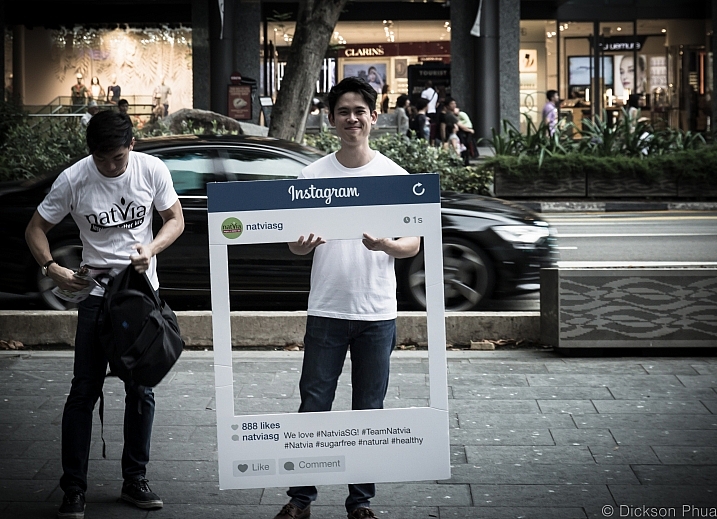
Dickson Phua

By Dickson Phua

With advertising coming to Instagram, and Facebook limiting its organic reach in favor of paid-for posts, email marketing becomes even more attractive for small business, and photographers are no exception. Some of the major trends in this area are personalization and automation, with most services like MailChimp and MadMimi extending and improving their functionality in this area. As a result, it gets quite easy to create a sequence of emails that will be triggered when someone subscribes for your updates, or send out your special offers to small segments of your contact list in order to maximize relevancy and click-throughs.

The popularity of visual storytelling will continue to grow which is obviously great news for photographers. Big companies will be employing professional photography to communicate their brand philosophy and aesthetics. So consider adjusting your proposition to accommodate corporate clients.

Web Design

Talking about web design, there are a few standards you might want to take into account while updating your photography portfolio.

Image-focused design featuring clean typography and ghost buttons is going to be a winner, just like last year. Sticking to the storytelling trend in content marketing, full-size videos and images will take the world by storm contributing to a website’s interactivity, and increasing return visits.

David Joyce

By David Joyce

Moreover, custom photo galleries and slideshows available for mobile viewing will become more and more popular. Don’t forget to make your site mobile-friendly this year, if you have not done it yet. In 2016 a mobile version of your portfolio will rock, otherwise you run the risk of losing over 40% of your potential clients.
Mobile

While there’s a lot of buzz around the revolutionary potential of mobile payments, it’s unlikely that the photography industry is going to adopt this trend too soon. However, mobile payments are definitely something to keep your eye on since mobile is conquering nearly every sphere of our life.

Mobile usage is going to increase even more. For example, the latest data shows that the U.S. users spend 51% of their media time on mobile compared to 42% on desktop.

Byronv2

By byronv2

This means mobile Internet users should be kept at the forefront, whenever you start a marketing campaign. Planning to print a solid pack of flyers for an upcoming tradeshow? Consider putting a QR code on it. Do you know image editing inside out? Think about creating your own mobile app, or figure out a mutually beneficial arrangement with app developers. Smartphones and tablets will keep their leading position in the coming years, so make the most out of this growing trend.
Technology

Wearable devices are by far one of the most exciting trends to follow. With the competition fuelled by Apple Watch, this market is about to bring photographers a lot of neat capabilities via wearables.

Sdu7cb

By Sdu7cb

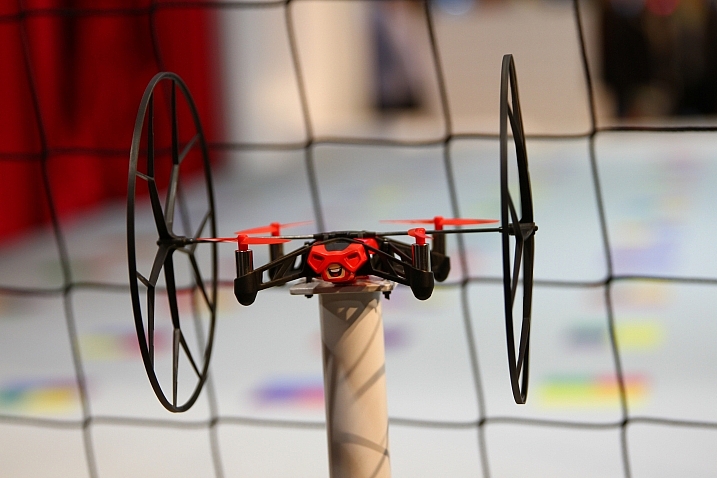
Drones are another major trend in the tech field. A lot of models with features ranging from built-in cameras shooting 12 megapixel RAW, to smartphone app remote control, were on display at this year’s CES.

CES 2015 also brought a few interesting solutions to the ever-increasing problem of image storage. Thus, Canon has introduced Canon Connect Station CS100 that connects wirelessly to phones and Wi-Fi enabled cameras, and uploads images to be displayed on a TV. Another potentially interesting technology was presented by Toshiba. The new memory cards from this manufacturer can be read with a NFC-enabled Android phone. This invention is rather raw at the moment, but it hints at advancing possibilities in the near future.

Printing

A printer about the size of a smartphone, that doesn’t require ink, and is controlled via your smartphone? Any event or wedding photographer could utilize a thing like that. Well, it’s actually a reality now. Meet Polaroid Zip. Presented at the CES 2015, this neat device is a glance into the future of compact printers which definitely moves towards compactness, wireless connection, and fast work.

Son Of Groucho

By Son of Groucho

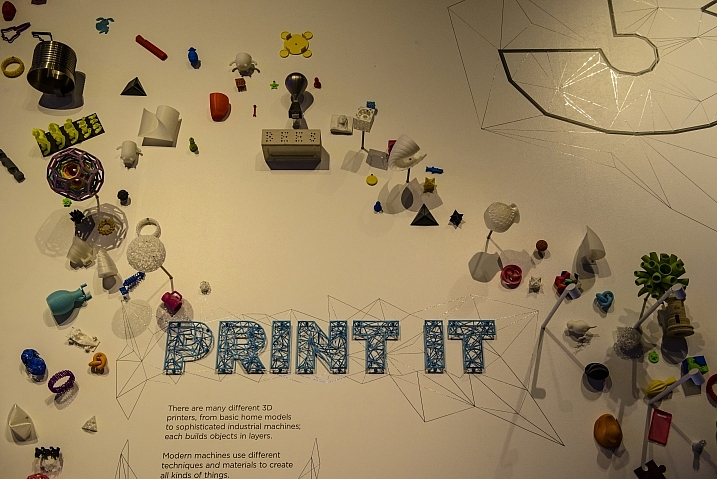
3D printing is becoming more accessible for end consumers and opens new opportunities for photographers. For instance, Amanda Ghassaei created amazing 3D prints that feature subtle texture and high precision, when backlit with a diffused light. If you’d like to utilize this one-of-a-kind method before it hits the mainstream, the artist shared the instructions on how to do it.

Interior Design

The meeting room climate can make or break your deal, so knowing what design elements get people hooked these days is a must for a savvy photographer, no matter whether you meet clients in your studio or apartment.

Paulisson Miura

By paulisson miura

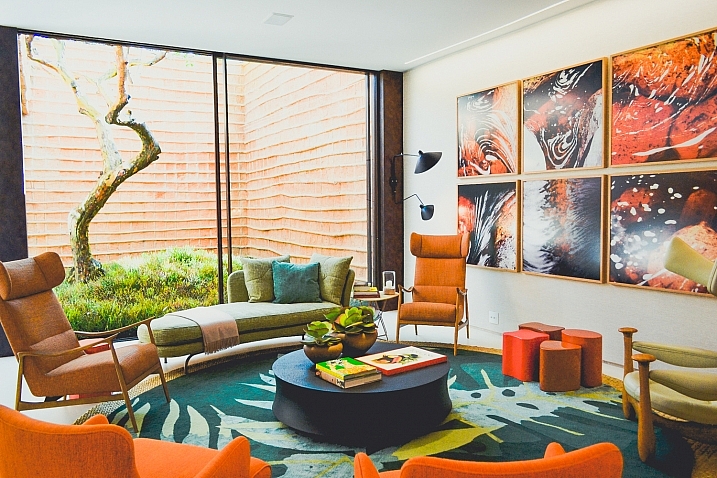
In 2015 electric modern vibe and unexpected textures are finding their way out. More sophisticated looks featuring natural textures, gold hardware, and mid-century modern undertone are the latest fashion. For example, one sophisticated idea of the kind is a cowhide rug, which would be a perfect decoration for your meeting room.

Wallpapers with natural flowers and textures have come back this year too. Blue seems to be one of the most popular colors for interior decorations. Taking into account the latest trends, you can create a cool, impressive look for your office or spice up your home interior.

Bottom Line

Staying informed about the modern novelties and trends in different areas of our life can be a great way to single out your photography brand, and differentiate you from the competition while taking your career to the next level.

What recent trends do you find most exciting and promising? Let us know your thoughts by leaving a comment below.

googletag.cmd.push(function() {
tablet_slots.push( googletag.defineSlot( “/1005424/_dPSv4_tab-all-article-bottom_(300×250)”, [300, 250], “pb-ad-78623” ).addService( googletag.pubads() ) ); } );

googletag.cmd.push(function() {
mobile_slots.push( googletag.defineSlot( “/1005424/_dPSv4_mob-all-article-bottom_(300×250)”, [300, 250], “pb-ad-78158” ).addService( googletag.pubads() ) ); } );

The post 5 Trends to Take Your Photography Business to the Future by Julia May appeared first on Digital Photography School.


Digital Photography School

 
Comments Off on 5 Trends to Take Your Photography Business to the Future

Posted in Photography


Could the future of photo viewing be virtual reality? Flickr thinks so

15 Sep

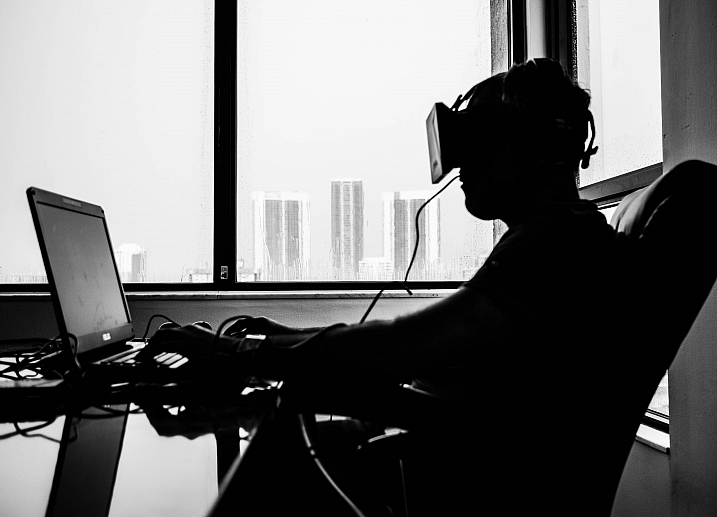
This past weekend Flickr demonstrated an early preview of a ‘virtual reality experience’ designed for viewing 360-degree panoramic photos. The demonstration used the Oculus DK 2 headset connected to a computer, and allowed wearers to completely immerse themselves within the panorama. Read more

Articles: Digital Photography Review (dpreview.com)

 
Comments Off on Could the future of photo viewing be virtual reality? Flickr thinks so

Posted in Uncategorized


Canon plans high-res future with 120MP DSLR and 8K Cinema EOS in development

10 Sep

Canon is clearly in a forward-looking frame of mind: announcing more development projects that it has under way. These include a 120MP DSLR and a Cinema EOS camera that can shoot 8K video. Although it adds caveats that specifications can change, the press release suggest both projects are planned for commercial, rather than research purposes. Read more

Articles: Digital Photography Review (dpreview.com)

 
Comments Off on Canon plans high-res future with 120MP DSLR and 8K Cinema EOS in development

Posted in Uncategorized


Future of Fenestration: Every Window Will Generate Solar Power

28 Aug

[ By WebUrbanist in Design & Fixtures & Interiors. ]

solar power windows

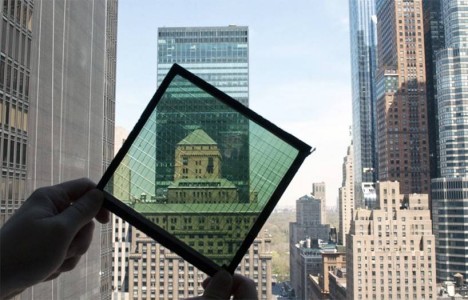
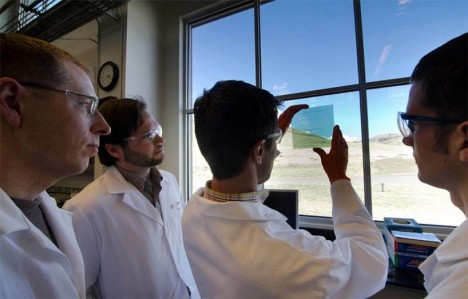
Better, cheaper and easier than solar windows, this newly-patented flexible coating can be applied to existing glass and plastic surfaces, turning any aperture into a source of electricity. With this technology on all of its surfaces, buildings can generate up to 50 times more solar energy per structure.

solar energy polymer

Developed by SolarWindow Technologies, this inexpensive approach has a payback time of as little as one year (far less than the 5 to 10 years of traditional solar approaches. As the technology evolves and expands, it is only a matter of time until every window draws energy from light.

solar generation panel transparent

By adding it to the inside surface of a window, the process protects the tech from exterior sources of damage and simplifies application. The solution is also lightweight and adaptable, making it easier to retrofit existing architecture without cost-intensive shipping or labor-intensive installation processes.

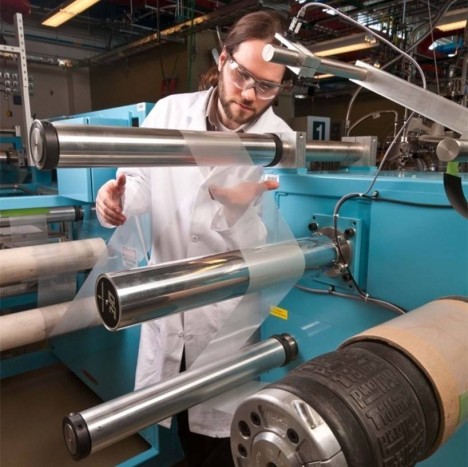
solar sheet making process

These sensitive photovoltaics can draw power from lunar energy and artificial lights in addition to the sun’s rays. Their relatively low price per unit reinforces the sensibility of simply putting them on all sides of a structure, including those with less natural light.

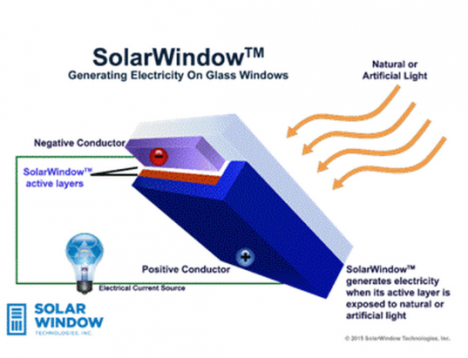
solar window tech

Effectively invisible wires draw electricity from the exposed surfaces while a uniform and architecturally-neutral color tinting process allows for a variety of of looks and degrees of transparency.

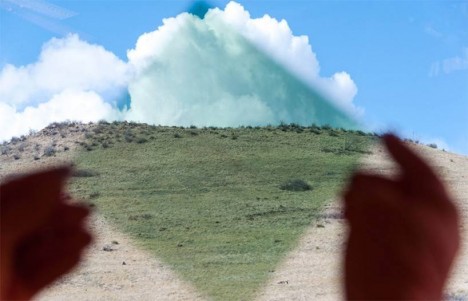
solar light neutral color

This new substance can be deployed as a sticky film on a surface or potentially even painted on as a liquid. The organic (but secretive) constituent source materials of the core polymer include common elements such as carbon, hydrogen, nitrogen, and oxygen.

Share on Facebook


[ By WebUrbanist in Design & Fixtures & Interiors. ]

[ WebUrbanist | Archives | Galleries | Privacy | TOS ]


WebUrbanist

 
Comments Off on Future of Fenestration: Every Window Will Generate Solar Power

Posted in Creativity