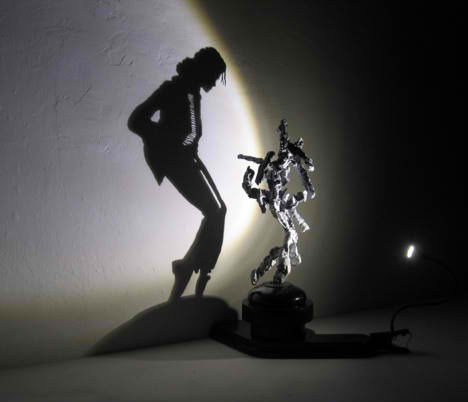
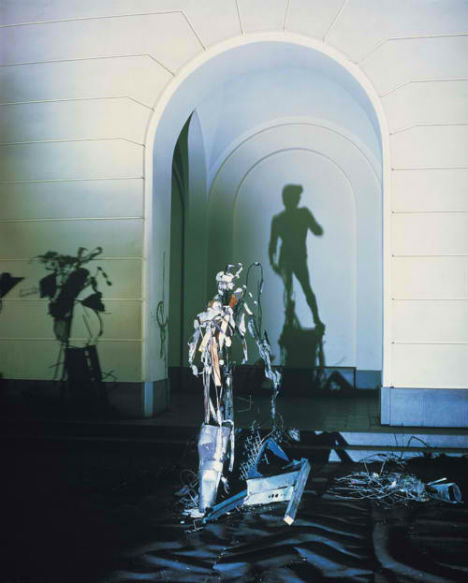
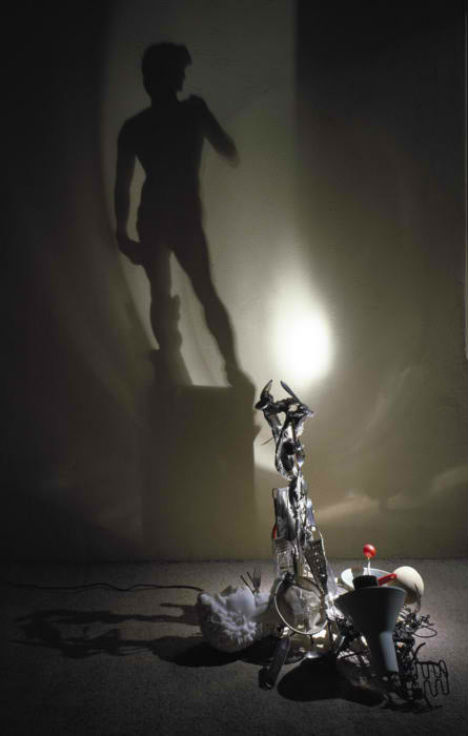
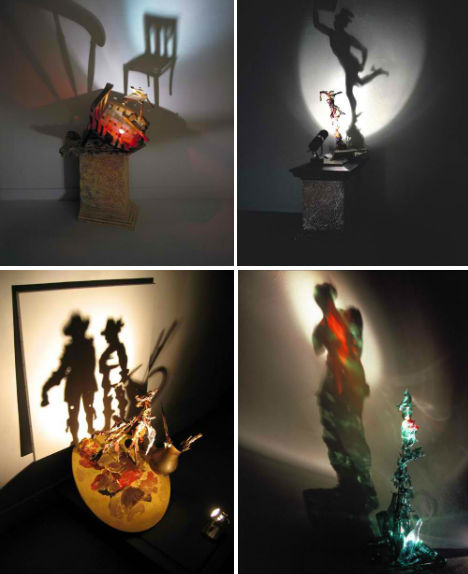
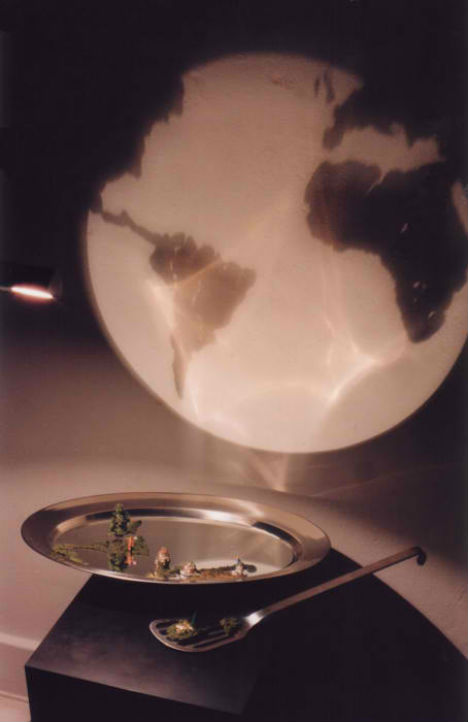
These chaotic and random collections of objects placed on pedestals don’t seem gallery-worthy on first glance, but shine a light upon them in just the right way, and something magical occurs. These bits of broken glass, disassembled furniture and household objects created by Diet Wiegman transform into Michelangelo’s David, the Venus de Milo, hovering chairs or Michael Jackson.
While Wiegman is not the only artist producing light and shadow art of this kind, he seems to have been the first; most of these works were created in the 1980s. In addition to these light and shadow sculptures, Wiegman is known for ceramics that mimic broken and rusted junkyard finds, from crumpled tin cans to pieces of old gears.
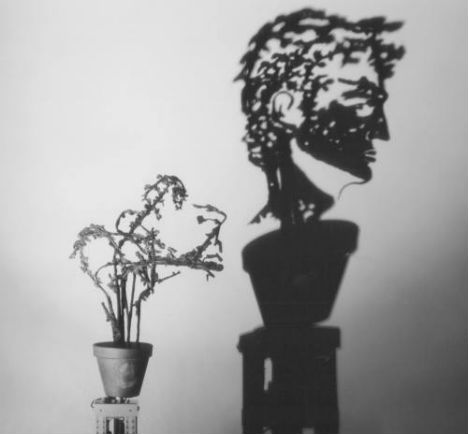
Wiegman has a gift for seeing beauty in the most unexpected places, whether in these surprising sculptures or in his still-life photography of his own art juxtaposed with trash and a cast of a human head. See his entire portfolio at his Tumblr.
Russian photographer Vitaly Raskalov, known on the web for his ‘skywalking’ exploits in which he scales man-made structures (without authorization) has added Egypt’s Great Pyramid of Giza to his list of conquests. And, as is his custom he has posted photos taken atop of one of the Seven Wonders of the World. Raskalov and his companions managed to hide from armed guards and climb the pyramid undetected under at night. Climbing the Great Pyramid is illegal of course but you can click through to see the images Raskalov captured. (via Daily Mail)
[ By Steph in Conceptual & Futuristic & Technology. ]
Inspired by ‘plantimals’, photosynthetic organisms like lichen, sea slugs and salamanders that welcome algae into their bodies in order to thrive, the Algaculture Symbiosis Suit aims to enhance humans with new, partially artificial bodily organs. The suit designs a new symbiotic relationship between us and algae, letting us become more plant-like by gaining food from light.
Exploring alternative ways in which we could sustain ourselves in the future, designers Michiko Nitta and Michael Burton propose suits made of plastic tubes that wrap and wind around the body, looking a bit like an artificial exoskeleton.
Essentially, the algae inside the tubes is fed both by sunlight and by the carbon dioxide in the wearer’s breath, and is then consumed by the human wearing the suit. In this way, our own breath is helping to produce the nutrients that we take in. “As such, we will be symbionts (meaning that both entities entirely depend on each other for survival), entering into a mutually beneficial relationship with the algae,” say the designers.
One of the suits was used in The Algae Opera, another project by Nitta and Burton that used the extraordinarily large lung capacity of a professional opera singer to produce the highest quality algae-product possible, enriching its taste. “So in the age of biotechnology not only can the audience listen to her talent but they can also savor her unique blend of algae that are enriched by her song.”
Via CollabCubed
[ By Steph in Conceptual & Futuristic & Technology. ]
Austrian photography enthusiast Christopher Malin has produced a short film featuring time-lapse photography taken by astronauts aboard the International Space Station. Captured with several Nikon D3S cameras, these sequences make for a unique and compelling view of the Earth and its surrounding environment. The film also includes a first hand account of the considerable challenges of photographing from space.
Nikon has posted a gallery of ten images and a video of the new Coolpix A DX-format compact camera. The camera features a 16MP APS-C sensor with no optical low-pass filter and a 28mm equivalent F2.8 prime lens. The images that Nikon has posted are taken by documentary photographer Doug Menuez in JPEG Fine (8-bit) mode. Click through for some images and a link to the full gallery.
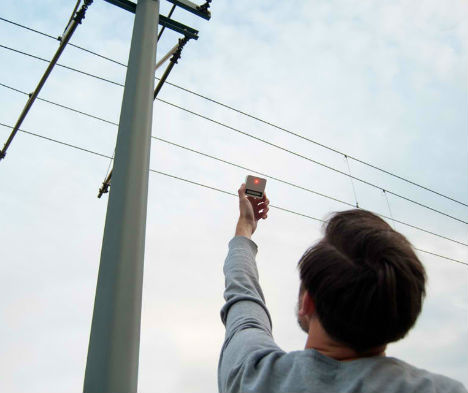
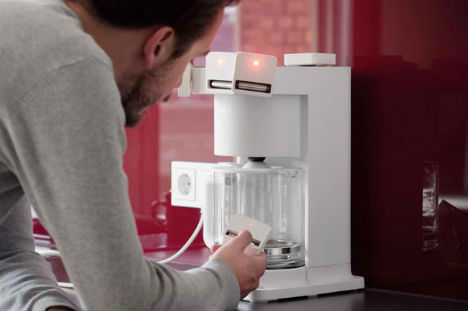
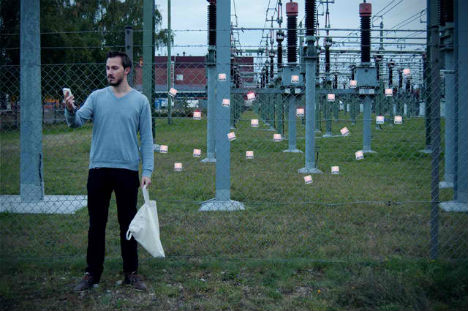
The entire city is your power source with an innovative gadget by designer Dennis Siegel that harvests energy from electromagnetic fields and instantly recharges batteries. These ‘energy parasites’ make use of electromagnetic fields produced as a result of information transfer, or as byproducts of electric equipment, from power lines to coffee machines.
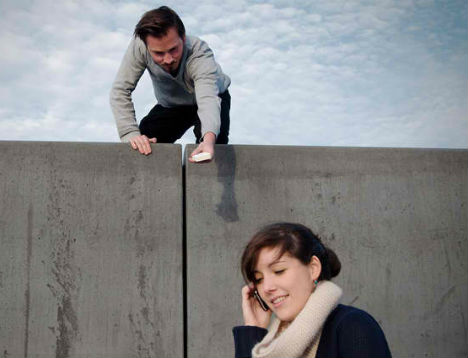
In a series of images, Siegel holds out the device to gather energy from home appliances and power plants, even hovering creepily beside a cell phone user. An LED light on top of the device will let you know that electromagnetic fields are nearby, and even how strong they are.
The energy gathered is stored in a conventional battery, so you can gain ‘redundant’ energy from the power supply of all kinds of electronics and then use the battery to power something else.
Siegel created two types of harvesters, one suitable for frequencies below 100Hz, like those produced by home electronics and appliances, and one for higher frequencies like radio broadcast, Bluetooth and WLAN. Imagine if this capability could be built into devices like smartphones, so you never had to worry about losing your charge while out and about.
Like dreams while you are having them, these buildings make perfect sense subjectively and yet no sense objectively. They are seamlessly integrated, yet structurally surreal … and, like a dream when waking up: the details are hard to recall when you look away.
Jim Kazanjian searches through tens of thousands of photographs in search of the perfect bits and pieces for each otherworldly creation. Some of the results seem almost plausible, while others stretch the limits of gravity, structural integrity and even the imagination.
Per his artist statement at 23Sandy (where you can also buy prints): “Jim Kazanjian’s surreal landscapes offer phantasmagoric visions of a where-is-this world, defined by impossibly complex architecture and M.C.Escher-esque black-and-white graphics.”
“Inspired by the imaginary realms of cult author H.P. Lovecraft—whose wild, cosmic short stories set the mold for much of the 20th century’s best science fiction—Kazanjian’s aim is to redress the “misunderstanding that photography has a kind of built-in objectivity…to defamiliarize the familiar.”
Over the last two years here at dPS we’ve run very popular competitions with the New York Institute of Photography to give away to lucky dPS readers some of their great photographic teaching.
Due to popular demand – we’re doing it again this week!
This year NYIP is giving away two prizes
Fundamentals of Digital Photography
These two prizes are designed to be helpful for two different levels of photographers. Each will be won by a different dPS reader. Here’s what you could win:
Fundamentals of Digital Photography – worth $ 499
Complete Course in Professional Photography – worth $ 1499
Complete Course in Professional Photography
Both courses include comprehensive and illustrated lesson books, CD Audio Guides, DVD Video Training, Photo Projects and Professional Evaluation and Personal Student Advisers. Learn a little more about how New York Institute of Photography works in this video:
How to Win
To win this competition you’ll need to:
visit the above two course information pages and choose which of the two courses suits your needs more. Choose one that you’d like to win.
leave a comment below and tell us which one you’d like to win and WHY you’d like to participate in the course. Please note: there is a limit of 1 entry per person.
do this in the next 8 days and on Tuesday 12th March the team at NYIP will choose the best 2 answers and we will announce the winners in the following days.
By ‘best’ – we’re looking for people who have an understanding of what the course offers and how it suits their needs. So you’ll need to check out the course pages to put yourself in the best position to win.
There’s no need to write essay length comments to win – but we’re looking to hear what you like about the course and how it would help your development as a photographer.
This competition is open to everyone around the world no matter where you live – but there is only one entry per person.
To enter – simply leave your comment below.
Post originally from: Digital Photography Tips.
Check out our more Photography Tips at Photography Tips for Beginners, Portrait Photography Tips and Wedding Photography Tips.
Win One of Two Photography Courses from New York Institute of Photography
Nikon has announced the launch of its Nikon School in UK. The company’s education and training program that has been popular in the US for a decade will start in London from April 2013. It will offer photography courses, from beginner to advanced, to product specific courses and workshops. The company is currently offering £20 discount for online bookings. Click through for more information and links to the School’s website.
Our regular contributor and essayist, Alain Briot begins a new series today titled Vision.
Sean Reid has just published an in-depth analysis of image quality from the new Leica M (240). Reid Reviews is a subscription site, but no one else on the web or in print delves as deeply into the subjective aspects of image quality as Sean.
My own review of the new M Leica will have to wait till I return from Mexico. Getting a prototype through the Byzantine world of Mexican Customs was too much to bother with. It also now appears that release of the new M has been delayed until at least late April. My own hands-on review will be completed by then and will appear at around that time.
Win a New 128GB iPad with Retina Display
Including all Major Luminous Landscape Videos
– Pre-Installed –




 Over the last two years here at dPS we’ve run very popular competitions with the New York Institute of Photography to give away to lucky dPS readers some of their great photographic teaching.



You must be logged in to post a comment.