RSS
 

Posts Tagged ‘Free’

‘Everybody Street’ documentary free streaming options arrive on YouTube, Prime Video

21 Nov

Cheryl Dunn’s 2013 street photography documentary Everybody Street is now available to stream on YouTube and on Amazon Prime Video. The YouTube stream is ad-supported and the Prime Video option requires an Amazon Prime subscription. Alternatively, viewers can purchase the documentary on DVD. Everybody Street was previously only available on-demand through Vimeo.

The documentary, which enjoys a healthy 7.7-star rating on IMDb, focuses on New York street photographers Bruce Davidson, Ricky Powell, Mary Ellen Mark, Elliott Erwitt, and others, covering their life and work in the city.

IMDb explains:

Shot by renowned photographer Cheryl Dunn on both black and white 16mm film and color HD, the documentary pays tribute to the spirit of street photography through a cinematic exploration of New York City, and captures the visceral rush, singular perseverance and at times immediate danger customary to these artists.

Articles: Digital Photography Review (dpreview.com)

 
Comments Off on ‘Everybody Street’ documentary free streaming options arrive on YouTube, Prime Video

Posted in Uncategorized


The New York Times opens up free applications for its 7th annual portfolio review

14 Nov

Tomas Roggero

The New York Times has opened up applications for its 7th annual New York Portfolio Review on March 30 and 31 in New York City, New York.

The applications, which are free to submit, are now open on The New York Times’ website for the review, which is put on by The New York Times Lens column, the Craig Newmark Graduate School of Journalism at the City University of New York and United Photo Industries.

So long as the applicant is over 18 years old, they’re free to apply. The New York Times says “all types of photography will be considered.” The deadline for applications is December 10, 2018 at 11:59 p.m. Eastern Time.

“The first session, on Saturday, March 30, will be for photographers 21 and older,” reads The New York Times announcement post. “Each participant will receive six private critiques. The second session, on Sunday, March 31, will be solely for photographers 18 to 27 and will consist of at least four private critiques for each participant, as well as free workshops on how to best present, promote and publish photographs. We will screen all applicants and choose 100 participants for Saturday and 60 for Sunday.”

The New York Times specifically mentions anyone who attended last year’s review is ineligible to apply. Also, if someone has attended more than twice in the seven years the portfolio review has been going on, they too are ineligible.

When a photographer is chosen for a portfolio review, they will be able to requiem their top choices for who is to review their work. The New York Times has provided a partial list of the reviewers on the bottom of its announcement page.

To enter, head over to The New York Times’ application page and fill out the required form. In addition to personal details, such as first name, last name, age, contact information, and a short biography, applicants can upload up to 20 photos from one or two projects. The images must be JPEGs and no more than 1,200 pixels across at 72 DPI.

Applicants who have been selected will be notified by January 12, 2019. The New York Times warns “Be sure to triple-check the email address you submit, because in past years some people were accepted into the review, but couldn’t be contacted with the good news because of a typo in their address. Don’t be that person.”

Articles: Digital Photography Review (dpreview.com)

 
Comments Off on The New York Times opens up free applications for its 7th annual portfolio review

Posted in Uncategorized


Photopea online image editor is a free Photoshop clone with advanced tools

09 Nov

Programmer Ivan Kutskir of the Czech Republic has created an online-based Photoshop clone called Photopea. The web app was created solely by Kutskir in his free time during college, according to a Reddit AMA the developer held on Wednesday. Photopea features a Photoshop-like interface and is supported by advertisements.

The Photoshop clone offers a wide variety of image editing tools, including advanced features like spot healing, a clone stamp healing brush, and a patch tool. The software supports layers, masks, smart objects, layer styles, filters, vector shapes and masks, and more. A full rundown of Photopea’s tools is available on the app’s website, as well as tutorials for select basic activities.

Photopea took more than 7,000 hours of work, according to Kutskir’s Reddit post. The web app had 1.5 million visitors in October and offers a premium subscription for customers who want to support the product. Free usage includes PSD importing and exporting, as well as access to the editing tools. The premium version includes those features, eliminates the advertisements, and helps support the developer.

A single-user premium subscription is $ 9/month or $ 20 for 90 days. The developer also offers team and distributor options. Photopea joins other free photo editing programs, including the web app Pixlr Editor and desktop application GIMP.

Articles: Digital Photography Review (dpreview.com)

 
Comments Off on Photopea online image editor is a free Photoshop clone with advanced tools

Posted in Uncategorized


Why Limiting Free Users to 1,000 Photos on Flickr is a Smart Move

02 Nov

Tim O'Reilly

Yesterday Flickr made their first big restructuring announcement since recently being purchased by SmugMug. Beginning next year on January 8th, Flickr will limit free accounts to 1,000 photos. The previously offered free 1 terabyte of storage goes away. At the same time Flickr is returning their paid pro account to unlimited storage which had been their original offer before capping new Pro accounts at 1 terabyte back in 2013. If you were Pro before 2013 you were considered “old school” Pro and kept your unlimited storage, but new accounts were limited. Now all Pro accounts are back to being unlimited.

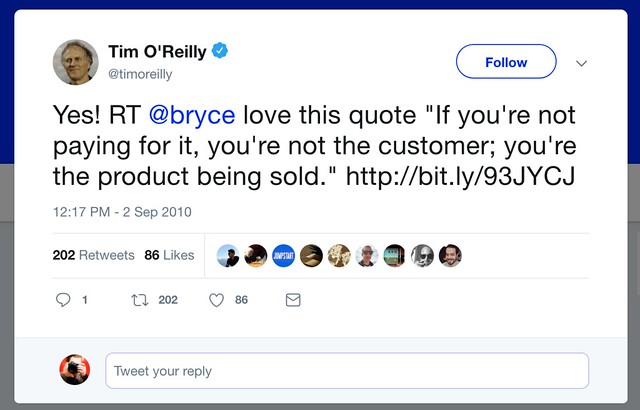
In 1973 the artists Richard Serra and Carlota Fay Schoolman broadcast a short video titled “Television Delivers People”. In that video a simple assertion was made: the product of television. commercial television. is the audience. Television delivers people to an advertiser. Since then, various influential individuals from Tim O’Reilly to Steve Wozniak to Apple CEO Tim Cook have all repeated the mantra: “if you’re not paying for it, you’re not the customer, you’re the product being sold.”

To put things more simply, there are two viable business models on the internet today to deliver service. There is a paid subscription model and there is a “free” model where business sell your data and make money on advertising everything from Butterfinger candy bars on Instagram to “brain force” pills via Alex Jones.

Personally I prefer to pay for an ad-free online experience which is one of the reasons why I’ve enjoyed Flickr so much where I’ve had an opportunity to pay annually since I joined the service back in 2003. Flickr delivers a clean user interface, full high res photos, a compelling app for my iPhone, unlimited storage, kick ass organizational tools, a social community to engage with, search tools, stats, and much more.

At $ 50/year (well technically $ 49.99 but I like to round up) I think Flickr delivers tremendous value. I have spent thousands of hours of my life on the site — thousands of ad-free hours not just for me, but for any of my friends or even strangers who happen to land on my photo page too. I am more than happy to pay this every year and will continue to do so until I die most likely. Hopefully I will figure out a way to even continue paying after I die as my personal life goal is to publish 1,000,000 photos before I die and then let that archive of work stand in all perpetuity after I am gone.

So obviously Flickr works for me, but what about all those people who don’t/haven’t paid and just want to use the service for “free.”

I believe that one of the reasons why Flickr was sold by Oath (who had purchased Yahoo’s content businesses) to Smugmug was because Oath realized that a hybrid subscription/free service doesn’t really work. It’s the same reason why Facebook is so resistant to offering a paid ad-free option to customers.

Oath is basically an advertising company and when you are advertising at people you need to be able to advertise to your most profitable customers to make the service work. When you give your most profitable customers (i.e. the ones with money) the option to pay to opt out of ads they do and will. What you are left with is a bunch of accounts by heavy users who are either poor Americans or more likely poor overseas accounts or very light users who can put up with ads but won’t see very many because they are only on your site 2 minutes a week. Whatever the case, you are basically providing a terabyte of enterprise storage, bandwidth, support, etc., to customers who cannot economically be supported by advertising.

In order for Flickr to survive it has to be a long-term profitable business. SmugMug knows a thing or two about how to do this as their primary model for over a decade has been entirely subscription based. As someone who wants to be able to host my photos on Flickr for the 50 remaining years I likely have left on this planet (and even after my death) in order to publish 1,000,000 photos, it’s important to me that Flickr has a long-term viable business model. This means that strongly encouraging free users (who are not currently paying their way) to migrate to paid Pro is important.

I do think it is important for Flickr to offer a free account in order to give people an opportunity to try out the service to see if it is for them. 1,000 photos gives you plenty of opportunity to do just that. It gives you hundreds, even thousands, of hours to explore and enjoy the service without paying — but if you are a heavy user of the site and are using over 1,000 photos of space, at some point you ought to pay.

By the way, Flickr’s original deal when I started with them was that they would only show your most recent 100 photos if you were a free account and the Pro account cost $ 60 (or $ 59.99) per year. So you might say the current account that gives you 10x that or 1,000 is 10x more generous than the original Flickr from way back.

Besides the obvious business model reasons why this is a smart decision for Flickr and their users, there are other important reasons this makes Flickr better as well. One of the things I noticed after Flickr began offering 1 terabyte for free to users was that many users simply began using Flickr as a backup site for all of their photos. Instead of sharing their best photos with a community, they simply dumped everything on their hard drive to Flickr and left and went away. These photos were then indexed for search and populated the service littering it with low quality content (screengrabs, 1,000 bad photos in a row of fireworks, 3,000 poorly composed photos in a row of somebody’s sister’s wedding, etc.). By focusing Flickr’s vision on photo sharing and community rather than simply another online photo backup dump this makes the visual experience better for those of us who are actually there to share photos and engage with each other.

Also, if people are willing to pay for something they tend to put more effort into it. If you are paying for something and perceive it’s value you’ll care more, contribute more and be a part of something. These are the accounts that I value on Flickr the most.

Yesterday morning I had an opportunity to talk to Don MacAskill (SmugMug/Flickr CEO) about this most recent decision that Flickr is making on the phone. Don is someone who cares deeply about Flickr and its community. How many CEOs do you know that spend an entire day interacting with users in an online forum about a big change like this?

I truly believe that yesterday’s decision not only paves the way to make Flickr viable for many years ahead, but that it paves the way for Don and his team to continue to spend money growing and building out the site for the community that is there and loves the service so much.

There are still so many great things that can be done with Flickr going forward. Groups need work. Search needs work. Community needs work. The app needs work. All of these things do cost money though and by getting rid of the massive storage/bandwidth demands of 1 terabyte free accounts and gaining more paid subscribers, this will allow Flickr to do this important work to continue making Flickr the best photo sharing site on the internet for all of us who are a part of the Flickr community and love the site so much.

I do understand that people don’t always want to pay for things, but I think that the right people will pay for Flickr because it provides them tremendous value. I pay for my Adobe Lightroom subscription. I pay for my Netflix account. I pay for these things because they provide me value. This is also why I pay for Flickr and will continue doing so many years into the future.

Unfortunately as we have seen with services like Friendfeed (purchased by Facebook) or even Google+ (in the process of being killed by Google) social networks oftentimes get shut down. It is very important to me that Flickr remains profitable for the long-term so that I can count on it being there many, many years from now. I think yesterday’s decision helps make Flickr more economically viable and sustainable many years into the future.

You can find me on Flickr here.

[disclosure, I know people and have friends that work at both Flickr and SmugMug]


Thomas Hawk Digital Connection

 
Comments Off on Why Limiting Free Users to 1,000 Photos on Flickr is a Smart Move

Posted in Photography


Canon USA revives CarePAK Plus, free accidental damage repair on EOS R, most DSLRs

23 Oct

Canon USA has reintroduced its CarePAK Plus service as a promotional incentive for most of its recent DSLR cameras, as well as for the new EOS R full frame mirrorless body. The service plan offers 13-months’ worth of free accidental damage cover, as well as two Canon Maintenance Services during that period.

The offer covers 10 of the company’s DSLR and the EOS R, and will also be accessible for those buying one of 13 lenses from the L professional series. Customers have a month to register their products for the service, and Canon boasts that it handles everything from calls and emails, to the actual servicing, so you’ll never have to deal with a third party. Below is a complete list of the participating products:

EOS R EOS 6D Mark II EF 24-70mm F2.8 II USM
EOS 1D X Mark II EOS 80D EF 70-200mm F2.8 IS II USM

EOS 5D Mark IV

EOS 77D EF 70-200mm F2.8 IS III USM
EOS 5D Mark III RF 28-70mm F2 L USM EF 50mm F1.2 L USM
EOS 5Ds RF 50mm F1.2 L USM EF 85mm F1.2 L USM
EOS 5Ds R EF 16-35mm F2.8 L II USM EF 85mm F1.2 L II USM
EOS 6D EF 16-35mm F2.8 L III USM EF 100mm F2.8 L Macro IS USM
EOS 7D Mark II EF 17-40mm F4 L USM EF 100-400mm F4.5-5.6 L IS II USM
EOS 6D Mark II

The offer applies to products purchased from authorized dealers from now until 5th Jan 2019. See the Canon website for more information.

Articles: Digital Photography Review (dpreview.com)

 
Comments Off on Canon USA revives CarePAK Plus, free accidental damage repair on EOS R, most DSLRs

Posted in Uncategorized


Capture One Fujifilm editions to support GFX and X series cameras for free

28 Sep

Phase One’s Capture One image editing and archiving software package will finally support Raw files created by Fujifilm cameras, including the GFX bodies, via a free bundled deal with the cameras. In an arrangement similar to that enjoyed by Sony users, owners of Fujifilm GFX and X cameras will be able to use a scaled-back version made especially for them to process the Raw files from the GFX 50, as well as files from cameras going back as far as the Fujifilm Finepix S2 Pro.

Fujifilm camera owners will be able to use a free version of the software, but can buy the full program but with its additional features at a discounted rate. The Full version with full camera support costs a little bit more again, for those who need support for a wider range of camera brands.

The Free version that will come with the cameras is called Capture One Express Fujifilm. If you want more advanced features such as the ability to work in layers, to tether your camera to your computer, and faster image processing, a second tier of the Fujiiflm version allows photographers the full range of controls. The full Pro edition does the same but will also work for brands other than Fujifilm as well. The Capture One Pro Fujifilm costs €159 a year on a subscription basis, while the full version costs €180 annually.

For more information, including a list of all compatible cameras, please see the Capture One website.

Articles: Digital Photography Review (dpreview.com)

 
Comments Off on Capture One Fujifilm editions to support GFX and X series cameras for free

Posted in Uncategorized


Skylum’s DAM will be included with future version of Luminar, free of charge to current owners

10 Jul

Skylum has announced that Digital Asset Manager (DAM) for Luminar will be provided for free to owners of the current version of Luminar – details of which will be revealed “within a few weeks.” Coming with the next version, Skylum will increase Luminar’s retail price, promising that it will “still be very affordable.”

Skylum hasn’t yet revealed a shipping date for DAM, explaining that it is still working on development. The company anticipates its DAM taking Luminar “in a new direction,” offering faster workflows, custom workspaces, a less cluttered interface, and much more. Talking about this is Skylum president Scott Bourne, who said in the company’s recent blog post:

Skylum plans to build our DAM so that we can keep simple things simple. We’re focusing our research and engineering efforts on a few key things. We want our software to be fast. Our goal is to be the fastest. Period. We also want to make sure that with Luminar, it will be fast, fun and easy to browse, rate, edit, share, and enjoy your pictures. That’s it.

Future versions of Luminar will be created with the company’s design goals in mind. Skylum is encouraging its customers to make sure they’re using the latest Luminar version to be put in the queue for the eventual free beta DAM.

Via: 43Rumors

Articles: Digital Photography Review (dpreview.com)

 
Comments Off on Skylum’s DAM will be included with future version of Luminar, free of charge to current owners

Posted in Uncategorized


Skylum’s DAM will launch as a free beta for current Luminar owners

03 Jul

Skylum has announced that a beta version of its Digital Asset Manager (DAM) for Luminar will arrive ahead of the full product launch. The beta will be provided for free to owners of the current Luminar version, the final sale of which will be revealed “within a few weeks,” the company said. After this final sale, Skylum will increase Luminar’s retail price, promising that it will “still be very affordable.”

Skylum hasn’t yet revealed a shipping date for the DAM, explaining that it is still working on development ahead of the beta arrival. The company anticipates its DAM taking Luminar “in a new direction,” offering faster workflows, custom workspaces, a less cluttered interface, and much more. Talking about this is Skylum president Scott Bourne, who said in the company’s recent blog post:

Skylum plans to build our DAM so that we can keep simple things simple. We’re focusing our research and engineering efforts on a few key things. We want our software to be fast. Our goal is to be the fastest. Period. We also want to make sure that with Luminar, it will be fast, fun and easy to browse, rate, edit, share, and enjoy your pictures. That’s it.

Future versions of Luminar will be created with the company’s design goals in mind. Skylum is encouraging its customers to make sure they’re using the latest Luminar version to be put in the queue for the eventual free beta DAM.

Via: 43Rumors

Articles: Digital Photography Review (dpreview.com)

 
Comments Off on Skylum’s DAM will launch as a free beta for current Luminar owners

Posted in Uncategorized


Apple launches service program for MacBooks affected by keyboard issues, offers free repairs

25 Jun
RawPixel/Unsplash

Apple has launched a new service program for select MacBook and MacBook Pros potentially affected by a keyboard issue that results in sticky, unresponsive keys and repeated characters when typing.

The service program comes after three separate class action lawsuits were filed against the Cupertino company for issues related to MacBook and MacBook Pro keyboards.

In a statement provided to 9to5Mac by an Apple spokesperson, the program ‘covers a small percentage of keyboards in certain MacBook and MacBook Pro models which may exhibit one or more of the following behaviors: letters or characters that repeat unexpectedly or don’t appear when pressed or keys that feel “sticky” or aren’t responding in a consistent manner.’

If believe your MacBook or MacBook Pro is being affected by the above issues, the first step is to check whether or not your model is part of the service program. To do this, go into the Apple (?) menu in the upper-left-hand corner of your Mac and select ‘About This Mac.’ Below are the eligible models:

  • MacBook (Retina, 12-­inch, Early 2015)
  • MacBook (Retina, 12­-inch, Early 2016)
  • MacBook (Retina, 12-­inch, 2017)
  • MacBook Pro (13­-inch, 2016, Two Thunderbolt 3 Ports)
  • MacBook Pro (13-­inch, 2017, Two Thunderbolt 3 Ports)
  • MacBook Pro (13-­inch, 2016, Four Thunderbolt 3 Ports)
  • MacBook Pro (13-­inch, 2017, Four Thunderbolt 3 Ports)
  • MacBook Pro (15-­inch, 2016)
  • MacBook Pro (15-­inch, 2017)

If your MacBook or MacBook Pro is one of the above models and is experiencing keyboard issues, the next step is to set up the repair process. You can have the repair done at an Apple authorized service provider, make an appointment at an Apple retail store, or mail in your computer to Apple’s repair center.

Before any repairs are made, Apple will verify whether anything needs to be fixed. If it does, Apple will ‘service [the] eligible MacBook and MacBook Pro keyboards, free of charge.’ The repairs will consist of either replacing the affected keys or potentially replacing the keyboard as a whole if required.

You can find more details on how to get your device repaired by going to Apple’s documentation page detailing the service program.

Articles: Digital Photography Review (dpreview.com)

 
Comments Off on Apple launches service program for MacBooks affected by keyboard issues, offers free repairs

Posted in Uncategorized


Peak Design acknowledges flaw with its Anchor connectors, is offering free replacements

06 Jun

For the fourth time since Peak Design launched its first camera strap system, the San Francisco-based camera bag and accessory manufacturer is changing its Anchor connectors—the little pieces that attach to your gear and snap into its camera straps.

The change comes after Peak Design realized its third version of the dyneema Anchor connectors, which were originally made to accommodate a larger variety of camera systems with smaller eyelets, are prematurely wearing out and failing.

According to Peak Design, there have only been seven reported failures of Anchor connectors of the more than one million sold since August 2017. That means only one in every 17,000 customers have been affected. But Peak Design said that’s still too high of a failure rate.

As seen in the above comparison image, Peak Design is fixing the issue by making the Anchor connector cord thicker once again.

Peak Design says it’s notified all customers who’ve purchased version three of its Anchor connectors, be it standalone or in a package with a camera strap. If you’re afraid you missed the email or otherwise want to double-check, Peak Design has created an Anchor update survey to help you see if you qualify. Also, as of May 22nd, 2018, all camera straps purchased through Peak Design’s website will come with a free Anchor Update Kit. According to a post on its support page, Peak Design said ‘eventually’ all Peak Design camera straps will contain version four Anchor connectors.

Articles: Digital Photography Review (dpreview.com)

 
Comments Off on Peak Design acknowledges flaw with its Anchor connectors, is offering free replacements

Posted in Uncategorized