 Photo by Kenneth Lau
When you light any three-dimensional object, you create four zones of light. It doesn't matter if it is a face or a tomato. So today let's learn from this tomato, photographed by Strobist reader Kenneth Lau.Read more »
Strobist
Photo by Kenneth Lau
When you light any three-dimensional object, you create four zones of light. It doesn't matter if it is a face or a tomato. So today let's learn from this tomato, photographed by Strobist reader Kenneth Lau.Read more »
Strobist
[ By Steve in Art & Sculpture & Craft. ]

Looking for love in all the right places? Replicas of artist Robert Indiana’s iconic Pop Art “LOVE” sculpture have spread to the 4 corners of the globe.


Robert Indiana (formerly Robert Clark) first expressed the essential iconography of “LOVE” in 1958 but it wasn’t until 1964 that the image garnered wide public notice, via a Christmas card commissioned by the Metropolitan Museum of Art. One of the first three-dimensional LOVE sculptures has stood, since 1970, in front of the Indianapolis Museum of Art.


Like many metal artworks designed to stand out in the open, the IMA’s LOVE sculpture is made from Cor-ten steel, an alloy that weathers to a rich, slightly iridescent, purplish-brown patina after years of seasonal changes. The sculpture measures 12′ x 12′ x 6′ and has recently undergone a structural and aesthetic restoration.


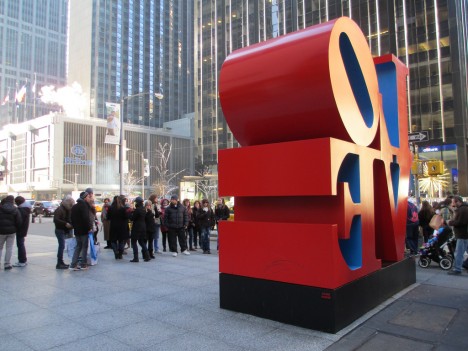
There are currently around 50 LOVE sculptures installed in public and private spaces worldwide. Some are better-known than others, mainly due to their proximity to pedestrian traffic. One of the first NYC LOVE sculptures was installed at 59th Street and 5th Avenue in 1971, while perhaps the most prominent NYC LOVE sculpture stands at the corner of 6th Avenue and 55th Street in Manhattan. Kudos to Flickr users Chee917 and Robert Wright (wrightrkuk), who snapped the sculpture in 2012.


Most of the world’s LOVE sculptures have red painted facades with blue or blue & green sides to match Indiana’s original MOMA card and popular USPS stamp. This isn’t a must, however, as Indiana famously neglected to properly copyright the work. This bright blue representation outside 1445 West Georgia Street in Vancouver, Canada (later moved) shares its blue & green color scheme with another LOVE sculpture located at the Park Mall in Singapore.

Photographer Wassily from nl brings us the striking scene above. Featuring a large LOVE sculpture set into the reflecting pool outside the Langen Foundation’s main building in Neuss-Holzheim, Germany, the photo dates from 2005 shortly after the building opened.

Jumbles of illegible text form oversized, contemplative human figures looking over public spaces from London to Dubai in these typographic works by Jaume …
Click Here to Read More »»

Most people walk right by driftwood on the beach. Heather Jansch picks it up and sees its potential. Her driftwood sculptures are full of life and character.
Click Here to Read More »»

We all remember funny balloon animals made by clowns at the circus. But Jason Heckenworth takes the same balloons and makes them into amazing, unique art.
Click Here to Read More »»


[ By Steve in Art & Sculpture & Craft. ]
[ WebUrbanist | Archives | Galleries | Privacy | TOS ]
 |
Chinese lens maker Zhongyi Optics has added M42, Canon FD and Minolta MD lens adapters to its second-generation Lens Turbo lineup for Micro Four Thirds cameras. Like Metabones’ Speedboosters, the adapters shorten the effective focal length, increasing the F-number by one stop and partially negating the crop factor. The 0.726x focal length reduction combines to give a net 1.45x focal length crop, rather than the 2x crop that you’d usually experience on a Micro Four Thirds camera.
These three adapters join ZY Optics’ existing Lens Turbo Version II adapters for Canon EF and Nikon G lenses. Among the adapters’ four optical elements is an extra-low dispersion element, and all three offer stainless steel mounts and metal bodies.
All three adapters are available directly from ZY Optics for $ 149 USD.
$ (document).ready(function() { SampleGalleryV2({“targetContainerClass”:”sampleGalleryImageViewerContainer”,”galleryId”:”2215321511″,”isEmbeddedWidget”:true,”selectedImageIndex”:0,”startInCommentsView”:false,”isMobile”:false}) });
Panasonic is adding a high-end super telephoto zoom lens to the Micro Four Thirds lineup: the Leica DG Vario-Elmar 100-400mm F4-6.3 ASPH. This lens has the longest focal length of any MFT lens, and Panasonic promises fast autofocus thanks to its 240 fps AF drive speed.
This lens is equivalent to a whopping 200-800mm when attached to a Micro Four Thirds body and features much-needed ‘Power’ optical image stabilization to keep things steady. It has has one aspherical, one UED, and two ‘regular’ ED elements, as well as a nine-bladed circular aperture. The minimum focus distance is 1.3m, with a magnification of 0.25x.
A cool feature of this lens is its compact tripod collar which rotates with the camera body, taking the buttons with it. The collar has a tripod screw mount built into it, into which a longer (included) ‘foot’ can be added if additional clearance is need. The zoom lock is built into the lens barrel, as is a small pull-out lens hood (a full-sized hood is available as an optional accessory). The 100-400mm is also sealed against dust and moisture.
The Leica DG Vario-Elmar 100-400 F4-6.3 will be available in early April at a price of $ 1799.99.
View our hands-on preview of the Panasonic Leica DG 100-400mm F3.5-5.6
Press release:
New lens combines 200-800mm zoom (35mm equivalent) and 4K video compatibility in a durable and lightweight body
Las Vegas, NV (January 5, 2016) – Panasonic has today introduced a new telephoto lens for its LUMIX G range of Micro Four Thirds System cameras – the LEICA DG VARIO-ELMAR 100-400mm F4.0-6.3 ASPH. Telephoto-Zoom (H-RS100400) with Power Optical Image Stabilization (O.I.S.).
Small, light and highly durable, the latest addition to Panasonic’s range of interchangeable lenses is perfectly suited for photographing birds and other wildlife in all types of environments.
The lens is constructed of 20 elements in 13 groups and incorporates a number of aspherical and extra low dispersion elements to assure best quality and avoid flaring. The advanced construction of the new Telephoto-Zoom leads to highest quality standard earning the LEICA Logo for a LUMIX Lens once again.
Outstanding image quality and Telephoto-Zoom performance
Elegantly designed with a metallic black finish, the new 100mm-400mm LEICA DG VARIO-ELMAR lens from Panasonic provides superb image rendering across the entire zoom range. The lens’ 200-800mm focal length (35mm equivalent) and 0.5x Magnification capability provide highly detailed shots from distance, as well as stunning close up capability– ideal for subject matter regardless of shape and size.
In order to capture steady, vibration free images across the entire zoom range, the lens also incorporates Power O.I.S. to keep unwanted shaking under control and ensure pictures look crisp and clear.
The 100mm-400mm lens is also suited to a variety of photographic styles – with nine diaphragm blades providing a circular aperture to produce a smooth and beautiful bokeh.
Smaller and lighter than other Telephoto-Zoom lenses
When compared with conventional super telephoto DSLR lenses, the latest addition the LUMIX G line up offers outstanding mobility – perfect if you’re travelling and don’t want to pack too much. Similarly, the lens also boasts a durable, gapless construction so you no longer have to worry about unwanted dust or light rain damaging your equipment.
In addition to the lens’ practical size and weight, a compact, two-part tripod mount has also been incorporated to enable faster conversion between landscape and portrait orientation. While conveniently and speedily turning to the 90° angle, the levers for Focus Limiting, Power O.I.S. and the manual focus switch remain right at your fingertips as they do not move when you turn the lens.
The lens also incorporates an integrated, hide-away hood to help you capture that perfect shot, without having to worry about sun glare.
Stunning 4K video capability
Panasonic’s new LEICA Telephoto-Zoom lens is perfectly suited for 4K video recording with its construction assuring the best contrast and colors. Furthermore the Telephoto-Zoom incorporates Panasonic’s high speed and precise 240 fps AF-motor. Due to the modern design, filming can also be conducted silently, so you can get up close to the subject without drawing attention.
As well as high resolution video, the lens’ 4K capability also enables you to take photos like never before. Panasonic’s 4K Photo function – found on LUMIX G cameras including the LUMIX DMC-G7 – lets you extract an 8-megapixel still from 4K video (30fps) easily right on the camera’s screen with a simple fingertip touch.
Key features:
| Principal specifications | |
|---|---|
| Lens type | Zoom lens |
| Max Format size | FourThirds |
| Focal length | 100–400 mm |
| Image stabilisation | Yes |
| Lens mount | Micro Four Thirds |
| Aperture | |
| Maximum aperture | F4.0 – F6.3 |
| Minimum aperture | F22.0 |
| Aperture ring | No |
| Number of diaphragm blades | 9 |
| Aperture notes | Circular blades |
| Optics | |
| Elements | 20 |
| Groups | 13 |
| Special elements / coatings | 1 aspherical ED, 1 UED, 2 ED elements |
| Focus | |
| Minimum focus | 1.30 m (51.18″) |
| Maximum magnification | 0.25× |
| Autofocus | Yes |
| Motor type | Micromotor |
| Full time manual | Yes |
| Focus method | Extending front |
| Distance scale | No |
| DoF scale | No |
| Focus distance limiter | Yes |
| Physical | |
| Weight | 985 g (2.17 lb) |
| Diameter | 83 mm (3.27″) |
| Length | 172 mm (6.75″) |
| Sealing | Yes |
| Colour | Black |
| Zoom method | Rotary (extending) |
| Power zoom | No |
| Zoom lock | Yes |
| Filter thread | 72.0 mm |
| Hood supplied | Yes |
| Tripod collar | Yes |
Chinese lens manufacturer Shenyang Zhongyi Optics has redesigned the optical construction of is Turbo Adapter that allows Micro Four Thirds users to mount Nikon and Canon lenses to their cameras. The details are slight, but the company says the configuration is completely different, although still using four elements, and new coatings have been applied to reduce flare and increase contrast. Read more
Chinese optics company Shenyang Zhongyi Optical and Electronic has announced that it is adding a super-fast standard lens to its range designed for the Micro Four Thirds system. The new 25mm lens features a maximum aperture of F0.95 but has a very small and lightweight body. Read more
Drone maker DJI has announced a pair of Micro Four Thirds aerial cameras including a model that can shoot lossless 4K Raw footage. The Zenmuse X5 and X5R are built around 16MP Four Thirds sensors, are compatible with a handful of small Micro Four Thirds lenses and can be flown on the company’s Inspire 1 drones. Read more
UK company Scratch Ideas is seeking £25,000 in funding on crowdsourcing site Kickstarter for a new camera mount it’s calling ‘Loki’. Loki can be transformed into a dolly, underslung rig, shoulder rig, and cage, and folds up into a portable rectangular brick about the size of a battery grip for transportation and storage. Click through for more details
Z Camera, a China-based photography startup, has introduced a connected Micro Four Thirds camera called the E1. Shaped like GoPro’s HERO action cameras, the E1 carries a 16MP Four Thirds sensor and can record video at 4K 4096×2160 resolution. It provides Wi-Fi connectivity and an open platform for developers. Read more
