Tag: first

  • First impressions and real-world samples from the Pentax K-50

    IMGP0226.JPG

    Fresh from the Pentax Ricoh launch event in New York, we’ve put together a real-world samples gallery from the Pentax K-50. The 16MP mid-range DSLR builds on the very likeable K-30 and promises improved image processing. We take a closer look at the K-50 and its similar sibling, the K-500, to see just what they bring to the table, as well as presenting a selection of full-resolution sample images.

    News: Digital Photography Review (dpreview.com)

  • First impressions shooting with the Sigma 18-35mm F1.8 DC HSM

    Cover2.jpg

    We’ve just published our first impressions of shooting with the Sigma 18-35mm F1.8 EX DC lens. We’ve tried to express just why we’re so excited about this lens, which offers APS-C DSLR users access to some of the depth-of-field and low-light capabilities that full-frame shooters get from their F2.8 zooms. We’re hoping to hear about pricing and availability soon so, in the meantime and in the light of our first impressions, what would you expect to pay for this lens?

    News: Digital Photography Review (dpreview.com)

  • Roger Cicala gives first impressions on new Zeiss Touit 32mm F1.8

    150443405.VK1EcURc.jpg

    Roger Cicala of Lensrentals has published a blog post in which he gives his first impressions of the new Carl Zeiss 32mm F1.8 ‘Touit’ lens, in Sony E-mount. Unlike Roger’s normal approach, where he exhaustively tests multiple samples of the same lens, he was only able to look at a single example of the 32mm F1.8 on the Sony NEX-7. Click through for some details of his findings, and a link to the full article at the lensrentals blog.

    News: Digital Photography Review (dpreview.com)

  • My First Concert: Lighting Craziness

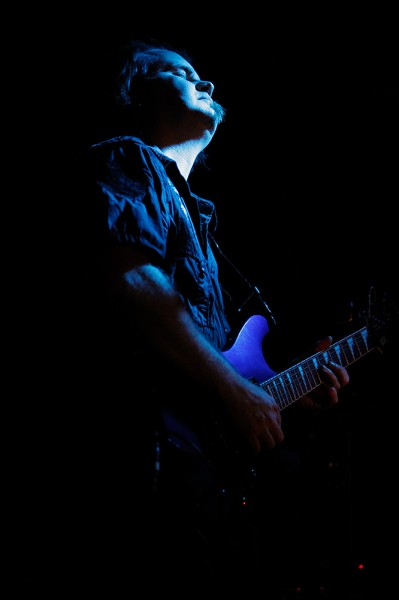
    I had noticed this lighting scheme earlier in the song and missed it, focusing elsewhere. But when guitarist Brendt Allman went into his solo, I waited to see if it would happen again. Sure enough, it did. EOS-1D Mark IV, EF 70-200 f/2.8L IS II. ISO 3200, 1/200 f/2.8.

    I had noticed this lighting scheme earlier in the song and missed it, focusing elsewhere. But when guitarist Brendt Allman went into his solo, I waited to see if it would happen again. Sure enough, it did. EOS-1D Mark IV, EF 70-200 f/2.8L IS II. ISO 3200, 1/200 f/2.8.

    A few years ago, I managed to start working with one of my favorite groups of musicians, a progressive heavy metal band from Pennsylvania called Shadow Gallery.  This has led to me collaborating with them in a number of ways.  I did some publicity photos for them, shot a music video (in another first for me) that ended up getting play on MTV in Europe, and in what I consider a career highlight, shot my first concert performance- which also happened to be their first concert performance.

    Having never shot a live performance, I didn’t know what to expect.  I knew the venue was a small local place, so I had no idea what the lighting would be like. I came prepared with two lenses, an EF 24-105 f/4L and EF 70-200 f/2.8L IS II, as well as a 580EX II speedlite. I wasn’t sure the speedlites would be allowed, and even if they were, felt they would limit my shooting since I’d have to wait for the recycle. I used two cameras- a Canon EOS 7D and a Canon EOS-1D Mark IV. Both are capable of relatively high ISO’s, which I knew I’d be using in a dimly lit concert venue. By raising the ISO, it minimized how hard the flash would have to work.  I experimented starting at ISO 800, and finally settled on ISO 3200 a song or two into the show.

    The great thing about musical performances is the lighting is generally pretty
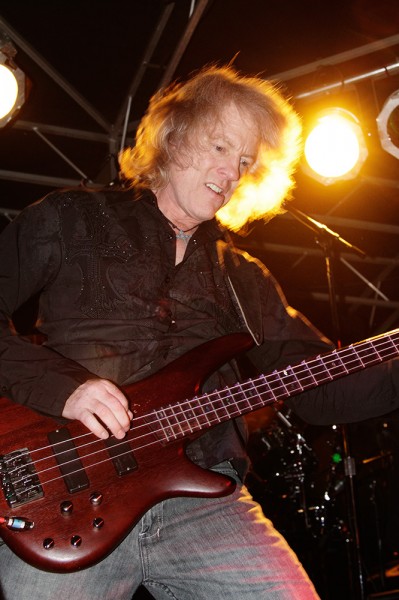
    This shot was early in the show, and I was experimenting with flash for my exposures. I used the built-in flash on the EOS 7D, and set the flash exposure compensation to -1 so as not to overpower the ambient. The result was good fill on his face, while the stage lighting created a nice backlight. The slower shutter speed of 1/100 allowed some motion blur in the hair, but that adds to the energy of the image. ISO was only 800 here, as it was the first song and I was still experimenting.

    This shot was early in the show, and I was experimenting with flash for my exposures. I used the built-in flash on the EOS 7D, and set the flash exposure compensation to -1 so as not to overpower the ambient. The result was good fill on his face, while the stage lighting created a nice backlight. The slower shutter speed of 1/100 allowed some motion blur in the hair, but that adds to the energy of the image. ISO was only 800 here, as it was the first song and I was still experimenting.

    interesting, if not all that bright.  What I wanted to do was figure out, when the lights were at their brightest, what my exposure should be.  I had the luxury of an opening act to shoot some tests. In addition, I wasn’t limited to just three songs like you might be with more well-known performers. I had an entire two hour show, so I took the first two songs to really nail my exposure down.

    Even when using flash, I wanted to balance the flash with ambient light, not overpower the ambient lighting.  To do this, I shot in Manual mode.  I set my aperture wide open at f/2.8 or f/4 depending on the camera.  I wanted a shutter speed fast enough to stop any movement on stage, so I ended up settling on 1/200 for the most part. Knowing the 7D would be a bit noisier at the high ISOs due to the smaller sensor, and that the lens I was using was a stop slower, I put the 24-105 on that camera and shot it at 1/100 at f/4 to give it an extra stop of exposure.  That allowed some motion blur to creep in, but for the most part I lost very shots due to motion blur.

    The constantly changing lighting meant that some shots just vanished as I pressed the shutter button.  The lighting was frantic and pulsing and constantly changing. But after a song or two, it got easier to predict the patterns, as well as see where the band members liked to stand so I could plan for a shot. After a time I ditched

    the flash and opted to shoot sequences at 8 and 10 frames per second to be sure I caught a good expression or peak action. In some cases, I’d catch great lighting for an instant, and then wait to see if the lighting sequence repeated and I could catch it again.

    Overall, it was a great experience, one I hope to repeat again some time. It was the perfect combination for me- great music and photography.
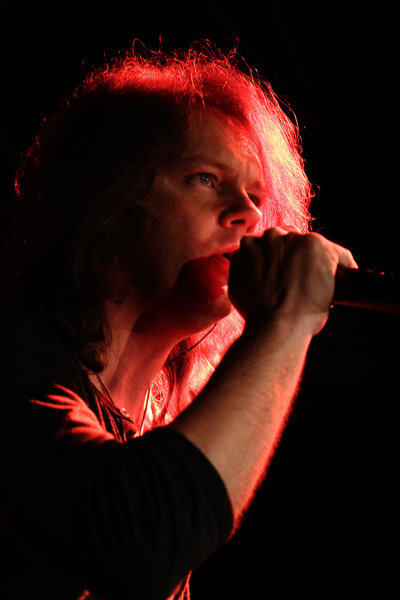
    After a while I turned off the flash and raised the ISO up. Shooting using only the ambient light created some dramatic lighting situations. EOS 7D, EF 24-105 f/4L IS/ ISO 3200, 1/100, f/4.

    After a while I turned off the flash and raised the ISO up. Shooting using only the ambient light created some dramatic lighting situations. EOS 7D, EF 24-105 f/4L IS/ ISO 3200, 1/100, f/4.

    Post originally from: Digital Photography Tips.

    Check out our more Photography Tips at Photography Tips for Beginners, Portrait Photography Tips and Wedding Photography Tips.

    My First Concert: Lighting Craziness


    Digital Photography School

  • 16 May, 2013 – Fuji 55-200mm Zoom First Impressions

    Fuji is about to release their eagerly awaited XF 55-200mm OIS zoom lens. I have been working with a sample for the past couple of weeks and my First Impressions report is now online.


    "Yes I downloaded the videos. THEY ARE AWESOME!!! I learned so much I think my brain is going to explode.


    The Luminous Landscape – What’s New

  • Samsung Galaxy S4: Our first look at imaging features

    Eraser_passerby.png

    The Samsung Galaxy S4 has no doubt been one of the most high-profile smartphone launches of the year. We’re digging into its camera capabilities for our full review of Samsung’s newest flagship phone, first playing with some of the more innovative capture features from its Dual Shot to Drama mode. We offer our first thoughts on the S4’s camera today on connect.dpreview.com.

    News: Digital Photography Review (dpreview.com)

  • HTC One camera first look: Imaging features

    htcone.png

    After our recent Smartphone Super Shootout we are working full steam ahead toward our comprehensive camera review of the HTC One, the Taiwanese manufacturer’s new flagship smartphone which features a 4 ‘ultrapixel’ sensor, a fast F2.0 lens and optical image stabilization. Unti then, we offer up a close look at the new phone’s imaging features.

    News: Digital Photography Review (dpreview.com)

  • Algae-Fueled Building: World’s First Bio-Adaptive Facade

    [ By WebUrbanist in Architecture & Public & Institutional. ]

    algae powered building

    Bio-reactors and micro-algae sound like the stuff of science fiction, but this is the real deal: biomass built into panel glass is both generating heat and acting as a responsive light and sound barrier, all in one brilliant new building in Hamburg.

    bio facade algae building

    Arup has long been predicting incredible innovations in architecture, but they are also keen to show that their designers and engineers are actually working toward world-changing technologies.

    algae biomass building design

    Bright sunlight causes the bio-reactors to grow faster and supply more shade on demand. The resulting biomass captures solar heat as well, and can be harvested and used as a source of energy itself. It is, in essence, an architectural ecosystem in which all parts of the process are not only sustainable but multi-functional and fully integrated.

    algae energy fuel source

    There is always talk of futuristic building technologies, but few firms are able to break new ground in some of the most promising directions. If there is to be a new ‘living architecture’ movement involving micro-climates, bio-chemical processes and responsive materials, Arup continues to prove itself on the forefront of its exploration.

    Share on Facebook


    [ By WebUrbanist in Architecture & Public & Institutional. ]

    [ WebUrbanist | Archives | Galleries | Privacy | TOS ]


    WebUrbanist

  • 1 April, 2013 – Leica M(240) First Impressions

    Last week I had an opportunity to shoot with the new Leica M for the first time along with with Sean Reid of Reidreviews and our own Mark Dubovoy. We did photography, talked equipment and did a lengthly video round table discussions about the current state of Leica M cameras and the whole non-reflex camera environment.

    The video will appear soon, but today I am publishing my Leica M First Impressions Report and Sean’s write-up on our get-together.


     "Every time I go back to a module I had already seen, I learn additional things.  I have never seen tutorials that have the excellent mix of what the features are, 
    how to use them, enough of the under-the-hood information 
    and concepts so that I can utilize the features creatively and efficiently, 
    and just enough humor to keep the motivation level high.  Wow!"


    The Luminous Landscape – What’s New

  • World’s First Mobile Research Station Opens in Antarctica

    [ By Steph in Architecture & Public & Institutional. ]

    First Mobile Research Station Antarctica Main

    Built under some of the most extreme conditions on planet Earth, the Halley VI Research Station by Hugh Broughton Architects is now serving as a mobile home base for Antarctic expeditions. The facility is located on the floating Brunt Ice Shelf, and can be moved inland on its ski-like feet to avoid being stranded as the shelf drifts. Hydraulic rams enable it to be raised above accumulating snow.

    First Mobile Research Station Antarctica 1

    First Mobile Research Station Antarctica 2

    The $ 25.8 million research station was constructed over 36 weeks spread out over four years of Antarctic summers, and consists of seven interlinking blue modules that serve as laboratories, offices, bedrooms and energy plants. A two-story red module offers up to 32 crew members social space in the summers, with that number dwindling to 16 in the three winter months with total darkness, when temperatures dip as low as -56 degrees Celsius.

    First Mobile Research Station Antarctica 4

    In fact, the wintering team often includes no scientists at all – it typically consists of technical specialists including a vehicle mechanic, a doctor, an electrician, a plumber, electronics engineers and meteorologists to keep the scientific experiments running. Halley VI was shipped to Antarctica in 2007 after a trial-run assembly in South Africa, but due to the extreme weather conditions on-site, it only became ready for use in February 2013.

    First MObile Research Station Antarctica 3

    Halley VI replaces the 20-year-old Halley V, and is the sixth to be built on the Brunt Ice Shelf. The location for this research facility has long functioned as a ‘natural laboratory’ for the Earth’s magnetic field and the near-space atmosphere. It is under the auroral oval, resulting in frequent displays of the magnificent Aurora Australis natural light display overhead.

    Share on Facebook


    [ By Steph in Architecture & Public & Institutional. ]

    [ WebUrbanist | Archives | Galleries | Privacy | TOS ]


    WebUrbanist