Tangerine, a feature film by Sean Baker, is headed for theaters on July 10th. It was shot entirely on the iPhone 5, keeping the overall budget of the film under $ 100,000, and the production utilized anamorphic adapter prototypes for shooting. Read more
Tag: film
-
Celebrate the New SLR670m With Free Film Today!

Your worlds are about to collide. In the best way possible!
The Polaroid SX-70 has not only been restored to factory perfection by MiNT, but it’s also been given a modern kick with Time Machine. The result? A new classic as the SLR670m.
Time Machine gives you incredible creative control, with 16 manual settings including long exposure, Auto and Off modes.
To celebrate our instant love for this modern marvel we’re throwing in free instant film with these instant cams and printers, today only! Not since the 70s has there been a better time to go instant.
Free Film With These Instants
(…)
Read the rest of Celebrate the New SLR670m With Free Film Today! (0 words)
© Erin for Photojojo, 2015. |
Permalink |
No comment |
Add to
del.icio.us
Post tags:
-
Free Download: VSCO Film Pack 00 includes Tri-X and Kodak Gold Film presets
Who doesn’t love free stuff? Visual Supply Co has been churning out Photoshop and Lightroom-compatible film presets for some time now. To date, they’ve released seven different ‘Film Packs’ each containing presets that mimic both classic and contemporary film stocks. Now, they’re offering one for free. Read more
-
New RainbowMini Instax Film

Somewhere over the rainbow … way up high!
Bluebirds fly, and the Instax Film of our dreams is more colorful than ever.
The newest Instax Mini Film in our shop features rainbow gradient borders on each print.
No two in any pack are the same. Each color only happens, once in a lullaby.
So take up your instant cam (or pick up a new one) and start dreaming those dreams that you dare to dream.
Follow the Rainbow (or, this link) for Film
© laurel for Photojojo, 2015. |
Permalink |
No comment |
Add to
Mini Instax Film”>del.icio.us
Post tags:
-
Mint introduces Instantflex TL70 instant film TLR camera
Polaroid camera repair and maintenance company Mint has introduced its own instant camera called the Mint Instantflex TL70. Fitted with a 65.4mm lens the camera offers aperture settings of f/5.6, f/8, f/16 and f/32 with an additional setting called f/bokeh – which creates a 5-pointed star shaped aperture. The Instantflex also features a flip-up flash unit housed above the viewing lens. Read more
-
Impossible launches B&W 2.0 quick-process instant film for 600 series cameras
Instant film manufacturer Impossible has launched what it calls a Generation 2.0 film called B&W 2.0. The company claims it’s not only sharper and clearer than previous Impossible products, but also develops much quicker. The new film is the result of a new chemical formula for Impossible that has been developed by former Polaroid research chemist Stephen Herchen. Read more
-
Fujifilm adds film simulation to Raw File Converter EX 2.0 and tethered shooting for X-T1
Fujifilm is to release a new version of its Raw File Converter EX at the end of the month, bringing the film simulation modes used in its X-series cameras to the Silkypix-based desktop software package. Initially the new feature will be available for files shot with X-T1, X-A2, X100T, X30 and XQ2 cameras, but the company has said that other models will be included in a further update at a later time. Read more
-
A Starter’s Guide to Film Photography: What You Need to Know
Photography has never been more accessible than it is now in the digital age. Every cell phone features a camera, and those cameras are quickly becoming more advanced. DSLRs are becoming more affordable while offering increasingly higher quality and functionality. And the advent of mirrorless cameras are packing more photo punch into smaller and easier to use packages. So why would Continue Reading
The post A Starter’s Guide to Film Photography: What You Need to Know appeared first on Photodoto.
-
Old Glass: How to Use Old Film Lenses with New DSLR Cameras
Do you want a sharp and well built lens? Of course you do. Everyone does. Think you can’t afford great glass? Think again. You may not be looking in the right place.
If you’re like me, browsing through latest high-end lenses can be a little depressing. The cost of luxury grade glass can easily peak in the thousands of dollars. What if I told you that you could have excellent lenses without breaking the bank?
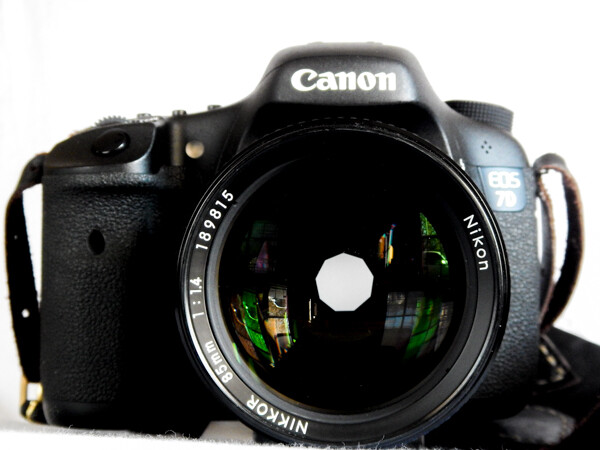
Recently I learned about a method for retrofitting older film lenses to function with our modern cameras. The possible bad news is that these are mostly manual focus prime lenses so your autofocus and metering won’t work (with one exception we’ll talk about later). The great news is that the majority of these lenses are built like photographic tanks and possess extremely capable optics. These lenses are also readily available and affordable on most any budget.
So how is it done? How can you make a twenty, thirty, or even forty year old piece of gear work with today’s advanced camera bodies? Believe it or not, the answer is deceptively simple. For virtually every lens and camera combination there is an adapter that will enable you to use any lens with any camera – regardless of manufacturer. Here’s an example:
I have an old analog Nikon F3 that was given to me by my father along with a couple of lenses: a Nikkor 85mm f/1.4 and a Nikkor 50mm f/1.8.

The entire kit remained mostly forgotten in a camera bag, and in storage for years. One day I stumbled across some information about how a few photographers were using old M42 Zeiss screw-mount lenses with their DSLR’s using adapter rings and producing outstanding photographs. That got me thinking – if it were possible to find adapters for these old M42 lenses, could there also be manufacturers who produced similar adapters for other lens types? Almost instantly the old Nikon leaped from some distant corner of my memory. My main shooting body is a Canon 7D MkI. Could I possibly use those thirty year old Nikkor film lenses on my 7D Canon? Shockingly, the answer was yes! All I needed were these unassuming aluminium adapter rings which I sourced on eBay for about $ 12 USD each.
One side of the ring matches the Nikkor mount.

The other mates with the Canon body.

The entire process is very simple; the adapter simply snaps onto the lens.

Without the adapter.
With the Canon adapter.Then it’s business as usual attaching the adapted lens to the camera. Just line up the indicator dot with the mounting dot on your camera body.

You’re done.

The adapters are also removable if you choose to do so later by depressing a small spring catch (most brands have these).
As I said earlier, these are completely manual lenses. Meaning that you adjust your aperture by hand as well as focusing the lens.

Personally, I enjoy the deliberateness this action forces. You have to think about your composition so much more, and you get to experience the effects of aperture adjustment literally first hand.

The impressive aperture blades on this beautiful Nikkor 85mm.Don’t worry if this manual operation doesn’t appeal to you. The exception concerning the adapter rings I spoke of is that some are now being made with focus indicator chips built into the adapter. While this chip doesn’t enable you to use autofocus, it does allow the lens to communicate to the camera when the selected point of focus has been obtained. This is complete personal preference. I opted for the non-autofocus indication adapters because I wasn’t comfortable using aftermarket electronics of that type with my camera. Again, this is a completely subjective.
Please Note: Neither the author nor Digital Photography School are responsible for any damages to your camera or lens as a result of using aftermarket devices. Please be an informed photographer prior to attempting any modifications to your precious gear!
Now, here are some images produced through a little Frankensteinish innovation.


googletag.cmd.push(function() {
tablet_slots.push( googletag.defineSlot( “/1005424/_dPSv4_tab-all-article-bottom_(300×250)”, [300, 250], “pb-ad-78623” ).addService( googletag.pubads() ) ); } );googletag.cmd.push(function() {
mobile_slots.push( googletag.defineSlot( “/1005424/_dPSv4_mob-all-article-bottom_(300×250)”, [300, 250], “pb-ad-78158” ).addService( googletag.pubads() ) ); } );The post Old Glass: How to Use Old Film Lenses with New DSLR Cameras by Adam Welch appeared first on Digital Photography School.