RSS
 

Posts Tagged ‘f1.4’

Panasonic introduces splash-proof Lumix G Leica Summilux 12mm F1.4

15 Jun

$ (document).ready(function() { SampleGalleryV2({“containerId”:”embeddedSampleGallery_4269830725″,”galleryId”:”4269830725″,”isEmbeddedWidget”:true,”standalone”:false,”selectedImageIndex”:0,”startInCommentsView”:false,”isMobile”:false}) });

Panasonic is introducing a new prime lens to the Micro Four Thirds family: the Lumix G Leica DG Summilux 12mm F1.4 ASPH. It will be the widest prime that company offers (not counting its 8mm fisheye) and provides an equivalent 24mm view on Micro Four Thirds bodies. Designed to withstand a little wear-and-tear in the form of splashes and dust, the 12mm F1.4 offers a dedicated ring to control its nine-bladed aperture.

Its rugged build includes a metal mount, body and included lens hood. The lens uses inner focus drive and a stepping motor for quiet operation, and is made up of 15 elements in 12 groups. Pricing and availability information has yet to be announced.


Press release:

PANASONIC LUMIX G LEICA DG SUMMILUX 12mm, F1.4 ASPH Lens

The H-X012 Micro Four Thirds Professional Wide Angle Mirrorless Lens

NEWARK, NJ (July 1, 2016) – Panasonic unveiled a new LEICA DG SUMMILUX 12mm/F1.4 ASPH. (35 mm camera equivalent: 24 mm) digital interchangeable lens for Digital Single Lens Mirrorless camera based on the Micro Four Thirds standard. The new 12mm wide-angle lens enables photographers to capture beautiful group, event, and nature photography. It also allows indoor shooting in low lighting and produces an impressive, natural defocusing effect with its F1.4 aperture. In addition, the LEICA DG SUMMILUX 12mm/F1.4 ASPH. boasts a rugged, splash/dust-proof design (when combined with splash and dustproof LUMIX G Mirrorless camera models) to meet the needs of a wide-range of photographic situations.

Integrating two aspherical lenses, two UED (Ultra Extra-Low Dispersion) lenses and an ED (Extra-Low Dispersion) lens, the lens system is comprised of 15 elements in 12 groups. The adoption of five special lenses makes it possible to meet the stringent LEICA standard for exceptional image quality with high resolution and minimum distortion. In general, flare is commonly seen around the periphery of a point source with many high-speed lenses when a large aperture is employed. However, the new LEICA DG SUMMILUX 12mm/F1.4 ASPH. achieves high resolution from the center of the image to the corners by suppressing this flare. Users can take advantage of this lens to shoot a brilliant night skies or night scenes containing illumination to capture true-to-life images with minimal blurring and distortion at the edges. The multi-coated lens elements also minimize ghosting and flaring.

Incorporating an inner focus drive system and a stepping motor, the new LEICA DG SUMMILUX 12mm/F1.4 ASPH. is capable of smooth, silent operation together with the camera’s high-speed, high-precision contrast AF system for both photo and video recording. It is also compatible with the sensor drive at a maximum of 240 fps to take full advantage of cameras with high-speed AF. This stunning AF performance is excellent for recording 4K videos, where precise focusing is essential.

The LEICA DG SUMMILUX 12mm/F1.4 ASPH. comes with an aperture ring for direct, intuitive aperture control. Nine blades give the aperture a rounded shape that produces an attractively smooth effect in out-of-focus areas when shooting at larger aperture settings. A highly reliable metal mount assures durability for repeated use. The lens mount, the barrel and the hood are all made of metal to provide a sleek, sophisticated design that matches the entire line-up of LUMIX G Digital Single Lens Mirrorless (DSLM) cameras.

Panasonic Lumix G Leica DG Summilux 12mm F1.4 specifications

Principal specifications
Lens type Prime lens
Max Format size FourThirds
Focal length 12 mm
Lens mount Micro Four Thirds
Aperture
Maximum aperture F1.4
Minimum aperture F16
Aperture ring Yes
Number of diaphragm blades 9
Optics
Elements 15
Groups 12
Special elements / coatings 2 aspherical lenses, 1 ED lens, 2 UED lenses
Focus
Minimum focus 0.20 m (7.87)
Maximum magnification 0.1×
Autofocus Yes
Motor type Stepper motor
Full time manual Unknown
Physical
Weight 335 g (0.74 lb)
Diameter 70 mm (2.76)
Length 70 mm (2.76)
Sealing Yes
Filter thread 62.0 mm
Hood supplied Yes

Articles: Digital Photography Review (dpreview.com)

 
Comments Off on Panasonic introduces splash-proof Lumix G Leica Summilux 12mm F1.4

Posted in Uncategorized


Hands-on with new Panasonic Leica Summilux 12mm F1.4 ASPH

15 Jun

Hands-on: Panasonic Leica Summilux 12mm F1.4 ASPH

Panasonic has just announced a new prime lens for Micro Four Thirds. The Lumix G Leica DG Summilux 12mm F1.4 ASPH is a metal-bodied prime that provides an equivalent focal length of 24mm in full-frame terms. We’ve got one in our hands, and we’ve got pictures to prove it! 

Hands-on: Panasonic Leica Summilux 12mm F1.4 ASPH

As you can see, the new 12mm prime is a fairly substantial lens, and at 335g it’s relatively heavy, too. Panasonic is touting its all-metal construction (which even extends to the detachable hood) and 15 glass elements also contribute substantially to the weight. A nine-bladed aperture should ensure both attractive bokeh and sunstars at smaller apertures. 

Hands-on: Panasonic Leica Summilux 12mm F1.4 ASPH

Of those 15 elements, two are ‘ultra’ extra-low dispersion glass, and one is regular extra-low dispersion. According to Panasonic, they should combine to provide very good edge-to-edge sharpness even at wide apertures, making this an ideal lens for astrophotography (among other things). The front filter ring has a diameter of 62mm. 

Hands-on: Panasonic Leica Summilux 12mm F1.4 ASPH

A manual aperture ring and wide, well-damped focus ring give a feeling of real quality to the new 12mm, and although it’s not a lightweight lens, handling is very nice on the Lumix DMC-GH4. Autofocus is handled by a stepping motor, which Panasonic claims is capable of keeping up with the 240 fps refresh rate of modern Panasonic M43 cameras’ sensor-based autofocus. 

Hands-on: Panasonic Leica Summilux 12mm F1.4 ASPH

When paired with a weather-sealed camera like the GH4, the 12mm F1.4 becomes relatively weather-resistant. Panasonic claims that this combination should be ‘splash and dust’ proof. 

Hands-on: Panasonic Leica Summilux 12mm F1.4 ASPH

It’s hard to make out in this image, but around the lens mount you’ll find the slimmest of rubber seals, to prevent moisture and dust from getting into the camera when the 12mm F1.4 is attached.

Hands-on: Panasonic Leica Summilux 12mm F1.4 ASPH

Here’s the included lenshood in all its glory. The Panasonic Leica Summilux 12mm F1.4 ASPH is the sixth Leica lens in Panasonic’s current M43 lineup – pricing and availability have yet to be announced, but we’ll keep you posted.

Articles: Digital Photography Review (dpreview.com)

 
Comments Off on Hands-on with new Panasonic Leica Summilux 12mm F1.4 ASPH

Posted in Uncategorized


Sigma 30mm f/1.4 DC HSM Art Lens Review

08 May

The world of camera lenses can be separated into two main groups: zooms and primes. Prime lenses are those which have a fixed focal length, meaning that they don’t zoom in and out. Once upon a time there were only primes. With the advent of zoom lenses photographers no longer had to rely on just their feet in order to get achieve the desired composition. This versatility brought with it a trade-off. Zoom lenses have more moving parts and components, which adds weight and reduces the speed of the lens, along with sharpness. Optically, primes are generally much faster and sharper than zoom lenses but limit the shooter to only one focal length, which can be off-putting to some.

But times change. Today we see a new generation of photographers realizing the merits of shooting with prime lenses. This paradigm shift is reflected by lens manufacturers who are beginning to produce more prime lenses for a hungry new market.

Sigma 2

The 30mm f/1.4 DC HSM Art lens from Sigma is among one of these that is meant be an all-purpose fast prime, for those needing a lens with excellent sharpness and great low light capabilities. I put the Sigma 30mm f/1.4 through its paces and have a feeling you will be well pleased.

Build Quality

Sigma 4

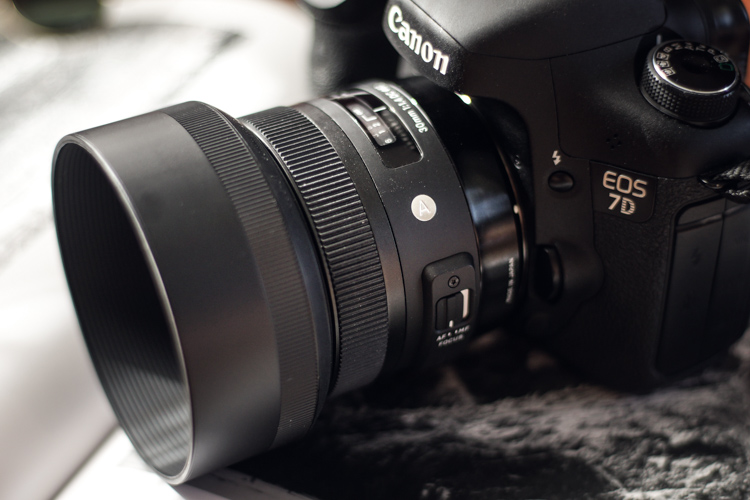
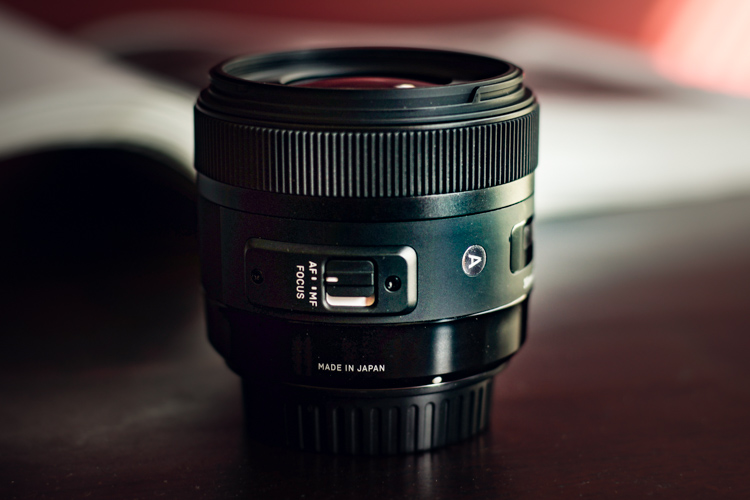
Being part of Sigma’s well regarded Art line of lenses, I expected the 30mm to be highly refined and well-built; it did not disappoint in this area. It’s manufactured from the same thermally stable composite (TSC) which is incredibly metallic in its heft and appearance. The entire lens looks very smooth and professional, with all markings and indicators being commendably well executed. The focusing ring has that perfect feel of silk when it’s turned. It moves very smoothly, being neither overly tight, nor too loose. The travel from minimum focus distance to infinity is just right, and it still leaves a lot of cushion for focusing accurately when in manual mode. The AF/Manual switch is ideally placed for no-look operation, and is very crisp when it is clicked from one to the other.

Sigma 5

Sigma 3

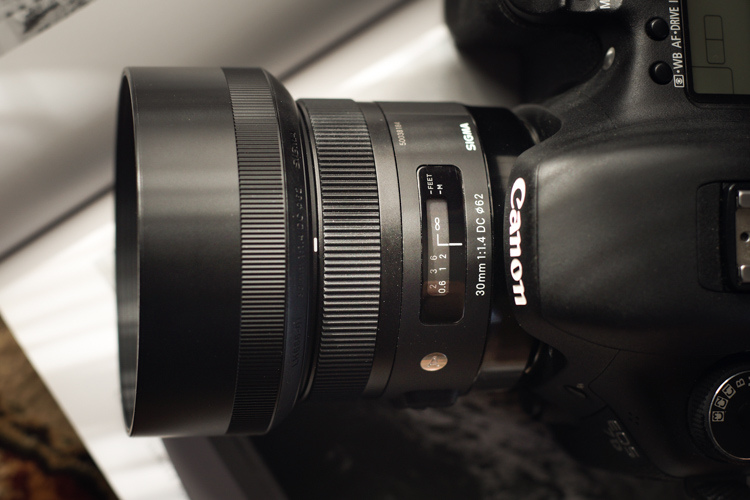
Included in the package is also a great looking lens hood which causes a bit of deception when attached because it makes the lens appear markedly larger than it actually is in reality. But it does a superb job of reducing the amount of contrast-robbing peripheral light from making its way to the lens’s front element. Overall, the quality of workmanship displayed in the 30mm is outstanding. It feels very well balanced when mounted to the camera (Canon 7D).

Sigma 1

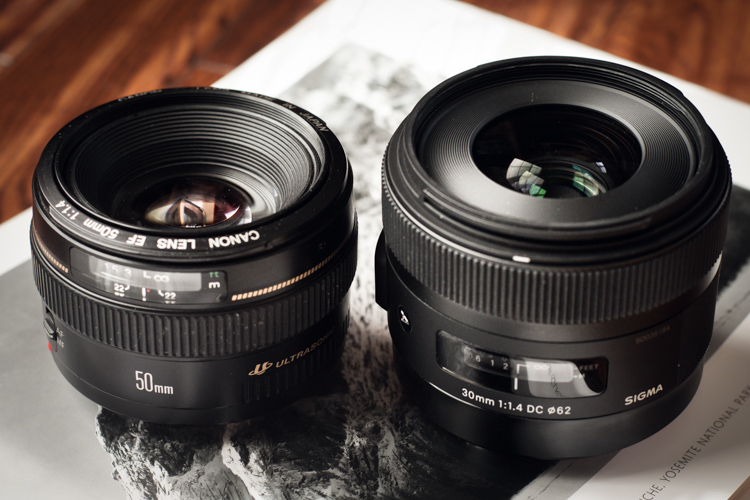
It leans towards the robust side in terms of weight for a normal (close to the naked eye’s field of view) prime lens at 15.3 ounces (434g), but it is by no means clunky or difficult to shoulder for long periods. Here we see the Sigma 30mm f/1.4 compared to another prime work horse, the Canon 50mm f/1.4.

Canon Sigma

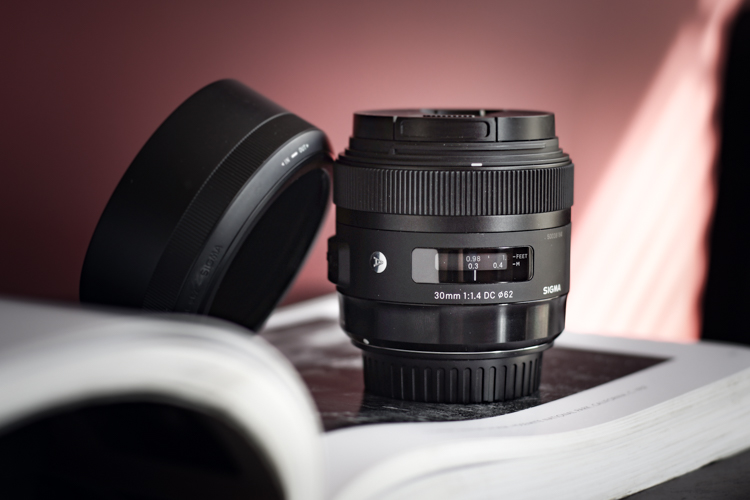
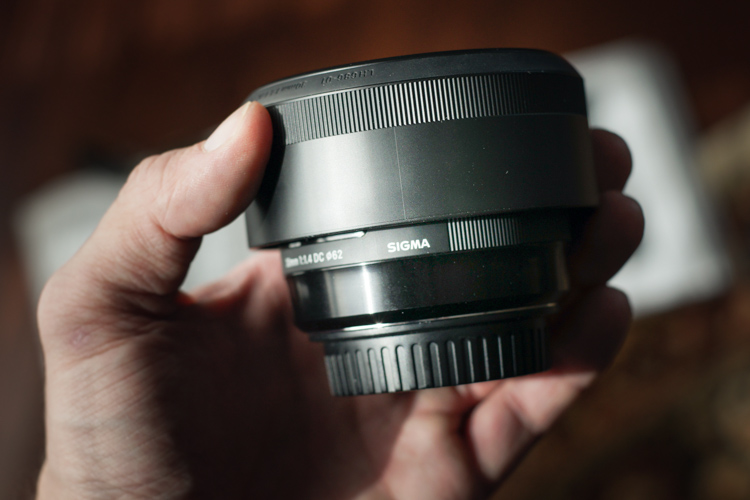
With the lens hood reversed for storage, it’s easy to see just how compact this lens really is in the hand.

Sigma in hand

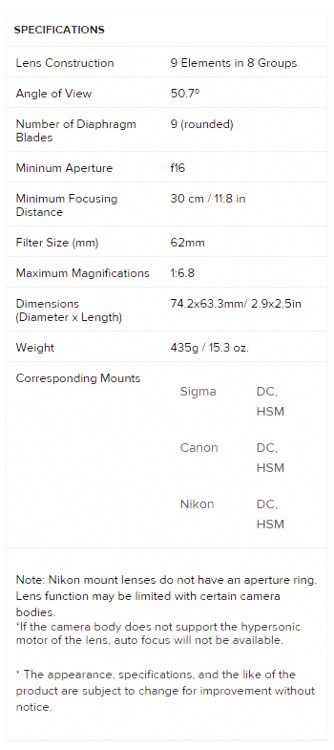
Here are the official lens specifications and element array provided via Sigma USA.

Sigma 30 Specs


Image Quality

The Sigma 30mm f/1.4 is quite the beast, photographically speaking. The 30mm focal range is very close to what could be considered wide angle, yet it shows no perceivable distortions at the corners. The bokeh is absolutely beautiful; the nine curved aperture blades produce an incredibly smooth, nearly dream-like, background blur when shooting at wide apertures. Some portraits today are being shot with alarmingly short focal lengths with very positive results. This lens would serve that purpose well, and offers richly vibrant colors across the entire aperture range. This great color rendition will make for a love at first sight situation with landscape photographers also. If you shoot a lot of nightscapes this lens will appeal to you as well. Of course the f/1.4 aperture capability makes for great low light work, but the coma was found to be very low likewise. This means all your great shots of the night sky will be produced clearly, with little distortion of those small points of starlight.

The autofocusing of the Sigma 30mm f/1.4 is also a point of praise. Focusing was very fast and accurate, and very quiet. It’s great to see a prime lens with AF that is on par with its other features. While manual focusing is always a good idea, the benefit of a high-performing autofocusing mechanism can’t be understated when shooting at the wide open apertures which this lens is capable of achieving.

This brings us to one of the only two downsides thus far found in the 30mm; its sharpness at small and large apertures. It is certainly not uncommon to see a marginal reduction in sharpness when approaching minimum and maximum apertures, from even the most highly prized lenses. From f/2.2 through to f/11, the sharpness of this lens is wonderful. Anything smaller than f/11 or wider than f/2.2 however, saw a significant drop in overall sharpness in my tests. Happily though, that leaves an enormous range of possibilities for optimal image sharpness, and in my opinion, should not diminish the respect this lens deserves.

Here are some sample images to demonstrate the corner sharpness over a range of apertures from f/1.4 through to f/16. The first picture is for reference to the 1:1 magnification applied to the samples.

Corner 1 to 1

And now for the samples:

F 1 4

F 2

F 2 8


F 5 6

F 8

F 11

F 16

The other downside is relatively noticeable chromatic aberrations at wide apertures. Of course this is to be expected, but it bears mentioning nonetheless. For a lens of this quality the chromatic aberration is a little more than expected when the lens is wide open at f/1.4. These aberrations drop extremely quickly past f/1.8 and diminish completely around f/2.2.

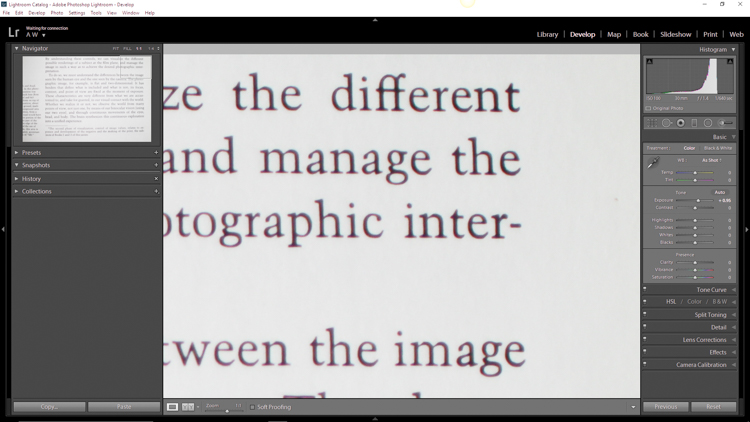
Even at their most noticeable, Lightroom handled the fringing easily in post-processing. Much like the sharpness issue, for most shooters, the chromatic aberrations shouldn’t be a concern, or at the very least should be manageable.

The 30mm F1.4 DC HSM | Art is a terrific lens, despite any marginal concerns with sharpness and aberrations. It performs quite well across a wide range of situations, and will be a great addition to those looking for a low light prime lens with low distortion. Astro photographers will love it for its low coma and sweeping perspective, and landscapers will be drawn to its wonderful color rendition. Even street photographers would be elated to have this lens in their bag due to its incredible bokeh.

Here are a few real world sample images which were shot with the Sigma 30mm F1.4 DC HSM | Art lens, mounted to a Canon 7D, processed in Adobe Lightroom CC.

Sigma 30 Sample 1

Sigma 30 Sample 2

Sigma 30 Sample 3

Sigma 30 Sample 4

Sigma 30 Sample 5

Sigma 30 Sample 6

I would recommend this lens to virtually anyone who needs a sturdy low light prime lens. It fits a myriad of circumstances when high grade professional quality photographs are needed. When shooting at common apertures it is an incredible value for a prime lens at this price point.

googletag.cmd.push(function() {
tablet_slots.push( googletag.defineSlot( “/1005424/_dPSv4_tab-all-article-bottom_(300×250)”, [300, 250], “pb-ad-78623” ).addService( googletag.pubads() ) ); } );

googletag.cmd.push(function() {
mobile_slots.push( googletag.defineSlot( “/1005424/_dPSv4_mob-all-article-bottom_(300×250)”, [300, 250], “pb-ad-78158” ).addService( googletag.pubads() ) ); } );

The post Sigma 30mm f/1.4 DC HSM Art Lens Review by Adam Welch appeared first on Digital Photography School.


Digital Photography School

 
Comments Off on Sigma 30mm f/1.4 DC HSM Art Lens Review

Posted in Photography


Samyang announces 14mm F2.8 and 50mm F1.4 autofocus FE lenses

04 May

Samyang Optics has announced its first autofocus lenses. The 14mm F2.8 ED AS IF UMC and 50mm F1.4 AS IF UMC will be offered in Sony’s E-mount and are designed to cover a full-frame sensor. With a robust metal housing, each lens will be able to utilize phase detection AF as well as contrast detection, and will offer 67mm filter threads.

The 14mm F2.8 and 50mm F1.4 will be available in July 2016; no price is given yet. Keep an eye on Samyang’s Facebook page and website for more information.


Press release:

May 3rd, 2016, Seoul, Korea – The global optics brand, Samyang Optics (http://www.samyanglensglobal.com) today announced the long-awaited launch of two autofocus lenses: 14mm F2.8 and 50mm F1.4 lenses for Sony E mount Mirrorless cameras with full frame sensor size. The new 14mm and 50mm are the widest and brightest lenses in their class and offer superb quality images to photographers. This launching expands the boundaries of Samyang Optics photo lens line-up from manual focus only, to now include autofocus lenses.

Optimised Optical Design as Full Frame Mirrorless Camera Lens

Both 14mm F2.8 ED AS IF UMC and 50mm F1.4 AS IF UMC are specifically designed to work in harmony with full frame mirrorless cameras in Sony E mount. The flow of light is devised based on the uniqueness of the distance from glass to sensor in mirrorless cameras to create optimal performance. Along with portability of mirrorless lenses, the 14mm F2.8 and 50mm F1.4 are compatible with full frame sensors to deliver the wideness and sharpness of image to photographers.

The 67mm filter diameter brings the maximum amount of light into the lens to create the best work of light in photography. The 14mm F2.8 is the widest angle available in the market and the F1.4 of 50mm and F2.8 of 14mm apertures are by far the brightest of full frame mirrorless lenses, offering a beautiful bokeh effect and the best quality images under various exposure conditions.

Based on Samyang Optics’ exceptional optical technology, aspherical lenses have been included in both lenses to minimise aberration and unnecessary light dispersion, delivering high resolution from the centre to the corners of the image.

AF Performance and Ergonomic Design Based on Class-Leading Technology

These new products will be the first autofocus lenses in over 40 years of Samyang’s class-leading core optics technologies. Samyang has captured the essence of world leading image technology with their manual focus lenses and reinterpreted it into autofocus lenses. Photographers now can enjoy the prime manual lens image quality and autofocus lens. These new 14mm F2.8 and 50mm F1.4 are compatible with both phase detect and contrast detect sensors to operate fast and accurate focus detection.

The 67mm filter diameter is also the result of years of R&D for best handling, by adding stability to the photo-taking experience. Also the minimal and sleek design and metal-housing solidify the build quality with the internal focus system.

These two new autofocus lenses from Samyang Optics will be exhibited at the Photo & Imaging 2016 Show in Seoul, South Korea. The lenses will be globally available from July 2016. Further details, pricing and availability will follow.

Articles: Digital Photography Review (dpreview.com)

 
Comments Off on Samyang announces 14mm F2.8 and 50mm F1.4 autofocus FE lenses

Posted in Uncategorized


Prime time: Sigma 30mm F1.4 DC DN | C full-production sample gallery

20 Apr

We had our first opportunity to shoot with the Sigma 30mm F1.4 Contemporary at CP+, spending some time with a pre-production lens taking in Japan’s freshly snow-coated landscapes. With a full-production lens in hand and good weather in the air, we’ve put the Sigma 30mm through its paces a little closer to home. Designed for Micro Four Thirds and Sony E-mount cameras, the featherweight prime is at home on Sony’s a6300 and a6000. Take a look at what this combo can do.

Articles: Digital Photography Review (dpreview.com)

 
Comments Off on Prime time: Sigma 30mm F1.4 DC DN | C full-production sample gallery

Posted in Uncategorized


Leica announces price and details of its 35mm F1.4 lens for the T system

24 Mar

$ (document).ready(function() { SampleGalleryV2({“containerId”:”embeddedSampleGallery_3566641259″,”galleryId”:”3566641259″,”isEmbeddedWidget”:true,”standalone”:false,”selectedImageIndex”:0,”startInCommentsView”:false,”isMobile”:false}) });

Leica has formally announced the specifications and price of the Summilux-TL 35mm F1.4 lens for its T-series mirrorless camera. The lens, which is available now, will cost $ 2395/£1650. Leica says that the lens performs at its best wide open, with maximum resolution achieved at F1.4 – though its own MTF charts suggest this is only true in the center of the imaging circle.

Designed to suit the Leica T’s compact footprint, the Summilux-TL F1.4 can also be used on the Leica SL in crop-sensor mode.

Made with a total of 12 elements in 8 groups and a closest focus distance of 0.4m, the lens acts as a standard focal length for the APS-C sensor of the T. Focus can be achieved manually as well as in auto mode, and the smallest aperture on offer is F16.

The lens measures 77 x 70mm/3.0 x 2.7in, weighs 428g/15oz without the hood and will be available in anodized black or silver. Leica originally announced that it would make the lens when it released firmware 1.4 for the T at the end of 2015. We should expect a Leica APO-Macro-Elmarit-TL 60mm F2.8 ASPH in the autumn.

For more information see the Leica website.


Press release:

LEICA SUMMILUX-TL 35mm f/1.4 ASPH.

Introducing a new reference lens in the APS-C system category

Leica Camera has today introduced a new addition to the Leica T Camera System portfolio – the Leica Summilux-TL 35mm f/1.4 ASPH. – an extremely fast prime lens with a classic focal length. Set to become the reference lens in the APS-C category, it offers exceptional imaging performance.

The Leica Summilux-TL 35mm f/1.4 ASPH. delivers maximum sharpness, and superb resolution and colour reproduction when shooting wide open, throughout its aperture range, and at all distances from its closest focusing limit to infinity. It also produces stunning pictures with that unmistakeable ‘Leica look’ and a unique and beautiful bokeh.

Considering the outstanding speed and extraordinary image performance, this 35mm lens is surprisingly compact – and, thanks to the internal focusing system, its overall length remains unchanged in use. Furthermore, the lens’ manual focusing ring enables the smoothest adjustments to be made when shooting.

As with all other Leica lenses, the Leica Summilux-TL 35mm f/1.4 ASPH. has been designed by Leica’s own specialists in Wetzlar, Germany, and represents a perfect union of optical and technical expertise. This combination of cutting-edge technology and the highest quality materials ensures consistently excellent results

As indicated by the ‘TL’ in its name, the Leica Summilux-TL 35mm f/1.4 ASPH. is the first of two new prime lenses for the Leica T Camera System that is fully compatible with the bayonet mount of the Leica T, as well as the L-mount of the Leica SL-System. The second TL lens, the Leica APO Macro-Elmarit-TL 60mm f/2.8 ASPH., will be available from Autumn 2016.

Availability and pricing

The Summilux-TL 35 mm f/1.4 ASPH. is available now in a choice of black or silver anodised finish from authorised Leica stockists in the UK, at a suggested retail price of £1,650 including VAT. A matching lens hood is also available at an SRP of £65 including VAT.

Additional information can be found at uk.leica-camera.com

Articles: Digital Photography Review (dpreview.com)

 
Comments Off on Leica announces price and details of its 35mm F1.4 lens for the T system

Posted in Uncategorized


Seriously sharp: Sony FE 85mm F1.4 GM samples

11 Mar

We knew Sony’s FE 85mm F1.4 G Master lens was sharp. After all, we had the chance to shoot with it briefly back in February at the Sony a6300 launch event in New York City. But last week we got better acquainted with the lens, putting it through its paces in different shooting scenarios throughout Miami. And simply put, this lens is seriously sharp. All of the samples in the gallery were shot using the Sony a7R II. Please note, we’ve included Raw files for download for a selection of the images.

Note: This sample gallery was shot while on a Sony-sponsored shooting event in Miami. Part of the excursion included photographing models in scenes that call back to famous Miami-based TV shows and movies including Scarface, Miami Vice and CSI Miami. No actual gangsters or cops were photographed during the making of this gallery.

Articles: Digital Photography Review (dpreview.com)

 
Comments Off on Seriously sharp: Sony FE 85mm F1.4 GM samples

Posted in Uncategorized


Sigma 30mm F1.4 DC DN Contemporary real-world sample gallery

09 Mar

Among all its releases at CP+ 2016, Sigma’s 30mm F1.4 DC DN Contemporary lens is the smallest in size, but its wide aperture should help it pack an image quality punch. Designed for Micro Four Thirds cameras and Sony E-Mount, the Sigma 30mm F1.4 uses a stepping motor for quiet autofocus, weighs in at a feathery 265g (9.3oz), and will retail for $ 339 when it’s released later this month.

During a visit to the Sigma factory in Aizu, Japan, we had a chance to test it out in a snowy winter wonderland. The lens is a pre-production sample, and the images were shot on a Sony a7R II in crop mode. We’ve included JPEGs processed from Raw using Adobe Camera Raw (some with and without manual distortion correction), and original Raw files as well, for your viewing pleasure. Check them out and see how the lens stacks up.

Articles: Digital Photography Review (dpreview.com)

 
Comments Off on Sigma 30mm F1.4 DC DN Contemporary real-world sample gallery

Posted in Uncategorized


My New Favorite Lens: The Fujinon 35mm F1.4 R

01 Mar

Before I switched to Fujifilm I was a Canon EOS user. My favorite camera was the EOS 5D Mark II and my favorite lens the 85mm f/1.8. I liked that lens because it was ideal for portraits, and for close-ups revealing details.

When I switched to Fujifilm I expected the Fujinon 56mm f/1.2 lens, the closest equivalent (on an APS-C crop sensor camera) to the 85mm, to become my new favorite. It’s a great lens, especially for portraiture. But, to my surprise, the humble 35mm f/1.4 lens, bundled with the X-Pro 1, has become my new favorite.

Favorite lens 35mm Fujinon f1.4

At first I was a little puzzled as to why. With Canon I owned a 50mm lens, and while I tried to use it in practice, it didn’t get used much. It was more of an experimental lens – I used it with extension tubes, and reversed for experimental close-up and macro photography. Occasionally I used it while out shooting, but always ended up preferring either the 85mm (short telephoto) or a wide-angle.

So what happened with the 35mm f/1.4 lens (which has the same angle-of-view, and is a normal lens for an APS-C camera)? I think, a number of things happened.

  • The 35mm suits the X-T1, the camera I use most of the time, very well. The camera feels well balanced, and is light enough to carry around all day.
  • This camera and lens combination is ideal for taking candid photos of people, without being too far away (losing the sense of intimacy and closeness) or having to get too close to fill the frame (where I would be getting close enough to bother people). People may notice me with it, but they don’t seem to be worried by it.
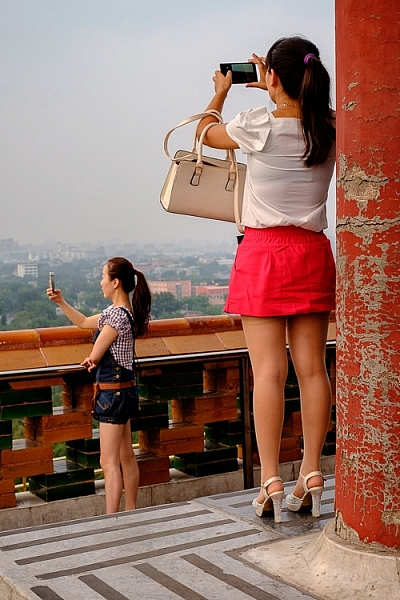
  • It’s an ideal focal length for environmental portraiture. I used it the 35mm lens a lot during a recent trip to China, where I had a lot of fun photographing people. It allows me to capture a scene with people in it, without revealing too much (always a danger with wide-angle lenses) or too little (as can happen with short telephotos).

These two photos are great examples.

Favorite lens 35mm Fujinon f1.4

Favorite lens 35mm Fujinon f1.4

Another thing I like about the 35mm lens, is that it focuses quite close to the subject, allowing me to move in close for detail shots without having to use a close-up lens or extension rings. The 85mm lens that I used with my Canon camera didn’t focus quite so closely, and I had to use a 500D close-up lens (filter) with it for close-up photography. Here’s an example.

Favorite lens 35mm Fujinon f1.4

One of the benefits of a mirrorless camera system, with an APS-C sensor, is that the lenses are smaller and lighter than those made for camera systems with full-frame models. The 35mm lens is small (it’s only 55 mm long) and light (it only weighs 187 grams, 6.5 ounces). Compare those dimensions to a 35mm f/1.4 lens made for a full-frame camera and you’ll see what I mean (Canon’s 35mm f/1.4 is 20.46 oz., or 580 grams).

That wide aperture comes in very useful when shooting in low light, or if you want to use a wide aperture for creative effect. This lens gives me the best of two worlds – small size and wide aperture. This photo, taken at f/1.4, ISO 6400, shows how useful a wide aperture is in low light.

Favorite lens 35mm Fujinon f1.4

Another benefit of this lens is that I can take photos that aren’t affected by converging verticals. With wide-angles, even moderate ones, any slight tilt of the camera results in converging verticals. Vertical lines are crooked rather than straight. It’s not necessarily a bad thing, but sometimes I prefer the straightness and order, imposed by the 35mm lens. This candid photo shows the point – with a 35mm lens it was easy to frame the photo and make sure the pillar (and the other verticals) were straight.

Favorite lens 35mm Fujinon f1.4

The focal length also works very well when I shoot in the square format. There is something a little magical about the results, and I have been using it a lot for that lately. Here is a photo I took recently in Spain.

Favorite lens 35mm Fujinon f1.4

Your turn

Have you used the Fujinon 35mm f/1.4 lens? Or indeed any other normal or standard lens? Let us know what you like, or dislike, about these lenses in the comments. It will be interesting to hear what you think.


Mastering Lenses photography ebookMastering Lenses

My new ebook Mastering Lenses: A Photographer’s Guide to Creating Beautiful Photos With Any Lens shows you how to get the best from the lenses you own already. A comprehensive guide to exploring the creative potential potential of wide-angle, normal and telephoto lenses, it’s also the ultimate buying guide for readers thinking about purchasing a new lens for their camera. Please click the link to learn more or buy.

googletag.cmd.push(function() {
tablet_slots.push( googletag.defineSlot( “/1005424/_dPSv4_tab-all-article-bottom_(300×250)”, [300, 250], “pb-ad-78623” ).addService( googletag.pubads() ) ); } );

googletag.cmd.push(function() {
mobile_slots.push( googletag.defineSlot( “/1005424/_dPSv4_mob-all-article-bottom_(300×250)”, [300, 250], “pb-ad-78158” ).addService( googletag.pubads() ) ); } );

The post My New Favorite Lens: The Fujinon 35mm F1.4 R by Andrew S. Gibson appeared first on Digital Photography School.


Digital Photography School

 
Comments Off on My New Favorite Lens: The Fujinon 35mm F1.4 R

Posted in Photography


Sigma announces 30mm F1.4 for E-mount and Micro 4/3 and 50-100mm F1.8 Art for APS-C

23 Feb

$ (document).ready(function() { SampleGalleryV2({“containerId”:”embeddedSampleGallery_8227781120″,”galleryId”:”8227781120″,”isEmbeddedWidget”:true,”standalone”:false,”selectedImageIndex”:0,”startInCommentsView”:false,”isMobile”:false}) });

Sigma has added two new fast-aperture lenses to its Art and Contemporary lineups. 

For owners of Canon, Nikon and Sigma APS-C bodies there’s the 50-100mm F1.8 DC HSM Art, which is equivalent to 75-150mm. This lens has a redesigned Hyper Sonic Motor, nine-blade rounded aperture and internal zoom. Being a weighty lens (1490g/3.3lbs), it also has a built-in tripod socket.

The other lens is for Sony E-mount and Micro Four Thirds bodies, and it’s a fast 30mm F1.4 prime, equivalent to 45mm and 60mm, respectively. This lens uses a stepping motor for fast and quiet focus during video and weighs just 263g/9.3oz. 

The 30mm F1.4 will ship in mid-March at an MSRP of $ 339, while the 50-100mm F1.8 is expected in late April priced at $ 1099.

Press release:

Sigma Expands Its Global Vision Lens Line With Two New High-Performance Lenses

50-100mm F1.8 DC HSM Art and 30mm F1.4 DC DN Contemporary 

50-100mm is first constant aperture F1.8 telephoto zoom; 30mm represents first affordable F1.4 high-performance lens for mirrorless cameras

KANAGAWA, JAPAN — February 23, 2016 – Sigma Corporation of America, a leading DSLR lens, camera, flash and accessories manufacturer, today announced the addition of two high-performance APS-C format lenses to the Sigma Global Vision product line: Sigma 50-100mm F1.8 DC HSM Art Lens and the Sigma 30mm F1.4 DC DN Contemporary Lens. 

“Sigma’s aim is to provide high-performance lens options that lead with innovation and break new boundaries for every photographic scenario our customers can dream up,” states Mark Amir-Hamzeh, president of Sigma Corporation of America. “These new lenses build on Global Vision’s great IQ technology and reflect this goal, delivering immense value, quality and performance that the Sigma brand is known for.”

Sigma 50-100mm F1.8 DC HSM Art

Building on the groundbreaking Sigma Global Vision 18-35mm F1.8 DC HSM Art Lens, the new Sigma 50-100 F1.8 (75-150mm on 35mm format) mid-range zoom lens embodies the same engineering prowess to deliver outstanding prime lens-like results. Factoring in the APS-C image circle of 1.5x, the 50-100mm F1.8 covers three popular short tele prime focal lengths: 85mm, 105mm and 135mm. Like the 18-35mm F1.8, the new 50-100mm F1.8 maintains a constant F1.8 aperture yielding exceptional brightness and resolution throughout the zoom, while simultaneously maintaining focus as the lens is zoomed, a feature videographers will greatly appreciate. 

Sigma Art Line Image Technology Innovation

  • Features three FLD (F Low Dispersion) glass elements, one SLD (Special Low Dispersion) glass element, and one high-refractive index, high-dispersion glass element to minimize aberrations.
  • Redesigned and enhanced, the new Hyper Sonic Motor is 30% slimmer and provides fast and accurate AF.
  • Highly durable polycarbonate diaphragm made with fluorine; blades feature carbon feather film offering exceptionally smooth operation even during continuous shooting.

Outstanding Zoom Lens Maneuverability

  • Inner focusing and zoom design offer versatile shooting options
  • Tripod socket for stable, comfortable operation
  • Features 21 elements / 15 groups, Minimum Aperture: F1.6, 82mm filter thread, Minimum Focus Distance: 37.4in, Dimensions: 3.7×6.7, Weight: 52.6oz

The new Sigma 50-100mm F1.8 Art will be available in Canon, Nikon and Sigma mounts. For more information, please visit www.sigmaphoto.com/50-100mm-f1-8-dc-hsm-art.

Sigma 30mm F1.4 DC DN Contemporary 

Combining outstanding optical performance and compact design, the new affordable Sigma 30mm F1.4 DC DN Contemporary Lens brings immense value to mirrorless cameras. Boasting superior image quality with F1.4 brightness, the versatile lens covers a wide range of photo and video capture scenarios, delighting users with its beautiful bokeh effects. 

Contemporary Line Performance and Value

  • Represents first affordable F1.4 performance lens for the mirrorless market
  • Sigma engineered quality within a sleek compact design
  • Fast, smooth AF stepping motor designed to support video
  • Features one aspherical element and one double-sided aspherical element producing imaging quality comparable to the Art line.
  • Features 9 elements / 7 groups, Minimum Aperture: F16, 52mm filter thread, Minimum Focus Distance: 11.8in, Weight: 9.3oz, Dimensions: 2.6×2.9in.

The new Sigma 30mm F1.4 DC DN Contemporary Lens will be available in Sony E-Mount and Micro Four Thirds mount. For more information, please visit www.sigmaphoto.com/30mm-f1-4-dc-dn-c.

Sigma Global Vision lenses including the new 50-100mm F1.8 DC Art and 30mm F1.4 Contemporary lenses can be updated with the latest lens software from a workstation or laptop using the Sigma Optimization Pro software and Sigma USB Dock (sold separately).

Tested for Optimum Performance

Sigma lenses are born of well-thought-out design concepts, exceptional Japanese craftsmanship and manufacturing, and advanced lens performance testing and evaluation. To this end, Sigma has developed its own A1 proprietary MTF (modulation transfer function) measuring system using 46-megapixel Foveon direct image sensors. Even the most elusive high-frequency details are within the scope of Sigma’s quality control inspections. Every Global Vision lens is A1 tested, analyzed and approved before leaving the factory ensuring maximum performance out of the box.

For more information on Sigma’s industry leading testing, please visit http://blog.sigmaphoto.com/2012/a1-mtf-testing-for-new-sigma-lenses/

Specialized Mount Conversion Services 

Ensuring continued ROI, Sigma will convert the current mount of your Sigma Global Vision lens to another of your choice. Sigma lenses currently from the Contemporary, Art or Sports line, in Sigma, Canon, Nikon, Sony, Pentax mounts can be converted to Sigma, Canon, Nikon, Sony or Pentax*.  Mirrorless lenses can be converted to Micro Four Thirds and Sony-E Mount. They cannot be converted to either an APS-C or a Full Frame format.  *For specific details, please visit http://www.sigmaphoto.com/service-support/mount-conversion-service

Sigma 30mm F1.4 DC DN Contemporary and 50-150mm F1.8 Art specifications

  Sigma 30mm F1.4 DC DN | C Sigma 50-100mm F1.8 DC HSM Art
Principal specifications
Lens type Prime lens Zoom lens
Max Format size APS-C / DX
Focal length 30 mm 50–100 mm
Image stabilisation No
Lens mount Micro Four Thirds, Sony E (NEX) Canon EF, Nikon F (DX), Sigma SA Bayonet
Aperture
Maximum aperture F1.4 F1.8
Minimum aperture F16.0
Aperture ring No
Number of diaphragm blades 9
Aperture notes Rounded blades
Optics
Elements 9 21
Groups 7 15
Special elements / coatings 1 aspherical and 1 double-sided aspherical Three FLD, one SLD, one HRI elements
Focus
Minimum focus 0.30 m (11.81) 0.95 m (37.4)
Maximum magnification 0.14× 0.15×
Autofocus Yes
Motor type Stepper motor
Full time manual No
Focus method Internal
Distance scale No
DoF scale No
Physical
Weight 265 g (0.58 lb) 1490 g (3.28 lb)
Diameter 65 mm (2.56) 94 mm (3.7)
Length 73 mm (2.87) 171 mm (6.73)
Sealing No
Colour Black
Zoom method Rotary (internal)
Power zoom No
Filter thread 52.0 mm 82.0 mm
Hood supplied No Yes
Tripod collar No

Articles: Digital Photography Review (dpreview.com)

 
Comments Off on Sigma announces 30mm F1.4 for E-mount and Micro 4/3 and 50-100mm F1.8 Art for APS-C

Posted in Uncategorized