RSS
 

Posts Tagged ‘Emount’

Finally! Sony NPA-MQZ1K Multi-Battery Adaptor Kit provides power for E-mount users

20 Apr

Announced alongside the a9 is an accessory that should excite existing E-mount camera owners, particularly videographers: the NPA-MQZ1K Multi-Battery Adaptor Kit. It comes with two of the new NP-FZ100 batteries and has space for another two. The kit not only works as a charging station for up to four Z type batteries, but also has a dummy battery that allows it to be used as an external power pack.

The unit is compatible not only with the a9 but also with the a7, a7R, a7S, a7 II, a7R II, a7S II, a6000, a6300, a6500, a5000, a5100 and RX10 III, providing up to 8x their current battery capacity. It includes tripod-style mounting sockets for attachment to a video rig.

The dummy battery is the same shape as the a9’s new ‘Z type’ battery but has an outer shell that can be removed, revealing a ‘W type’ adapter, which can slot into cameras that use the NP-FW50 battery.

Articles: Digital Photography Review (dpreview.com)

 
Comments Off on Finally! Sony NPA-MQZ1K Multi-Battery Adaptor Kit provides power for E-mount users

Posted in Uncategorized


CP+ 2017: Hands-on with new Voigtländer E-mount primes

24 Feb

CP+ 2017: Hands-on with new Voigtländer E-mount primes

Voigtländer announced three new lenses at this year’s CP+ show in Yokohama, for the Sony E Mount. We’re at the show, and we made our way to the Voigtländer booth earlier to take a closer look at the Nokton classic 35mm F1.4, Nokton 40mm F1.2, and Macro APO-Lanthar 65mm F2 (pictured above). 

CP+ 2017: Hands-on with new Voigtländer E-mount primes

This is the Macro APO-Lanthar 65mm F2, which like all Voigtländer primes, is finished to a very high standard. A physical aperture ring with well-placed 1/3EV detents is positioned – rangefinder style – at the far end of the lens, and a broad, knurled focusing ring further back, towards the camera. The red, green and blue flashes are a nod to the older and much sought-after 125/2.5 APO-Lanthar.

CP+ 2017: Hands-on with new Voigtländer E-mount primes

Electrical contacts communicate EXIF to the camera body, which is a big advantage in manual lenses.

CP+ 2017: Hands-on with new Voigtländer E-mount primes

At its minimum focusing distance, the 62mm can achieve a maximum magnification of 1:2. Not quite ‘true’ macro, but not bad. As you can see though, despite its modest focal length, the lens extends considerable when in its near-macro focus range. 

CP+ 2017: Hands-on with new Voigtländer E-mount primes

At infinity on the other hand, it’s a pleasantly compact short telephoto prime.

CP+ 2017: Hands-on with new Voigtländer E-mount primes

The Macro APO-Lanthar 65mm F2 Aspherical was announced at Photokina 2016 as a concept, but is now moving towards production. Pricing and availability has yet to be confirmed.

CP+ 2017: Hands-on with new Voigtländer E-mount primes

Here is the Nokton 40mm F1.2 Aspherical – a fast, ‘normal’ prime lens for the Sony E mount. Cosmetically similar to the 65mm macro, the 40mm is more compact, obviously much brighter lens. 

CP+ 2017: Hands-on with new Voigtländer E-mount primes

The fastest 40mm ever made for full frame (in case you’ve been waiting for one) the 40mm Nokton is based on an older VM (Leica M) mount lens, but has been ‘optimized’ for Sony E mount.

CP+ 2017: Hands-on with new Voigtländer E-mount primes

Again, electrical contacts ensure that EXIF information is recorded to the camera. According to Voigtländer’s (slightly imprecisely translated) press release, the 40mm Nokton features a ‘weak aperture stop click release mechanism’ for smooth, clickless aperture progression in video shooting. Full disclosure – we couldn’t figure out how to engage it, but it’s been a very long day. 

CP+ 2017: Hands-on with new Voigtländer E-mount primes

A close focusing distance of 40cm isn’t amazing, but that’s one of the tradeoffs of such a fast maximum aperture. Again, pricing and availability of the 40mm Nokton has yet to be confirmed, but we’ll update this story if and when the information becomes available. 

CP+ 2017: Hands-on with new Voigtländer E-mount primes

Another design adapted from an older lens, the Nokton classic 35mm F1.4 is an E-mount version of the M-mount Nokton that Voigtländer has been selling for some time. This lens was only on show under glass, so we didn’t get to handle it. We’d expect it to be built to the same high standard as the older M-mount version though.

CP+ 2017: Hands-on with new Voigtländer E-mount primes

Another view of the Nokton 35mm, showing off its minimalist design.

CP+ 2017: Hands-on with new Voigtländer E-mount primes

Again, in the rangefinder style, the Nokton classic features a slim aperture ring positioned at the front of the lens. A broad focusing ring makes up most of the lens’s length. 

Articles: Digital Photography Review (dpreview.com)

 
Comments Off on CP+ 2017: Hands-on with new Voigtländer E-mount primes

Posted in Uncategorized


Cosina announces development of three Voigtlander E-mount lenses

24 Feb
From left to right: Nokton classic 35mm F1.4, Nokton 40mm F1.2, Macro APO-Lanthar 65mm F2.

Cosina has announced the development of three manual focus Voigtländer prime lenses for Sony E-mount: the MACRO APO-LANTHAR 65mm F2 Aspherical, the Classic Nokton 35mm F1.4, and NOKTON 40mm F1.2 Aspherical. All three lenses offer complete E-mount support and will transmit EXIF data, will work with in-body image stabilization and allow automatic magnification when focusing.

Originally announced at Photokina 2016, the Macro APO-Lanthar 65mm F2 is one of the brightest Macro lenses for full-frame, and offers a reproduction ratio of 1:2. The Classic Nokton 35mm F1.4 is a redesign of the M-mount version, with optimization for the Sony’s sensor. Finally, the Nokton 40mm F1.2 is the fastest 40mm for full-frame format, and will be one of the fastest E-mount lenses available.

Pricing and release dates for all three lenses are currently unavailable.

Articles: Digital Photography Review (dpreview.com)

 
Comments Off on Cosina announces development of three Voigtlander E-mount lenses

Posted in Uncategorized


Meyer-Optik-Görlitz reveals Nocturnus 50 F0.95 II lens for Sony E-Mount

08 Dec

German lens maker Meyer-Optik has launched the Nocturnus 50 F0.95 II, a super-fast manual-focus standard lens for the Sony E-Mount that is optimized for use with full-frame sensors, but also works with APS-C cameras. 

The lens comes with a focal length of 50mm and an aperture range from F0.95 to F22, offering lots of flexibility, both when shooting in low light and in terms of depth-of-field. The lens design features 10 elements in 7 groups and ensures high levels of sharpness in the focus-plane. Meyer-Optik says the 15 aperture blades with anti-reflective coating create a pleasant bokeh with circular highlights. The Nocturnus has a minimum focus distance of 50cm and weighs 680 grams. Manual focus control and the stepless aperture ring operate almost silently, making the Nocturnus an interesting option for video applications. 

The Nocturnus 50 F0.95 II will be available from January 1st for €3000 (approximately $ 3225). More information is available on the Meyer-Optik-Görlitz website.

Nocturnus 50 F0.95 II samples provided by Meyer-Optik

$ (document).ready(function() { SampleGalleryV2({“containerId”:”embeddedSampleGallery_1858460089″,”galleryId”:”1858460089″,”isEmbeddedWidget”:true,”standalone”:false,”selectedImageIndex”:0,”startInCommentsView”:false,”isMobile”:false}) });
Articles: Digital Photography Review (dpreview.com)

 
Comments Off on Meyer-Optik-Görlitz reveals Nocturnus 50 F0.95 II lens for Sony E-Mount

Posted in Uncategorized


Voigtlander shows off three new lenses including 65mm F2 Macro for E-mount

06 Oct

$ (document).ready(function() { SampleGalleryV2({“containerId”:”embeddedSampleGallery_9965740614″,”galleryId”:”9965740614″,”isEmbeddedWidget”:true,”standalone”:false,”selectedImageIndex”:0,”startInCommentsView”:false,”isMobile”:false}) });

Lens manufacturer Voigtlander is set to introduce three unusual lenses this autumn and has posted pictures and specifications on its website, but isn’t letting on when they will arrive.

The most interesting, visually at least, is a VM 50mm F3.5 Heliar designed for M-mount bodies. It uses an almost symmetrical configuration of five elements in three groups and forms a conical shape reminiscent of the Tessar 50mm lenses of the Carl Zeiss Jena Werra cameras. The lens will have a minimum aperture of F22 and will use a 10-bladed iris that promises nice circular out-of-focus highlights. Remarkably, the aperture ring will be without click stops.

A more popular lens will be the 65mm F2 Macro Apo-Lanthar for the Sony E-mount system. This will have a closest focusing distance of 0.31m and will be able to transmit EXIF data to the camera as well as trigger manual focus assistance such as automatic magnification and peaking. It will have 10 elements in 8 groups and will offer apertures down to F22. The company has yet to decide whether the aperture ring will feature click stops, but again the iris will use 10 blades.

The third lens on display is a SL ll – S 58mm F1.4 Nokton designed for Nikon AI-S bodies. This new version of the company’s existing SL ll – N lens appears to be optically unchanged but it offers a more retro barrel design that echoes Nikon’s own manual focus lenses, and it has the addition of a meter coupling prong that will allow it to be used with much older bodies.

The company has not given any information on pricing or delivery dates, but you can read more specification on the Voigtlander website.

Articles: Digital Photography Review (dpreview.com)

 
Comments Off on Voigtlander shows off three new lenses including 65mm F2 Macro for E-mount

Posted in Uncategorized


Zeiss adds 85mm F2.4 to Loxia line for full-frame E-mount

16 Sep

Zeiss has just added an 85mm F2.4 to its Loxia range for full-frame Sony E-mount cameras. The 85mm brings a traditional portrait option to the 35mm F2, 50mm F2 and 21mm F2.8 existing models in the lineup. The manual focus lens offers the aperture de-click feature found on its siblings and promises ‘virtually distortion-free’ optics. The Zeiss Loxia 85mm F2.4 will go on sale in mid-December for $ 1399/€1399.

Press release:

Telephoto lens for the ZEISS Loxia family

With the ZEISS Loxia 2.4/85, the optics company expands its compact lens family for mirrorless Sony full-frame cameras with E mount

OBERKOCHEN/Germany, 15/09/2016.

The newest member of the ZEISS Loxia family is a short telephoto lens called the ZEISS Loxia 2.4/85. It supplements three focal lengths that are already available for this lens family, namely the ZEISS Loxia 2.8/21, Loxia 2/35 and Loxia 2/50, and was specially designed for mirrorless full-frame cameras with E mount. The compact ZEISS Loxia lenses are the ideal choice for travel and street photographers who value light and compact camera equipment. “In terms of its technology and the feel of its surface, the ZEISS Loxia 2.4/85 fits perfectly with the existing focal lengths, and is particularly well suited for portrait photography,” said Christophe Casenave, product manager with ZEISS Camera Lenses. The ZEISS Loxia 2.4/85 will be available in stores starting mid of December 2016.

Optimized ZEISS Sonnar® design

The new ZEISS Loxia 2.4/85 has been designed for digital sensors. Based on an optimized ZEISS Sonnar design, it has seven lens elements in seven groups. “With the ZEISS Loxia 2.4/85, we have managed to develop a well-rounded and new interpretation of the original ZEISS Sonnar optical design that meets all the requirements of digital photography and videography,” continued Casenave. The lens has a minimum object distance of 0.80 meters and a manual focus ring with a rotation angle of 220 degrees, enabling the subtlest variations of focusing. The large aperture of f/2.4 combined with the high-quality optical design ensures an appealing bokeh. The electronic interface transfers both lens data (EXIF) and focus movements, and activates the magnification function of the camera if desired by the user. “Precise manual focusing with hard stop and the mechanical setting of the aperture (working aperture priority mode) provide sophisticated photographers who don’t want to leave everything to the camera abundant possibilities for composition,” said Casenave.

Also suitable for cine applications

With the well-known De-Click function of the ZEISS Loxia lenses, the optics company is also targeting videographers. The De-Click function allows to mechanically deactivate the click stops on the aperture ring — a condition for silent and smooth adjustments of the aperture. As a result, the ZEISS Loxia 2.4/85 is also an attractive lens for video cameras that have an E mount, such as the Sony PXW-FS7 and PXW-FS5. A robust metal barrel, the filter diameter of M52 (which is identical across all focal lengths) and protection against penetration of dust and spray onto the lens mount complete the entire package. In addition, the external diameter, which is uniform across all ZEISS Loxia lenses, simplifies film shoots.

ZEISS Lens Gears

ZEISS Loxia lenses can also be used with a follow focus system. Made of high-quality aluminum with a hardened surface coating, the ZEISS Lens Gears are slid onto each respective lens and, through simple mounting, attached to the focus ring of the lens by turning two rings that each go in the opposite direction. Supplemented by a follow focus system, precise focusing is therefore possible and ZEISS Loxia lenses become endowed with similar features as a full-scale cine lens. The ZEISS Lens Gear Rings in the sizes mini (62 – 69mm, 60 – 67mm with GumGum) fit the ZEISS Loxia lenses.

Price and availability

Global delivery of the ZEISS Loxia 2.4/85 will begin mid of December 2016. The lens shade is included with delivery. The recommended retail sales price is 1,399 euros (including 19% VAT in Germany) or 1,399 US$ .

Articles: Digital Photography Review (dpreview.com)

 
Comments Off on Zeiss adds 85mm F2.4 to Loxia line for full-frame E-mount

Posted in Uncategorized


Sigma 30mm F1.4 DC DN Contemporary for Sony E-mount lens review

13 Sep

The Sigma 30mm F1.4 DN DC Contemporary was announced in February 2016, and sits atop Sigma’s line of DN mirrorless lenses, with a two-stop advantage over their previous 30mm F2.8 offering. It’s currently the only APS-C F1.4 autofocus lens currently available for the Sony E-mount and has an MSRP of $ 339.00.

With F1.4 and a 45mm equivalent field of view, this lens on paper appears to be a good choice for a ‘walkaround’ normal prime lens. The bright aperture will satisfy low light shooters and bokeh fanatics, and the near 50mm field of view puts it right inside the versatile ‘normal’ lens range. While it won’t replace a dedicated macro lens with its magnification ratio of 1:7, it still is able to focus down to a working distance of 30cm (less than a foot).

The relatively low price, especially for an E-mount lens, means it’s also accessible to beginners and enthusiasts alike, making it sound like an ideal prime lens that may never leave the front of the camera once it’s mounted.

Within the E-mount system this lens has one natural competitor: the Sony 35mm F1.8 OSS. Let’s look at how the two stack up on paper:

  Sony E 35mm F1.8 OSS Sigma 30mm F1.4 DC DN | C
MSRP $ 448 $ 339
Image Stabilization Yes No
Max Aperture F1.8 F1.4
Minimum Aperture F22 F16
Aperture Ring No No
Diaphragm Blades 7 9
Number of elements 8 9
Number of groups 6 7
Special elements/coatings 2 aspherical elements 1 aspherical and 1 double-sided aspherical
Minimum Focus 0.30 m (11.81?) 0.30 m (11.81?)
Maximum Magnification 0.15x 0.14x
Motor Type Stepper motor Stepper motor
Full Time Manual No No
Weight 155 g (0.34 lb) 265 g (0.58 lb)
Dimensions (DxL) 63 x 45 mm (2.5 x 1.8 in.) 65 x 73mm (2.6 x 2.9 in.)
Sealing None None
Filter Thread 49mm 52mm

In terms of just spec we see a couple of major differences. First, while the Sony is 2/3 of a stop slower than the Sigma, it does include optical image stabilization. That alone gives it a better chance at being the preferred lens for video, although when shooting 4K the slightly wider FOV of the Sigma might fare better on any body that gives an additional crop.

In stills terms, though, there’s little real-world difference between the Sigma’s 45mm equivalent view and the 52.5mm equivalent of the Sony. The difference between them doesn’t suddenly open one up to a type of photography that couldn’t be achieved with the other.

Build quality between the Sigma and the Sony is fairly similar. They both use a machined metal chassis with plastic internals. Compared to older Sigma DN lenses, the 30mm F1.4 doesn’t let its focus elements rattle about when unmounted, which is a very welcome change. The focus ring is also an improvement, and a step above the Sony. The rubber grip turns smoothly and easily with minimal effort, making the Sony feel a bit stiff. The only downfall in terms of build is the Sigma’s lens hood, which doesn’t seem to confidently click in to place, and is made of rather fragile feeling plastic.

The long barrel of the Sigma, and even longer overall dimensions do make it quite large in comparison to APS-C Sony Alpha cameras, but the weight isn’t entirely off-balance. While heavier and much bigger, it is less expensive and brighter than the Sony 35 F1.8. The question is, does the extra weight and lack of OSS keep it from topping the Sony as the ideal ‘normal’ for APS-C E-mount shooters?

Articles: Digital Photography Review (dpreview.com)

 
Comments Off on Sigma 30mm F1.4 DC DN Contemporary for Sony E-mount lens review

Posted in Uncategorized


FotodioX Lens Adapter – How to Put Your Canon EF Lens on Your Sony E-Mount Camera

29 Aug

One of the big hurdles for DSLR camera owners considering the switch to mirrorless, is the notion of having to buy brand new lenses to accompany their new purchase. While it’s ideal to have brand name lenses that match your camera body, it’s not at all necessary, thanks to third-party lens makers and lens adapters. This article discusses the latter option, specifically, a lens adapter that allows just about any Canon EF lens, to be used with a Sony E-Mount camera.
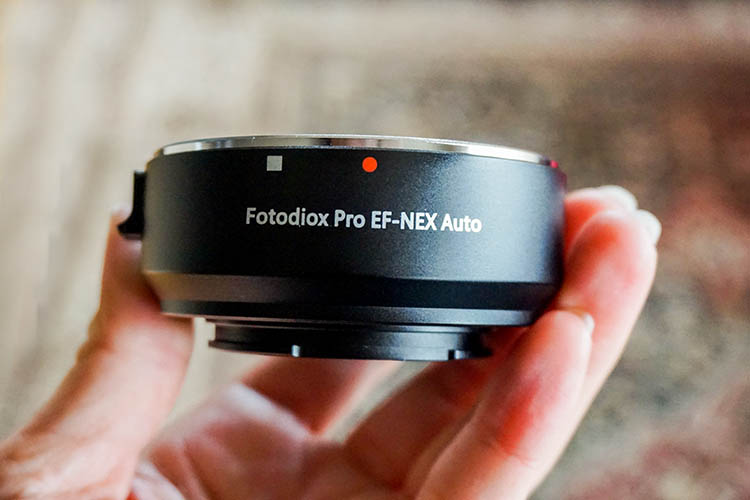
ony Canon Lens Converter

My Camera Background

As a corporate event and food photographer, the Canon 5D Mark III, plus an array of Canon zoom lenses and a handful of primes, are my go-to choices for professional photo work. However, the desire to carry a smaller camera while traveling casually, led to my recent purchase of a Sony a6300 camera, my first investment in a mirrorless system. While I did opt for a Sony 16-50mm kit lens and a 20mm f/2.8 prime lens, I wasn’t financially ready to invest in any more Sony brand lenses. Instead, research and recommendations from other fellow photographers led me to purchase a lens adapter, which promised the ability to use my existing Canon EF lenses with my new Sony E-Mount camera body.

If you’re in a similar position, where you’ve accumulated a collection of DSLR lenses and are considering adding the Sony a6300 to your kit, this article is for you!
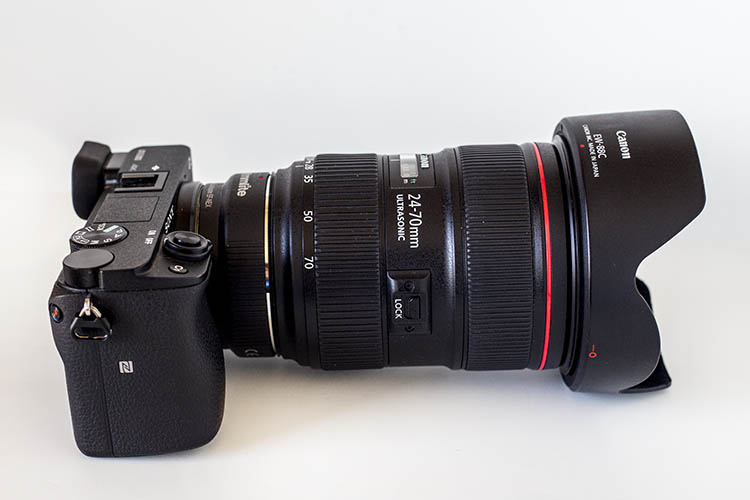
ony Canon Lens Converter

Sony a6300 body with a Canon 24-70mm f/2.8 lens, mounted using the Fotodiox adapter.

Lens Adapter Options

Third-party brands have already hopped on the lens adapter train, and there are quite a few options available, but two main ones that came up in research were the Metabones Smart Adapter IV and the FotodioX AF Adapter. At first glance, both options seemed comparable in their offerings:

  • Compact, lightweight, all-metal design.
  • Allows for automatic focus and aperture control from the Sony E-Mount camera body.
  • Infinity focus allowed if needed.
  • Removable tripod mount included to help distribute the weight.

The main difference between the two products came down to price: the Metabones version is priced at $ 385.99, while the FotodioX option is considerably cheaper at just $ 99.99. In the end, the price was the determining factor, and I went for the FotodioX lens adapter.
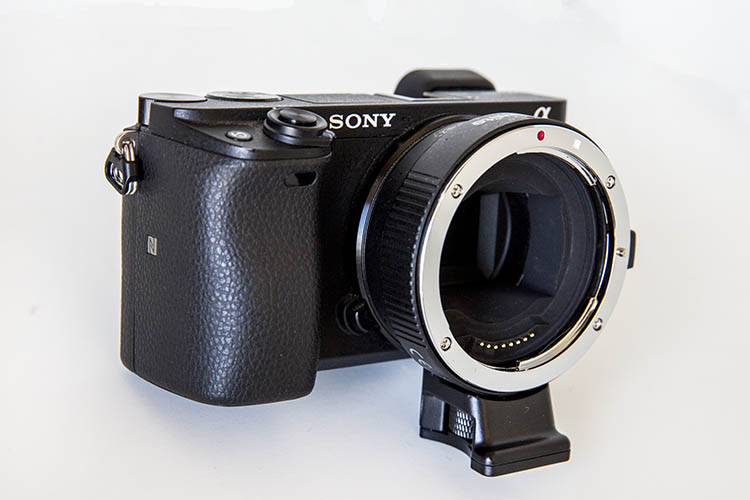
ony Canon Lens Converter

Sony a6300 with the FotodioX AF Adapter attached.

How did it perform?

The first thing to note about using an adapter is how it will impact the overall heaviness, bulk, and appearance of your system. The FotodioX adapter itself is truly compact, and isn’t much larger than the Sony a6300 kit lens. As a result, it looks like a natural complement to the a6300 when it’s connected. Adding on Canon EF lenses changes the look and feel of the a6300, depending of course, and which lenses are paired. Small, lightweight, prime lenses such as the Canon 50mm f/1.8 don’t add a lot of bulk to the camera, and also look like a natural fit.
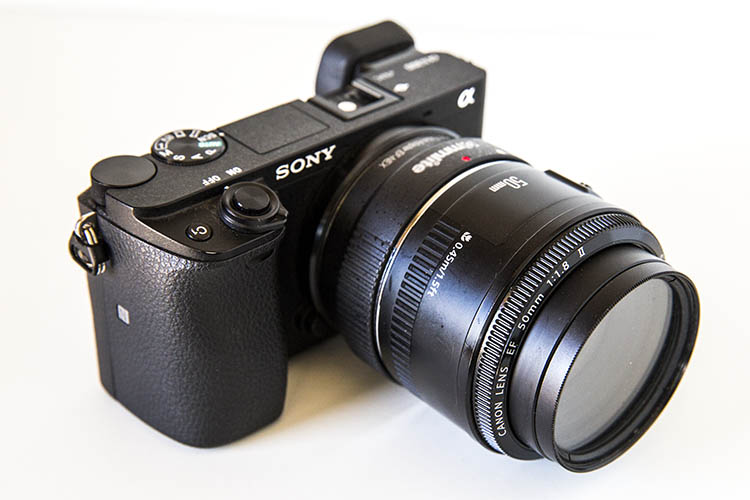
ony Canon Lens Converter

Sony a6300, FotodioX AF Adapter, and Canon 50mm f/1.8 lens.

However, adding larger zoom lenses such as the Canon 24-70mm f/2.8 definitely make the camera more front-heavy, to the point that it makes sense to grip the rig by the lens rather than the camera body. Still, the rig is considerably lighter than pairing the same Canon lenses with a DSLR such as the 5D Mark III.

ony Canon Lens Converter

Apart from aesthetics, the adapter actually performed surprisingly well! There are many reports of adapters causing autofocus to be either painfully slow, or lost altogether. While autofocus was not as snappy and accurate as it was using a Sony brand lens, the a6300 was still decently responsive, even with the FotodioX adapter and a Canon EF lens attached. If autofocus wasn’t working properly, which tended to happen for close-range shots, it was easy to switch the lens to manual focus and still capture a photo. Image quality was also tack-sharp, here are some image examples:


ony Canon Lens Converter

ony Canon Lens Converter

ony Canon Lens Converter

ony Canon Lens Converter

ony Canon Lens Converter

ony Canon Lens Converter

Overall thoughts

Using a lens adapter isn’t a perfect solution. The lagging autofocus was fine for casual use, but eventually became more noticeable and cumbersome when trying to shoot anything that moved. I’d hesitate to rely on an adapter when shooting something where quick autofocus mattered. It also felt like a pretty big tradeoff to not be able to take full advantage of what Sony purports to be the “world’s fastest autofocus” in the a6300. But other than that, the ability to use my existing DSLR lenses with a new camera body made by another manufacturer is a convenient luxury.

Have you tried a lens adapter before? What was your experience like?

googletag.cmd.push(function() {
tablet_slots.push( googletag.defineSlot( “/1005424/_dPSv4_tab-all-article-bottom_(300×250)”, [300, 250], “pb-ad-78623” ).addService( googletag.pubads() ) ); } );

googletag.cmd.push(function() {
mobile_slots.push( googletag.defineSlot( “/1005424/_dPSv4_mob-all-article-bottom_(300×250)”, [300, 250], “pb-ad-78158” ).addService( googletag.pubads() ) ); } );

The post FotodioX Lens Adapter – How to Put Your Canon EF Lens on Your Sony E-Mount Camera by Suzi Pratt appeared first on Digital Photography School.


Digital Photography School

 
Comments Off on FotodioX Lens Adapter – How to Put Your Canon EF Lens on Your Sony E-Mount Camera

Posted in Photography


Samyang AF 14mm F2.8 for Sony E-mount set to ship in September

18 Aug

Samyang Optics has completed its launch of five new lenses over the summer with the announcement that its full-frame 14mm F2.8 autofocus lens for Sony E-mount is ready to hit stores.

The Samyang AF 14/2.8 FE, as it is known, includes 14 elements in 10 groups, 3 of which being aspherical and two extra-low dispersion. The lens has nearly a 114° field-of-view when mounted to a full-frame body and about 90° on a crop body. The 14mm has a minimum focus distance of 20cm/7.9in and sports 7 circular aperture blades.

The lens will be available in September for €699. US and UK pricing was not available at press time.

Press release:

Samyang Announces the Release of AF 14/2.8

August 15th, 2016, Seoul, Korea – The global optics brand, Samyang Optics (http://www. samyanglensglobal.com) today announced the long-awaited release of autofocus lens: 14mm F2.8 for Sony E mount Mirrorless cameras with full frame sensor size. The new Samyang AF 14/2.8 FE is the widest lens in its class offering superb quality images to photographers. This launch follows the recent availability announcement of Samyang AF 50/1.4 FE.

Optimised Optical Design for Full Frame Mirrorless Camera Lens
Samyang AF 14/2.8 FE is specifically designed to work in harmony with full frame mirrorless cameras in Sony E mount. The flow of light is devised based on the uniqueness of the distance from glass to sensor in mirrorless cameras to create optimal performance. Along with portability of mirrorless lenses, the 14mm F2.8 is compatible with full frame sensors to deliver the wideness and sharpness of image to photographers.

The 14mm F2.8 is the widest angle available in the market in its class, broadening the sight of photographers to capture the world. Based on Samyang Optics’ exceptional optical technology, Ultra Multi Coating and three aspherical lenses have been included among 14 glasses in 10 groups to minimise aberration and unnecessary light dispersion, delivering high resolution from the centre to the corners of the image.

AF Performance and Ergonomic Design Based on Class-Leading Technology
This new product will be one of the first autofocus lenses in over 40 years of Samyang’s class-leading core optics technologies. Samyang has captured the essence of world leading image technology with their manual focus lenses and reinterpreted it into autofocus lenses. Photographers now can enjoy the prime manual lens image quality and autofocus lens. Samyang AF 14/2.8 FE is compatible with both phase detect and contrast detect sensors to operate fast and accurate focus detection.

The 86mm of maximum diameter is also the result of years of R&D for best handling, by adding stability. Also the minimal and sleek design and metal-housing solidify the build quality with the internal focus system.

Available from September 2016
This launching expands the boundaries of Samyang Optics photo lens line-up from manual focus only, to now include autofocus lenses. With the addition of 14mm to 50mm, Samyang now has two autofocus lenses along with 39 manual focus photo & cine lenses and 6 professional cine lenses, XEEN. The lens will be globally available from September, and the suggested retail price is EUR 699.

More information will be released soon on Samyang Optics official website (http://www.samyanglensglobal.com), Facebook page (http://www.facebook.com/samyanglensglobal) and Instagram (http://www.instagram.com/samyanglensglobal).

Samyang AF 14mm F2.8 specifications

Principal specifications
Lens type Prime lens
Max Format size 35mm FF
Focal length 14 mm
Image stabilization No
Lens mount Sony FE
Aperture
Maximum aperture F2.8
Minimum aperture F22
Aperture ring No
Number of diaphragm blades 7
Optics
Elements 14
Groups 10
Special elements / coatings 3 aspherical elements + Ultra Multi Coating
Focus
Minimum focus 0.20 m (7.87)
Maximum magnification 0.12×
Autofocus Yes
Focus method Internal
Distance scale No
DoF scale No
Physical
Weight 505 g (1.11 lb)
Diameter 86 mm (3.37)
Length 98 mm (3.84)
Sealing No
Colour Black
Hood supplied Yes
Tripod collar No

Articles: Digital Photography Review (dpreview.com)

 
Comments Off on Samyang AF 14mm F2.8 for Sony E-mount set to ship in September

Posted in Uncategorized


Sigma Mount Converter MC-11 adapts Sigma lenses to E-mount cameras, supports autofocus

23 Feb

$ (document).ready(function() { SampleGalleryV2({“containerId”:”embeddedSampleGallery_5668726877″,”galleryId”:”5668726877″,”isEmbeddedWidget”:true,”standalone”:false,”selectedImageIndex”:0,”startInCommentsView”:false,”isMobile”:false}) });

Sigma has announced an adapter for Sony E-mount cameras, making it possible to use Sigma’s most recent lenses in Canon and Sigma mount on full-frame or APS-C E-mount bodies. The MC-11 adapter is able to use phase detection AF with adapted lenses, and makes use of both camera and lens stabilization when present. An LED display on the side of the mount provides compatibility information of attached lenses. The adapter also communicates EXIF data to the camera body, and retains profiles of compatible lenses – those included in Sigma’s Global Vision line – to optimize AF performance. 

Sigma has not announced pricing or availability at this time.

Press release:

New Sigma Global Vision Lens Mount Converter Expands High-Performance Lens Options for Sony Cameras

Brings Sigma’s Global Vision Lenses to the Sony E-Mount Camera Family

KANAGAWA, JAPAN — February 23, 2016 – Sigma Corporation of America, a leading DSLR lens, camera, flash and accessories manufacturer, today announced the release of its new high-performance Sigma Global Vision lens converter – the Mount Converter MC 11 – for Sony E-mount, full frame and APS-C sensor cameras. With the new MC-11, Sony camera users will be able to utilize 19 Global Vision lenses in Sigma Canon Mount (EOS) and Sigma Mount (SA).

“There are many challenges to designing high-quality mount converter and topping the list is aptly handling phase detection AF in newer cameras and this is where the Sigma MC-11 is groundbreaking in its support for the Sony E-mount systems,” states Mark Amir-Hamzeh, president of Sigma Corporation of America. “The new Sigma MC-11 mitigates complications with a purpose-built lens control data system engineered for maintaining superior AF functionality. So the growing number of Sony E-mount camera users who have been asking for more lens options, now have access to a large pool of lenses that fully embody Sigma’s signature quality and performance.” 

The Sigma MC-11’s sleek LED display lets Sony users know if the attached Sigma lens is compatible and whether or not the MC-11 needs to be updated for that specific lens. Its internal control data system keeps detailed information on each compatible Sigma lens, automatically optimizing performance of AF drive, aperture control and other critical lens functions. The MC-11’s internal control data system also maintains continuity with key camera functions that control brightness and correct transverse chromatic aberration, distortion, and more. The complete compatibility with both Sigma lens OS and Sony in-camera OS ensures correction of camera shake and other stability issues and when used with in-camera stabilization, MC-11 allows angle shake correction in the lens. The integrated flocking helps prevent internal reflections and reduction in lens performance. In addition, the MC-11 retains important EXIF data ensuring users can analyze every detail of their lens setting. 

The Sigma MC-11 converter can be updated with the latest compatible lens information from a workstation or laptop using the Sigma Optimization Pro software and Sigma USB Dock (sold separately).

For more information on the Sigma MC-11 converter please visit www.sigmaphoto.com/mount-converter-mc-11

Articles: Digital Photography Review (dpreview.com)

 
Comments Off on Sigma Mount Converter MC-11 adapts Sigma lenses to E-mount cameras, supports autofocus

Posted in Uncategorized