RSS
 

Posts Tagged ‘Dynamic’

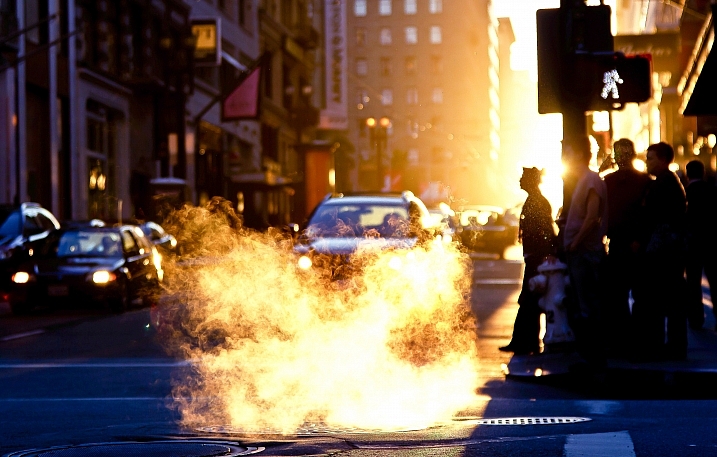
24 Dynamic and Dramatic Backlit Images

12 Sep

Light is key in photography and the direction of light an important factor in creating dramatic photos. When the subject is backlit, or the light is coming from behind it towards the camera, it can make for very dynamic and interesting images.

Like these:

Jason

By jason

Rylee Isitt

By Rylee Isitt

Randy Robertson

By Randy Robertson

Daniel Oines

By Daniel Oines

Matteo

By Matteo

Ignacio Abé

By Ignacio Abé

Kohei314

By Kohei314

Jørgen Schyberg

By Jørgen Schyberg

Brynn Tweeddale

By Brynn Tweeddale

Stavros Markopoulos

By Stavros Markopoulos

Dave Gough

By Dave Gough

Victor Camilo

By Victor Camilo

Markus Spiske

By markus spiske

Myles Tan

By Myles Tan

Keith Davenport

By Keith Davenport

M.G.N. - Marcel

By M.G.N. – Marcel

Steve Corey

By Steve Corey

Bill Gracey

By Bill Gracey

Oiluj Samall Zeid

By Oiluj Samall Zeid

Tambako The Jaguar

By Tambako The Jaguar

Natalie Barletta

By Natalie Barletta

Jorge Dalmau

By Jorge Dalmau

Jim Staley

By Jim Staley

Anne Worner

By Anne Worner

googletag.cmd.push(function() {
tablet_slots.push( googletag.defineSlot( “/1005424/_dPSv4_tab-all-article-bottom_(300×250)”, [300, 250], “pb-ad-78623” ).addService( googletag.pubads() ) ); } );

googletag.cmd.push(function() {
mobile_slots.push( googletag.defineSlot( “/1005424/_dPSv4_mob-all-article-bottom_(300×250)”, [300, 250], “pb-ad-78158” ).addService( googletag.pubads() ) ); } );

The post 24 Dynamic and Dramatic Backlit Images by Darlene Hildebrandt appeared first on Digital Photography School.


Digital Photography School

 
Comments Off on 24 Dynamic and Dramatic Backlit Images

Posted in Photography


Pixelmator update brings Dynamic Touch and improved repair tools

15 Jul

The Pixelmator app for iPad and iPhone has received another update, ensuring it remains one of the most powerful mobile image editing tools in the App Store. Introduced in version 2.0.2 is Dynamic Touch, which automatically adjusts the brush to the surface area of your finger that’s touching the screen. Read more

Articles: Digital Photography Review (dpreview.com)

 
Comments Off on Pixelmator update brings Dynamic Touch and improved repair tools

Posted in Uncategorized


Examples of Perspective Change for More Dynamic Images

08 Jul

There’s a line in Return of the Jedi that has always struck me as particularly insightful, especially considering its inclusion in a movie filled with a two-ton slug-shaped bounty hunter and a planet full of fighting teddy bears. In a conversation with his former mentor Obi-Wan Kenobi, newly-minted Jedi Knight Luke Skywalker asks his sensei if Darth Vader is indeed his father. When Obi-Wan confirms the awful truth, Luke asks why his teacher had formerly lied to him, telling him instead that Darth Vader “betrayed and murdered your father.”

Luke Skywalker and Obi-Wan Kenobi discussing the importance of perspective.

Luke Skywalker and Obi-Wan Kenobi discussing the importance of perspective.

“What I told you was true,” Kenobi calmly replies, “from a certain point of view.” Incredulous, Luke balks at this assertion and wonders aloud how his mentor can claim such a relativistic stance on what is, in his mind, clearly a black-and-white issue. With a dose of characteristic zen Kenobi explains to his pupil, “Luke, you’re going to find that many of the truths we cling to depend greatly on our own point of view.”

Perspective and Photography

Without wading too deep into philosophical waters I just want to point out that this concept, also known as perspective, is critically important in photography, as well as cinematic space operas. Learning to shoot photos from different perspectives is a way of not only shaking up the status quo, but injecting new life into what might otherwise be dull, boring, or entirely pedestrian pictures. To illustrate how perspective changes can radically alter a picture, here are three examples that will hopefully give you an idea of some things to try if you want to breathe new life into your own photography.

Perspective in Nature

grass-full

Not a very photogenic location unless you look at it from a few different perspectives.

This is a fairly common scene you might find in any city: a fire plug with some tufts of grass sprouting clumps of purple seeds. It may not seem all that special, and indeed it’s the kind of scene I would probably pass by in pursuit of a more interesting picture. Look what happens with just a bit of perspective change, though:

grass

Looking down and focusing on one strand of grass yields an entirely different picture.

By getting up close with one of the stalks of grass and focusing on its purple seeds dripping, and slightly bent with fresh rain, I now have an entirely new picture of the same exact scene. This little perspective change results in a photograph that is much more intimate and reveals details that were invisible in the initial photo. Background elements such as the out-of-focus grass still give the impression that this stalk is part of a much larger scene though we also lose a few things too: the bicycles and other buildings are gone, which means the picture is much more isolated than the first one and lacking a larger context. Neither picture is inherently better, but both are quite different, even though they contain the same subject. One final perspective shift results in an entirely different picture yet again.

grass-building

Re-framing the same piece of grass makes for a new, and much more interesting image.

Now the same stalk of grass as the previous version (literally the exact same one and not a different piece of grass on the same plant) is given an entirely new context and the picture here is quite different. It has a much more urban feel with brick buildings instead of green grass in the background, and it feels more majestic and powerful overall. To get this picture I had to get out of my comfort zone a little by kneeling down and contorting my body, but the extra effort resulted in a photo that I like quite a lot. Perspective changes like this can add entirely new dimensions to a picture, and even change its whole meaning, and all it takes is a few seconds of extra work before you click the shutter.

Perspective in Architecture

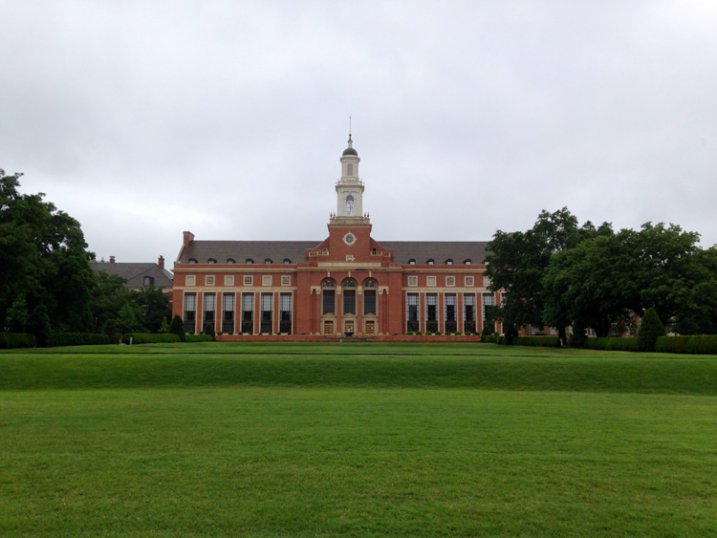
For another example of how perspective can alter a picture here’s a shot I took of the Edmon Low Library on the campus of Oklahoma State University in the midwest United States:

library-far

This perspective shows the Low Library within a larger context, sitting between trees and at the end of a grassy open mall.

It’s an interesting shot but virtually identical to hundreds if not thousands of other pictures you might find on a simple Google Images search. Watch what happens when I change perspective just a bit by walking closer:

library-medium

This perspective isolates the library itself, and imparts a feeling of scale and grandeur on the viewer that was missing in the first shot.

To get this picture I walked about a hundred yards down the lawn which isolated the building from its environment, and now the picture is much more constrained: it’s about the building itself, not the building in relation to the surrounding campus features. The picture is similar but subtly different, and its overall meaning has been changed by taking a very short walk (and as a bonus, getting a bit of exercise in the process). Watch what happens with one final change in perspective:

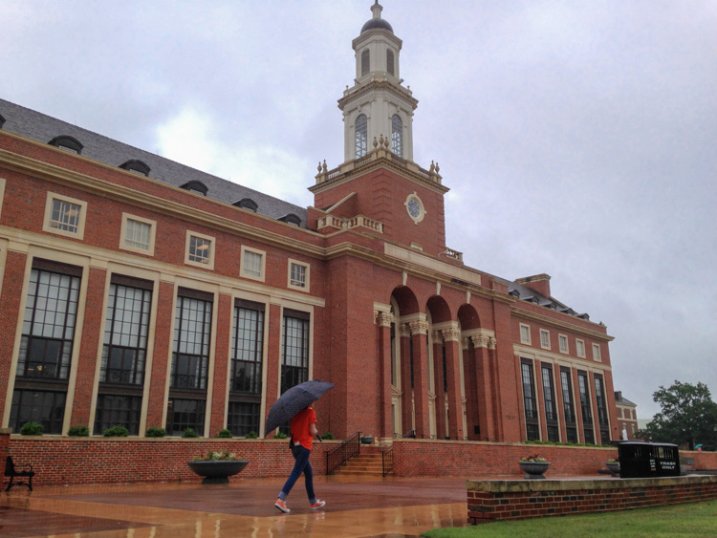
library-close

Finally we see the same building, on the same day, but in a much more dynamic and interesting context.

It’s still the same library, but the picture has changed dramatically from the first shot. Instead of a static image of a building surrounded by green spaces, this now shows the library in a whole new context. The imposing bell tower looms large over the veranda, and the student walking past adds a new dynamic element, to what was formerly a rather boring picture. Showing the building from this angle as it recedes into the background, illustrates how it is part of a much larger campus, and overall I find this a much more interesting image.

Working with People

Looking at buildings and nature is one thing, but changing perspective when taking pictures of people can blow the doors wide open when it comes to creating pictures that are new, interesting, and much more impactful. To illustrate this, here are a few photos of my nephew skipping rocks at the beach on a recent family vacation.

My nephew practicing his rock-skipping technique.

My nephew practicing his rock-skipping technique.

There’s nothing particularly wrong with this photo but there’s nothing especially interesting about it either. To get this picture I stood on the beach with my camera while he skipped rocks, and did put in much effort to take perspective into account. It’s a decent snapshot that more or less captures the scene, but watch what happened when I changed my perspective:

photography-perspective-skipping-rocks-front-side

The same scene as above, but far more interesting with the background activity and low angle of view.

The scene has been drastically improved simply by walking 20 feet down to the beach, and crouching down to my nephew’s eye level. There’s now a sense of action and movement, and you can also see the intense concentration on the boy’s face as he winds up to skip a rock. In addition to these alterations you now have a sense of context; you see where the subject is in relation to his surroundings. By changing perspective I am able to show the rest of the beach, which includes some of his cousins and my brother having fun in the background. Here’s one final perspective change that alters the picture even more:

photography-perspective-skipping-rocks-front

That rock went sailing, and skipped a half dozen times.

This one is all about my nephew with nothing else except the beach to provide a sense of context and is, in my opinion, the best of the bunch. You see him alone, along with the same intense expression as in the previous photograph but without any distracting background elements. To get this picture I waded into the water and crouched down until my camera was just a few inches above the surface. It was more difficult to get this shot, and certainly would have been easier if my camera had an articulating LCD screen, but the payoff was well worth it. Compare this to the initial shot, and you will see a massive difference just from a little work on my part to change perspective.

Hopefully these examples give you a few things to ponder the next time you are out with your camera. It takes a little more work to shoot things from different perspectives, but you may find yourself with new creative possibilities and new ways of looking at your subjects and the world around you.

What are your favorite tips and tricks for finding and exploring new photographic perspectives? Share your thoughts in the comments below.

googletag.cmd.push(function() {
tablet_slots.push( googletag.defineSlot( “/1005424/_dPSv4_tab-all-article-bottom_(300×250)”, [300, 250], “pb-ad-78623” ).addService( googletag.pubads() ) ); } );

googletag.cmd.push(function() {
mobile_slots.push( googletag.defineSlot( “/1005424/_dPSv4_mob-all-article-bottom_(300×250)”, [300, 250], “pb-ad-78158” ).addService( googletag.pubads() ) ); } );

The post Examples of Perspective Change for More Dynamic Images by Simon Ringsmuth appeared first on Digital Photography School.


Digital Photography School

 
Comments Off on Examples of Perspective Change for More Dynamic Images

Posted in Photography


Dynamic range test added to Canon EOS 5DS R First Impressions Review

12 May

Canon’s EOS 5DS R tops anything we’ve seen in its class for resolution, but that’s only part of the image quality equation. We put its 50MP sensor to the test in our Raw dynamic range studio and real-world tests. Take a look at the kind of performance you might expect from the 5DS R’s (enormous) Raw files. Read more

Articles: Digital Photography Review (dpreview.com)

 
Comments Off on Dynamic range test added to Canon EOS 5DS R First Impressions Review

Posted in Uncategorized


Nikon D4S dynamic range and tone curve measurements

07 May

D4s_58_1.4_front.png

We’ve updated our first impressions review of the Nikon D4S with our JPEG Tone Curve and Dynamic Range measurements. Included are real-world examples of Nikon’s Active D-Lighting modes, which can significantly help in dealing with scenes containing challenging ranges of (dark to bright) tones. Have a look and, as always, you can compare the D4S to any other camera in our database. Learn more

News: Digital Photography Review (dpreview.com)

 
Comments Off on Nikon D4S dynamic range and tone curve measurements

Posted in Uncategorized


Composing Dynamic Landscape Images

18 Jul

A Guest Post by Todd Sisson from www.sisson.co.nz.

As a landscape photographer I am constantly seeking that next X-factor shot – an image that leaps from the screen or page and demands the viewer’s attention – preferably attention of the favourable variety.

If you spend an hour or two on a photosharing site like Flickr viewing landscape images in un- curated groups you will note that a very small percentage of the total image population stands out from the crowd.

However, if you view a carefully curated collection of top-shelf landscape images you will probably start to notice some themes appearing. Certain visual cues and devices appear across multiple images – there will often be subtle commonalities between these attention hogging photos.

In many instances these images will possess the qualities of what I consider a dynamic landscape image.

What is a Dynamic Landscape Image?
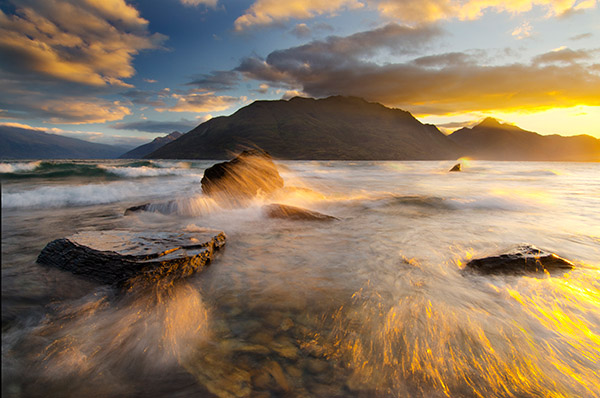
Summer Storm, Queenstown New Zealand. An example of a dynamic landscape image. To maximise the number of dynamic elements in this image I locked this composition off in the field and shot multiple images. The best of about five wave-action frames were then blended together to form the final image.

There is no dictionary entry that defines a Dynamic Landscape Image* – heck, there’s not even a Wikipedia entry – so it is a somewhat personal interpretation.

To my mind, a dynamic landscape image is one that in some way conveys the energy and scale of the natural world. Dynamic images also often seek to breach the confines of their 2D medium by inferring a sense of depth – many truly dynamic image have an almost 3D quality about them.

*As far as I am aware, the term Dynamic Landscape was first popularised by the late Galen Rowell – one of the most influential American landscape photographers of his generation. Rowell used the term to demarcate his work from the somewhat literal colour landscape photography that dominated the early 1970′s. Although he was certainly not the only photographer employing these principles in his work, he appears to have been an excellent self-promoter and the term is somewhat synonymous with his name.

Dynamic Composition

Composition is the backbone of all great photos – dynamic or otherwise – but it is essential in the creation of a truly strong landscape image.

I feel that the goal of a successful composition is to draw the eye into image and hold it there for as long as possible – which is seemingly, a maximum 15 milliseconds these days*. The following image is an example of an image that I feel achieves this objective.

Sunrise Over The Moeraki Boulders, Otago New Zealand. Seascapes lend themselves to the creation of dynamic landscape images.

This image combines all of the elements that I feel comprise a Dynamic Landscape Image:

  • Leading or converging lines
  • Interesting perspective
  • Visually interesting foreground elements
  • Visually interesting mid-ground & background elements
  • Vivid colour or incredible light
  • Vision-locking tonal control
  • Suggestion of movement

It is important to note that not all dynamic landscape images possess all of these factors. In fact, it is depressingly rare to have it all come together in one moment. It must also be stated that what follows is not a recipe for creating great images. Photography can only be practised as an art when personal interpretation is injected into the process – only use this information as a guideline for evolving your own images.

So let’s have a very quick look at each of these Dynamic Landscape factors.

Leading Lines & Converging Lines

One of the simplest ways to draw a viewer’s attention into an image is to use converging or leading lines. Converging lines have been used by painters for centuries to create the illusion of depth within a 2 dimensional medium.

This is why photos of wharves, roads, and rivers make such successful photographic subjects. Although many consider such subjects to be cliches, I strongly council my workshop students to shoot them heavily to build an awareness of the power of a line in an image.

Leading lines not only draw attention into the image, they can also help to hold the eye within the confines of the image.

Check out the crudely overlaid wharf image below combines the strong converging lines of the wharf with secondary supporting lines in the water, hills and clouds.

Look for these lines whenever you are shooting – they are almost everywhere.
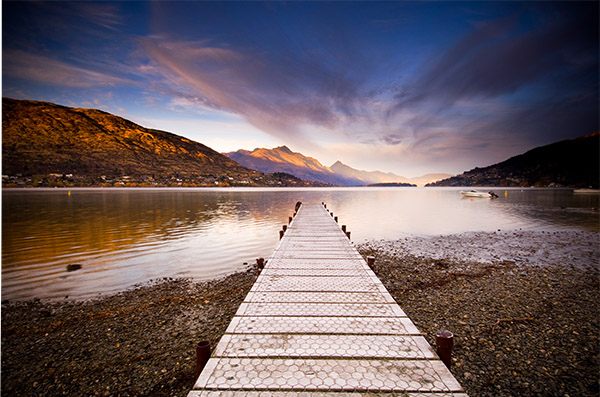
The Wharf at Frankton, Queenstown New Zealand. Shoot ‘cliched’ subjects like wharves and roads until it hurts a little. The pain is just your visual muscles growing stronger. Shooting man-made lines will teach you to look for more subtle lines in nature.
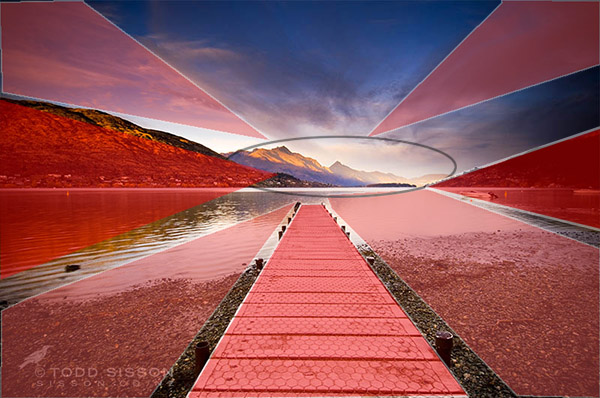
Although the wharf is the primary leading line device in this image there are a number of leading lines present in the water, hills and clouds. The darker reflected lines in the water help hold the eye in the central region of the frame.

Interesting Perspective

As a photographer you are an artist not a forensic documentarian. You get paid the mega-bucks and live the champagne lifestyle to show your audience something a little different – that is your raison d’être.

Hence I rarely find myself shooting at my natural standing position. For some reason, compositions seem to get more dynamic the closer you are to the ground/mud/ snow/ice-encrusted cow turd – it’s just the way it is.

This is especially apparent when using an ultra-wide lens. Subject matter becomes incredibly diminutive and interesting leading lines really lose their visual power when viewed from 5 or 6 feet high – so try getting uncomfortably close and low.

Aim high also. Look for ways to gain elevation to find that privileged viewpoint – I find that this often works really well when shooting telephoto lengths for some reason. Try scrambling up banks, standing on cars and sitting on your wife’s/husband’s shoulders (sans tripod) in an effort to find an interesting perspective.

Paddock Bay, Lake Wanaka New Zealand. Getting uncomfortably low in this instance dramatically altered the perceived form of the rock on the lower right of the frame. B y moving about I was able to create the satisfying impression of the rock 'interlocking' with the reflection. Note the strong leading line formed here also.

Foreground Elements

I believe that a dynamic image almost always possesses a strong foreground element, or elements, that complement the greater scene.

Take a sunset/sunrise for example. Sure, spectacular light makes for great images, but personally photos that contain nothing but vast expanses of super-saucy red clouds do little to engage me as a viewer.

The best dynamic images typically have a strong point of interest in the lower half, or foreground. This is your visual entree into an image. If your foreground element happens to include leading lines you are quite possibly onto the much vaunted money-shot.
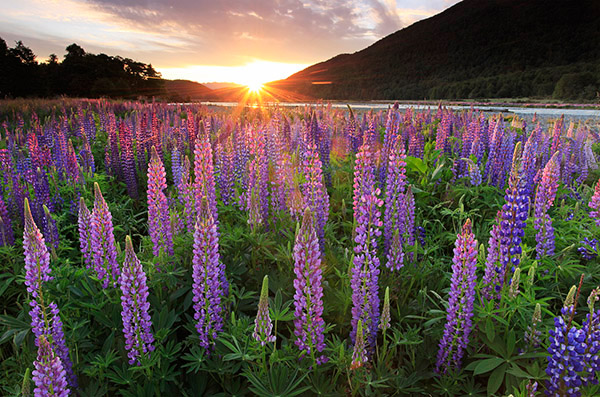
Lupin(e)s, Fiordland New Zealand. Yeah, this is cheating – foreground elements don’t come much easier than this. That aside, keen observers will note the subtle converging lines formed out of the lupin pattern. This was accentuated by deliberately placing a bloom in each corner and leaving a little empty space at the bottom of the frame. Sunstars make an exceptional background element (segues niftily to my next point)

Visually interesting Background Elements

I often compose back to front. Firstly I will find the subject of my image, say a spectacular sunset playing out on mountains, and then I will run around like a deranged prison escapee in search of a foreground element to complement the background.

It is very much a balancing act – defining who or what element gets to play the lead role in your composition. Ideally the background is where the eye should gravitate to and the foreground should pick up a gong for best supporting actor.
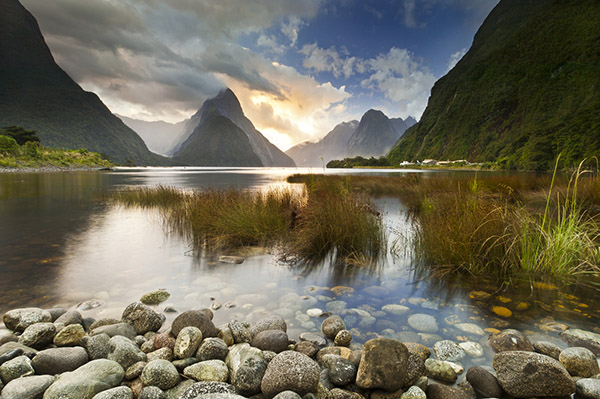
Milford Sound, Fiordland New Zealand. The star of this image is the dramatic light playing out in the clouds over the eye- catching form of Mitre Peak – the foreground & mid ground elements are critical supporting parts of the whole composition but don't hog the lime-light.

Unusually, I didn’t scramble to find a foreground element for this image – I staggered. Four minutes earlier I had been happily sleeping in the back of my truck – my alarm went off and I saw this – panic ensued….

Vivid Colour or Incredible Light

By now it should be obvious that I have some un-checked colour-dependancy issues. I love colour*, especially natural light shows. However, I feel that vivid colour needs to be kept in balance and be a part of the overall composition. Too often I see images that rely solely upon dollops of super- saturated colour.

For a dynamic landscape image to work, balance must prevail. Hence I attempt to avoid filling the frame with too much colour (yes, there is such a thing – see below).

*I am even partial to the American version – colour.

Sunrise from Mt Taranaki / Egmont, New Zealand. In this image the main act was the rapidly dissipating beams of sunrise goodness and the rich colour in the clouds. Lens choice and composition mean that the sunrise colour is just one component of the image. I often like to keep dark forms in my images (anathema to the HDR readers amongst you) as a counterpoint to the extreme lightness of a sunset/sunrise. I find the dark hills here quite mysterious in contrast to the sunstar and clouds.

Too much colour. This was one of the most intense sunrises that I have ever witnessed. I should have just sat and enjoyed it – this is just too much colour for my tastes – it looks un-realistic. This shot has actually been partially de-saturated in an effort to tame the colour.

Vision-locking Tonal Control

I am tempted to trademark this term – it sounds like a mind-control experiment deployed by shady branches of the US intelligence community.

Basically all I am referring to is the phenomenon of vignetting.

The eye is drawn towards lightness within an image, particularly near the centre of frame. Furthermore, the eye is restrained by darkness at the edges of the frame.

When employed deftly, the viewer’s eye is gently drawn into the image by lightness and held there by the darker edges of the image.
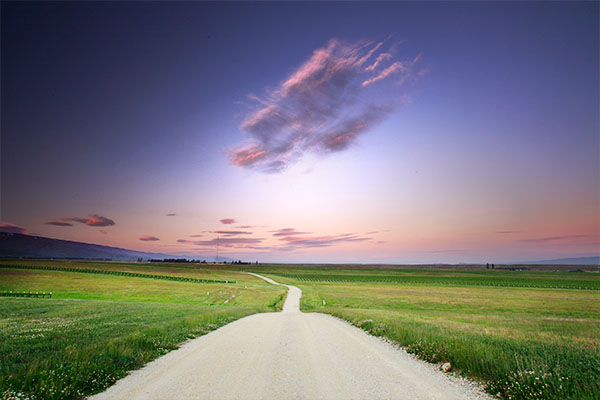
Look at all of the images above and you will see this technique in use. Often this happens in- camera just by virtue of the composition and through use of ND grad filters. However, I will often darken the top edge of an image in post and even add a subtle vignette as the last thing I do. Weird Cloud formation & Road to Nowhere. Alexandra New Zealand. In order to achieve vision-lock here I painted in a brighter layer near the central portion of the image. A little vignetting was added to further enhance the effect.

Suggested Motion

Suggested motion, by way of blur or frozen motion is not always an achievable, or desirable, element to utilise within an image – but it can add another layer of dynamism to a composition.

Don’t just get locked into shooting long exposures either – frozen, or partially-frozen motion can convey movement just as well as a long exposure in some circumstances (see the first image, Summer Storm, for an example of this).

Moeraki Boulder, Otago New Zealand. Long Exposure motion blur creates a dynamic tension between the static boulder and the relentless sea. Note the other dynamic ingredients added to this image – interesting perspective, use of colour, vision-lock, foreground/background interest.

Can Dynamic Landscape Images be B&W?

Absolutely. There are many thousands of truly incredible B&W dynamic landscape images. No style renders texture and contrast better than B&W – at it’s best it is magnificent.

In order to compensate for their ‘lost’ colour Black & Whiters will often apply industrial grade quantities of Vision Locking Tonal Control (that’s why vignette sliders to go -100) and rely heavily upon strong graphical elements such as leading lines (you will find a lot of B&W photos of wharves and sewerage pipes heading out to sea).

I would show you an example of this, but I am mono-challenged. If you want to see B&W Dynamic landscapes at their best check out the work of Mitch Dobrowner & Hengki Koentjoro.

So Are All Good Landscape Images ‘Dynamic’?

Not at all. Stunning images can be made by avoiding almost all of the techniques that I have just espoused in this essay. Dynamic Landscape composition is just one style of landscape photography.

In fact, many of my favourite images by others are beautifully composed static, flat compositions. These ‘static’ images respectfully comply with the two dimensional constraints of the photographic medium and rely upon a separate set of visual devices in order to ‘succeed’.

If they will have me back here at DPS, these static landscapes will be the topic of my next blog post.

Todd & Sarah Sisson are full-time landscape photographers based in Central Otago New Zealand.

Their work can be found as fine art prints & canvas prints at www.sisson.co.nz Todd also offers private and group photographic tuition. They can be found on facebook, Google Plus and twitter.

Post originally from: Digital Photography Tips.

Check out our more Photography Tips at Photography Tips for Beginners, Portrait Photography Tips and Wedding Photography Tips.

Composing Dynamic Landscape Images


Digital Photography School

 
Comments Off on Composing Dynamic Landscape Images

Posted in Photography


Magic Lantern ‘Dual ISO’ firmware increases dynamic range on 5D Mk3, 7D

18 Jul

0R0A0640-fullres-soft.jpg

The folks at Magic Lantern are no stranger to adding new features to Canon DSLRs, courtesy of their EOS Camera Tool software. Their latest creation, Dual ISO, increases the dynamic range of the 5D Mark III and EOS 7D by four stops, bringing the total dynamic range to 14EV. This allows you to pull detail out of the shadows with a lot less noise than with the ‘stock’ firmware. Click through for more details.
News: Digital Photography Review (dpreview.com)

 
Comments Off on Magic Lantern ‘Dual ISO’ firmware increases dynamic range on 5D Mk3, 7D

Posted in Uncategorized


Dynamic range and Noise pages added to Sony RX1R Preview

05 Jul

firstimpressions.jpg

We’re working on Sony’s flagship compact camera, the 24MP RX1R, and as part of our usual testing we’ve updated our preview with noise and noise-reduction analysis, and our standard page looking at dynamic range. This is in addition to our studio comparison scene pages, and a real-world samples gallery showing just what the RX1R – which lacks an AA filter – can do. Click through for a link to our updated preview. 

News: Digital Photography Review (dpreview.com)

 
Comments Off on Dynamic range and Noise pages added to Sony RX1R Preview

Posted in Uncategorized


Social Signage: Digital Street Sign Gives Dynamic Directions

28 Jun

[ By WebUrbanist in Gaming & Computing & Technology. ]

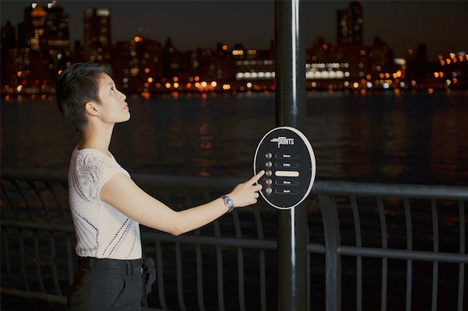
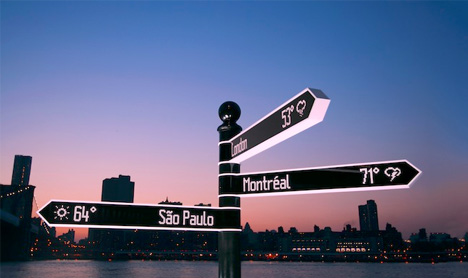
digital signpost display

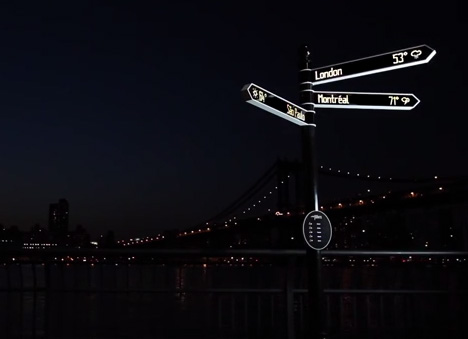
The shape is a familiar classic – a central post pointing toward different destinations, sometimes near and other times a world away. This evolved version, however, replaces static locations and fixed directions with interactive ones.

Designed by Breakfast of Brooklyn, Points lets you input a query and receive both a written response and an orientation to go with it, giving distance and location along with other information.

digital all points sign

The device is programmed with API data from real-time sources including regional public transit and, more broadly,Twitter, FourSquare and RSS feeds.

digital street sign design

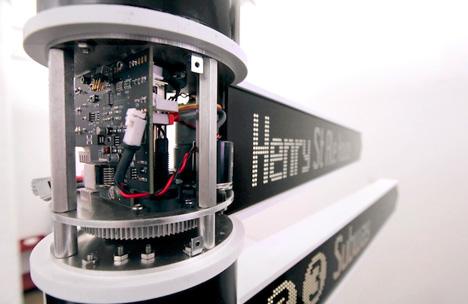
The resulting database gives passers by up-to-the-minute info as requested, displayed on 16,000 LED lights. It can also potentially display default local information automatically – about current news, events, performances or venues – when not otherwise (manually) engaged.

digital interactive local directions

The intention here is to go beyond a simple touch screen, creating something recognizable at a distance, familiar to pedestrians and interactive both digitally and physically.

digital sign technology design

Aside from the creative challenges, fitting the required mechanisms for a smoothly-rotating effect into such a small space proved difficult but the designers are close to a finished product.

Share on Facebook


[ By WebUrbanist in Gaming & Computing & Technology. ]

[ WebUrbanist | Archives | Galleries | Privacy | TOS ]


WebUrbanist

 
Comments Off on Social Signage: Digital Street Sign Gives Dynamic Directions

Posted in Creativity


Rambus unveils ‘Binary Pixel’ sensor tech for expanded dynamic range

27 Feb

binarypixels-nocaps.jpg

US technology company Rambus has unveiled ‘Binary Pixel’ sensor technology, promising greatly expanded dynamic range for the small sensors used in devices such as smartphones. Current image sensors are unable to record light above a specific saturation point, which results in clipped highlights. Binary Pixel technology gets around this by recording when a pixel has received a certain amount of light, then resetting it and in effect restarting the exposure. The result is significantly expanded dynamic range from a single-shot exposure. The company has demonstrated the technology using a low resolution sensor, and says it can easily be incorporated into CMOS sensors using current manufacturing methods. 

News: Digital Photography Review (dpreview.com)

 
Comments Off on Rambus unveils ‘Binary Pixel’ sensor tech for expanded dynamic range

Posted in Uncategorized