RSS
 

Posts Tagged ‘Dynamic’

Canon introduces global shutter CMOS sensor with improved dynamic range

01 Sep

Canon has announced a global shutter CMOS sensor with a re-designed pixel structure aimed at boosting dynamic range. Using global shutter presents a clear benefit for the sensor’s videography applications, as it doesn’t suffer from the distortion effects that a standard ‘progressive scan’ sensor does when capturing fast-moving subjects.

However, global shutter designs have tended to offer less dynamic range than their conventional counterparts. Canon says that the sensor’s drive system (the way it’s read out) increases the amount of light the sensor can capture before overexposing. This is combined with a more efficient pixel structure and ‘optimized internal configuration’ to reduce noise and increase sensitivity. The result should be improved dynamic range, though it’s not clear how this improved performance will compare with traditional chips of the kind that exhibit rolling shutter.

Canon says it will explore use of the chip in measurement and industrial applications, and consider applications in video production. No details of the sensor’s size or resolution were given.

Press release:

Canon develops global shutter-equipped CMOS sensor that achieves expanded dynamic range through new drive method

TOKYO, August 31, 2016—Canon Inc. today announced that it has developed a new CMOS sensor equipped with a global shutter function that, because it exposes all of the sensor’s pixels at the same time, enables the capture of distortion-free images even when shooting fast-moving objects. Employing a new signal-readout drive system and new pixel structure that significantly expands the full well capacity and reduces noise, the sensor contributes to high-image-quality video capture by making possible the realization of a wide dynamic range.

Distortion-free image capture when shooting fast-moving objects

Standard CMOS sensors make use of the rolling shutter method, which sequentially exposes the pixels one row at a time. Because rolling shutters can create slight discrepancies in signal-readout timing depending on the location of the pixel, images of fast-moving objects may appear distorted and flash photography may result in the occurrence of the flash band phenomenon, in which the upper and lower portions of images display different levels of brightness. Because Canon’s newly developed CMOS sensor employs a global shutter, when shooting such fast-moving objects as a rotating propeller or a speeding train, subjects are able to retain their proper form to create distortion-free images. Enabling the confirmation of object shapes with a high degree of accuracy, the sensor offers potential benefits in industrial applications, including as a sensor for use in inspection cameras.

Wide dynamic range realized through new proprietary drive method and pixel structure

When the newly developed CMOS sensor converts light into electrical signals and stores the signal charge in memory, the new drive system achieves a significant expansion in full well capacity. Also, because it employs a structure that efficiently captures light and each pixel incorporates an optimized internal configuration, the sensor makes possible increased sensitivity with reduced noise. The expanded full well capacity, realized through the sensor’s new drive system, and substantial reduction in noise, enabled by the new pixel structure, combine to deliver a wide dynamic range, facilitating the capture of high-image-quality, high-definition footage even when shooting scenes containing large variances in brightness.

Canon will explore various industrial and measurement applications for the newly developed CMOS sensor and consider deploying it in the field of video production for cinema production applications, TV dramas, commercials and more.
Articles: Digital Photography Review (dpreview.com)

 
Comments Off on Canon introduces global shutter CMOS sensor with improved dynamic range

Posted in Uncategorized


Zig-Zagging Cantilevered Shipping Containers Create a Dynamic Pavilion

28 Jun

[ By SA Rogers in Architecture & Cities & Urbanism. ]

cantilevered shipping crates 1

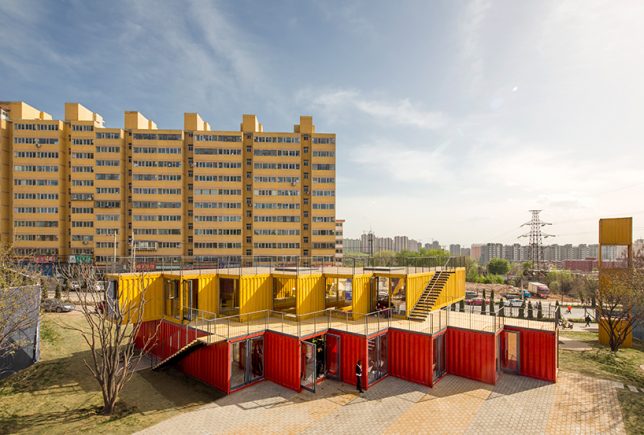
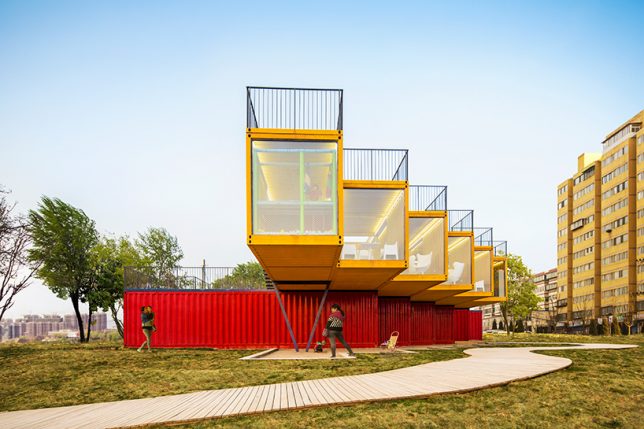
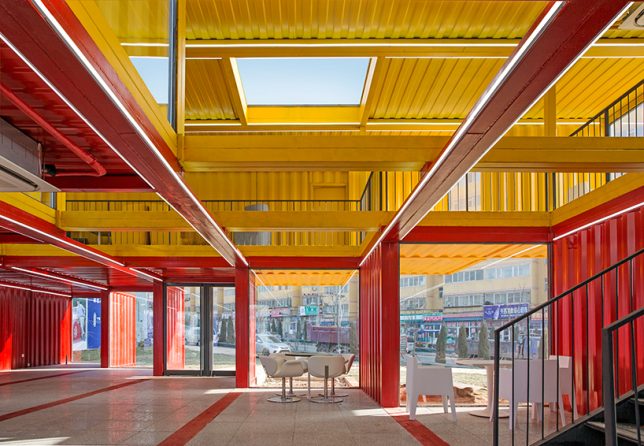
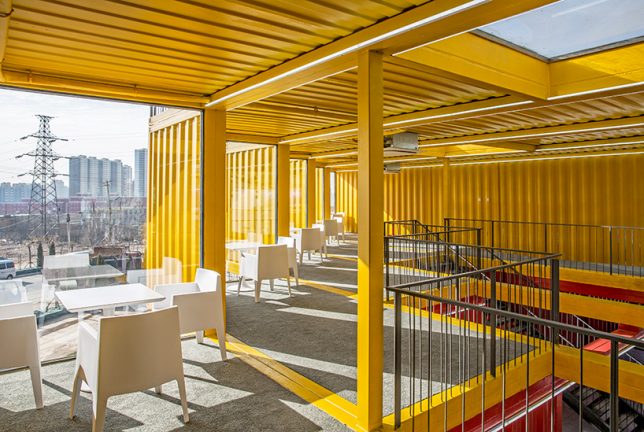
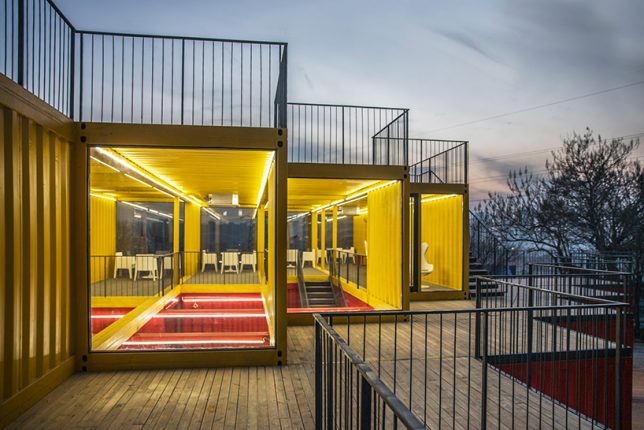
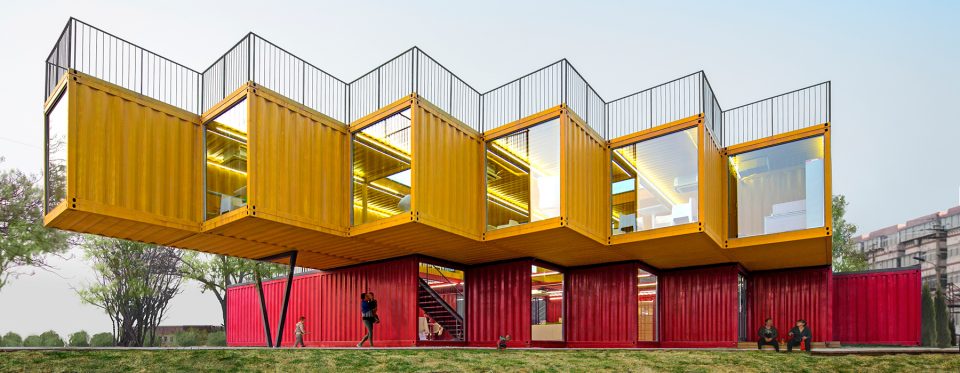
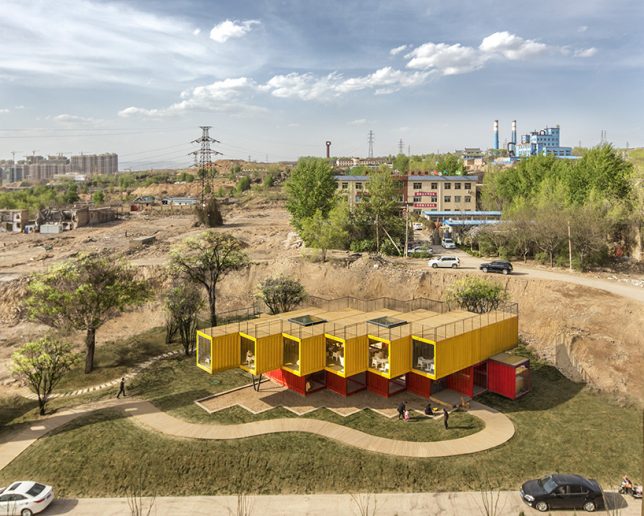
Recognizable in their original form, twelve shipping containers form a two-story recreational pavilion for the Chinese city of Shanxi, stacked and set at an angle with the top units cantilevered over the bottom ones. People’s Architecture Office (PAO) capped the ends of each container in glass and removed sections of the walls, floors and ceilings to create a surprisingly bright and open interior that carries natural daylight into every corner.

shipping crate architecture

shipping container building

The containers are staggered, which not only creates a terrace on the open ceilings of the lower red crates, but also produces a dynamic floor plan with lots of nooks and crannies for seating overlooking the surrounding city. This clever arrangement effectively multiplies the space without having to add additional containers, and each container acts like a viewfinder stretching out toward the skyline.

shipping container building 2

shipping container building 3

shipping container building 4

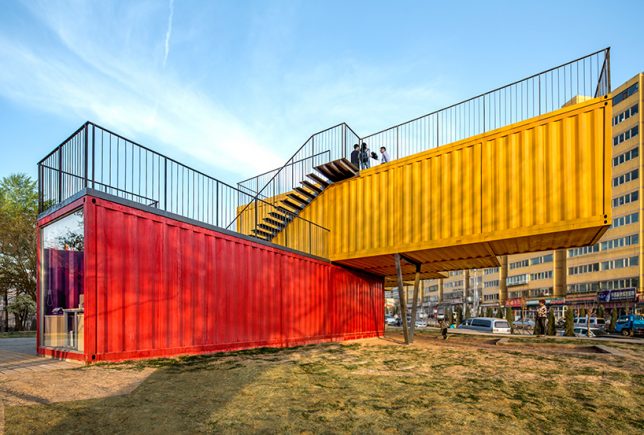
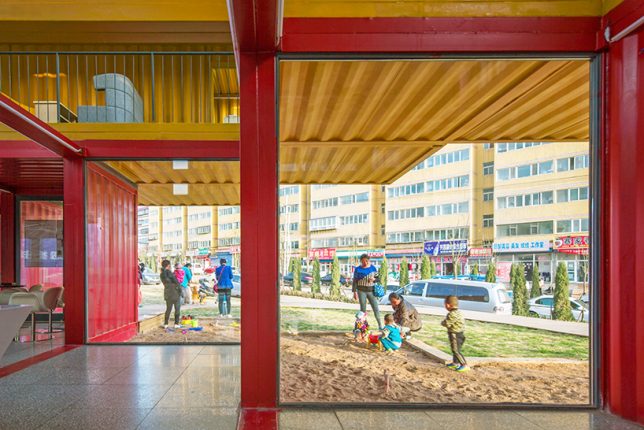
Exterior stairs offer easy access to both rooftop terrace levels, providing residents with even more views. Perpendicularly set on top of the red containers, the yellow cantilevered units cast shadows on the ground to create sheltered spaces outside. Inside, there’s plenty of room to congregate, making it a convenient meeting space for people who live in the adjacent housing developments.

shipping container building 5

shipping container building 6

shipping container building 7

Since the containers have barely been modified, it would also be a breeze to pack the whole thing up and transport it to a new location when necessary, or replace individual containers if they get damaged. While other architectural projects reclaiming used shipping containers often take pains to disguise them (and at least insulate the interiors, which seems like a budget-friendly but potentially uncomfortable oversight in this case), this one stands as a highly visible example of affordable alternative architecture making use of widely available portable materials.

Share on Facebook


[ By SA Rogers in Architecture & Cities & Urbanism. ]

[ WebUrbanist | Archives | Galleries | Privacy | TOS ]


WebUrbanist

 
Comments Off on Zig-Zagging Cantilevered Shipping Containers Create a Dynamic Pavilion

Posted in Creativity


Not Just a Facade: 15 Dynamic Modern Exterior Treatments

09 Jun

[ By SA Rogers in Architecture & Offices & Commercial. ]

facades fish 3

The word ‘facade’ implies illusion, and that can be true even when it’s used to refer to the faces of buildings, as secondary structures wrap around them like veils, obscuring their true form and creating dazzling displays of light and shadow like a distracting sleight of hand. Some facades disguise the original building in a form of low-impact renovation, while others are kinetic, opening and closing or rippling in the wind.

Geometric Planter Facade

facades geometric planter 1

facades geometric planter 2

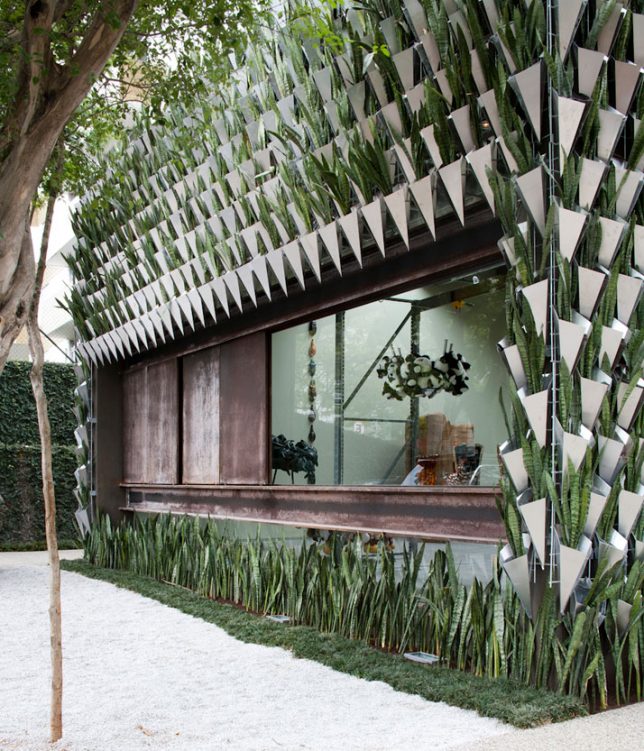
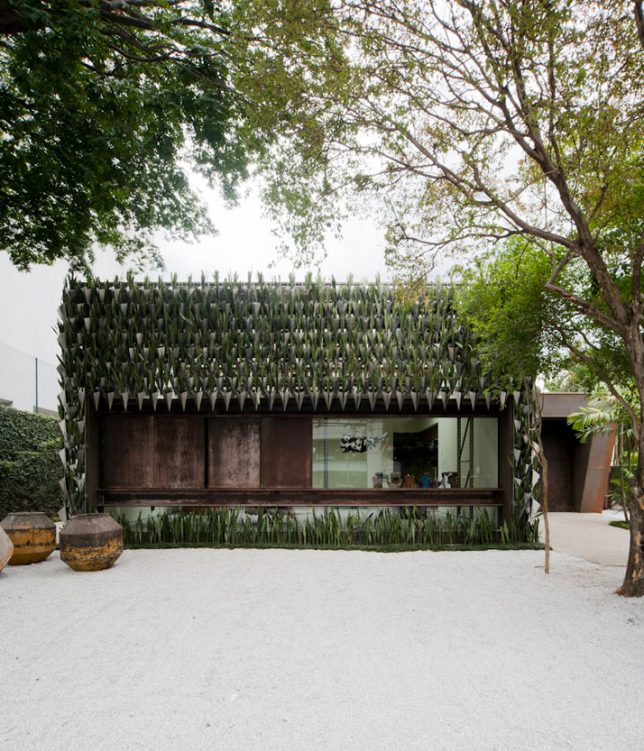
The exterior of the Firma Casa store in São Paulo, Brazil, which promotes young Brazilian furniture designers, gets an appropriately hip and modern look with the addition of a screen of geometric vases. 3,500 individual planters hold 9,000 seedlings and project slightly out from the exterior walls, keeping soil and water away from them for a relatively low-impact and low-budget green wall solution.

Roll-Up Facade Forms Canopy

Facade roll up 1

facade roll up 2

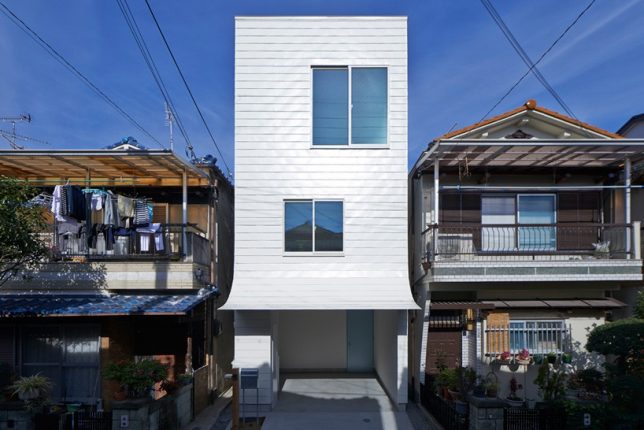
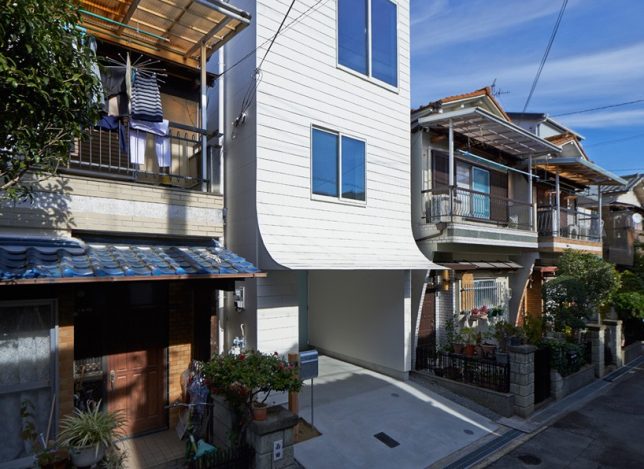
Incredibly simple, yet unusual enough to stop you in your tracks on the street, this facade uses ordinary materials with an unexpected twist. Tokyo-based studio Ninkipen! made this contemporary white home stand out from its neighbors with a peeling facade that rolls up slightly from the ground level to create an awning for the garage.

Undulating Facade of Fins Looks Like Swimming Fish

facades fish 1

facades fish 2

facades fish 3

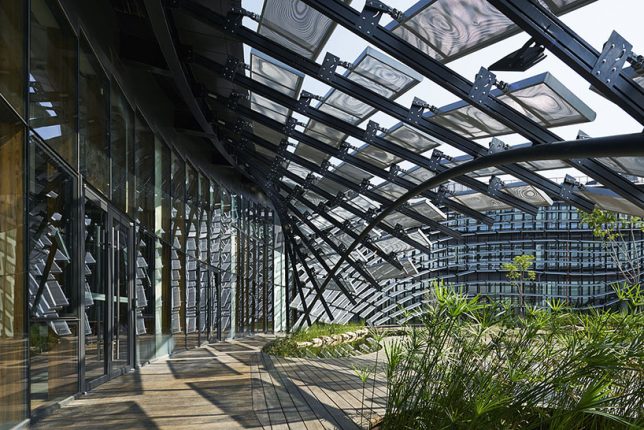
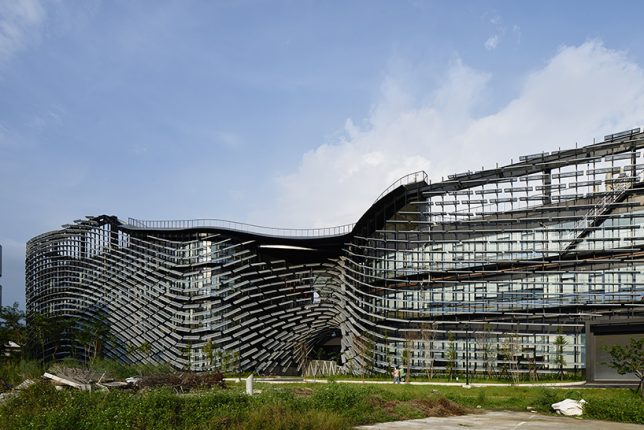
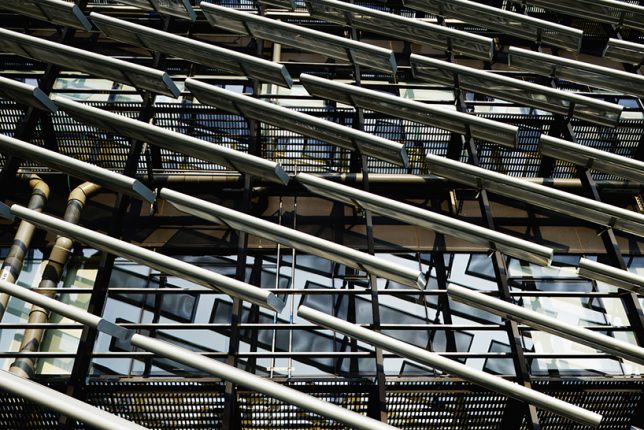
The angled steel fins enveloping the Industrial Technology Research Institute at the Central Taiwan Innovation & Research Park is intended to recall the look of a school of fish swimming in synchronicity. Noiz Architects customized the opacity of the screen according to the function going on inside each particular area of the building, since some research areas, exhibition spaces, greenhouses, cafes and other programs require different degrees of sunlight. This veil-like screen is separate from the building itself, making for easy repairs and additions and occasionally stretching out to create indoor/outdoor spaces.

Kinetic Parking Garage Facade

facades kinetic garage 1

facades kinetic garage 2

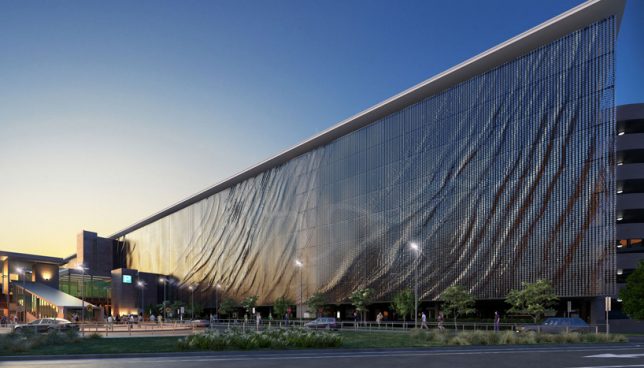
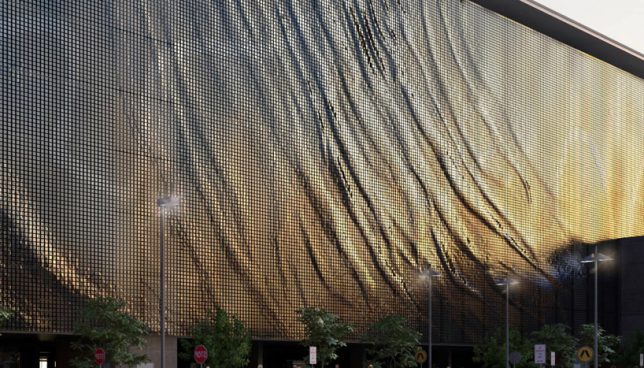
118,000 suspended aluminum panels gently flap in the wind, creating textures reminiscent of flowing textiles and rippling water. Designed by artist Ned Kahn and fixed to the exterior of the Brisbane Airport parking garage in Australia, the kinetic facade reacts to its natural environment, constantly changing as it provides shade and ventilation for the interior.

Perforated Shutters on a Concrete Home

facade perforated 1

facade perforated 2

facade perforated 3

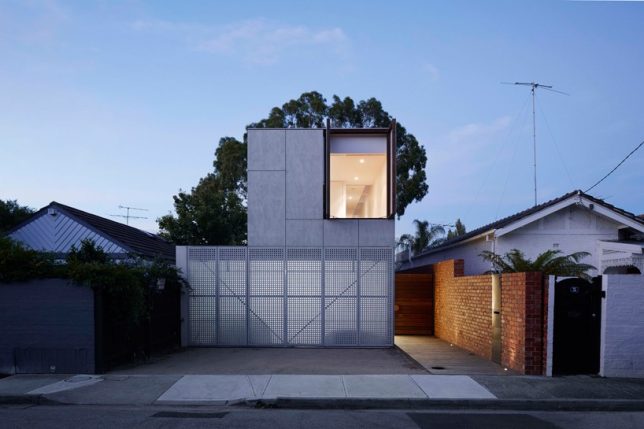
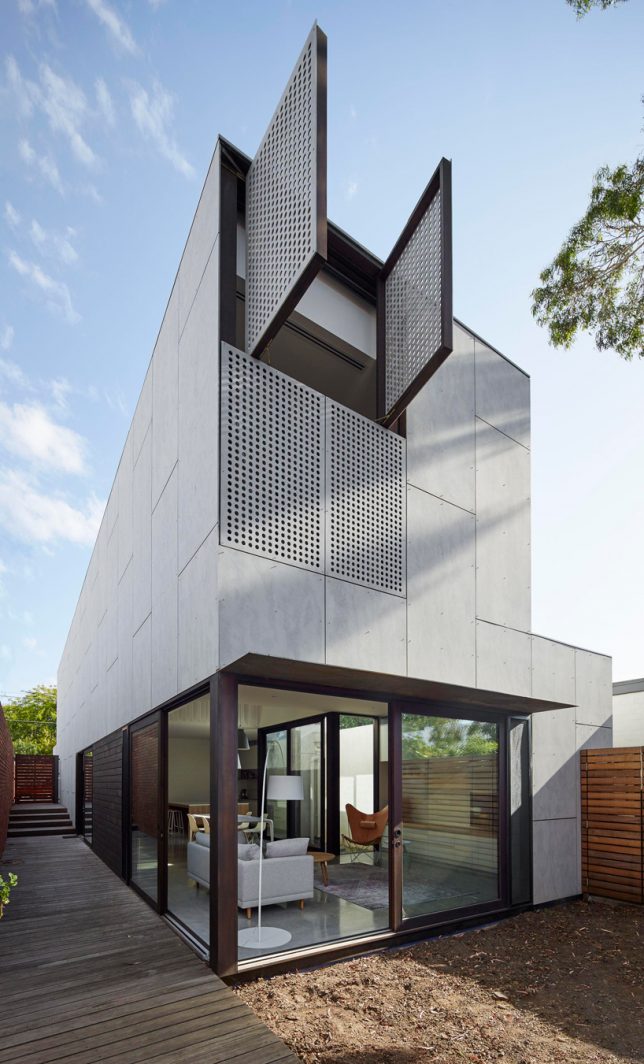
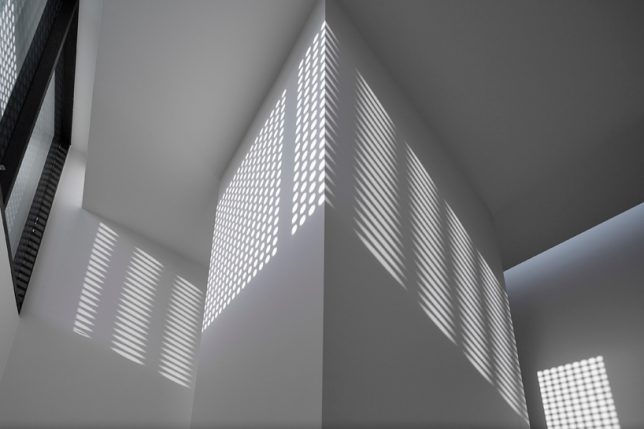
All street-facing and neighbor-visible windows on the ‘May Grove’ residence in Melbourne by Jackson Clements Burrows can be covered with perforated shutters integrated right into the facade, or opened when the inhabitants want a clear view. Not only do they control ventilation and privacy for this low-cost modern home, they create a play of light and shadow throughout the interior during the day.

Next Page – Click Below to Read More:
Not Just A Facade 15 Dynamic Modern Exterior Treatments

Share on Facebook


[ By SA Rogers in Architecture & Offices & Commercial. ]

[ WebUrbanist | Archives | Galleries | Privacy | TOS ]


WebUrbanist

 
Comments Off on Not Just a Facade: 15 Dynamic Modern Exterior Treatments

Posted in Creativity


Pentax K-1’s Pixel Shift challenges medium-format dynamic range

10 May

The Pentax K-1 has produced one of the best dynamic range performances we’ve yet seen. As our testing of the camera continues, we’ve been looking through the results of our Raw dynamic range test and we’ve been very impressed. And that’s before we looked at the benefits brought by Pixel Shift Resolution mode.

Raw Dynamic Range

Exposure Latitude

In this test we look to see how tolerant of pushing exposure the Pentax K-1’s Raw files are. We’ve done this by exposing our scene with increasingly lower exposures, then pushed them back to the correct brightness using Adobe Camera Raw. Examining what happens in the shadows allows you to assess the exposure latitude (essentially the dynamic range) of the Raw files.
Because the changes in this test noise are primarily caused by shot noise and this is mainly determined by the amount of light the camera has had access to, the results are only directly comparable between cameras of the same sensor size. However, this will also be the case in real-world shooting if you’re limited by what shutter speed you can keep steady, so this test gives you an idea of the amount of processing latitude different formats give.
$ (document).ready(function() { ImageComparisonWidget({“containerId”:”reviewImageComparisonWidget-34744790″,”widgetId”:357,”initialStateId”:null}) })

Compared with the Nikon D810, the Pentax does a great job. There’s less chroma noise visible after a 5 and 6EV push, suggesting the Pentax is adding even less noise to its images than the already very good Nikon. It’s a similar story when compared with the Nikon D750$ (document).ready(function() { $ (“#imageComparisonLink2463”).click(function() { ImageComparisonWidgetLink(2463); }); }). The difference compared to the Sony a7R II$ (document).ready(function() { $ (“#imageComparisonLink2464”).click(function() { ImageComparisonWidgetLink(2464); }); }) is even greater, marking the K-1 as one of the best results we’ve ever seen.

The picture is slightly muddied by the D810 offering an ISO 64 mode$ (document).ready(function() { $ (“#imageComparisonLink2467”).click(function() { ImageComparisonWidgetLink(2467); }); }), which can tolerate around 2/3EV more exposure before clipping, allowing longer shutter speeds that provide a shot noise benefit commensurate with that. This allows the D810 to pull almost imperceptibly ahead in brighter, shot-noise limited tones$ (document).ready(function() { $ (“#imageComparisonLink2468”).click(function() { ImageComparisonWidgetLink(2468); }); }), but doesn’t stop the K-1’s result (from a camera with a list price roughly half as much) from being hugely impressive.

The difference is even bigger in Pixel Shift Resolution mode. Because it samples the scene multiple times, it effectively collects more total light, which means less shot noise. As you might expect, the result from the four 1/320 sec exposures used to create the 1/320 + 6EV image$ (document).ready(function() { $ (“#imageComparisonLink2465”).click(function() { ImageComparisonWidgetLink(2465); }); }) show similar levels of noise to the 1/80th second exposure shot in single image mode (a 2EV advantage), only with the greater sharpness that Pixel Shift mode brings. This lower noise means you can push the files to a tremendous degree – far beyond what the Nikon D810’s ISO 64 mode allows$ (document).ready(function() { $ (“#imageComparisonLink2466”).click(function() { ImageComparisonWidgetLink(2466); }); }).

ISO Invariance

A camera with a very low noise floor is able to capture a large amount of dynamic range, since it add very little noise to the detail captured in the shadow regions of the image. This has an interesting implication: it minimizes the need to amplify the sensor’s signal in order to keep it above that noise floor (which is what ISO amplification conventionally does). This provides an alternate way of working in situations that would traditionally demand higher ISO settings.

Here we’ve done something that may seem counter-intuitive: we’ve used the same aperture and shutter speed at different ISO settings to see how much difference there is between shooting at a particular ISO setting (and using hardware amplification) vs. digitally correcting the brightness, later. This has the advantage that all the shots should exhibit the same shot noise and any differences must have been contributed by the camera’s circuitry.

$ (document).ready(function() { ImageComparisonWidget({“containerId”:”reviewImageComparisonWidget-50200048″,”widgetId”:355,”initialStateId”:null}) })

You can see all the K-1’s full ISO Invariance results here and its pixel shift results here. The K-1 is as close to being ISO Invariant as we’ve seen, meaning there’s no cost to shooting at ISO 100 and pushing the files later, rather than using a higher ISO. This means you can keep the ISO down and protect multiple stops worth of highlight information that would otherwise be pushed to clipping by the hardware amplification.

ISO invariance isn’t an end in itself: there are cameras such as the Sony a7R II that are ISO variant because their higher ISO results are so good, not because their low ISO DR is deficient. However, a look at our standard test scene shows its high ISOs are extremely good, so you’re not losing much in comparison with these dual-mode sensors. The K-1’s files have a very high level of flexibility when it comes to processing.

Conclusion

In conclusion, the K-1 gives one of the best Raw dynamic range results we’ve ever seen, when shooting in single shot mode and absolutely outstanding results in circumstances where you can use the pixel shift mode. The multiple sampling of the same scene effectively gives a 2EV dynamic range boost, meaning it out-performs both the D810 and the 645Z by a comfortable margin. Less noise (though multiple captures) and multiple 14-bit values at every pixel mean it can give outstanding levels of DR for static scenes where you can use the Pixel Shift mode.

Articles: Digital Photography Review (dpreview.com)

 
Comments Off on Pentax K-1’s Pixel Shift challenges medium-format dynamic range

Posted in Uncategorized


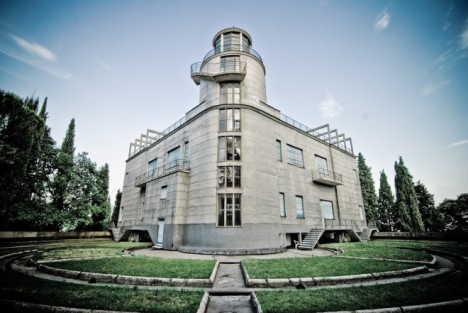
Dynamic Architecture: 13 Buildings with Moving Parts

04 May

[ By Steph in Architecture & Houses & Residential. ]

moving buildings villa girasole 2

Entire Italian villas spin in circles on wheels, solar-powered shades follow the sun, rooms zoom up into the air on telescopic stilts and windowless facades lift up on one end like shoebox mousetraps, all at the push of a button. These dynamic houses, apartment buildings, pavilions and offices have all sorts of moving parts, transforming as if of their own accord to change the views or keep the interiors cool.

Phalanstery Module

moving buildings phalanstery 1

moving buildings phalanstery 2

phalanstery module 3

phalanstery module 4

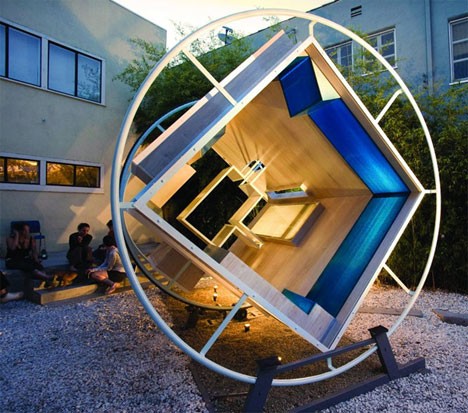
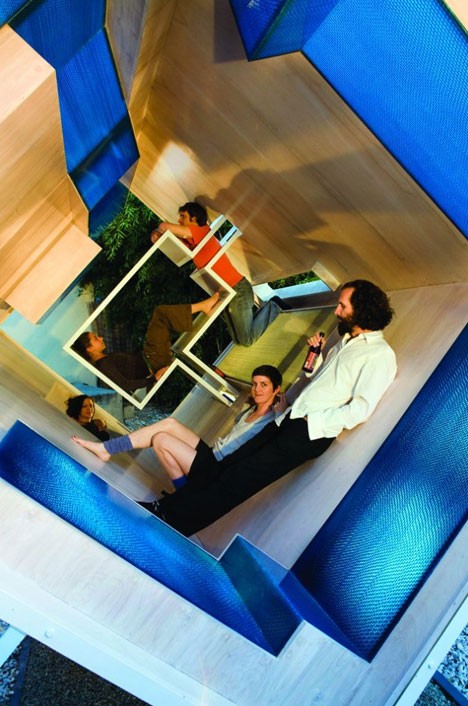
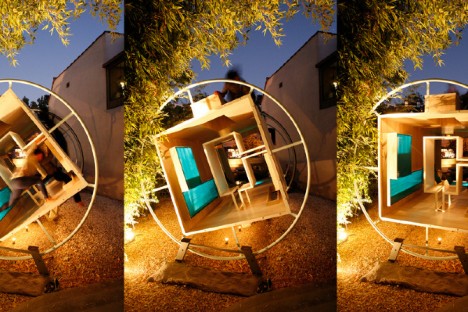
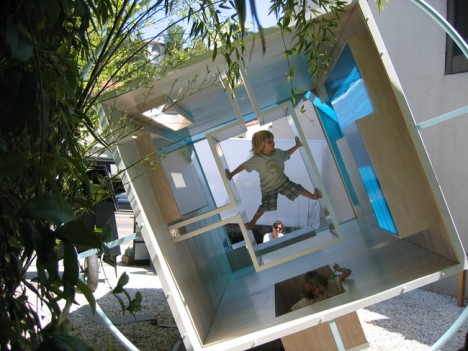
Envisioned as a house for zero-gravity, where all surfaces are treated equally, the Phalanstery Module rotates a full turn per hour, with one of the surfaces becoming parallel to the ground every fifteen minutes. Say the creators, “In the middle of every 7.5 minute conversation, two people are bound to collide. Architectural program and activities become overpowered by the instinctive interpretations of our bodies against measurable dimensions.”

Sharifi-Ha House
moving buildings sharifi-ha

moving buildings sharifi-ha 2

moving buildings sharifi-ha 3

moving buildings sharifi-ha 4
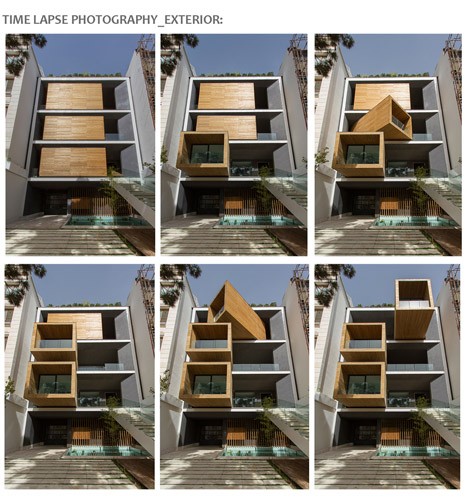
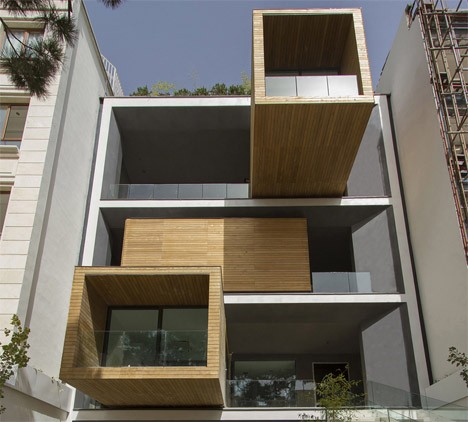
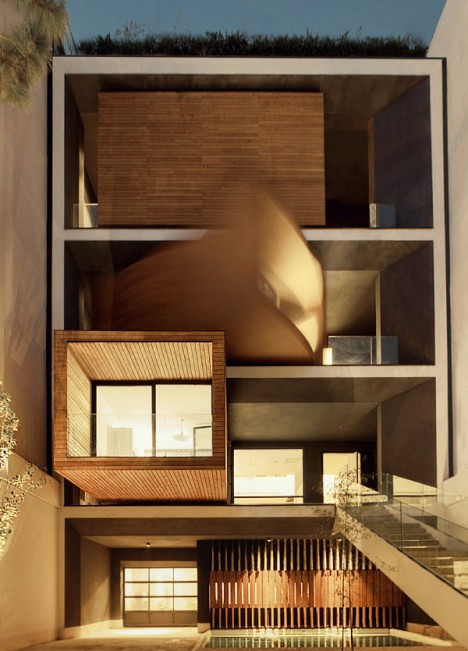
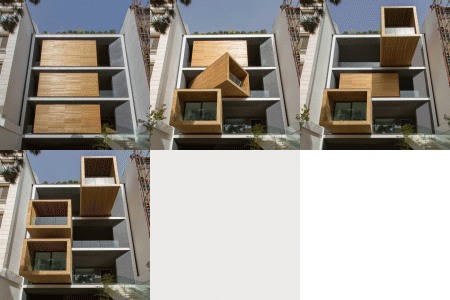
At the push of a button, three wooden volumes tucked inside a main structure turn their glass-capped ends in various directions. The residents of the Sharifi-Ha House by next office i Tehran can choose whether they want these particular rooms to be shaded or illuminated by the sun, as well as the view they prefer. Rotated fully out of their containing spaces, they telescope out over the driveway.

Villa Girasole
moving buildings villa girasole

moving buildings villa girasole 2

Set on wheels and rails, northern Italy’s Villa Girasole rotates to follow the sun as it arches across the sky throughout the day, just like its namesake, the sunflower. Built in the 1930sby a wealthy engineer the two-story house rotates from a 42-meter-tall tower at the center, moving about 4 millimeters per second. It takes 9 hours and 20 minutes for it to rotate a full turn.

La Caja Oscura
moving buildings caja oscura 1

moving buildings caja oscura 2

moving buildings caja oscura 3

moving buildings caja oscura 4

moving buildings caja oscura 5

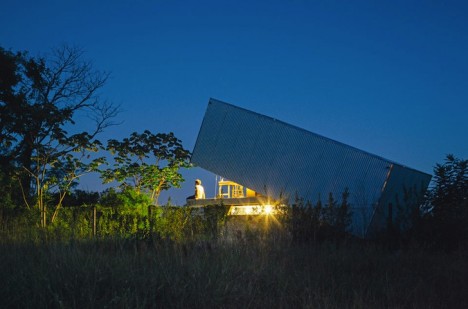
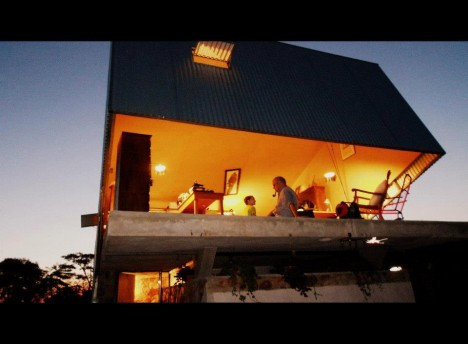
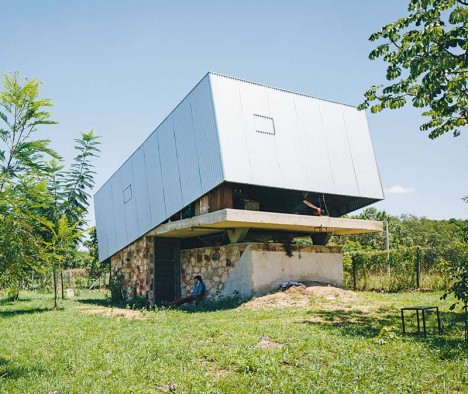
From afar, this house looks like a giant shoebox mouse trap, one end tilted up to reveal an elevated concrete slab. The windowless exterior moves up and down to either open the interior to the elements, or seal it off completely when the owners are gone. Designed by architect Javier Corvalan as the vacation home of a filmmaker, the house transforms with a manual winch. When closed, a pinhole allows the entire structure to function as a camera obscura, projecting an upside-down image of the landscape outside onto the interior walls.

Next Page – Click Below to Read More:
Dynamic Architecture 13 Buildings With Moving Parts

Share on Facebook


[ By Steph in Architecture & Houses & Residential. ]

[ WebUrbanist | Archives | Galleries | Privacy | TOS ]


WebUrbanist

 
Comments Off on Dynamic Architecture: 13 Buildings with Moving Parts

Posted in Creativity


Front-runner: Nikon D500 leads class in studio and dynamic range tests

27 Apr

At long last, a Nikon D500 has found its way into our office (thank you LensRentals!). We put the camera straight into our studio to find out what the long-awaited successor to the D300 is capable of. It’s only the beginning of course, but you can see for yourself below what the D500’s full ISO range looks like in our studio scene (cranked all the way up to ISO 1,638,400) and on the next page you’ll see the results of our dynamic range testing. There’s good news in store – in our initial testing the D500’s performance is class-leading with respect to low light (high ISO) noise performance, as well as dynamic range. In fact, it’s essentially ISO invariant, taking after Nikon’s own D7200 rather than the D5.

$ (document).ready(function() { ImageComparisonWidget({“containerId”:”reviewImageComparisonWidget-64689860″,”widgetId”:346,”initialStateId”:null}) })
Articles: Digital Photography Review (dpreview.com)

 
Comments Off on Front-runner: Nikon D500 leads class in studio and dynamic range tests

Posted in Uncategorized


Studio report: Nikon D5 has lowest base ISO dynamic range of any current FF Nikon DSLR

29 Mar

When the Nikon D5 arrived in our office on Friday we immediately wanted to answer a few questions: How is the low light performance? How good is the autofocus? How is the Raw dynamic range? After running our Exposure Latitude and ISO Invariance tests we’ve found that while the D5’s sensor is clearly optimised for low-light image making, it represents a rather surprising – and disappointing – step backwards in terms of base ISO dynamic range.

Let’s take a closer look, starting with our Exposure Latitude test scene. There are two pages in this article, so don’t miss page 2, where we’ll look at ISO invariance. 

Exposure Latitude

In this test we look to see how tolerant of pushing exposure the D5’s Raw files are. We’ve done this by exposing our scene with increasingly lower exposures, then pushed them back to the correct brightness using Adobe Camera Raw. Examining what happens in the shadows allows you to assess the exposure latitude (essentially the dynamic range) of the Raw files.

Because the changes in this test noise are primarily caused by shot noise and this is mainly determined by the amount of light the camera has had access to, the results are only directly comparable between cameras of the same sensor size. However, this will also be the case in real-world shooting if you’re limited by what shutter speed you can keep steady, so this test gives you an idea of the amount of processing latitude different formats give.

$ (document).ready(function() { ImageComparisonWidget({“containerId”:”reviewImageComparisonWidget-40640152″,”widgetId”:333,”initialStateId”:2280}) })

Even at a modest 3 stop push, we see the D5 has already contributed a considerable amount of noise to its low ISO images compared to the 24MP D750. After a 5 stop push the gap widens, with the D750’s 5 stop file looking more like the 3 stop file from the D5. In fact, the D5’s performance closely resembles the performance seen from the Canon 6D$ (document).ready(function() { $ (“#imageComparisonLink2279”).click(function() { ImageComparisonWidgetLink(2279); }); }), with just a bit more color noise showing in the 6D’s file.

After very aggressive pushes, an interesting series of bands appears at the top and bottom of the image. We don’t know what’s causing this additional noise (which appears to be confined to specific read-out rows) but it’s interesting to note.

Articles: Digital Photography Review (dpreview.com)

 
Comments Off on Studio report: Nikon D5 has lowest base ISO dynamic range of any current FF Nikon DSLR

Posted in Uncategorized


How to Create Dynamic Images with an LED as Your Only Light Source

02 Feb

With a limited budget it’s easy to feel limited by your gear (or lack of gear I should say) but with time, and experimentation, you can discover ways to use the gear you have now, to make compelling images. In this tutorial you will be given a few pointers on how you can use just one LED light to make beautiful and dynamic images.

Equipment

For this tutorial you will need:

Intro image 1

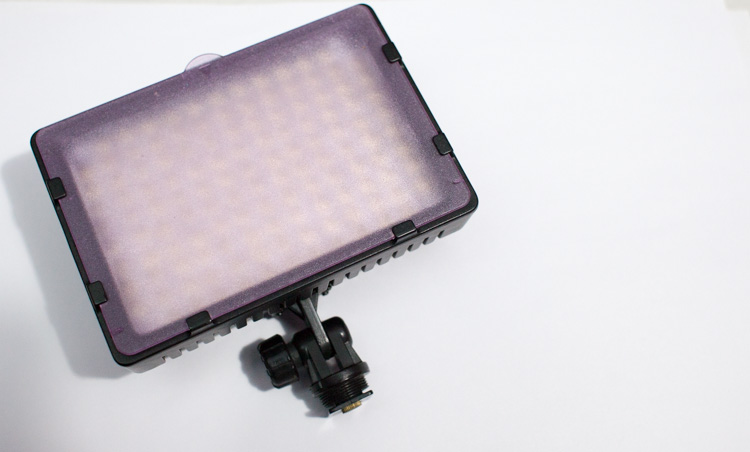
  • An LED light. The light used here is a Neewer CN-126 LED Video Light which was bought on Amazon for under $ 35.
  • A DLSR – Canon, Sony, or any other brand is suitable. I used a Canon 5D Mark II.
  • A tripod or stable surface.

Direct light

Let’s start with the easiest setup: Placing your LED light directly on top of your camera, or on a light stand directly in front of your subject, may seem fairly basic. On its own, it can create a standard, flatly, lit image, which may not seem very exciting to your viewer. However, placing an item that has an interesting pattern or shape directly between your light and your subject can give a unique and creative result.

You can, for example, place a lace tablecloth between your LED light and your model/subject. Playing around with the fabric’s distance from the light, causes the pattern’s shadow to change size, and sometimes even shape. Adjust the distance and placement of your fabric (or other item) until you find a combination that works for you.

DL image 1

DL image 2

DL image 3

For the image above, I used my 50mm lens with an ISO of 2000, and my exposure set manually with shutter speed at 1/50th and aperture at f/1.4. My LED light was adjusted to medium brightness.

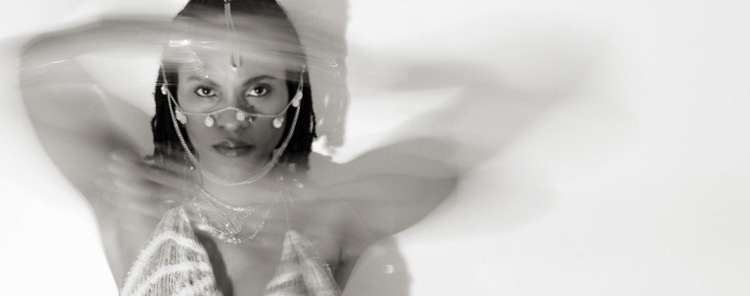
You can also use movement to add interest to your image as shown below. A slow shutter speed along with quick movements can make your images a real conversation piece. Try experimenting with moving your body, or an object like a colourful scarf or umbrella in your image.

DL image 4

Side light

Taking your LED off-camera, and placing it at an angle to your subject is another easy way to create a beautiful image with this simple setup. Keep your LED light setting between low and medium, and angle it at roughly 45 degrees from your subject, can give a nice soft light cascade across your image.

SL image 1

If you try placing your LED light directly to the right, or left, of your subject, you will get a pretty cool effect as well. This placement creates an interesting shape in the natural shadow your subject makes. In the image below, the LED is propped up at eye level, on a bookshelf to my left. The angle of the light, coupled with a delicate pose, created an image that was both compelling, and visually interesting. Camera settings for this image were ISO 1600, f/3.2 and 1/160th of a second with a 50mm lens.

SL image 2

Playing around with overlays and textures in Photoshop can further enhance your photo.

SL image 3

Backlight and overhead light

For small objects you can do a simple backlight setup, using your LED light. If you place a sheet of white letter sized printing paper directly over your LED light, and place your subject directly on top of it, the result is pretty interesting. When using this method try to choose a subject that you think would have an interesting silhouette. You can also try items that are slightly translucent and may possibly glow when back lit. Try capturing your final image by shooting from an overhead angle, but don’t be afraid to experiment with other camera positions as well.

BL image 1

BL image 2

Interesting images can also be created by putting your LED light directly above your subject. In the first image below, the light was angled slightly above the rose. This created a nice, softly angled, light effect that gave the rose a different dimension.

OL image 1

Coupling the overhead LED placement with interesting poses gives really striking results. Posing your subject with their face turned upward, in the direction of the light, for example, creates some really nice shadows along the contours of the face. Some creative editing in Photoshop resulted in these final images.

OL image 2

OL image 3

With this simple tool and a little imagination, you can create dynamic, visually appealing images for your portfolio. The key here is to experiment, play and have fun.

Let me know other creative ways you have used an LED light to add interest to your photography in the comments below.

googletag.cmd.push(function() {
tablet_slots.push( googletag.defineSlot( “/1005424/_dPSv4_tab-all-article-bottom_(300×250)”, [300, 250], “pb-ad-78623” ).addService( googletag.pubads() ) ); } );

googletag.cmd.push(function() {
mobile_slots.push( googletag.defineSlot( “/1005424/_dPSv4_mob-all-article-bottom_(300×250)”, [300, 250], “pb-ad-78158” ).addService( googletag.pubads() ) ); } );

The post How to Create Dynamic Images with an LED as Your Only Light Source by Tricia Bent appeared first on Digital Photography School.


Digital Photography School

 
Comments Off on How to Create Dynamic Images with an LED as Your Only Light Source

Posted in Photography


Macphun launches Aurora HDR high dynamic range software for Mac users

10 Nov

Software developer Macphun has announced a new package designed to help photographers to combine multiple exposures into HDR images. Created in partnership with HDR specialist Trey Ratcliff, Aurora HDR provides tools for a wide range of effects via manual controls and a collection of pre-sets. Read more

Articles: Digital Photography Review (dpreview.com)

 
Comments Off on Macphun launches Aurora HDR high dynamic range software for Mac users

Posted in Uncategorized


Sony Alpha 7R II dynamic range analysis published

06 Oct

Our in-depth testing of the Sony Alpha 7R II continues, and we’ve just published 3 pages of Raw dynamic range analysis. Along with AF, the a7R II’s dynamic range capabilities have been the subject of much attention and could help put Sony’s latest full frame camera at the top of its field. Take a look and see how the a7R II’s 42MP BSI CMOS sensor performs when its Raw files are pushed to the limit. Read more

Articles: Digital Photography Review (dpreview.com)

 
Comments Off on Sony Alpha 7R II dynamic range analysis published

Posted in Uncategorized