By Don Komarechka
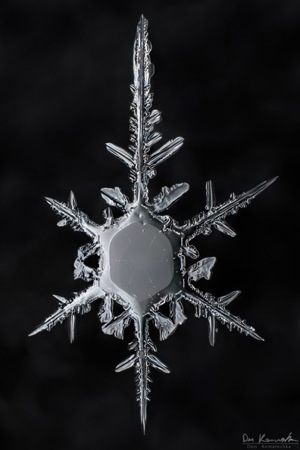 The winter months are typically uninteresting for macro photographers. Flowers, insects, and tiny details in nature all but disappear. Only one faithful subject is left in abundance – the tiny snowflake.
Thankfully, “abundance” is an understatement. For nearly half of the year, you’ll find countless trillions of them mere feet from the warmth and comfort of home. So, how do you start? How do you capture one of these tiny crystalline subjects and fill the frame behind your lens?
The Gear:
The first thing you’ll need is an old mitten.
You’ll need more than that, however. The average snowflake is around 2-5mm across, so filling the frame with one of these crystals will require powerful magnification and good lighting. Any camera will do, as long as you can get close enough. For snowflake photography, you’re going to need to delve into the world beyond 1:1 lifesize magnification.
1:1 lifesize is the highest scale of magnification that most macro lenses are capable of. On a full-frame sensor, a 4mm snowflake will only fill about 2% of the image – we need to get closer.
Adding a set of extension tubes to your macro lens will often get you close to 2:1 life-size, and Kenko makes a great set. These are hollow tubes that sit between the camera and the lens, effectively allowing the camera to focus closer to its front element. This is the most convenient way to increase your magnification, but close-up filters are another good option.
Close-up filters are basically reading glasses for your camera. They act as a magnifying glass, and multiple can be stacked together for an increased effect. They cause the edges of the frame to get distorted, but when photographing snowflakes you’ll likely be cropping out the edges anyhow. Close-up filters also interfere with the autofocus capabilities of most DSLRs, but we’ll be shooting manual focus for this subject.
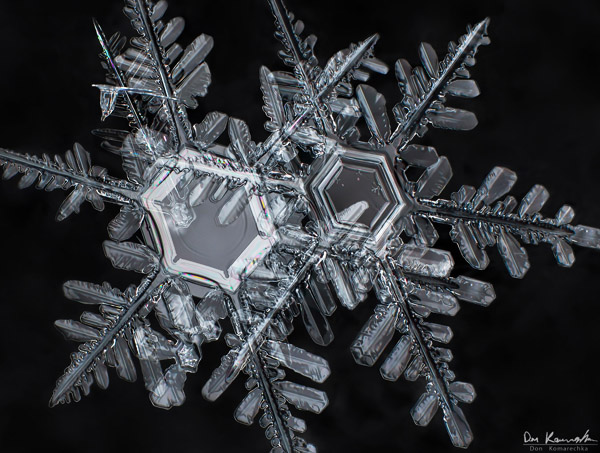
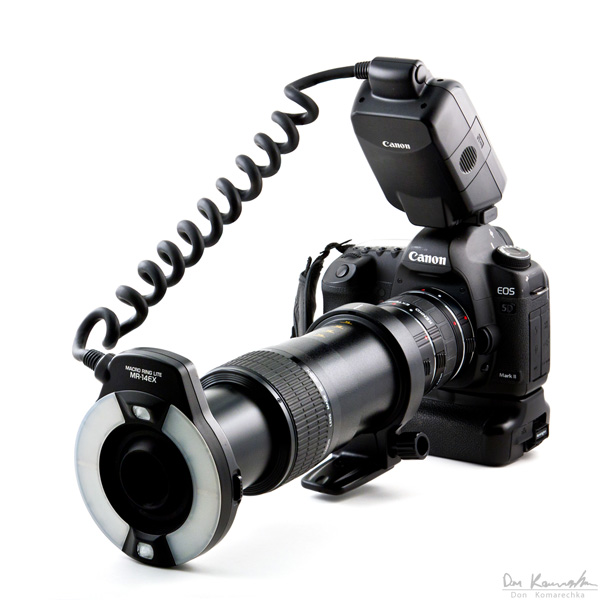
Lighting a snowflake may seem like a challenge, but it’s fairly simple: use a ring flash. Ring flashes may not be favored in all areas of macro photography because they create a distracting reflection in water droplets and some insect eyes. It’s the perfect solution for snowflakes however, and makes capturing them a little easier. Most ring flashes (I use a Canon MR-14EX) allow you to control two banks of light and make one brighter than the other. I nearly completely turn one bank off and use half of the flash – and I aim for the perfect angle.
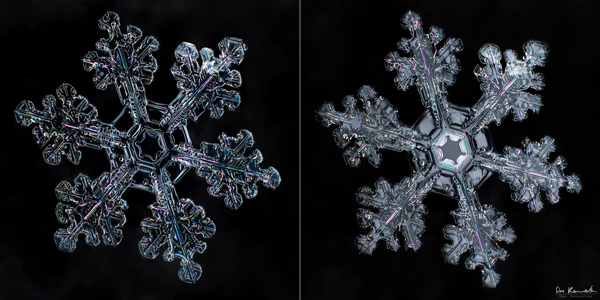
Getting the right angle can drastically change the outcome. The above image is photographed at two different angles only a few degrees apart. It takes plenty of experimenting in the field to find these angles, and I’ll occasionally use a small paintbrush to nudge the snowflake to the proper angle. I avoid this unless necessary, because the crystals often shatter when manipulated too much.
So we’ve got a lens, a light, and now we need a stage. All of my snowflake photographs are made on the same old black mitten. It’s an essential component in my images, and there are plenty of reasons why:
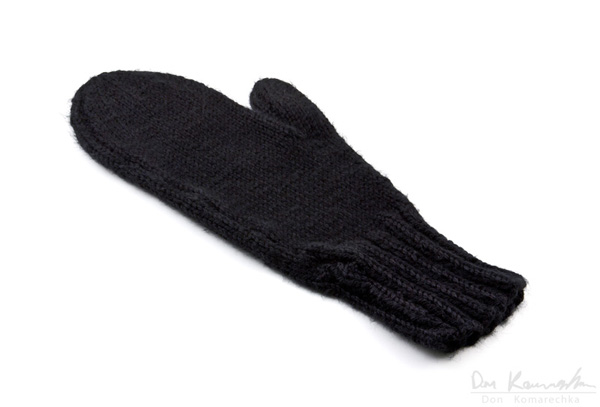
- Dark background: the mitten creates a darker background for the snowflake and allows for some beautiful contrasts. Choose another color besides black for a different feel to your images – but keep it darker for good contrast.
- Insulation: If the snowflake were to fall on a flat metal surface, and that surface were to transfer even the slightest amount of heat – the snowflake would be a water droplet fairly quickly. With the mitten, the ice gets caught in the fibers and only makes a few contact points with the surface, keeping it insulated from heat.
- Subject Isolation: Every shot will have some number of woolen fibers present, but these are far easier to edit out than a flat and detailed surface like felt or a BBQ cover in your backyard.
The Process:
Set out the mitten during a snowfall and wait for the snowflakes to land (tip: you shouldn’t be wearing the mitten). Take a close look and see if the snowflakes are of the “beautiful” variety. You’ll commonly see balls of ice or crystals covered in frozen water droplets (called “rime”). It may take a few snowfalls before you see the best crystals for photographing – big, clean snowflakes with lots of branches:
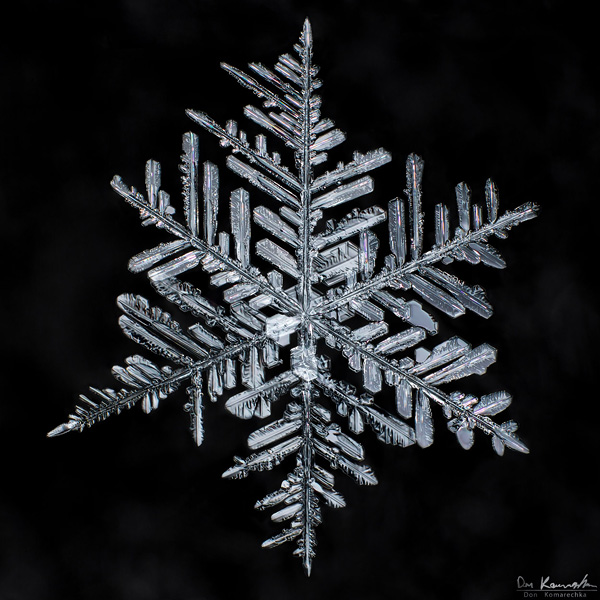
It’s very important to photograph the snowflakes during a snowfall. As soon as one hour afterwards, the crystals will begin to melt or sublimate (evaporate without melting first) and the sharp crystal edges will soon disappear. If you’ve just missed the snowfall, try to place the mitten on freshly fallen snow and pick it up again – the fibers will catch the fallen snowflakes like Velcro and you’ll have a chance at photographing a few before they deteriorate too far.
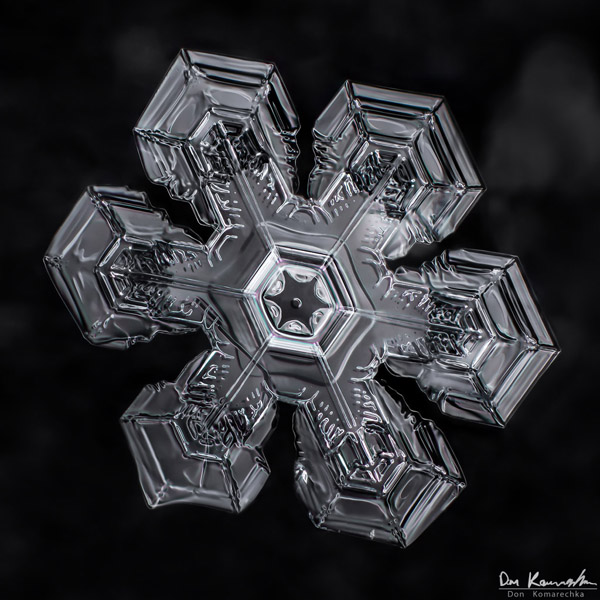
All of my snowflakes are focus-stacked. This means that I take multiple frames of the same snowflake at many different focus points; I do this by physically moving the camera forward and backward through the focus plane of the crystal, continuously shooting all the while. This process is necessary because they’re often photographed on an angle, giving only a tiny sliver of focus. I photograph them on an angle to bring out surface reflections, prismatic colors and even vibrant center colors as a result of optical interference:
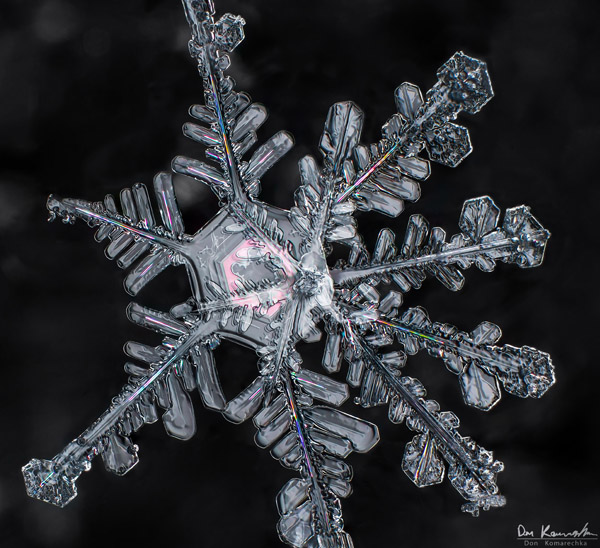
This is not, however, how the image comes out of the camera. The below image is one of 33 images used in the final composition. The process of combining the frames is lengthy, in part because every image is done without a tripod – they’re all hand-held. Because I handhold these images, I need to take far more frames than I’ll actually use (I over-shoot to make sure I cover every point). The 33 frames I used in this image were selected out of 112 in total.
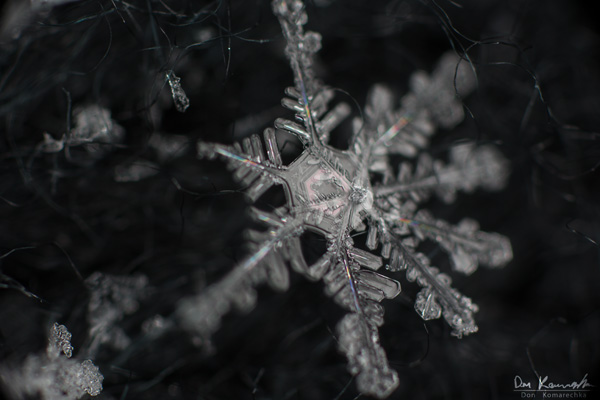
I’m often asked why I don’t use a tripod for these photographs. Getting a tripod set up to exactly the right angle and adjusting a focus-rail to get everything set perfectly would take a significant amount of time. I find the snowflake freehand and adjust the angle of the camera to get the desired reflection by taking test shots, something far more time-consuming if a tripod were involved. Time can’t be spent aligning a tripod in this way – I need to move quickly to be sure the snowflake won’t melt, blow away or get smothered by more falling snow. Photoshop does a pretty good job re-aligning the images, as long as your angle doesn’t deviate too much.

Snowflakes measuring roughly 0.4mm in diameter, photographed at 6:1 magnification and cropped significantly
The editing and focus-stacking process will be discussed in a future article.
The Book:
If the tutorial above interests you, it will be spelled out in greater detail in my upcoming book, “Sky Crystals: Unraveling the Mysteries of Snowflakes”. The book is currently being crowd-funded on indiegogo, and a $ 35 contribution will get you a copy when it’s released in October 2013. Support the project and help the book get published!
The book will be 300 pages, hardcover and detail all of the photographic techniques, science & physics, and even the psychology and philosophy of why we find snowflakes beautiful. The campaign ends April 30th 2013.
Post originally from: Digital Photography Tips.
Check out our more Photography Tips at Photography Tips for Beginners, Portrait Photography Tips and Wedding Photography Tips.
How to Photograph Snowflakes with a DSLR

Digital Photography School


