RSS
 

Posts Tagged ‘Don’t’

Don’t Miss Out: These 12 Photography Deals Will Disappear With 2016

28 Dec

Over the last 12 days we’ve presented you with some amazing daily deals on photography training resources in our 7th annual 12 days of Christmas.

12 days

The savings this year were our biggest yet and we had a lot of really positive feedback from readers who picked up some fantastic deals.

As in previous years we did get a few sad messages from readers who missed deals along the way asking if there was any way to get them.

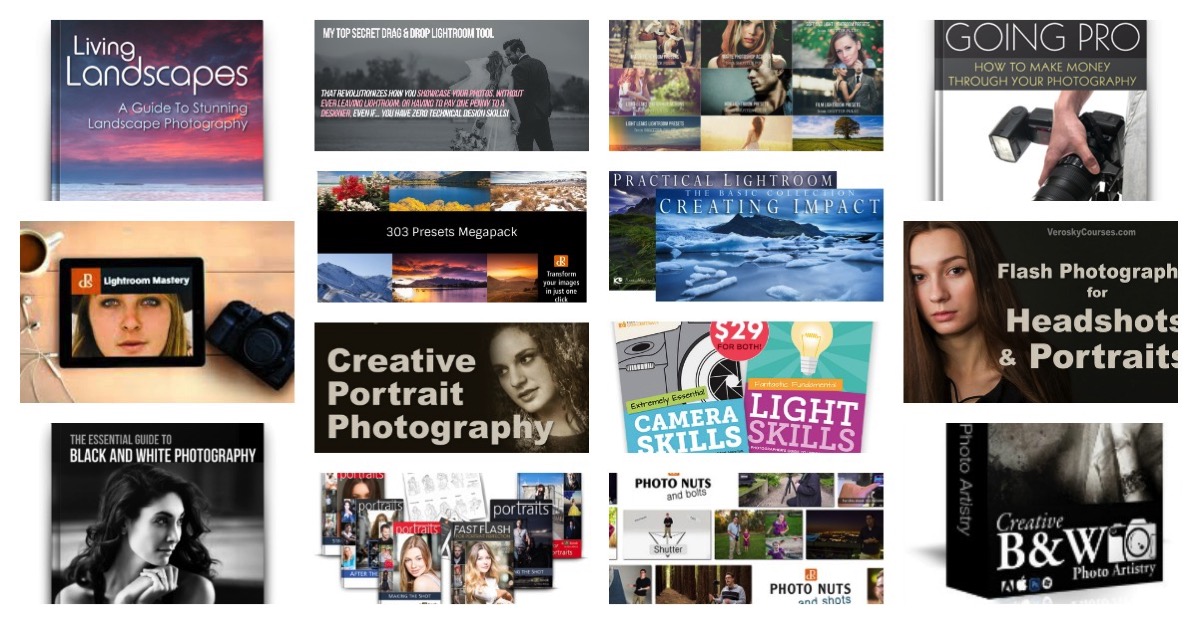
As a result – today we’re opening all 12 deals back up again for one last chance. You can find them all here or listed below.

So if there’s a deal you regret missing or you might have missed one of our emails – you’re in luck. Here they are!

  • Deal 1: Save 50% on this Trade Photography Guide (it’s just $ 5)
  • Deal 2: Save 76% on this Mega Portrait Photography Bundle (course, eBooks and more)
  • Deal 3: Save 70% on our Lightroom Mastery Course (hottest deal of the 12 days)
  • Deal 4: Save 67% on our Lightroom Presets (transform your images in a click)
  • Deal 5: Save 60% on these Professional Photoshop Actions and Lightroom Presets
  • Deal 6: Save 60% on these Landscape Photography Courses (from two of our favorite photographers)
  • Deal 7: Save 85% on this Drag and Drop Lightroom Collage Tool (includes bonus)
  • Deal 8: Save 65% on this Camera Skills and Light Skills Training (satisfaction guaranteed)
  • Deal 9: Save 77% on this Portrait Photography Training (includes 4 exclusive bonuses)
  • Deal 10: Save 85% on our Our Photo Nuts Courses (PERFECT for beginners)
  • Deal 11: Save 60% on Black and White Photo Artistry Course (this was very popular)
  • Deal 12: All dPS eBooks – just $ 9 (there’s 23 to choose from)

All these will be available until midnight US Eastern time on 31st of December, after that they will be gone for ever (just like 2016) – so get to it and grab yours today!

googletag.cmd.push(function() {
tablet_slots.push( googletag.defineSlot( “/1005424/_dPSv4_tab-all-article-bottom_(300×250)”, [300, 250], “pb-ad-78623” ).addService( googletag.pubads() ) ); } );

googletag.cmd.push(function() {
mobile_slots.push( googletag.defineSlot( “/1005424/_dPSv4_mob-all-article-bottom_(300×250)”, [300, 250], “pb-ad-78158” ).addService( googletag.pubads() ) ); } );

The post Don’t Miss Out: These 12 Photography Deals Will Disappear With 2016 by Darren Rowse appeared first on Digital Photography School.


Digital Photography School

 
Comments Off on Don’t Miss Out: These 12 Photography Deals Will Disappear With 2016

Posted in Photography


How to Find Your Photography Niche: You Don’t Have To Master It All

05 Nov

When it comes to photography, there can sometimes be this strange assumption that we are (or should be) experts in all types of photography. Photography is essentially painting with light, so there’s no reason why we shouldn’t be able to do newborn photography, astrophotography, weddings, family portraits, landscape photography, and food photography, right? Light is light, whether it’s on a newborn or a spider, right? The simple answer is yes, and no. But, there’s good news, you don’t have to master it all. Let’s talk about how to find your photography niche.

find-your-photography-niche

Different strokes for different folks

Much like a chef benefits from learning about cooking as a whole, photographers benefit from learning the fundamentals that apply across all types of photography: aperture, shutter speed, ISO, finding light, capturing movement and emotion, and focus. However, much like chefs often break off into different specialties, photographers also tend to break off into different niches. Some photographers find that they love newborns, but hate weddings (raises hand). Others love landscapes, but don’t enjoy photographing humans ever. Some photographers love to work in a studio, while others prefer to work only outdoors with natural light. Finally, some photographers prefer to shoot in digital, while others prefer film.

niche-photography

Do what you enjoy

Whichever type of photography sparks your passion and fills you with joy? Do that. Whether that’s black and white portraits, lifestyle newborn images, macro photography of spiders, or architecture – do what you love.

Then when it comes to post-processing, if there’s a method that transforms your image the way that you’ve always pictured it in your head, do that. If it’s a hipster vintage wash, do it. If it’s a quick curves adjustment and nothing else, do that too. Heck, if it’s black and white with selective coloring that makes you happy when it comes to post-processing, by all means, do that.

Do it even if it isn’t cool, and no one else is doing it. Whether you consider photography to be a craft or an art, it is most certainly an opportunity to have a creative voice. And as corny as it may sound, your authentic voice, whether expressed in cooking or in photography, is important.

find-your-niche-photography

It’s okay not to do it all

Just in case no one has ever told you before, it’s okay not to do it all. If you specialize in food photography and someone calls you up and asks if you’ll consider accepting a wedding booking, it’s okay to say, ‘Thank you so much for thinking of me, but no.” It’s okay to love photographing families and have absolutely zero interest in doing macro photography of insects.

Whether you’re an amateur or a professional, it’s really hard sometimes to admit that a particular area of photography isn’t your preference or your strong suit. No one wants to feel incompetent. On the other hand, there’s no shame in telling someone that you are unable to accept a newborn booking because it isn’t your specialty and consequently you aren’t familiar enough with newborn posing safety to feel comfortable with accepting that job.

Say it with me – I do not have to master it all.

photography-specialty

Finding your niche

If you’re reading this article and thinking, “Okay great, so how do I find my niche?’ The answer is simply to try everything you can. Trying different types of photography is very different than feeling compelled to master every type of photography. Giving different genres of photography a try in low stakes (often unpaid) environments allows you to experiment, and to discover what it is that you really love.

It also requires possibly humbling yourself a bit and allowing yourself to be taught by someone else. Even if you’re the best wedding photographer in your state or area, you may not know the first thing about being a wildlife photographer. So if you really want to learn, you have to be ready and willing to be taught.

photography-you-love

Benefits of trying things

My personal niche in photography is newborns and families. It’s what really makes me excited, and what I really enjoy most. However, every time that I’ve stepped outside that comfort zone, with the goal of learning about another genre of photography, it’s been worth it.

I’ve not been a master of every genre that I’ve tried, nor have I enjoyed them all, but I’ve learned something valuable in every case. When I buckled down and focused on landscape photography, it gave me an opportunity to review techniques of composition, metering, and shooting with a relatively small aperture in ways that I don’t typically use on a daily basis when it comes to people photography.

finding-photography-passion

When I made an attempt to learn about astrophotography (a genre of photography that had always greatly intimidated me) I had the opportunity to learn more about long exposures, and the technique of shooting with a wide open aperture in a different application than portraits. Are my astrophotography images perfect? Absolutely not! I’m not an astrophotography expert, and probably never will be. I have two kids, so staying up all night to photograph the stars is a special kind of sleep deprivation torture that I have no interest in repeating with any frequency.

Yet, there’s also a certain importance in taking something that you have no idea how to do and learning the steps necessary to make it happen. When all the pieces finally fall into place, and you have an image that sort of resembles the gorgeous astrophotography images that you see in magazines, it’s a pretty amazing feeling. Like creating something out of thin air.

photography-niche

Conclusion

The more types of photography you try, the more you’ll find yourself saying both “Yes!” and “Nope, I don’t need to do that ever again.” You may also find that there are several types of photography that you enjoy, which is fine. When I suggest finding your niche, I’m not suggesting that you choose one photography genre and one post-processing style and stick to those for the rest of your life and career.

Your niche in the photography world should grow, shrink, and evolve over time. Give yourself the freedom to identify the types of photography that you really enjoy, and forget the rest of it. You do not have to master it all.

What’s your photography niche? What types of photography do you love? Are there any types of photography that you hate? Chime in below!

googletag.cmd.push(function() {
tablet_slots.push( googletag.defineSlot( “/1005424/_dPSv4_tab-all-article-bottom_(300×250)”, [300, 250], “pb-ad-78623” ).addService( googletag.pubads() ) ); } );

googletag.cmd.push(function() {
mobile_slots.push( googletag.defineSlot( “/1005424/_dPSv4_mob-all-article-bottom_(300×250)”, [300, 250], “pb-ad-78158” ).addService( googletag.pubads() ) ); } );

The post How to Find Your Photography Niche: You Don’t Have To Master It All by Meredith Clark appeared first on Digital Photography School.


Digital Photography School

 
Comments Off on How to Find Your Photography Niche: You Don’t Have To Master It All

Posted in Photography


‘I don’t use my camera as my memory’: we interview Graham Nash

18 Oct
 Graham Nash, photographed by Amy Grantham.

From Lancashire to California, Graham Nash’s journey has been a long and winding one, both as a musician and a photographer. 

As he prepares for his keynote talk at this week’s Photo Plus Expo in New York, we spoke to Graham Nash about his career as a photographer, and his role in developing modern digital photographic printing.


Graham – most people probably know you primarily as a musician, but when did you start taking photographs?

I’ve been a photographer for longer than I’ve been a musician. The first portrait I took was a picture I took of my mother when I was 11. And it was at that moment that I knew that I saw differently to most people.

You and I both grew up in Northern England. I was born in Yorkshire and you were raised in Lancashire, in Salford.

It’s alright, I’ll still talk to you!

So you’re from L.S. Lowry country – dark, satanic mills, and all that. How did growing up in Salford influence your visual style?

I think it did wonders for me as a person, not necessarily in terms of any talent I may have. When you grow up in that kind of area after World War II, your feet are on the ground. You’re thankful that you’re still alive, that your friends are still alive, and that your house is still standing. Because when I was younger, that wasn’t always the case.

Once you have this sense of having survived, it’s a sense of accomplishment. And also, you know, don’t complain to me about the room not being the right temperature. Talk to me about something more important.

 Johnny Cash, Nashville, TN. 1960. Photograph by Graham Nash, used with permission. 

So being raised in the industrial north of England, coming to America in the 1960s must have been a mind-blowing experience?

Mind-blowing and joyful. I had sunshine, I had music, David (Crosby) and Stephen (Stills) and I were just forming our relationship and falling in love with each other, and each other’s music. Having all that music to make, and records to make, and sunshine and beautiful weather… it was an extraordinary time.

‘I’m interested in those little surreal moments that happen in front of me’

And just visually – even now, America isn’t like anywhere else…

It’s an incredible country. The first time the Hollies came to America, we came to New York. But where I went to live, and where I really thrived was Los Angeles.

The people are very interesting to look at, the countryside is beautiful, but I’m not really one of those photographers. I’m more interested in those little surreal moments that happen in front of me, and they seem to happen in front of me daily. I’m not interested in pictures of kittens with balls of wool, or making an image to match the color of my couch. I don’t take landscapes, and I don’t use my camera as my memory.

Nash’s bandmate David Crosby. Photograph by Graham Nash, used with permission.

So you’ve been taking pictures now for more than 50 years. What would you say the biggest difference – technically or culturally, between when you started taking pictures, and now?

I think it’s more mindless now. People are taking pictures of everything. And nothing is that important. I don’t want a picture of me at Disneyland, pulling the sword out of the stone, or any of that stuff. I’m not interested. I’m not interested in selfies. I’ve been taking self-portraits since 1968. It’s so mindless now and I experience it daily. There’s not a show when I don’t get approached afterwards by someone with 20 albums to sign and a selfie that they want taken, immediately. And often they don’t even ask for permission.

‘I draw inspiration from moments’

As a photographer, do you draw more creative inspiration from people, or from places?

Neither, actually. I draw inspiration from moments. I’ve had so many pictures taken of me, I know when a lens is being turned on me. I know that look. And I can’t stand it. If I take portraits, I want to take pictures when they have no idea when I’m there.

Girl with Uzi, North Hollywood, CA. 1998. Photograph by Graham Nash, used with permission.

What were your earliest photographic influences?

My father was an amateur photographer. He used me and my sister’s bedroom as a darkroom, and it was his enthusiasm and his passion that remains with me even today. I’m still thrilled by the magic of photography, and it really is magic.

For the last 15-20 years I’ve been collecting daguerreotypes. The world’s first photographic format. Daguerre invented himself into a corner, because there was no negative to reproduce the image. That’s what Henry Fox Talbot did – he invented the negative, and therefore invented himself into the future.

‘Fox Talbot invented himself into the future’

You’ve been very influential in the development of what we now call digital photographic printing. Can you give me some context around that?

It was pure selfishness. I used to live with Joni Mitchell, and Joni always loved my images, but I never shared them because I thought of myself as a musician. She had had a really good experience with a gallery in Tokyo. The Parko Gallery. She said why don’t you send them some of your photographs?

I was very hesitant to do that, but she told me to send some pictures to this gallery and see if they’d be interested in doing a show. So reluctantly I made 5 or 6 prints and sent them off, and forgot about it. And then they called me and said they’d love to do a show. They wanted 50 images, which was fine, but they wanted them printed about 3 or 4 feet square, which was a problem.

Dennis Hopper, Kentucky Derby, Louisville KT, 2002. Photograph by Graham Nash, used with permission.

At the same time as I was pondering how to do that, I was introduced to the Iris Printer. And when I saw what that printer was capable of doing, I asked the owner two questions. Could it print in black and white? And would the inks last more than ten minutes?

I bought the machine, it cost about $ 125,000, and my partner Mac Holbert and I voided the warranty immediately because we were modifying it and forcing it to do what we wanted it to do. We opened Nash Editions in the early 90s after a couple of years of research, and we’re still in business.

At that time, in the late 1980s and 90s, as I understand it, the abilities of computers to generate digital images had exceeded the ability of printers to output the files. Is that right?

Exactly. You couldn’t get them off the screen. The honor of having our first printer put into the Smithsonian Museum of American History was a real thrill.


Graham Nash will appear at the Photo Plus Expo 2016 this week, in a conversation with photographer and musician Mark Seliger on October 20th.

Articles: Digital Photography Review (dpreview.com)

 
Comments Off on ‘I don’t use my camera as my memory’: we interview Graham Nash

Posted in Uncategorized


In Europe? You Don’t Want to Miss Pop_UP Berlin in Three Weeks

11 Oct

At the end of the month, GPP PopUp is coming to Berlin. If you are in Northern Europe, this city is within reach for you. And for a variety of reasons, it’s almost certainly the last time Pop_UP will be held in Europe.

Here’s why you shouldn’t miss it.

A Compact, Info-Filled Weekend

This will be my third time teaching at Pop_UP. Over the course of one weekend—two days—the instructors there work hard to bring you a learning experience that centers on photography, but hits it from four unique and different perspectives.

That’s important, because no two photographers’ environments are the same. And learning from people who have successfully navigated various waters in different ways can be very valuable.

The sessions are all pretty fast paced. We each have a lot to cover and only a few hours to do it. For that reason, we each tend to step back from the daily cacophony and concentrate on things that might spark you to think about your own situation in a different way.

I wouldn’t expect to learn 500 things. If past Pop_UPs are a guide, I think the more likely experience is that you’ll get a deeper look into a couple dozen new concepts—many of which will be things that you have never really considered before.

People don’t learn sequentially. Accumluated knowledge kind of builds up, then something causes that dam to burst and important concepts come together in a very concentrated way. Which is why there are times when you suddenly realize multiple things at once.

Creating those intersections is the main goal of my session at Pop_UP. But more on that in a minute.

Greg Heisler is a One-Off

Consider Greg Heisler. And yes, I realize there is a Joe and a Zack involved. But they each have their own online venues to talk about their approach to Pop_UP. But Greg really doesn’t.

So let’s talk about him for a minute.

First, Greg is one of the world’s pre-eminent portraitists. You’ve grown up seeing his work. And you think there is this gap, for lack of a better word, that separates his work from yours. And in some ways you are right. The technical gaps are there, because he has a mastery of photography and lighting and color that few can match.

But what I have learned, watching him teach in his very open way, is that the camera-related gaps only partly explain the difference between his work as compared to that of the average “good” photographer.

I have learned that there are other gaps. Important gaps. Probably more important than the photography-related gaps that we can easily identify.

His work ethic, his thought ethic, his approach to dealing with the people in front of his camera, his respect for (and knowledge of) the history that came before us as photographers—all of that is at least as important as his mastery of photography or lighting.

Probably more important, actually.

Spending a half a day seeing that is something that is hard to put a value on. You go in expecting F/stops and you coming out realizing the important stuff had nothing to do with F/stops. If you have read 50 Portraits, you already have some idea of what I am talking about.

(And if you own his book, bring it. Get him to sign it. In 100 years, no one is going to remember me. But Greg Heisler will still be alive and well in the lexicon of photographers.)

Yes, he will almost certainly be shooting at Pop_UP. And it will be a learning experience to watch him work. He might use a Profoto light, or he might use a cheap fluorescent tube from a local hardware store. To Greg, it’s all just light. His versatility and unflappability is a lesson in itself.

Lastly, back to the idea of this being a one-time opportunity. Because for the most part, Greg has been taken off of the market.

Syracuse University in upstate New York has very wisely snapped him up to keep largely for themselves. He loves it there. It’s a wonderful college town with a steady stream of curious (and lucky) young minds for him to mold.

Which means he almost never teaches externally these days. And because of his academic schedule, when he does teach it is generally close to home.

If you are in Europe, this might well be the only chance you have to learn from him.

And I Have to Follow That

I have taught in a lot of places—many cities, many countries. And suffice to say that following Greg Heisler in any kind of teaching environment is its own little nightmare. Not unlike the one where you show up at school without pants.

It stems from a deep-seeded fear of relative inadequacy, something I readily confess as a “lighting guy” in the context of Greg. So you can damn-well be sure I won’t be talking about lighting.

“What an amazing cooking presentation by Julia Child! Please stick around for David Hobby, who is next and will show you how to make toast…”

No.

So my class on Sunday afternoon will be more about the things that surround photography:

• How do you find the areas in photography where you are particularly well-suited?

• How do you identify—and create—areas of extreme competitive advantage?

• How do you create the ecosystems that, in turn, create the positive feedback loops you need?

• Which “outputs” from those systems do you optimize for? (Not just money.)

• Is it a good idea to optimize for money? (Not usually.)

• What balance do you need to create to foster sustainability?

• Where do your best ideas come from?

• Is it possible to engineer a stream of strong incoming ideas? (Yes, definitely.)

I have watched for ten years as my particular field—editorial/photojournalism—has largely collapsed. Many assignment fees today don’t even cover the cost of periodic gear replacement. It’s crazy.

So my last ten years have been spent studying and practicing new ways to approach the “new” world of photo and its related professions. To learn to adapt to a world that has completely shifted under my feet, and to anticipate those changes still yet to come.

This is not something I write about on this site, simply because it is way out of the lighting niche. But it is something that I feel is existentially important for photographers to understand.

That’s the deep dive we’ll be taking on Sunday afternoon.

So That’s One Day

Like I said, I’ll let Joe and Zack speak for themselves. Feel free to ping them on Twitter if you have any Q’s. But for those of you joining us in Berlin, this is what’s on tap for your Sunday.

Pop_UP is not a forever thing. We have been to UK, Asia, US—and this month, EU. If it continues, it would almost certainly be in South America or Africa.

If you are in Europe, and you want to attend one, this is your chance. Come join us.

And if you have photo friends in Europe, please help to spread the word. None of us live there, so we would very much appreciate your help in that way.

Thanks—and see you there,
David

:: GPP Pop_UP Berlin, Oct 29-30 ::
Strobist
 
Comments Off on In Europe? You Don’t Want to Miss Pop_UP Berlin in Three Weeks

Posted in Photography


So, you don’t care about the iPhone 7? Here’s 10 reasons why you should

10 Sep
The iPhone 7 has a newly designed 12MP camera with a six-element, optically stabilized lens. As well as stills it can shoot 4K video at up to 30p, and the iPhone 7 Plus offers a twin-lens camera providing 28mm and 56mm focal lengths. 

Another year, another iPhone, the usual chorus of Internet commenters going to great lengths to tell the world how little they care. But we’d be foolish to ignore the world’s most popular camera – and so would you.

Here’s why.

$ (document).ready(function() { SampleGalleryV2({“containerId”:”embeddedSampleGallery_5515118563″,”galleryId”:”5515118563″,”isEmbeddedWidget”:true,”standalone”:false,”selectedImageIndex”:0,”startInCommentsView”:false,”isMobile”:false}) });

Official iPhone 7 sample photos, courtesy Apple

1: 12MP is good enough

Ok, most DSLRs and high-end compacts offer 20MP+ but if we’re being honest, 2MP is good enough for Facebook, 3MP is good enough for a magazine cover, 6-8MP is good enough for a large-ish wall print and anything more than that is a bonus, most of the time. In short, the chances are that 12MP is good enough for you. 

2: It shoots Raw

It was only a matter of time before Apple added a Raw capture option to its iPhone series, and the day has come. As such, the iPhone 7 and 7S are arguably more enthusiast-friendly than the majority of low-end zoom compact cameras, and almost all tough cameras.

Adding Raw capture to the iPhone gives photographers a lot more creative freedom, and should allow them to mitigate – if not entirely overcome – some of the limitations of shooting with a control-limited device and a small sensor format. Raw shooting is coming to older iPhones soon too, with the upcoming release of iOS 10.

3: The iPhone 7 Plus has a proper zoom. Kind of.

The iPhone 7 and 7 Plus feature 12MP imaging sensors – most likely a 4.9 x 3.7mm BSI-CMOS which gives an equivalent crop factor of around 7X. The 7 Plus has two of them, which form twin cameras shooting at 28mm and 56mm equivalent. Their F1.8 and F2.8 apertures are equivalent in depth of field terms to ~F12 and ~F22 respectively.

The iPhone 7 Plus features a twin-camera design, which comprises 28mm F1.8 and 56mm F2.8 equivalent prime lenses. A forthcoming update will enable a computationally-derived bokeh simulation effect.

A 28-56mm two-step zoom might not set your heart ‘a flutter, but for the average beginner, or keen smartphone photographer, the added versatility of a proper choice of optical focal lengths is a serious selling point of the iPhone 7 Plus over every other phone on the market. A true optical zoom would be hugely complicated, but Apple’s approach makes sense. One lens for landscapes, one for portraits.

5: The iPhone 7 Plus can do bokeh. Kind of. 

We’ve seen attempts to blur out backgrounds using software before, but they don’t tend to end well. Typically, in the devices which offer some kind of algorithmic background blur feature, the effect is inconsistent. Even when it works, it doesn’t hold up well to critical examination.

We won’t be able to properly test the iPhone 7 Plus’s bokeh simulation effect for a while, but early samples look very encouraging indeed. 

Apple seems to be doing two things a little differently. The first is that the feature only works in ‘Portrait’ mode (when the iPhone 7 Plus’s 56mm equivalent lens is employed), and the longer focal length probably gives it a bit of a head-start in terms of baseline background blur for portraits compared to a bog-standard wideangle cellphone lens.

The second is that rather than just identifying your subject, making a mask, then blurring everything which looks like it probably isn’t your subject, the iPhone 7 Plus’s software makes a very complex depth map of the scene, and selectively applies blur based on the calculated distance of the background from your intended subject. For now, we only have Apple’s sample images to go by, but it seems to work impressively well.

6: It’s optically stabilized

Here’s an exploded view of the iPhone 7’s camera, showing its six-element construction.

This is old news in the mainstream camera market, but optical stabilization still isn’t included in some fixed-lens cameras. Optical I.S. will make the iPhone 7 and 7 Plus cameras more useful in poor light, extending the potential of the products for social and environmental photography.

7: It’s quick, and powerful

Modern smartphones incorporate an incredible amount of processing power, and compared to most cameras they’re capable of churning through much more data. With the cameras activated, the iPhone 7 and 7 Plus are constantly sampling a scene in preparation for exposure. So effectively, when you tap the shutter button, they’ve already taken the picture. On-sensor phase-detection autofocus using dedicated pixels means there’s virtually no hunting for focus, either.

Apple claims that the iPhone 7/Plus’s imaging processor manages more than 100 billion operations every time a picture is taken. Think about that the next time you take a photo of your cat.

8: It shoots 4K

Maybe you think you don’t care, but trust us – even if you’re not a filmmaker, the ability to capture 8MP frames at up to 30fps can be pretty handy.

9: It’s water-resistant

You can take the iPhone 7 and 7 Plus out in the rain, or drop them in the bath without worrying. How many photographers can say the same thing about their ‘proper’ cameras?

Supposedly, the iPhone 6S was almost water-sealed, but not quite. With the removal of the headphone jack, the iPhone 7 and 7 Plus have been made fully water resistant, and are both capable – apparently – of being submersed for up to 30 minutes without damage. 

10: Good iPhone cameras lead to better ‘proper’ cameras.

Even if you’re one of those people who has an almost religiously-held indifference to cellphones (and I know you exist because I get emails from you), consider this:
The greater the public’s expectations of the cameras in their cellphones, the more they expect of ‘proper’ cameras, if and when they buy one. There is certainly an argument to be made that the only reason we have things like beautiful high-resolution touch-screens, wireless connectivity, GPS and 4K video in cameras now is the iPhone. That ten years ago, Apple kicked off a smartphone revolution with the original iPhone which lead to the inclusion of these features in cameras becoming an expectation on the part of smartphone upgraders.

Habitual iPhone photographers won’t put up with laggy low-resolution touch-screens on DSLRs, or the omission of features like 4K video and wireless connectivity that they’re used to from their phones. This drives camera manufacturers to add more features to their products, and we all benefit. Right?

10.5: It’s an iPhone camera.

This is an obvious point, but bear with me. Remember what I just wrote about this being the ‘world’s most popular camera?’ Apple has been phenomenally successful when it comes to putting its devices in people’s pockets. More people are taking photographs now than ever before, and the iPhone, in its various versions, is the most popular picture taking device (or strictly speaking, series of devices) in the world.


What that means is that like it or not, when Apple does something, even if it didn’t do it first, it tends to have a certain significance. It’s safe to assume that there are a lot of people talking about the words ‘Bokeh’ and ‘Raw’ today who had never heard the terms before Apple’s launch event this week. Maybe I’m just a misty-eyed optimist, but I think that’s kind of cool. 

Articles: Digital Photography Review (dpreview.com)

 
Comments Off on So, you don’t care about the iPhone 7? Here’s 10 reasons why you should

Posted in Uncategorized


Don’t get ahead of yourself: Canon EOS 5D Mark IV rolling shutter test

27 Aug

Much of the initial concern about the EOS 5D Mark IV’s video has been about its substantial 1.64x crop (relative to the full width of the sensor, 1.74x compared to the 3:2 region) and its use of the inefficient Motion JPEG compression system (which limits the ability to use SD cards with any dependability).

However, upon shooting with the camera we found it to have significant rolling shutter. We’ve demonstrated the effect alongside the EOS-1D X Mark II, which reads out its sensor fast enough to exhibit pretty low levels of rolling shutter, and the Sony a6300, which shows a relatively high level of rolling shutter.

Obviously we’ve panned faster than you ever sensibly would, to make the difference clearer. If you’re careful with the way you move the camera, this rolling shutter effect may not be too apparent however, for some kinds of shooting, it can be distracting.

Articles: Digital Photography Review (dpreview.com)

 
Comments Off on Don’t get ahead of yourself: Canon EOS 5D Mark IV rolling shutter test

Posted in Uncategorized


I Don’t Carioca: Awesome Abandonments Of Rio de Janeiro

15 Aug

[ By Steve in Abandoned Places & Architecture. ]

abandoned-rio-1a

Rio de Janeiro may host the 2016 Olympics but Brazil‘s most picturesque and second-most populous city also boasts a host of infamous abandoned buildings.

abandoned-rio-1d

Perhaps the most notorious and obvious abandonment in Rio de Janeiro, the 37-story Torre Abraham Lincoln (also known as Torre H) sticks out of western Rio’s Barra da Tijuca district like a sore thumb. Sealed off by plywood hoardings and guarded by round-the-clock security to keep squatters out, the Oscar Niemeyer-designed apartment building is collectively owned by its roughly 250 (out of 454) individual unit owners… who have owed property taxes on their units for decades though they’ve never moved in.

abandoned-rio-1c

abandoned-rio-1b

abandoned-rio-1e

The second of a proposed 76 residential apartment buildings meant to transform Barra da Tijuca before the advent of unrestrained development, Torre H has sat frozen in time since 1972 when construction was halted due to concerns about the building’s structural integrity. The neighboring Torre Charles de Gaulle, fully occupied and functional, offers a clue of what a utopian Rio de Janeiro might have looked like.

Above & Beyond

abandoned-rio-2a

You’d think a hotel built in the mountains overlooking metro Rio de Janeiro would be a sure thing… and you’d be wrong, at least in this case. Modern Brazil brings us this stark image of an abandoned hotel that once offered unparalleled views but is now itself the focus of visual interest.

No Park King

abandoned-rio-4a

abandoned-rio-4b

Park Albanoel is an abandoned Christmas-themed fun park located in Itaguai, just west of metro Rio de Janeiro. The park was the brainchild of the late entrepreneur Albano Reis, known affectionately as Santa Claus Quintino. Unfortunately, however, the founder’s heirs did not share his vision and the park is now home to four families invited to homestead there by the owners.

abandoned-rio-4c

abandoned-rio-4c

abandoned-rio-4d

Unfortunately for those families, the park’s swampy and low-lying landscape is also home to mosquitoes carrying the Dengue fever virus. Kudos to Flickr user chrisgj6 for posted the above images taken at Park Albanoel in mid-August of 2013.

Next Page – Click Below to Read More:
I Dont Carioca Awesome Abandonments Of Rio De Janeiro

Share on Facebook


[ By Steve in Abandoned Places & Architecture. ]

[ WebUrbanist | Archives | Galleries | Privacy | TOS ]


WebUrbanist

 
Comments Off on I Don’t Carioca: Awesome Abandonments Of Rio de Janeiro

Posted in Creativity


Don’t Delete Your Failed Images – Instead Learn from Your Mistakes with These Tips

28 Jul

I know you’ve done it. It’s okay to admit it. I’ve done it too! We all have! You’ve shot some terrible photographs.

Perhaps you shot the whole time in the wrong white balance, or you didn’t pay attention to shutter speed and everything is blurry. When this happens it’s incredibly disappointing. Frustrated and angry with yourself, you consider the experience a write-off, and delete the images. Then you head for the snack cupboard searching for some kind of solace.

But, everyone makes mistakes when they shoot, even professionals. There are times when we get excited and forget to check our settings, or make sure we are using the right lens for the right moment. It happens.

Image 1

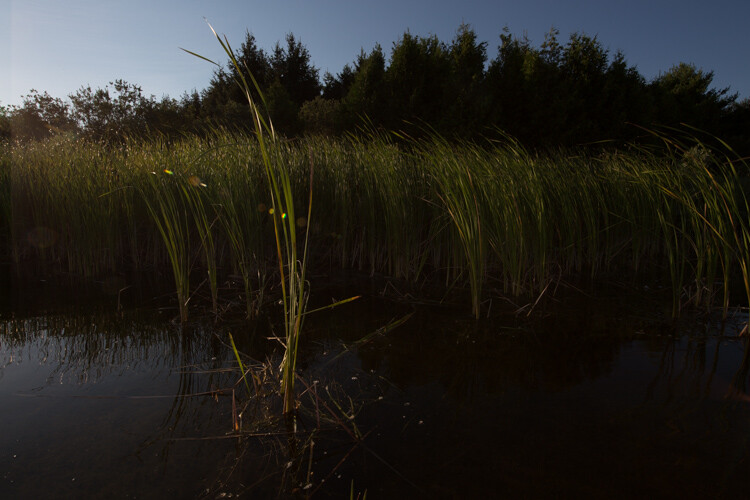
We were canoeing and in my rush to get an image of a small bird I underexposed the shot.

These failures don’t have to be a complete waste though. There’s nothing negative about making mistakes. Willie Nelson once said, “Once you replace negative thoughts with positive ones, you’ll start having positive results.”

So with that in mind, start looking at every photograph you take, as a step forward. Don’t delete those mistakes right away. You can learn a lot about taking good photographs from the missteps you make. I’ve met some photographers who have created a special file for all of their failures. Then when they have a little bit of time, they peruse through the collection and reflect upon them. This type of exercise can help you grow as a photographer.

There are lots of ways to reflect on your images. Some people make mental notes about their images. Others like to use a written journal format. I know of a few photographers who use the keyword section in Lightroom to make notes. I’ve even seen a detailed scrapbook in which the photographer printed out his failures and scribbled notes beside each. Just be sure to pick a format that works for you. Regularly reflecting on your work is important.

To start you down the path here’s a list of questions that you can use to help you reflect on your images.

Reflection Tips

  • In the first few seconds of viewing the photograph, what was the first emotion you experienced? Why? Now let it go. Detach from the emotion and be critical.
  • Why do you consider this image a failure? Don’t analyze too much just scribble down the first thought that comes to your mind. Try to make this part of the analysis a stream of consciousness.
  • What were your goals or intentions when you shot this image? Why were you unable to meet those goals?
  • If you could turn back time and reshoot the image what would you do differently?
  • Think carefully about the image and come up with one key piece of learning that you can take away from this experience.

Now let’s practice your reflection skills. It’s not easy to analyze your own photographs; it can take some time to perfect. Let’s analyze some of my failures, and some successes.

View each image, and really look at it in a critical sense. You can use the guiding questions from above to help you. After you’ve finished your reflection, scroll down and take a look at my notes, see if you agree with my thoughts. Perhaps you noticed something different then I did.

Image 2

What did you come up with? Keep in mind there’s no right or wrong to this whole process. Some people might argue the image isn’t a failure. I personally, hate it.

Notes about the image

  • I cut off the hockey stick, it’s bad framing.
  • She’s looking down at the puck, there is no eye contact.
  • Loss of impact or connection with the viewer.
  • The edge vignette makes it too dark.

Ways to improve

  • Mark out the ice and give players a guideline for where to stop.
  • Remind players to look at the camera at all times.
  • Remove one complication by having kids skate without the puck (Photoshop the puck into the image in post-processing).

Image 3

Compare the shot above, with the previous image. It was taken in the same arena a few months later. Do you think there’s a difference? The framing is certainly better and he makes eye contact with the camera. Have I improved over the first shot?

Let’s consider another mistake. This image was shot for a magazine article. Can you tell why it’s a fail?

Image 4

Notes about the image

  • Her face is slightly out of focus.
  • The client wanted a unique angle for the shot but the focus is on the ball.
  • The houses behind in the background don’t suggest or support that we are on a soccer field.

Ways to improve

  • Ensure the focus is on the correct part of the scene by using back button focus.
  • Always take the time to set up the scene. Remember that the background is as important as the foreground.
  • Direct the player more to remain in a certain area.

Here’s the image the magazine chose to use for the article. You can see how the background gives this image more context than the previous shot.

Image 5

The more you reflect upon your images, the more you will grow as a photographer. If you find you are stuck in a rut, this kind of activity may just be a way to move forward. Coming back to images after a few days, or weeks, is always a good idea. By separating yourself from the image it will help you to analyze it more carefully.

I’ve posted a few more images here for you to reflect upon below. Once you’ve finished analyzing my work, try it on some of your own shots. Leave some examples in the comments below, and include your reflections.

Image 6

Image 7

Image 8

This is an opportunity to grow and become a stronger photographer. I expect that everyone who shares will be heartened by the fact that they are not the only ones to have taken a bad photograph. If you choose to reply to other people’s posts, please be kind and be constructive. This is all in the name of learning, we are not here to criticize each other.

Keep in mind, even geniuses have some failures!

“I have not failed. I’ve just found 10,000 ways that won’t work.” – Thomas Edison

googletag.cmd.push(function() {
tablet_slots.push( googletag.defineSlot( “/1005424/_dPSv4_tab-all-article-bottom_(300×250)”, [300, 250], “pb-ad-78623” ).addService( googletag.pubads() ) ); } );

googletag.cmd.push(function() {
mobile_slots.push( googletag.defineSlot( “/1005424/_dPSv4_mob-all-article-bottom_(300×250)”, [300, 250], “pb-ad-78158” ).addService( googletag.pubads() ) ); } );

The post Don’t Delete Your Failed Images – Instead Learn from Your Mistakes with These Tips by Erin Fitzgibbon appeared first on Digital Photography School.


Digital Photography School

 
Comments Off on Don’t Delete Your Failed Images – Instead Learn from Your Mistakes with These Tips

Posted in Photography


2 Long Exposure Photography Hacks to Try if You Don’t Have an ND Filter

20 Jun

We all love long exposures, well I personally do. They are a great way to create dynamism, movement, and add depth to your images.

In this tutorial, I’ll show you two long exposure hacks that can be useful if your Neutral Density filters are not dark enough, if it’s too bright outside and you cannot get a long exposure, or if you simply don’t have any ND filters. Dark ND filters can be really expensive, so this is a good alternative.

IMG 8076

Long exposures create this surreal, and yet very pleasing effect to give a WOW factor to your images. Whenever you take a photo at night you will automatically get a long exposure, unless you use a very high ISO. For this tutorial I am talking about long exposures during the daytime, which are a bit more complicated to achieve.

The two hacks involves taking nine different images, and stacking them together. Now before I actually explain them, I will briefly give you the best camera settings and shooting conditions:

Shooting and camera settings

  • You will ultimately get the best results if you shoot on a cloudy day with a lot of wind. Why? Because on a cloudy day you will get clouds, and the wind is going to give them movement, and that’s what you want – movement. On a cloudy day, you will also get the minimal amount of light to be able to extend your shutter time.
  • You absolutely need a tripod, first all of all because your images need to be aligned, and you want your images as sharp as possible. With a shutter speed slower than 1/60th, you will start to get blurry results without a tripod.
  • Use a cable release or a 2-second timer every time you take an image. This again is a great way to avoid camera shake and get sharp results.
  • Focus on your subject and put the lens to manual focus, before you start taking your images. DO NOT refocus between the nine shots you are going to take.
  • Use an ISO of 100. You are on a tripod, so you don’t really need a higher ISO.
  • Use a very small aperture, like f/22. This will cut down the light entering your camera as much as possible and with an ISO of 100, will help slow down the shutter speed.
  • Shoot one or two hours before sunset, then you will also have a minimal amount of light to extend your shutter speed even slower.
  • Use your ND filters if you have some. If your ND filters are very dark (10 stop for example) you won’t need these hacks because you will directly get long exposures. If your filters are not dark enough, I would still recommend using them even if you have a one second exposure.
  • I recommend exposing, and focusing before putting your ND filters on, because after that – well you won’t be able to see clearly.

Hack #1 – multiple exposure mode

The first hack consists of using the multi-exposure mode on your DSLR. If you do not have this mode, don’t worry the second hack works for all cameras. I personally use a Canon 6D, but this multi-exposure mode is mostly available for all sorts of advanced DSLRs.

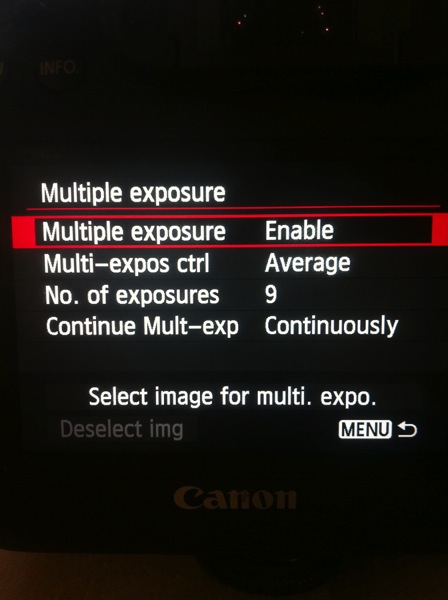
You will find this mode on your menu, you just need to enable it.

IMAGE1

For the settings:

  • Average for the Multi-expos ctrl option
  • Continuously for Continue Mult-exp setting

You have the choice to pick how many exposures you want to shoot, the maximum will depend on your DSLR. I usually pick nine exposures to get as much movement on the clouds as I want.

This mode will allow you to multiply your shutter speed by the number of exposures you shoot. For example, If you shoot a single image with an exposure of one second, you will get a total exposure of nine seconds if you shoot nine exposures. It works the same if you have an exposure of 15 seconds.

With this mode, the camera will automatically stack the images together and give you one single image with all the cloud movement. This trick also works if you want some nice silky water.

If the clouds are moving really fast, then I recommend waiting around two seconds before you take another shot. The main trick is to not have the clouds at the same position one shot after the other. If the clouds are moving very slowly then I recommend waiting around 10-15 seconds between shots.

This mode will also tell you on your screen, how many images you have left to complete your multi-exposure.

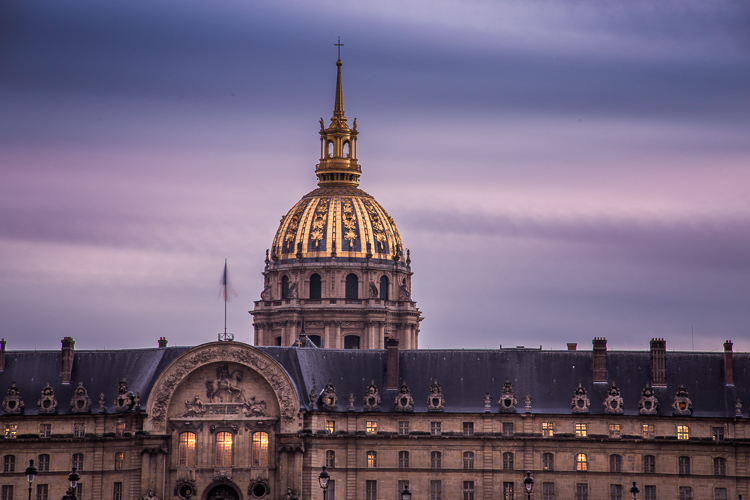
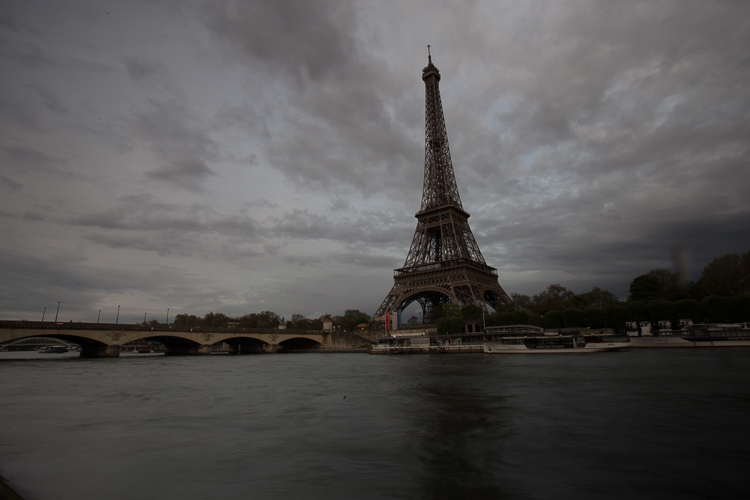
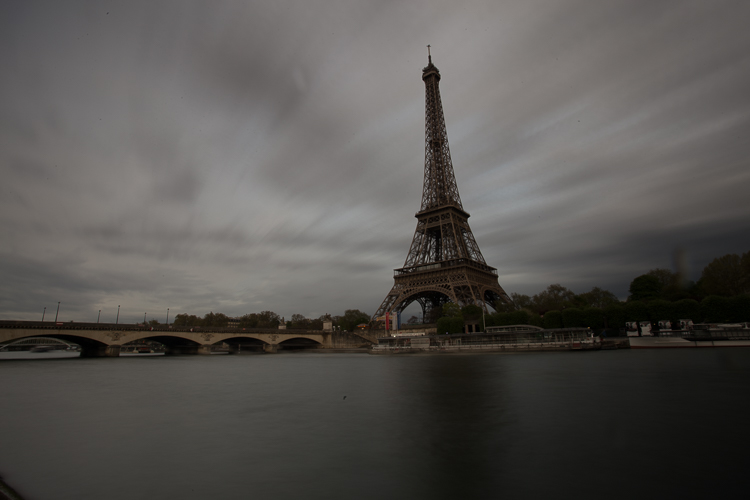
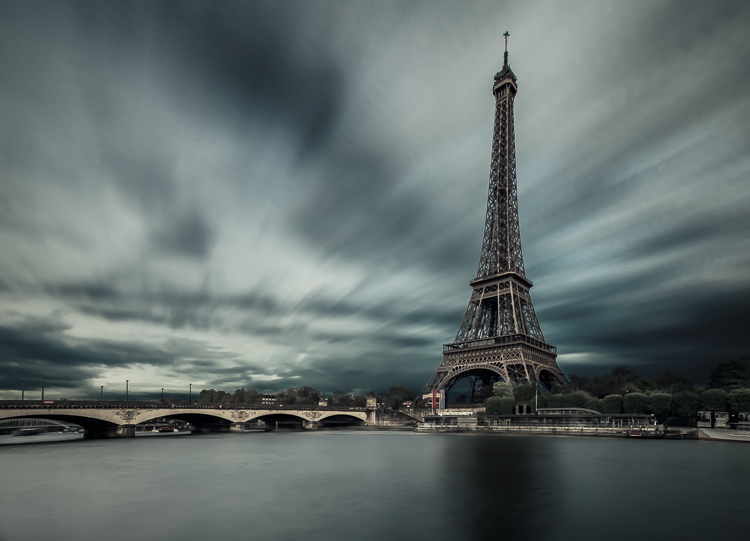
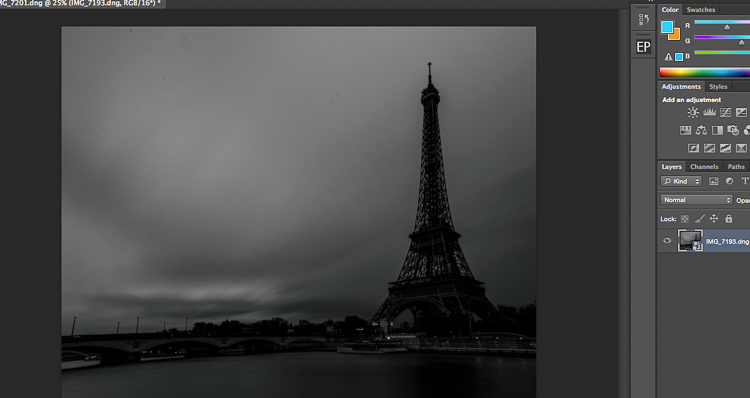
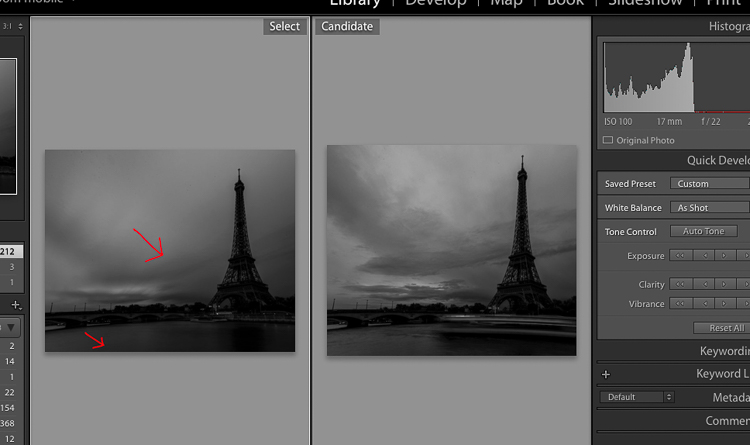
This is an example of a long exposure I got using this method. My aperture was f/22, ISO 100, and I had a shutter speed of one second after using my ND filters. That wasn’t enough to get a long exposure with stretchy clouds, so I decided to use the multi-exposure mode. I took a total of nine shots, and you can see below the before and after using this mode. You can see that it does not only affect the clouds, my water looks nice and silky as well.

IMAGE2

Single image

IMAGE3

Nine shots using multi-exposure in-camera.

IMAGE4

After some retouching, I got this result!

Hack #1 – multiple exposures merged in Photoshop

The second hack consists of doing exactly the same thing but manually. If you are used to shooting time lapses, then this shouldn’t be too complicated to understand.

The multi-exposure mode in-camera gives you automatically, and directly, the long exposure result in one image. For this hack, will shoot nine separate images, one after the other.

You need to use the same camera settings I mentioned above (manual mode, manual focus, tripod, small aperture, ISO 100, release cable or 2-second timer). For the shooting conditions I would also recommend the same thing, and use ND filters if you have some.

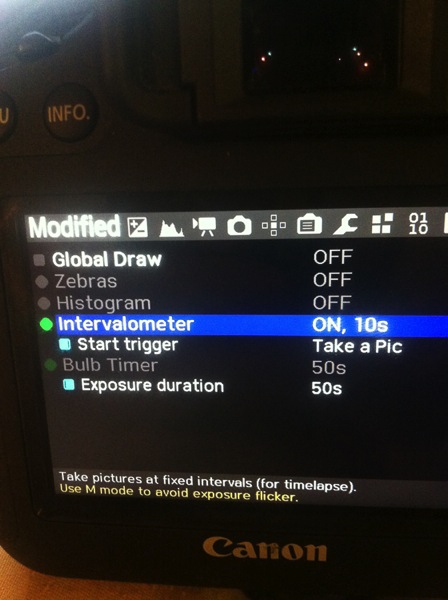
You will basically shoot a time lapse of nine images only. Do not forget to have an interval of 10 seconds minimum between each shots. This process can be quite boring. I personally use the magic lantern camera hack that has an intervalometer built inside the camera. I can then pick how long I want my interval to be between each shot, and the camera will automatically take an image every 10 seconds, for example, until I decide to stop.

IMAGE5

You can buy an intervalometer or use the timer on your phone to count your intervals. It’s really up to you.

Here’s an example of nine images I shot one after the other with an interval of 15 seconds between each. You can clearly see that the clouds are moving. For demonstration purposes, I have intentionally underexposed these shots.

IMAGE6

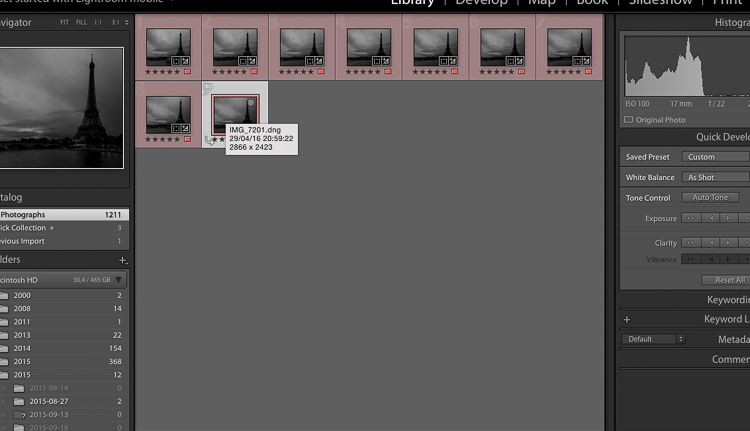
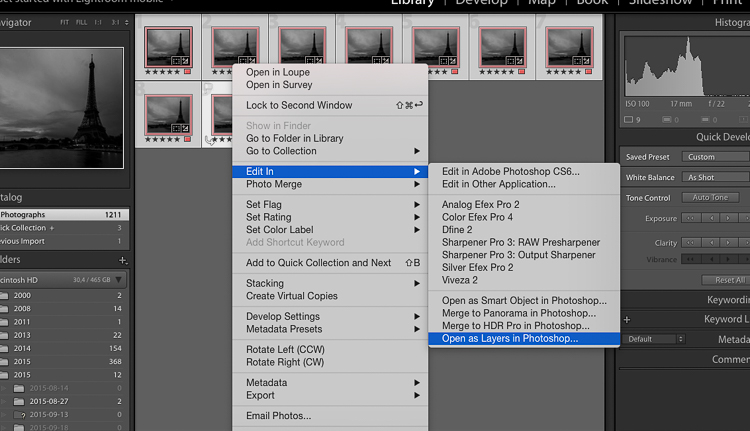
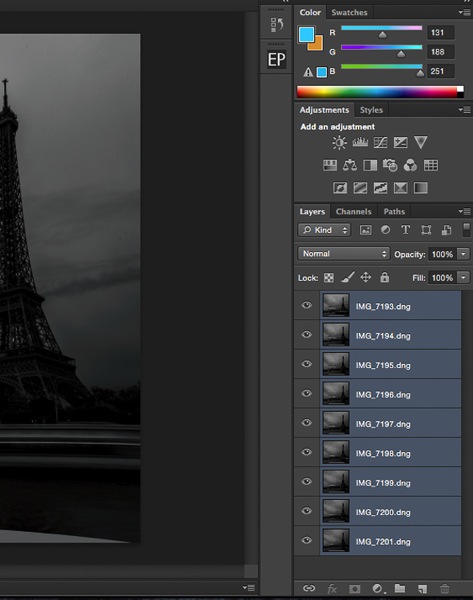
So after you get all your images, import them into Photoshop as layers (from Bridge or Lightroom whatever fits with your workflow).

IMAGE7

Open as Layers in Photoshop after selecting the images in Lightroom.

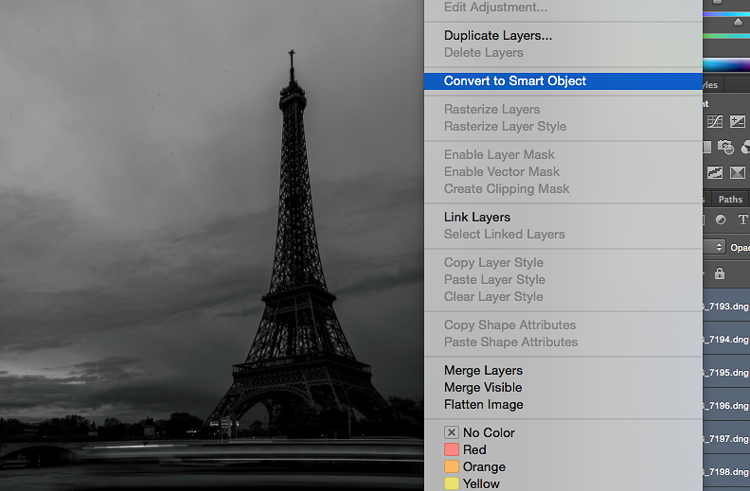
Then next thing you want to do is to select all the layers, and create a smart object.

IMAGE8

IMAGE9

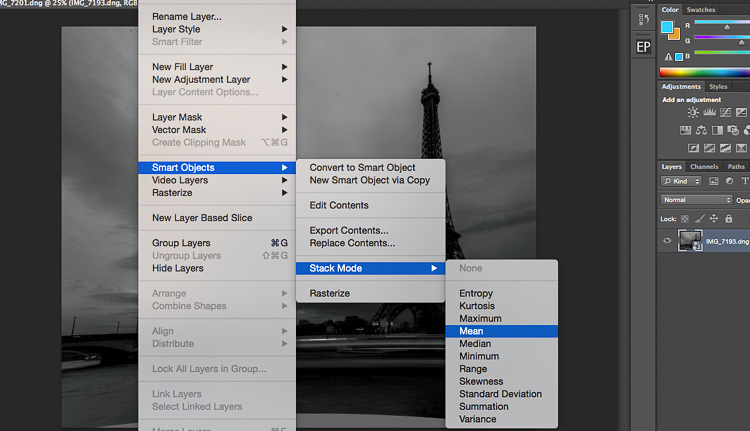
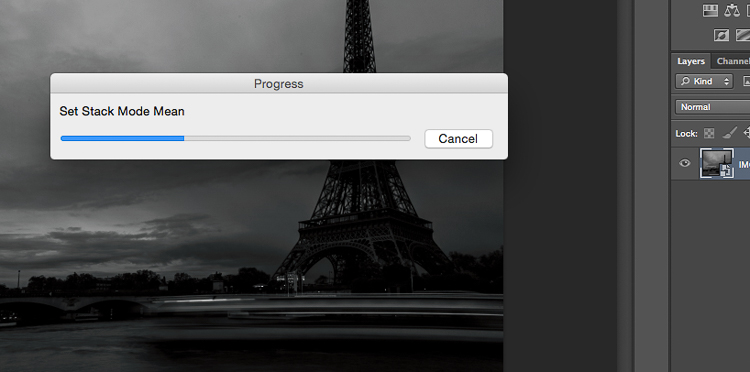
After that go to Layers -> Smart Objects -> Stacking -> Mean.

IMAGE10

IMAGE11

Photoshop will create a nice long exposure now, combining all the layers.

IMAGE12

Here’s the before and after:

IMAGE13

Before is on the right of a single image – after is on the left.

Conclusion

You don’t need super dark expensive filters to create long exposures. Of course, you will get the best results with them, but this is a pretty cool alternative. Now personally as a 19 year old student, I cannot spend a lot of money on gear, and so far these two hacks have worked perfectly for me.

IMG_7663-Edit

Enjoy the art, and share your hacked long exposure images in the comments below. I’d love to see your results.

googletag.cmd.push(function() {
tablet_slots.push( googletag.defineSlot( “/1005424/_dPSv4_tab-all-article-bottom_(300×250)”, [300, 250], “pb-ad-78623” ).addService( googletag.pubads() ) ); } );

googletag.cmd.push(function() {
mobile_slots.push( googletag.defineSlot( “/1005424/_dPSv4_mob-all-article-bottom_(300×250)”, [300, 250], “pb-ad-78158” ).addService( googletag.pubads() ) ); } );

The post 2 Long Exposure Photography Hacks to Try if You Don’t Have an ND Filter by Yacine Bessekhouad appeared first on Digital Photography School.


Digital Photography School

 
Comments Off on 2 Long Exposure Photography Hacks to Try if You Don’t Have an ND Filter

Posted in Photography


Don’t Miss Out: These 12 Photography Deals Will Disappear With 2015

25 Dec

Over the last 12 days we’ve presented you with some amazing daily deals on photography training resources in our 6th annual 12 days of Christmas.

photography deals

The savings this year were our biggest yet and we had a lot of really positive feedback from readers who picked up some fantastic deals.

As in previous years we did get a few sad messages from readers who missed deals along the way asking if there was any way to get them.

As a result – today we’re opening all 12 deals back up again for one last chance.

So if there’s a deal you regret missing or you might have missed one of our emails – you’re in luck. Here they are!

  • Deal 1: Natural Light ebook bargains!
  • Deal 2: 85% OFF Cole’s Classroom Lightroom Course
  • Deal 3: 101 dPS Lightroom presets for ONLY $ 10!
  • Deal 4: The Ultimate Landscapes Bundle!
  • Deal 5: 54% OFF Phil Steele’s Event Photography Course
  • Deal 6: Photography Concentrate Composition & Light guides
  • Deal 7: 104 NEW Hacking Photography Lightroom Presets for $ 10
  • Deal 8: $ 5 Snapn Motion mini-guide
  • Deal 9: dPS Portraits ebooks by Gina Milicia $ 7 each… or 4 for $ 21!
  • Deal 10: dPS Photo Nuts Courses – 2 for $ 30!
  • Deal 11: All dPS ebooks $ 10!
  • Deal 12: Black & White Photo Artistry Course – 60% OFF!a

All these will be available until midnight US Eastern time on 31st of December, after that they will be gone for ever (just like 2015) – so get to it and grab yours today!

googletag.cmd.push(function() {
tablet_slots.push( googletag.defineSlot( “/1005424/_dPSv4_tab-all-article-bottom_(300×250)”, [300, 250], “pb-ad-78623” ).addService( googletag.pubads() ) ); } );

googletag.cmd.push(function() {
mobile_slots.push( googletag.defineSlot( “/1005424/_dPSv4_mob-all-article-bottom_(300×250)”, [300, 250], “pb-ad-78158” ).addService( googletag.pubads() ) ); } );

The post Don’t Miss Out: These 12 Photography Deals Will Disappear With 2015 by Darren Rowse appeared first on Digital Photography School.


Digital Photography School

 
Comments Off on Don’t Miss Out: These 12 Photography Deals Will Disappear With 2015

Posted in Photography