RSS
 

Posts Tagged ‘Digital’

Review of the Polaroid Pro Studio Digital Flash Umbrella Mount Kit

22 Aug

One of the biggest challenges for amateur photographers is getting comfortable with shooting with off-camera flash. Not only does the technique take much time to master, but lighting equipment is expensive! This is where Polaroid is aiming to help out. The new Polaroid Pro Studio Digital Flash Umbrella Mount Kit might be a mouthful to say, but it is exactly what it says: a portable umbrella lighting kit. What it doesn’t mention is that it is also very affordably priced for the amateur photographer (under $ 65!). Find out more details about the new Polaroid lighting kit below!

Review of the Polaroid Pro Studio Digital Flash Umbrella Mount Kit

What’s Included

Altogether, this lighting kit weighs a total of 8.5 lbs and runs $ 64.99 USD. According to the product description, the “Polaroid Digital Flash Umbrella Mount Kit includes all of the essential lighting equipment you will need.” These items include:

1) Two Light Stands

These Polaroid brand light stands are three-sectioned twist locks AND they are air cushioned. They fold down to 26 inches and can extend as high as six feet and hold up to 15 lbs. The weight of the light stands isn’t stated, but they’re not heavy at all. This means they travel very easy, but you’ll have to compromise some stability and support.

Review of the Polaroid Pro Studio Digital Flash Umbrella Mount Kit

2) Two Umbrellas

Umbrellas are one of the simplest, most compact ways to beautifully diffuse light. Polaroid smartly includes two white satin umbrellas with this lighting kit. Both umbrellas have a removable black backing, allowing you to use it as a bounce or shoot through umbrella. Best of all is the fact that the removable backing is stiffer, with sturdier end caps than competing (even higher-end) umbrella brands like Westcott. This makes it much easier to put the backing back on the umbrella.

These octagonal umbrellas are about 33 inches in diameter, which might be a miss for those who need a larger size. But based on the sturdiness of the light stands, you probably don’t want to stick overly large and heavy umbrellas on those stands anyway.

Review of the Polaroid Pro Studio Digital Flash Umbrella Mount Kit

Review of the Polaroid Pro Studio Digital Flash Umbrella Mount Kit

3) Two Cold-Shoe Mount Umbrella Adapters

The last components of this lighting kit are the cold-shoe mount adapters. These allow you to attach the umbrella to the light stand, and mount a speedlight flash. Polaroid’s own adapters each have a swivel, umbrella socket, and a cold-shoe mount that should fit most standard speedlight flashes. The adapters are adjustable, allowing you to shift the angle of the whole setup.

Review of the Polaroid Pro Studio Digital Flash Umbrella Mount Kit

Review of the Polaroid Pro Studio Digital Flash Umbrella Mount Kit

4) A Carrying Case

One of the best parts about the Polaroid Pro Lighting Kit is that all of the above items come delivered in a perfectly sized carrying case. The bag is about 29 inches long, 8 inches wide, and 7 inches high. It’s also very lightweight and holds all of the lighting kit components, with room to spare. The inclusion of the carrying case is a really nice touch, as many other lighting stand providers almost never include a case.

Polaroid Pro Studio Light Kit

What’s Not Included

You may have noticed that a few critical lighting kit items were omitted: a camera, flash units, and flash triggers. Thus, this does not include all of your “essential lighting equipment you will need,” so note the need to purchase these additional items. On the bright side, there are some affordable flashes and triggers on the market that you can add to keep your overall lighting kit inexpensive.

  • Instead of Canon or Nikon brand flashes, consider the Polaroid PL-190 TTL Flash.
  • Instead of Pocket Wizards, consider Yongnuo RF-603 Flash Triggers.
Review of the Polaroid Pro Studio Digital Flash Umbrella Mount Kit

Note: Flash unit and flash triggers are not included.

This kit is for you if…

If you’re just getting started with off-camera flash and studio lighting equipment, the Polaroid Pro Kit is a great way to start out. The kit is affordable while providing you what you need. It may not hold up in the long run, but at this price, buying a second kit doesn’t hurt. Also, if you’re a pro photographer needing a lightweight, portable lighting kit for on-the-go shoots, this may meet your needs as well.

For photographers needing extremely durable lighting stands or umbrellas bigger than 33 inches, this kit probably isn’t for you. It costs $ 64.99, and you get what you pay for. If you’re needing equipment for a pro studio for daily use, spend more money on heavier-duty gear.

Verdict

After testing out the Polaroid Pro Studio Digital Flash Umbrella Mount Kit, I fell head over heels in love with it. The kit isn’t much different from my current setup (two Manfrotto 5001B Nano light stands with Westcott umbrellas). While my Manfrottos feel sturdier than the Polaroid light stands, the price of one Manfrotto stand is nearly equal that of the entire Polaroid Pro kit. Not so terrible.

I used this lighting kit on a couple of on-location food photography photo shoots and was pleased with the results, plus the kit’s extreme portability. Sample photos taken with the Polaroid Pro kit are shown below. All images were shot with a Canon 5D Mark III with 24-70mm f/2.8 lens and Canon 580 EXII Speedlight Flashes.

For simple professional jobs where I’d use a 33-inch umbrella, the Polaroid Pro kit is ace. However, if I were planning to work with bigger, heavier lighting units or modifiers, I’d definitely turn to a heavier duty option.

The post Review of the Polaroid Pro Studio Digital Flash Umbrella Mount Kit by Suzi Pratt appeared first on Digital Photography School.



Digital Photography School

 
Comments Off on Review of the Polaroid Pro Studio Digital Flash Umbrella Mount Kit

Posted in Photography


Where Gods Live: Forest Environment Enhanced by Live Digital Projections

01 Aug

[ By SA Rogers in Art & Installation & Sound. ]

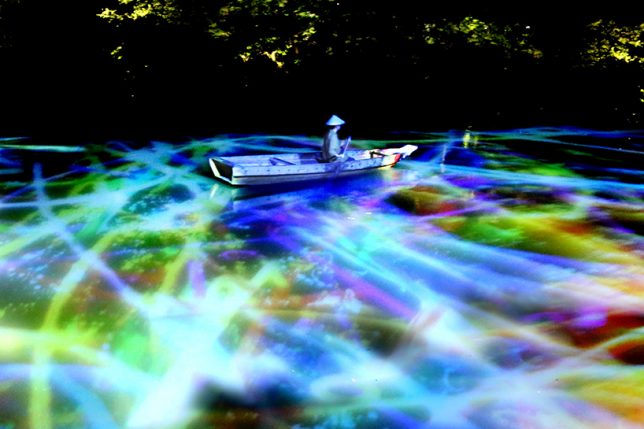
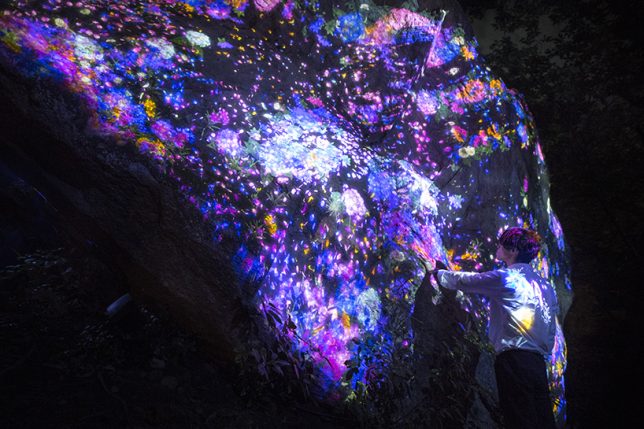
As if forests aren’t magical enough already, the Japanese art/technology collective Teamlab will be live-projecting their signature transforming visuals onto the surfaces of Mifuneyama Rakuen Park, giving visitors the feeling of being on an alien planet. ‘Forest Where Gods Live’ is a collection of individual installations with names like ‘Ever Blossoming Life Rock,’ Drawing on the Water Surface Created by the Dance of Koi and Boats,’ ‘Memory of Continuous Life’ and ‘Resonating Forest.’

“TeamLab is executing an art project called ‘Digitized Nature’ where ‘Nature Becomes Art.’ The concept of the project is that non-material digital art can turn nature into art without harming it. We exist as part of a process of eternal continuity of life and death, a process which has been continuing for an overwhelmingly long time. It is hard for us, however, to sense this in our everyday life. It was when we were wandering through the woods that we realized the shapes of those giant rocks, caves and forests, that have been formed over an infinite amount of time, are the continuous cycle of life itself.”

“By applying digital art to this unique environment, the exhibition celebrates a massive chunk of life that nests on such continuity. In Mifuneyama Rakuen, we got lost in the ambiguous border of garden and forest, and finally, we have come to realize we exist on the borderless continuity between nature and humans.”

Sponsored by Japanese beauty brand Shiseido, the awe-inspiring installation will be in place throughout the 500,000-square-meter garden located in the Saga prefecture July 14th through October 9th, 2017. If you can’t make it out there in person to experience the immersive exhibit firsthand, taking some time to delve into the individual pieces on the teamLab website is well worth it. The collective has produced a number of videos showing their projections in action, with descriptions of their inspiration behind each one.

Share on Facebook


[ By SA Rogers in Art & Installation & Sound. ]

[ WebUrbanist | Archives | Galleries | Privacy | TOS ]


WebUrbanist

 
Comments Off on Where Gods Live: Forest Environment Enhanced by Live Digital Projections

Posted in Creativity


Recycled: the Dakota Digital single-use digital camera

16 Jul
True DIGITAL quality at a single-use price!*

*Printing costs as much as the camera.

July 2003 was a pretty big month for digital photography. Digital camera sales were up 93%, the Nikon D2H was announced, and DPReview posted three enthusiast compact reviews in a single day. Oh, and Ritz Camera announced the Dakota Digital single-use camera.

According to Ritz Camera, the Dakota Digital gave ‘consumers the exciting benefits of digital photography without the cost and complexity.’ That’s true, to an extent.

The concept was simple enough. You buy the camera for $ 11, go out and take your 25 photos, then bring it back to a Ritz or Wolf Camera store. After handing over another $ 11, Ritz would give you prints and a Photo CD, and then they’d ‘recycle’ the camera to sell again.

For 8 dollars more you could view the last photo you’d taken.

The Dakota Digital is as basic as you can get. It had a 1.3 Megapixel sensor, automatic flash, self-timer, an optical viewfinder and a lens of unknown focal length. On the back of the camera was literally an entire printed manual as well as an LCD that told you how many photos were left on your digital ‘film.’ After you took a photo you had the option to delete it, even though you couldn’t see it. About a year later, Ritz introduced a camera that let you view the last photo you took on the LCD – a big step up.

So how did the photos look? Not very good, according to a PC World review at the time. The magazine recommended buying a cheap digital camera rather than essentially paying $ 22 every time you wanted to take 25 shots with the Dakota Digital.

The guts of a single-use digital camera. Well, single use for only a bit longer. Photo by Tyler Akins.

You probably won’t be surprised to hear that folks found a way to modify these cameras so you didn’t have to take them to Ritz after 25 shots. You simply need to disassemble it, solder on some cables that you’ve wired properly, and glue the USB receptacle in place with some epoxy. Et Voila, you now have a poor quality digital camera that you can use again and again, and for $ 11, it was quite the bargain.

After some soldering, cable wiring and plenty of epoxy, your Dakota Digital now had a USB port, so you could use it again and again. Photo by Tyler Akins.

We couldn’t figure out when this single-use camera store disappeared from shelves or if anyone actually bought one. Ritz Camera itself filed for bankruptcy twice, first in 2009 and then again in 2012, and stores were closed or sold to other companies.


Did you happen to own a single-use digital camera? Share your memories in the comments below.

Articles: Digital Photography Review (dpreview.com)

 
Comments Off on Recycled: the Dakota Digital single-use digital camera

Posted in Uncategorized


OnePlus 5 2x tele camera uses 1.6x optical in combination with digital zoom

24 Jun

When we shot our sample images with the brand new OnePlus 5 we noticed that the dual-camera’s 2x tele-module did not quite deliver the pixel-level image quality you would expect from the 20MP Sony IMX350 sensor. Images showed low levels of fine detail and looked as if they had been upscaled which would point towards some form of digital zoom implementation.

This has now been confirmed by OnePlus co-founder Carl Pei in a tweet. He clarified that the second lens on the back uses a 1.6x optical zoom and that digital zoom is used to reach the claimed 2x zoom factor. The cropped image is then upscaled to achieve the specified 20MP image size.

The company says it is using its SmartCapture multi-frame technology to make the zoom “lossless” but arguably not everybody would agree with this term. Exif viewers show the focal length of the wide-angle and tele lenses to be 24mm and 36mm equivalent respectively which would mean a 1.5x zoom factor. However, there is a chance Exif isn’t taking the SmartCapture portion of the zoom into account.

Some other dual-cam implementations we have seen, for example on the iPhone 7 Plus are using a 2x optical zoom with a smaller sensor than the main camera. It appears OnePlus opted for the same 1/2.8″ sensor size in both cameras. An optical 2x lens would probably have required a thicker body or noticeable camera bump.

Articles: Digital Photography Review (dpreview.com)

 
Comments Off on OnePlus 5 2x tele camera uses 1.6x optical in combination with digital zoom

Posted in Uncategorized


CIPA figures for April illustrate steadying of the digital camera market and continued mirrorless growth

10 Jun
DSLR sales continue to decline, but great news: the overall camera market seems to be stabilizing.

The latest figures released by the Camera and Imaging Products Association (CIPA) show that the total camera market remained mostly steady year-on-year for the month of April, and that mirrorless sales are growing against a decline in the number of DSLRs sold. CIPA’s data demonstrates that its member companies produced almost the same number of cameras this April as they did in April 2016, but that they were worth fractionally more.

During the period from January to the end of April CIPA members actually produced more cameras than they did in the same period last year, and even though the difference was only 3-4% by volume and value, it is still very positive news.

The decline in the Japanese market rather drags the worldwide shipping figures down from 8.4% by value, when Japan is excluded, to just under 4% when looking at the whole world. Outside of Japan the market grew year-on-year for the period Jan-April by 3% by volume and 12% by value, indicating the cameras being shipped are higher in price than last year.

While the interchangeable lens camera market grew by 7.4% in volume and 4.5% in value for the month, the bulk of that growth came from the ‘non-reflex’ sector. CIPA includes mirrorless cameras, compact system cameras and rangefinder cameras in these figures, though without the membership of Leica or Hasselblad we can assume that most of the category is compact system and other mirrorless cameras that have interchangeable lenses – such as Fujifilm’s GFX.

Asia remains by far the largest market for these cameras and sold almost as many bodies as Japan, Europe and America combined.

This non-reflex category jumped in value by 37.5% in Japan but in the rest of the world that growth hit 80.5%. An area designated by CIPA as ‘Other’, that doesn’t include Asia, Europe, Japan or the Americas, saw mirrorless growth of 141% by volume and 136.5% by value – though the actual figures are relatively small. Asia remains by far the largest market for these cameras and sold almost as many bodies as Japan, Europe and America combined.

While only 89% of last April’s SLRs shipped this April, the worldwide market for these cameras is still just less than twice the size of the mirrorless segment, though in Japan the value of DSLR market was only 57% of what was managed last April – a really significant drop.

The good news, of course, is that the market didn’t shrink.

For more information see the CIPA website.

Articles: Digital Photography Review (dpreview.com)

 
Comments Off on CIPA figures for April illustrate steadying of the digital camera market and continued mirrorless growth

Posted in Uncategorized


Alpa Silex unit offers electronic control of Canon and Nikon lenses on digital medium-format backs

17 May

Swiss camera and adapter manufacturer Alpa has introduced a new device that allows Nikon and Canon users to mount some of their lenses on digital medium format backs and have access to aperture controls. The Alpa Silex control unit works with the company’s 12 series bodies and brings aperture control to electronically operated lenses from Canon and Nikon, as well as Contax, Hasselblad and Rollei. All Canon EF lenses can be controlled but only Nikon E lenses, with electromagnetic diaphragm mechanisms, will work.

With a Silex in place compatible lenses can be used to record images on a wide range of digital medium format backs. The A12 cameras accept digital backs of a variety of ages, so users don’t necessarily need the latest, and the image area will depend on the size of the sensor used and the covering circle of the lens. 

The Silex not only allows aperture adjustments but also AF control in most Hasselblad H, Canon EF and Nikon E lenses, and web access means the device can be handled remotely over a server.

Initially presented at Photokina 2016 the Alpa Silex is available now for $ 3600/CHF3355. For more information see the Alpa website.

Press release

The control unit ALPA Silex is a brand new, central element of ALPA’s extended modular photographic system. Photographers and soon even videographers will be able to combine ALPA cameras with digital backs of various manufacturers and lenses from Canon, Contax, Hasselblad, Nikon or Rollei. A variety of functions and operating modes are available to the user.

Handy and flexible – Silex is the Swiss pocket knife of the control units. Under this claim, ALPA presented the product at the Photokina 2016. The name Silex itself, however, goes much further back: it reminds us of the material for the all-purpose tools of the stone-age. ALPA Silex is the new all-purpose tool in the ALPA system. It can be used to convert any model of the classic ALPA-12 series into an electronic camera.

The basis for the development of ALPA Silex is the ALPA 12 FPS, introduced at Photokina 2012, with electronically controlled focal plane shutter. The integrated controller was separated as a standalone module and all functions except for the slot shutter were taken over. All known digital components from Hasselblad, Phase One / Leaf and Sinar can be synchronized and the electromechanical diaphragms of Canon EF, Contax, Hasselblad H, Nikon E and Rollei can be controlled. The leaf shutter in Hasselblad HC / HCD (up to 1/800s, “orange” line even up to 1/1000s) and Rollei 6000 (up to 1/500s) can be used, as well as the focus control of many of the lenses from Canon, Hasselblad H and Nikon E. The integrated web server allows remote control in networks without software installation. The future support of Sinar eShutter systems is already prepared.

Together with existing camera models from ALPA, the photographer can use a vast number of third party lenses and, depending on the available image circle, also perform shifts (shifting and stitching). In the future, our back-end adapters will also make it possible to use ALPA cameras for video recording in conjunction with the corresponding digital backs.

Available now:

  • The control unit ALPA Silex,
  • The electronic lens adapter (ELA),
  • As well as the ALPA lens module Hasselblad fix (HAF).
  • Also, immediately available for download is the latest firmware version 4.03, which makes all new functions of ALPA Silex also available for the ALPA 12 FPS. Free as always – as an investment in the ALPA system is sustainable and the term ‘planned obsolescence’ is alien to ALPA. Even if the environment changes, an ALPA will persist.

Articles: Digital Photography Review (dpreview.com)

 
Comments Off on Alpa Silex unit offers electronic control of Canon and Nikon lenses on digital medium-format backs

Posted in Uncategorized


Digital Photography – Is it the Death of Prints?

09 May

Fotografía, foto, photograph…all ways of saying the same thing. But what is this thing that we all strive to become better at doing and in turn share with the world? There was a time not so long ago that the idea of producing a photograph involved a good bit of skill, patience, and hard work in darkrooms making prints.

The only way for one’s work to make its way in front of the eyes of someone else was for it to be printed. Today, the capability of communicating our images to others digitally has virtually become boundless. We are accomplishing the same old thing in decidedly new ways.

Digital Photography - Is it the Death of Prints?

So, are we slowly bearing witness to the death of prints entirely? With the advent of digital photography, the world of photo making changed. The medium morphed into something more translucent for the masses. The craft became less organic; less physical. Making photographs, dare I say, became “easy.”

That’s not to imply that there aren’t incredible advancements being made to the photographic art directly as a result of digital photography and sharing. What we’re talking about here is a possible disconnection between craft and craftsman (or craftswoman) which happened slowly.

Digital Photography - Is it the Death of Prints?

Perhaps that disconnection is an inevitable natural step as we evolve as a photographic culture. Have we entered into the stages of some type of weird photogenic altruism? Are we missing something by not printing our work?

To print or not to print?

As it turns out we likely are shorting ourselves by not regularly printing our photographs but not in the way we might think. Why go through the problems of manifesting prints when they are, in the eyes of many, unnecessary for most people who shoot with digital cameras.

Printing costs money whereas digital storage cost nothing or next to nothing. Physical prints can’t be “shared” or “liked” on social media. They aren’t something that we can readily copy and paste somehow. And therein lies their value. Not in a monetary sense even though art prints and portraits are still profitable for some. The worth of seeing your own photographic work printed comes from something else.

Digital Photography - Is it the Death of Prints?

Digital photography is wonderful in terms of production, cost, and convenience. But it very well may be that it also lessens our own perception of the power derived from photography, which causes us to stop short of the full scope of the art.

The finality of a print is something that gives us as photographers total control over the end product of all our hard work. The print represents a cathartic culmination of everything that we know about making an image and we present that image to world confidently. Prints don’t rely on screen resolution, color modes, or other variables that plague the viewing of our work digitally.

Digital Photography - Is it the Death of Prints?

How many times have you viewed a photo on your laptop, your cell phone, or your home computer screen only to notice that in fact, you are viewing three different versions of the same photo? If you’re like me, it causes no small amount of photographic anxiety.

The resurgence of prints?

Lately, there has been somewhat of a possible resurgence in the understanding about the benefits of physical photographic prints. Take the increased popularity of Instamatic cameras which hearken back to Lomography and Polaroid-type cameras. Even Leica and Fuji now manufacture cameras that make singular self-developing prints that are one-of-a-kind expressions. Fuji has taken it one step further by also developing a photo printer which wirelessly prints images from your cell phone onto its Fuji Instax instant film.

Digital Photography - Is it the Death of Prints?

The rise in the popularity of the instant medium could mean that we are yearning to slow down and be more committed to our photography. We have become accustomed to swiping right, scrolling up, and clicking over. Could it now be that we are beginning to favor the exclusivity that comes from possessing a print instead of a digital file? Only time will tell what direction the trend will follow.

Final thoughts….

Digital images and physical prints are the twin manifestations of the same artistic vision. Should you always print your work? Perhaps not always. Not every digital photo you make will always be worth a print…but that’s up to you.

Whether or not the digital camera revolution signaled the end of traditional prints is not the issue here. Instead, digital photography, even with all its outstanding contributions to the photographic arts, has possibly caused us to lose sight of the endgame. Sure, sharing your photos so easily with the world is great. It’s an important part of the art of photography. But at the same time, we shouldn’t stop there.

Digital Photography - Is it the Death of Prints?

Print your work from time to time. If you have an image that speaks to you just a little bit louder than the others, print it; hang it on your wall, sell it, share it with a photo gallery. Do something more meaningful than just looking at it on your screen.

The post Digital Photography – Is it the Death of Prints? by Adam Welch appeared first on Digital Photography School.

Digital Photography School

 
Comments Off on Digital Photography – Is it the Death of Prints?

Posted in Photography


Digital Knitting Machine: Kniterate is a 3D Printer for Custom Apparel

23 Apr

[ By WebUrbanist in Gaming & Computing & Technology. ]

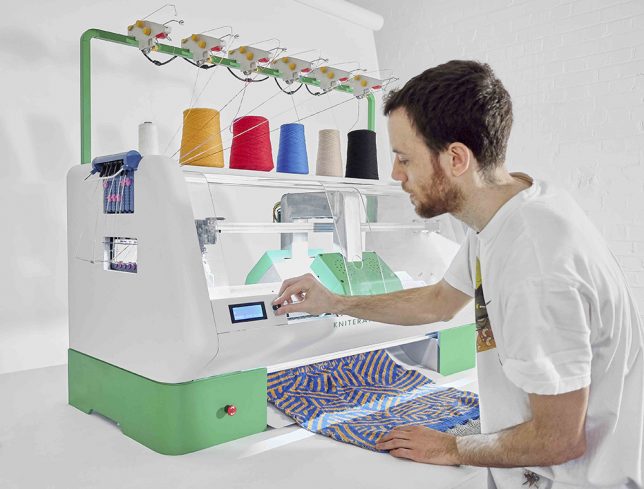
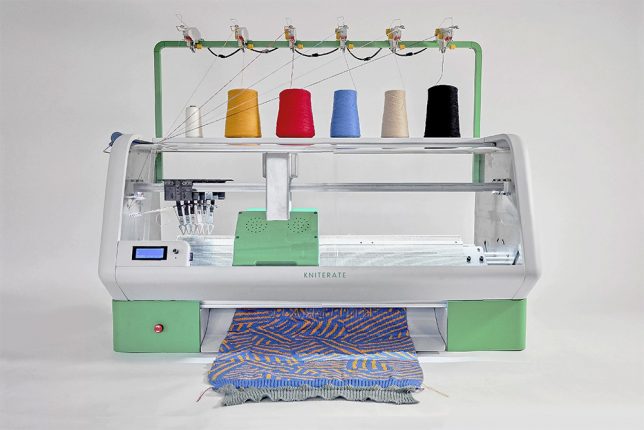
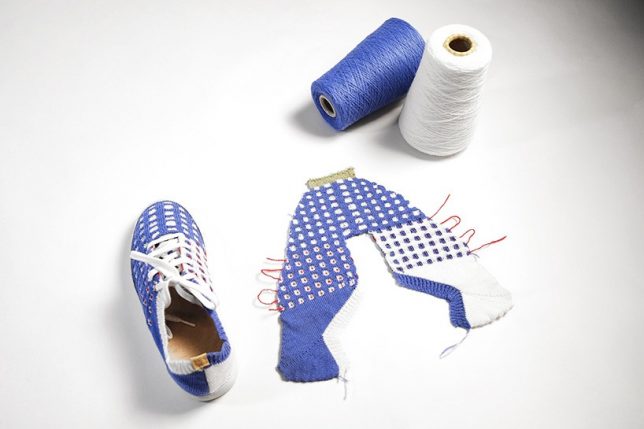
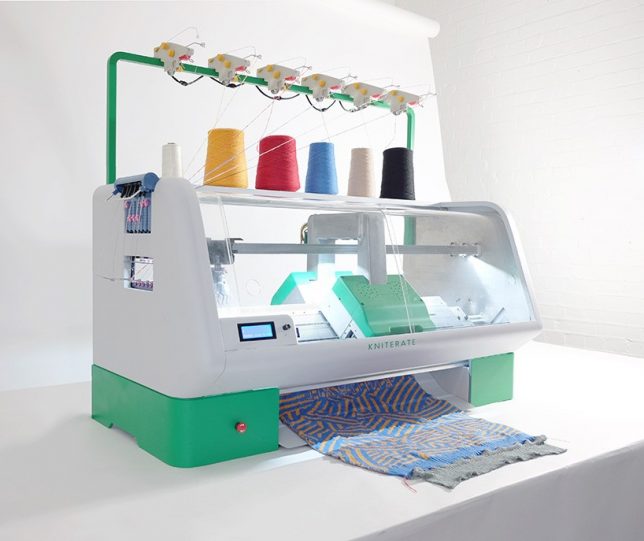
Borrowing logic from the 3D printing industry, Kniterate lets users turn ideas and designs from digital files to one-off wearable garments in hours. Able to “print” shirts, scarves, sweaters, dresses and more, the machine is aimed at enabling customized creations as well as rapid prototyping.

Compact, portable and affordable, the gadget itself links into computer and mobile apps – creatives can build out ideas in Photoshop, build them in Kniterate’s device-specific application, then send them to straight to production with the touch of a button.

The application comes with a number of preset patterns that can be used but the intuitive interface is also designed to allow for easy from-scratch creations, even by people with limited digital design experience. Even in cases there the final product will be made via other methods or materials, this machine allows for iterative design experiments to test size, fit and styles.

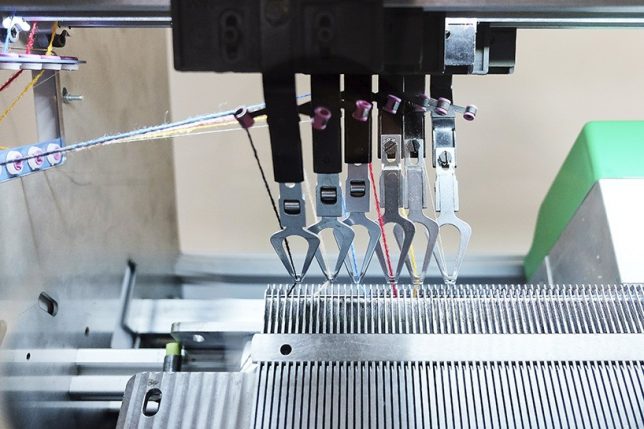
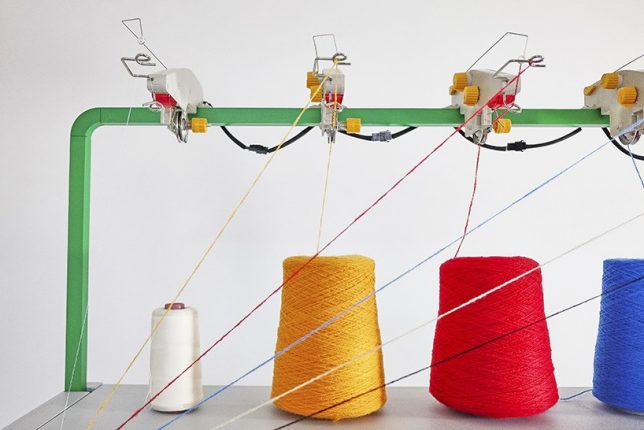
The system is also designed to reduce waste from off-cut materials, printing with the exact amount of material needed to make a particular piece. The device can carry up to six yarns at a time to span an array of colors and materials – it is also made to be compatible with off-the-shelf yarns, making it more flexible and affordable than printers (often designed to make money from material sales rather than the machines themselves).

Share on Facebook


[ By WebUrbanist in Gaming & Computing & Technology. ]

[ WebUrbanist | Archives | Galleries | Privacy | TOS ]


WebUrbanist

 
Comments Off on Digital Knitting Machine: Kniterate is a 3D Printer for Custom Apparel

Posted in Creativity


Guitar for Modern Nomads: This Digital Instrument is Designed to Travel

18 Apr

[ By SA Rogers in Gadgets & Geekery & Technology. ]

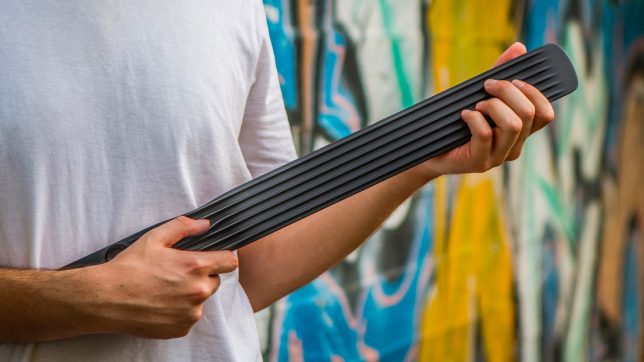
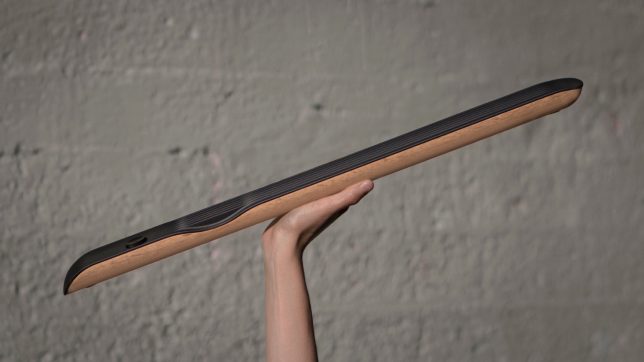
What if you were to eliminate the unwieldy parts of a guitar but maintain its resonant sound and the same exact way of playing, in order to make the instrument are more convenient traveling companion? It might sound ridiculous or downright impossible, but that’s exactly what designer Orit Dolev has done with NOMAD, a compact digital instrument with pressure-sensitive frets and flexible rubber strings to replicate the traditional guitar playing experience.

Dolev came up with the idea for NOMAD after taking a long journey through Asia and South America, where she imagined her guitar would offer a handy and powerful way to make new connections across language barriers. She quickly learned that getting around would be frustrating, noting that she couldn’t just shove it into her backpack, and the strings were constantly breaking and getting out of tune.

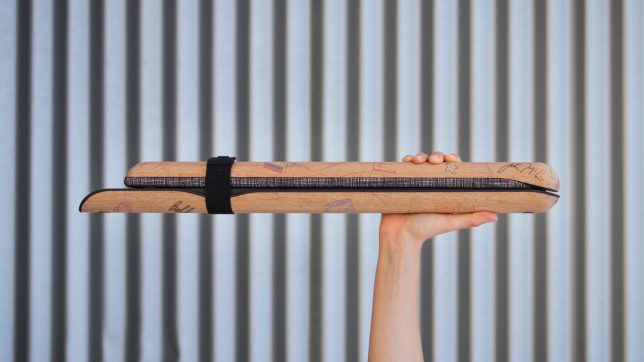
Designed to encourage mobility, the NOMAD features a wooden neck for a familiar feel in your hands. It pairs up with an app to play a wide variety of sounds, and you can turn the frets on and off to switch between acoustic and electric guitar modes or even to entirely different string instruments, like sitars. Hook it up to headphones so you can play on train rides or in hotels without disturbing anyone, or play through the accompanying portable amp, which doubles as a case cover.

“Technology is constantly changing the way we are living,” says Dolev. “Powerful mobile devices and widespread connectivity are serving as fertile ground for a new generation of nomads. From urban work-from-anywhere lifestyle to digital nomads roaming the globe freely, new cultural movements are rising. We are more mindful of the objects we surround ourselves with, striving to travel light and collect experiences more than things. Own less, explore more.”

Share on Facebook


[ By SA Rogers in Gadgets & Geekery & Technology. ]

[ WebUrbanist | Archives | Galleries | Privacy | TOS ]


WebUrbanist

 
Comments Off on Guitar for Modern Nomads: This Digital Instrument is Designed to Travel

Posted in Creativity


Western Digital launches its first portable SSD

07 Apr

Western Digital today announced its first portable SSD, adding solid state storage technology to its My Passport line of portable storage devices. The new My Passport SSD comes with a USB Type-C port and with transfer speeds of up to 515 MB/s is WD’s fastest current My Passport model. 

The My Passport SSD is available with capacities ranging from 256GB to 1TB and its small dimensions make it very portable. It has also been drop tested from a height of 2m / 6.5ft and Western Digital claims it can withstand 1500G of force.

The Western Digital My Passport SSD comes with a USB-C to USB-C cable and a USB-A adapter in the box. It is available now from Best Buy and from other select retailers starting this quarter. The 256GB model will set you back $ 99.99, the 512GB version is $ 199.99, and for the 1TB variant $ 399.99 have to be invested. More information is available on the Western Digital website.

Articles: Digital Photography Review (dpreview.com)

 
Comments Off on Western Digital launches its first portable SSD

Posted in Uncategorized