Lens maker Zeiss has written a blog post about its relationships with other manufacturers – specifically its partnership with Sony. The post sheds some light on exactly what that little blue logo on your lens can mean. The blog post itself appears to have been written by the marketing department, but reading between the lines gives us a better idea of how its relationship with Sony works. Read more
Tag: Details
-
Amazon releases more details of ‘Prime Day’ event on July 15th
To mark 20 years since it opened its (virtual) doors, Amazon is planning a ‘Prime Day’ next week, on July 15th. Billed as a ‘global shopping event’, Prime Day will feature more deals than Black Friday for Prime members, including more than 60 deals from top camera brands. Click through for more details
-
Details of Google’s new photo app leaked
It’s been rumored for some time that Google is planning to separate the photo component from its Google Plus app and establish it as a stand-alone service. Ahead of Google’s annual I/O event taking place this week, some leaked information and screenshots have surfaced that shed some light on Google’s plans. Read more
-
Adobe details OS support for next version of Lightroom
In a new blog post, Adobe has said Lightroom 6 will require a 64-bit operating system, meaning it will only run in 64-bit versions of Windows 7, or OS X 10.8 or newer. The announcement suggests Lightroom 6 will continue as a stand-alone application, rather than being swallowed into the company’s subscription-only Creative Cloud program. Read more
-
Phase One and Alpa release official details and pricing of A-Series medium format cameras
Phase One has announced official details of its new A-Series medium format cameras after information about the new pairing of the company’s digital backs with an Alpa body and lenses was leaked in November. As was reported at the time, the series will comprise Phase One 50MP, 60MP and 80MP backs, combined with the Alpa 12 TC body and a choice of three lenses – the Alpagon 5.6/23mm, Alpar 4.0/35mm and the Alpagon 5.6/70mm. Read more
-
It’s all in the details: Canon PowerShot G7 X Review posted
One of the year’s most interesting compacts comes in the form of the Canon PowerShot G7 X, which bears a 20MP 1-inch BSI CMOS sensor. It’s not just the bigger, likely Sony-branded sensor that’s the G7 X’s attraction, it’s also the 24-100mm equivalent F1.8-2.8 lens. On paper it’s a serious rival to Sony’s RX100 series, widely considered class leaders in terms of compact camera image quality. Does the G7 X live up to its impressive spec sheet? Read review
-
Shooting Details to Tell a Visual Story

The bride’s most prized possession for the wedding day
A visual story, although no longer used as frequently in magazines or media, is a powerful way to give your viewer a taste of a
situation without having to be there. It’s also a great way to challenge yourself to produce a coherent body of work. A collection of images, or picture story, can be engrossing and tell a story far beyond what a single image could do.
Think back to a recent trip you took, a night out with your significant other, a favourite book or film. Try to describe it to an audience using only overarching themes. Thailand is hot and the people friendly. We went to see a movie. Lord of the Rings is about good and evil. These give your audience an idea of the content, but no clear idea of the details. The power of a story does not lie only in the bigger themes, or the “include-all” wide shot. In order to clearly convey your message, you often need small details that give your audience a glimpse into the building blocks of your story. The devil is in the details, as they say.
If your pictures aren’t good enough, you’re not close enough. – Robert Capa
Capa meant this in a couple of different ways: physically of course, but also emotionally. Both of these will help you shoot clear details to aid your viewer’s understanding.
Go Wide
In order to get closer, you don’t always need to zoom in. This will cut out distractions, but also give your viewer a sense that you’re not really close to your subject. Longer focal lengths necessitate being further from your subject. There is an intimacy that comes about by using wide-angle lenses and physically moving in very close. Just be careful of distortion.
The street surrounding this man was littered with his creations, but by getting in close with a wide lens, I was able to just show his current work.
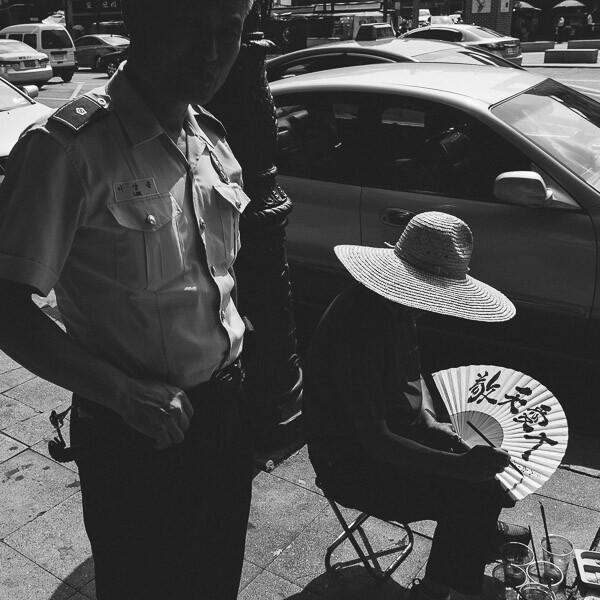
Street Calligrapher in Seoul
Feel
Being emotionally close can help you not only with being able to get physically close, but also give you a deeper understanding of your subject, and thus photograph details that are meaningful. If you are working with people, it will also help you gain trust. In the photograph below, it was important to gain the monk’s trust before asking him to take time out of his schedule to pose for a while. By watching and understanding him, the decision for which detail to shoot was obvious.
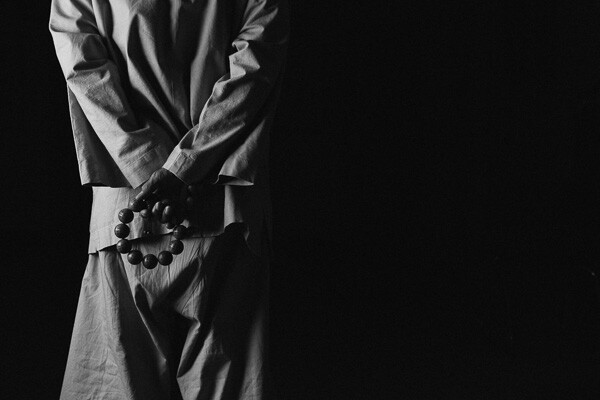
A Buddhist Monk with prayer beads
John Loengard, the picture editor at Life Magazine, always used to tell me, “If you want something to look interesting, don’t light all of it.” – Joe McNally
Loengard’s quote, by way of Joe McNally, gives us a very important concept that essentially tells us to shoot details. If, by not showing all of something we are making it more interesting, then details by their very nature are a strong starting point for interesting photographs.
Light
Light is a wonderful tool for showing only the details you want your viewer to see. Although our eyes are able to see a wide range of tones from light to dark, our cameras do not have that luxury, so you have to make creative decisions.
In the scene below there were multiple interpretations that could have been made. The exposure could have been based on the faces of the candle bearers, blowing out (photographically speaking) the candles to pure white. But the story I chose to tell was about the prayer-candles themselves, and knowing that the scene would fade to black very quickly around the candles made for a great detail shot of a very chaotic scene.
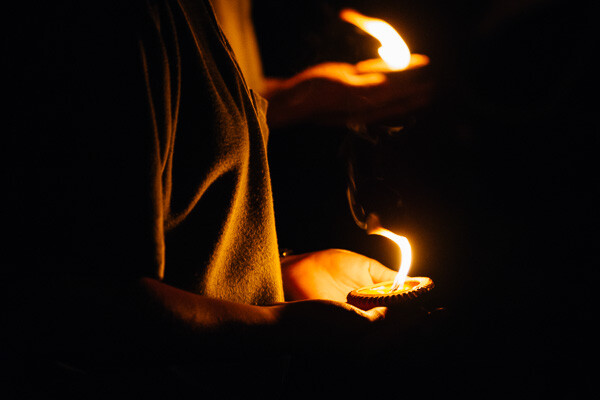
Choosing to expose for the brightest parts of the scene to show only the necessary details
This applies to lighting, and also to composition. The strongest stories we read are the ones that leave us with guess-work and hints to pique our interest. The same goes for photographs. If you show the entire subject, or the entire scene, you are giving your viewer the answers. If you want them to linger on your photo, fill it with hints, but not complete answers.
Focus
Depth of Field, or selective focus, is a great way to shoot important details. Your eyes are drawn to areas of sharp contrast (which could be light, or focus) before areas of low contrast. This means that you can use depth of field to very effectively direct your viewer’s eye to what you want them to look at.
While shooting this portrait of a young girl, I noticed that she was playing with her ribbon quite intently. This details speaks volumes about her that her mother will remember forever. Her hands will never be that small again, and that is an important reason to highlight them with a detail shot.

A young child’s hands holding the ribbon on her Hanbok
You can use light, subject distance, lens choice, emotion, depth of field, and so many other technical aspects to show details and give extra depth to a story, or at the very least provide you with another interesting way to look at your subject.
Set aside a few hours over the next couple of weeks to practice this. Choose a subject. That could be a person, a craft, a street in your town, a time of day, or whatever else you choose. The task here is to explore that subject. Shoot it from as many angles, and in as many ways as you can, with each and every frame trying to tell the story of your subject. Be sure to shoot as many details as you can using the techniques above. When you finish, take the time to look over these images and make a selection based on the ones that speak the most about your subject. The details will shine here, giving another dimension to the collection of images you have shot.

Tools at a Thai umbrella factory
Do you have any other tips for capturing details to tell a story? Please share in the comments below.
The post Shooting Details to Tell a Visual Story by Dylan Goldby appeared first on Digital Photography School.
-
Details & Diagrams: $1,000 IKEA Flat-Pack Refugee Shelter
[ By WebUrbanist in Architecture & Houses & Residential. ]

Emergency shelters are designed to be short-term solutions, and many cannot withstand rain, wind and sun for more than six months. Yet the average stay in refugee camp is over twenty times that duration.

The IKEA Foundation, in cooperation with the United Nations High Commissioner for Refugees, has developed a longer-term solution to this problem, turning their experience with flat-pack furniture and language-free instruction manuals toward disaster relief efforts in and around war-torn places like Syria (they are already testing in Lebanon and Iraq). Sticklers for detail should scroll carefully below for a step-by-step deconstruction of what goes into this remarkable dwelling.

The problem, in part, is building the most universal unit possible in a world where emergencies happen globally, spanning regions both hot and cold and with vastly different cultural norms. Their solution is much like an ordinary IKEA product: flexible, adaptable, modular and packed into cardboard boxes of components. Naturally, they require no tools that are not included.

While the structures themselves are still only expected to last a few years, they are made to be modified, enhanced and expanded in various ways. For instance, earthen walls and corrugated metal roofs can be pushed up against, fastened to and ultimately help reinforce the core buildings, or even eventually replace the need for underlying framework entirely, rendering it redundant.

The shelters are constructed primarily from polymer panels that clip into a wire frame. On top sits an aluminum-mesh roofing sheet that is designed to reflect sunlight by day and retain heat by night. Solar energy charges a USB outlet for electrical needs. The target price range for mass production is under $ 1000, making it affordable in bulk to international organizations. Images and diagram via The Telegraph, IKEA Foundation and Graphic News.


[ By WebUrbanist in Architecture & Houses & Residential. ][ WebUrbanist | Archives | Galleries | Privacy | TOS ]


-
Architecture: Photographing Exterior Details
Between shooting for clients, teaching my kids photography class, family obligations, and all of the non-photography activities essential to running a photography business, Life has a way of not letting me shoot just for me very often. So, when I do get a chance to get out and shoot for myself, I find that I gravitate to architectural subjects. I live pretty close to a busy downtown area with a lot of history, so there’s never any shortage of interesting buildings to photograph. Much has been written about the technical aspects of architectural photography. Everything from perspective-correcting tilt-shift lenses to reflection-reducing polarizing filters have been suggested by some of the best in the business for capturing compelling images of buildings big and small. Don’t fall into the trap, though, of thinking that you need lots of expensive accessories to take interesting architectural photos.
Architectural photography, like every other genre, has its share of cliches, and I’ve probably shot them all. Skylines? Check. Laying down on the sidewalk and shooting straight up the side of the city’s tallest building? Check. So, if you believe (as I mostly do) that there is no such thing as an original idea, how do you capture something original and unique? Step #1 is to not care whether somebody else has taken a similar photo before you. If it’s original to you and you like it, then go with it. Print it big and hang it proudly. But if you’re still looking for an original, unique perspective, start concentrating less on the big picture and more on the details.

Older buildings like these in Detroit offer a wide variety of textural and structural components to photograph.
You’ve heard the old line about the whole being greater than the sum of its parts. It’s the theory that something grand and impressive can result from the combination of less significant components. What you may not have heard is that the opposite can be just as true. Depending on your lens, vantage point, available lighting, and a host of other variables, it is entirely possible– if not likely– that an entire building would appear so small in the frame that whatever drew you to it in the first place could be lost and overlooked in the actual photo. Also, light that might be perfect for windows, doorways, and other details could be completely unsuitable for capturing the detail and character of the building as a whole.
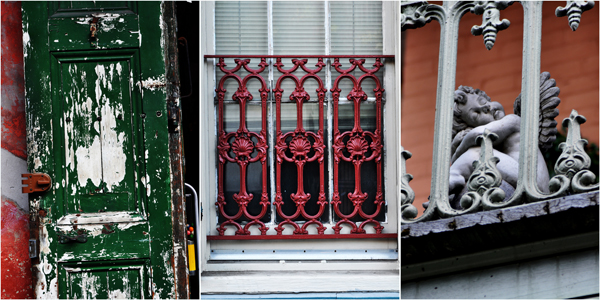
The French Quarter in New Orleans is a treasure trove of distinct architectural elements.
As photographers, we strive to put our personal stamp on every image. Every picture tells a story. Architects are no different, imprinting style, history, and textures into their work. They are easy to find. Just take a step back and look for the parts that make up the whole. As with any other type of photography, concentrate on angles, composition, and lighting. As far as selecting the right lens? Just like photographing portraits, landscapes, food, or any other subject, your ideal focal length is going to depend on the size of the subject and your proximity to it. If, for instance, you are photographing gargoyles several stories above the ground, a long zoom of at least 200-300 mm is a must. On the other hand, if you are photographing a doorway, you’ll definitely need a wide angle of 28mm or wider.
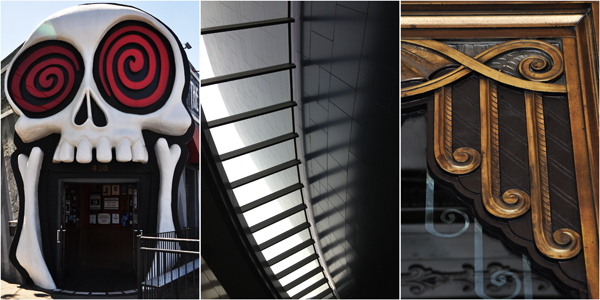
Three of my favorite Atlanta doorways. Going for bigger details will require a wide angle lens.
Beware of some of the common pitfalls. Even though you are not photographing the entire building, you still have to be careful about tilting your camera back too far and causing distortion. When you tilt back to look up at a building through your camera, the bottom of the sensor is closer to the building that the top of the sensor, resulting in an image where the top of the building looks considerably more narrow than the bottom. While you won’t encounter this issue too often while photographing details, you still need to be aware of it. Also watch out for reflections in windows and glass doors. Sometimes, slightly shifting your angle so you are not shooting at a direct 90-degree angle to the glass can correct the problem (and keep your own reflection out of the photos).
One last note on safety and choosing your buildings carefully. In this post-9/11 world–particularly in the United States– there are security issues to be considered. If you are photographing a government building, for example, do not be surprised to find yourself in a discussion with armed security guards within moments of taking your shot. While you are legally and technically allowed to take photos of public buildings from public vantage points, this does not always apply to federal office buildings, courthouses, and banks. Be polite. Don’t argue. If asked for your ID, provide it. Be prepared to delete the images on the spot. I’ve run into this issue a few times with non-governmental buildings also. I was once photographing the office building where I practiced law in another life, when I was approached by two very large men who were demanding to know what I was doing. I was not doing anything illegal or even anything for which they had the right to detain or question me. In these situations you have to ask yourself just how important that photo of the archway over the door really is. In my case, they pushed so I pushed back. They threatened to call the police, so I sat down on a bench and politely told them I’d wait. Everything worked out fine in the end, but it probably wasn’t my smartest move. Do as I say, not as I do.

A few of the elements outside my old office building. Details above the first couple of floors will require a zoom lens
Photographing architecture can be a great way to hone your skills in a low-pressure setting. You can experiment with composition and natural light without worrying about your subject getting bored and walking out on you. Take advantage of the opportunity to push your creativity and grow as a photographer.
Post originally from: Digital Photography Tips.
Check out our more Photography Tips at Photography Tips for Beginners, Portrait Photography Tips and Wedding Photography Tips.
Architecture: Photographing Exterior Details
-
New York Times details photo editing policy for fashion magazine

A cover image in the latest issue of the New York Times’ monthly style magazine, T, has led to an interesting discussion about the newspaper’s policy on photo retouching. While editors forbid any image manipulation beyond, ‘minor color-toning and brightness’ in news stories, retouches and removal of blemishes are allowed in the style magazine’s fashion photography. Does a newspaper risk credibility by allowing retouching on editorially-branded content? Click to read more and share your thoughts.