RSS
 

Posts Tagged ‘Depth’

Mastering the Art of Depth Creation

12 Apr

In the simplest terms, photography is a method of duplicating reality. While you cannot change reality, you can present it in the best way possible. Though you are duplicating reality, you can present your subjects in a way that tells a story — you can make the everyday seem ordinary or fantastic, by using simple photographic techniques. No matter what Continue Reading

The post Mastering the Art of Depth Creation appeared first on Photodoto.


Photodoto

 
Comments Off on Mastering the Art of Depth Creation

Posted in Photography


Urban Jungle Street View: 3D Hack Uses Hidden Depth Data

26 Mar

[ By WebUrbanist in Gaming & Computing & Technology. ]

urban jungle street view

An explicitly illicit use of dimensional data buried in Google Street View, the Urban Jungle project adds eerie layers of post-apocalyptic green overgrowth to major cities around the world.

animated-new-york-city

urban jungle side street

As in Google Maps, a user can simply drag and drop their tiny avatar in a location of their choosing, then explore a plant-infested, tree-filled, vine-covered alternate version of reality. Click here to start exploring.

urban jungle street maps

From its creator: “This experiment using an undocumented part of Street View, the depth data. With that a depth map and a normal map is generated, which can be used in the shaders and to plot geometry and sprites in (almost) the correct position in 3d space.”

animated-street-jungle-view

street trees vines plants

Despite a glitch here or there, most locations and settings are shockingly convincing, looking like something that was lovingly crafted in incredible detail for a game (or an artist’s rendition of life after the apocalypse).

animated-time-square-signs

street view urban jungle

This otherworldly effect could just be the beginning – you too can grab the depth data at GitHub and create your own surreal landscapes or otherwise-hacked environments (samples via GMM, PSFK & PK).

Share on Facebook


[ By WebUrbanist in Gaming & Computing & Technology. ]

[ WebUrbanist | Archives | Galleries | Privacy | TOS ]


WebUrbanist

 
Comments Off on Urban Jungle Street View: 3D Hack Uses Hidden Depth Data

Posted in Creativity


How to Create Portraits With Depth

28 Jan

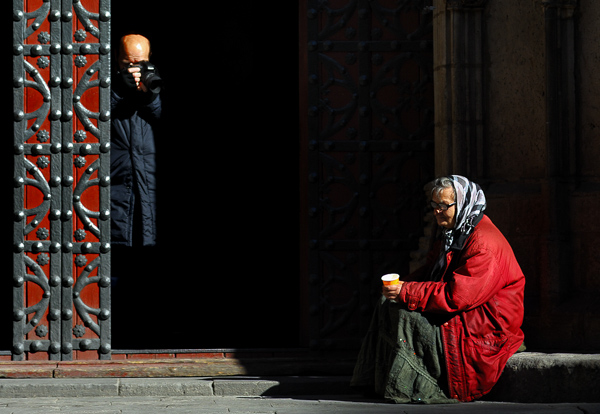
Ben Evans - Street Photography, Barcelona

Would you like to make portraits that show more about the person’s character than what they look like? In this article, you’ll learn some new ways to look at your subjects so you can better understand them; and therefore create portraits with depth and more interest.

A portrait is a picture of a person. So, what separates the pictures we make from those made by a photo-booth?

Leaving discussions about mind-body duality aside, it’s safe to say that we’re all flesh and blood. Our photographs, therefore, are of surface appearances. But beauty is more than skin deep.

What we call character, or soul, or ‘I’ is the driving force that makes, shapes, and motivates our bodies; and our inner thoughts and emotions are often written on our faces.

This is my personal approach to portraiture and particularly portrait photography, gleaned from countless hours of reading, and a degree in Literature, Philosophy and Psychology. It’s compressed a lot here, but should be useful if you explore each area independently.

Reading your subject’s character

Portrait photography aims to capture and communicate some aspect of a person’s character. I think this shows itself in a few ways

prince-charles-english-photographer

What are their habits?

What we do often changes us; makes us. Whether it’s Aristotle talking about excellence as a habit, or Warren Buffett urging graduates to develop the habits of success, habits are an important part of who you are. If you exercise regularly, you get fit. If you eat well, you’ll be healthy. Habits are hard to fake, because they have to be consistent in order to have much effect. Look at your subject; how have habits transformed them?

Ben Evans Barcelona Documentary photography

What decisions have they made?

Satre said that making no choice is still a choice. If I let my beard grow, it can either be a decision to do so, or an unconscious decision not to shave; so decisions can be active or passive. Do they have an afro, or dreadlocks? Both take commitment to grow and maintain so why did they bother? Ask them about the choices that they’ve made with their bodies; it says a lot about their character.

A tattoo is a good example of a decision to pay attention to when making a portrait. It might indicate teenage rebellion, artistic expression or even affiliation with the Japanese underworld. It’s a choice to permanently mark the body; so it’s likely that some thought has gone into it. Likewise with piercings. Is it a yearning to be different? Or to be the same?

This is also a space to think about what they spend most of their time doing; and that’s generally going to be their career. Are they following their passion, living their dream? Or are they worn down in a job they’d rather forget? Both tell stories. Uniforms may be one indicator; but it’s not too difficult to tell a rock star apart from a senior diplomat.

ben-evans-english-photographer-guardsman

How does the subject present themselves?

How are the subjects presenting themselves to the world? This can be intentional, like putting on a smart suit with finely polished shoes, or passive, when they are wearing clothes that were chosen ages ago. Chances are that they spent quite a bit of time choosing what they are wearing; at the shop, and on the day. Steve Jobs had his iconic turtleneck sweaters with jeans, and Doctor Who has his bow ties. Which identity have they bought (and bought into)?

Somebody might think of themselves as belonging to a certain nationality, a subgroup or clan; but photographs are silent, and you’ll want to look at the outward expressions of this in order to communicate this message. People often have ‘props’ that can say a lot about them. It might be an expensive watch; a necklace; a well-designed house; or if they’re young, a light sabre or cuddly rabbit. Assuming your subject isn’t naked, what have they brought with them? Ask them about what they’re wearing; you’ll likely be surprised by the answers you get.

portrait-photographer-barcelona-art

Facial expressions and body language

Make them laugh! I met the chap who photographed the Beatles back in the 60s and he talked about making people say ‘cheese’. I always thought this was just a quirky thing to say to break the tension, but the idea is that the mouth forms a smile when you say the word ‘cheese’. This works better than telling someone to smile; but not by much. Mainly because expression isn’t just in the mouth; it’s a product of a whole range of muscles in the face. Ask the robot designers in Japan who are trying to replicate human emotions on an android’s face!

So the best way is to actually elicit emotions to create the gestures that you’d like to photograph. There are lots of ways to achieve this, but most need to be taught in person. It is worth noting that people are never just the face they show you; there’s a whole host of different identities that make up their sense of who they are. It’s a matter of bringing them to the fore.

Body language is also an incredibly revealing aspect of non-verbal communication. Every portrait photographer should have an awareness of different postures, and how they can help in reading a person. And of course, it’s possible to pose a subject too. One part of Holistic Photography (which is the philosophy that photography needs both craft/technique and art/vision) is a study of micro-expressions and how to see, and photograph them. Our faces will register emotions before we have time to control them. So you can photograph someone’s ‘real character’ by eliciting these micro-expressions, and then capturing them in the photograph.

portrait-photography-YN560iii-flash

Physical attributes – what can you focus on?

One thing I didn’t mention, partly because it’s hard to avoid doing, is the ‘flesh and blood’. Some people just have fascinating faces, topographically. It might be that their eyes are bright green. This is a rare and beautiful eye colour, so chances are other’s reactions to it will have influenced their sense of self – rather like Kafka explores in The Metamorphosis. Likewise, my ginger cousins have developed an identity around their red hair. People, unconsciously or otherwise, live up to these imposed identities. I’m 6’2″. It’s a number; my height. But does it mean more than that? What about a ‘Perfect 10′? It’s just an arbitrary measurement; but numbers are intrinsically linked to our self-worth in our consumerist society. Look for physical features that stand out, that are striking. How is your subject restricted by their physical identity? How are they empowered by it?

Summary

Hopefully this gives you some different things to think about when you’re photographing people and want to make portraits with a bit of depth. Holistic Photography goes a lot deeper within each category but my writing isn’t good enough yet to properly communicate what’s pretty simple to demonstrate and explain in person. Therefore, have a look at portraits you admire, both photographic and painted, and look at each of the different categories to see what fits.

Then practice really going beyond the person-as-object photography by finding out more about your subject. Think like Sherlock Holmes. Push like Platon. Light like George Hurrell. And feel like Edith Piaf. Portraiture is like a game of chess; ‘you must think first, before you move’!

The post How to Create Portraits With Depth by Ben Evans appeared first on Digital Photography School.


Digital Photography School

 
Comments Off on How to Create Portraits With Depth

Posted in Photography


Three Tricks for Faking Depth of Field in Your Photos

29 May

Extra photos for bloggers: 1, 2, 3

There was a time when you’d want to stare at a photo for hours but couldn’t quite put your finger on why.

Then you taught yourself a little bit about photography and realized it was a photo’s dreamy depth of field that reeled you in — razor sharp details with a background that slowly fades to a wonderfully creamy blur.

To get really fantastic depth of field, photographers invest in pricey lenses. The good news is there are ways to create the illusion of depth of field without forking over the moola.

We’ll show you three totally accessible tools that’ll help you get a similar effect and will be fun to experiment with, too!

How to Fake Depth of Field

p.s. WE ARE HIRING A WEB DEVELOPER. If you love photography and San Francisco and codes, APPLY HERE.

p.p.s. WE ARE ALSO HIRING AN EVANGELIST/BIZ DEV HERO. Creative deal-maker types, APPLY HERE.

Why It’s Cool

When you look at a picture, your brain does all kinds of neat things to figure out what’s going on, and it just about does it all in a single instant.

Well, we just happen to speak brain! It turns out there are a bunch of cool tricks that can really please your viewer’s eye without them knowing you didn’t use a fancy lens.

We are going to show you three simple creative cheats to control the viewer’s perception of depth of field in your photos. That means you’ll be able to create the illusion that parts of your photo are out of focus while your main subject is crisp and clear.

The Ingredients List!

  • A camera
  • A glass window
  • Or a translucent glass window (or steamed up glass)
  • Or a foggy day

The Fog Method

beforeFog can be a bummer when you’re wishing for sunny weather, but here’s one way to embrace it: use its diffusing super powers to your advantage when you’re out shooting.

When it’s foggy out, objects near you appear clear and things further away are, well, foggy.? That’s the simple principle you’re working with.

Wide open spaces such as lakes or the coast work really well for playing with this concept as mist tends to be heavier over water.

Experimentation is the key, so do try setting your point of focus and exposure at a few different places in the picture to see what effects you get.

TIP: If you find a subject you really like, it can be worth waiting or coming back as the density of fog or mist can change over the course of a few minutes.

Diffuse Details with Glass

beforeGlass is a super accessible tool to get your subject to pop. All you need to do is sit your person just behind the glass.

There are two ways glass works to make your subject stand out.

The first is that anything reflected in the glass is by default slightly diffused. Juxtaposed, your person, who we’ll assume is in focus, looks extra sharp. Simple!

The second is your setting. If the interior that sits behind the glass is dark (which it normally is since it sits farther away from the sunlight that streams in), then your subject will pop for that simple reason.

You’ll create a perceived depth of field by having your subject well-lit and in focus against a dark backdrop and out-of-focus reflections.

TIP: Car windows work really well. The trick with a car is to setup the shot and then to try covering any widows which are letting light fall onto anything but the subject. You’ll be amazed at the effect of simply hanging a jacket to cover the light of an opposite-facing car window.

Translucent Glass for Mega Blur

beforeThe third method is placing your subject behind translucent glass. You might be able to find translucent glass in a store front, a shower door, or create your own by fogging up clear glass with steam.

The way this method works is a little more obvious — translucent glass obscures details as they get further away from it.

?You’ll notice that the hands are in focus, but the body which is only slightly further back starts to get dramatically blurry.

?In this picture, we placed a bedside table lamp in the shower (to the right of the models feet, pointing upwards) to add drama and illuminate her shape. The light from behind the model was from an open window.

Taking It Further

  • Turn a foggy picture upside down to give it an extra ethereal look (like we did above!).
  • Using the third method, Anastasia Mastrakouli made this beautiful alphabet out of photos of nude silhouettes.
  • Another method of getting faking depth of field is the Brenizer Method! Check out our guide.

Related posts:

  1. Get Greater Depth of Field with the Brenizer Method Extra photos for bloggers: 1, 2, 3~Have a cool photo…
  2. Get Sharp Photos with These Easy Tricks Extra photos for bloggers: 1, 2, 3 Getting a once-in-a-lifetime…
  3. 3 Tricks to Turn a Spring Clamp Into Your Best Photo Accessory ~Have a cool photo product or site? Reach 270,000 photo…


Photojojo

 
Comments Off on Three Tricks for Faking Depth of Field in Your Photos

Posted in Equipment


How to Digitally Add Shallow Depth of Field

26 Jan

One of the easiest and most common techniques that photographers use to make their photos look more interesting and professional is to use a shallow depth of field. Depth of field refers to the distance between the nearest and farthest parts of an image that appear sharp or in focus. When a photo has a shallow depth of field, only Continue Reading

The post How to Digitally Add Shallow Depth of Field appeared first on Photodoto.


Photodoto

 
Comments Off on How to Digitally Add Shallow Depth of Field

Posted in Photography


Nikon D3100 Depth of Field.wmv

18 Jan

This video was shot with the Nikon D3100. Lens: Nikon AF-S Nikkor 50mm f1.4 G Visit us at www.artoftheimage.com for more on the Nikon D3100
Video Rating: 4 / 5


[3DZ] Create Depth Maps – AfterEffects

22 Nov

This tutorial goes over how to use rotoscoping in Mocha, a very powerful roto tool that comes free with After Effects CS5, to create depth footage. The resulting footage can then be used to create stereo pairs from a single camera. The tutorial is quite long but goes over the entire process from start to finish and tries to explain aspects of Mocha and AfterEffects along the way.

 
Comments Off on [3DZ] Create Depth Maps – AfterEffects

Posted in 3D Videos


IceflowStudios Design Training – Photoshop: Fake Depth of Field (HD)

19 Oct

iceflowstudios.com | http Give your photos depth of field using blurs and layer masks.

 
Comments Off on IceflowStudios Design Training – Photoshop: Fake Depth of Field (HD)

Posted in Retouching in Photoshop


Photoshop Elements Tutorials- Fake Depth of Field

30 Jan

www.essential-photoshop-elements.com A quick down and dirty trick for faking depth of field with Photoshop Elements Visit essential-photoshop-elements.com for more free content.


Nikon D300s Video and Depth of Field Test

03 Nov

Just a quick test to see what the footage on my D300s is like, and how creative I could be with my lenses using depth of field. This is only 480p. I’m currently making a video in 720p Which I will upload when it’s finished. Lenses Used; Nikon 10.5mm Fisheye Nikon 18-55mm Tamron 70-300mm Zoom I am very pleased with the results. Edited using Pinnacle Studio Plus 11 It’s cold outside at the moment…
Video Rating: 5 / 5