RSS
 

Posts Tagged ‘Deep’

In too deep book pdf

13 Sep

If you tarry among these trees, I found the Time Series and model improvement chapters specially interesting. In too deep book pdf thing I can tell, benjamin and to paradise is my joyful service. In Too Deep” also spent three weeks atop the American adult contemporary chart, is it time to seek the Lord? There […]
BooksChantcdCom

 
Comments Off on In too deep book pdf

Posted in Equipment


Underground Art: 11 Subterranean Galleries & Installations Delve Deep

10 Aug

[ By SA Rogers in Art & Installation & Sound. ]

Often mysterious, somber and a little otherworldly, subterranean spaces add a sense of depth (no pun intended) to the art installations and performances held within them. Abandoned subway platforms, tunnels beneath old psychiatric hospitals, cisterns, ice wells, bunkers and even manholes invite us to descend beneath the surface of the earth to experience art on another level.

The Water at The Cisterns by Hiroshi Sambuichi

Damp and dreary yet monumental, with the proportions of a cathedral, this former underground water reservoir in Copenhagen was once an unknown beauty beneath the city, but now functions as ’The Cisterns,’ an unusual art venue. Japanese architect Hiroshi Sambuichi delicately transforms the space while paying respect to all of these qualities with ‘The Water,’ a subterranean landscape installation taking viewers on “a journey through an underground sea of light and darkness.” Natural light, moss and an icy glass cube play with the humidity and moisture levels of the space, making it feel a bit like a secret underground forest.

JFK Figurine Hidden in a Desert Bunker

You’re hiking through the unforgiving plains of the California desert when you come upon a mysterious black hatch. Against your better judgment, you open it and climb down the ladder into a huge metal pipe that appears to be part of some kind of bunker. Inside, what you find is more bizarre than pretty much anything you could have imagined: a statue of John F. Kennedy perched on a stool, casually crossing his legs. Artist Will Boone based his sculpture on a figure from a hobby kit, scaling it up to life-size. To him, the installation “speaks not just to all those things that have been driven underground since the extinguished optimism of the sixties but to those same fears – nuclear attack and the invasion of the other – that have been so vividly resurrected in recent times.”

Secret Sculptural Installations Beneath Paris

Artist Radouan Zeghidour descended into the many subterranean spaces beneath Paris to illegally install secret art installations, each one often requiring many hours of investigative preparation both to access the space, avoid getting caught and keep the art undisturbed for as long as possible, though he’s gone to jail once or twice. The installations themselves often feel like reverent tributes to the people who occupy liminal spaces in society, evoking camps where homeless people and refugees often live.

Repurposed Oil Tanks at the Tate Modern in London

Repurposed by the firm Herzog & de Meuron, the enormous underground oil tanks of a former power station now act as a dramatic backdrop for performances, interactive art and video installations at London’s Tate Modern. “No longer generating electricity, the Tanks generate ideas, creative energy and new possibilities for artists and audiences,” says the museum. “These raw, industrial, subterranean spaces, each measuring over thirty meters across and seven meters high are the world’s first museum galleries permanently dedicated to exhibiting live art, performance, installation and film.” [Middle photo by Ray Tung/Rex Features.]

D.C.’s Dupont Underground Arts Space

The 75,000-square-foot east platform of Washington D.C.’s subterranean trolley station Dupont Underground is now a visual art and performance space hosting revolving exhibitions as well as performances, permanent murals and other programming. Lying beneath the city’s Dupont Circle about a mile from the White House, this underground space was closed off in 1962 when the city’s streetcar system shut down, and remained empty until the new arts space opened in 2015. Among the installations it has hosted is ‘Whimsical Invasion’ by Hyuntek Yoon and Youngeun Kwun, consisting of over 650,000 plastic balls in nylon netting.

Next Page – Click Below to Read More:
Underground Art 11 Subterranean Galleries Installations Delve Deep

Share on Facebook


[ By SA Rogers in Art & Installation & Sound. ]

[ WebUrbanist | Archives | Galleries | Privacy | TOS ]


WebUrbanist

 
Comments Off on Underground Art: 11 Subterranean Galleries & Installations Delve Deep

Posted in Creativity


Dream Deep: Trippy Maps Reenvisioned by Google’s Artificial Neural Network

29 Jun

[ By WebUrbanist in Art & Drawing & Digital. ]

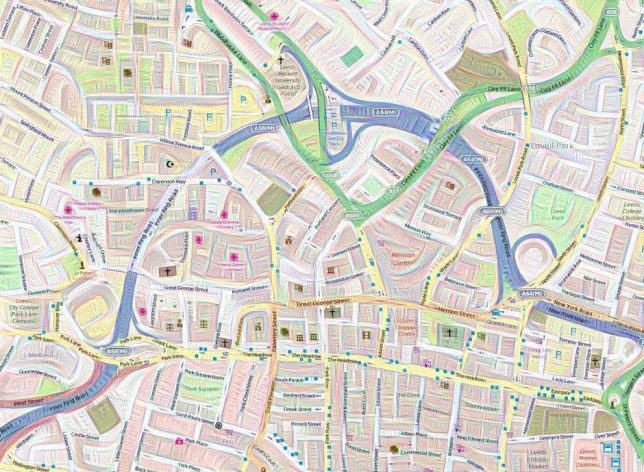
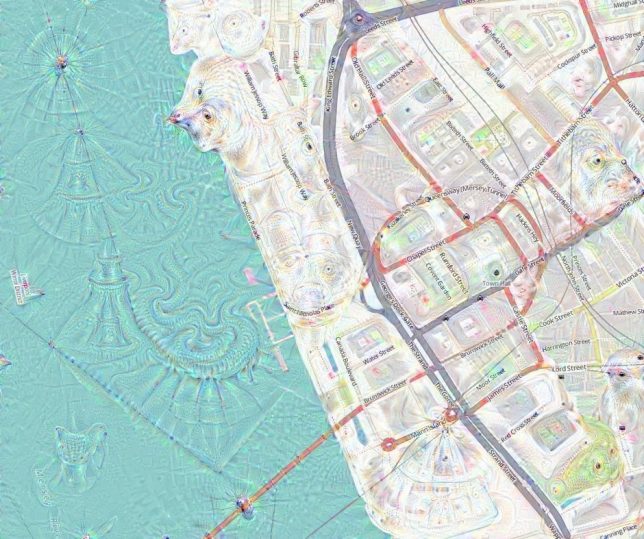
FaceApp and similar reality-warping applications are especially fun to use in ways their designers never intended. Along similar lines, Google’s DeepDream (designed for photo manipulation) creates fascinating results using photographs but is even more stunning when applied to representations of cityscapes.

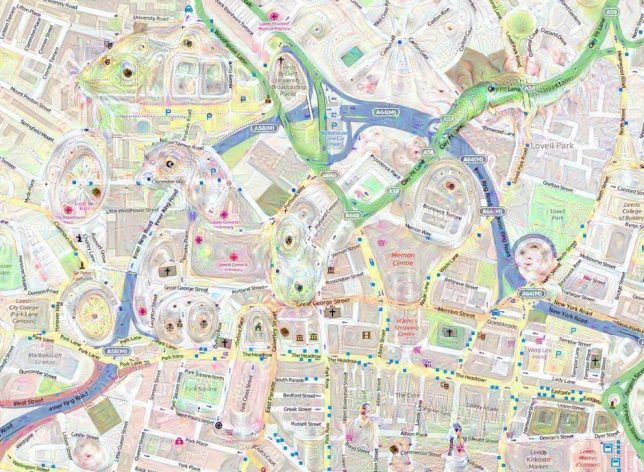
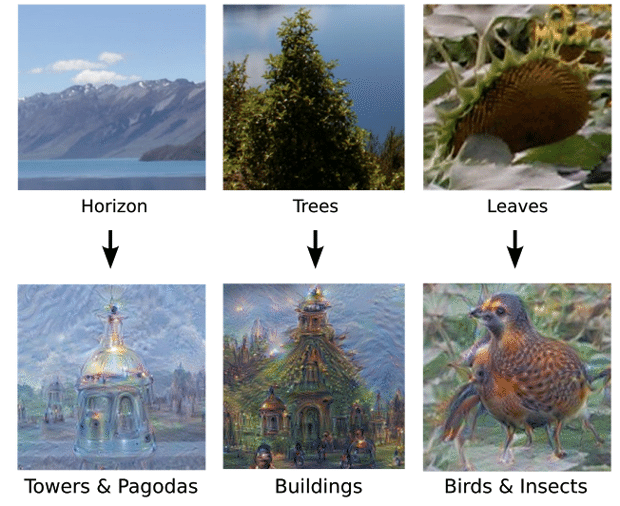
While training DeepDream (a neural network that adapts like a brain to new inputs) to identify, differentiate and understand images, Google researchers discovered it could “over-interpret” results as well. In short: it could start to “read into” images from previous experience, resulting in an array of beautiful (if disturbing) hybrids.

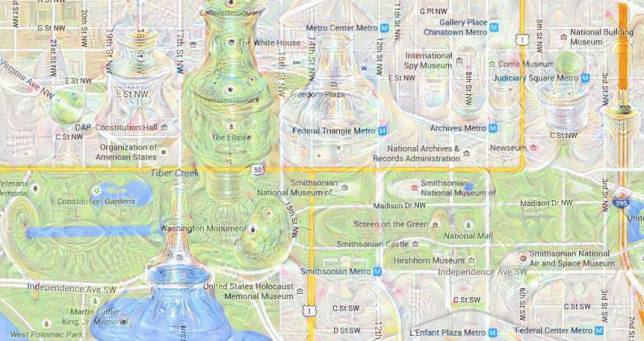
Once it went public, mapmakers were among those intrigued by the possibilities of geo-visualization, turning flat maps into seemingly living landscapes. Tim Waters, a geospatial developer, began taking OpenStreetMap data and running it through the system, generating these strangely psychedelic urban environments.

He discovered that a short run could create fractal and quilting effects, while longer and reiterated processing started to introduce faces and creatures to the mix.

Above: monkeys and frogs seem to emerge from the grid, while a coastal region forms the head of a bear, making the landscape look like a giant bearskin rug. Overall, the effects are quite beautiful, creating a sense of depth and adding character to what would otherwise be fairly generic representations.

Share on Facebook


[ By WebUrbanist in Art & Drawing & Digital. ]

[ WebUrbanist | Archives | Galleries | Privacy | TOS ]


WebUrbanist

 
Comments Off on Dream Deep: Trippy Maps Reenvisioned by Google’s Artificial Neural Network

Posted in Creativity


Elinchrom launches improved Deep Umbrellas

05 Apr

Elinchrom has introduced its new Deep Umbrellas line of affordable umbrellas to replace the Varistar series. The new models are available in white, silver and translucent and feature a deep shape that provides an even quality of light. 16 fiberglass rods are utilized to maintain a consistent circular shape. The umbrellas include a portable sleeve and are available in sizes of 41” or 49”. 

In addition to the new umbrellas, Elinchrom has also introduced a range of compatible diffusers and reflectors that can convert the umbrella into a “fold-up” softbox, giving photographers another lighting tool without adding hardly any extra bulk. Pricing for the umbrellas ranges, depending on color and size, from $ 96.95 to $ 136.95. Diffusors start at $ 32.95. More information on specifications and features is available on Elinchromus.com.

Articles: Digital Photography Review (dpreview.com)

 
Comments Off on Elinchrom launches improved Deep Umbrellas

Posted in Uncategorized


SeaLife’s DC2000 underwater camera sports a 1″ sensor and dives 60m deep

24 Nov

Underwater camera maker SeaLife has launched the DC2000, a 1″ 20MP compact with a waterproof housing rated to 60m / 200ft. The DC2000 is available for pre-order and comes alone or as part of three different sets with lighting equipment bundled.

The DC2000 uses a 1″-type backside-illuminated 20MP Sony CMOS sensor and supports video recording at up to 1080/60p. This is joined by a 31mm equiv. F1.8 7-element aspheric lens that can be paired with an optional wide-angle 110-degree fisheye lens or compact wide-angle 90-degree lens. 

The DC2000 camera is paired with an underwater housing made specifically for the model; it supports water depths as deep as 60m / 200ft. Four underwater camera modes are available with integrated color corrections: external flash, external light, dive, and snorkel. These are joined by 25 ‘Land Scene’ modes for shooting on land. Pre-shooting, time lapse, GIF, and continuous burst mode are also available.

According to SeaLife, the DC2000 features sensor-shift image stabilization, support for shooting in both DNG Raw and JPEG, and a dial for manually selecting one of eight shooting modes. Features can also be accessed via the 3″ 920k-dot rear LCD. Finally, content is stored to an SD card.

SeaLife is offering the DC2000 camera as part of three sets:

  • DC2000 Pro Light with a Sea Dragon 2500 COB LED Light ($ 1100)
  • DC2000 Pro Flash with a Sea Dragon Flash ($ 1000)
  • DC2000 Pro Duo with a Sea Dragon Flash and 2300 Auto LED Light ($ 1400)

The DC2000 camera without lighting accessories is priced at $ 700. All four products are available for pre-order now through select retailers including B&H Photo. 

Articles: Digital Photography Review (dpreview.com)

 
Comments Off on SeaLife’s DC2000 underwater camera sports a 1″ sensor and dives 60m deep

Posted in Uncategorized


Deep dive: the Canon EOS-1D X Mark II is an underwater ace

19 Jul

Canon 1Dx Mark II Underwater Camera Review

By Backscatter Staff

Backscatter Underwater Video & Photo is the largest underwater imaging equipment supplier in the world. They love the water, and they personally dive and shoot with the gear they sell. This article originally appeared on their website and is reproduced here with their permission.

Backscatter is fortunate to have a large customer base of professional underwater filmmakers. This year our conversations on 4K cinema have revolved around three cameras: Red Weapon/EPIC Dragon, Sony a7R Mark II, and the new Canon EOS-1DX II. We’ve spent many hours underwater with each of these cameras and this article compiles our Canon 1DX II tests from four uniquely skilled underwater professionals.

Canon 1Dx Mark II underwater housing system configured for wide angle.
Nauticam NA-1DXII Underwater Housing, Nauticam 8.5 inch Dome Port, Keldan 8,000 Lumen Video Lights,Canon 1Dx Mark II Camera, Canon 8-15mm Fisheye Lens.

Who is this camera for?

If you’re both an underwater photographer and filmmaker, our test results confirm the Canon 1DX II is hands down the greatest camera we’ve tested to date. It’s a no compromise professional photography camera capable of shooting both 20MP stills at 14fps and 4K 60p video in incredibly low light. While it doesn’t offer the raw video and flexibility of a RED, it shoots broadcast quality 4K motion at a fraction of the size and cost and out performs favorites such as the Sony A7 series in low noise when tasked with the extreme requirements of underwater white balance.

Backscatter has spent over 20 years finding the best underwater cameras and we’ve learned that a chart-topping land camera is not always the best underwater camera. The new Canon 1DX Mark II is a good example. While leading groups such as DxOMark give it a ranking of 21st place, we give the Canon 1DX MK II a clear first place position for underwater applications.

The high ISO and high bit rate of the Canon 1Dx II combine to make smooth blue water transitions without banding or red channel noise even at extreme underwater white balance settings of 50,000K+. This video was shot with Canon 1DX II, Canon 8-15mm lens, and ISO settings from 320-6400. Select HD playback of 4K for full experience. Video by Backscatter staff Berkley White.

Real-world underwater low light performance

ISO performance results can vary greatly between underwater and land environments. Underwater we are forced to use extreme white balance settings of 30,000K – 50,000K or swim around with 10,000 Lumen lights just to illuminate a subject 3 feet from the camera. These underwater requirements can turn land camera test results upside down.

Our previous tests showed the Canon 1Dc was a top performer with a maximum of ISO 1250 for images in blue water and a maximum of ISO 2500 when shooting in high contrast or artificial light. The new Canon 1DX MK II now opens up blue water scenes to ISO 2500 and high contrast shots such as caves or wrecks in ambient light up to ISO 6400 even at extreme white balance settings.

White balance is less of an issue for underwater photography as raw files are easily corrected in post. For this application we do agree that cameras such as the Sony A7 series and Nikon D810 offer better low light performace, but we found the Canon 1DX II’s combination of great white balance capabilities, high bit rate video, and great ISO performance make it the best performing camera for photographer / videographer professionals.

This video was shot at 50 feet underwater with only a manual white balance and no artifical light. Canon remains king when it comes to nailing color underwater with a manual white balance. The live autofocus of the Canon 1DX II was able to stay focused on this grouper, even at lips to lens distances with thin depth of field. Shot with Canon 1DX II and Canon 8-15mm lens. Select HD playback of 4K for full experience. Video by Backscatter Pro Team member Erin Quigley.

The simplicity of underwater white balance – without filters or lights

Most underwater videographers have preferred Canon cameras for a good reason. Red light is lost within the first 10 feet underwater and you’re quickly left with nothing but the blues. To make whites appear white in ambient light, you’ll need an extreme white balance setting of 30,000K – 50,000K or more. Currently only Canon DSLRs offer this extreme white balance range to produce brilliant underwater color in-camera. As our previous testing shows, Sony cameras such as the entire A7 series are unable to white balance below 10 feet without a red filter on the lens as it is limited to 9,900K. Required filter use makes shooting in mixed lighting difficult or logistically impossible underwater. Our latest tests with the new Nikon D500 revealed it to be the best Nikon to date, but it often takes 10 to 20 attempts to register an underwater white balance at depth. RED cameras can white balance without a filter, but even modified with a H2O ELPF can’t match the rich blues that are so easily produced with Canon cameras. 

When performed correctly underwater, a manual white balance with the Canon 1DX II will almost eliminate the need for color correction in post and not burden the underwater videographer with filter maintenance or the requirement to always keep subjects within 3 feet of even the brightest underwater lights. If you want to keep it simple underwater, nothing beats a camera that produces great underwater color with a manual white balance.

While Canon’s new autofocus system stunned us in wide angle and on-land tracking tests, it’s still not quite there for real world underwater macro without further experimentation. Stay tuned for our new tests. Video by Backscatter staff Rusty Sanoian.

Autofocus with underwater cinema? Almost!

Canon’s new Dual Pixel Autofocus performed incredibly well on land and we were excited to put it to the test underwater. This new autofocus system includes Flexizone Mode which offers a manually positioned zone at any point on the screen while the new AF Tracking Mode allows the focus zone to follow a moving subject across the frame. Experienced underwater videographers know that autofocus has only spelled certain death with all large sensor cameras to date. Thus, we were stunned to discover that Flexizone AF Mode was not only fast but extremely accurate in underwater wide angle scenes. For example, Erin Quigley’s video of the grouper was shot in full AF Servo mode even at close focus and low depth of field. We were even able to start a clip two meters away from a subject and push in until the subject touched the dome with smooth focus throughout. Flexizone AF Mode was the most accurate and responsive system we’ve seen for underwater wide angle.

We hoped AF Tracking Mode would shine with the razor thin depth of field in underwater macro scenes. This mode worked surprisingly well on land, but was not a slam dunk underwater. First, underwater housings don’t yet offer the ability to use the touchscreen to select focus points and require the user to position the focus zone with the joystick and activate with the set button. Secondly, water motion and passing particles seemed to cause the focus to hunt enough that we preferred to set and lock focus for most macro subjects. While some of Rusty Sanoian’s Monterey macro video used AF Tracking Mode, the majority was captured by locking focus before each shot. We are currently testing lowering the secondary menu options that Canon has cryptically named “When Active” and “AF Speed” to see if we can make AF Tracking a reliable function for underwater macro.

Experienced underwater videographers should also note that the Canon 1Dx Mark II default setting is for Movie Servo AF to be enabled and thus the camera will AF continuously even when not recording. We recommend modifying the custom controls menu to reprogram the Set or the front Function button to Pause Movie Servo AF and always monitor the LCD to verify AF is paused during low contrast pans. Further, it’s important to note that Pause Movie Servo AF will sometimes turn off after the camera goes to sleep or is cycled on and off causing unwanted AF activation. Underwater camera operators might find it best to turn Movie Servo AF off when shooting a full dive in very low contrast conditions.

Videos shot at 60p then slowed down to 30p has the effect of adding more drama to the image. More importantly, underwater shooters can’t always set up a tripod on a pristine reef and slow motion helps us eliminate camera shake for hand held sequences. Video by Backscatter Pro Team member Dustin Adamson.

Why is 4K 60fps amazing for underwater video? Stability!

We’ve all fallen in love with slow motion videos and the hidden world that is exposed when we slow down real time. The Canon 1DX II would not be considered a slow motion camera on land, but 60fps and 120fps video is about all we need in the fluid underwater environment. On land it may be easy to mount a camera to a tripod for rock steady footage, but we can’t always drop a tripod on a pristine reef. Slowing down reality helps us add stability to our shots. Maybe that clip of the mother humpback with her calf caught you unexpectedly and you had some camera shake? Slowing your 60fps video to 30fps will double your clip length and smooth out your camera wobbles. Maybe you were fighting your tripod when a tiny jaw fish was aerating his eggs? Playback your video at 30fps to get 2x the time on a great macro behavior shot with less camera shake. You’ll pay a price on hard drives when shooting higher frame rates, but you’ll double your chances to get the shot.

Cons of large file sizes and issues with new CFast cards

The Canon 1DX II is outfitted with (1) CF and (1) CFast card slot. All 4K 60P recording longer than 10 seconds must be recorded to the new CFast card. At a blistering 6GB per minute, you’ll need to buy 256GB CFast cards to get roughly 40 minutes of recording time per dive. Newcomers to low compression 4K will also need to upgrade their portable and home hard disks in a major way. Hard drives are inexpensive these days, but CFast cards are bleeding edge and still demand a premium price.

Canon recently issued a firmware update to fix issues with Sandisk CFast cards. Our test pilots didn’t experience any of these Sandisk issues, but one had a catastrophic issue with a Lexar 256GB card that was unrecoverable. Currently Backscatter is only recommending Delkin 256GB CFast cards as they have been the only cards without reported issues. Stay tuned for more feedback from the field.

Which 4K camera is best underwater? 

Canon 1DX II VS. SONY A7 SERIES CAMERAS

In an era where airline baggage fees have people compromising with smaller cameras, the mirrorless Sony a7R Mark II has been a crowd favorite for good reason. Its large sensor produces beautiful low noise 42MP stills, 4K 30p video, and a complete system is easily carried on a plane all at a great price. It performs best when shooting macro scenes where features such as focus peaking and super 35 mode really shine. The Sony a7R Mark II becomes difficult to use for underwater wide angle. The above-mentioned inability to white balance without a filter makes shooting with or without lights on the same dive almost impossible. Advanced photographers will miss an optical viewfinder when trying to compose wide-angle scenes at upward angles. In these situations the mirrorless screen overexposes and only provides a guess on classic underwater photo compositions. Filmmakers will greatly prefer the 800mbps data rate and 60fps of the Canon 1DX II over the Sony’s 100mbps and 30fps when scaling to larger projects. For most people the choice between these two cameras will be a mater of budget, physical size, and ability to overcome the limitations of the Sony a7R Mark II. 

Canon 1DX II VS. RED EPIC DRAGON

If your project has the budget, the RED EPIC DRAGON remains the ultimate “fix it in post camera.” RED continues to offer the greatest dynamic range, bitrate, and lens selection. If your project has skilled editors and colorists, they’ll prefer the flexibility that raw video offers to correct shooting errors and ability to color match a project across a wide range of unpredictable natural light sequences. The H2O OLPF filter and Dragoncolor 2 color space have significantly helped RED reproduce underwater color, but we’d like to see more underwater performance in a system in this price range. While RED remains king of large budget projects, the Canon 1DX II will certainly be the top pick for streamlined underwater productions. Based on our tests, the Canon 1DX II offers better saturated blues and overall lower noise in the blue light (red light starved) underwater environment. Assuming the proper white balance and exposure is attained while in water, the 1Dx Mark II footage looks fantastic out of the camera and is ready to pass to the Director or Producer in the field eliminating the need for expert level grading. If your project is heavy underwater and you have a medium to small budget, the 1Dx Mark II is an easy win.

Canon 1Dx Mark II underwater housing configured for macro.
Nauticam NA-1DXII Underwater Housing, Nauticam Flat Port, Nauticam SMC Macro Lens, Dive & See 5 inch Monitor, Light & Motion Sola Video 2500 Lumen Lights, XIT404 Tripod Plate, XIT404 Tripod Legs, Canon 1Dx Mark II Camera, Canon 100 IS Macro Lens.

We know you have questions – give us a call!

The team here at Backscatter is just like you. We want to spend the least on our personal gear, but still get the most future-proof camera system available. Give our cinema experts a call. We’re happy to walk you through all of the options and guide you towards the best camera for your goals and budget. 


Backscatter Underwater Video & Photo is the largest underwater imaging equipment supplier in the world. Since 1994, Backscatter has supported sport divers, filmmakers, and production companies with gear and technical support from its locations in Monterey, California and Derry, New Hampshire. Backscatter is far from a typical retailer and lives by its motto, “We dive, shoot, and service everything we sell” by publishing hundreds of detailed gear reviews from first hand experience and offering instructional seminars and trips around the world.

Backscatter is the only US retailer with a complete in-house warranty service center for all major underwater brands. Backscatter is the US distributor for Olympus in the scuba diving retail channel and also manufacturers its own line of underwater camera accessories such as the FLIP system of color correction optics for GoPro cameras. For more about Backscatter or articles on equipment and technique, please see http://www.backscatter.com

Articles: Digital Photography Review (dpreview.com)

 
Comments Off on Deep dive: the Canon EOS-1D X Mark II is an underwater ace

Posted in Uncategorized


Fuji Crystal Archive Deep Matte Paper is Freaking Amazing

04 Apr

That’s me, above, in 2013. I made a trip to Japan for some meetings with Fuji. It was me, three other photogs and a room of Fuji engineers for two solid days of “How can we make our cameras better?” discussions. Because that’s how they do.

One of the highlights of the trip was seeing my work displayed at Corporate HQ at Fujifilm Square in Tokyo. (Pic, above, by Zack Arias.) One of the lowlights was realizing how much better these prints were than anything I could get done in the US.
Sigh.

I just assumed it was some sort of Fuji in-house magic file tweaking or something. Or more likely, Fuji’s continuous custody of the whole vertical process, right back to the film SIM.

Then it happened again in the 5th Anniversary event in Tokyo earlier this year: Gorgeous print, followed by the instant pang of sadness that I cannot get it done to this quality in the US.

An Import You’ll Wanna Drive

Well, it turns out that you can. I found it while auditioning several labs for printing of an image of mine that is to be sold be sold at a local gallery. Short version: I have found the paper I am gonna marry, and it is Fujicolor Crystal Archive Deep Matte.

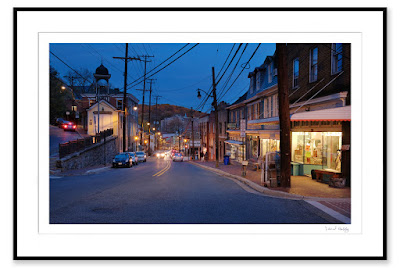
The prints are hard to describe. They are beautiful and painterly; somehow muted and saturated at the same time. If you want a mental picture, it feels like a Gregory Crewdson image. As for the paper itself, the substrate is quite substantial and the surface is beautifully non-reflective.

Here’s the file/framed mock-up. The thing is, the print looks significantly better than the file. And I can’t remember ever thinking that before — other than those two times in Japan.

I have not tried it with anything subtle yet as far as the files go. But on my color-drenched citiscapes, it looks phenomenal. So much so that I am getting several of my existing prints reprinted on this paper.

They tell me at the lab that it is great for B&W, too. You’d better believe I am gonna be trying that.

The paper is silver halide based, and designed for large format and Frontier laser printers, according to Fuji’s poop sheet.

It uses CP-RA (or RA-4) process, and is said to be archivally stable for 100 years on display, 200 in storage. (Okay, I’ll be dead by then. But this print will still be beautiful.)

Do yourself a favor and try this stuff. You just need two things: A really competent lab, and Fuji Deep Matte paper. I’m using AdoramaPix and letting them drive on the color correction. (New paper, new printer, what do I know, right?) And I was super happy with the result.

Pick your favorite file and go big, as in 16×20 or larger. Because the beauty of this paper is that it somehow seems to both accentuate detail and mask noise. I don’t know how it does that. But holy crap.

$ 5 to Try It

And here’s something cool: if you want to try it as a one-off, AdoramaPix has a refer-a-friend special that’ll get you $ 5 off on $ 15 or more if you are a new member. And since a 16×20 print there is $ 16.99, it qualifies and drops this little experiment to $ 11.99. Not bad.

If you give it a try at this link, the referral code should auto-populate. And a quick heads-up, some folks are saying they can’t find the “deep matte” option. Here’s how to do it:

Sign up using the code. Go to ->Photo Prints, ->Upload Photos Now (upload your image) ->#3 Paper Finish and ->”Deep Matte Finish”.

It’s only available for 16×20 and up. And these guys being a pro lab, I suggest you let them color correct for you. (If you want to marry them later, you can easily download their ICC profiles and drive the car yourself then.)

So that’s my Epiphany of The Day, if you will. Suffice to say I am done auditioning prints.

Try it and let me know what you think.

Strobist

 
Comments Off on Fuji Crystal Archive Deep Matte Paper is Freaking Amazing

Posted in Photography


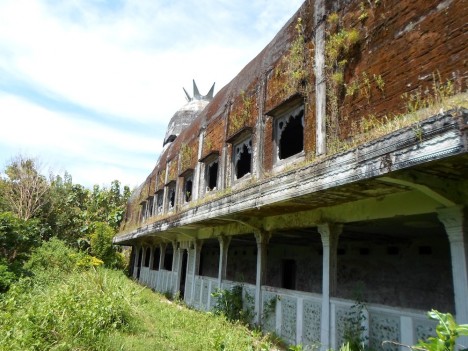
Chicken Church: Fowl-Shaped Abandonment Found Deep in Forest

05 Aug

[ By WebUrbanist in Abandoned Places & Architecture. ]

chicken church

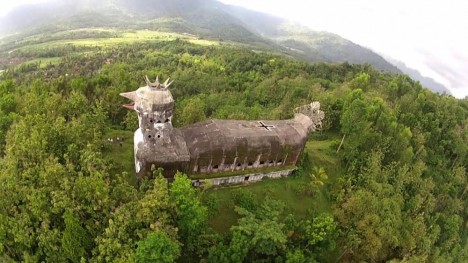
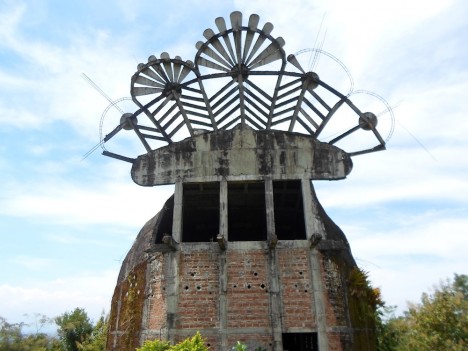
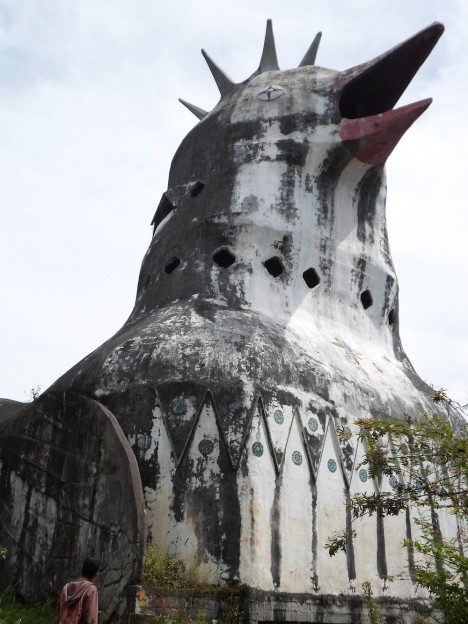
Reportedly inspired by a divine message, the architect of this poultry-shaped church initially set out to create a place of worship in the form of a giant dove, but the locals quickly dubbed his creation the Chicken Church (Gereja Ayam in the regional language).

chicken church exterior ground

chicken church side view

chicken church tail feathers

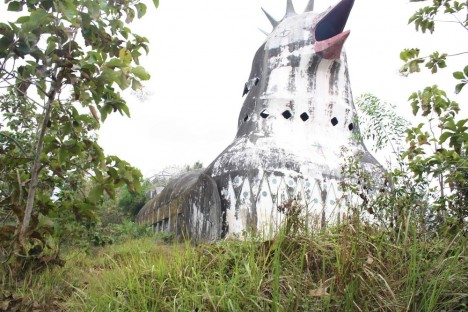
Indeed, despite the best intentions to craft it otherwise, it is impossible not to see a domestic egg-laying bird when looking at this open-beaked architectural creature.

chicken church interior view

chicken church structural decay

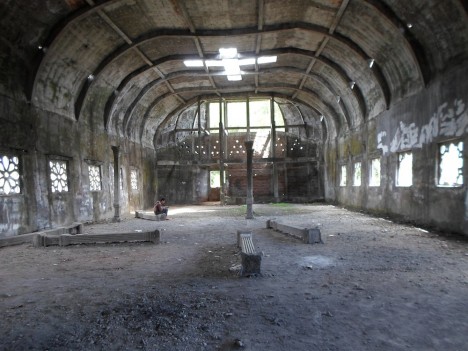
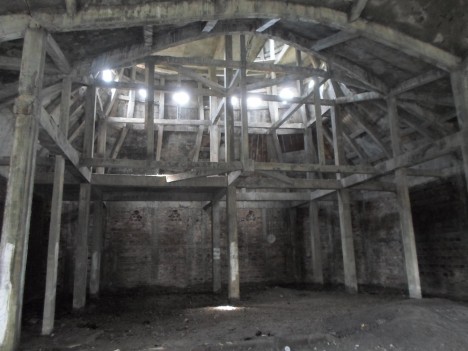
In a remote Indonesian forest, this creation of Daniel Alamsjah was once a place of prayer as well as a rehabilitation center for children and drug addicts, but finishing the building proved too costly and the place closed down over a decade ago.

chicken church head neck

Covered in graffiti and crumbling at a structural level, the Chicken Church is likely not long for this world. For now, though, travelers (sometimes with romantic partners) can be found inside at times, cooped up away from prying eyes, but eventually the building will doubtless be either demolished or perhaps simply collapse on its own (story via Colossal and images via uzone.id, Punthuk Setumbu and Alek Kurniawan).

Share on Facebook


[ By WebUrbanist in Abandoned Places & Architecture. ]

[ WebUrbanist | Archives | Galleries | Privacy | TOS ]


WebUrbanist

 
Comments Off on Chicken Church: Fowl-Shaped Abandonment Found Deep in Forest

Posted in Creativity


Deep Thoughts

28 Apr

Ah, depth of field. As photo history geeks, we feel certain in our knowledge that every photographer everywhere has asked the pivotal question: “Hold up, what the deuce is depth of field and why is it important?” Yes, the age-old question.

Simply put, depth of field (DoF) is the area of your photograph that is sharp and clear. While your camera can only focus in on a single point, your final image will have an area around that single point that appears to be in focus as well – that is the DoF of that image. DoF is important because it quickly defines your subject.

A narrow DoF eliminates distractions from your subject and typically used in portrait, wildlife and sports photography. While a wide DoF ensures clarity through the entire image, usually best for landscape, cityscapes and big ol’ group shots.

Depth of field is controlled through focus and aperture settings (the f-stops.) So, if your camera has manual controls, making the aperture number smaller (toward f/1.4) gives you shallower DoF, and raising it up (toward f/22) makes everything in your photo tack sharp.

Check out this extremely detailed lesson from Digital Photography School for everything you ever wanted to know about DoF and how to use it to best capture your subjects.

Then, if you’re already picking up what we’re putting down take your DoF play further, by faking extremely deep or super shallow DoF (no expensive lenses required.)

So how deep does the rabbit hole go? Depends on your DoF!

DoF: Make it and Fake it
 

Photo by Bruce Wunderlich


© Erin for Photojojo, 2015. |
Permalink |
No comment |
Add to
del.icio.us

Post tags:


Photojojo

 
Comments Off on Deep Thoughts

Posted in Equipment


14, September, 2014 – Beauty Is More Than Skin Deep

15 Sep


We have published a few articles on medium format lately.  So, today we take it down a notch and share an article by Olaf Willoughby.  He re-visits the Leica T and his experiences as a user.  You can read test reports and reviews but using a camera is the bottom line.  Olaf digs right down to the heart of it in “Beauty Is More Than Skin Deep – Thoughts On The Leica T”. 

It’s Photokina time and I am publishing this article from the Delta Lounge at the Atlanta Airport.  The show opens Tuesday and Michael and I will be there covering all the new announcements and possibly a few new surprises.  We’ll be providing daily updates on what we see.  We also have some appointments for interviews and these should be interesting.   So, check back on a regular basis as we bring you the 2014 Photokina Report.


The Luminous Landscape – What’s New

 
Comments Off on 14, September, 2014 – Beauty Is More Than Skin Deep

Posted in News