RSS
 

Posts Tagged ‘Creative’

7 Ideas for Creative Lens Ball Photography [video]

25 May

The post 7 Ideas for Creative Lens Ball Photography appeared first on Digital Photography School. It was authored by Caz Nowaczyk.

In this video by our friends over at Cooph, you’ll learn 7 great ideas for creative lens ball photography to have fun with.

The 7 ideas for creative lens ball photography include:

1. Typography

Type some text and print it out (or find some text you already have) and photograph the lens ball on top. The ball acts as a magnifying glass and distorts the edges of the text.

Look for large letters on signage and displays and photograph the lens ball in front of it for a cool effect.

2. Split World

Look for corners with contrast to create a yin/yang effect.

3. Altering Structure

Find interesting flat structures to photograph the sphere against. The sphere will alter its structure and give it form.

Scan your lawn for flowers and photograph them through the sphere.

4. Inner Circle

Find round shaped objects that support the shape of the lens ball. Crawl into a tunnel (only a safe one, of course), set up your lens ball for the perfect shot.

5. Elements

Fill up a bucket with water. Set up your camera with a high shutter speed and have someone throw the lens ball out of the water bucket. You capture all the action.

Prepare lighter fluid and a spark (Editor note: actually, I don’t fully recommend this one unless you can absolutely do this safely. Fire is dangerous!!)

6. Portraits

Play with nature and your model for capturing cool portraits using the lens ball.

You can also have fun in the studio with this.

7. Abstract Spheres

Create custom backgrounds (cool wrapping paper or printouts will work great). Find interesting patterns too. These make for awesome shots using the lens ball.

Grids also work well. Place your grid in front of a colored wall and light it up. Put your lens ball in front and take some shots.

Bonus Tip:

Use light sabers and your ball for cool effects.


You may also find the following helpful:

  • How to Create Glass Ball Landscapes – 6 Techniques
  • Which Size Lensball is Best for Crystal Ball Photography?
  • How to Make Creative Photos with Prism Photography
  • Copper, Prisms, and Orbs, Oh My! – 3 Creative Techniques for People Photography
  • How to Take Unique Crystal Ball Portraits
  • 5 Photography Hacks to Improve Your Creative Photography


The post 7 Ideas for Creative Lens Ball Photography appeared first on Digital Photography School. It was authored by Caz Nowaczyk.


Digital Photography School

 
Comments Off on 7 Ideas for Creative Lens Ball Photography [video]

Posted in Photography


8 Creative Ways to Photograph Trees

16 May

The post 8 Creative Ways to Photograph Trees appeared first on Digital Photography School. It was authored by Simon Bond.

A favorite subject for many photographers is the tree. Tree’s can be found everywhere, so wherever you are in the world, you’ll have a chance to photograph them. In this article, you’ll see how adding a tree to your composition can add oxygen to your photography! So take a deep breath and learn how inspiring tree photography can be by using these seven different approaches to photograph trees.

1. The lone tree

A lone tree frames a typical landscape scene in southern England.

The lone tree alone in a field or on the brow of a hill really is a photo for the ages. It’s as strong a main subject as you’ll ever take in landscape photography. Whether you position this tree in the center of your frame or the left or right third, the photo is likely to work. The main thing is to ensure the tree is truly isolated and doesn’t have other rival trees in the frame competing for attention. The challenge, of course, is to find such a tree. In some cases, these tree’s are famous like the one at Wanaka lake in New Zealand. The chances are you’ll find a tree near where you live though.

Lens choice

The choice of lens you use may well help you isolate that tree once you’ve found it.

  • Wide angle – This type of lens works well when you want to get close to the tree, yet want to show the tree in its entirety. Through the use of this lens you might be able to create a minimalist style photo containing just the tree, the sky, and some fields where the tree is located.
  • Telephoto – When that tree is a long distance away, and is perhaps inaccessible because it’s on private land, a telephoto lens could work.Of course, make sure you’re not impinging on someone’s privacy when taking that photo. You’ll also be able to zoom in to isolate a lone tree, which is perhaps near to other trees and removing those other trees from your composition.

2. The tree tunnel

Another popular type of photo is the tunnel. These contain a strong leading line and an infinity point. They’ll also work very nicely with portrait photos, where the model acts as a foreground element in front of this tunnel. When it comes to trees, you’ll find they’re naturally good at creating tunnels. This happens when a mature tree has an arching main trunk, and branches that hand down to the side of the tree. Another place you can see a tree tunnel is a path or road that has trees on both sides, where those trees form a roof of interlocking branches. Photos of tree tunnels like this are usually more dramatic taken at longer focal lengths, where the comprehension that gives will enhance the effect of the trees creating the tunnel.

Tree lines work very well in photography.

3. The change of seasons

As with all things in nature, they’ll change with the seasons. As long as you’re not in the tropics, you’ll be able to see the change in a tree throughout the year. The most powerful way to record this is to choose one composition and photograph it for each of the four seasons. Whether that composition is a single lone tree or a path with trees along it will be up to you.

You don’t necessarily need to make your seasonal set from the same location though. You could choose to show photos of trees in the country you’re from, with clear markers that you’re in a particular country from your photos. Each scene you show can show the different seasons, and show the trees of that country.

Autumn is one of the most popular times to take photos of trees, and with good reason.

4. Applying creative techniques

There are many photography techniques out there which you can try. A lot of these techniques are adaptable to use with tree photography. Here is a selection you could try the next time you photograph a tree:

  • Silhouette – This works great with trees, especially those trees with beautiful branches that show the detail of the tree when silhouetted. Silhouettes are relatively easy to achieve. Expose for the sky, and aim towards the sky. The tree should naturally silhouette as long as you’re photographing with the sun in front of you.
  • Refraction – Another classic for tree photography involves using a lensball. Here you’ll see an inverted image of the entire tree all captured with a small glass sphere.
  • Infrared – Choose a sunny day with some clouds in the sky. You’ll want to choose the summer as well, as this technique needs green leaves on the tree. These photos can be taken with infrared filters or repurposed cameras. You’ll need to adjust the white balance in post processing. Once done, you’ll produce a beautiful dreamscape image.
  • Long exposure – The tree itself won’t benefit from long exposure. However, on days when clouds are moving across the sky, this technique looks great. The static tree juxtaposed against blurred moving clouds will work very well.

This is a slightly different take on the lone tree photo, and uses a lensball to achieve it.

5. Details photos

Having taken plenty of photos of entire trees, it’s a good idea to balance this with some detail photos. You’re really spoiled for choice when it comes to the type of photos you take here. All areas of the tree offer potential.

The following ideas can guide you:

  • Leaves – Detail photos of leaves could take different forms. You could focus on a single leaf, and produce a bokeh background behind it. You might use a macro lens and focus on all the detail the veins of the leaf give you. Photographs of leaves work very well with the sun shining through the leaf from behind.
  • Bark – The texture of bark is a natural fit for a detail photo. Look to side light the bark to get maximum texture in your photo.
  • Trunk – The trunk is not just about the bark on the tree. Focus on the root system around the trunk, and all the patterns you can find at the foot of the tree.
  • Branches – Looking up works equally well. Interlocking branches make for great pattern photos, especially when silhouetted.

One of the best places to photograph trees is the jungle. This photo show the detail at the tree trunk.

6. Portrait work

The use of trees as backgrounds for portrait photos is a popular idea. There is a good reason for that; much of which is related to the points made earlier in this article. Tree’s have the potential to form natural frames, especially where branches arch back from the trunk towards the ground. A line of trees forms a leading line, one that can draw the eye towards your model.

In the summer months, you’ll find leaves are amazing for creating a natural bokeh background for your portrait. Your model will be able to interact with the tree, perhaps mimicking the shape of the branches. There are many ways trees can add to your portrait work. So using trees for portrait work is another way to use trees creatively.

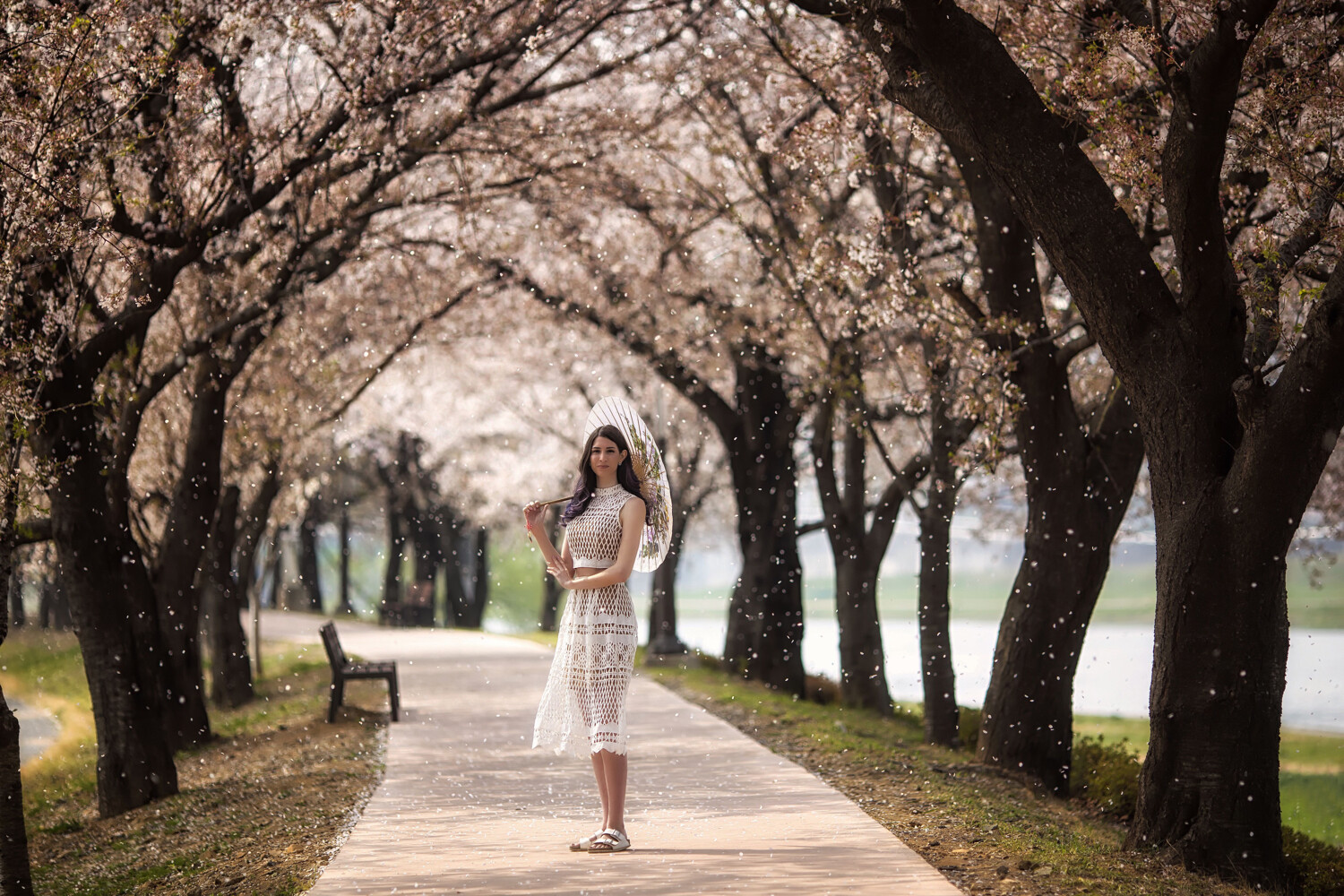
In this photo the model stands under cherry blossom trees as the petals fall down.

7. Different perspectives to photograph trees

Another way to photograph trees more creatively is to change the perspective. There are lots of angles you can use, though you’ll need to be close to the tree to utilize some of these. Take a look at the angles you could be using, and see how you can apply them to your work.

  • Low angle – Either from a distance or closer to the tree, photographing from a low angle will give you a different perspective. Foreground elements will show up a lot more in the frame, so you could place flowers in the foreground with the tree in the background.
  • Worm’s eye view – Low to the floor, but now looking up at the sky. This is a great angle when there are several trees together, and you stand in the middle between them.
  • Bird’s eye view – Should you have a way of getting an overhead photo of the tree, or a canopy of trees, this is a great angle.
  • Framing – Look for ways to frame a tree, perhaps use another tree in the foreground to frame a tree in the background.

This photo uses the branch of one tree to frame another tree in the background.

8. Wildlife photography

It goes without saying that a tree is a living ecosystem. Many living things rely on trees for life, including humans. In terms of photography, you could start small by looking for beetles in the soil, or under the bark. Leaves will also be home to a lot of smaller life such as caterpillars. So you’ll be able to get your macro lens out and explore the world of insects.

Of course, larger creatures feed on these insects, and you’ll be able to photograph them as well. You’ll find lots of species of birds, squirrels, and other animals. Photographing these is trickier, and you’ll certainly need a longer focal length. The use of camouflage gear and bird-watching huts also enhance your chance of photographing life within a tree.

In some countries the wildlife in the trees is a little bigger than a squirrel.

Conclusion

A tree is an interesting subject for a photo and has been used by photographers many times to create photography projects. In this article, you’ll have seen several methods you could use to photograph a tree.

Are there any in this list that interest you? What other approaches to tree photography have you used that aren’t discussed here?

At Digital Photography School, we’d love to see examples of your tree photography, together with your thoughts about this article.


The post 8 Creative Ways to Photograph Trees appeared first on Digital Photography School. It was authored by Simon Bond.


Digital Photography School

 
Comments Off on 8 Creative Ways to Photograph Trees

Posted in Photography


Adobe Creative Cloud no longer offers most older Lightroom and Photoshop versions

11 May

Adobe Creative Cloud no longer offers customers access to most older versions of Lightroom and Photoshop. The company announced its decision to limit Creative Cloud download availability via its Adobe Blog this week, stating that subscribers can now only download the two most recent major versions of both Lightroom and Photoshop.

The direct download access is provided through the Adobe.com website and Creative Cloud desktop app. According to the company, the ‘vast majority’ of Adobe CC customers are already using the two most recent major release versions of both applications.

By forcing the remaining users to make this transition, Adobe says it can ‘ensure peak performance and benefits across Windows and Mac operating systems.’ This change means Adobe CC subscribers can only download Photoshop versions that start with ’19.x.x’ and ’20.x.x,’ and Lightroom versions that start with ‘7.x.x’ and ‘8.x.x.’

Articles: Digital Photography Review (dpreview.com)

 
Comments Off on Adobe Creative Cloud no longer offers most older Lightroom and Photoshop versions

Posted in Uncategorized


Creative Commons launches improved CC Search tool with access to 300 million images

03 May

Creative Commons has fully launched its new CC Search tool following a beta period, the organization has announced. The tool provides rapid access to a library of more than 300 million images indexed from 19 different collections, including the Cleveland Museum of Art, Metropolitan Museum of Art, DeviantArt, Behance, Flickr, and Thingiverse

Users can search for images using keywords and filter the results based on the license type and/or the collection from which the content is sourced. The new search tool has a cleaner interface with improved navigation and direct access to attribution code and text.

The old search portal is still accessible online, but Creative Commons says the new CC Search tool has been given a number of changes that speed up loading times and also improve search phrase relevance. As well, CC Search implements a number of critical bug fixes that aren’t available on the old search portal.

Starting later this year, Creative Commons plans to start indexing open textbooks, audio, and other CC-licensed materials with CC Search.

Articles: Digital Photography Review (dpreview.com)

 
Comments Off on Creative Commons launches improved CC Search tool with access to 300 million images

Posted in Uncategorized


Creative Lighting Tips Using Household Items

30 Apr

The post Creative Lighting Tips Using Household Items appeared first on Digital Photography School. It was authored by Jackie Lamas.

Ever want to create interesting photographs without having to spend so much on equipment? Chances are that you already own ordinary household items that can give your photos that creative lighting twist to make them pop! Read and try these creative light tips using things that are already in your home.

In almost all of the tips, I use my smartphone to light my subject, which is also another item you can use that is already in your home!

1 - Creative Lighting Tips Using Household Items

1. Shadows and patterns

To create shadows and patterns in your photos, try some of the following items that you have in your home already. Create a dot pattern with a colander. Hold it under the light – it can be a flashlight or natural light over your subject and you’ll see how the shadows form.

Experiment with different items with similar holes like a spatula, cheese grater, or laundry basket. Hold the items close and far away from your subject until you get the look that you want! Another easy way to create shadows is with the blinds on your windows. You can place your subject next to the blinds and angle them so that you get the desired pattern on your subject.

2 - Creative Lighting Tips Using Household Items

Using one small light like the flash on my phone and a colander works for making patterns.

You can also cut out patterns on paper, cardboard, or other similar materials to get the patterns you want. Hold them over your subject, and under your light source, and you’ll have shadows and patterns for your photos.

2. Color filters

Using translucent paper like cellophane or even document protectors that are translucent can help you add color casts to your photos. Cut them into squares or circles the diameter of your lens and hold each one up as you take a photo. You can also use tape to keep them on the lens while you’re photographing your subject.

3 - Creative Lighting Tips Using Household Items

I used cut up CD color cases. Document protectors would also work. Anything translucent.

Layer the colors or place them at the edges of the lens to create different color casts in the same photo. Another way is to put the colored paper in front of your light source, like a flashlight or sunlight, in order to achieve the color cast. This way you don’t have to have the paper over your lens and you can mix in different colors in the scene.

4 - Creative Lighting Tips Using Household Items

You can also use a tablet, laptop, or phone to create color casts as well. Try and aim to photograph your subject in a bit of a darker place so that the color cast shows up a little more. Place your device close to the subject and see how the colors show up onto your subject. Make sure your camera is steady as less light will cause more camera shake if you’re using slow shutter speed. Use a fast lens so that you don’t have blurry photos.

5 - Creative Lighting Tips Using Household Items

Use the color filter to the side of the lens.

3. Making rainbows

Using an old CD can create a rainbow light when it’s being reflected. Use this to create interesting rainbows on your subject or background. You can tilt it to get different effects.

6 - Creative Lighting Tips Using Household Items

Another way you can use a CD to create interesting light is to cut it up and glue it to poster board or cardboard and hold it up to the light that way. See what kind of creative light you can get onto your subject!

Try moving it around so that you can angle the rainbow just how you want it in your photo. Get creative with placing the rainbow to highlight different parts of your scene.

4. Fairy or string lights

String lights can give your photos a creative twist all while lighting your subject as well. Place the lights close to the lens to get the blurry orbs of light or place them on your actual subject to get that warm and inviting color on your subject.

7 - Creative Lighting Tips Using Household Items

Tape the lights to the wall so you can have free hands to photograph your subject.

String lights work best in a darker scene but you can experiment with different lighting situations to see what works best. Christmas lights also work for this but they are bulkier.

8 - Creative Lighting Tips Using Household Items

Use the fairy light close up to your lens to get the orb effect.

5. Spray bottle

Water refracts light, this means that when the light hits the water, it bends and can give you a unique way of lighting a photograph! Grab a spray bottle and give the lens a little spray. You might have to point your camera toward the light source, like a backlight or the sun in order to get the light refracting.

9 - Creative Lighting Tips Using Household Items

Using distilled water in a spray bottle gives some really interesting effects too. You could even go another step and use a colored filter over the light or lens to get a mixture of the effects.

In conclusion

10 - Creative Lighting Tips Using Household Items

Create interesting images by combining all of the tips together. This image has the rainbow from the CD, twinkle lights, water droplets all lit by my smartphone flash.

All of these cool lighting effects will give you more creative lighting to your images all using household items that you already have or can create under a budget. Which one will you try?

Share some of the images you take using these techniques with us in the comments below.


The post Creative Lighting Tips Using Household Items appeared first on Digital Photography School. It was authored by Jackie Lamas.


Digital Photography School

 
Comments Off on Creative Lighting Tips Using Household Items

Posted in Photography


This Adobe quiz reveals what creative type you are

24 Apr

If you would describe yourself as a creative type and are into personality tests this fun little self-test that has been released by Adobe might just be what you needed to keep procrastinating for a little longer. In the Creative Types test you have to answer a series of slightly abstract questions in order to find out — you guessed it — what kind of creative type you are.

The 15 questions are binary and definitely a little quirky, for example ‘I tend to see life through the lens of systems or stories?’ or ‘Are you a ruler or a spring?’ Nevertheless your answers are used to compute a result which is one of eight creative types: the Artist, the Thinker, the Adventurer, the Maker, the Producer, the Dreamer, the Innovator, and the Visionary.

I am apparently a thinker, which means my creative strengths are ‘intellectual curiosity’ and an ‘ability to find and create meaning.’ My untapped potential is ‘bridging theory and practice” as well as “applying ideas in real life.’

I can’t deny I can see myself in some parts of the more detailed description of the thinker type, so even though this test is meant to be just a little bit of fun, there definitely seems to be some substance behind it. Head over to the Creative Types website if you would like to try the test yourself.

Articles: Digital Photography Review (dpreview.com)

 
Comments Off on This Adobe quiz reveals what creative type you are

Posted in Uncategorized


5 Secrets for Stunning Creative Bird Photography

16 Apr

The post 5 Secrets for Stunning Creative Bird Photography appeared first on Digital Photography School. It was authored by Jaymes Dempsey.

Do you want to capture stunning bird photography…

…that goes beyond the usual, standard bird photos?

You can!

In this article, I’ll give you 5 bird photography secrets that will ensure you consistently create incredible bird images.

Images that are creative, unique, and original.

Sound good?

Let’s dive right in!

1. Get Low for Gorgeous Bird Photography Backgrounds

Here’s the bread-and-butter of creative bird photography:

Get down low.

Really low.

It may seem tough. You might prefer to stay up high, away from the dirt and water and mud.

But if you want incredible bird photos, you’ve got to get out of your comfort zone. You’ve got to get down low.

Specifically, you need to get on a level with the bird. Your lens should be about even with the bird’s eye.

Why is this so important?

When you shoot from down low, the distance between the bird and the background is greatly increased. And that causes the background to be far more blurred.

Therefore, you’ll capture some beautiful bokeh.

And beautiful bokeh?

Makes for a stunning bird photo.

This is how professionals capture such dreamy backdrops in their bird photography.

They get down as low as they can go. That’s all.

It really does make a huge difference!

Try it. I can guarantee that you won’t regret the resulting shots.

2. Shoot in water for stunning reflections

Do you want to capture especially gorgeous bird photography?

One of my favorite ways to do this…

…is to shoot reflections.

Let me explain:

A photo of a bird is nice. It’s standard. It can be beautiful.

But if you add a reflection, the image immediately becomes far more captivating. Viewers are instantly sucked into the scene.

The reflection adds a sense of subtle beauty and delicateness – one that you can’t get any other way.

Now, here’s how you capture gorgeous bird reflections:

First, shoot by still water.

Mudflats (with puddles) work well. Same with sheltered lakes.

If you’re struggling to find water still enough to generate full reflections, try shooting during the early morning. That’s when the wind tends to be a lot less noticeable.

Second, make sure the sun is low in the sky. (The lower, the better.) This will ensure that the reflection includes some nice colors.

You also have to be careful not to get too low over the water.

Why?

If you’re too low, the full reflection won’t come through. And a broken reflection has far less power than a full reflection.

Bottom line?

Find some birds near the water, and start taking photos!

3. Capture action for compelling bird photos

One of the biggest problems with beginning bird photography…

…is that it’s static.

The bird just stands in the frame.

And while there are methods of making this type of photo work, it’s often just a boring photo.

That’s why you should spice up your bird photos using action.

Once you’ve found a subject, watch it through your camera. Keep your finger on the shutter button.

Then, as soon as it starts to move, take a burst of photos. The more photos, the better!

Of course, you’re going to have a lot of failed shots. But you’ll also capture some keepers. And these will (with a little luck) blow you away!

Some of my favorite shots involve birds flapping their wings, preening, or feeding. If you wait for this behavior, you’ll get some stellar action shots.

One thing I’d recommend:

When you’re watching a bird through the camera viewfinder, keep some space between the bird and the edge of the frame.

Because birds can rapidly change their size – just by opening their wings. And clipped body parts are one of the easiest ways to ruin a bird photo.

Just remember these tips, and you’ll be capturing some great action photos in no time!

4. Shoot through vegetation for unique images

Another way to capture original images…

…is to find a subject.

Get down low.

And shoot through some vegetation.

This creates a gorgeous foreground wash – one that frames the subject without dominating the photo.

To pull this off, you generally have to lie flat on the ground. I advise experimenting with a few different angles – move around your subject, testing different possible foregrounds.

Note: It’s important that the vegetation is very close to your lens (and very far from your subject). Because the farther the vegetation is from your lens, the more in focus (and distracting) it becomes.

It’s also important to limit the amount of vegetation in the photo. You don’t want to cover up the bird entirely. Instead, you want to frame the bird with the vegetation.

Make sense?

Then start taking some shots with a foreground wash. You’ll love the shots you get.

5. Capture silhouettes for dramatic bird shots

Here’s one more way to capture creative bird photos:

Shoot silhouettes!

Silhouettes are really easy to pull off – and they look incredible.

Here’s how you do it:

Go out as the sun is just about to set. Find a subject (birds with a clear outline are best).

Then change your position so that the bird is between you and the setting sun. Ideally, the bird blocks the sun from your camera. This will prevent the sky from being completely blown out.

Make sure that the bird is in front of as much of the sky as possible.

That is, you want to frame the bird with sky – and you don’t want any dark patches behind the bird (from trees or other objects).

If you’re struggling with this, try getting down as low as you can. Because the lower you get, the more sky you’ll include in the frame.

Finally, ensure that you drastically underexpose your subject. One trick is to set the exposure based on the sky next to the bird.

That way, you’ll get a beautiful sky – with a nicely silhouetted subject.

Creative bird photography: next steps

Now you know how to capture stunning, original bird photos.

You know how to produce amazing backgrounds.

You know how to generate interest.

And you know how to capture incredible foregrounds.

The next step…

…is to get out and shoot!

Have any tips for creative bird photography? Share them in the comments!

The post 5 Secrets for Stunning Creative Bird Photography appeared first on Digital Photography School. It was authored by Jaymes Dempsey.


Digital Photography School

 
Comments Off on 5 Secrets for Stunning Creative Bird Photography

Posted in Photography


Adobe After Effects gets Content-Aware Fill, more in latest Creative Cloud updates

04 Apr

With the annual NAB media show coming up, Adobe has rolled out its spring update for the Creative Cloud video and audio apps, including Premiere Pro, After Effects, Audition, and Character Animator.

After Effects now comes with a new Content-Aware Fill function for video which works pretty much in the same away as the still image version in Photoshop. Users can select an object in the footage that they want removed and Content-Aware Fill does the job automatically, filling in the background.

Premiere Pro now features a new Freeform Project panel that lets you organize clips into select shots, making it easier to build and visualize project ideas. In addition text and graphics alignment is made easier through rulers and guides as well as guide templates that can be shared between After Effects and Premiere Pro. Adobe has also managed to speed up mark tracking. The company says this will make color and effects workflows more efficient. H.264 and HEVC encoding has been optimized for smoother playback in Premiere Pro and After Effects.

In After Effects users have now a an Expressions Editor at their disposal. It was designed with advanced users in mind, for examining code visually and comes with features such as syntax highlighting, line numbers, matching brace highlighting, and code folding.

In Character Animator puppet rigging has been improved to give more personality to characters and new Twitch live-streaming triggers allow for enhanced livestream performances, allowing viewers to engage with characters using real-time costume changes, dance moves, gestures, and poses.

As usual, there are also a range of general bug fixes and performance improvements. All improvements and new features are described in more detail on the Adobe blog. The updates are available now.

Articles: Digital Photography Review (dpreview.com)

 
Comments Off on Adobe After Effects gets Content-Aware Fill, more in latest Creative Cloud updates

Posted in Uncategorized


3 Creative Ingredients for Every Photo You Take

25 Mar

The post 3 Creative Ingredients for Every Photo You Take appeared first on Digital Photography School. It was authored by Mat Coker.

We all look at our photos at times and think, “these just aren’t that great.” New photographers who aren’t sure what to do feel this way all the time. But so do seasoned photographers.

Sometimes, looking at the most basic elements of your photo can help you a lot.

I have a mental checklist that I use to help me take the best photo I can. When I review my photos I use this checklist to ask what I could have done better.

Whether you’re a new photographer trying to develop your style or a seasoned photographer wanting to revive a stagnant style, you can use these 3 ingredients to make dramatic changes to your photos.

  • Moment
  • Composition
  • Light

All three of these ingredients are present in every photo you take, it’s just a question of what you do with them. Begin by understanding the moment you’re photographing and then build your composition and play with light.

We’ll look at moment, composition and light separately, but I’ll identify all three in each photo as we move along.

candid action moment photo

Moment: candid, action
Composition: high angle
Light: soft, backlight
When I first began using an old iPhone to take pictures I knew I couldn’t rely on camera settings to make my photos look good. Instead, I would have to focus on other elements such as gesture, angles, and light.

Moment

Most people would agree that the moment is the most important part of any photo. We won’t even notice the shortcomings in your photo if the moment is strong enough.

First, begin by considering what sort of moment you’re about to photograph. The first question to ask is whether the moment is one that you’ve set up (still life, food photography or posed portraits) or is it happening naturally (candid moments, photojournalism, lifestyle or street photography)?

Posed moment

Moment: posed
Composition: face to face angle
Light: soft, side light

Candid moment

Moment: candid
Composition: high angle
Light: soft side light
After photographing thousands of the same pose over and over, this candid moment was a breath of fresh air.

Whether it’s a natural or posed moment, there are further questions to ask. That moment may be packed with action (sports), or emotion (events) or mystery (portraits).

Action moment

Moment: action
Composition: slightly higher angle
Light: soft, side light

Emotional moment

Moment: candid moment combing two emotions; a loving embrace and a crying infant
Composition: face to face
Light: backlight

You can go even deeper into the moment. When the environment or background plays a role, the moment may be a season, a time of day, or a sudden storm.

Candid moment at golden hour.

Moment: a childhood moment at golden hour
Composition: face to face
Light: warm, soft, backlight

Types of moments to look for:

  • Natural
  • Posed
  • Action
  • Emotion
  • Mystery
  • Stage of life
  • Time of day
  • Season
  • Weather

The type of moment that you’re photographing will influence your decision about composition and light too.

Composition – especially angles

Composition refers to everything your photo is composed of. Which means no matter what part of the photo you’re discussing, it’s all composition. However, photographers often use the term composition to refer to a specific type of element such as angle, background, framing, symmetry, lines, centering, rule of thirds, etc. So even though moment and light are technically part of the photo’s composition, they often stand on their own.

We’ll take a close look at angles because you must use an angle in every photo, whereas other elements such as lines, symmetry, or rule of thirds may not be possible or desirable in every photo.

Angles are easy to learn and fun to use. To change the angle you simply need to get your camera higher or lower or rotate horizontally from left to right.

There are five vertical angles to choose from, and each one changes the look and feel of the photo. You should choose your angle based on the type of moment you’re photographing.

  • Bird’s eye view – when you get up high and look straight down (candid and still life moments).
  • High angle – like a grown-up looking down at their kids (posed or emotional moments).
  • Eye level – at the same level as the thing you’re photographing (emotional or action moments).
  • Low angle – like a child looking up at the world of grown-ups (action moments).
  • Bug’s eye view – looking straight up from down on the ground. (dramatic moments).

Experiment with angles and you will soon learn what works best for you.

High angle food photography

Moment: setup, “posed”
Composition: bird’s eye view. Great for food photography because it mimics the angle that you use to look down at your food.
Light: soft, side light

Moment: posed
Composition: low angle
Light: soft, side light
Climbing a mound of dirt with your Tonka trucks is pretty epic for a little kid. So photographing it from a lower angle helps to exaggerate the size and how the moment feels.

Use angles and the other elements of composition to bring out the nature or essence of your moment.

Choose your angle well and then fill out your composition with other elements to draw the eye. Try negative space (also with portraits), centering, black and white, silhouettes, lines, framing and other unique approaches.

“One doesn’t stop seeing. One doesn’t stop framing. It doesn’t turn off and turn on. It’s on all the time.” – Annie Leibovitz

Light

There will be all sorts of moments that you have either orchestrated (posed) or discovered (candid). You respond to that moment with your composition, bringing out the meaning of the moment. Finally, you do your best with light to make the moment look better.

Sometimes you can control the light (strobes, off camera flash, or window light). In most other cases you can’t control the light. But no matter what light you’re given, you can always modify it with scrims and reflectors.

There are a few aspects of light to keep in mind since they dramatically affect your photo.

Color

Most light has a color to it. Perhaps it’s clean white light, or maybe it’s being reflected off a colored surface. Consider the temperature of the light. Is it warm or cool?

cool light

Moment: season, night
Composition: lower angle
Light: cool, backlight

Warm light

Moment: posed
Composition: face to face angle, framed by the branches
Light: warm, backlight

Quality

When it comes to the quality of light, remember that a larger light source will produce softer light while a smaller light source produces harsh light.

So a large window is a source of soft light, while a bare light bulb produces harsh light. Photographers use umbrellas and softboxes to make the light source larger and produce a softer light.

An overcast sky is a source of soft light, while the sun is a source of harsh light.

Moment: posed
Angle: face to face
Light: harsh, side light

soft window light

Moment: perfectly still, but not posed
Composition: bird’s eye view angle
Light: soft, side light produced by a window

soft overcast light

Moment: posed
Composition: face-to-face angle, symmetrical composition
Light: soft light was produced by an overcast sky.
The orderliness of the photo is broken by the silly expression on her face.

Direction

Whatever the color and quality of light, it will always be coming from a particular direction. The direction of light changes the feel of your photo.

front light

Moment: candid
Composition: low angle
Light: green, harsh, front light

side light

Moment:action
Composition: high angle, centered
Light: harsh, side light

low angle photography

Moment: action
Angle: low angle
Light: backlight from the setting sun, producing texture in the sand

There is a lot to learn about light, but keep in mind these three big elements:

  • Temperature, color
  • Quality (large and soft, or small and harsh)
  • Direction

Every creator uses ingredients

Photographers are no different.

None of the three main ingredients are optional, they’re going to be in every photo. The question is what you do with them and how they affect your photo.

There is going to be a moment, but did you think it through and capture it the way you hoped?

There will always be an angle (and many other elements of composition), but did you choose one that made the moment stand out better?

And, there will always be light, but did you use it in such a way as to make the moment look it’s best?

The post 3 Creative Ingredients for Every Photo You Take appeared first on Digital Photography School. It was authored by Mat Coker.


Digital Photography School

 
Comments Off on 3 Creative Ingredients for Every Photo You Take

Posted in Photography


9 Creative Architecture Photography Techniques for Amazing Photos!

19 Mar

The post 9 Creative Architecture Photography Techniques for Amazing Photos! appeared first on Digital Photography School. It was authored by Simon Bond.

It’s great to get a technically sound photo, and architecture photos demand this. Getting the technical side of your photo correct should be your first priority, but beyond that, it’s worth experimenting. In this article, you’ll learn about some creative photography techniques, and how you can apply these to your architecture photography. Whether you adopt any of these for your work will be at your discretion, but having extra options for your photography is never a bad idea. So read on to find out which creative architecture photography techniques you could apply.

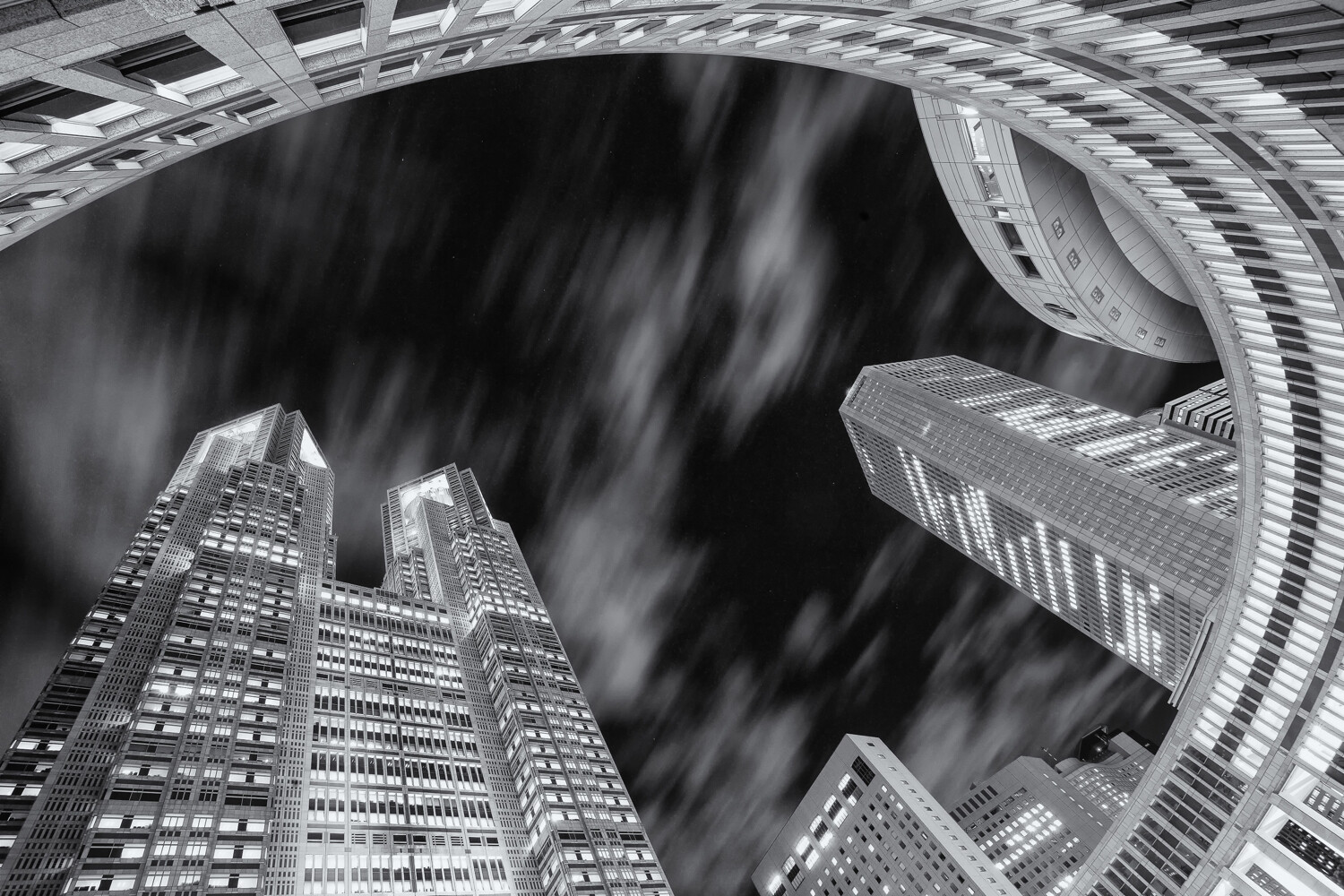
This photo of the Tokyo metropolitan government building has used a worm’s eye view, and a wide-angle lens.

1. A different perspective

Many architecture photos are taken at eye level. In other words, a standing composition from street level or an elevation that brings you level with the building if that’s available. This is far from the only way to photograph architecture though. Using extreme perspectives like worms eye or birds eye views can give dramatic results.

  • Worms eye view – This is likely to be the easiest perspective to achieve and works best when photographing taller structures. You can use this to emphasize interesting ceiling features or to take photos of skyscrapers from the base of the building. If you happen to be surrounded by tall buildings that are close to each other, you can use this perspective to fill the sky.
  • Birds eye view – To get this type of angle, you’ll first need to find a way of getting above the structure you’re photographing. With the advent of drone photography, this has now become a lot easier to achieve. No drone? No problem. You can always find a tall building to photograph from or, if you’re lucky, a hot air balloon ride!

2. Infrared photography

You can change the nature of your creative architecture photography, without needing to use extreme perspectives. One of the best ways to do this is by using infrared photography. This will change your image into more of a dreamscape. This style of photography works much better outdoors, and in places where there is some vegetation. Through some post-processing, you’ll create an image where photosynthesizing plants are white, and the sky is dark. Architecture then forms a powerful focal point within your infrared photo. There are some excellent guides on this style of photography. You have three main choices when it comes to carrying out this style. You can convert your camera for infrared, use an infrared filter, or you can produce this effect through post-processing.

Infrared photography is a great technique to experiment with.

3. Light painting

One of the most creative photography techniques out there is light painting. Through the use of light painting techniques and styles, you can customize the way you photograph architecture. The trick is knowing where and how to apply this to your photograph because not all architecture lends itself to every technique. Perhaps it’s impossible to gain access to the area of the structure in which you’d like to light paint? Perhaps light painting will be too big a distraction and detract from the architecture itself. When you can use light painting to form a leading line to the architecture, or perhaps to frame the architecture, you’ll be on the right lines. There are various tools you can use. Below is a selection.

  • A torch – The simplest of light painting tools. This can be used to create patterns in front of the camera, or perhaps to light up a section of the architecture you wish to photograph.
  • A light source on a string – Repeating patterns work well in photography, and spinning a light source on a string will provide this repetition. You could also use this to create a light orb, and strategically place the orb in front of your architecture.
  • LED light sticks – In recent years products like the pixelstick and the magilight have really revolutionized light painting. These excellent tools can be used to create bespoke light paintings in front of the architecture you’re photographing.

In this photo a pixelstick has been used to light paint around the pagoda.

4. Kinetic light painting

Light paintings’ cousin is kinetic light painting. The technique also requires a tripod, but this time you move the camera rather than the light source. Once again, this can be quite experimental, and not all locations are well served by this photography style. The two main types of kinetic light painting are the zoom burst and camera rotation.

  • Zoom burst – This technique works well with tall buildings, from a distance, and where they’re lit up with lots of interior building lights. You’ll need to set the camera on a tripod, with a lens that can zoom. A kit lens works very well for this, or perhaps a 24-70mm lens. You begin the photograph at the longer focal length, and then zoom out. You can read more about this technique here.
  • Camera rotation – This time you rotate your camera around a tripod head. It works well with tall buildings, where you have a worms eye view. Once again, you can read more about how to do this by reading this guide.

This is a single photo of the Tokyo Skytree. It’s straight out of the camera, and has used kinetic light painting.

5. Refraction photography

You can also use refraction photography with a crystal ball for creative architecture photography. That’s because the fisheye-like properties of the glass ball will capture the entire piece of architecture you intend to photograph. There are tricky aspects you need to handle including the upside-down image within the ball, and centering the architecture within the ball. Providing you can find a good place to position the ball, you’ll be able to use this technique to produce a unique photo of a building or sculpture.

This location is a popular place to photograph St Paul’s cathedral in London. The addition of a crystal ball gives this image another perspective.

6. Detail photos

The main focus of architectural photography is to capture the whole scene. That’s not always needed though, and you can find great detail photos by using lenses of longer focal length. These photos might not work on their own but would certainly add to a selection of photos of one particular piece of architecture. You’ll need to look out for details in the roofing, lines of repeating architecture like arches in a church, or ornate decorations on a wall. Then look to focus in on this particular area. Look to light the detail photo well by either choosing the correct time of day for the sun or using an external flash.

Detail photos of architecture are always worth taking.

7. Digital blending

A process known as digital blending allows you to get perfect pictures. The technique is great for getting technically perfect photos, but you can push beyond that and get more creative. One of the main advantages of this is the ability to photograph towards a sunset sky, and then to balance light across the scene so your architecture doesn’t become too silhouetted. The technique requires you to use a tripod for best results and to take a set of bracketed images. You’ll then need to use luminosity masks to blend the bracketed images in post-processing.

In this photo digital blending is used to ensure the roof windows aren’t blown out.

8. Contrast

Contrast is a broad term, and can be interpreted in several ways. You can use any of these interpretations for more creative architecture photography. Let’s look at some of the ways contrast can be applied.

  • Light and shadows – The most obvious when it comes to photography is to use the light in your photo. You can use this to accentuate areas of interest on the architecture, by using shadows to show detail points.
  • Colors – In some cases, you can play colors off against each other. Obviously, you can’t move architecture, so you’ll need to be creative about how you add opposite colors that contrast with it.
  • Old and new – Old architecture surrounded by new can make an effective photo. Think of a church or temple surrounded by modern skyscrapers.

Framing is a potent photographic technique, which draws the eye to the main subject.

9. Framing

Look to frame the architecture you’re photographing. An arched doorway is a great way to frame your main subject. You could introduce the framing yourself, by holding something in front of the camera. You can use gaps in a fence as a way of framing your photo.

Which creative architecture photography technique will you use?

There are many ways to add creativity to your photography. You’ve now learned about some of the best creative architecture photography techniques. Are any of these techniques you’ve tried before? Which of these ideas will you try? We’d love to see the results of your photography from the past, and anything you might take in the future. As always please share your thoughts and photos in the comments section of this article.

The post 9 Creative Architecture Photography Techniques for Amazing Photos! appeared first on Digital Photography School. It was authored by Simon Bond.


Digital Photography School

 
Comments Off on 9 Creative Architecture Photography Techniques for Amazing Photos!

Posted in Photography