RSS
 

Posts Tagged ‘Creating’

8 Tips to Improve Your Photography by Creating Instead of Taking Photos

22 Feb

If you’re like most photographers you use your camera to capture a moment; you see an interesting subject, so you photograph it to the best of your ability. But a worthwhile experiment is to try staging a photo. Rather than waiting for all the elements to perfectly arrange themselves, take control and create the moment yourself.

It’s an important lesson in thinking about the story and composition, and it’ll improve your photography in no time. I spent three years photographing everything in sight, but it was only after taking control of my images that I was able to turn my hobby into a profession.
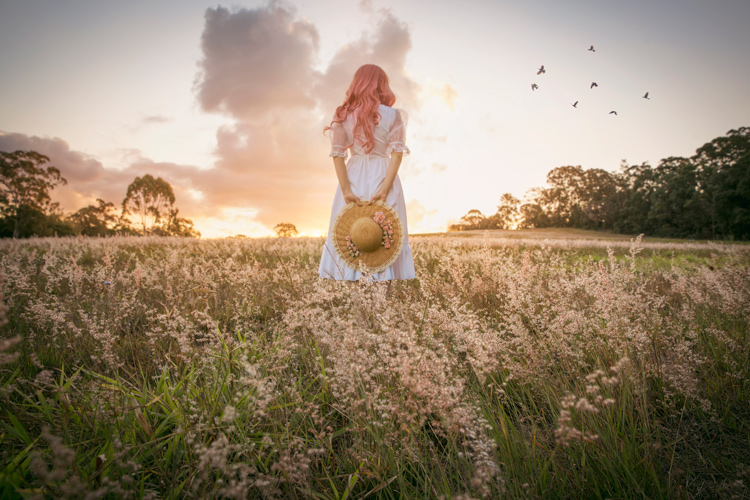
Field of Dreams

Creating a photo can be as simple, or elaborate, as you wish. If you’re interested in street photography, this could involve asking an interesting stranger to pose in a particular place or way. For macro photography, setting up a backdrop behind a pretty flower can make the subject more dynamic. For portraits it could be a photo of your child dressed in their favourite costume, acting out a scene in your backyard. As long as you have actively directed the subject in some way.

Elements to consider are:

  1. Story
  2. Subject
  3. Setting and location, era, time of day
  4. Props
  5. Wardrobe
  6. Pose
  7. Lighting
  8. Framing / Composition and angle, lens used

Let’s break these down one by one.

#1 – Story

What’s happening in your photo? What’s your subject or character doing? A story isn’t always necessary, but having answers to these questions certainly helps make it more engaging, and gives you an idea of what extra elements can help enrich the story.

In “Return of the Sword” (below) I was playing with the idea of King Arthur’s Excalibur, and I wanted my character’s reflection to look as if it were offering her the sword. To be able to tell this story I needed to have the right prop, costume, and location, to help the viewer understand what was happening, and associate it with the original story.
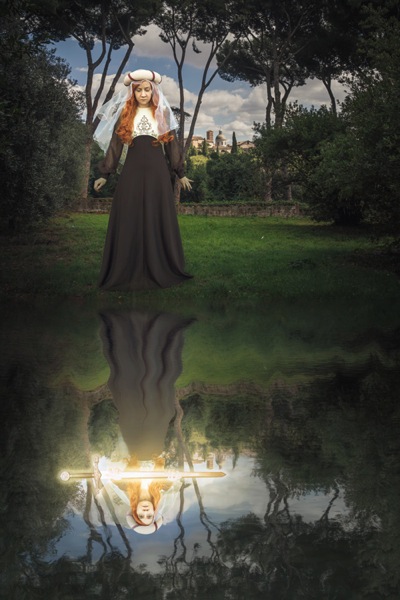
Return of the Sword

#2 – Subject

Who is your character? What physical attributes do they need to have? If you have a willing family member or friend on hand, that’s great! Otherwise you can recruit models through places like ModelMayhem. However, your subject needn’t be a person, an object or an animal are fine too.

I shoot self-portraits, primarily because it’s convenient, but I’m certainly no classic beauty, so I try to disguise my face as much as possible. In “Red Runs” below, I wanted to show Red Riding Hood running through a forest, followed by a wolf, so my character needed a red cape and blonde hair. This was easily achieved with the help of a blonde wig and my dog, Koda.
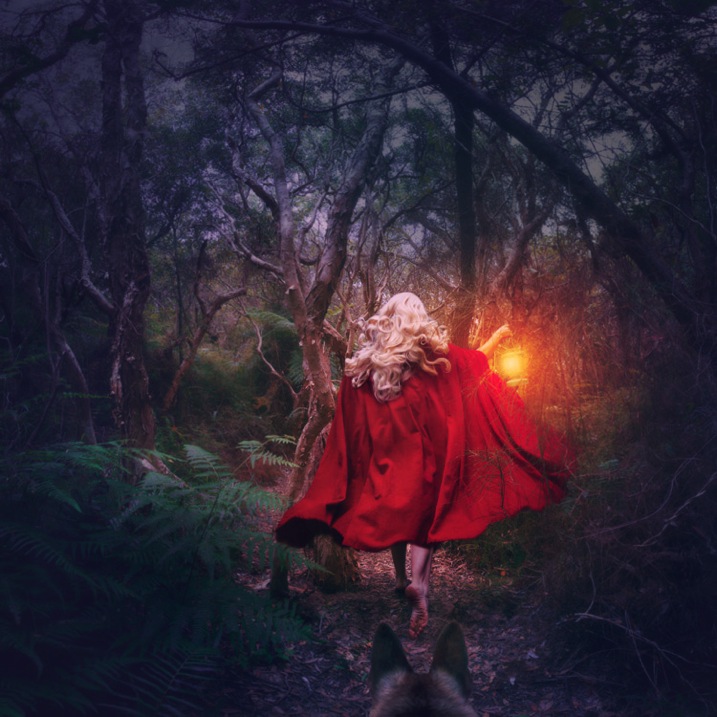
Red Runs

#3 – Setting

Where and when is your story taking place? To find interesting locations, assess your local area for unique landmarks. Use Google Maps to discover what’s nearby, then use your car and your feet to explore further. If your goal is to photograph an interesting insect, your where might be in front of some black cardboard to cut out the background clutter, and your when might be early morning when the light is soft and appealing.

In “Siren’s Sorrow” below, I used an impressive local relic, the Gayundah Shipwreck, to tell the story of a regretful mermaid. I shot at sunset to add interest to the sky, and I wanted the time period to be non-specific, so I was sure not to include any objects in the shot, that would anchor it in time. There were many walkers passing by, and an active construction site overlooking the area, but you’d be surprised how quickly you stop being self-conscious when you start doing self-portraits.
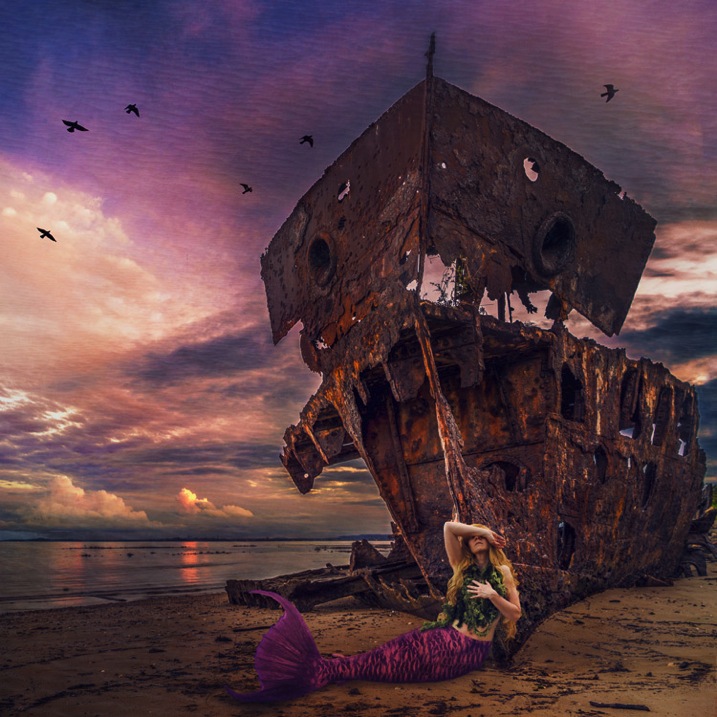
Siren s Sorrow

#4 – Props

Having your subject interact with something will make your shot more interesting and further your story. You can buy props from cheap used clothing shops, eBay, or just use things you have lying around the house. If you’re going for something simple, spraying water on a flower adds interest, as does adding people to a landscape.

In “The Blue Girl” I wanted to tell the story of a girl who had cried for so long, that she filled a room with tears, and turned it into an ocean. I placed polyfill behind her head for the clouds, and added birds and a friend’s model ship, to give interest to the scene.
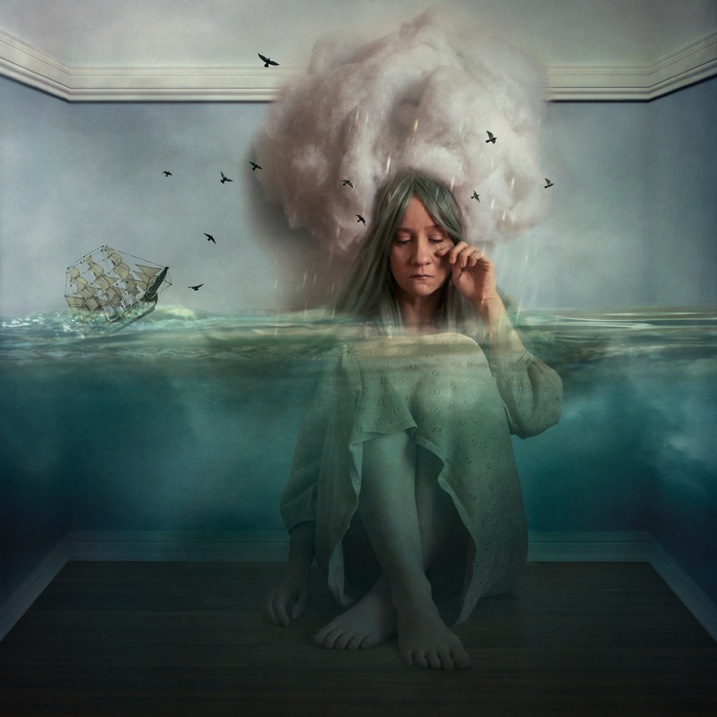
The Blue Girl

#5 – Wardrobe

What would your character be wearing? I have a rack full of costumes, specifically to be used in photoshoots, that I’ve bought from eBay and op shops, but you needn’t get this involved. My main considerations are usually whether the outfit suits the story, and if its colour will contrast with the surroundings, to make it stand out. If my face will be seen, I generally wear basic make-up I’ve applied myself.

In “Dance of the Jacarandas” I used a $ 30 wig from eBay, and a $ 5 dress I bought at a local theatre’s costume sale. The dress was the perfect colour and shape, to make my character look like a Jacaranda flower.
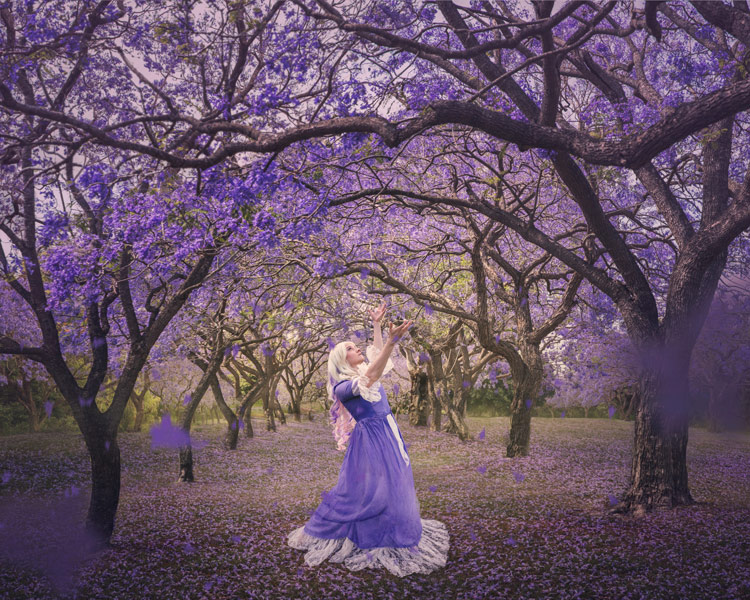
Dance of the Jacarandas

#6 – Pose

What would your character naturally be doing in their story? Are they powerful or submissive? I tend to shoot the main pose, and then do a few variations so I have options to work with.

In “I Tried to Drown My Sorrows”, I wanted to show a girl who looked like she’d fallen into a glass. The pose had to be compact to fit in the glass, yet rigid to show the shock of the fall. I did this by jumping around in my backyard, then flipping the image upside down so I was falling instead of jumping. The movement caused by jumping makes the pose more dynamic and my hair look like it’s floating.
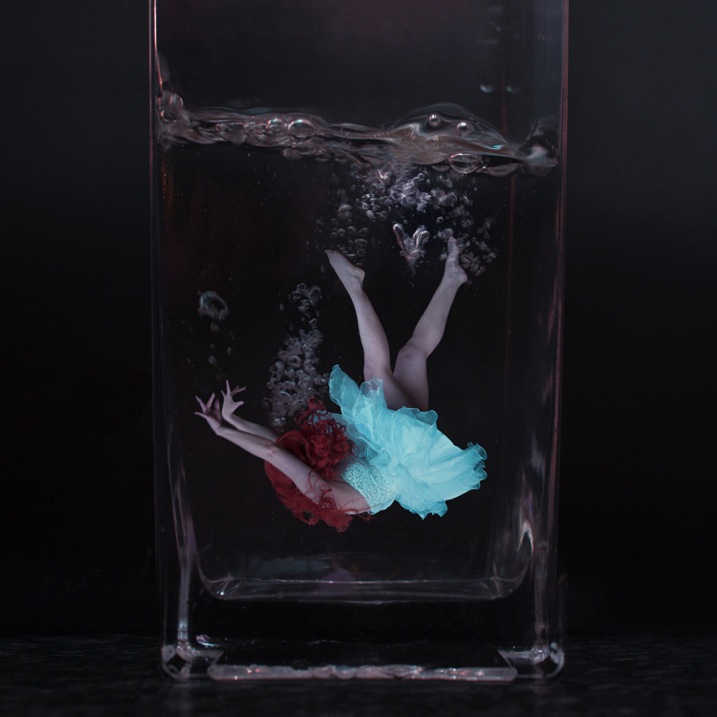
I Tried to Drown My Sorrows

#7 – Lighting

Lighting can be tricky, and expensive, so it’s always best to start out with natural light, positioning your subject so the light sculpts their features. Shoot early, or late in the day, and aim for overcast or cloudy days to avoid harsh shadows (unless that’s what you want). You can start experimenting cheaply with lamps and candles.

I usually like to work with natural, overcast lighting, because it makes compositing easier. But, in “Self-Destruct” I wanted the character to look as if she were burning the world down, so I shot as the sun was rising which would make the landscape a warm orange.
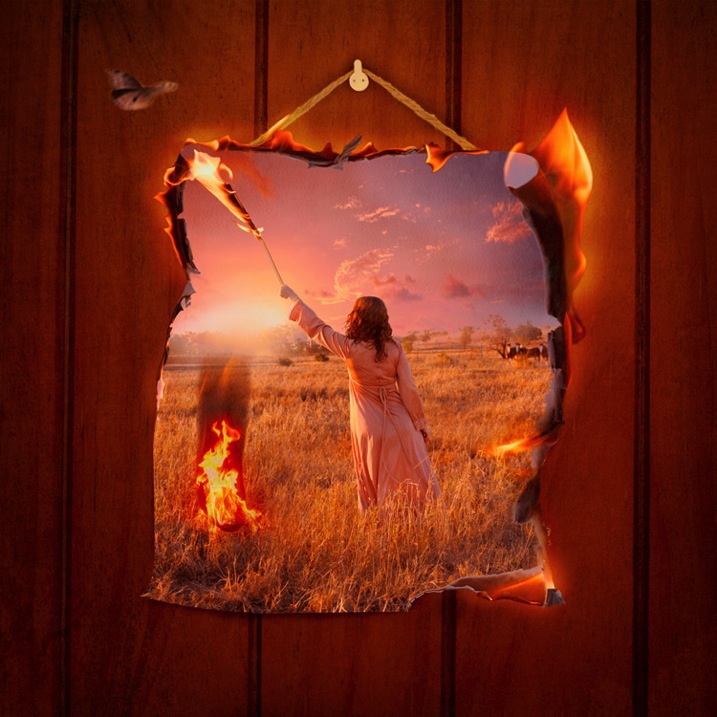
Self Destruct

#8 – Framing

Do you want a wide shot to see the location, or a tight shot to really focus on your subject? Do you want to shoot from low down to make them look powerful, high up to make them look submissive, or straight on to let the image alone tell the story? Do you want the whole scene in sharp focus, or do you want the background to be blurry?

I shot the three elements (sky, character, flowers) of “Time Flies” straight on, so they were easy to composite together. I cropped the image so the girl filled the frame, but removed her face to add mystery to the image. The loosely pointed hand directs the eye around the scene.
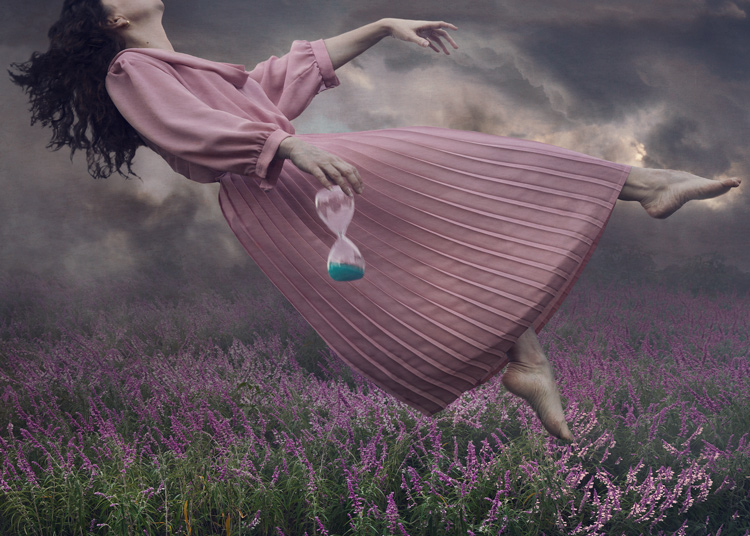
Time Flies

Summary

When planning your image, try sketching out your idea beforehand, as this helps you visualize what it will look like, and if any extra elements are needed to strengthen your story. My images often take on a life of their own, different from my original concept, so don’t get too disheartened if your shoot doesn’t work out. You’ll still have learned a ton of things from the experience that you can use next time.

Naturally your concepts don’t need to be as involved, or as heavily Photoshopped as mine, but I’m certain you’ll find the process of creating something from your imagination incredibly fun and rewarding. I’d love to see the results of your own staged shoots, please share in the comments below.
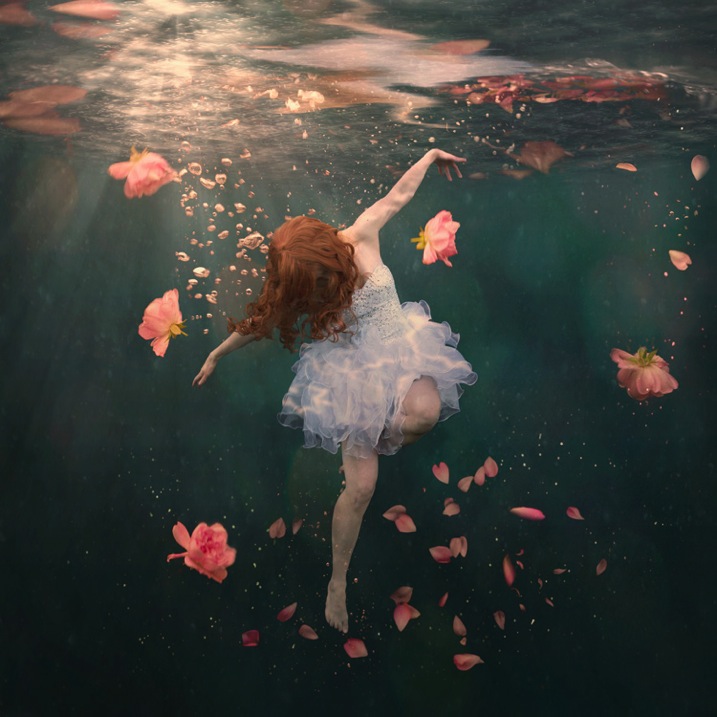
Rosewater

googletag.cmd.push(function() {
tablet_slots.push( googletag.defineSlot( “/1005424/_dPSv4_tab-all-article-bottom_(300×250)”, [300, 250], “pb-ad-78623” ).addService( googletag.pubads() ) ); } );

googletag.cmd.push(function() {
mobile_slots.push( googletag.defineSlot( “/1005424/_dPSv4_mob-all-article-bottom_(300×250)”, [300, 250], “pb-ad-78158” ).addService( googletag.pubads() ) ); } );

The post 8 Tips to Improve Your Photography by Creating Instead of Taking Photos by Hayley Roberts appeared first on Digital Photography School.
Digital Photography School

 
Comments Off on 8 Tips to Improve Your Photography by Creating Instead of Taking Photos

Posted in Photography


4 Steps to Creating Images With More Meaningful Composition

06 Feb

If you wonder what composition really means, it is basically what elements you choose to put in a photograph, and where you decide to place them in the frame.

Vickie-Lewis-MtHood

When composing a photograph you need to consider several things:

  1. What is the story you are trying to tell? In other words, what do you want the viewer to see or feel when they look at your photograph?
  2. What’s your center of interest or focal point?
  3. What elements will most support that story?
  4. How can you maximize those elements?

Let’s consider each of those points individually.

1- What is the story you are trying to tell?

In other words, what do you want your viewer to know or experience when they see the photograph?

Some ideas if you are photographing your children:

  • You might want the viewers to see how cute they are.
  • You might want the viewers to see how smart they are.
  • You might want the viewers to see how much they love their sibling or new puppy.

Each of those ideas will impact how you choose to compose the picture. In the first example, you might choose to dress your daughter with a pink bow and sit her on her princess bed. If you want to show how smart your child is, you may decide to photograph them winning a spelling bee, or playing with test tubes. Of course, if the story is the new relationship with their puppy, you want to capture that moment of them hugging the puppy, or the puppy licking their face.

Lake-Vickie-Lewis-Photography-for-dps

Here’s another example shooting landscapes. Let’s say you want to take a photograph of a beautiful lake in a park, in the middle of a city. What’s the story you want to tell? What’s the experience you want your reader to have when they see your photo?

Here are some ideas:

  • You can isolate the lake and shoot it in such a way that it looks as though it is in the middle of nowhere.
  • You could shoot the lake with the cityscape in the background to show it as a haven in the middle of a grimy city.
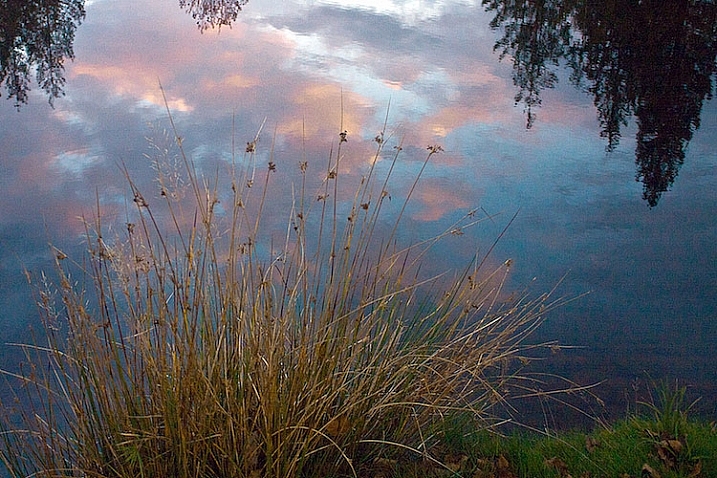
  • You could show the restful, or quiet feeling, of the lake by just focusing on an empty park bench, or the reflection of a tree in the water.

grass by edge of lake Vickie Lewis Photography for dps

In every situation, there are many different stories and compositions. Knowing what the story is, and what you want to say, is the first step in composing a photograph. You can start to see how your intention with the photograph becomes important in composing a photograph.

2 – Choosing a focal point

With that in mind, the next step you want to think about is what is your center of interest or focal point? In other words, what is the one element you want your viewer to see first? What ONE element do you want to stand out?

If you are photographing your children, that’s pretty simple, you want your child to stand out. We’ll talk about some strategies to do that in a minute, but first let’s look at our other examples.

If you see a lake that you are drawn to, first ask yourself the story, then ask yourself what one element can be the subject? Is it a tree or rock in the lake? Is it a house on the lake? Is it the moon rising above the lake? Is it the grass growing on the edge of the lake?

Drop-by-Vickie-Lewis

3 – What elements support the story?

As you view the scene, ask yourself, “What elements support the story I’m telling?” As you look through the viewfinder, move your eye around the outside frame of the photo, then look inside that frame and ask yourself if there is anything in the photo that doesn’t belong there.

For example when you are taking a photograph of your child, you ask yourself if you need the dining room table in the background? Do you need your car in the background? What’s important? What elements add to the subject and which distract?

4 – How can you maximize those elements?

In the next section, we’ll look at examples and talk about ways you can clean up your photographs in two simple ways.

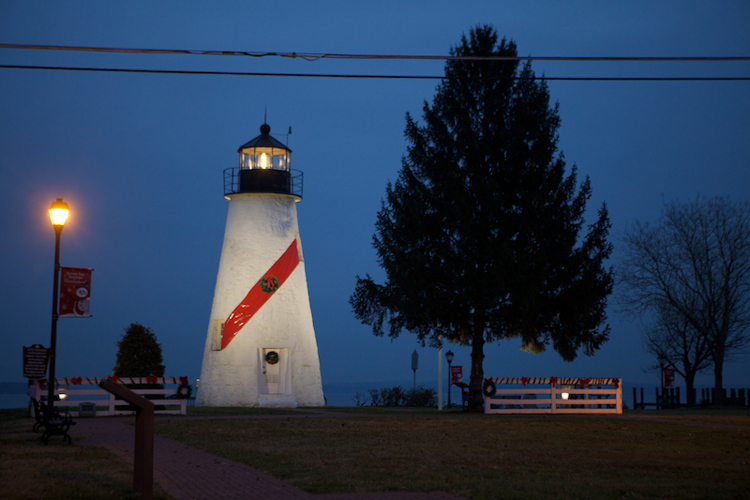
1 Lighthouse snapshopt Vickie Lewis Photography for dps

Above is a photo of a lighthouse. It’s a very pretty scene, but it’s filled with elements that don’t really help the composition. There are elements, including a wire overhead and an information stand in the front, that don’t add anything to the feel of the place.

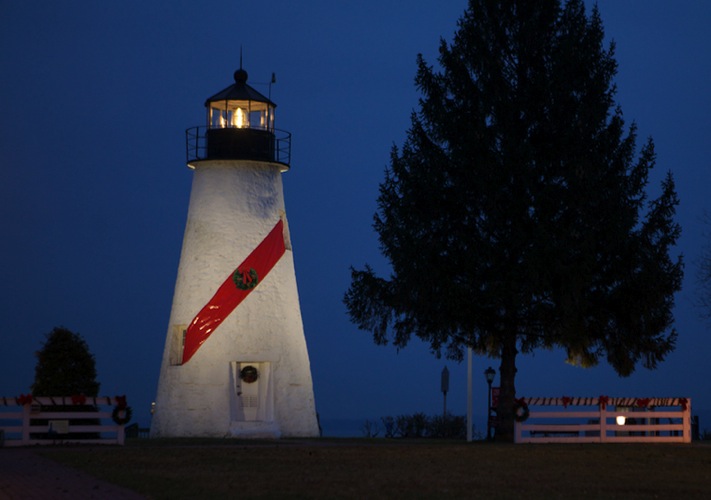
2 Lighthouse Vickie Lewis Photography for dps

This is better. The first shot was taken with a wider angle lens. In this shot, I took a few steps to the right, and zoomed in a little bit. Zooming in not only eliminates some of the foreground, it changes the perspective. Can you see how the image feels more compressed? Also, the wires were not magically Photoshopped out of the picture, I chose to eliminate the top of the tree from the frame.

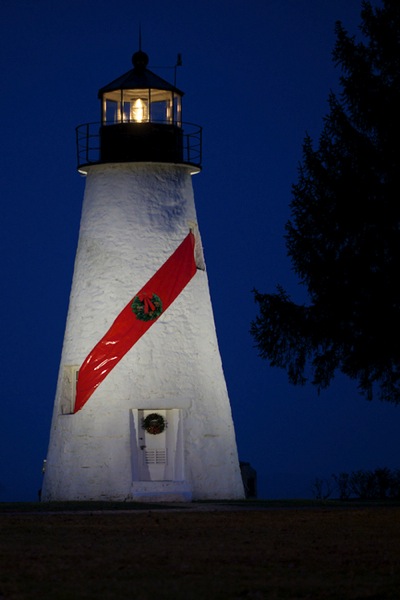
3 Lighthouse Vickie Lewis Photography for dps

Here’s yet another different perspective. For the shot above, I used an even longer lens, and moved more to the right. The most important element to me, the story, is the lighthouse. The dark tree nicely frames it, and adds perspective. This photo, compared to the first, is much cleaner.

Now, I could have chosen to get closer with the wide angle lens, but the light house would start to lean, and it would have emphasized the power lines.

Different angles can also help clean up backgrounds, so you ask yourself:

  • Would taking a step or two in a different direction get rid of some distractions?
  • Would getting a little bit higher or lower help the composition?
  • Would changing the focal length help with the composition?

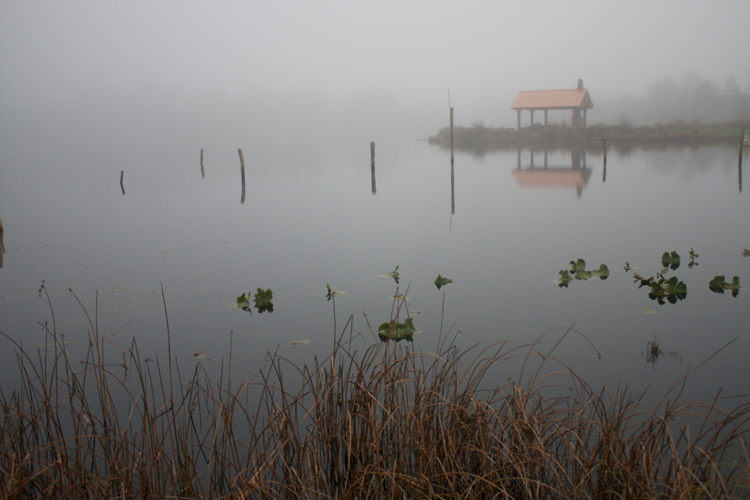
1 Foggy Shack vickie lewis for dps

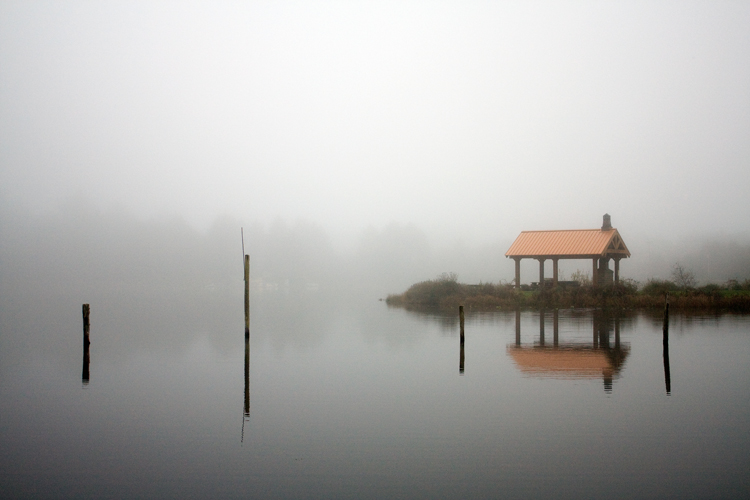
2 Foggy Shack Vickie Lewis for dps

Here’s a great scene of a foggy shack on a lake. It’s next to a very busy highway, so I chose an angle from which you can’t see any cars. In the first example, the emphasis is on the grass. I used a wider lens and looked for a patch of grass for the foreground that made a nice pattern. The grass leads the viewer into the photograph. The shack seems further away.

In the second image, I chose to focus just on the reflection and the quietness of the scene. I found an angle from which I could shoot with no grass. My focus changed, the feeling also changed. Which one do you like better?

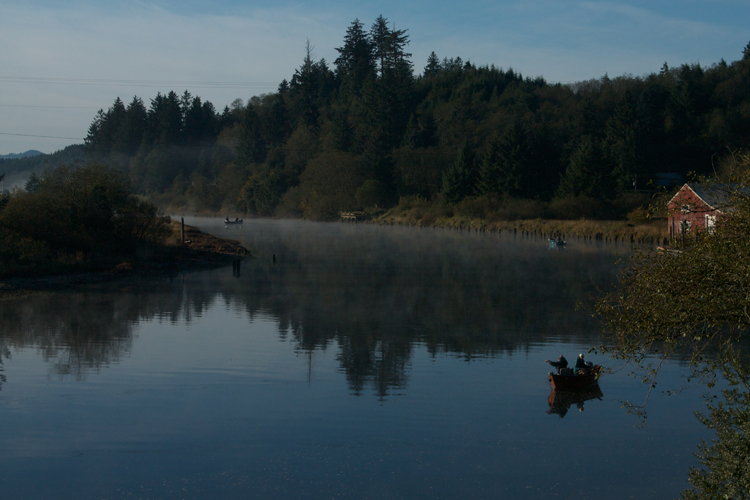
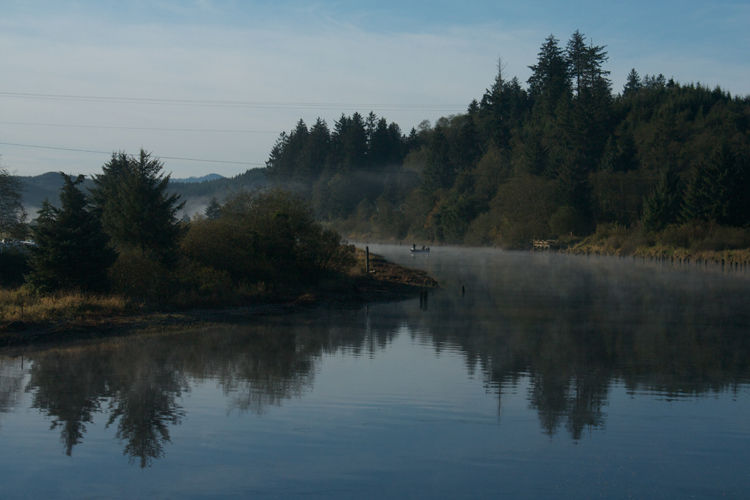
1 Nehalem River Vickie Lewis for dps

Here’s a beautiful scene with lots of potential. But your eye really has no place to go. There isn’t a strong sense of interest. The story is one of serenity and a great place to go fishing.

2 Nehalem River Vickie Lewis for dps

To improve the composition, I waited until some fishermen popped into the right place. In the second photo, can you see how your eye has a place to go? It’s immediately drawn to the fishermen in the red boat.

You can greatly dramatically improve the composition in your photographs by framing a photo and waiting for the right elements to come together.

So now, moving forward with your photography, you have some great ideas to work with:

  • Consider what story you are telling with your photographs.
  • Make sure you have a center of interest.
  • Decide what elements support the story.
  • Maximize the elements by changing position and focal length.

googletag.cmd.push(function() {
tablet_slots.push( googletag.defineSlot( “/1005424/_dPSv4_tab-all-article-bottom_(300×250)”, [300, 250], “pb-ad-78623” ).addService( googletag.pubads() ) ); } );

googletag.cmd.push(function() {
mobile_slots.push( googletag.defineSlot( “/1005424/_dPSv4_mob-all-article-bottom_(300×250)”, [300, 250], “pb-ad-78158” ).addService( googletag.pubads() ) ); } );

The post 4 Steps to Creating Images With More Meaningful Composition by Vickie Lewis appeared first on Digital Photography School.


Digital Photography School

 
Comments Off on 4 Steps to Creating Images With More Meaningful Composition

Posted in Photography


The Long Night: Tim Matsui on creating social change through stories

26 Jan

Award-winning and Emmy-nominated visual journalist and filmmaker Tim Matsui used to view stories as a means of having experiences. Now, he sees them as a means of creating change, engaging audiences and helping them see that they can make a difference. In this PIX 2015 video, Matsui speaks on The Long Night, his documentary on human trafficking, and how he leveraged grassroots distribution to effect social change.

Matsui’s insistence on grassroots distribution stems from the difficulty he found in getting sponsorships to fund creation of the project and get the final film in front of audiences. ‘This is a difficult subject,’ Matsui says. ‘Brands don’t want to touch it. It’s a little too dark. This pisses me off.’

After exhausting his grant money, leveraging his own savings and going into debt just to get the filming done, Matsui explored every avenue he could find to take his film to his audience. He explored social media, Kickstarter, mainstream media like TIME Lightbox and the Huffington Post, and GATHR, a crowdsourcing platform for bringing small productions into mainstream movie theaters.

To be successful in creating change, ‘don’t make them come to you,’ he says about his audiences. ‘Go to them.’

Articles: Digital Photography Review (dpreview.com)

 
Comments Off on The Long Night: Tim Matsui on creating social change through stories

Posted in Uncategorized


Your Guide to Creating Unique Conceptual Photography

06 Dec

What is conceptual photography? Have you heard about it, but not been able to work out what it is? Who are the artists doing it? How can you do it? If you have asked yourself any of these questions, then read on and see if they can be answered for you.

Conceptual photography is a type of fine art photography. Like the latter, everyone you ask will give you a different definition. It is an art form that has been around for as long as people have been making art. It seems to be something that people have only started talking about in the last 10 years or so.

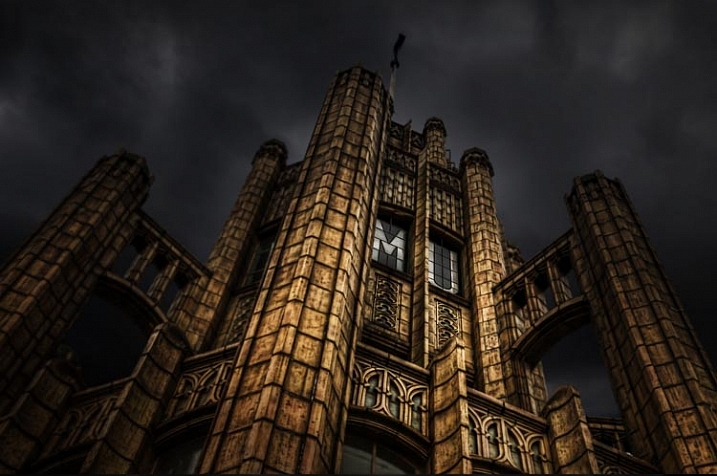
leanne-cole-conceptual-photography-046

The Tower of the Manchester Unity Building where the brief was to make it look like Batman lived there. So the sky was replaced and a lot of processing was done.

What is Conceptual Photography?

When I tell people about work that is conceptual the first thing many ask is, “What is it?”

Conceptual photography is often very imaginative. It seems unreal. Often reality in the photos is distorted, and what you know as normal, is completely changed. Then there are also some people who are doing things that aren’t as imaginative. They are changing some things, or exaggerating reality to a lesser degree.

Conceptual photography is about work that starts with a concept or an idea. In many instances, photography normally starts with an image or a place. You go out somewhere that you think will be interesting and take photos. Once you get home you put the photos on your computer, and for a lot of people, that is all besides some basic post-processing. There is nothing wrong with working that way, but conceptual photography starts out differently.

In conceptual photography you start with an idea, or the concept, of what you want to do. At this stage you start working out what you want your final image to be about. You are working in the dark so to speak, as you won’t know the final result until you have processed it.

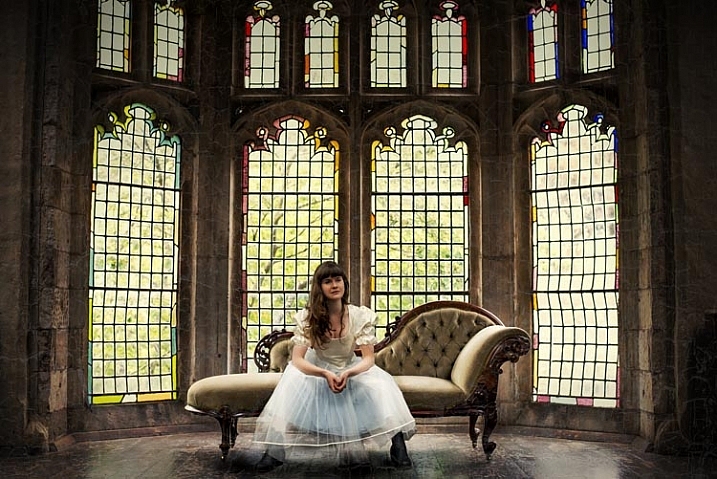
leanne-cole-conceptual-photography-045

A popular place in an artist retreat, but you can’t take photos with models. So this image was composited from the original, and one of the girl taken at a different time and place.

Artists working conceptually

Other artists (who aren’t photographers) often work this way. Sculptors have an idea of what they want to sculpt, but it isn’t until it is completed that they know if it will be any good. Many painters work the same way, especially abstract artists. The way they work can be fluid, but they have an idea of what they are trying to achieve. Again, it isn’t until the painting is finished, that the artist can judge whether it was successful.

There is no reason why photographers cannot work the same way. Many photographers do, and if you like that kind of work, you can as well.

It is about using your imagination, and seeing what you can envision. If you search Conceptual Photography in Google Images you will find many examples. There are some inspirational photos there as well. They are often clever, and usually highly processed. That does not mean you have to be really good at photo processing, but you do need to have a good imagination.

Adobe Photoshop used to say, “If you can dream it you can create it with the software”. I don’t know how true that is, but you can do a lot in Photoshop, and if you can imagine it, then you should try to create it.

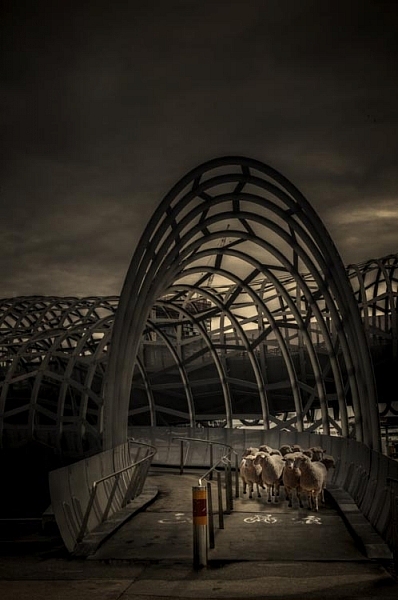
leanne-cole-conceptual-photography-043

Another composite of a popular walking bridge in the city and some sheep. The sheep were placed on the bridge in Photoshop.

It’s all about imagination

That is a big part of this type of photography. It is about imagination and ideas, planning and getting what you need to create the image, and finally the creation of the image.

Most conceptual work you see is created around portraits. There are many photographers in the world who specialize in fine art portraiture. They would also be considered conceptual artists. You can’t take a person out and simply take their portrait, you need to plan the whole session. Long before you have your model, you need to have an idea of what you want to do; what costumes you may need, and where you want to take the photos. That is how it starts.

leanne-cole-conceptual-photography-044

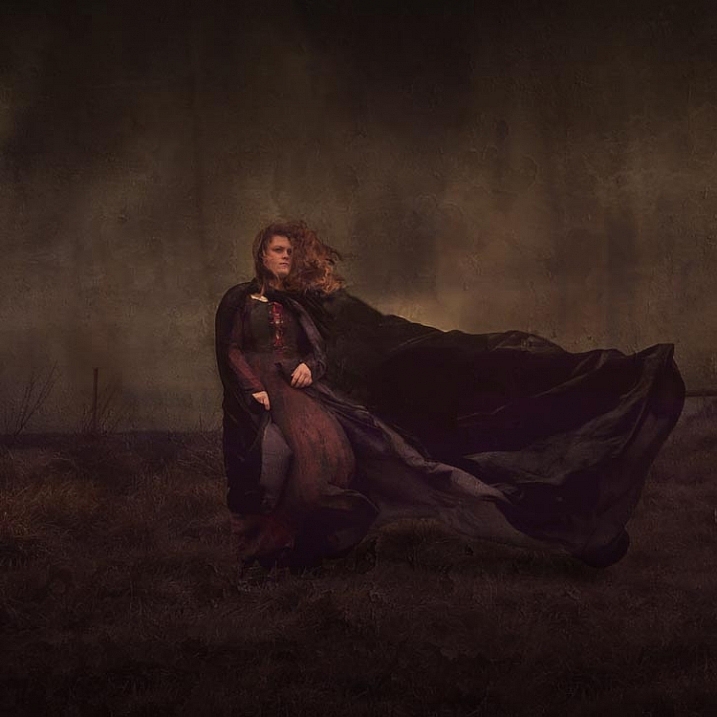
Trying for a Wuthering Heights look. A hill was found on a windy day and the model put into a costume. The cloak was made to look larger as it blew in the wind.

Not all conceptual work is portraiture though. There are many photographers working in landscape or architecture who are creating their own realities.

You might want to put your cat on top of a large building, so it looks like King Kong. You may have seen images where there is a house floating in the air, or someone is put inside a glass jar. These all started with the artist thinking about “what if”.

Some specific conceptual photographic artists

There are some incredible conceptual photographers and artists who are working now.

Rick Amor is an Australian painter. He often paints his environment around him, but not as we see it. He visits places and takes lots of photos. When he gets back to his studio, he goes through those photos to work out which ones he can paint. He will take a little from one image, and something from another, to create a new scene or a new reality. They aren’t straight copies, and he often distorts the sizes and views as well. A statue that is normally six feet tall might appear to be 30 feet tall in one his paintings.

Brooke Shaden is a fine art photographer whose work also fits into the category of conceptual art. She does portrait style images, but they are all more than a portrait of a person sitting in front of the camera. Before she starts, she plans what she wants first. She works out: what the colour scheme will be, what props she will need, if any, and then the location. The model is also important, and has to be someone that will fit the mood of the image she wants to create. Finally, she finishes the image by using Photoshop to give it her unique look.

Canadian Photographer Renee Robyn is also a conceptual artist. She does a lot of fantasy or ethereal images. Again, they would be images that start with an idea or concept. If you look at her website, you can see the before and after photos which makes it is clear that she works with a plan in mind. The models are photographed in a way so that they can then be put into other scenes on the computer.

leanne-cole-conceptual-photography-048

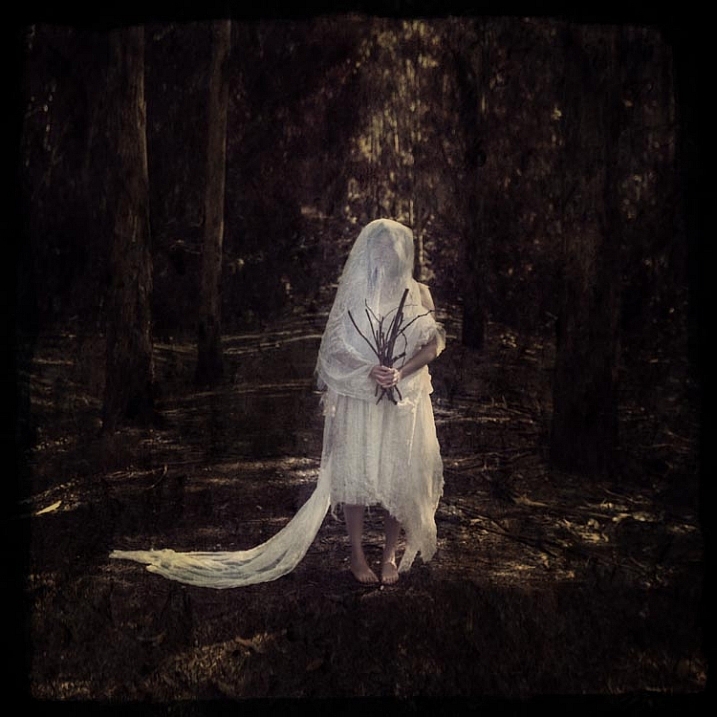
The Woodland Bride – Started with the idea of a bride dressed in rags in the forest. The bouquet of sticks came later.

Another artist that is gaining popularity for his incredible conceptual images, is Erik Johansson. He has an amazing ability to turn the world around him upside down. He manages to turn the ordinary into something extraordinary, to make you see the world in a new way. His imagination is amazing. The ideas he comes up really show how talented he is.

All these artists work differently. You may identify with one of them. You may want to find your own conceptual artists that work in a way that you admire, who you can gain inspiration from. It is important to find other photographers that give you motivation, to work and try new things. You shouldn’t copy them, except to learn, but look at the work and see if you can find your own style.

How can you do conceptual photography?

You need to start thinking conceptually. If you want to create images like the ones mentioned and shown here, then you need to start using your imagination. Think about how you can twist the world around you, or finding some interesting things you can do with it.

Think about how you are going to achieve the final result that you are after. Do you have to take specific photos for it? You need to make sure when you are taking the photos that everything will work together. It should look like it really is possible.

For most images you have to know how to composite. How to take something from one scene, then place it into another. As you put everything together, you start to see whether or not it has worked.

leanne-cole-conceptual-photography-047

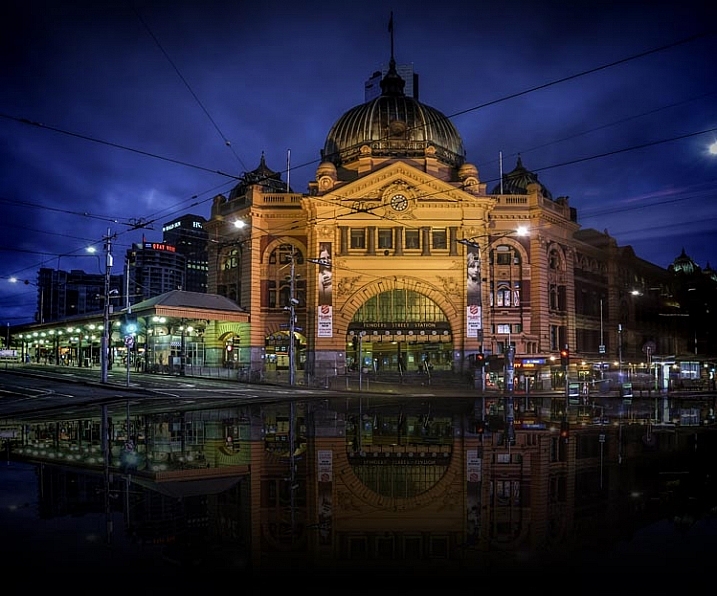
Flinders Street in Melbourne Flooded. A process done on the computer to make a place look like water is everywhere.

Working conceptually

Making conceptual images can be a rewarding way of working. It can help you stand out from many other photographers. It is not easy to do, and patience and time are often needed to learn it. However, if you have the drive, then a whole new world could be there for you.

Are you interested in learning more about how to do conceptual photography? What would you like to learn? Have you done any or have any favorite conceptual photographers you’d like to share? Please do so in the comments below.

googletag.cmd.push(function() {
tablet_slots.push( googletag.defineSlot( “/1005424/_dPSv4_tab-all-article-bottom_(300×250)”, [300, 250], “pb-ad-78623” ).addService( googletag.pubads() ) ); } );

googletag.cmd.push(function() {
mobile_slots.push( googletag.defineSlot( “/1005424/_dPSv4_mob-all-article-bottom_(300×250)”, [300, 250], “pb-ad-78158” ).addService( googletag.pubads() ) ); } );

The post Your Guide to Creating Unique Conceptual Photography by Leanne Cole appeared first on Digital Photography School.

Digital Photography School

 
Comments Off on Your Guide to Creating Unique Conceptual Photography

Posted in Photography


Tips for Creating Outdoor Portraits

27 Nov

On now at Snapsdeals is Wayne’s ebook: Portrait Tips and Techniques: Timeless Portraits. Sale ends December 8th (2015) get it now and save 20%.

These tips are a follow-up to my previous article about 6 Tips for Taking Better Natural Light Classic Portraits, and the process of creating simple posing and composition for outdoor portraits. To me, these things are what refines a portrait. You can have the perfect lighting conditions and location, but if the subject looks awkward or the composition is unbalanced, the image will fail aesthetically.

Each of these images will give you some tips and understanding of the creative process for creating outdoor portraits:

#1 – Creating back-view portraits

DPS 1

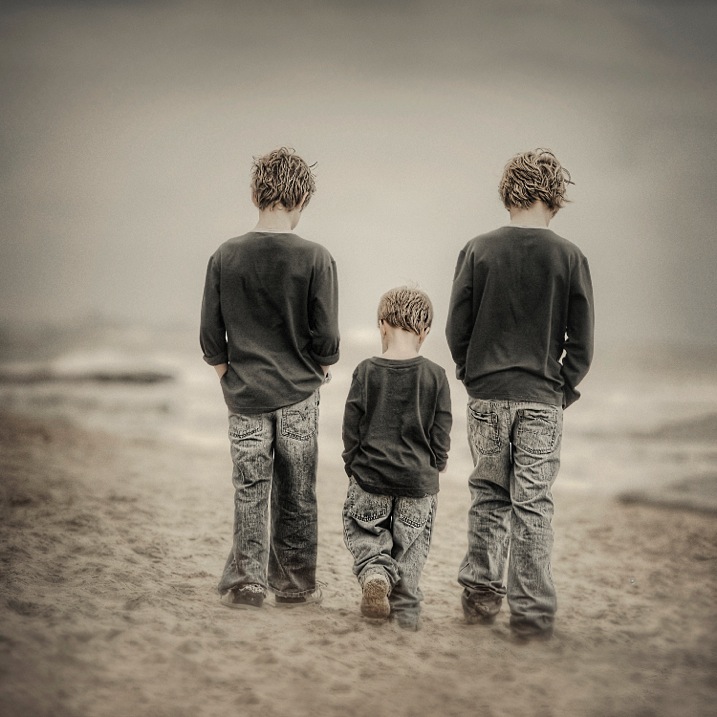
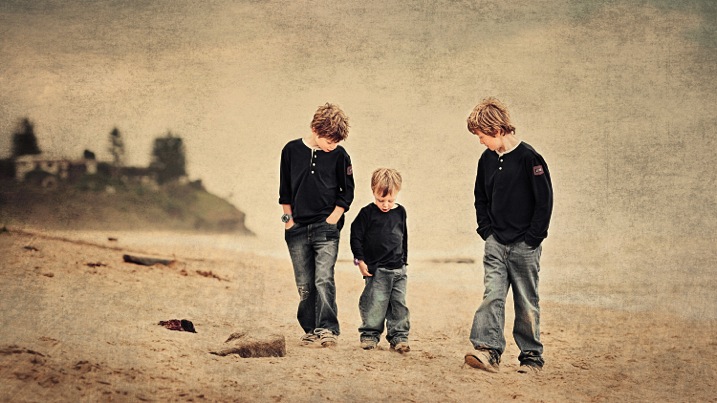
Creating interactive back-view portraits is fairly easy. In the portrait above I asked the two older boys to put their hands in their pockets, and start walking slowly in a specific direction. Of course the youngest one followed and mimicked his big brothers.

Ideally you want to get your subjects to talk to each other while walking and watch for the unexpected reactions. Getting them to talk about sports, school holidays or any interests they have, will make them more cooperative and loosen them up, making the portrait more natural looking.

I suggest you use continuous autofocus and a zoom lens for these types of portraits. This was taken with a 70-200mm lens at f/4. The original image of the three boys was the normal 3:2 rectangle, but in post production I decided on a square.

#2 – Interactive poses

DPS 2

Same three boys in an interactive pose. I set this shot up like a movie director, by simply giving them some direction of what to do, then let them go, and recorded their reactions. Just letting them walk around and happy snapping doesn’t work for me. I prefer to place them in the scene I want, based on background and lighting, tell them what to do and then record their natural reactions.

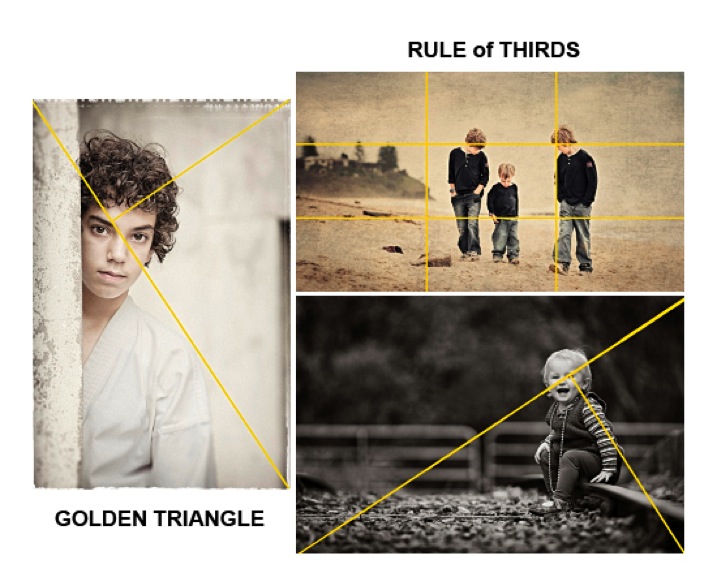
In this study I placed the boys away from the headland, so they were against the sky, and let them kick a piece of driftwood around. A ball would have been another option. The composition I used is the Rule of Thirds which can be seen at the bottom of this article.

When doing these types of environmental portraits, I suggest you create it like a landscape, then place the subjects into it.

#3 – Find the light and pose for the subject

DPS 3

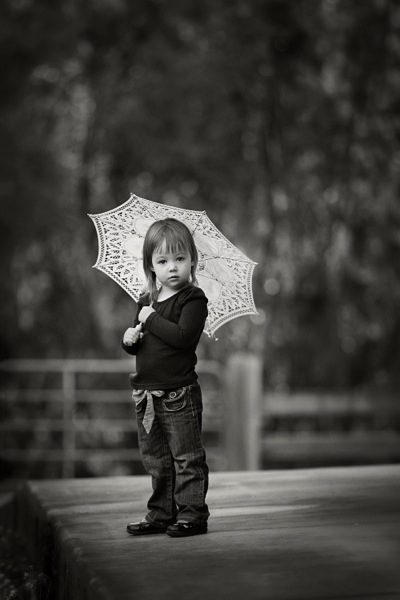
After establishing the location, background, and direction of light, I placed the the young girl near the edge of the path, her body turned away from the camera at approximately 45 degrees to the camera, her head turned back to camera.

There was a building to her left, which was subtracting light from the left hand side of her face. The umbrella was the client’s prop, which I decided to use. I felt that her hair would have blended into the background otherwise, but this way her head is framed by the contrast of the umbrella. I like the way she was holding on to the umbrella, it simplifies her hands from being a distraction.

If she had been older, I would have asked her to bend her front knee, therefore placing her weight on the back foot, creating an s-curve through her body. There was a temptation to place her to camera right, thereby in the RH third, but I chose the opposite side for a different look. No right or wrong reason, just my preference.

#4 – Connect people to each other and the background with posing

DPS 4

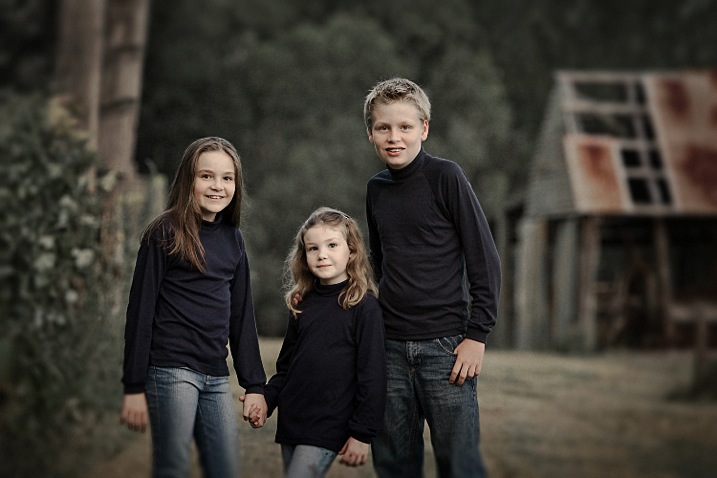
In the portrait of the children above, I wanted to place them between the old shed and the fence line, allowing their heads to appear against the soft muted tones of the out of focus trees. Having secondary backgrounds like the shed and fence against the distant background of trees can add extra depth, giving a more three dimensional look.

The pose is natural, with a small amount of refinement. I like the subjects to turn away from the camera, then look back, rather than shoulders square on to camera. Also by leaning the outside subjects to the centre, it creates more emotion through body language, which also creates a slightly more triangular composition (by luck matching the shed roofline).

The varying heights of the children allows each of them to have their own space. Often you will see heads in a row on the same plane. Note the simplicity of the hands, curled away from camera or in their pockets, not draped over the shoulders. Also with the two girls holding hands, and the youngest one leaning across towards her brother, it creates a connection within the group.

#5 – Match tones for high or low key portraits

DPS 5

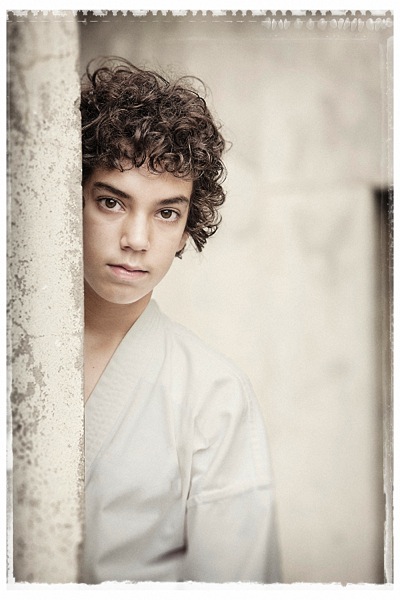
When creating high key or pastel portraits, it’s important to “key-in” the clothing colours to the background. For example: white against white, or cream against cream, or soft muted tones against other muted tones, NOT light on dark. The idea is to be drawn to the face, not the contrast between backgrounds.

This young boy (above) has great eyes, so we don’t want to be looking anywhere else but his face. His karate outfit is white, but for my artistic license, I changed it slightly to harmonize more with the background. In the black and white version for the client, I left it white.

The pose is simple, and he is square to camera, with his body and head leaning more to his left. His head is also tilted slightly down, which allows us to see the full roundness under his eyes. I find this pose more engaging for him. Composition is close to the Rule of Thirds but I do prefer the Golden Triangle. (See below)

#6 – Camera angle is important

DPS 6

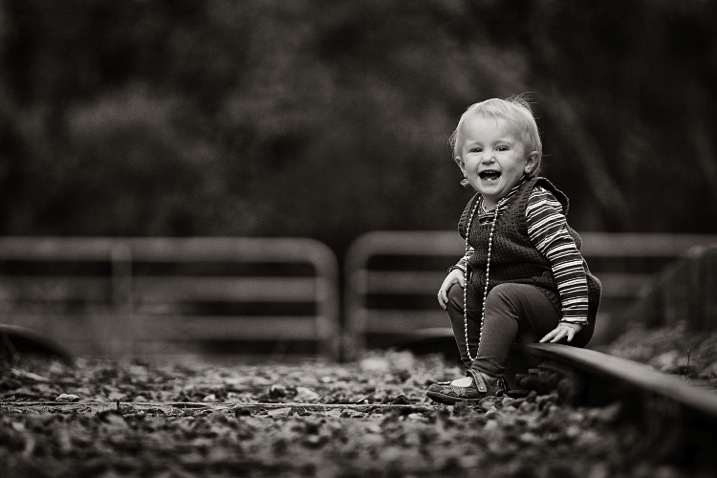
A low camera angle was selected for this portrait to bring the viewer down to the child’s level. Also by lowering the camera, this places her head above the gates in a neutral uncluttered area, allowing her face to stand out from the background. Another advantage is that the low angle causes the lens to blur the foreground so much, that it leads you directly to the sharp subject.

Again the subject is angled away from the camera and her head is turned back to camera. Her hands are naturally placed.

It’s very important to remember when posing children or adults, to turn the body and legs away from the camera to avoid unflattering crotch shots of all ages. If you don’t know how to pose hands, give a child something to hold, failing that, hide them as much as possible. Personally I recommend learning how to pose them to look natural, and then you will recognize when they’re not correct, and be able refine the pose.

Summary

DPS 7

  • Avoid the body and face being posed in the same direction.
  • Try keeping the face at about 45 degrees to the body as a starting point.
  • When seated, avoid knees and feet/shoes pointing directly at the camera. Turn them away.
  • Direct children to do natural things when creating interactive portraits such as talking to each other, kicking a ball, reading, etc. This will create realism.
  • Always watch your background, and give your subjects their own space to avoid a busy image.
  • Use hands to touch, and overlap bodies to create poses that have a connection between people. (E.g. the three kids above)
  • Try to shape poses to replicate objects that may be in the composition.
  • When possible, key-in clothing colours to harmonize or compliment background tones. (E.g. photo # 5)
  • Select a low camera angle when photographing kids. Get down to their level or below.
  • Use foreground blurring to make your subject pop. (E.g. photo #6)
  • Use the Rule of Thirds or the Golden Mean as a starting point for improving your composition.

On now at Snapsdeals is Wayne’s ebook: Portrait Tips and Techniques: Timeless Portraits. Sale ends December 8th (2015) get it now and save 20%.

googletag.cmd.push(function() {
tablet_slots.push( googletag.defineSlot( “/1005424/_dPSv4_tab-all-article-bottom_(300×250)”, [300, 250], “pb-ad-78623” ).addService( googletag.pubads() ) ); } );

googletag.cmd.push(function() {
mobile_slots.push( googletag.defineSlot( “/1005424/_dPSv4_mob-all-article-bottom_(300×250)”, [300, 250], “pb-ad-78158” ).addService( googletag.pubads() ) ); } );

The post Tips for Creating Outdoor Portraits by Wayne Radford appeared first on Digital Photography School.

Digital Photography School

 
Comments Off on Tips for Creating Outdoor Portraits

Posted in Photography


Creating Ghostly Images for Halloween

29 Oct

While we may never actually see, let alone photograph a real ghost, we can create the illusion of a ghost image with our cameras. There is no exact science to capturing these images, and it sometimes takes some trial and error to create the effect you are looking to achieve. Still, there are several ways this can be accomplished, so let’s take a look at three of them:

  1. Multiple exposures in-camera
  2. Long exposures
  3. Combining images in Photoshop
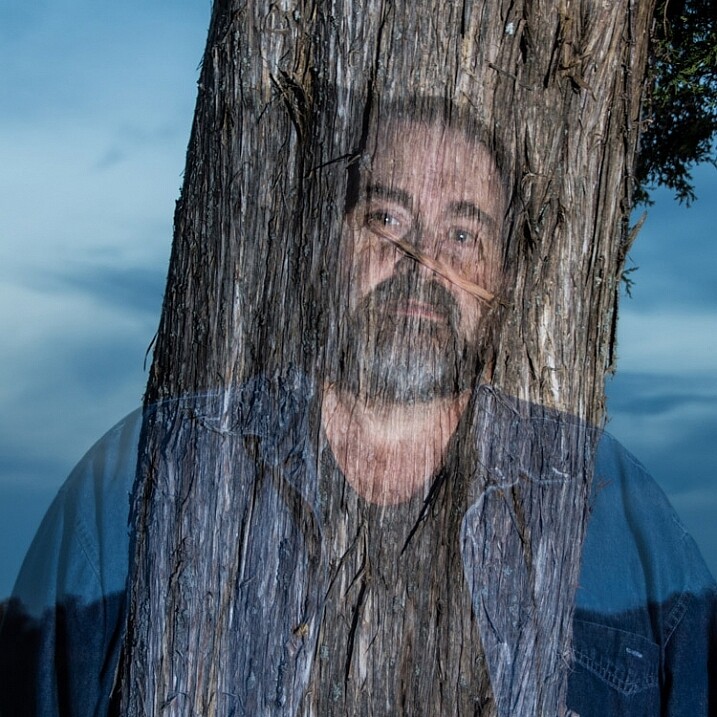
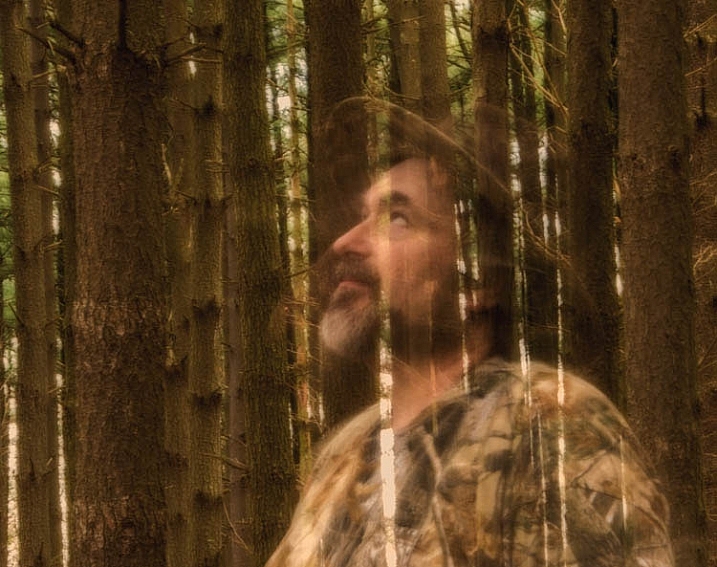
To create this multiple exposure image, two exposures were captured on one frame. The first exposure captured the ghost and the tree and the second exposure was of the tree only. Notice the dark areas do not reflect light, allowing the tree to show through the ghost.

To create this multiple exposure image, two exposures were captured on one frame. The first exposure captured the ghost and the tree and the second exposure was just of the tree. Notice the dark areas do not reflect light, allowing the tree to show through the ghost.

Equipment

  • DSLR Camera: or at least a camera that will capture multiple exposures, and allow you to set your shutter speed.
  • Tripod: In most cases this is a must to keep your images aligned and sharp.
  • Remote Shutter Release: Any touch of your camera can cause enough shake to create a blurry image.
  • Neutral Density Filters: If you are trying to create ghost images in the daytime you may need to limit the light entering your camera to get a longer exposure.
  • Flash/Speedlight: While not a necessity for capturing ghost images, one or more flash can be added to light your subject and also will freeze the movement. Which is especially helpful in ghost images done in low light.

creating-ghost--images-3

Different types of ghost images

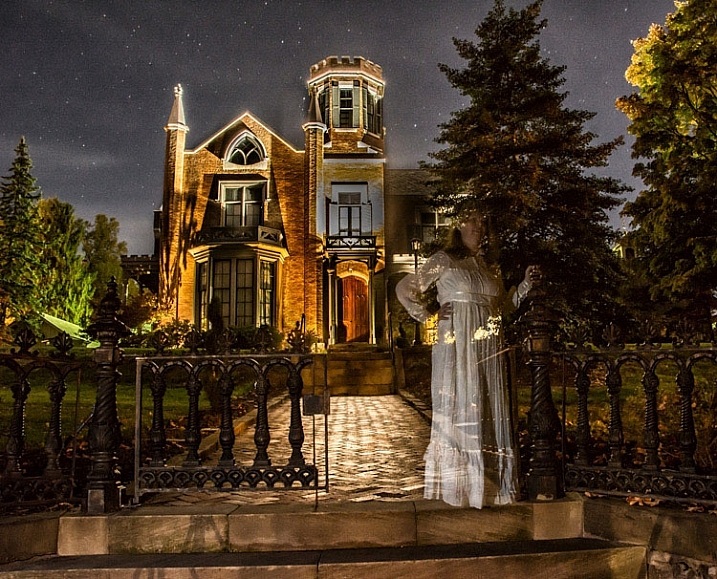
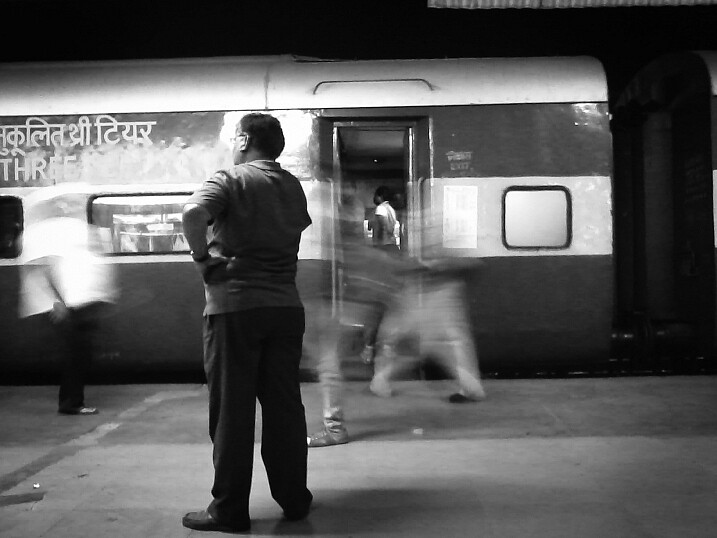
  • Sharp transparent figure: These ghosts will be sharply focused, which means a faster shutter speed should be used, or your subject must remain motionless during the exposure. Using a short burst of flash (freezes them) on the exposure that includes your ghost will also help to accomplish this.
  • Blurred motion figured: A blurred ghost is accomplished by allowing your ghost subject to move during a longer exposure. The trick here is not to have too long of an exposure or too much movement by your subject, because this may cause your ghost to completely disappear, or become so faint it is not noticeable.
creating-ghost-images2

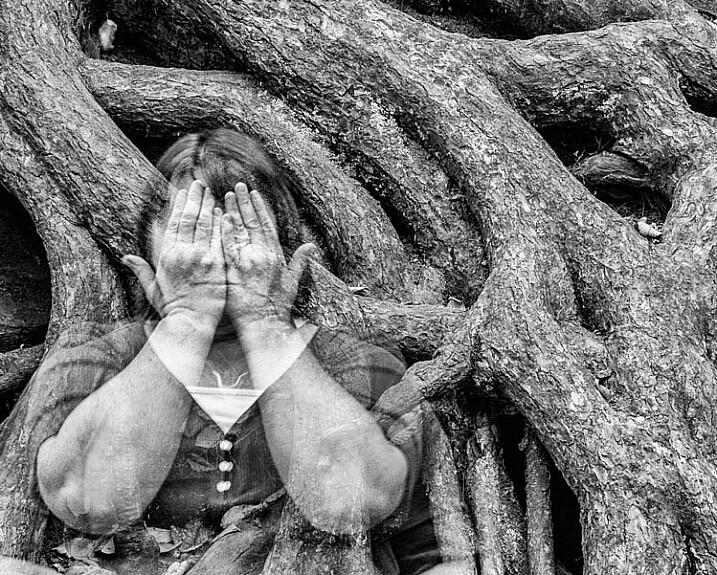
This multiple exposure ghost had three shots combined. In the first exposure, the ghost had her hands over her face, then for the second exposure, the ghost removed her hands. Finally, in the third exposure the ghost was removed from the scene to allow the tree roots to show through her.

Multiple exposures ghosts

Most DSLRs now have a multiple exposure function which will allow you to take two, or more, images on the same frame. This method of shooting ghosts can be used in any lighting, especially in a daylight scene. Here are the simple steps for this method:

  1. Choose a unique location. Though a popular location is a graveyard, be creative in choosing your spot.
  2. Set the exposures for the lighting of the scene. Depending on your camera, this means you may have to compensate your overall exposure to allow for the multiple exposures. Some cameras will have an auto gain setting that will auto correct the exposure to compensate for the multiple exposures (basically it adds them all together).
  3. Set your camera to Multiple Exposures. This function offers various amount of control, depending on the camera model. Choose the number of multiple images you want, a number that also varies among different camera models. At minimum, you will want two exposures.
  4. Placing the camera on a good sturdy tripod is a must, so that the background does not shift from exposure to exposure.
  5. Test your exposure by taking a complete set of images. At this point it is not necessary for your model (ghost) to be present.
  6. Once you have the settings correct for a desirable image, it’s time to add your ghost. Pose your ghost in the scene and take the first exposure.
  7. Remove the ghost from the scene or move the ghost to another location and take as many additional images as you choose.
  8. The final exposure should be taken without the ghost to allow the background to show through the ghost.
  9. Your camera should now display your final image.
  10. Repeat steps 3 through 8 until you get the desired results. It may take some experimentation.

creating-ghost-images7

Long exposures ghosts

Taking a long exposure shot while your ghost moves through the image will create a blurred-motion figure. This method is especially useful for ghost images in low-light situations. The best time of day to shoot this type of image outdoors is right around sunset, while there is still enough light to illuminate the background.

  1. Again, choose a unique location. Though a popular location is a graveyard, be creative in choosing your location.
  2. Set your camera to its lowest ISO and set the shutter speed to a slow speed (long exposure), typically around 10 seconds (or more, depending on the light and amount of movement your ghost makes). This means you may need to use a small aperture to achieve a correct exposure. You may even need to add an ND filter to limit the amount of light that is reflecting onto your camera’s sensor.
  3. Placing the camera on a good sturdy tripod is a must, because you don’t want your background to be blurry, only the subject.
  4. Compose your image.
  5. Test your exposure without the ghost so that you are happy with it before you add your ghost.
  6. Have your ghost rehearse the movements you are expecting. Keep in mind that the motion should be smooth and continuous. If the ghost stops moving in multiple spots during the exposure, you may end up with multiple ghosts in your image. Also, if the motion is too fast the ghost may not show up in the image at all.
  7. Begin shooting the long exposure with your ghost in motion in the scene.
  8. Check your results. Review and continue.
  9. Repeat steps 2-7 as necessary until you get the results that you want.
Naveed Dadan

By Naveed Dadan

Creating ghost images in Photoshop

If your camera doesn’t have multiple exposure capability, don’t worry! You can accomplish nearly the same effect in Photoshop. This option works best on black and white images. While it is not impossible to process a ghost image with color, sometimes it is difficult to get the color tones to look right.

  1. Open both images in Photoshop – your background image and your ghost one.
  2. Outline the ghost image.
  3. Copy and paste the ghost image onto the background image, which will place your ghost on a separate layer.
  4. Select the ghost layer.
  5. Move the ghost image into place in the image using the Move tool. You may need to enlarge or reduce the size of the ghost (use Transform) to match the proportions of your background image.
  6. In the layer palate, change the transparency of the ghost layer until you get the ghostly effect you want.
  7. You may want to add a layer mask to the ghost to hide sections of the ghost, especially if you want them to appear behind objects in your background image. You could also use some special effects such as motion blur to add mystery to the image.
  8. Save the image as a Photoshop file (.psd) so if you want to edit the image later you still have the layers to edit.
  9. Flatten layers and save the final image as JPG or Tiff, whichever is your preferred file type.
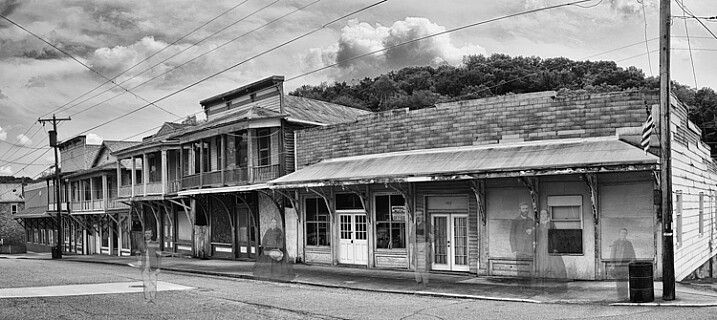
This ghost image was created in Photoshop by combining an image of an old ghost town and scanning some old family photos to use as ghost images.

This ghost image was created in Photoshop by combining a photo of an old ghost town with scans of some old family portraits to appear as ghosts.

Get out and try it

It may take a good deal of experimentation to come up with results you are looking for, but hopefully the steps above will kick-start your imagination. There are so many possibilities, so don’t be afraid to try creative methods, sometimes the best results happen when you least expect them!

Another aspect of the shot: the color of your ghost’s clothing may make a big difference in your result. Light colored clothing will reflect light, and reversely, darker clothing will not reflect much light, which will create an almost invisible effect for the ghost figure.

One reminder I’d like to pass on to you is to not trust your LED screen in low light for proper exposure. Learn to use your camera’s histogram, because in low-light an image may look really bright on the back of your camera, but still be extremely underexposed.

Now get out there and shoot, and don’t be afraid of the ghosts! (Unless, of course, you see a real one!) If you try one or more of these techniques please share your images in the comment below, I’d love to see what you come up with.

googletag.cmd.push(function() {
tablet_slots.push( googletag.defineSlot( “/1005424/_dPSv4_tab-all-article-bottom_(300×250)”, [300, 250], “pb-ad-78623” ).addService( googletag.pubads() ) ); } );

googletag.cmd.push(function() {
mobile_slots.push( googletag.defineSlot( “/1005424/_dPSv4_mob-all-article-bottom_(300×250)”, [300, 250], “pb-ad-78158” ).addService( googletag.pubads() ) ); } );

The post Creating Ghostly Images for Halloween by Bruce Wunderlich appeared first on Digital Photography School.

Digital Photography School

 
Comments Off on Creating Ghostly Images for Halloween

Posted in Photography


Five Techniques for Creating Impressionist or Abstract Photography

25 Oct

Whether you are new to photography, or have been photographing for a while, I’m sure you’ve gone through times when the ideas weren’t flowing, and inspiration was nowhere to be found. This happens to all of us. So how do you find ways to stay inspired and get the creative juices flowing again? Try abstract or impressionist photography. Finding inspiration isn’t about stepping outside of your box, it’s about stretching your limits, and abstract photography is the best way to learn to see things in a completely new and different way.

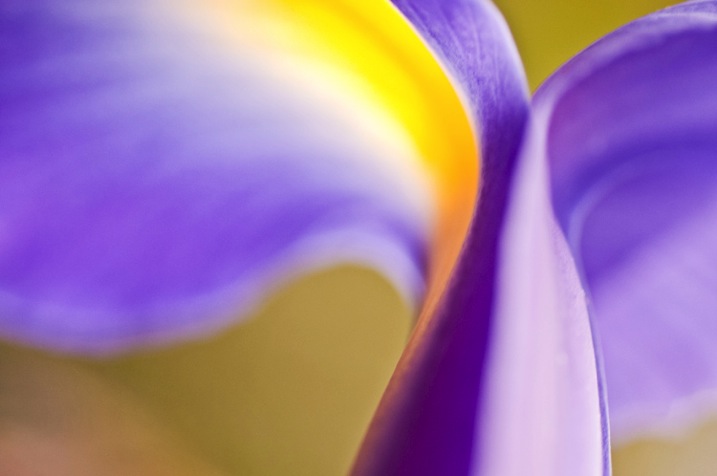
1 Look for shapes Irys by Eva Polak

Abstract and impressionist photography leave things to the imagination and help you concentrate on texture, form, and colour. Instead of making everything look real, I invite you to use bold colours, shapes, and lines to make exciting images.

So let’s start exploring the creative process of abstract photography. Here are five easy techniques that will help you to learn new skills and get your creative juices flowing.

1. Look for shapes, patterns and textures

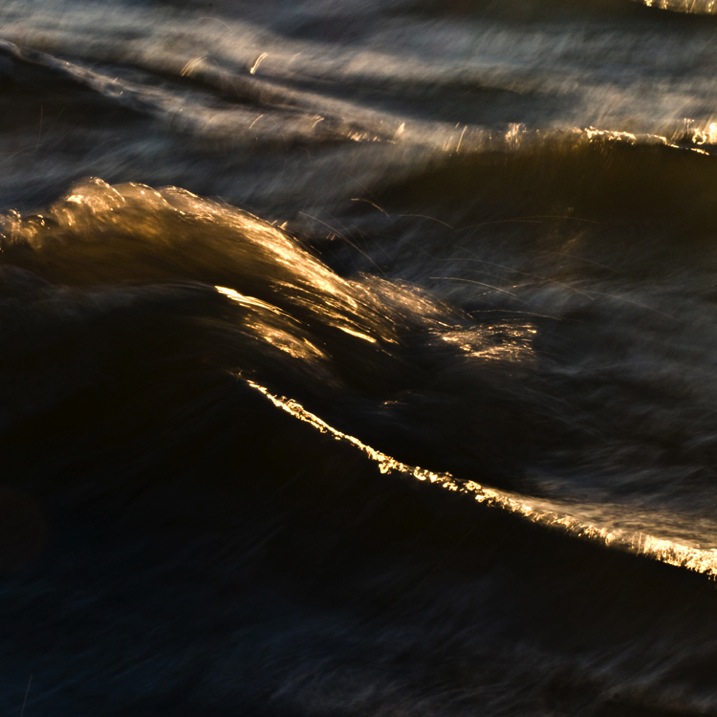
As you go about your daily activities, notice the shapes around you. Your house is full of interesting shapes, patterns and textures that can be used to make abstract photos. Look closely at different objects around you and consider whether there are any reoccurring shapes or themes within the object – then use them to your advantage. Lines can be used very effectively in a photograph, as the eye will tend to follow a line through a shot. Look at the undulating pattern the wave makes (see below), as it breaks into shore. In the city, look for patterns formed by the buildings. Discover different textures in flowers arrangements in the park (see photo above).

1 Look for shapes Waves by Eva Polak

2. Look for reflections

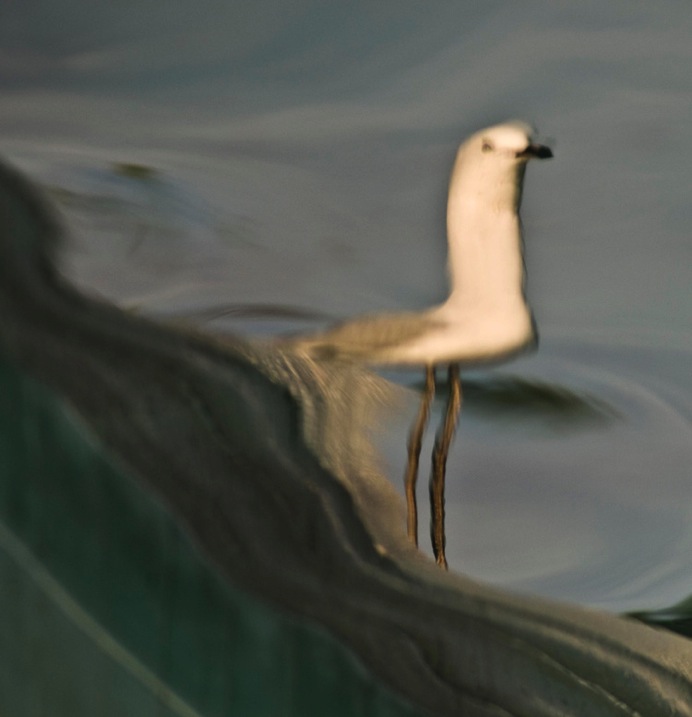
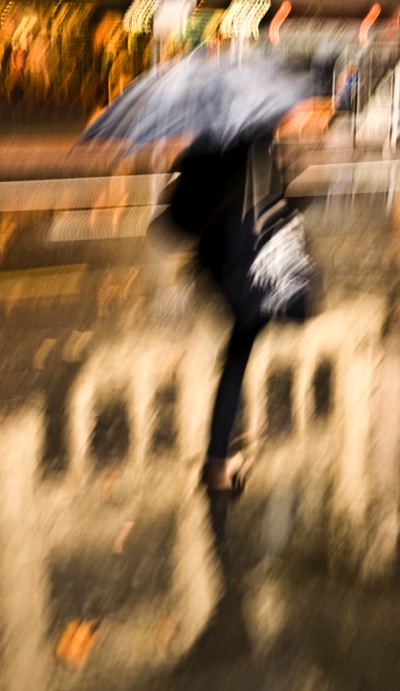
Reflections are one of the best ways to create abstract and impressionist photography. If you look carefully, you’ll see they are everywhere. As you walk around, look for smooth surfaces. Think about how you can use reflections to capture a viewpoint that you simply couldn’t have shot otherwise. Pay attention for colourful reflections in rain-soaked streets, they will create shimmering images with an impressionistic quality. Also, still lakes and rivers can create some wonderful reflective surfaces. When a surface is textured or shaped, unusual and interesting reflections can appear.

2 Reflection Seagull by Eva Polak

2 Reflections Rainy streets by Eva Polak

3. Defocus

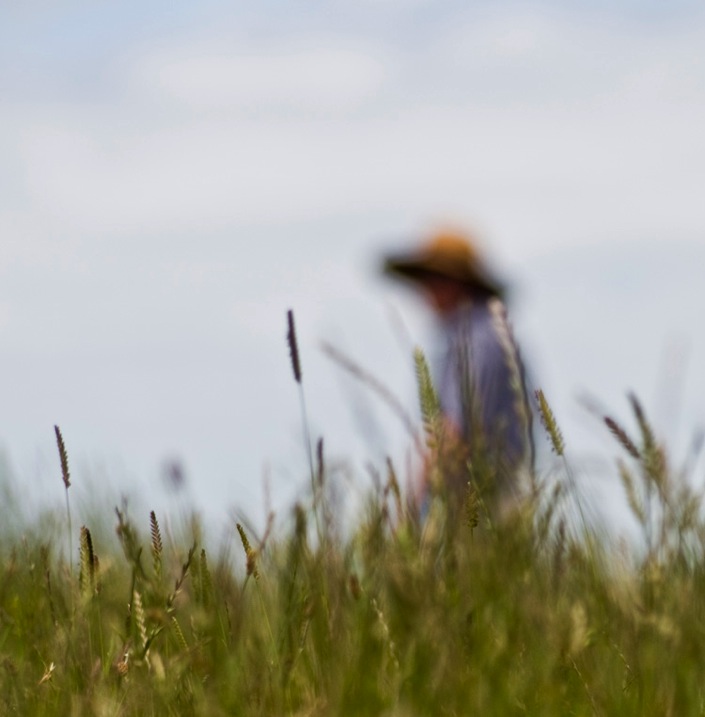
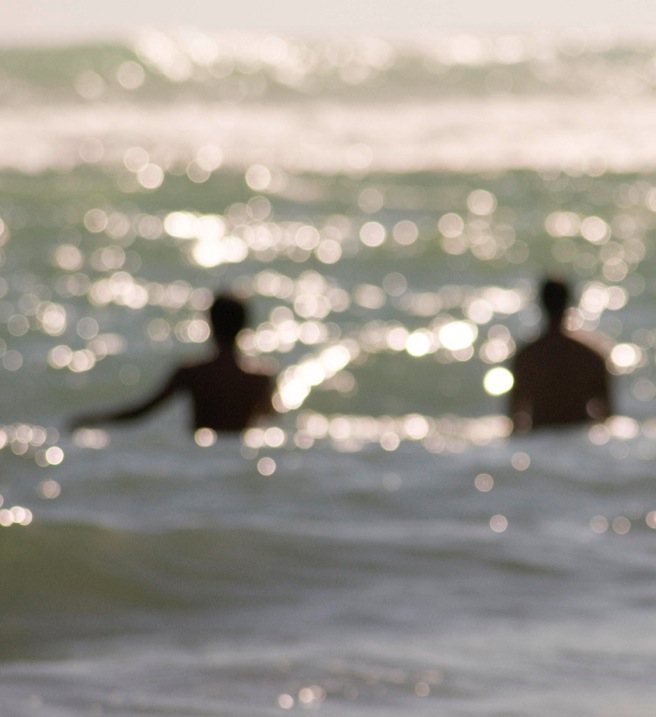
Pulling the lens out of focus is a quick way to give a scene an impressionistic look. Use Aperture Priority mode that allows you to set your lens to the widest aperture (small numbers such as f/2.4 or f/4). This is critical because you want a very shallow depth of field. Switch your lens to manual focus and start looking at things through the camera. Turn the focus ring until everything is blurry. Try varying the focus on the same scene to find out how much blur suits your subject best.

3 Defocus Lonly  by Eva Polak

3 Defocus Swimmers by Eva Polak

4. Pan your camera

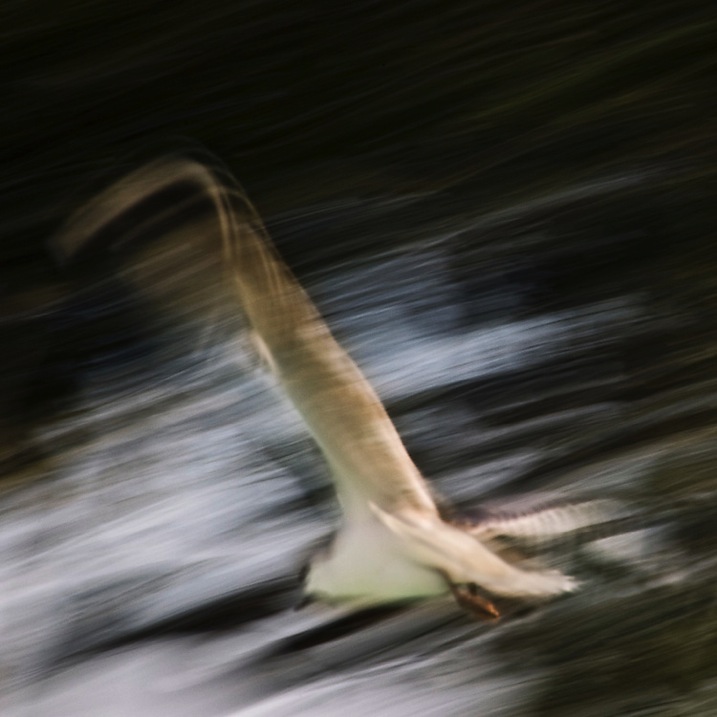
Panning is a fun technique to learn, and although it takes some practice, it is relatively easy to get started. You can pan running people, bicycles, cars, or just about anything that is moving. Once you have your subject, set the camera to shutter priority with the shutter speed between 1/10th and 1/60th of a second. As your subject approaches, focus on it and start tracking with your camera until you are confident that you are moving in sync with the subject.

4 Pan your camera Flight by Eva Polak

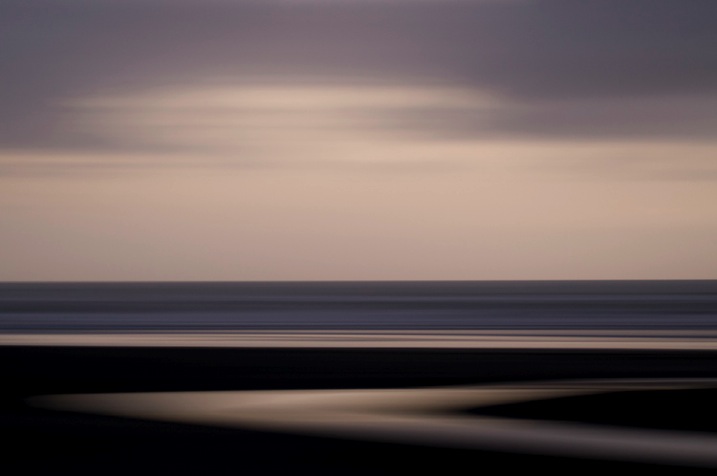
The trick to a successful camera-panning image is in finding a suitable subject. Strong vibrant colours are ideal, and lines through the frame will keep the colours distinct and separated. Apart from panning moving subjects you can use this technique to create beautiful seascapes and landscapes. The subject distortion will emphasize horizontal lines when panning horizontally, and vertical lines when panning vertically.

4 Pan you Camera  Wattle Bay  Eva Polak

5. Zoom

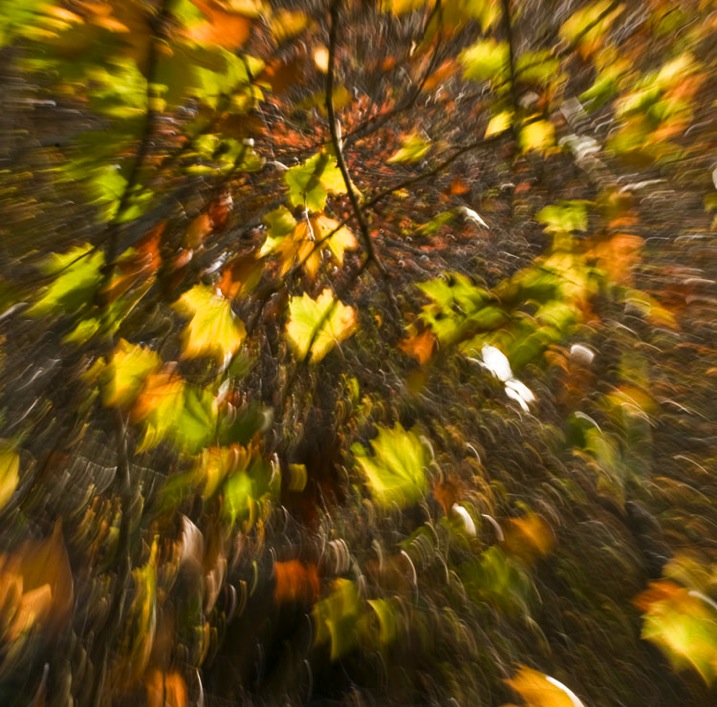
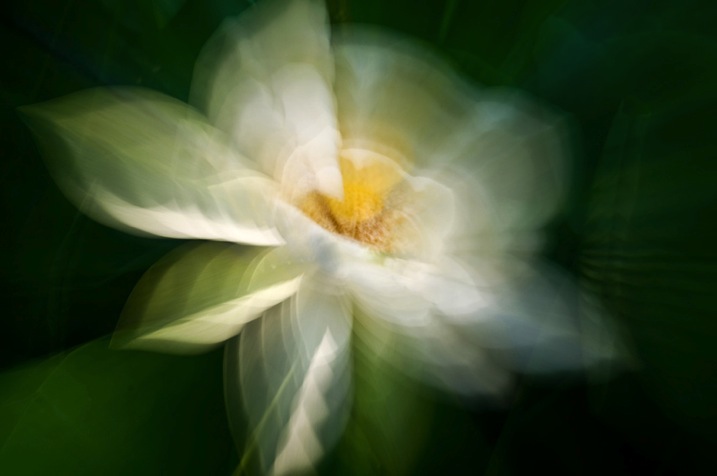
A zoom burst, or zoom blur, is another technique which is simple, fun, and easy to achieve. It involves changing the focal length of your lens (zooming in or out) while you take a photo, causing the shot to blur from the centre outwards, as if the scene is bursting towards you.

5 Zoom Water lily by Eva polak

To use this technique you’ll need a DSLR (or mirrorless camera) with a zoom lens. Set your camera to Shutter Priority. A shutter speed of 1/10th of a second is a good starting point. Compose your photo as you normally would, then just zoom the lens as you press the shutter. The key to success with this technique is to get the amount of zoom burst right. Experiment with zooming speed and direction.

5 Zoom Autumn Leaves by Eva Polak

Spend some time with each technique to discover its full potential. Photograph a lot and often. Don’t judge what you do. Analyze your images and try to improve upon them. But, most of all, have fun!

Tips to remember:

  • Keep an open mind; abstract photography is about seeing the potential in things that other people miss.
  • Spend time exploring everyday subjects and scenes; it’s surprising how many interesting abstracts you will find.
  • Look at familiar things from unfamiliar angles, and you will see them in a completely different light.
  • Forget about what something really is and concentrate on its shape and colour.

googletag.cmd.push(function() {
tablet_slots.push( googletag.defineSlot( “/1005424/_dPSv4_tab-all-article-bottom_(300×250)”, [300, 250], “pb-ad-78623” ).addService( googletag.pubads() ) ); } );

googletag.cmd.push(function() {
mobile_slots.push( googletag.defineSlot( “/1005424/_dPSv4_mob-all-article-bottom_(300×250)”, [300, 250], “pb-ad-78158” ).addService( googletag.pubads() ) ); } );

The post Five Techniques for Creating Impressionist or Abstract Photography by Eva Polak appeared first on Digital Photography School.

Digital Photography School

 
Comments Off on Five Techniques for Creating Impressionist or Abstract Photography

Posted in Photography


Tips for Creating Original Images

27 Sep

Years ago I shot an image for a competition that I was sure was a highly original piece of genius. Only to find out when looking at other entries, there seemed to be rather a lot of other highly original geniuses with exactly the same idea.

To get further in competitions I realized I had to start thinking outside the box. So I developed a strategy for getting a bit more original with my photography. Here are some tips you may find helpful for coming up with unique ideas and for creating original images.

Coming up with an idea

If you don’t already have an idea to work from, you can pick one right now – be it the first item you see after reading this sentence, or google your town and see what comes up. For example, the first link might be to a local hairdresser, so your theme could be hair. Try this with some other keywords like; photography or art, or go completely random and google both hair plus the first item to your left.

Send in the clowns

A quote from musician Nick Cave explaining his song writing process:

“Do you want to know how to write a song? Song writing is about counterpoint. Counterpoint is the key. Putting two disparate images beside each other and seeing which way the sparks fly. Like letting a small child in the same room as, I don’t know, a Mongolian psychopath or something, and just sitting back and seeing what happens. Then you send in a clown, say, on a tricycle and again you wait and you watch. And if that doesn’t do it, you shoot the clown.”

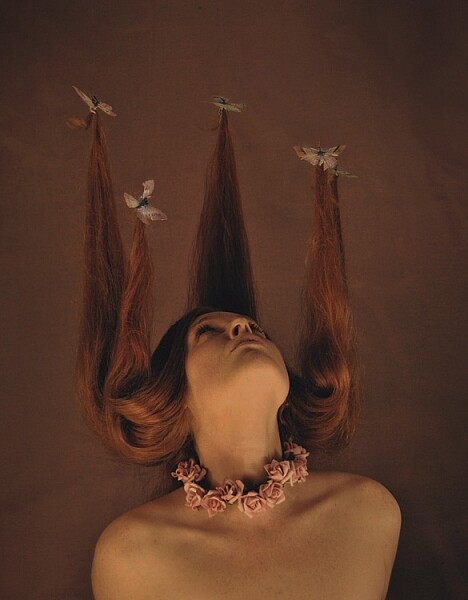
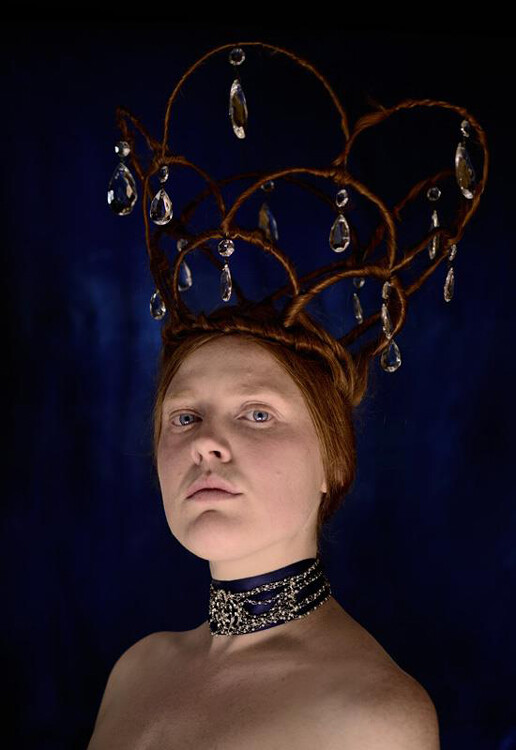
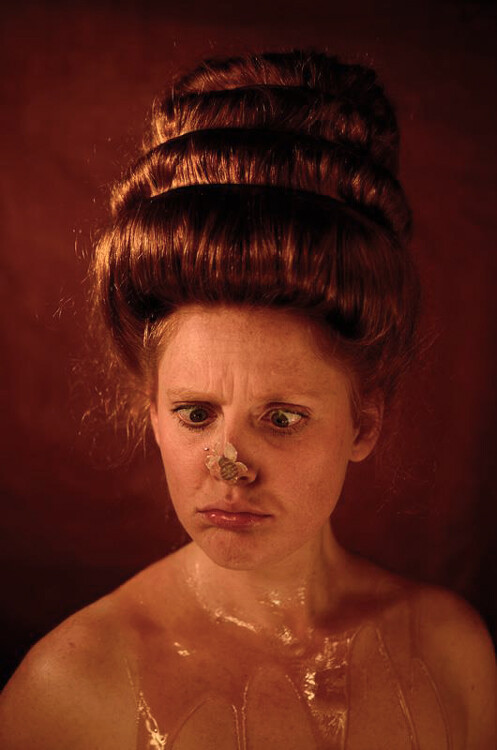
Apply this to your photography. Your theme, that’s your small child. Add to that a certain style of photography, macro , high speed , light painting, that’s your Mongolian psychopath. Now send in the clown, perhaps this could be, as above, the first thing you see to your left, or something available to you that might not be available to other photographers like an awesome local location, unique props, or skills. In my case some mad crafty skills and a friend, with a lot of red hair, to model for me.

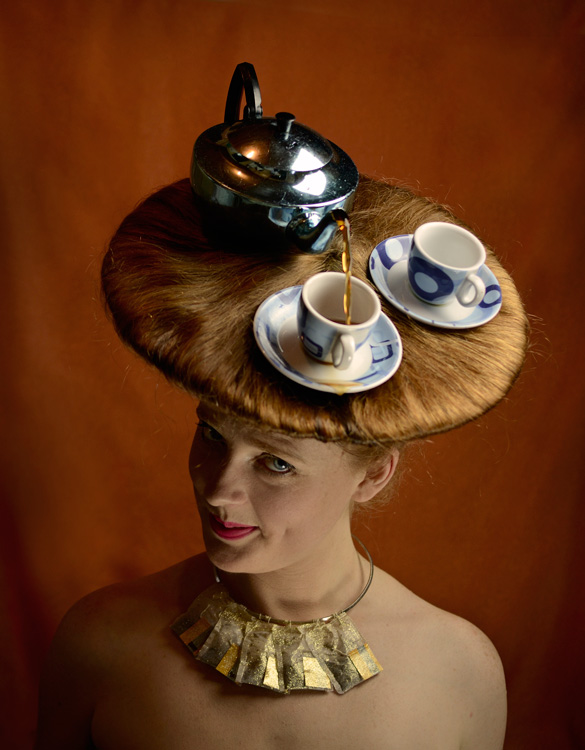
An unusual prop is a good place to start when aiming for an original image.

Combining other skills or hobbies (in this case my crafty skills) with your photography can help to create unique images. I made a crown out of coat hangers and wrapped the model’s hair around it. The jewels in the crown were some old chandelier parts I found at a market. Markets and thrift stores can be a good source for unusual items to inspire an original photograph.

Think about what is available to you

It’s all well and good to want to do a high-speed Kung Fu fighter action shot in low light, when all that is available to use is your mobile phone camera and your dog as the actor, and he has no Kung Fu training whatsoever. Not that it can’t be done, just saying, know your limits – then ignore them, or try to work around them.

Go for a walk

Even if you have a good idea, it’s a good idea to go for a walk.

When you get home, write or sketch further ideas. They don’t have to be good, or fully thought through, just get them down on paper or computer. Make notes of anything that comes to mind, you can sort out what works later. Even if you think your first idea is the one, still try to stretch yourself to come up with at least five to 10 more. This may sound like a lot, but sometimes that is what it takes to get yourself thinking outside the box.

If by then you don’t come up with anything original that you are excited about, go for another walk.

Let it rest

Creativity requires leisure, as they say. I am all for striking while the iron is hot, as they also say, but there is a lot to be said for allowing yourself to just mull over ideas for a while. Send in or shoot a few more clowns, see if you can improve the concept, or add a new element to really make it original.

Research

Google your idea or theme in an image search. This may not only inspire further ideas, but also allow you to check that any you’ve come up, with haven’t already been done a million times before.

Be prepared to re-shoot

Sometimes we can get caught up in an idea. I once went to great length with costume, setup and a bizarre concept, for a competition brief. After a lengthy photo session and editing, I realized the idea didn’t actually make any sense because the concept was too complicated. So I simplified the whole thing back down to basics, shot the clown as Mr. Cave advised, and the second attempt worked a treat. Going that extra mile to keep thinking and photographing, plus a willingness to let go of an idea you have worked hours on, will help you get to that truly original image in the end.

Shoot a series

This works on the same principle as coming up with 10 ideas in the sketching stage before you settle on one. Getting past your first inclinations, and pushing an idea, will get you outside your initial box. Photographing a series, forces you to take that a step further. When you are thinking about an idea over an extended period of time, over several shoots, you really give your creativity a work out. You may surprise yourself with what you come up with by your seventh photo shoot, based on your first concept.

Collaborate

Aristotle said; “The whole is greater than the sum of its parts”. Not all collaborations create equally, but when they work, something wonderful happens. The combination of two or more collaborators can create concepts and ideas that take you far beyond what you would have done on your own.

Even something as simple as asking a portrait subject to bring in some props or personal items of their own, can change a photo shoot from ordinary to original.

Go beyond the sunset

This applies to any form of photography but I’ll use the ubiquitous sunset shot as an example.

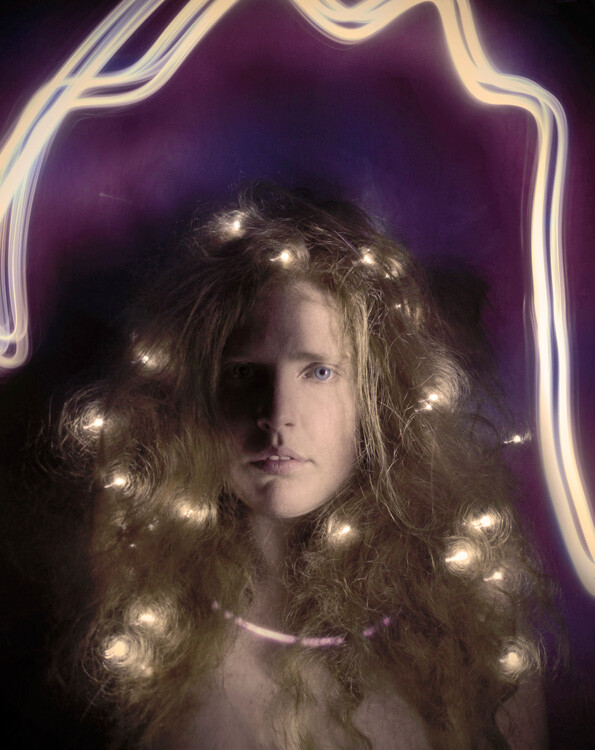
Basically what I am saying here is get out of your comfort zone, and take a different approach. Instead of the cliché sunset, try something new with it, be it learning different photographic method such as infrared photography, multiple or long exposures, light painting, or add a new element, some random item. Hair + sunset = a challenge, but it’s going to take you beyond the ordinary sunset photograph.

An exercise to stretch your imagination

Choose one of each from the two lists below, then try a few of the tips above, especially coming up with 10 possible photograph ideas. Then go have a hoot photographing the one you like best!

Items:

  • Something from your refrigerator
  • A bottle
  • A piece of fabric
  • An item from your bathroom

Camera method:

  • Long exposure
  • High shutter speed
  • Black and white
  • Low light

An image from that list could be a low light shot (sunset) and a message in a bottle on the beach, not exactly an original concept. However, just because something has been done before, doesn’t mean you shouldn’t run with it, put your own mark on it, find an original way to show that story.

Should you try the exercise, or any of the above tips, share your results in the comments, let’s have some fun with this!

googletag.cmd.push(function() {
tablet_slots.push( googletag.defineSlot( “/1005424/_dPSv4_tab-all-article-bottom_(300×250)”, [300, 250], “pb-ad-78623” ).addService( googletag.pubads() ) ); } );

googletag.cmd.push(function() {
mobile_slots.push( googletag.defineSlot( “/1005424/_dPSv4_mob-all-article-bottom_(300×250)”, [300, 250], “pb-ad-78158” ).addService( googletag.pubads() ) ); } );

The post Tips for Creating Original Images by Lea Hawkins appeared first on Digital Photography School.

Digital Photography School

 
Comments Off on Tips for Creating Original Images

Posted in Photography


6 Tips for Creating More Captivating Landscape Photographs

07 Sep

2-for-1 special

As part of Landscape Photography Week here on dPS, we’re offering TWO for the price of ONE on our best-selling Living & Loving Landscape Photography ebooks!

Click here to take advantage of this offer.


If landscape photography is your passion, you probably love to visit new places, and photograph beautiful natural scenes. But have you ever been unable to capture the beauty you saw in front of you in your camera? Do your images come out flat and boring? With these six tips, you’ll take your photography to the next level by creating more captivating landscape photographs that really stand out.

1. Time your shoot for the perfect light

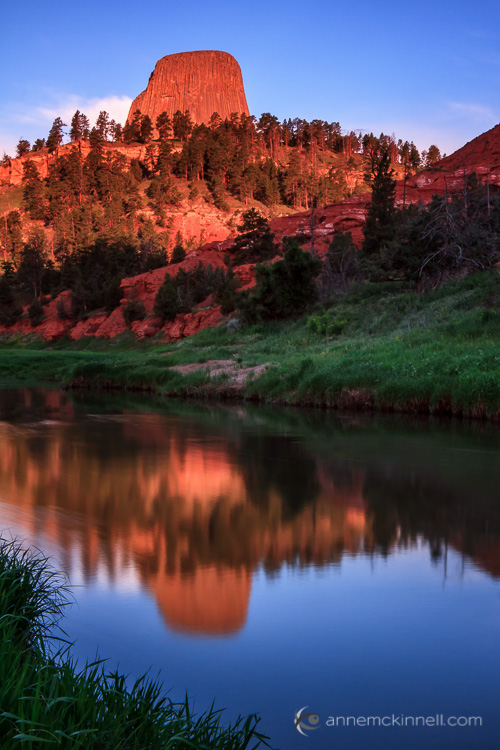
Making interesting photographs is all about the light. Boring light creates boring photographs. Dramatic light creates dramatic photographs. Once you find a scene to work with, be patient and wait for the dramatic light that will enhance your image. You may even have to return on a different day to make the most of the scene.

Devils Tower, Wyoming by Anne McKinnell

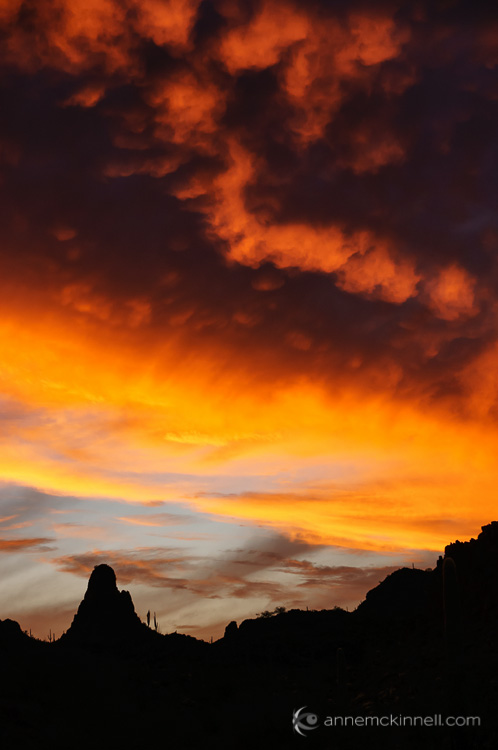
The quality of the light that illuminates your scene is going to change depending on the weather and the time of day.

Weather

The effect that weather has on your photo is usually obvious – a clear, blue sky gives a distinctly different feeling than dark storm clouds. Direct sunlight causes high contrast and dark, clear shadows – but the light becomes soft and even on an overcast day.

Time of Day

We know that the sun rises in the east and sets in the west, but the direction of the sun with respect to your landscape also makes a big difference. It could mean the difference between the sun being in, or out of the frame. It determines which side of a mountain is lit, and can change the way the shadows fall in a grove of trees.

When you’re scouting your location, try to figure out where the sun will be at different times of day, what effect that will have on your landscape, and when you think the light will be at its best. This can be as simple as deciding whether you are at a sunset or sunrise location, so you know the best time to return to the scene.

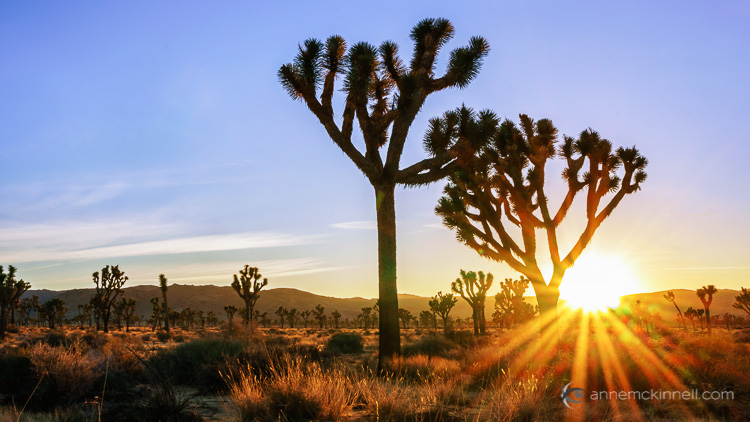
Joshua Tree National Park by Anne McKinnell

Keep in mind, as well, that the colour of the light changes throughout the day. When the sun is low in the sky (towards sunrise or sunset) the light takes on a warm golden hue, but in the middle of the day the light turns a brighter white. Just after the sun sets, and again before it rises, the blue hours give a scene a soft, cool tone.

2. Use the right equipment

Use a tripod to keep your camera steady and allow for longer exposures. A tripod will also help you be more purposeful in the way you compose the frame.

Choose your lens based on the type of photograph you want to make. A grand vista type of landscape photograph is usually made with a wide-angle lens, with a focal length below 35mm. The shorter your focal length, the larger your angle of view, and the more of the scene you can fit in the photo. However, by doing this you shrink everything within the frame.

Ajo Sunset by Anne McKinnell

If there is something in your frame that you want to appear large in the scene, using a longer focal length will emphasize it. Longer focal lengths are also excellent for more intimate landscapes that do not include a massive expanse of space.

3. Use the right camera settings

Understanding the exposure triangle is critical when it comes to choosing the best camera settings. Generally, for landscape photographs where nothing is moving in the scene, you don’t need to worry about shutter speed, especially if you are using a tripod (see tip #2 above).

In landscape photography, one very important setting is aperture, since that controls the depth of field in your image. When making a grand vista type landscape, you usually want everything from foreground to background to be in sharp focus.

To get your photo sharp all the way through, use a small aperture, like f/11, to maximize your depth of field. However, smaller doesn’t always mean sharper – because of an optical phenomenon called diffraction, images tend to get softer when the aperture is too small. Therefore, the clearest images are typically made closer to the middle of a lens’ aperture range. I recommend shooting landscapes at f/11 instead of f/22 for the sharpest possible photo.

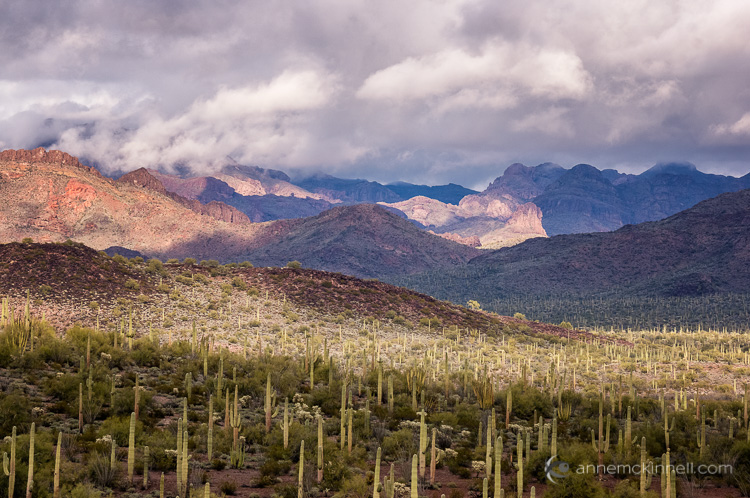
Organ Pipe Cactus National Monument Arizona by Anne McKinnell

That leaves ISO as the last factor in the exposure triangle. For the best image quality, your ISO should be set to a low value, like ISO 100.

If nothing is moving in your landscape, use aperture priority mode, set the aperture to f/11, set the ISO to 100, and then let the camera calculate the appropriate shutter speed to get a good exposure.

However, if there is something moving in the scene, you can set a higher ISO, to allow for a faster shutter speed.

4. Separate your foreground, middle ground, and background

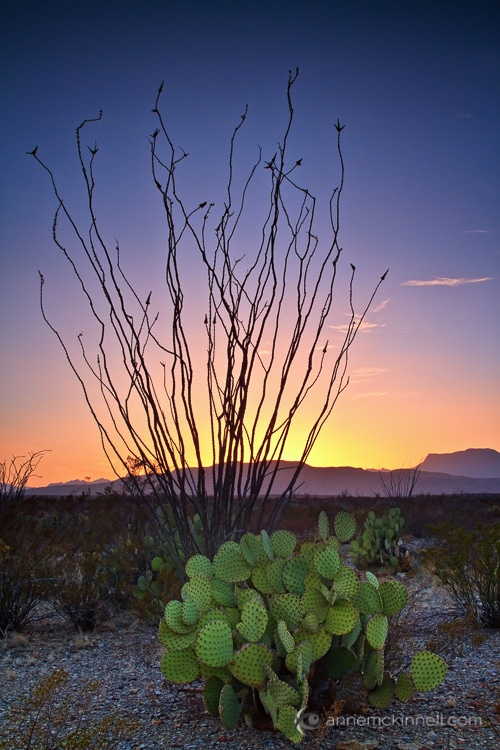
When composing your landscape photo, try to arrange it with elements in the foreground, middle ground, and background. Make sure they are framed to be distinct, and separate from each other, in order to create a sense of depth that draws the viewer into the picture.

Big Bend National Park , Texas, by Anne McKinnell

Background features are common things like mountains, the horizon, and sky – while foregrounds can be nearby objects such as trees, grasses, man-made objects, and even rocks on the ground in front of the camera. The middle ground, of course, is everything in between that occupies the main part of the scene.

Not all photographs have these three distinct areas, but if you can compose your image so it does, you’ll have a photo with great depth and more impact.

5. Include a point of focus

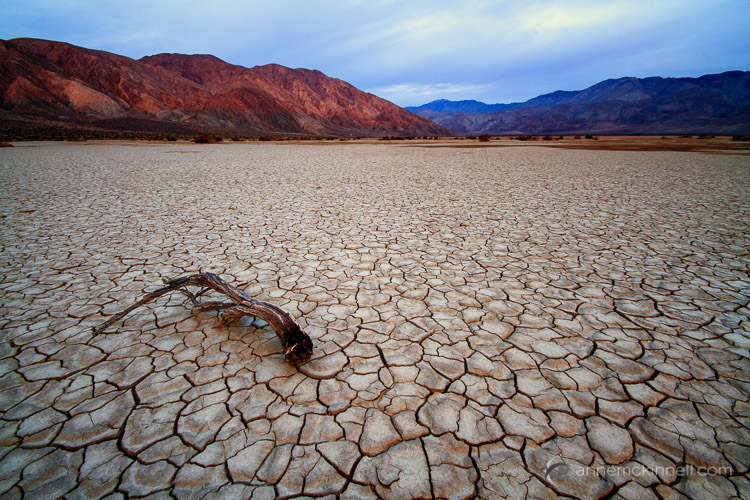
Sunsets and forests and seashores are beautiful, but they need something small to give them a sense of scale. Almost anything can serve this purpose – a person walking through the scene, a single silhouetted tree, a boat floating in a lake, a dock, or an animal – anything to give scale to the immensity of the landscape and create something for the eye to be drawn to.

Clark Dry Lake by Anne McKinnell

6. Bracket your shots

Landscape scenes can be very high in contrast, so it’s a good idea to shoot a few different exposures to make sure you get details in both the highlights and shadows. Some cameras will have an automatic bracketing feature built-in, but if not, you can do this manually. Simply take one picture at the recommended settings, then turn your exposure compensation button (+/-) to +1 and take another. Repeat this at -1 and you’ll end up with three pictures of different brightnesses. Later, when editing them on your computer, you can decide which exposure looks best and even combine multiple images in Photoshop or Lightroom (using the new Merge to HDR feature in LR CC or LR 6) to get the most detail possible.

Good light, the right equipment, the right settings, a strong composition, and a good exposure all work hand-in-hand to ensure you’ll make captivating landscape photographs.


Here on dPS this is landscape week – here is list of what we’ve covered so far. Watch for a new article (or two) on landscape photography daily for the next couple days.

  • 6 Tips for Better Low-Light Landscape Photography
  • Landscape Photography and the Human Element
  • 5 Ways a Telephoto Lens Can Improve Your Landscape Photography
  • Landscape Photography from the Side of the Road
  • 32 Majestic Landscape Photos to Inspire Your Wanderlust
  • Weekly Photography Challenge – Landscape
  • Landscape Photography – Shooting the Same Location Through the Seasons
  • How to Solve 5 Composition Conundrums Faced by Landscape Photographers

googletag.cmd.push(function() {
tablet_slots.push( googletag.defineSlot( “/1005424/_dPSv4_tab-all-article-bottom_(300×250)”, [300, 250], “pb-ad-78623” ).addService( googletag.pubads() ) ); } );

googletag.cmd.push(function() {
mobile_slots.push( googletag.defineSlot( “/1005424/_dPSv4_mob-all-article-bottom_(300×250)”, [300, 250], “pb-ad-78158” ).addService( googletag.pubads() ) ); } );

The post 6 Tips for Creating More Captivating Landscape Photographs by Anne McKinnell appeared first on Digital Photography School.

Digital Photography School

 
Comments Off on 6 Tips for Creating More Captivating Landscape Photographs

Posted in Photography


7 Tips For Creating A Standout Photography Portfolio

05 Sep

Photography Industry Leaders Share 7 Top Tips For Putting Together A Standout Portfolio

7 Top Tips For Putting Together A Standout Portfolio

FashionPhotographyBlog.com welcomes our friends at the Dots to join us on our site and share with our readers, the great tips they have uncovered from their recent masterclass in London, UK. The Dots is a community of creative professionals, designed to connect creatives with collaborators, companies and commercial opportunities. They are about collectively building a stronger, more profitable and diverse creative sector and we are excited to have them here with us today.
 

The Dots hosted a Photography Portfolio Masterclass at the incredible Spring Studios to give talented emerging Photographers the chance to have their work reviewed by some of the UK’s most prominent Picture Editors and Photographic Agents. With such a wealth of experience in the room, The Dots team took the opportunity to ask a few questions on how to get ahead in the hugely competitive Photography industry. Here’s what the industry representatives had to say:


Photography Portfolios – 7 Top Tips


  1. Showcase your work through different platforms


In a digital age, it is important to remember that there are many other ways to showcase your work than through the standard printed photography portfolio and the more widespread your work is, the more likely Creative Directors are going to find (and possibly hire) you.


Robin Derrick (Executive Creative Director, Spring Studios) told us, “I think a traditional portfolio is a rather out-dated way to present work […] I’ve normally discovered a photographer online.”


David Birkitt (Owner & Managing Director, DMB Represents) supported this by telling us to “consider that everything’s a portfolio these days. Anything you’re putting work out on, any platform you’re using – printed, social, online – they’re all different platforms, they’re all different portfolios and they all do different things in different ways for different reasons.”


In short, get your work out on as many platforms as you can and curate each as carefully as you curate your physical photography portfolio.


  1. Have your own style


There will obviously be photographers or magazines that you look up to and admire and it’s hard not to be influenced by them or feel that you have to create the same kind of work in order to get the job. But one of the key points the Masterclass Mentors all agreed on was to have your own sense of style and identity.


Nicola Kavanagh (Editor in Chief, Glass Magazine) strongly advocated this – “I think having your own visual identity is the strongest thing that you can have as a photographer.”


David Birkitt also advised to make sure that your photography portfolio is “an extension of you and it feels comfortable and it forms a part of you, your being, and your character.”


  1. Show personal work


The Masterclass Mentors all agreed that a photography portfolio “is not just about commercial work or editorial, it’s about projects that you’ve done off your own back that show how passionate you are about taking pictures.” (Holly Hay, Photographic Editor, AnOther Magazine & Another Man).


Matt Davey (Co-Founder & Director, Probation London) advises to “never underestimate the value of your personal work […] that’s the stuff that people remember, they want to see what a photographer’s heart and soul is, not just what they’ve been paid to create.” We couldn’t have put it better ourselves!


  1. Put your best foot forward.


Start your photography portfolio really strong and prioritise certain images to go near the front.  


Jamie Klinger (Publishing Manager, Shortlist/Stylist Magazine) explains why… “If the first 6 shots you see are landscape but they want to be a portrait photographer, you’re never going to think about them for portraits because it’s going to be at the end of their book.”


Lauren Ford (Photo Editor & Producer, Dazed) reinforced this point by reminding photographers “to make sure that you’re opening your book with something really strong and something that shows who you are and what your point of view is as a photographer.”


  1. Tell a story. Stimulate a conversation


Holly Hay advised that “there should be a reason for every single image in your portfolio, there should be a story behind every image. There should be a reason for it being there and a reason why you love it and a reason why you want to tell people about it.”


Matt Davey also emphasized this point “construct your portfolio in a way that stimulates conversation. Be able to talk about your work and present it confidently when you’re having a face-to-face meeting, it’s not just about the flow of the images it’s about how you present it.”


So, if you make sure your best work is at the front, your photography portfolio flows well and stimulates conversation, then you’re off to a cracking start.


  1. Edit, edit, edit!


This follows on nicely to our next point – be selective. Don’t add 20 different photos from the same shoot to your photography portfolio when you could have only added two. Whoever is looking through your photography portfolio is either going to get bored or think that is the only thing you can do.


Steve Peck (Picture Editor, WIRED Magazine) indicated the main thing he looks for is, “a lot of variation in someone’s book. If you are a portrait photographer that’s fine, but I don’t want to see the same head and shoulders crop 15 times, I know you can do that after I’ve seen two – so that’s great, move on, show me something else.”


As Nicola Kavanagh points out, “your portfolio is your most valuable tool in an interview, so make sure you present that as best you can, edit harshly […] make sure it’s really succinct.”

So, make sure you keep things short and sweet and ensure there’s a reason or a story behind every image.


  1. Get a second opinion!


You’ve taken amazing shots, edited and arranged your photography portfolio with a fine tooth comb… What else should you do before showing it to a potential client?


Jamie Klingler suggested “to have someone else edit your portfolio. You are too close to your work and you don’t know what your best shots are.”


This point was reinforced by Nicola Kavanagh who told us to “make sure your portfolio is the best it can be: get it up to scratch, try and get feedback from people from agencies before you present to clients or magazines,”


What we’re basically saying is a second (professional) opinion never hurt, and if anyone who knows what they’re talking about is offering to help – take it.


Looking to get feedback on your photography portfolio? Find out about The Dots’ next Photography Portfolio Masterclasses here: https://the-dots.co.uk/about/portfolio-masterclasses


You can also check out The Dots’ Vimeo channel for video interviews, tips & highlights from the Photography Portfolio Masterclass here:  https://vimeo.com/album/3444505 


IMAGE SOURCE: 

Feature image & images 1: courtesy of Jack Woodhouse


Fashion Photography Blog

 
Comments Off on 7 Tips For Creating A Standout Photography Portfolio

Posted in Uncategorized