[ By WebUrbanist in Design & Graphics & Branding. ]
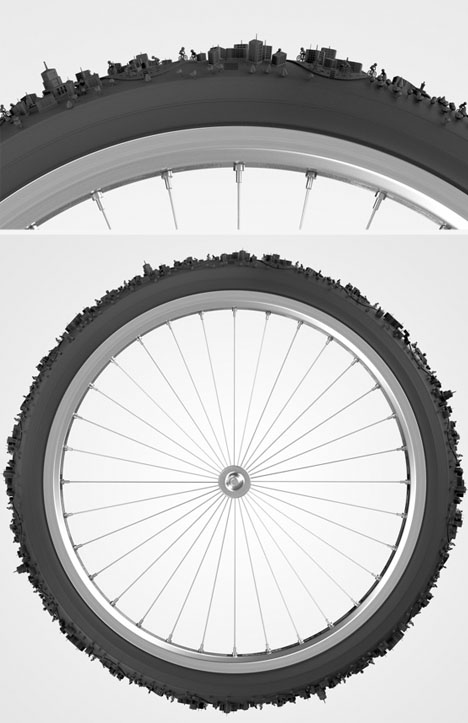
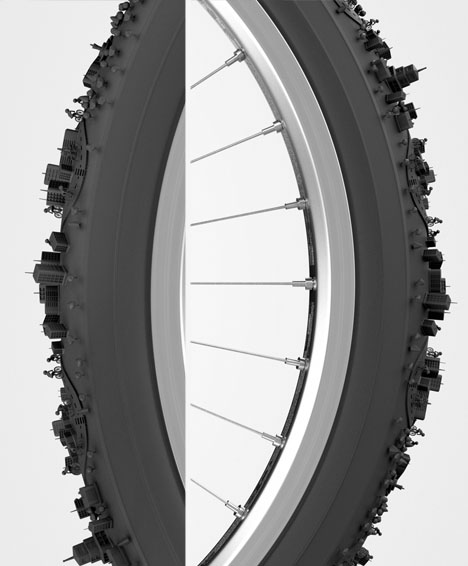
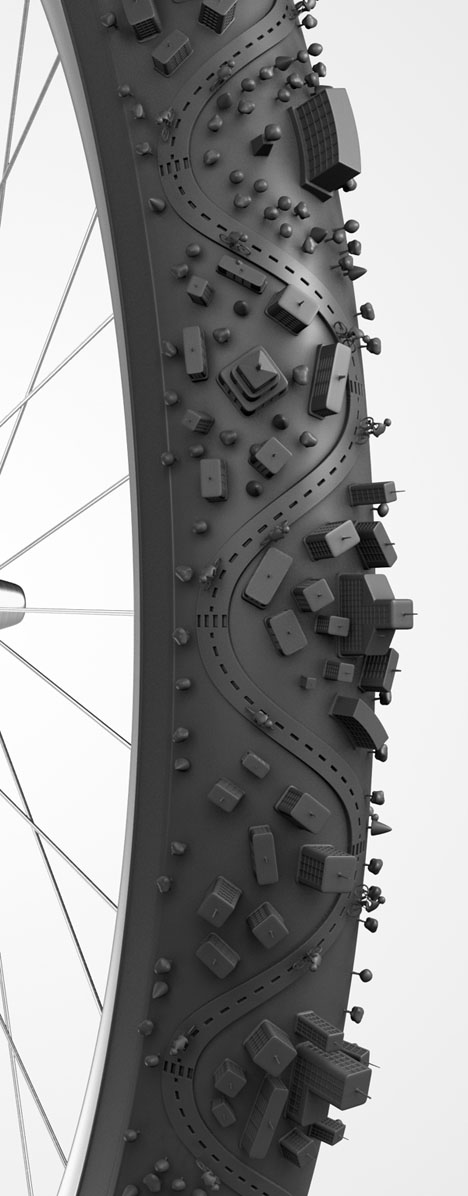
Rough around the edges, we rarely notice the unique landscape that evolves from regular wear and tear on our bicycle tires – this illustration draws on that familiar-yet-foreign topography.
Bruno Ferrari & Rodrigo Paranhos used Luxology and a little bit of Photoshop to craft this series of images for a creative agency – yes, sadly this is not a prototype for a real rubber bicycle tire tread pattern.
Yet you have to wonder: why not? If issues of unevenness were resolved, it would sure make a neat additional designer touch for riding around in cities. Either way, it is a neat inversion of the Halo-style ringed landscape concept.
[ By WebUrbanist in Design & Graphics & Branding. ]
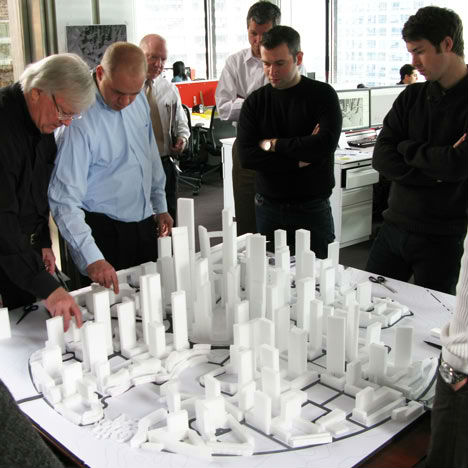
Altering most of today’s cities to eliminate cars altogether would be a daunting, if not impossible, proposition – which is why China is starting from scratch. Great City will be built around a high-rise core housing 80,000 people, entirely walkable, and surrounded by green space.
Planned for a rural area outside Chengdu, the high-density Great City will give residents access to a ‘buffer area’ of gardens and greenery making up 60% of the total area of the city. Walking from the center of the city to the green spaces takes just ten minutes, and other nearby urban centers will be accessible by a mass transit system.
Chicago architecture firm Adrian Smith + Gordon Gill Architecture say the city will use 48% less energy and 58% less water than a more conventional city of the same size; it will also produce 89% less landfill waste and generate 60% less carbon dioxide.
The development addresses the problem of overpopulation, pollution and urban sprawl by compacting a lot of residents into vertical housing, growing food nearby. “The design is attempting to address some of the most pressing urban issues of our time, including the need for sustainable, dense urban living at a cost people can afford,” says Gill.
“Accordingly, we’ve designed this project as a dense vertical city that acknowledges and in fact embraces the surrounding landscape—a city whose residents will live in harmony with nature rather than in opposition to it. Great City will demonstrate that high-density living doesn’t have to be polluted and alienated from nature. Everything within the built environment of Great City is considered to enhance the quality of life of its residents. Quite simply, it offers a great place to live, work and raise a family.”
Altering most of today’s cities to eliminate cars altogether would be a daunting, if not impossible, proposition – which is why China is starting from scratch. Great City will be built around a high-rise core housing 80,000 people, entirely walkable, and surrounded by green space.
Planned for a rural area outside Chengdu, the high-density Great City will give residents access to a ‘buffer area’ of gardens and greenery making up 60% of the total area of the city. Walking from the center of the city to the green spaces takes just ten minutes, and other nearby urban centers will be accessible by a mass transit system.
Chicago architecture firm Adrian Smith + Gordon Gill Architecture say the city will use 48% less energy and 58% less water than a more conventional city of the same size; it will also produce 89% less landfill waste and generate 60% less carbon dioxide.
The development addresses the problem of overpopulation, pollution and urban sprawl by compacting a lot of residents into vertical housing, growing food nearby. “The design is attempting to address some of the most pressing urban issues of our time, including the need for sustainable, dense urban living at a cost people can afford,” says Gill.
“Accordingly, we’ve designed this project as a dense vertical city that acknowledges and in fact embraces the surrounding landscape—a city whose residents will live in harmony with nature rather than in opposition to it. Great City will demonstrate that high-density living doesn’t have to be polluted and alienated from nature. Everything within the built environment of Great City is considered to enhance the quality of life of its residents. Quite simply, it offers a great place to live, work and raise a family.”
Want More? Click for Great Related Content on WebUrbanist:
Utopian ‘Private City’ Envisioned as Crime-Free Oasis
A private city surrounded by white walls is envisioned as a crime-free paradise away from the realities of homicide-plagued Guatemala City. But is it realistic?
Click Here to Read More »»
Starting at the End: 12 New Cities Built From Scratch
Cities take centuries to evolve – or do they? Here are 12 urban centres that offer a radical alternative to tradition – they are cities from the first day they open for business.
Click Here to Read More »»
This is short video I put together while in New York City (December 2009). It’s my second test with the Canon 7D. Equipment used: Canon 7D, Nikkor 50mm/f1.4 (w/Fotodiox pro adapter), Canon 10-22 f/3.5-4.5. Canon 28-135 f/3.5-5.6 Transcoded with CineForm Neoscene. Edited and graded in Sony Vegas Pro 9. www.facebook.com
[ By WebUrbanist in Architecture & Cities & Urbanism. ]
Normally, urban design is done with death and destruction in mind – but prevention, rather than facilitation, is the focus. This unique mini-city was made to be destroyed, pummeled into the dust by repeated drills by armed forces.
Built by the United States military in the remote Nevada desert, the Urban Target Complex (R-2301-West aka “Yodaville”) is the target of strafing, sniping, rocketing and bombing (above image by Lance Cpl. Zac Scanlon).
The terrain has a realistic layout patterned after settlements in the Middle East, and the structures themselves – mainly constructed from shipping containers – are stacked up to four stories high.
As Ed Darack writes for Air & Space Magazine, from his experience following troops into the faux action, ”The artillery and mortars started firing, troops advanced toward the target complex, and aircraft of all types—carefully controlled by students on the mountain top—mounted one attack run after another. At one point so much smoke and dust filled the air above the “enemy” that nothing could be seen of the target—just one of the real-world problems the students had to learn to cope with that day.”
BldgBlog asks what we should make of mysterious military architecture, often hidden from public view and thus veiled from scrutiny or critique. “So what, for instance, might something like a Yodaville National Park, or Urban Target Complex National Monument, look like? How would it be managed, touristed, explored, mapped, and understood? What sorts of trails and interpretive centers might it host?”
Want More? Click for Great Related Content on WebUrbanist:
Starting at the End: 12 New Cities Built From Scratch
Cities take centuries to evolve – or do they? Here are 12 urban centres that offer a radical alternative to tradition – they are cities from the first day they open for business.
Click Here to Read More »»
Ever wonder how your phone’s signal stays so clear even when you’re not within sight of a tower? Cellular towers are really hiding in plain sight all around us.
Click Here to Read More »»
[ By WebUrbanist in Architecture & Cities & Urbanism. ]
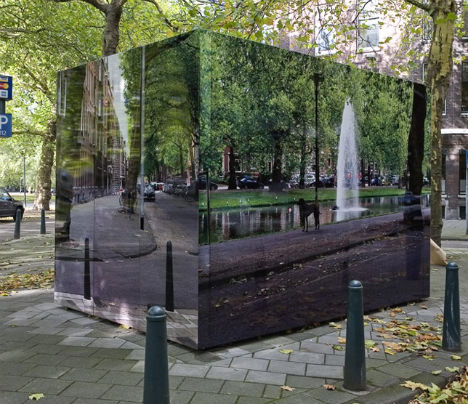
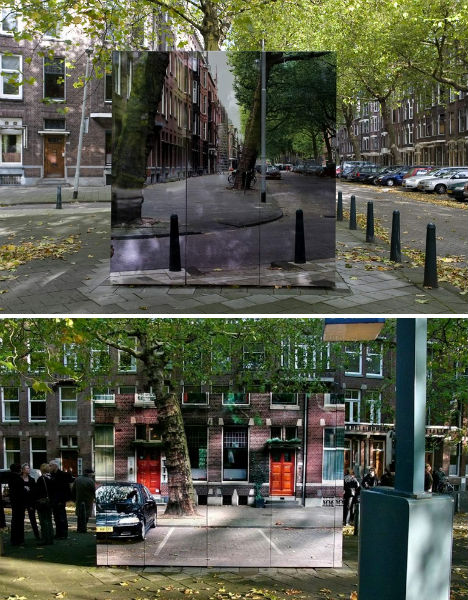
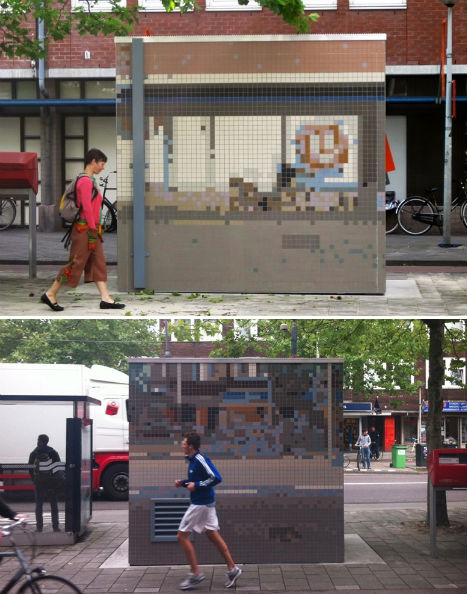
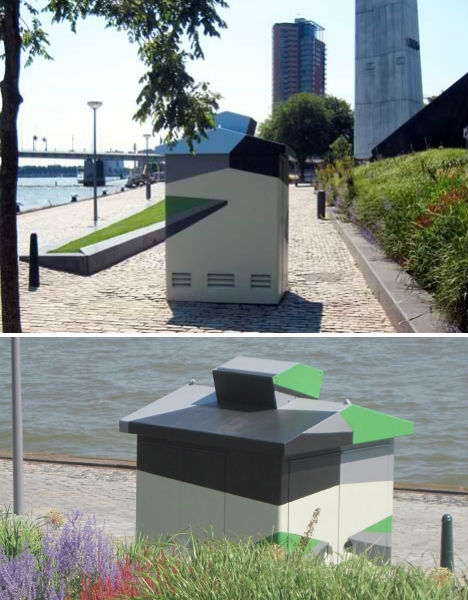
Electricity substations, bathrooms and other less-than-aesthetically pleasing public buildings can stand out as eyesores on the street, taking away from the beauty of their surroundings. Dutch designer Roeland Otten decided to disguise some of Amsterdam and Rotterdam’s worst offenders by making them blend into their environments, in both abstract and highly realistic ways.
‘City Camouflage’ employs mosaic tiles, paint and photographic prints affixed to the outside of these small buildings to make them less visually offensive. The 1970s structures were unmaintained and beginning to rust.
High-resolution photography printed on sheets of aluminum make some of the buildings seem almost invisible. Gazing down the street, one’s view is no longer interrupted; you can see exactly what is behind each of these camouflaged buildings.
Others are covered in tiles that create a more subtle pixelated effect. One electricity substation on the water was given a bold, graphic treatment with acrylic paint so that it blends in from some angles and looks merely artistic from others.
Want More? Click for Great Related Content on WebUrbanist:
Urban Camouflage: Liu Bolin, The Invisible Man
Chinese artist Liu Bolin painstakingly paints his subjects so that they seem to disappear into their surroundings in amazing urban camouflage photography.
Click Here to Read More »»
Public Camouflage: Make-Up Artist Makes Models Invisible
Illusion relies on expectation – we glance but only glimpse what is familiar and the rest blends neatly into the background of urban settings.
Click Here to Read More »»
An iPad, a projector and an app called Tagtool are all you need to turn your city into a virtual canvas for your own custom light art and animations. Created by Vienna-based OMAi, Tagtool enables you to create art with your fingers on an iPad and project it large-scale onto the sides of buildings. You can flip the interface if you’re left-handed.
Two or more collaborators can team up using wifi, inventing characters and animated stories or creating interactive light art shows for a crowd. In fact, any flat surface is turned into a performance art venue. Want to just play around at home? Use an AV adapter to display it on a TV, or just use an Apple TV for Airplay streaming.
Check out this video to see the app in ‘multiplayer’ action.
Tagtool was inspired by a DIY creation that works like a musical instrument, plugging into a projector. You can build your own version of the original Tagtool, but the app makes the whole process a lot easier and more intuitive. It’s available in the iTunes App Store. (via Pop Up City)
Want More? Click for Great Related Content on WebUrbanist:
Cover Up! 15 Ingenious iPad Case Designs
From book-like designs that offer disguise to $ 1,555 designer pouches, these 15 iPad covers, cases and sleeves are slick and stylish.
Click Here to Read More »»
10 Amazing Light Graffiti Artists and Photographers: From Light Writing to Extreme Exposures
Light graffiti, also known as light painting, is a kind of leave-no-trace, sustainable and incredibly awesome temporary graffiti if captured right by clever photographers.
Click Here to Read More »»
*****Only watch in HD for best Quality***** Sargodha, the city where eagles dare. My hometown, where i spend my childhood. I thought to make the time lapse video. My first time lapse experience in my hometown. Some friends help me throughout making this video, i would like to thanks. You guys are awesome. All rights reserved. “Time lapse” is combination of Pictures or the video in Fast. I took almost more then 6000 pictures in different days and finish this in almost 7 days. Throughout this is my first ever experience. i learn many things and will improve in coming up projects. Equipment: I used Nikon D90 with 17-70mm 2.8f tripod and remote. Music: Miss you by Loveshadow Thanks to all of my friends for helping me in throughout project. Video Rating: 4 / 5
Could a utopian dream of a crime-free private city actually bring fears of fictional dystopia to life? Developers are currently building a white-walled 34-acre complex of apartments, shops, nightclubs, boutiques and restaurants that would offer a safe haven from the notoriously high crime rates of Guatemala City. Paseo Cayala will offer luxury living in a nation where most citizens make less than $ 300 per month.
This walled compound will theoretically enable its residents, living in apartments that cost between $ 260,000 to $ 800,000 each, to avoid the realities of life in urban Guatemala altogether. Paseo Cayala will be virtually independent – a livable, walkable dream community that the developers hope will eventually expand into ‘Cayala City’, in a 870-acre area just a bit larger than New York City’s Central Park.
But just past those symbolically charged walls are the huts and shanties of the city’s poorest citizens. About half of Guatemala’s 14 million residents live in poverty. In a nation with one of the world’s highest homicide rates, it’s not hard to understand why some wealthier residents crave a place in which safety is not a concern. Unfortunately, though, arrangements like this can deepen class divides and cause even more strife in the long term.
What isn’t shared in publicly available information about the city is just how they plan to control who is allowed inside and who isn’t; low-wage workers will have to be brought in from outside to keep the private city’s essential functions running. Will there be armed guards? How will crime be defined in a community that prides itself on being crime-free? Do you think such a utopia can ever really be reality for long?
[See photographs of the city by AP photographer Moises Castillo at The Huffington Post.]
Want More? Click for Great Related Content on WebUrbanist:
Criminal Contours: Crime Rates as Topographic Maps
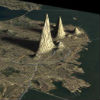
A topographic map of San Francisco’s crime rates reveals new landscape features including ‘Prostitution Peak’.
Click Here to Read More »»
10 Private Islands You Can’t Afford to Live On: Amazing, Exotic and Remote Luxury Retreats
Feeling a little cramped in your thousand square foot Manhattan apartment? Got a few extra million to blow?
Click Here to Read More »»
City Of God (2002) — 6/10. Full episodes of Movie Night, every Friday night at: bit.ly ~~ Movie Night ~~ This “Quick Review” is an excerpt from a full episode. Incorporating viewer comments and tweets, your host and film critic Jonathan Paula reviews everything from opening day releases, recent DVDs, and classics from years past. Along with your votes, these films are scored on the “Rate-O-Matic” for a 1-10 ranking. A “Five Word Summary” quickly encapsulates each review while “Factor Facts” highlight the the best and worst features of a movie in each of ten key categories. New episodes every Friday (November through May) on the JPizzle1122 channel. Born in February 1986, Jonathan Paula is a professional YouTuber and creator of the hit web series, “Is It A Good Idea To Microwave This?”. In April 2006 he founded Jogwheel Productions, a new media production company that specializes in web video. He has been reviewing films since 2003, and professionally since 2009. Jon graduated from Emerson College in 2008 with a degree in Television Production / Radio Broadcasting. He currently lives in Rockingham, NH with his wife Rebecca. ~~ Links ~~ Facebook —————- bit.ly Twitter ——————— bit.ly Main Channel ———– bit.ly 2nd Channel ———— bit.ly Movie Night Show —– bit.ly FAQ Video ————— bit.ly T-Shirts ——————- bit.ly ~~ Technical ~~ Created by —— Jonathan Paula Camera ———- Panasonic DVX-100b Microphone … Video Rating: 0 / 5
Anil tells Kiran that even she is unaware of her potential. He requests her to help him in his company matters. He convinces her to start calling him Anil. Vivek explains to Anandi that her mother has never been unkind to her, and tries to convince her to stay at her mother s place. Urmila and Manas argue about him taking Sonu away without informing her. Sonu starts crying seeing them fight. Kiran gets a lawyer for Abhimanyu, and when he suggests casting false accusations on Simran to get a divorce, Abhimanyu gets angry and asks him to get out. Video Rating: 5 / 5