Tag: City

  • Forested Facades: 13 Buildings Bringing Greenery to the City

    [ By Steph in Architecture & Cities & Urbanism. ]
    Vertical Greenery Main

    Why stop at parks when we could make cities lusher and greener by integrating thousands of plants right into the facades of urban buildings? Vertical greenery improves air quality, shades the buildings, adds privacy and creates habitats for native birds and insects. These 13 examples include a parking garage, private residences, retail spaces and the world’s tallest vertical garden.

    Vo Trong Nghia House Renovation
    Green Facades Vo Trong 1

    Green Facades Vo Trong 2
    Created as an example of how greenery can be incorporated back into urban Vietnam, this house renovation incorporates a galvanized steel screen that acts as a trellis for climbing plants, enhancing privacy and security while also filtering air and sunlight.

    Stacking Green by Vo Trong Nghia
    Green Facades Ho Chi Minh

    Another approach by the same architecture firm, Vo Trong Nghia, uses 12 layers of concrete planters to create a vertical garden around a tall and narrow home that’s 65 feet deep but only 13 feet wide. Staggered spaces between the layers offer room for different heights of plants.

    Bosco Verticale: Twin Green Towers
    Vertical Greenery Bosco 1

    Vertical Greenery Bosco 2

    Vertical Greenery Bosco 3

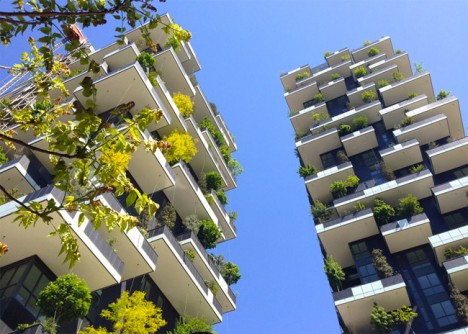
    Nearly 1,000 trees, 5,000 shrubs and over 10,000 other small plants have been added to the city of Milan in these two urban towers alone. The twin towers of the Bosco Verticale by Stefano Boeri were designed to meet all of the needs of a heavy load of plants, including irrigation, root systems and weight. The greenery brightens up the city, provides shade and cleaner air for residents, and offers habitats for regional birds and insects.

    Biological Concrete Absorbs Water & Grows Moss
    Green Facade Moss Concrete 1

    Green Facade Moss Concrete 2

    Building materials could be made with the growth of greenery in mind, making a layer of moss or ivy on the exterior a natural part of the structure rather than a potential problem. Scientists at the Universitat Politecnica de Catalunya in Barcelona are developing a ‘biological concrete‘ that captures rainwater to create living walls of moss and fungi.

    Green Cast by Kengo Kuma
    Green Facades Kengo Kuma

    Kengo Kuma and Associates created a patchwork aluminum facade with spaces for plants to grow for a pharmacy and clinic in Japan. Ventilation shafts and rainwater downpipes are concealed within the panels to keep the plants healthy.

    Next Page – Click Below to Read More:
    Forested Facades 13 Buildings Bringing Greenery To The City

    Share on Facebook


    [ By Steph in Architecture & Cities & Urbanism. ]

    [ WebUrbanist | Archives | Galleries | Privacy | TOS ]


    WebUrbanist

  • Dubai to Build New 50 Million Sq Ft Climate-Controlled City

    [ By WebUrbanist in Architecture & Cities & Urbanism. ]

    indoor mall of the world

    Always pushing the limits of posh possibility, this latest endeavor aims to put an entire urban center in a temperature-controlled bubble of indoor spaces, centered around a vast Mall of the World.

    indoor city street view

    Everything one can imagine will be found inside the complex, including 100 apartment and hotel buildings, various medical services, a huge shopping mall and the world’s largest indoor amusement park.

    indoor city giant billboards

    Its designers have unabashedly drawn from sources of inspiration around the world, including culturally central parts of New York, London and other historic metropolises.

    indoor city faux exteriors

    Like some surreal voluntary version of Stephen King’s Under the Dome, the whole thing can be experienced without stepping outside, particularly in hot summer months.

    indoor city terraces rivers

    In cooler winter months, some pedestrian street roofs and park domes will be retracted to allow for natural air circulation.

    indoor city domed spaces

    indoor city dubai design

    The goal, as expressed by Sheik Mohammed bin Rashid al-Maktoum (and envisioned by Dubai Holding), is to create a beacon for year-round tourism both from local visitors and those coming from abroad, transforming the UAE from a seasonal vacation spot to a place people can come at any time.

    indoor city exterior view

    indoor city cultural hub

    Its architects also claim the system will be eco-friendly, in part because the active and passive systems integrated throughout will work in concert with one another. Whether such a vast system in the desert can be green in the end (or willed be added to the growing list of failed abandonments in Dubai) remains to be seen .

    Share on Facebook


    [ By WebUrbanist in Architecture & Cities & Urbanism. ]

    [ WebUrbanist | Archives | Galleries | Privacy | TOS ]


    WebUrbanist

  • ‘Kodak City’ documents former imaging giant’s headquarters

    While many American cities have experienced the pains of a large population shift from the urban core to suburbs, there’s a poignancy to the abandoned storefronts in downtown Rochester, New York. The city’s name is inextricably tied to the name Eastman Kodak. Swiss photographer Catherine Leutenegger spent time photographing Rochester and Kodak’s headquarters, first in 2007 and again in 2012, and answered a few of our questions about the project. See gallery

    related news: Digital Photography Review (dpreview.com)

  • ‘Kodak City’ documents former imaging giant’s headquarters

    kodak_2007_1.jpg

    While many American cities have experienced the pains of a large population shift from the urban core to suburbs, there’s a poignancy to the abandoned storefronts in downtown Rochester, New York. The city’s name is inextricably tied to the name Eastman Kodak. Swiss photographer Catherine Leutenegger spent time photographing Rochester and Kodak’s headquarters, first in 2007 and again in 2012, and answered a few of our questions about the project. See gallery

    News: Digital Photography Review (dpreview.com)

  • Gritty City: Dark Oils Capture Essence of Bustling Urbanity

    [ By WebUrbanist in Art & Drawing & Digital. ]

    gritty city aerial view

    Buy shipyards, city streets, rain-streaked skyscrapers and other iconic staples of cities come alive in this portfolio of shadowy oil paintings.

    gritty moving cars towers

    gritty sidewalk intersection

    gritty city shipyard

    Valerio D’Ospina captures movement in the strokes of his brush, but the blurred results also take on that uncanny real-yet-indistinct character of a dream or memory, a little like the work of Alexandra Pacura.

    gritty multi way roads

    gritty city curve

    Born in Italy, Valerio studied in Florence, painted in Paris and eventually moved to Pennsylvania – his range of industrial subjects reflects studies of historic Europe as well as the infrastructure of the United States.

    gritty city skyscrapers

    gritty city street

    gritty narrow alley

    He was trained to teach, but has since turned toward full-time creation. From his bio: “After this teaching experience he decided to focus exclusively on painting, receiving positive feedback from private collectors and galleries from around the world.”

    Share on Facebook


    [ By WebUrbanist in Art & Drawing & Digital. ]

    [ WebUrbanist | Archives | Galleries | Privacy | TOS ]


    WebUrbanist

  • Sanges Indecent Eye & Lyubimkin’s City Lights

    Marco Sanges' The Indecent Eye Exhibition - Fashion Photography Blog (FashionPhotographyBlog.com)Readers based in London may be interested in hearing that the Hay Hill Gallery, who represent a selection of internationally recognized contemporary artists, will be presenting a double exhibition from the 26th May to the 21st June, showcasing the photographic works of fashion photographer, Marco Sanges, entitled “The Indecent Eye”, and the architectural images of Alexey Lyubimkin, called “City Lights”.

    Marco Sanges' The Indecent Eye Exhibition - Fashion Photography Blog (FashionPhotographyBlog.com)

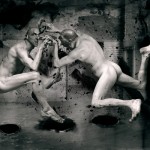
    Marco Sanges and possess a matchless photographic eye that creates alluring photography echoing the works of art from the Byzantine, Surrealist and Gothic periods. Not only are his images reminiscent of art paintings but he has ability to transmute and infuse each subject matter with its own and distinctive vibrancy and energy.

    Marco Sanges' The Indecent Eye Exhibition - Fashion Photography Blog (FashionPhotographyBlog.com)

    From developing and printing black and white photos in his uncle’s photographic lab, Sanges went on, in the pursuit of fashion, to become a photographer for Vogue Italia, before relocating to London where he presently resides. He has been exhibited worldwide, worked with clients such as Cutler and Gross, Agent Provocateur, Sunday Telegraph, Vogue, Trace, Elle, Dolce & Gabbana, and there is even a permanent collection of his work held in the Virginia Museum of Fine Arts, in the United States.

    Marco Sanges' The Indecent Eye Exhibition - Fashion Photography Blog (FashionPhotographyBlog.com)

    With his exhibition, Marco Sanges invites the public to visit and open their imaginations. As a storyteller, Sanges photographs appear to look more like cinematic narratives, as though we are looking through the lens as the photographer tells his tale. Having been influenced by the silent films of the 1920’s and 30’s, his dark and enchanting images portray the frailty and strength of humanity, confronting the viewer with the conclusion that there can be a funny side to our own mistakes if you choose to see it. Magician, puppet master and photographer, Sanges takes you on a journey of mystique and romantic intrigue in “The Indecent Eye” exhibition.

    Marco Sanges' The Indecent Eye Exhibition - Fashion Photography Blog (FashionPhotographyBlog.com)

    Having been provoked into deep thought by “The Indecent Eye”, you may wish to proceed through the “City Lights” exhibition in the same venue, displaying the architectural works of photographer, Alexey Lyubimkim. What can be described as love letter to the cities he shoots, revealing the tree and building lines as though they were part of the original city’s design blue-print. With a camera in hand, the lens is like a magnifying glass under Lyubimkim’s scrutinising eye that reveals what our naked eyes can’t see – an ever changing landscape.

    Alexey Lyumbimkin's City Lights Exhibition - Fashion Photography Blog (FashionPhotographyBlog.com)

    Born in Novosibirsk, Russia in 1963, Lyubimkim has worked as a professional architect, published the “Russian Gallery” art magazine, developed the growth of the Moscow’s Artist Center at Tretyakov Gallery and Savvinskaya Arts Center, was a founding member of London’s Hay Hill Gallery (where the exhibitions are held), and holds memberships in both the Russian Photo Artists Union and the International Journalist Union. His works have been sought after in private collections across the globe, including Russia, UK, Germany, Mexico and USA.

    Alexey Lyumbimkin's City Lights Exhibition - Fashion Photography Blog (FashionPhotographyBlog.com)

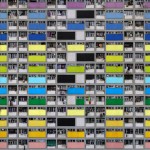
    How does architecture apply to fashion photography you may ask? Well, according to Alex Lyubimkin he says that “Architecture is the most stylish way of culture representation, and… like many people, I like to make my own discoveries. In this variety of city landscapes and cultural traditions no creative person can remain indifferent. I often carry my camera with me, which becomes my interpreter and even my partner… London is one of the most beautiful cities in the world for me.” Be inspired by the lines, shapes and bold use of color in Lyubimkin’s courtship of the cities he has photographed.

    Lyubimkin pays homage to the old technique of tinting images but incorporates a variety of contemporary solero hues. This artist’s colour fascination embodies the double take turn of the head towards beauty in amidst the bustle of a metropolitan city, encouraging the viewer to take notice of their surroundings next time they step outside. He brings to the surface the sense of home and belonging, while making conscious of the world around us at a local scale.

    Marco Sanges' The Indecent Eye Exhibition - Fashion Photography Blog (FashionPhotographyBlog.com)

    To visit or find more information for both Marco Sanges’ “The Indecent Eye” & Alexey Lyubimkin’s “City Lights” exhibitions, the contact details for the Hay Hill Gallery are below:

    Hay Hill Gallery

    Address: 35 Baker Street, London W1U 8EN

    Phone: 020 7486 6006

    Opening hours: Monday – Friday 10.30-6, Saturday 11-5

    Website: www.hayhillgallery.com

    Email: info@hayhillgallery.com

    Marco Sanges' The Indecent Eye Exhibition - Fashion Photography Blog (FashionPhotographyBlog.com)

    PHOTO CREDITS:

    Pictures 1, 2, 3, 4, 5, 8 & 9: from Marco Sanges’ “The Indecent Eye” Exhibition

    Pictures 6 & 7: from Alexey Lyubimkin’s “City Lights” Exhibition


    Fashion Photography Blog

  • Groundless City: A Guidebook to Underground Hong Hong

    [ By WebUrbanist in Travel & Urban Exploration. ]

    hong kong elevated walkway

    Between raised walkways, subways, ferries, cable cars, a multi-block outdoor escalator and extensive double-decker bus system, it is possible to traverse a huge swath of Hong Kong without even touching the ground (photo above by HappyKiddo).

    hong kong map detail

    At the same time, it is hard to find maps and illustrations of this vast urban phenomena – at least outside of Cities Without Ground: A Hong Kong Guidebook, which maps 32 networks of pedestrian paths above and below the surface.

    hong kong book cover

    Architects and authors Jonathan D Solomon, Clara Wong, and Adam Frampton (through ORO Editions) documented these interconnected systems in amazing detail. As Kevin Kelly writes, the book captures the essence of a sort of shadow city: “Beneath and between the gleaming skyscrapers built over the cramped confines of Hong Kong proper are miles of subterranean malls, passageways, stairs, subway stations, parking garages, escalators, skybridges, and food courts.”

    hong kong underground network

    Like aged cities themselves (or water-carved catacombs or piecemeal-generated anthills), these networks were not designed as a whole. Rather, they developed organically over time via both private and public initiatives, slowly forming a convoluted but beautiful and evolving patchwork of voids with various degrees of privacy and accessibility.

    hong kong detailed guidebook

    hong kong public diagrams

    If you do visit Hong Kong, try this for a start: take the escalator all the way up and back down the steeply-sloped hillside. Or: break off just before the bottom and stay on second-story walkways as far as they will take you. If you get stuck, instead of descending just to street level, go underground and see how far you can make it via subterranean passageways. If all else fails, hop on a bus, ferry or subway. You may be amazed at how far this combination can take you.

    hong kong urban diagram

    hong kong above

    More about the book from the official description: “Hong Kong is a city without ground. This is true both physically (built on steep slopes, the city has no ground plane) and culturally (there is no concept of ground). Density obliterates figure-ground in the city, and in turn re-defines public-private spatial relationships. Perception of distance and time is distorted through compact networks of pedestrian infrastructure, public transport and natural topography in the urban landscape.Without a ground, there can be no figure either. In fact, Hong Kong lacks any of the traditional figure-ground relationships that shape urban space: axis, edge, center, even fabric.” (Photo by Nicolas Vollmer)

    Share on Facebook


    [ By WebUrbanist in Travel & Urban Exploration. ]

    [ WebUrbanist | Archives | Galleries | Privacy | TOS ]


    WebUrbanist

  • Dense City: Mixed-Use ‘Urban Alloy’ Transit Hub for New York

    [ By WebUrbanist in Architecture & Public & Institutional. ]

    urban transit metal hub

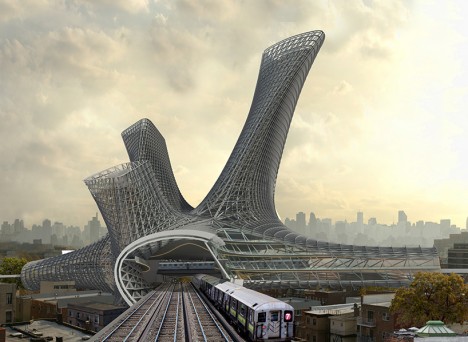
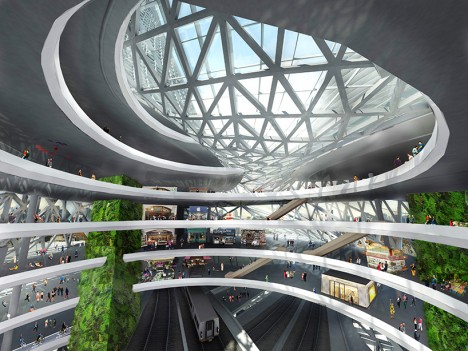
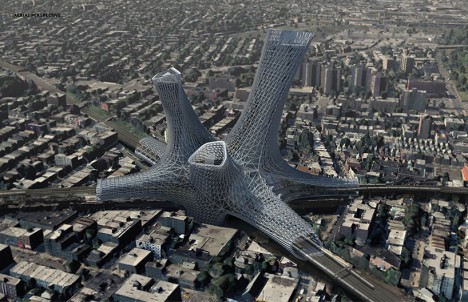
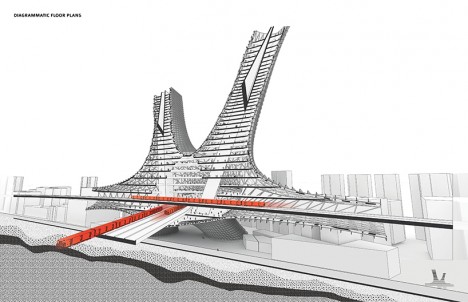
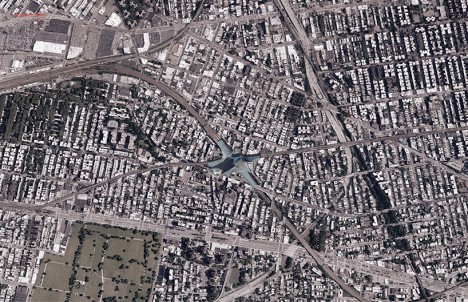
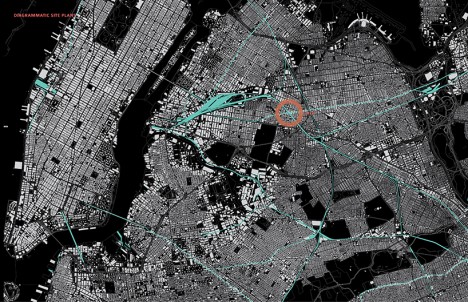
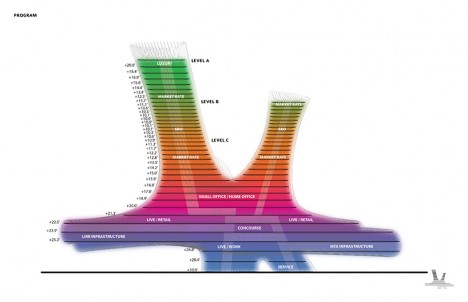
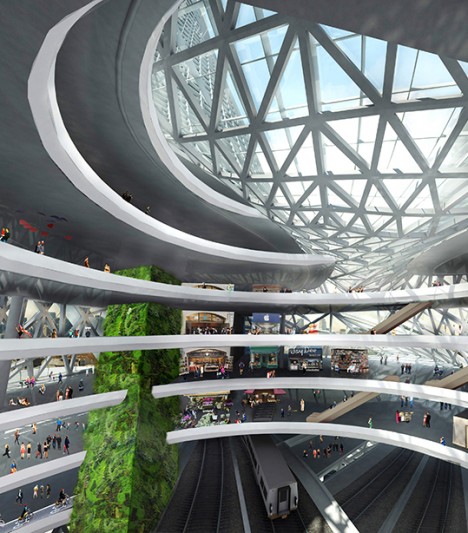
    Taking advantage of air rights above existing an transportation nexus, this design integrates elevated train lines, apartments, offices and shops to create a nodal point within NYC.

    urban wrapping interior levels

    urban amorphous architectural building

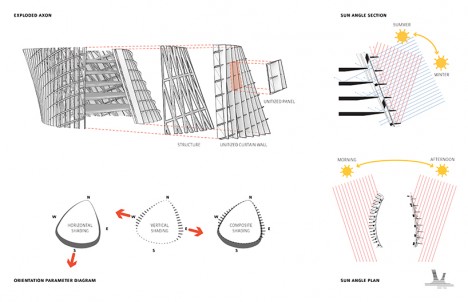
    Chad Kellogg and Matt Bowles of AMLGM clad the building in a distinctive metal-and-glass skin, intended to be iconic as well as functionally flexible, adaptive and responsive.

    urban lounge space level

    urban green eco strategies

    The connective steel structural elements morph according to an algorithm to allow for larger openings or shaded sections as needed.

    urban entry sliced section

    urban aerial satellite context

    The vertical extrusions shoot upward using the same language as the horizontal connectors, entries and extensions that tie the building into the urban fabric.

    urban skin concept models

    urban site context city

    The design is both oriented toward human occupation and contextually related to landscape of the surrounding city, operating effectively at multiple scales.

    urban section diagram drawing

    While similarly audacious large-scale, mixed-use projects have failed in the past, the density of NYC lends itself to such a compact, all-in-one approach.

    urban detail

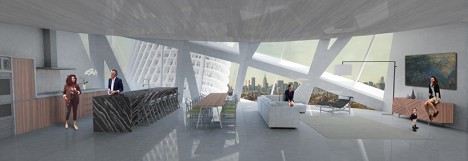
    From the designers: “A wide range of living conditions are offered within the one development. The programmatic options are set within a blend of floor plate geometries, transitioning from cylindrical to triangular from the base to the top of each tower. A composite or alloy of multiple flexible systems optimizes the skin so that each point has unique exposure, and is deployed on a grid that follows the direction of the surface.”

    Share on Facebook


    [ By WebUrbanist in Architecture & Public & Institutional. ]

    [ WebUrbanist | Archives | Galleries | Privacy | TOS ]


    WebUrbanist

  • ‘City of Samba’: Rio Carnival in tilt-shift

    Screen_Shot_2014-04-25_at_12.39.20_PM.png

    The breathtaking ‘City of Samba’ video chronicles the festival of Carnival in Rio de Janeiro through a creative mashup of stop-motion and tilt-shift photography. The world of Carnival is even more impressive when it feels like an immersive model, a cartoon come to life. Captured from a vantage point above the fray, the ‘City of Samba’ shows the hectic celebration as a crazy animated dance. See video

    News: Digital Photography Review (dpreview.com)

  • New York City: Straßenfotografie von Todd Gross

    Den Namen Todd Gross lernte ich kennen, als ich ein Video-Interview mit Eric Kim zu sehen bekam. Ich mochte den Typen und seine Bilder sofort, verlor ihn jedoch aus den Augen. Kurze Zeit später wurden seine Bilder in der TIME Lightbox vorgestellt, ich schaute seine Bilder noch einmal etwas genauer an und bin seither restlos begeistert von ihnen.

    Ein halbes Jahr später trafen wir uns persönlich. Und ich war aufgeregt. Doch Todd und ich, wir verstanden uns auf Anhieb und hatten einen ausführlichen Plausch über Leben, Jobs und natürlich die Straßenfotografie. Er erzählte mir, dass er seit den 90ern fotografiere und zeigte mir seine Kamera.

    Ihr Anblick ließ mich zuerst die Augenbrauen hochziehen und dann die Kinnlade herunterfallen. Ich sah eine analoge Kamera, an nichts einzustellen war. Nichts. Auslöser, Sucherlöchlein und Blitz. Das war förmlich alles. Ich konnte es gar nicht glauben. Ich fragte Todd, ob das sein Ernst oder ein Witz sei. Es war sein Ernst.

    Ich versuchte, in Gedanken seine grandiosen Bilder mit dem unscheinbaren Kästchen in Einklang zu bringen, das er sorgfältig betrachtend in Händen hielt.

    Straßenfotografie von Todd Gross: Ein Mann in gelbem T-Shirt schaut in einen Dohlen. New York City.

    Straßenfotografie von Todd Gross: Ein Mann mit Hut schaut in die Kamera – angeblitzt. New York City.

    Straßenfotografie von Todd Gross: Eine bedrohlich schauende Frau, fotografiert in einem Zimmer. New York City.

    Ein Mann sitzt am Boden und hat die Beine weit gespreizt. New York City.

    Straßenfotografie von Todd Gross: ein ausgelaufener Becher unter Bänken in der Bahn. New York City.

    Straßenfotografie von Todd Gross: Ein Mann hält sich an einem LKW fest und fliegt durch die Luft. New York City.

    Straßenfotografie von Todd Gross: Eine Frau beißt in ihren Geburtstagskuchen. New York City.

    Straßenfotografie von Todd Gross: an einer Scheibe steht "DESTINY" geschrieben und die Silhouette eines Mannes ist zu sehen. New York City.

    Straßenfotografie: Ein Mann in rotem T-Shirt und mit roter Kappe läuft um eine Ecke, an der ein roter Pfeil auf den Mann zeigt. New York City.

    Straßenfotografie von Todd Gross: Ein Mann sitzt neben einem Ghettoblaster am Strand. New York City.

    Eine Straßenfotografie von Todd Gross: Ein Autofahrer schaut aus dem Fenster, hinter ihm ist eine Welle zu sehen. New York City.

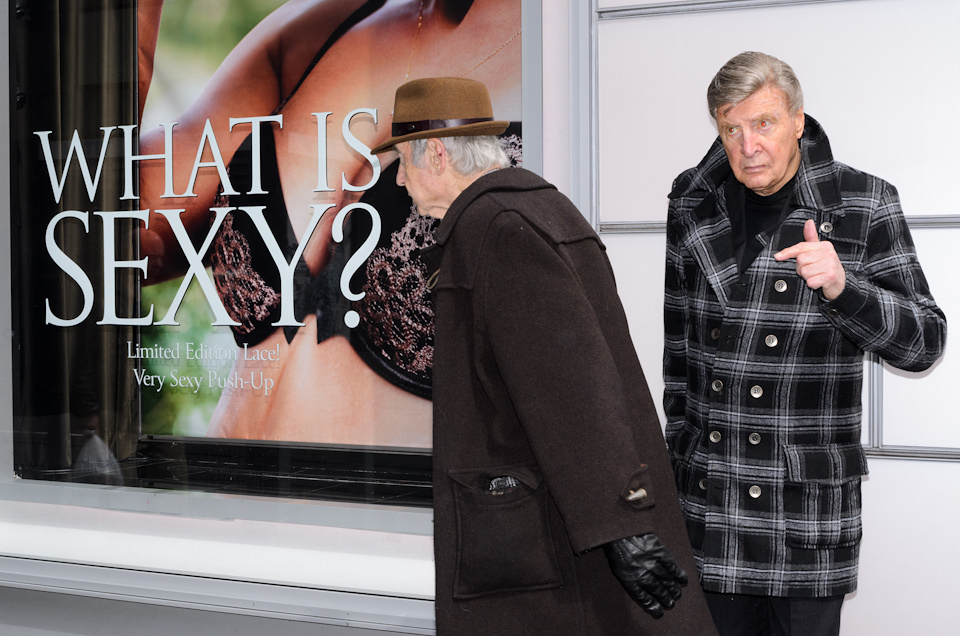
    Straßenfotografie von Todd Gross: Ein älterer Herr zeigt auf einen vorbeilaufenden Mann mit Hut und an der Wand hängt ein Poster, auf dem "What Is Sexy" steht. New York City.

    Straßenfotografie von Todd Gross: Das Portrait eines Mannes, der auf einer roten Banke sitzt, durch ein Fenster fotografiert. New York City.

    Was ich an Todds Bildern mag, ist diese kuriose Mischung aus schwarzem Humor und kongruierenden Farben.

    Etliche Aufnahmen scheinen mir zu gut, um wahr zu sein. Beispielsweise das Foto mit dem roten Pfeil oder dem gelben Telefon. Ich erinnere mich noch gut, als ich meinen Bürokollegen breit grinsend das „WHAT IS SEXY“-Foto unter die Nase hielt und wir vor lachen fast zusammengebrochen wären.

    Wenn ich diese Bilder sehe, weiß ich, dass Todd nicht nur Glück hatte, sondern unzählige Meilen aufmerksam gelaufen ist, um zu diesen Fotos zu kommen. Denn – und das vergisst man bei Todds Aufnahmen zu gern – originelle Straßenfotografie ist harte Arbeit. Als ich ihn irgendwann fragte, was ihn eigentlich motiviert, antwortete er:

    Ich habe so viel Zeug in meinem Kopf. Um das loszuwerden, ist die Kameraarbeit auf der Straße für mich die beste Lösung. Ein Bild führt zum nächsten.

    Und wie das nunmal so ist, wenn man jemanden persönlich kennt: Heute verbinde ich sehr viel mit den Bildern von Todd. Und deshalb folge ich ihm auf Twitter, Flickr und Tumblr.

    Und das könnt Ihr natürlich auch. Sucht Euch etwas aus, sagt hallo und erfreut Euch an seinen Updates. Ihr werdet merken, dass er kein Freund vieler Worte ist, aber seine Bilder wären es wert, ihm zehn Mal zu folgen.


    kwerfeldein – Fotografie Magazin | Fotocommunity