RSS
 

Posts Tagged ‘Capturing’

8 Simple Guidelines for Capturing Spectacular Sunrise and Sunset Images

26 Mar

When we are asked to think of popular subjects for landscape photography, images of beautiful sunsets immediately come to mind. What outdoor photographer worth his or her salt doesn’t have at least a couple of images of the sun dipping below the horizon? In most people’s minds, it is an easy thing to capture; the beauty and scale of the event itself should carry the photo, with minimal interaction from the photographer.
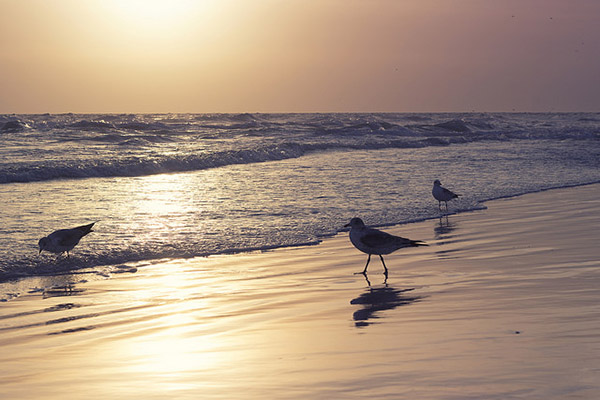
bird_trio

But is this really the case?

Unfortunately, it’s not. Unless you’re relying on luck alone, you’ll need to possess a few seeds of knowledge (eight in this case) to get you started in capturing that epic sunrise or sunset. None of these guidelines are difficult to comprehend, and can vastly improve your chances of properly capturing one of mother nature’s most incredible events.

1. Scout the Location

As tempting as it is to just show up at a convenient location and start shooting, you greatly increase your chances of success by planning the shoot in advance. The first thing you’ll want to determine is the best location from which to shoot.

Pick a location that is out of the way of road and foot traffic, where you’re unlikely to be disturbed. Go to the location in broad daylight before the shoot, and ensure your view of the horizon will be unobstructed and free of any hazards.

The most important factor after the location is time of the day. Obviously, this will vary depending on whether you’re capturing a sunrise or a sunset. Is there a storm coming? If your shooting time coincides with an approaching or recently-ended storm, the results can be staggering. Rain and storm clouds can add a dramatic layer of dimension to the scene.

Lastly, you can pinpoint the perfect time to shoot by using an online tool or smartphone app to determine precise sunrise and sunset times for your exact location. Many low-cost (and sometimes free) solutions are out there, including SunSeeker, Daylight Free, and the excellent Photographers Ephemeris to name a few.
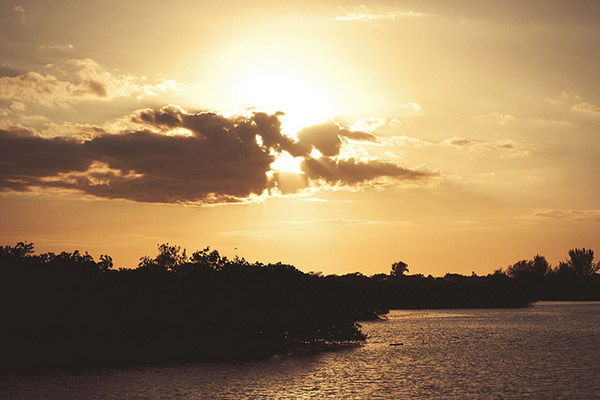
sunset_article3.jpg

2. Sunrise, or Sunset?

If you’re familiar with color temperature, you’ll know that there is a slight difference in the appearance of light at sunset versus what you’ll see at sunrise. Early morning light tends to be cooler (higher blue) than light in the late evening, which leans toward more warm color castings consisting of orange and red.

Since we know there are differing color temperatures at work here, you might need to adjust for this, depending on what feel you’re going for, either through warming or cooling filters, or adjustments in post-production to add or remove warmth into the color profile of the final photograph.

Be aware that physical filters used on your camera will degrade image quality slightly, due to the addition of another obstacle for light to pass through between your subject and your camera’s sensor
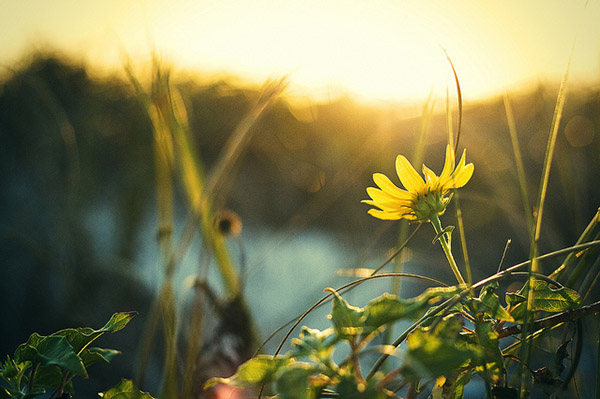
daisy

3. Plan your Shots

Another important step to accomplish before heading out is to plan out what you hope to achieve in the photo. What look are you going for?  Is there a definitive subject lit by the sunlight, or will the sunset itself be the star of the show?

This is also a great time to determine any other special considerations, such as the possibility of shooting an HDR (High Dynamic Range) photo. If that’s the case, you’ll need to prepare your camera for bracketed exposures to capture the full range of tones in the scene. Since these type of scenes normally consist of bright spots and shadows, this is a great way to produce some truly dramatic images.

4. Gather the Proper Gear

Obviously you can’t capture the right shot without the right gear; so make sure you have it all ready to go before you head out. First and foremost, you’ll want to bring your tripod. Sunrises and sunsets are potentially low-light situations (depending on what part of the sunset you’re trying to capture), so you want a steady base for your camera.

Secondly, you’ll want to determine what lens to use for the shot.  Even though beautiful landscapes can be captured using a 35mm or 50mm focal length (for sensors with a 1.6 crop factor – 56 to 80mm on a full frame system), a wide angle lens is preferred, including any zoom lenses that can capture a length of 25mm and below (40mm on a full frame system).  If you have a prime lens at these lengths, you will have a better chance of catching an even sharper image.  Using a wide angle lens will allow you to capture a more vast, sweeping portion of the scene.

Do you own and use screw-on filters for your camera?

Although using filters can degrade image quality a bit, due to the addition of another obstacle for light to pass through between your subject and your camera’s sensor, there are some that could be useful here, such as a GND (graduated neutral density) filter, to darken the upper portion of the sky a bit. Filters such as UV (ultraviolet) or polarizing filters may actually be a hinderance in these situations, and should be avoided. These filters reduce the amount of light coming in to the sensor, further increasing the required exposure time, which may not be idea if you’re trying to freeze any motion in the shot.
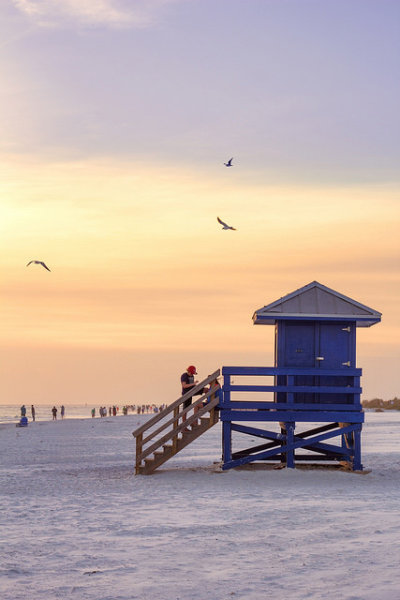
lifeguard_shack

5. Use the Right Settings

Another item that can be set up before you arrive to your shoot is the settings on the camera itself.

Since you’re shooting landscape, you’ll want to use a smaller aperture such as f/8, f/11 or even higher to maximize the depth of field and capture a sharp image throughout. If you’re using a tripod, this isn’t a problem.

Although shooting in manual mode is the norm here, to allow for minor changes in exposure compensation, I prefer to shoot almost everything in A/Av (aperture priority mode). This way I can lock in my aperture and let the camera choose a proper shutter speed. Since low-light situations like this can confuse the camera and you run the risk of overexposure, you can use your camera’s exposure compensation settings to fine-tune the exposure a bit lower.

A low ISO should also be used such as 100 or 200, to ensure there isn’t a lot of noise in the final shot. Again, with a tripod this isn’t an issue, but if you’re hand-holding for the shot, you will need to bump the ISO up to get a shutter speed that’s fast enough to avoid a disappointingly blurry photo.
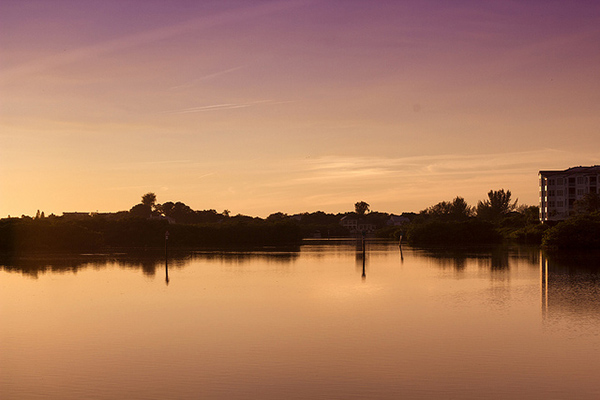
inlet_sunset

Another useful trick to increase warmth in your final shot is to set WB (white balance) to the “sunny” or “cloudy” setting instead of “auto”. Although you can certainly add warmth in post-processing, your initial image from the camera will be warmer if you make this adjustment now.

And of course, ALWAYS shoot in RAW! To a certain extent, shadows and highlights that are lost in a shot can be recovered in post-processing later.

6. Compose for Interest

Alright, the preparation is over, now we get to the fun part! Once you’re on location, and are ready to take the shot, you’ll want to make considerations for composition.

The most common error in shooting sunsets or sunrises is composing the horizon exactly in the middle of the photo. While this can work in some cases, it normally causes a bit too much symmetry and can make the picture uninteresting.

Take a moment to look the scene over; what part is the most dramatic? Are there any parts that aren’t as interesting of a focus?

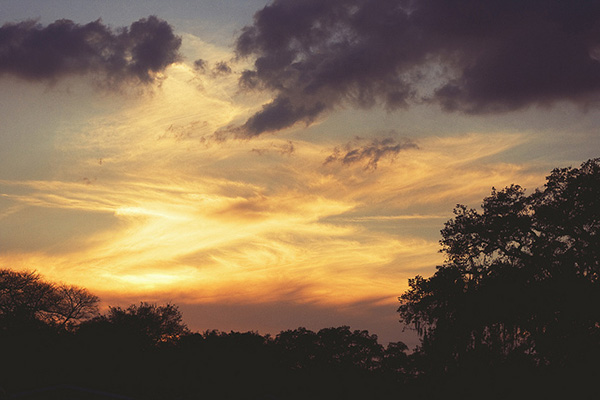
Once you have identified that, simply compose the shot to include more of the most dramatic scenery. If you have an angry, cloudy sky that accentuates the sunlight, let that occupy the upper 2/3 of the scene. If you have an interesting foreground or landscape below the sun, and a less-intriguing sky, let that occupy the bottom 2/3 of the image. You want to draw the viewer into the horizon, and then let their eyes drift to the most dramatic part of the image.
purple_sunset

7. Waiting for the Right Shot

If you already have experience shooting landscapes, you know that sometimes waiting is the name of the game. Because of the dynamics of natural lighting, a scene can completely change from one hour to the next, and sometimes even one minute to the next.

Now is the time to be creative! Try different exposure times, play with your exposure compensation settings for different tones. Let the clouds and sun change positions, and reshoot, or try a slightly different angle.

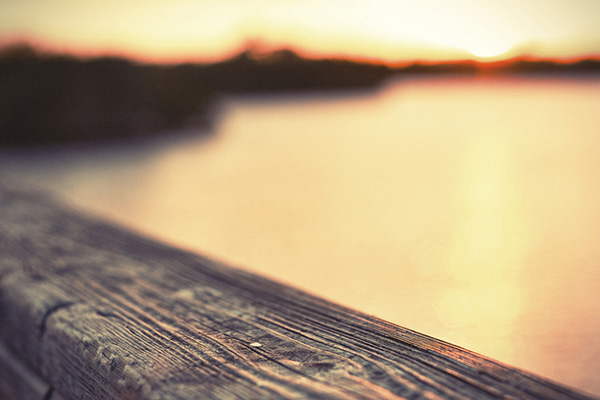
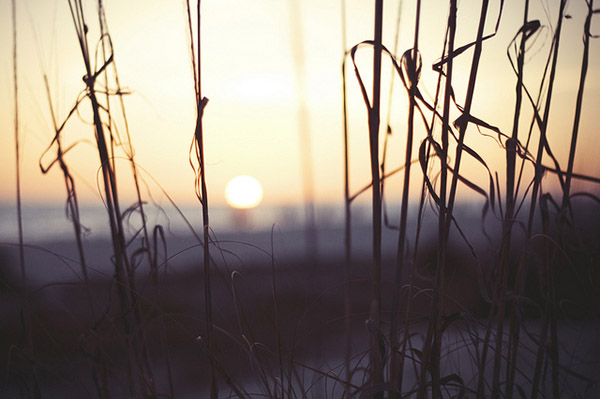
Maybe even allow different subjects to come in and out of frame, and shoot them in the foreground against the sunrise or sunset. The longer you’re at the location shooting, the more variety of shots you’ll end up with.
pier

Sunset article4

8. Don’t Leave Too Early

Lastly, one of the most common things you’ll hear about capturing sunsets, in particular, is to stick around after the sun dips below the horizon. This is certainly true, as the entire dynamic of a scene changes at this point.

Tones, colors and hues in the sky usually become more saturated and dramatic. You’ll need to allow for the loss of your main source of light, but it’s hard to deny some of the most beautiful images can be shot right after the sun is out of sight.

The post 8 Simple Guidelines for Capturing Spectacular Sunrise and Sunset Images by Tim Gilbreath appeared first on Digital Photography School.


Digital Photography School

 
Comments Off on 8 Simple Guidelines for Capturing Spectacular Sunrise and Sunset Images

Posted in Photography


8 Simple Guidelines for Capturing Spectacular Sunrise and Sunset Images

26 Mar

When we are asked to think of popular subjects for landscape photography, images of beautiful sunsets immediately come to mind. What outdoor photographer worth his or her salt doesn’t have at least a couple of images of the sun dipping below the horizon? In most people’s minds, it is an easy thing to capture; the beauty and scale of the event itself should carry the photo, with minimal interaction from the photographer.

bird_trio

But is this really the case?

Unfortunately, it’s not. Unless you’re relying on luck alone, you’ll need to possess a few seeds of knowledge (eight in this case) to get you started in capturing that epic sunrise or sunset. None of these guidelines are difficult to comprehend, and can vastly improve your chances of properly capturing one of mother nature’s most incredible events.

1. Scout the Location

As tempting as it is to just show up at a convenient location and start shooting, you greatly increase your chances of success by planning the shoot in advance. The first thing you’ll want to determine is the best location from which to shoot.

Pick a location that is out of the way of road and foot traffic, where you’re unlikely to be disturbed. Go to the location in broad daylight before the shoot, and ensure your view of the horizon will be unobstructed and free of any hazards.

The most important factor after the location is time of the day. Obviously, this will vary depending on whether you’re capturing a sunrise or a sunset. Is there a storm coming? If your shooting time coincides with an approaching or recently-ended storm, the results can be staggering. Rain and storm clouds can add a dramatic layer of dimension to the scene.

Lastly, you can pinpoint the perfect time to shoot by using an online tool or smartphone app to determine precise sunrise and sunset times for your exact location. Many low-cost (and sometimes free) solutions are out there, including SunSeeker, Daylight Free, and the excellent Photographers Ephemeris to name a few.

sunset_article3.jpg

2. Sunrise, or Sunset?

If you’re familiar with color temperature, you’ll know that there is a slight difference in the appearance of light at sunset versus what you’ll see at sunrise. Early morning light tends to be cooler (higher blue) than light in the late evening, which leans toward more warm color castings consisting of orange and red.

Since we know there are differing color temperatures at work here, you might need to adjust for this, depending on what feel you’re going for, either through warming or cooling filters, or adjustments in post-production to add or remove warmth into the color profile of the final photograph.

Be aware that physical filters used on your camera will degrade image quality slightly, due to the addition of another obstacle for light to pass through between your subject and your camera’s sensor

daisy

3. Plan your Shots

Another important step to accomplish before heading out is to plan out what you hope to achieve in the photo. What look are you going for?  Is there a definitive subject lit by the sunlight, or will the sunset itself be the star of the show?

This is also a great time to determine any other special considerations, such as the possibility of shooting an HDR (High Dynamic Range) photo. If that’s the case, you’ll need to prepare your camera for bracketed exposures to capture the full range of tones in the scene. Since these type of scenes normally consist of bright spots and shadows, this is a great way to produce some truly dramatic images.

4. Gather the Proper Gear

Obviously you can’t capture the right shot without the right gear; so make sure you have it all ready to go before you head out. First and foremost, you’ll want to bring your tripod. Sunrises and sunsets are potentially low-light situations (depending on what part of the sunset you’re trying to capture), so you want a steady base for your camera.

Secondly, you’ll want to determine what lens to use for the shot.  Even though beautiful landscapes can be captured using a 35mm or 50mm focal length (for sensors with a 1.6 crop factor – 56 to 80mm on a full frame system), a wide angle lens is preferred, including any zoom lenses that can capture a length of 25mm and below (40mm on a full frame system).  If you have a prime lens at these lengths, you will have a better chance of catching an even sharper image.  Using a wide angle lens will allow you to capture a more vast, sweeping portion of the scene.

Do you own and use screw-on filters for your camera?

Although using filters can degrade image quality a bit, due to the addition of another obstacle for light to pass through between your subject and your camera’s sensor, there are some that could be useful here, such as a GND (graduated neutral density) filter, to darken the upper portion of the sky a bit. Filters such as UV (ultraviolet) or polarizing filters may actually be a hinderance in these situations, and should be avoided. These filters reduce the amount of light coming in to the sensor, further increasing the required exposure time, which may not be idea if you’re trying to freeze any motion in the shot.

lifeguard_shack

5. Use the Right Settings

Another item that can be set up before you arrive to your shoot is the settings on the camera itself.

Since you’re shooting landscape, you’ll want to use a smaller aperture such as f/8, f/11 or even higher to maximize the depth of field and capture a sharp image throughout. If you’re using a tripod, this isn’t a problem.

Although shooting in manual mode is the norm here, to allow for minor changes in exposure compensation, I prefer to shoot almost everything in A/Av (aperture priority mode). This way I can lock in my aperture and let the camera choose a proper shutter speed. Since low-light situations like this can confuse the camera and you run the risk of overexposure, you can use your camera’s exposure compensation settings to fine-tune the exposure a bit lower.

A low ISO should also be used such as 100 or 200, to ensure there isn’t a lot of noise in the final shot. Again, with a tripod this isn’t an issue, but if you’re hand-holding for the shot, you will need to bump the ISO up to get a shutter speed that’s fast enough to avoid a disappointingly blurry photo.

inlet_sunset

Another useful trick to increase warmth in your final shot is to set WB (white balance) to the “sunny” or “cloudy” setting instead of “auto”. Although you can certainly add warmth in post-processing, your initial image from the camera will be warmer if you make this adjustment now.

And of course, ALWAYS shoot in RAW! To a certain extent, shadows and highlights that are lost in a shot can be recovered in post-processing later.

6. Compose for Interest

Alright, the preparation is over, now we get to the fun part! Once you’re on location, and are ready to take the shot, you’ll want to make considerations for composition.

The most common error in shooting sunsets or sunrises is composing the horizon exactly in the middle of the photo. While this can work in some cases, it normally causes a bit too much symmetry and can make the picture uninteresting.

Take a moment to look the scene over; what part is the most dramatic? Are there any parts that aren’t as interesting of a focus?

Once you have identified that, simply compose the shot to include more of the most dramatic scenery. If you have an angry, cloudy sky that accentuates the sunlight, let that occupy the upper 2/3 of the scene. If you have an interesting foreground or landscape below the sun, and a less-intriguing sky, let that occupy the bottom 2/3 of the image. You want to draw the viewer into the horizon, and then let their eyes drift to the most dramatic part of the image.

purple_sunset

7. Waiting for the Right Shot

If you already have experience shooting landscapes, you know that sometimes waiting is the name of the game. Because of the dynamics of natural lighting, a scene can completely change from one hour to the next, and sometimes even one minute to the next.

Now is the time to be creative! Try different exposure times, play with your exposure compensation settings for different tones. Let the clouds and sun change positions, and reshoot, or try a slightly different angle.

Maybe even allow different subjects to come in and out of frame, and shoot them in the foreground against the sunrise or sunset. The longer you’re at the location shooting, the more variety of shots you’ll end up with.

pier

Sunset article4

8. Don’t Leave Too Early

Lastly, one of the most common things you’ll hear about capturing sunsets, in particular, is to stick around after the sun dips below the horizon. This is certainly true, as the entire dynamic of a scene changes at this point.

Tones, colors and hues in the sky usually become more saturated and dramatic. You’ll need to allow for the loss of your main source of light, but it’s hard to deny some of the most beautiful images can be shot right after the sun is out of sight.

The post 8 Simple Guidelines for Capturing Spectacular Sunrise and Sunset Images by Tim Gilbreath appeared first on Digital Photography School.


Digital Photography School

 
Comments Off on 8 Simple Guidelines for Capturing Spectacular Sunrise and Sunset Images

Posted in Photography


Infographic Feature: Capturing Perfect Wedding Photos

06 Jan

There are many wedding photographers (or people who merely think they can shoot weddings), but there are also many who could brush up on their skills. That’s putting it lightly. We believe that wedding photography is basically a category onto itself because of the high degree of skill and specificity required to pull off shooting any wedding successfully. We’ve covered Continue Reading

The post Infographic Feature: Capturing Perfect Wedding Photos appeared first on Photodoto.


Photodoto

 
Comments Off on Infographic Feature: Capturing Perfect Wedding Photos

Posted in Photography


Secret Cities: Capturing Hidden Abandoned Places on Film

12 Nov

[ By Steph in Abandoned Places & Architecture. ]

Secret Cities Abandoned Places 1
Just beyond all of the noise and activity of daily urban life is a secret world of forgotten spaces which are nearly always dank and dusty, but often surprisingly beautiful. Photographer Andrew Brooks seeks out these spots in Manchester, UK and Sittard-Geleen, The Netherlands, capturing them on film so the less adventurous can experience a small fraction of their crumbling glory.

Secret Cities Abandoned Places 2

Brooks gains entry into grand disused buildings that seem frozen in time, like the Hulme Hippodrome and Manchester’s Albert Hall, as well as subterranean tunnels and decommissioned water towers. At his website, the photographer provides detailed information about each location he shoots, describing what it felt like to experience them firsthand, as well as offering his stunning images.

Secret Cities Abandoned Places 3

Secret Cities Abandoned Places 6

The forgotten spaces just out of view of the average person in virtually any major city around the world start to occupy ‘imaginary spaces,’ says Brooks. It’s easy to envision them as settings for all sorts of fictional intrigue, to let our imaginations run wild with the possibilities of these often complex spaces, yet most of us are too wrapped up in our immediate surroundings to give them much thought.

Secret Cities Abandoned Places 4

Secret Cities Abandoned Places 5

“The familiar space we occupy gradually take on the character of wallpaper in our lives as we hurry from meeting to meeting, commitment to commitment, never stopping to appreciate the places where we live. In our rush we miss both the fantasy and reality of our pace in the world, habitually ignoring even the points where the opportunities for simple adventure encourage us to indulge.”

Share on Facebook


[ By Steph in Abandoned Places & Architecture. ]

[ WebUrbanist | Archives | Galleries | Privacy | TOS ]


WebUrbanist

 
Comments Off on Secret Cities: Capturing Hidden Abandoned Places on Film

Posted in Creativity


28 September, 2013 – Capturing a Mysterious Incident

29 Sep

During their testing of the new Blackmagic Pocket Cinema Camera, Chris, Kevin, and Michael witnessed a strange occurance. A brief video, which they were able to capture shows what happened. You may view this on the site’s Home Page.


The Luminous Landscape – What’s New

 
Comments Off on 28 September, 2013 – Capturing a Mysterious Incident

Posted in News


How Capturing Expressive Eyes Can Be The Key To Good Portraiture

13 Aug

Paul Kostabi

If you look at some of the most famous photographs in history, such as Dorothea Lange’s Migrant Mother, Steve McCurry’s Afghan Girl, or much of Irving Penn’s work, you might notice there’s one thing that they have in common, a powerful emotion in the main subject’s eyes.

While this is far from a steadfast rule, if you’re doing portraiture, street photography, or photojournalism, catching a powerful expression in the eyes can be the difference between a mediocre photograph and the best photo you’ve ever taken.

If you watch a person’s eyes and wait, you can see when they are experiencing something, recalling a moment, or feeling an emotion.  That sometimes split second is when you need to take the shot.  You can create an amazing composition with gorgeous lighting, but if there is no expression coming through from the subject then the photograph will be lacking.  And that expression often begins with the eyes.

It could be a fleeting glance away from the camera as the subject recalls a story or a powerful gaze into the camera.   A momentary glance from the eyes can portray strength, fear, romance, nostalgia, confidence, glamour, and so many other emotions.

A good trick to elicit these emotions is to get the subject talking about a meaningful moment in their lives.  The more time you are able to spend with them, the more they will open up and the more opportunities you will have to capture these emotions.  Or with some, you can even simply state the emotion and they will be able to portray it (“Give me confidence!”)

So the next time you create a portrait, make sure to pay special attention to the eyes.

Pushups, Rucker Park

Post originally from: Digital Photography Tips.

Check out our more Photography Tips at Photography Tips for Beginners, Portrait Photography Tips and Wedding Photography Tips.

How Capturing Expressive Eyes Can Be The Key To Good Portraiture


Digital Photography School

 
Comments Off on How Capturing Expressive Eyes Can Be The Key To Good Portraiture

Posted in Photography


7 Secrets to Capturing Awesome Beach Photographs

12 Aug

To be on the beach in summer is relaxing, fun and beautiful. It is also a great idea to capture those happy moments in the photographs but if you are not sure where to begin from, you can actually fall victim to the stress. Therefore, you need to prepare well in advance about what you are going to do while Continue Reading

The post 7 Secrets to Capturing Awesome Beach Photographs appeared first on Photodoto.


Photodoto

 
Comments Off on 7 Secrets to Capturing Awesome Beach Photographs

Posted in Photography


Capturing colorful high-speed lightbulb explosions with a low-cost rig

12 Jul

Hatching.jpg

Ever since Harold Edgerton photographed a bullet tearing through an apple, it seems the urge to document these split seconds of destruction has not flagged. In photographer Jon Smith’s case, his victims are lightbulbs filled with colorful objects. He creates the images using a DSLR, a pellet gun and a relatively inexpensive lighting setup all in his garage. Click through for more details. 

News: Digital Photography Review (dpreview.com)

 
Comments Off on Capturing colorful high-speed lightbulb explosions with a low-cost rig

Posted in Uncategorized


5 Tips For Capturing Great Street Portraits

27 May

A Guest Post by Desmond Louw

I just love street photography and with this comes street portraiture.

DPS post 02.jpg

It can be a bit daunting to go up to a stranger and ask them to take their photo, but after a day or two it becomes addictive!  Here are some tricks that might make it a bit easier for you:

Trick number 1

?Always have your camera with you, don’t lug your whole photo bag or a tripod around like a tourist in your own town, just have your camera body and one lens handy. It sucks walking in the street and seeing something awesome and not having my camera with me!

DPS post 13.jpg

Trick number 2

?Have a good lens, this makes a huge impact. I like the 50mm F1.4/F1.8 and the 85mm F1.4/ F1.8, they are also small and relatively lightweight.

DPS post 01.jpg

The wide aperture isolates your subject nicely with a shallow depth of field.

Trick number 3

?Don’t use a flash! Remember you want to maintain a low profile. Rather push your ISO up if you have to. I personaly think an onboard flash could spoil a photo.

DPS post 07.jpg

Trick number 4

?Before approaching a person to ask him or her if you can take a photo, have your settings spot on. When they say yes, lift your arms and snap snap snap, say thank you, and walk away. Easy.

DPS post 09.jpg

Trick number 5

?If you are taking a shot of someone without them knowing, keep the auto focus assist light off, otherwise they will see it and spoil the mood.

DPS post 14.jpg

Connect with Desmnd Louw at his website and on instagram where his id is – desmond_in_capetown

Post originally from: Digital Photography Tips.

Check out our more Photography Tips at Photography Tips for Beginners, Portrait Photography Tips and Wedding Photography Tips.

5 Tips For Capturing Great Street Portraits


Digital Photography School

 
Comments Off on 5 Tips For Capturing Great Street Portraits

Posted in Photography


6 Secret Photography Lighting Techniques For Capturing A Good Photo

22 May

Everyone loves to take pictures. With the easy availability of cheap DSLR cameras on the market and the advent of affordable photography gadgets, who wouldn’t right? If you are one of those who loves photography, then you probably are already aware of one or two techniques to make your pictures look awesome! But if you’re looking to further improve your Continue Reading

The post 6 Secret Photography Lighting Techniques For Capturing A Good Photo appeared first on Photodoto.


Photodoto

 
Comments Off on 6 Secret Photography Lighting Techniques For Capturing A Good Photo

Posted in Photography