RSS
 

Posts Tagged ‘Cameras’

DPReview Recommends: Best compact cameras for travel 2015

18 Dec

Whether you’re traveling the world or the next town over, having the right camera at your side makes all the difference. We’ve picked out our best picks for the photographer who wants to keep things simple by carrying a compact camera rather than one with interchangeable lenses. If you fall into that category, we’ve got great news for you – there are more high quality cameras with attached lenses than ever before, brimming with features tailored to your needs. 

Fujifilm X100T

$ 1099 | 16MP APS-C sensor | 35mm equiv F2 lens | Hybrid electronic / optical viewfinder | 3″ LCD

Few cameras in recent history have attracted as much of a cult following as Fujifilm’s X100 series. They’re the photographer’s darling – not just a good-looking camera, but a beautifully effective machine. The X100T is small and light, and won’t burden a weary traveler, and its low-profile lends itself to street shooting. If you don’t mind zooming with your feet, its 35mm F2 equivalent lens and 16MP X-Trans APS-C sensor will serve you well.

In addition to its travel-friendly size, the X100T offers a hybrid viewfinder with optical and digital views. That’s especially handy when the sun is high in the sky and the 1.04M-dot 3″ LCD becomes harder to see. Having been on the market over a year (at time of publication), its 16 megapixels are starting to feel quite low in comparison to some of its peers, but it also means that the price has dropped slightly since its launch. It is worth noting though that its movie mode, which was far from class-leading at launch, is now well behind the competition in terms of quality and 4K support.

With obviously classic design cues, the X100T’s controls and handling are timeless. Though it doesn’t offer the cutting-edge modern features of its newer peers, it won’t go out of style anytime soon. 

Also consider…

Ricoh GR II
Not a revolutionary update to the original by any means, but the Ricoh GR II’s 16MP APS-C sensor and 28mm F2.8 make the camera one of the best bargains on the market for under $ 600.

Panasonic Lumix FZ1000

$ 750 | 20MP 1″-type sensor | 4K video | 25-400mm equiv. focal range | XGA OLED viewfinder

You can zoom with your feet all day long, but some situations and shooting styles call for real zoom. The Panasonic Lumix FZ1000 doesn’t top its class in terms of massive zoom reach, but its 25-400mm equivalent zoom opens up plenty of options, and an F2.8-4.0 aperture is brighter than most of its peers. With a 1″-type 20.1MP CMOS sensor, it borrows some tech from the GH4 including 4K video recording at 30 fps. Its DSLR-style build includes a fully articulated 921k-dot 3″ LCD and a 2.4M-dot OLED viewfinder.

Also consider… 

Nikon Coolpix P900 
On the seventh day, the Nikon Coolpix P900 was created. And there was much zoom. An incredible 24-2000mm equivalent range, in fact. The P900 uses a considerably smaller 16MP sensor than the FZ1000, but its lens is impressive considering what it has to do, the image stabilization is amazing, and the built-in GPS won’t let you forget where you’ve been.

Sony Cyber-shot DSC-RX100 IV

$ 950 | 20MP 1″-type sensor | F1.8-2.8 24-70mm equiv. lens | Pop-up EVF | 4K video

It’s hard not to recommend the Sony RX100 IV to anyone buying a compact. It’s by no means a budget-friendly option, but it’s among the most capable pocket-sized cameras we’ve ever tested. Sony’s excellent 20MP 1″-type sensor is bigger than your garden-variety compact camera sensor with lots of dynamic range, and a 24-70mm equiv. F1.8-2.8 lens is much brighter than most of its competition. The camera’s tiny pop-up EVF is higher resolution than that of it predecessor and comes in very handy in bright outdoor light.

The RX100 IV really shines when you set the mode dial to movie mode. 4K/UHD recording is available, and at lower resolutions (upscaled to 1080p) high frame rates of 240, 480 and 960 fps can be used. Slow motion video is an awful lot of fun.

If you want to take control over your settings, shoot high quality video and make the most of your vacation Raw files, the RX100 IV is a solid choice. Of course, if you can live without 4K and high frame rates, the RX100 III will save you a couple hundred dollars and get you much of the same excellent image quality. Neither will get you a lot of zoom if that’s what you’re after, but their image quality is at the top of their class.

Also consider…

Panasonic Lumix DMC-ZS50 
Before there were fancy Sony point-and-shoots with 1″ sensors, Panasonic had the market cornered on premium zoom compacts for travelers. While its 12MP 1/2.3″ sensor looks a bit pedestrian in comparison, there’s something to be said for a 24-720mm equiv. zoom that just about fits in your pocket. And for under $ 300, it’s pretty much a steal for full manual controls, Raw support and Wi-Fi with NFC.

Panasonic Lumix DMC-LX100

$ 700 | 13MP Four Thirds sensor | 24-75mm equiv. F1.7-2.8 lens | Electronic viewfinder | 4K video

Why stop at a 1″-type sensor? That’s the question Panasonic engineers must have asked themselves, and lo and behold, the Lumix LX100 was born. It uses a cropped 13MP Four Thirds sensor coupled with a very fast 24-75mm equiv. F1.7-2.8 lens and offers great ergonomics and handling for the kind of photographer who wants quick access to exposure settings. It’s not as pocket-friendly as the RX100 IV, but its solid handgrip gives it a steady feel and its responsive user experience is one of the best we’ve encountered in a compact.

In addition to recording 4K video, the LX100 also offers a useful 4K Photo Mode, which lets you extract a high quality 8MB still from your clip. Its time-lapse and stop motion animation modes are also a lot of fun. Its zoom is certainly on the shorter side, and for someone who plans to stay in Auto mode the camera’s controls and customization will verge on overkill. But for the seasoned photographer wanting to give her shoulders a break from the big camera, the LX100 is a joy to carry and shoot with.

Also consider…

Canon PowerShot G5 X 
If you want just a bit more zoom (100mm at the top end) and a more traditional SLR-style body you may want to consider the Canon PowerShot G5 X. It sports a 20MP 1″-type BSI CMOS sensor (likely the same as in the RX100 III) and a 24-100mm equiv. F1.8-2.8 lens, along with a fully articulating LCD, high resolution EVF, and full set of manual controls. It’s not great for action shooting and it lacks 4K video, but the G5 X is still worth a look.

Olympus Tough TG-4

$ 350 | 16MP 1/2.3″ BSI CMOS sensor | 25-100mm equiv. F2.0-4.9 lens | Everything-proof

Nothing spoils a vacation like spilling a Mai Tai on your fancy new camera. The Olympus TG-4 isn’t just sealed against spills, its fully waterproof to 15m/50ft, as well as shockproof from 2.1m/7ft, crushproof to 100kg/220lbf and freezeproof to -10C/14F. Wherever your travels may take you, the TG-4 is up to the challenge.

Outside of its rugged specs, we like the TG-4’s ability to shoot Raw, making it possible to get very nice image quality with a little time invested in post-processing. Its moderate 25-100mm equiv. zoom, which is fast at its wide end, will get you a little closer to the action, and optional accessories like a macro LED ring light and waterproof fisheye lens open up more possibilities. It also provides the peace of mind of knowing your camera will survive just about anything your vacation throws at it.

Also consider…

Olympus Tough TG-860
The Stylus TG-860 is the TG-4’s more casual sibling, lacking buttoned-up features like Raw capture and Aperture priority mode, but provides identical rugged specifications with a flip-up selfie-friendly LCD. If you don’t anticipate doing extensive editing to your snapshots, the TG-860 is good, clean fun for a significantly cheaper price.

Articles: Digital Photography Review (dpreview.com)

 
Comments Off on DPReview Recommends: Best compact cameras for travel 2015

Posted in Uncategorized


DPReview recommends: Best Cameras for Kids 2015

16 Dec

If they’re young enough, your kids have always known a world in which smartphones are the most popular devices for taking photos. That’s too bad. To ensure that the next wave of young photographers understand the performance and ergonomic advantages of using a real camera, you’ll need to get one into their hands as soon as possible.

But wait! Before you sneak a Nikon D810 into your baby’s basket of toys, you’ll need to consider choking hazards and the fact that some children are a lot more careful than others when it comes to handling expensive electronics. If you want to buy a camera specifically for your child – or a camera that your entire family can share without worrying too much – durability and ease of use are just as important, if not more, as image quality and features.

And, of course, much of that depends on the age and maturity level of your child. We wouldn’t trust any toddler or the vast majority of 10-year-old boys with an advanced point-and-shoot, but for a teenager or pre-teen that’s wise beyond their years and genuinely interested in photography, a compact with a lot of zoom and manual controls to grow into might be a great fit.

So here’s a selection of some of what we think are the best camera options for your kids. Most of these models aren’t specifically for kids, and all of the obvious caveats apply. Batteries aren’t edible, memory cards are choke hazards, cameras can hurt when they’re thrown at people, etc. All prices are approximate street prices, correct at time of publication, and if you think we’ve missed a model that deserves consideration, let us know in the comments!

Younger Kids

If you’re shopping for kids 6 and under, you probably don’t want to spend a lot of money, and durability is likely to be important. You want something lightweight that won’t break the first time it gets dropped, and the simpler the operation the better.

Vtech Kidizoom Connect ($ 48)

1.3MP sensor | 4X digital zoom | 1.8″ LCD | 320 x 240 video | 128MB built-in memory | uses AA batteries

Baby’s first piece of kit should be tough and inexpensive, and the VTech KidiZoom fits the bill. This durable 1.3-megapixel camera/toy comes has a fixed lens with 4X digital zoom, 128MB of internal memory (with an option for MicroSD memory card expansion), a 1.8″ LCD and 320 x 240 video. There are even three photo-related games to keep your kids entertained.


Nikon Coolpix S33 ($ 99)

13.2MP CMOS sensor | 30-90mm equiv. lens | Waterproof to 32ft | Shockproof from 5ft | Full HD video

Cameras do get bumped and dropped (or worse), making Nikon’s inexpensive waterproof, shockproof and freezeproof Coolpix S33 worth a look. It features an easy-to-use interface and dedicated one-touch buttons for simple shooting. Although it’s 13.2 megapixel CMOS sensor is roughly the size of what’s in your smartphone, it can capture decent quality images. Its lens has a focal range of of 30-90mm – adequate for most purposes. A dedicated movie record button allows users to quickly shoot Full HD video clips. The S33 offers sixteen creative styles and effects options (including Underwater Face Detection) and an option to shoot videos with a miniature effect.


Fujifilm instax mini 8 ($ 80)

Makes card-sized instant prints | 60mm equiv. fixed lens | Uses AA batteries | Comes in several colors

Now your kids can relive the days of instant prints with the Fujifilm instax mini 8, one of several models available from the company. It’s definitely not rugged, but the thrill of getting a 2.4 x 1.8 inch print in about 2-3 minutes will excite both kids and adults alike. The mini 8 is a very basic camera, with a small optical viewfinder (and no LCD), dial-in exposure, and a flash that always fires. One important thing to know is that instax cameras are a bit of a money pit, with a ten pack of film priced at around $ 8.50, so your little photographers will need to be pretty selective before pressing that shutter release button.  


Viddy Pinhole Camera kit ($ 57)

DIY pinhole camera | Accepts 35mm or medium-format film | Available in four colors

For the creative kid with a do-it-yourself attitude, the VIDDY is a pinhole camera kit made from tough, durable recycled cardboard in four colors: green, black, blue or red. It accepts both medium format and 35mm film. Bonus: it’s a perfect project between parent and child. Pop out VIDDY’s screen printed parts and assemble in 30 minutes.


Polaroid Cube ($ 99)

6MP sensor | 35mm lens w/124° angle-of-view | Weatherproof | Full HD video | Numerous mounts available

The latest HD action camera from Polaroid combines a 6MP sensor with a lens with an impressive 124° field-of-view and puts it into a weatherproof body measuring just 35mm on each side. The camera has can record Full HD video onto an optional microSD card, and a 90 minute battery allows extended recording for every bike ride and beach adventure. Just like more expensive GoPros, there are numerous mounts available for the Cube, plus an underwater housing. And a magnet in the camera’s base opens up even more potentially interesting vantage points.

For those seeking Wi-Fi capabilities, the Cube+ offers that for $ 149.

Older Kids

Durability may be less important in a camera for this age group, but it really depends on the child. In our selection we’re assuming that you’re buying for a kid who’s learned not to throw precious things around, and most of the models we’ve chosen offer a little room for your child to grow away from the strictly auto-everything snap-shooting if they get more confident.

Olympus Tough TG-4 ($ 349)

16MP BSI CMOS sensor | 25-100mm equiv. lens | Waterproof to 50ft | Full HD video | Wi-Fi + GPS

For kids that are on the go – or have the tendency to drop expensive pieces of electronics, the Olympus TG-4 is a good choice. It’s well built, responsive, full-featured and produces excellent quality images for a small-sensor camera. It offers automatic shooting modes but opens up the world of manual exposure for older children ready to get their feet wet (no pun intended) in more serious photography. Other features include numerous ‘art filters’, Full HD video recording, and support for fisheye and telephoto conversion lenses. It has very good battery life as well, so it can make it through the day with ease.

The TG-4 is waterproof to 50ft, shockproof from 7ft, crushproof to 220lbf and freeze proof to +14F, so it can take a beating. Wi-Fi is built-in for easy photo sharing, and the GPS receiver will let young photographers check a map to see where a photo was taken.

Panasonic Lumix DMC-ZS50 ($ 250)

12MP BSI CMOS sensor | 24-720mm equiv. lens | Electronic viewfinder | Full HD video | Wi-Fi


For the child you trust with more fragile cameras, might we suggest the Panasonic Lumix DMC-ZS50. It’s a great camera to take on vacation, thanks to its long 24-720mm (30X) zoom lens and ultra-compact body. It offers speedy focusing and continuous shooting, and photos can be composed on either a 3″ LCD or a small (but still useful) electronic viewfinder. The camera can record Full HD video with ‘hybrid’ image stabilization to reduce severe camera shake. 

The ZS50 offers more advanced manual controls than the TG-4 above, so if you want to teach your budding photographer about aperture and shutter speed or how to manual focus, the ZS50 is a camera which can do it.


Apple iPod Touch ($ 199 and up)

Full-featured smart device | 8MP BSI CMOS sensor | F2.4, 29mm equiv. lens | 4″ Retina display | Full HD video

While it may be too early in their lives to buy your kids an iPhone, you might as well prepare for the inevitable by picking up an iPod Touch (2015). It’s essentially an iPhone without the phone, meaning that you get access to hundreds of thousands of apps, many photo-related, easy photo sharing over Wi-Fi, and all of the other things that have made iPhones a smash hit.

On the photo side, the iPod Touch sports a 8MP BSI CMOS sensor and an F2.4, 29mm equivalent lens, plus a lower resolution front-facing camera for selfies. It has the usual features you’d expect to see on a ‘regular’ camera, plus impressive Auto HDR and panorama features. The iPod Touch can also record Full HD video, with slo-mo and time-lapse options. You couldn’t ask for a better screen on which to compose photos, either, as the 4″ Retina display truly shines. You can even add extra lenses from companies like Olloclip for more flexibility.

Articles: Digital Photography Review (dpreview.com)

 
Comments Off on DPReview recommends: Best Cameras for Kids 2015

Posted in Uncategorized


HandeVision announces five lenses for its Iberit family – full frame lenses for mirrorless cameras

10 Dec

German/Chinese optics brand HandeVision is set to introduce five new lenses next year that are designed for full-frame mirrorless cameras. Each with a maximum aperture of F2.4, the focal lengths the company is planning to release in its Iberit series will be 24mm, 35mm, 50mm, 75mm and 90mm. 

The company says it has concentrated on making the lenses small and lightweight to suit small and light cameras, but has used brass, aluminum and stainless steel in the construction of the barrels and mounts. 

The lenses, which look more than a little like Leica M lenses, are all manual focus and offer aperture rings with markings for F2.4-16. Although they have a 44mm imaging circle that covers a full frame sensor, the lenses will be released with mounts for APS-C cameras, such as the Sony NEX and Fuji X system. These lenses will offer electronic aperture control. The 35mm, 50mm and 75mm lenses have six-blade apertures, while the iris in the 90mm uses 10. There is no specification as yet for the 24mm lens.

The first set of lenses will be made for Leica M, Sony E and Fuji X cameras, though the company doesn’t specify what other mounts will be available eventually. A Micro Four Thirds mount Ibelux 40mm F0.85 lens already exists, but there is no mention of whether MFT mount versions of these new models will be introduced at any point.

January 2016 is given as the launch date for the 35mm, 50mm and 75mm lenses, and the 24mm and 90mm lenses will be available ‘later in the year.’ Prices are a bit vague at the moment, but HandeVision says the lenses will cost between $ 480 and $ 660 depending on the model. 

HandeVision is a brand created through cooperation between German lens manufacturer IB/E Optics and the Chinese company Shanghai Transvision Photographic Equipment Co – the company behind the Kipon brand. 

For more information visit the HandeVision website. 

Focal Length   35mm  50mm  75mm  90mm
 Angle of View  63.4  46.8  32.2  27
 Aperture  2.4-16 2.4-16  2.4-16  2.4-16
 Close Focus (M/NEX,FX)  0.7/0.35m  0.7/0.6m  0.7/0.6m 0.7m 
 Iris Blades  6  6  6  10

 Length 
(M/NEX, FX)

 35/45mm  55/65mm  35/75mm  69/79mm
 Diameter  58mm  58mm  58mm  58mm
 Filter Thread  M49x0.75  M49x0.75  M49x0.75  M49x0.75
 Weight (M/NEX, FX)  NA  250/310g  270/330g  NA
 Elements/Groups  6/6  6/6  5/5  4/4

Articles: Digital Photography Review (dpreview.com)

 
Comments Off on HandeVision announces five lenses for its Iberit family – full frame lenses for mirrorless cameras

Posted in Uncategorized


6 Benefits of Using Cameras With Larger Sensors

08 Dec

With ever increasing megapixel counts in smartphone cameras, do you need a dedicated camera at all? Or perhaps could you just get a really tiny compact camera?

At this point in time at least, the answer is probably no. Or at least not if you really want consistently good image quality. The reason is, that these devices don’t have large enough digital sensors.

The digital image sensor is the part of the camera that actually captures the image, from the light that is reflected onto it by the lens. The sensors are of a good size in any DSLR or mirrorless camera you are likely to buy, but in an iPhone or compact camera they are tiny.

It may be obvious to you that a larger digital sensor might result in higher resolution in your pictures. But, there are other benefits of a larger sensor that you might not be aware of, which go well beyond resolution. Therefore, in this article, I want to explain why a digital sensor is so important to your photography. The fact is it may be the most important factor to consider when purchasing a new camera.

1. Larger sensors generally provide higher resolution

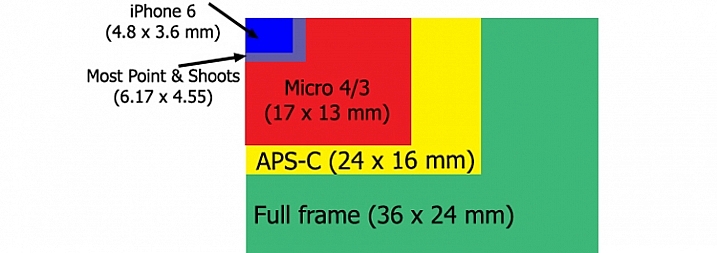
Sensor size comparison chart

Sensors in DSLRs and mirrorless cameras are generally either Micro Four Thirds, APS-C, or Full Frame. Any of these will usually work fine, and as you can see they are all of good size. The sensors for smartphones and compact cameras, on the other hand, are extremely small in comparison.

Let’s start with the obvious thing – resolution. Having a digital sensor with a larger surface area provides the opportunity to include more pixels. Assuming the pixels are the same size, having a digital sensor that is 40% larger, reads that there can be 40% more pixels. That means higher resolution for your images, which in turn means more detail and the ability to make them larger.

A larger sensor can also lead to larger pixels, which has significant benefits for your pictures. If you see a Full Frame camera with the same number of megapixels as an APS-C camera, that doesn’t mean they will have the same image quality. Rather, that means the pixels will have been spread out over a larger surface area in the Full Frame model, and as you will see in the remainder of this article, having larger pixels spread out over a wider surface area has a whole host of benefits for your photography.

2. Larger sensors result in improved low-light performance

The number one predictor of whether a camera will have good low-light performance is the size of the digital image sensor. The camera testing that has been done shows a direct correlation between larger image sensors, and improved low-light performance.

A company called DxO Mark tests all digital cameras and assigns them a low-light performance score, which it calls its “sports” score (presumably because using high ISO is important to sports shooters, who often face poor light and need to use fast shutter speeds). This score is actually an ISO value. Specifically, the score is the highest ISO at which the camera will create a picture, without noise becoming too large of an issue (there is actually a technical formula they use involving decibels and signal to noise ratio, but that is my layperson’s definition of their score). The higher the score, the higher the useable ISO for that camera. For example, if a camera scores 900, that means the highest usable ISO for that camera is ISO 900. A camera with a score of 1250 would mean that its low-light performance was better, and performed well up to ISO 1250. And so on.

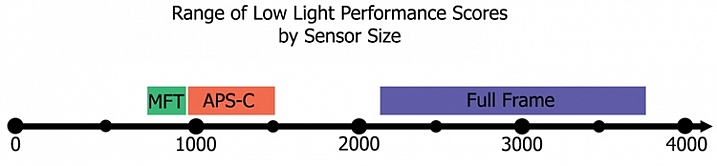
When comparing the scores for the current models of DSLRs and mirrorless cameras being sold right now, and then separating the results by sensor size, the result is rather striking:

Low light performance by sensor sizeTo explain this chart a little further, the range on the bottom is DxO Mark’s “sports scores,” which as mentioned above are really ISO values. Each camera was assigned a score, and I sorted them by sensor type. The range of values for Micro Four Thirds cameras is between ISO 757 and 896 (with the average at 825). The range for cameras with APS-C sensors is ISO 915 – 1438 (with an average of 1161). The range for full frame cameras is ISO 2293 – 3702 (with an average of 2811).
Notice that even the lowest rated APS-C camera performs better than the highest rated Micro Four Thirds camera. Similarly, even the lowest rated full frame camera performs better than the highest rated APS-C camera. When it comes to low-light performance, sensor size appears to make all the difference.

3. Dynamic range will likely be increased with larger image sensors

A larger digital image sensor also appears to lead to an increase in dynamic range for your camera. This is the range of tones that your camera can capture between pure white and pure black. The wider the range, the better.

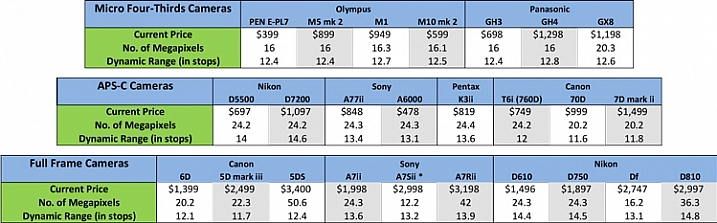
There is no simple measurement for dynamic range, so comparing cameras is difficult. Finding the low-end of the spectrum (black) has a lot to do with the low-light performance of the camera, because digital noise increases when capturing very dark tones. At some point, the noise overwhelms the picture, so the bottom end of the dynamic range scale is not really “pure black” but rather “usable black.” What that means for us is that low-light performance determines part of the dynamic range of the camera, and as we saw in the previous section, low-light performance is largely a function of sensor size. Therefore, it would appear that a larger sensor would mean a higher dynamic range.

The digital image sensor testing done by DxO Mark bears this out. They call this their “landscape” score, and their results show a correlation between sensor size and an increase in dynamic range. The average for Micro Four Thirds cameras I looked at was 12.5 stops of dynamic range. That increased a bit to 13.0 for cameras with APS-C sensors, and then to 13.4 for full frame cameras. Therefore, a camera with a larger digital image sensor is very likely to have a larger dynamic range.

Comparison of dynamic range in digital cameras

All these scores are pretty comparable, and my point is not so much to compare these sensors (which will all get the job done), but rather simply to show that sensor size matters. Based on this, we can see that a camera with a much smaller image sensor (like a phone or compact camera) would not perform as well when it comes to these measures of image quality.

4. A larger sensor lets you create more background blur

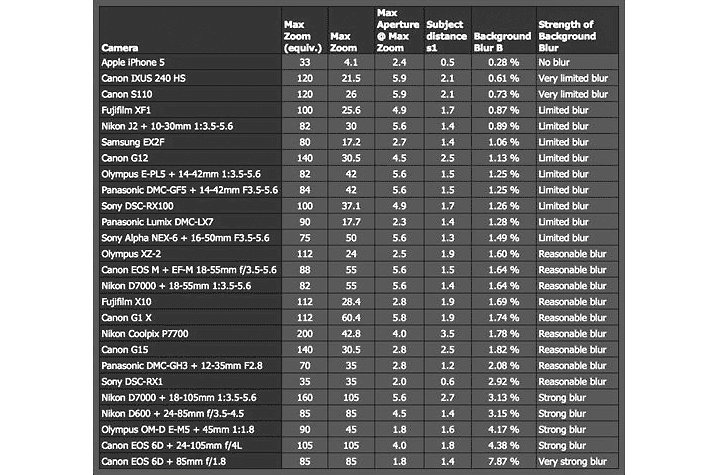
If you want an appreciable degree of background blur in your images, you will need to use a larger digital image sensor. It is not just a function of aperture size (although that is obviously a very big part of it). In fact, it is virtually impossible to achieve a strong amount of background blur with a camera that has a tiny image sensor.

The relationship between digital image sensor size and background blur has actually been tested by the folks at DP Review. Here is a link to their testing and results. Be warned that they use a lot of math and technical terms. Here is a chart with some of their results:

DP-Review-Background-Blur-Chart


The results are that cameras with very small digital image sensors like smartphones and compact cameras are worthless if you aim to include background blur in your pictures. They go on to show that the larger the digital image sensor, the more blur you can include in your pictures. Therefore, sensor size is an important consideration if you want to achieve any amount of background blur in your photos.

5. A larger sensor can mean less diffraction

One other impact that the size of the digital image sensor has on your photos – and one of which you might not be aware – is on the amount of diffraction in your photos.

This may come as a surprise to you, if you are somewhat familiar with diffraction, because it is largely a function of using a very small aperture. Here’s how diffraction affects your pictures: When you use a small aperture, light reaching the edges of the image sensor can only get there after passing through the small aperture and then spreading out. That spreading of light causes the light rays to hit adjacent photo sites. Essentially, this spreading causes the light to sometimes hit the wrong photo site and leads to blur.

What does that have to do with the digital image sensor? Remember that diffraction is caused by a scattering of light across photo sites. Therefore, if you cram a lot of megapixels on a digital image sensor, the photo sites will be very small, and the scattering of light will cross over onto other photo sites more easily. That will mean an increase in diffraction. But in a camera where megapixels are more spread out, the same amount of scattering, will have less of an impact on your pictures.

As a result, larger image sensors where pixels are more spread out, tend to result in less image diffraction.

6. Larger sensors reduce the crop factor

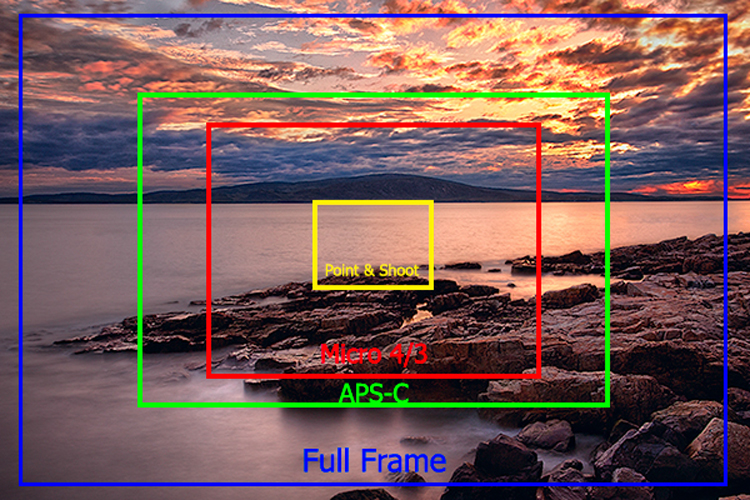
Finally, let’s not forget about the crop factor that results from using a smaller digital image sensor. This chart shows the impact of crop factors. Notice in particular the yellow square in the center that shows the range of view for compact cameras:

Impact of crop factors

Of course, camera manufacturers have adapted to this by introducing extremely wide angle lenses which are designed for cameras with smaller sensors. Still it is generally much easier to obtain wide angle pictures using a larger image sensor.

Conclusion

It is not my intent to trash any particular camera, or system. The fact is that any camera is better than no camera, so use what you have. What I want to show here is that there are significant benefits to lugging around your DSLR, or mirrorless camera. That is true whether it is a Micro Four Thirds, APS-C, or a Full Frame camera. The benefits go well beyond resolution, and affect your overall image quality.

Larger sensors help you take better pictures in low-light, capture a greater dynamic range of tones, result in reduced diffraction, and let you achieve more background blur. So keep lugging around those cameras rather than trying to get it done with a phone or a compact model.

Do you have any additional data or questions you’d like to add? Please share in the comments below.

googletag.cmd.push(function() {
tablet_slots.push( googletag.defineSlot( “/1005424/_dPSv4_tab-all-article-bottom_(300×250)”, [300, 250], “pb-ad-78623” ).addService( googletag.pubads() ) ); } );

googletag.cmd.push(function() {
mobile_slots.push( googletag.defineSlot( “/1005424/_dPSv4_mob-all-article-bottom_(300×250)”, [300, 250], “pb-ad-78158” ).addService( googletag.pubads() ) ); } );

The post 6 Benefits of Using Cameras With Larger Sensors by Jim Hamel appeared first on Digital Photography School.


Digital Photography School

 
Comments Off on 6 Benefits of Using Cameras With Larger Sensors

Posted in Photography


The 19 Most Popular Compact System and Mirrorless Cameras with Our Readers

26 Nov

Earlier in the week we revealed the DSLRs that were best selling among our readers as well as the most popular DSLR Lenses in our community over the last few months. While DSLRs are still the most popular type of readers among our readers this last quarter has seen a big rise in the number of you using compact system/mirrorless cameras.

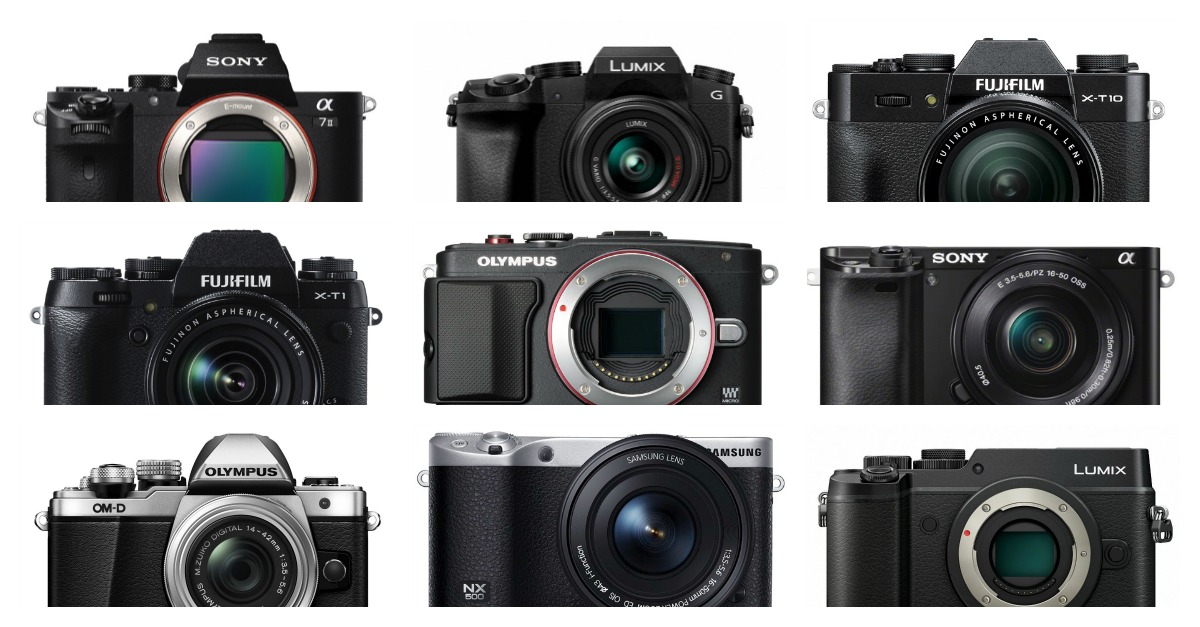
popular mirrorless cameras

Here are the most popular compact system cameras among our readers!

Note: we’ve only included cameras with interchangeable lenses in this list. While other cameras like Fujifilms X100 series are sometimes classified in this way we’ll include them on a future list with other fixed lens cameras.

Lastly: Amazon currently have some great specials at the moment on cameras and gear as part of their Holiday Promotions.

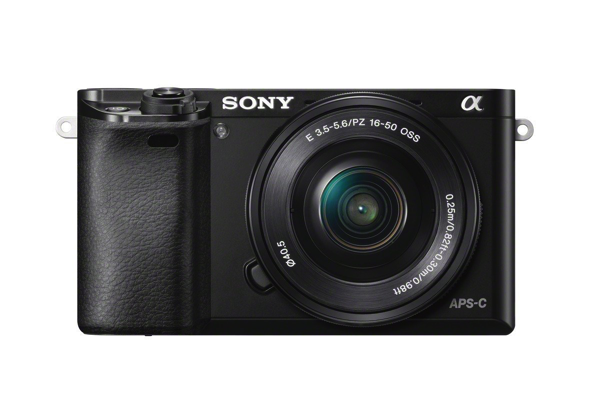
1. Sony Alpha a6000

NewImage

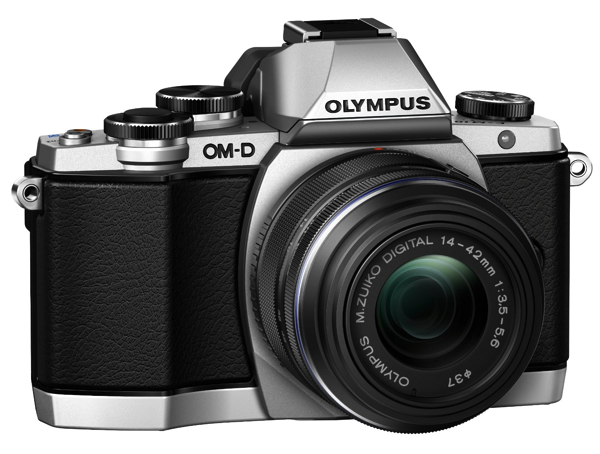
2. Olympus OM-D E-M10

NewImage

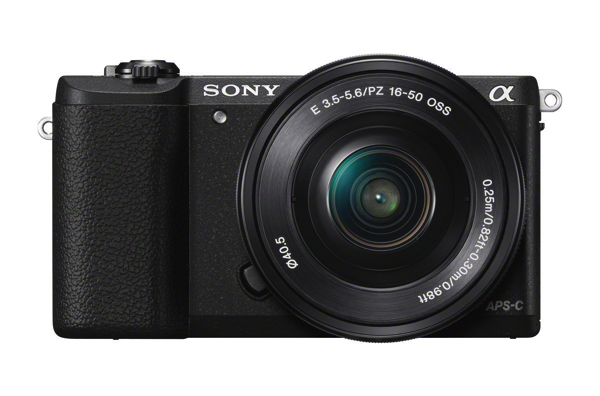
3. Sony a5100

NewImage

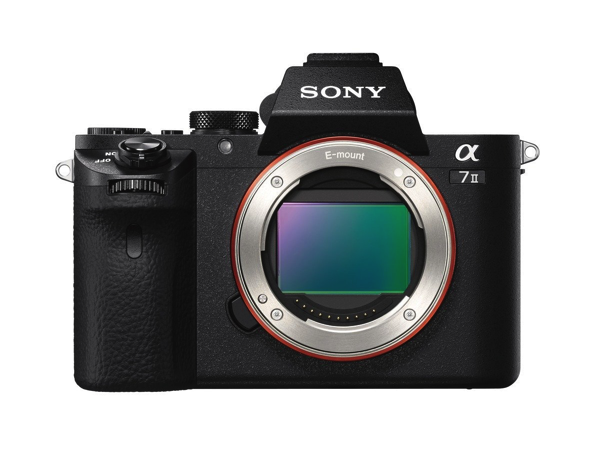
9. Sony Alpha a7II

NewImage

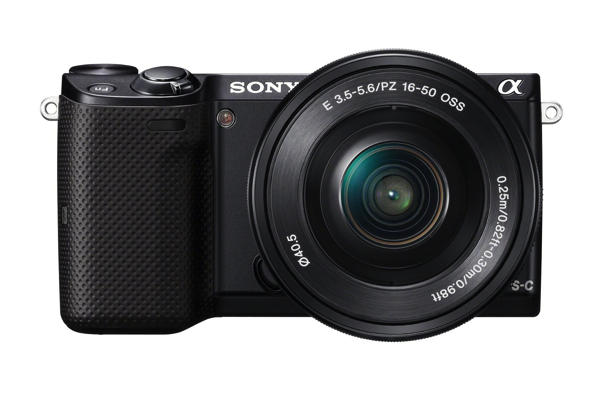
3. Sony NEX-5TL

NewImage

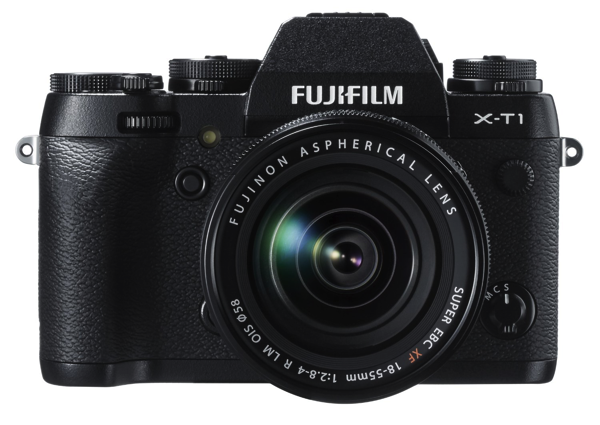
4. Fujifilm X-T1

NewImage

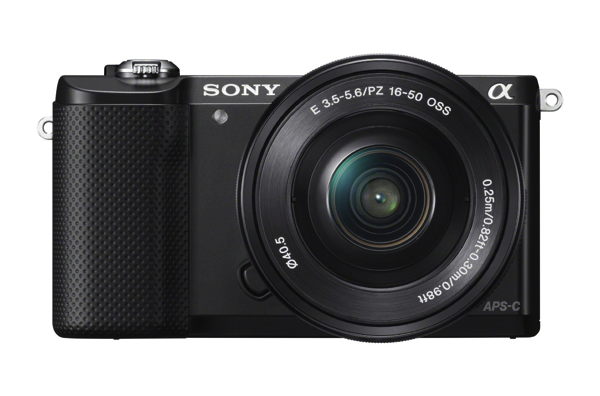
5. Sony Alpha a5000

NewImage

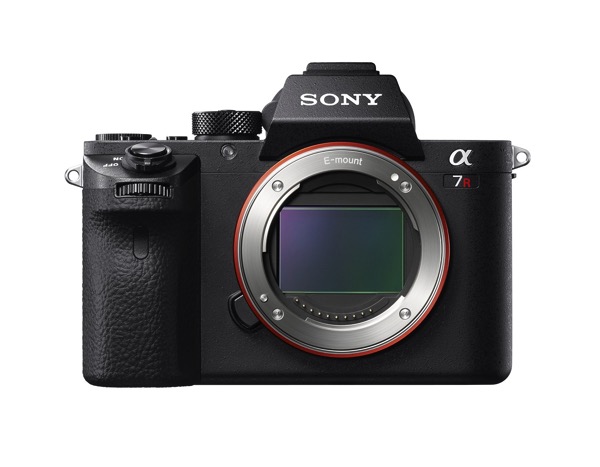
6. Sony a7R II

81 rf9B7cML SL1500

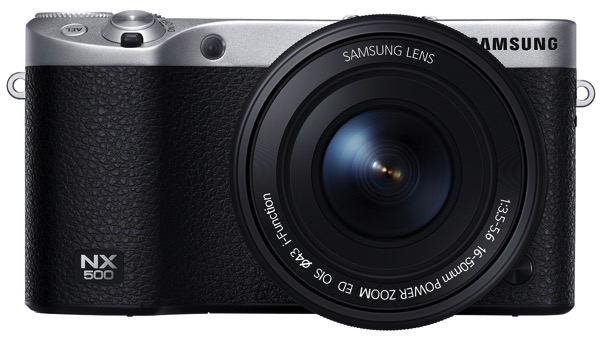
7. Samsung NX500

91f 4dtUbjL SL1500

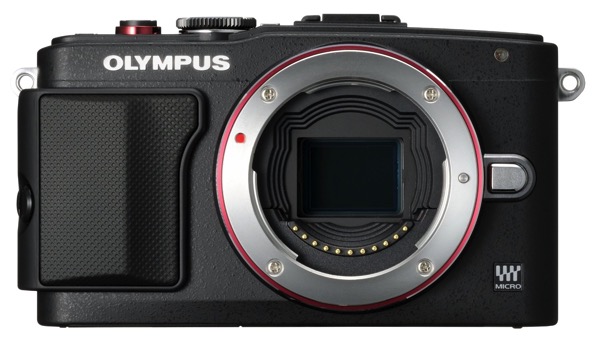
8. Olympus PEN E-PL6

81srU2SK2OL SL1500

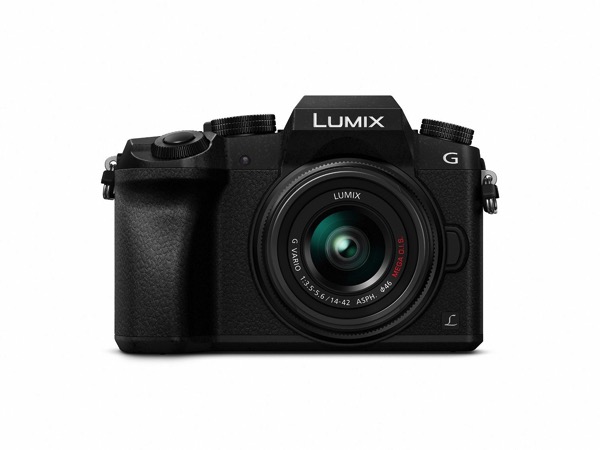
9. Panasonic LUMIX DMC-G7KK

81UUhvqyviL SL1500

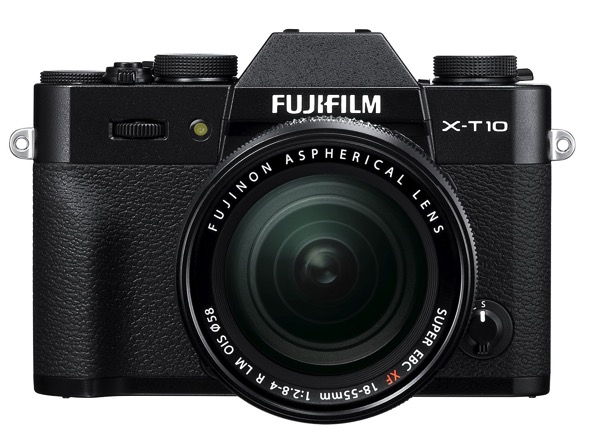
10. Fujifilm X-T10

91hN9jCE1cL SL1500

That’s our top 10 – here are the next 9 most popular compact camera systems.

  1. Canon EOS M3
  2. Olympus OM-D E-M10 Mark II
  3. Panasonic LUMIX DMC-GX8K
  4. Olympus OM-D E-M1
  5. Olympus OM-D E-M5 Mark II
  6. Sony Alpha a7S
  7. Sony a7
  8. Samsung NX30
  9. Panasonic LUMIX DMC-GM5KK

*Note: this list was compiled from reports supplied to us from Amazon.com where we are affiliates. One of the ways dPS is able to cover its costs and be a sustainable business is that we earn a small commission when readers make a purchase from Amazon after clicking on our links (including those above). While no personal details are passed on we do get an overall report from Amazon about what was bought and are able to create this list.

googletag.cmd.push(function() {
tablet_slots.push( googletag.defineSlot( “/1005424/_dPSv4_tab-all-article-bottom_(300×250)”, [300, 250], “pb-ad-78623” ).addService( googletag.pubads() ) ); } );

googletag.cmd.push(function() {
mobile_slots.push( googletag.defineSlot( “/1005424/_dPSv4_mob-all-article-bottom_(300×250)”, [300, 250], “pb-ad-78158” ).addService( googletag.pubads() ) ); } );

The post The 19 Most Popular Compact System and Mirrorless Cameras with Our Readers by Darren Rowse appeared first on Digital Photography School.


Digital Photography School

 
Comments Off on The 19 Most Popular Compact System and Mirrorless Cameras with Our Readers

Posted in Photography


2015 Roundup: High-end Interchangeable Lens Cameras $2000+

26 Nov

This category has something for everyone, whether it’s ultra-high resolution, 4K video, high dynamic range, and super-fast burst rates. For the enthusiast or pro who refuse to compromise, here’s a look at cameras priced over $ 2000.  Read more

Articles: Digital Photography Review (dpreview.com)

 
Comments Off on 2015 Roundup: High-end Interchangeable Lens Cameras $2000+

Posted in Uncategorized


Upgrading? Here are Some Good Cameras Under $1000

21 Nov

Thinking of upgrading to a newer camera but don’t want to spend a fortune?  Here are two videos that will give you some options for both DSLR and Mirrorless in the under $ 1000 USD price range.

Best Mirrorless Camera Under $ 1000

The one they recommend in the video about is the Fuji X-T10 which comes in at $ 999 with the 18-55mm kit lens.

Other Cameras Under $ 1000

The guys at Digital Rev TV do a humorous comparison between the Canon 700D (T5i) at $ 649 with the 18-55mm lens, and the Panasonic Lumix DMC-GM5 at $ 669 USD with the 12-32mm kit lens.

An alternative choice

Or you could take the approach in the video below (he’s talking about doing video but the same applies to sill photography). You could save your money, and work on your photography education instead. This is a great place to start right here on dPS – do a search for topics you’re interested in, invest in some ebooks or a video course.

googletag.cmd.push(function() {
tablet_slots.push( googletag.defineSlot( “/1005424/_dPSv4_tab-all-article-bottom_(300×250)”, [300, 250], “pb-ad-78623” ).addService( googletag.pubads() ) ); } );

googletag.cmd.push(function() {
mobile_slots.push( googletag.defineSlot( “/1005424/_dPSv4_mob-all-article-bottom_(300×250)”, [300, 250], “pb-ad-78158” ).addService( googletag.pubads() ) ); } );

The post Upgrading? Here are Some Good Cameras Under $ 1000 by Darlene Hildebrandt appeared first on Digital Photography School.


Digital Photography School

 
Comments Off on Upgrading? Here are Some Good Cameras Under $1000

Posted in Photography


2015 Roundup: Interchangeable Lens Cameras $1200-2000

20 Nov

In the latest of our roundup we’re looking at interchangeable lens models ranging from roughly $ 1200 – $ 2000. This price range spans sensor sizes from Four Thirds to full-frame, and contains a diverse range of cameras geared toward fast-action still shooting, ultimate resolution, great video and more. If you are considering this price range for a camera, you have an opportunity to choose the camera that is really right for you based on features, size and operation. Read more

Articles: Digital Photography Review (dpreview.com)

 
Comments Off on 2015 Roundup: Interchangeable Lens Cameras $1200-2000

Posted in Uncategorized


2015 Roundup: Interchangeable Lens Cameras $800-$1200

17 Nov

In late 2015, many (if not most) consumers are likely to shop based on price and capability, rather than according to whether a certain model contains a mirror or not. In this category, you’ll find both mirrorless and DSLR cameras that are highly capable under a variety of shooting situations, offer built-in high-spec viewfinders – either optical and electronic – and a bevy of external controls. Read more

Articles: Digital Photography Review (dpreview.com)

 
Comments Off on 2015 Roundup: Interchangeable Lens Cameras $800-$1200

Posted in Uncategorized


2015 Roundup: Interchangeable Lens Cameras $500-800

13 Nov

The $ 500-800 category (based on US MSRP) features quite a few strong offerings, some of which should satisfy first-time camera buyers with easy-to-use interfaces and point-and-shot style functionality. Others are aimed more at seasoned enthusiasts, offering direct manual controls and high-end features. Read more

Articles: Digital Photography Review (dpreview.com)

 
Comments Off on 2015 Roundup: Interchangeable Lens Cameras $500-800

Posted in Uncategorized