RSS
 

Posts Tagged ‘Camera’

Samsung announces Android-powered Galaxy NX 20MP mirrorless camera

21 Jun

GALAXY-NXFront.png

Samsung has announced the Galaxy NX: the world’s first mirrorless interchangeable lens camera running the Android operating system. The Galaxy NX takes a 20.3 megapixel, SLR-style mirrorless camera and adds 3G, 4G LTE and Wi-Fi, connectivity and Android 4.2 (Jelly Bean). The camera sports a gigantic 4.8″ HD LCD touchscreen – with which you’ll control nearly all camera functions. The Galaxy NX will be available sometime this summer for an undisclosed price.

News: Digital Photography Review (dpreview.com)

 
Comments Off on Samsung announces Android-powered Galaxy NX 20MP mirrorless camera

Posted in Uncategorized


In Camera Veritas

19 Jun

Show of hands, who knew that the cameras we use every day are named after a room?

The latin word for room is camera, which makes sense when you realize the first objects for recording light were cameras obscura.

And in this case instead of the room being the camera, the camera is in fact the light modifier.

Read more »
Strobist

 
Comments Off on In Camera Veritas

Posted in Photography


Just posted: Our Canon PowerShot D20 underwater camera review

19 Jun

news_teaser.png

We’ve posted the first in a series of six reviews of rugged/waterproof compact cameras. First up is the Canon PowerShot D20, whose fish-inspired design can go for swim, get dropped on the floor, and shoot in freezing temperatures. Once we’ve completed our reviews of all six cameras, we’ll put together a comparison, so you can find out which is best-in-class. Follow the link to see how the PowerShot D20 performed in our tests.

News: Digital Photography Review (dpreview.com)

 
Comments Off on Just posted: Our Canon PowerShot D20 underwater camera review

Posted in Uncategorized


77% of dPS Readers Take A Camera Everywhere [POLL Results]

18 Jun

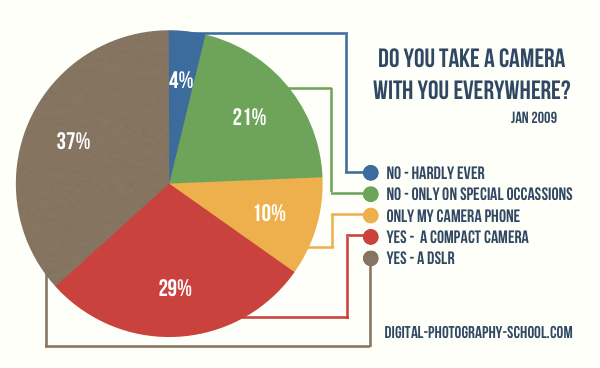
Last month we asked readers whether they took their camera with them everywhere in a poll. The results are in!

Screen Shot 2013 06 17 at 12 47 40 PM

If you include the camera in your phone… 77% of the almost 20,000 people who responded take a camera with them everywhere.

What I find interesting is that we ran this exact same poll in January 2009 so we can track how things have changed over the last 4 years among our readers. Here are the 2009 results (the results were from around 18,000 readers at that time).

Screen Shot 2013 06 17 at 12 47 22 PM

While the changes have only been subtle there are a few interesting observations to make.

Firstly – more people are relying upon the cameras in their phones to capture their everyday events. This is no wonder – back in 2009 the iPhone had been out for a couple of years but since then the camera in iPhone (and other phones) have improved significantly (in fact a segment of our readership ONLY use camera phones).

Secondly the rise in camera phone use has come at the expense of compact camera solutions and those who only took cameras on special occasions.

What surprised me most was the slight rise in those taking DSLRS everywhere because there’s been such a push of late from camera manufacturers to improve their offerings in the compact camera space.

How have your camera usage habits chanced in the last 4 years?

Post originally from: Digital Photography Tips.

Check out our more Photography Tips at Photography Tips for Beginners, Portrait Photography Tips and Wedding Photography Tips.

77% of dPS Readers Take A Camera Everywhere [POLL Results]


Digital Photography School

 
Comments Off on 77% of dPS Readers Take A Camera Everywhere [POLL Results]

Posted in Photography


Understanding Evaluative Metering on Your EOS Camera

14 Jun

01

Photo by Flickr user MiNe

By Andrew S. Gibson – the author of Understanding Exposure: Perfect Exposure on Your EOS Camera (currently 36% off at SnapnDeals).

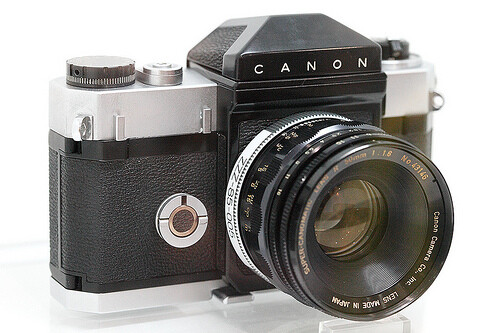
Imagine that it is early 1959. Alaska has just been admitted as the 49th state in the USA. Fidel Castro has become premier of Cuba. Elvis Presley and Buddy Holly are in the charts. And Canon releases the Flex – its first SLR camera in a time when only eight other SLR camera models were in existence.

The Flex (pictured above) was so basic by today’s standards that it didn’t even have a built-in light meter. Instead, it used an external selenium photocell coupled to the shutter speed dial for metering. Most photographers back then used external light meters and dialled the exposure settings into their cameras, so I guess to some folk even this primitive system seemed like magic.

The first Canon camera with through-the-lens (TTL) metering came in 1965. The Pellix had just one way of reading light levels – a 12% spot meter in the centre of the viewfinder.

Centre-weighted averaging came along later and served photographers well until the evaluative metering system we are familiar with today was invented in the late eighties.

Evaluative metering arrives

The first Canon camera to feature evaluative metering was the EOS 650, released in March 1987. It was also the first Canon camera to use the newly designed EOS mount.

The EOS 650 had a six zone evaluative metering mode. Evaluative metering has come a long way since then, and now most EOS cameras use a 63 zone metering system and advanced micro-processors to analyse the information gathered.
02

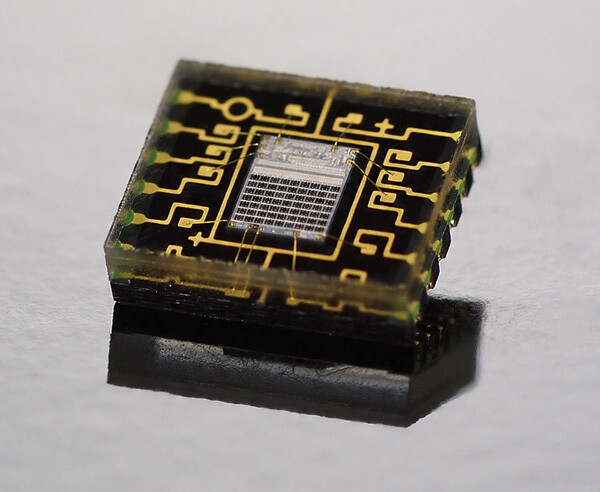
The auto exposure sensor from the EOS 60D. Note the grid of seven by nine black squares in the centre. These are the 63 metering zones of the EOS 60D’s iFCL evaluative metering system.

Understanding evaluative metering

Evaluative metering is the most sophisticated metering mode on your EOS camera. As it is the one you are most likely to use at any time, it’s useful to know how it works. Indeed, if you use your EOS camera in any fully automatic mode, it is the only metering mode the camera lets you use. You can only switch to one of the others in Program, Shutter Priority, Aperture Priority or Manual modes.

Other metering modes

Most EOS cameras have four metering modes: evaluative, partial, spot and centre-weighted metering (One series cameras also have multi-spot metering).

Partial, spot and centre-weighted metering all have a single characteristic in common – they take an exposure reading from the centre of the viewfinder.

03

This is fine if, as in the photo above, that’s where your main subject is.

04

But if your subject is off-centre, like in this portrait, you have to point the centre of the viewfinder at your subject, press the shutter button half-way to lock in the exposure setting, then recompose. This is bit of a pain to say the least and wastes time.

Evaluative metering was developed as a way of accurately metering off-centre subjects. It works by dividing the viewfinder into zones, each giving a separate reading that the camera analyses to calculate exposure. It also co-operates with your camera’s autofocus system. The reading is weighted towards the active autofocus point on the basis that it is most likely to be covering the main subject.
05

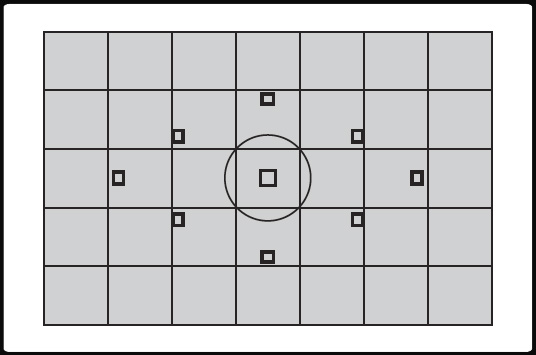
This is the 35 zone evaluative metering pattern used on the EOS 300D, 350D, 400D, 450D, 500D, 1000D, 10D, 20D, 30D, 40D, 50D, 5D and 5D Mark II. Note how each AF point occupies a different square.

iFCL evaluative metering

Canon introduced Intelligent Focus, Colour and Luminance (iFCL) evaluative metering on the EOS 7D. It has been included on every new EOS camera since then (excluding One series models).

The premise behind this new system is that exposure meters that react to the brightness of the subject only are more sensitive to the red light than the human eye. They may think that a red coloured subject is brighter than it really is and return a false reading that underexposes the subject.
06

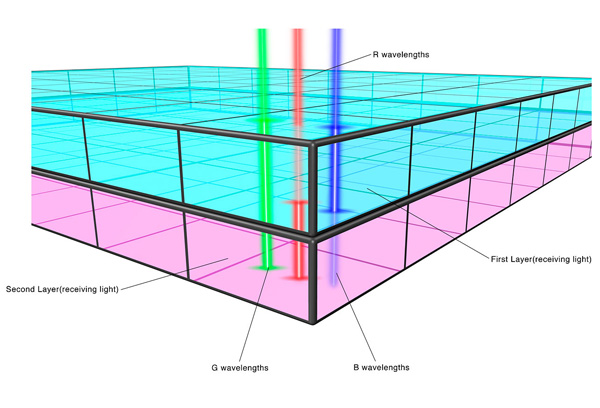
To counter this, the exposure meter used by iFCL evaluative metering has two layers. The top one is sensitive to green and blue light and the bottom one to green and red. Each layer measures the colours that it is sensitive to and the camera combines the readings to calculate exposure settings.

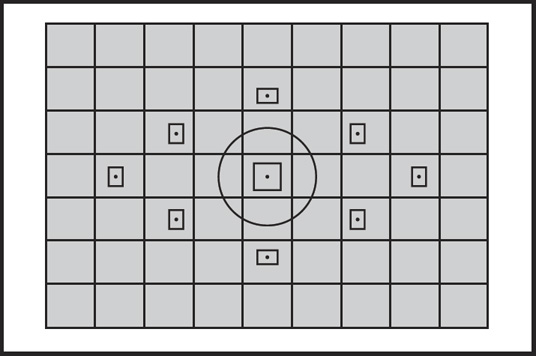
In addition, iFCL metering uses information from multiple autofocus points. It knows which AF points have achieved focus, and which ones have nearly achieved focus, and weights the exposure reading towards the zones those AF points are in on the basis they are likely to be covering the subject.
07

The 63 zone evaluative metering pattern used by the EOS 100D, 550D, 600D, 650D, 700D, 750D, 1100D, 60D, 7D and 6D. All but the last two models use the 9 point AF pattern in the diagram.

Evaluative metering and Speedlites

Evaluative metering really comes into it’s own when used in conjunction with a portable Speedlite flash unit. It is important that the camera meters the light reflected from the subject in order to accurately calculate the exposure required from the flash. Centre-weighted, spot or partial metering can only do this if the subject is in the centre of the frame. Evaluative metering can cope regardless of which part of the frame the subject occupies.

Understanding Exposure
08

That’s a brief overview of how evaluative metering works on your EOS camera. Hopefully it helps you understand how your camera’s metering system works and will help you take better exposed photos.

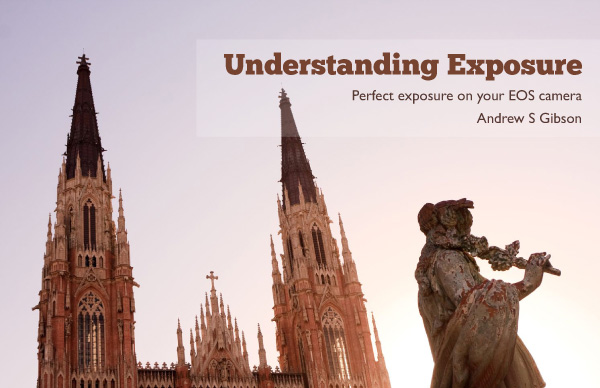
If you’d like to learn more about how exposure works on your EOS camera my ebook Understanding Exposure is available on special now over at Snapndeals.

Post originally from: Digital Photography Tips.

Check out our more Photography Tips at Photography Tips for Beginners, Portrait Photography Tips and Wedding Photography Tips.

Understanding Evaluative Metering on Your EOS Camera


Digital Photography School

 
Comments Off on Understanding Evaluative Metering on Your EOS Camera

Posted in Photography


Sony Xperia Z Camera Review: Do its impressive specs measure up?

13 Jun

SonyXperiaZ.jpg

Sony’s flagship Xperia Z offers some head-turning specs, including a 13-megapixel primary camera and a high-definition 1920×1080 443 ppi display on its 5-inch screen. It’s even and water- and dust-resistant — the ad campaign shows users rinsing the Xperia Z off by pouring water over it. We were eager to see if these exciting features make for a quality mobile camera. See our findings on connect.dpreview.com.

News: Digital Photography Review (dpreview.com)

 
Comments Off on Sony Xperia Z Camera Review: Do its impressive specs measure up?

Posted in Uncategorized


Pompidoo Palermo Camera Bag Review

13 Jun

POMPIDOO BAG REVIEW

www.pompidoo.com

Until recently I wasn’t fully aware of the availability of such stylish camera bags for women, until I received the opportunity to review this refined camera accessory.

Pic1-Pompidoo

The Palermo Camera Bag by Pompidoo is a very stylish and functional way to carry your camera equipment to any occasion. Whether I’m out taking photos, or having a milkshake with my family, this bag plays it’s part perfectly.

When I’m out taking photos, I love the fact that this Palermo bag doesn’t look like a typical camera bag. As well as looking stylish this bag acts as a great safety function for the “Female Street Photographer” like myself, the general person on the street wouldn’t realise your carrying expensive camera equipment as it looks just like a larger style hand-bag.

Pic2-Pompidoo

First Impression was ‘Style & Quality’.
I was very impressed by how the bag was packaged when I opened the shipping carton; it was very protected. My initial impression to the Palermo Bag was quality of the leather and fixtures then the lining inside and padding.

Pic3-Pompidoo

Pic3a-Pompidoo

What I Loved

1. There’s something special about handmade European leather goods. The quality of the genuine bane leather is simply beautiful and it has a pearl touch to it. The bag comes in 3 different colours, this one that I am using is Kitty Red, which I love.

Pic4-Pompidoo

Pic4a-Pompidoo

2. The two carry options. The Palermo Bag has two handles to use like a carry bag or an adjustable de-attachable cross shoulder strap. The leather strap I found to be very functional and comfortable for those longer photo walks, it made it easy to distribute the weight of my equipment evenly across my back.

Pic5-Pompidoo

3. The padded main body and the 4 padded Velcro dividers to customise the bag to suit your belongings and keep them well protected. I found it to be the perfect size for my gear, as an example, the equipment for my typical outing would be – Canon 5D MarkII with a 24-70mm lens attached, external flash, 50mm lens and a Lensbaby Spark. I really like the built in padded section with a soft cloth attached to carry your ipad / tablet. The front pocket is ideal to hold camera accessories like CF Cards, cloths, and business cards along with some personal belongings such as your mobile phone, keys and even snacks for my little man ?. There really is plenty of room. There is also a zip pocket at the back, which I found perfect for a notebook to keep any notes or lists.
I need to mention that the floral material used inside this bag is beautiful.

Pic6-Pompidoo

Pic7-Pompidoo

Pic8-Pompidoo

Pic9-Pompidoo

What Could Be Improved

1. The metal feet are a perfect idea for the bag to stand upright when you place it on the ground in whatever situation or environment, however I did find that the bag would still sometimes fall forward, as if unbalanced. This didn’t happen all the time.

2. I’m not sure if this next feature actually needs to be improved, as this probably would depend on each individual using the bag. I am very fussy with my camera gear and I found when removing my camera from inside the bag, I needed to fold the zipper section back on either side of the main compartment so the zipper wouldn’t scrap along the camera body. I also found that when the zipper section is folded back, it made the top opening larger and easier to view and remove my equipment without obstruction.

Overall, I would recommend Pompidoo products to any Female Photographer who is looking for a bit of “Style, Quality & Functionality”.

Lisa Cole – Melbourne based photographer

Post originally from: Digital Photography Tips.

Check out our more Photography Tips at Photography Tips for Beginners, Portrait Photography Tips and Wedding Photography Tips.

Pompidoo Palermo Camera Bag Review


Digital Photography School

 
Comments Off on Pompidoo Palermo Camera Bag Review

Posted in Photography


Apple updates Digital Camera RAW compatibility

13 Jun

Screen_Shot_2013-06-12_at_11.31.37_AM.png

Apple updated its Raw engine to include more cameras. The new update applies to Aperture 3 and iPhoto ’11. Cameras now supported include the Canon EOS-1D C, Canon EOS Rebel SL1 / 100D / Kiss X7, Canon EOS Rebel T5i / 700D / Kiss X7i, Hasselblad Lunar, Nikon COOLPIX A, Nikon D7100, Nikon 1 J3, Nikon 1 S1, and Sony Alpha NEX-3N.

News: Digital Photography Review (dpreview.com)

 
Comments Off on Apple updates Digital Camera RAW compatibility

Posted in Uncategorized


Hasselblad Lunar interchangeable lens camera now shipping

11 Jun

Lunar-Mahogany-Wood-18-55-Hood_b.jpg

Swedish camera manufacturer Hasselblad is finally shipping the ‘Lunar’. This 24 megapixel camera – essentially a rebadged Sony Alpha NEX-7 – was announced at Photokina last year and comes with your choice of grips: black or brown leather, carbon fiber, and wood: mahogany or olive, to be precise. The Lunar includes an 18-55mm lens and is priced at $ 6995/£5280. 

News: Digital Photography Review (dpreview.com)

 
Comments Off on Hasselblad Lunar interchangeable lens camera now shipping

Posted in Uncategorized


The Worst Forms of Abuse Your Camera Wants You to Stop Doing

10 Jun

All photographers are some of the most well-intentioned people on the face of the entire planet. They like to think of themselves as never, ever doing anything to their precious cameras that would ever result in damage coming to them or in their misuse. However, in spite of their sense of being well-intentioned, the reality paints quite a different story. Continue Reading

The post The Worst Forms of Abuse Your Camera Wants You to Stop Doing appeared first on Photodoto.


Photodoto

 
Comments Off on The Worst Forms of Abuse Your Camera Wants You to Stop Doing

Posted in Photography