RSS
 

Posts Tagged ‘Camera’

Choosing a Camera

04 Sep

There is no perfect camera. So get that idea out of your head right now. Far better to think of any camera as a set of compromises. Size, speed, image quality, low-light performance, price, etc., can all be features—and they can all be liabilities.

You want image quality? Get an 11×14″ film camera. Great for detail and tonal range. But sucks for action sequences / portability / low light performance.

Every camera is a compromise in at least one area. So to start, list your most important features on a sheet of paper and let that guide your choosing strategy.
__________

• If you want best-possible image quality, you might sell your car/house/plasma and buy a digital medium format camera.

• If you need super long glass and/or FPS speed (sports, nature, etc.) maybe grab a fast Nikon (or Canon) and a super-telephoto lens.

• If you shoot people, speed and high ISO performance might not matter as much as gorgeous color.

• I you travel a lot you might put a premium on your cameras being small and lightweight, with good low-light performance.

• If you are following a toddler around the living room, continuous AF performance may trump price.

So think about what is important to you (and your budget, of course) and begin your search for cameras using that as a compass point.

If you are old like me, you might be tempted to only consider cameras built around the dated form factor of film cameras to be the only cameras worth serious consideration. That’s an age bias. Have it if you like, but be aware of it. To a twenty-year-old that doesn’t matter any more.

Speaking of age, if I were just dipping my toe into the water I’d strongly consider a late-model used digital camera and a used lens or two. If I was not happy, it would be a cheap marriage to unwind. Within a year I could probably sell the lot on eBay for a couple hundred less than I paid, max.

And if I was happy it would be a great platform to build on. Once committed, my next body might something current and the original body goes to a second/backup. Either way, I would not expect to be using the camera after five or six years.

Point is, you don’t have to jump in the deep end. Buy one body and a lens or two. Maybe buy used from a shutterbug friend, knowing the camera implicitly comes with ad hoc tutoring. (And a good outlet to borrow/lend lenses, bodies, etc.)
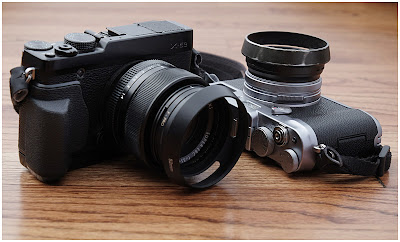
I spent over 30 years with Nikon film and digital SLRs as my primary cameras. But the further I got away from shooting for newspapers (which at the time had included lots of sports photography) the more my priorities shifted. Here is what is important to me now: small, lightweight, good image quality, great in low-light and quiet/unobtrusive. That led me to move to mirrorless (Fuji) a couple years back.

Pictured at top are the cameras that currently get more use than anything else I have (save maybe my iPhone): a Fuji X-E2 and a Fuji X100s.

Whatever camera style/brand you are considering, you can use the ‘net to easily scope out how other photographers are using it and what kind of image quality it has.

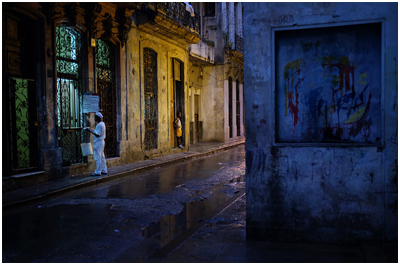
For instance, try this: click on the night photo just above, which will take you to its Flickr page (in a new window). Scroll down beneath the photo’s page where it says “Fujifilm x100s” (or just click here) and you go to a page that will show you lots of different photos shot with exactly that model of camera.

And here’s the thing: clicking on that link from just about any camera icon on a Flickr photo page will quickly show you that you can make amazing photos with just about any current camera. So don’t sweat it or pixel peep too much.

Instead, focus on how you will be using the camera and what features are truly most important. Then let that drive your choices. And understand that the camera you use today probably won’t be the camera you are using in five years.

NEXT: Lenses


Strobist

 
Comments Off on Choosing a Camera

Posted in Photography


Canon marks 80 years since the Kwanon, its first camera

03 Sep

In the build-up to Photokina, Canon is celebrating its 80th anniversary. The seed was planted in 1934 when a company called Seiki-Kogaku Kenkyusho placed an advert for a camera called the Kwanon in the Asahi Camera magazine. The company, whose name translates as Precision Optical Instruments Laboratory, was formed to develop the first Japanese 35mm rangefinder camera in a world where European brands, such as Leica and Contax, dominated. Read more

Articles: Digital Photography Review (dpreview.com)

 
Comments Off on Canon marks 80 years since the Kwanon, its first camera

Posted in Uncategorized


Cold War camera: 1950s Berlin in color (part 1)

01 Sep

Ten years after the end of WWII, Germany was rebuilding. Cities like Berlin, which had been severely damaged during the war were emerging from the rubble as the ‘Wirtschaftswunder’ or ‘economic miracle’ transformed West Germany. In the immediate post-war period hundreds of thousands of allied troops were stationed in the divided country, many of them with cameras. Found recently at a flea market, the images in this article date from 1956-7 and were taken by a US Serviceman in Berlin. Click through to take a look. 

Articles: Digital Photography Review (dpreview.com)

 
Comments Off on Cold War camera: 1950s Berlin in color (part 1)

Posted in Uncategorized


Olympus PEN E-PL7 compact mirrorless camera announced

28 Aug

Olympus has announced the PEN E-PL7, refreshing its entry-level mirrorless line. It offers a 16MP CMOS sensor, 3-axis image stabilization system borrowed from the OM-D E-M10, 8 fps continuous shooting and built-in Wi-Fi. Not forgetting the self-portrait-obsessed masses, the E-PL7 provides an articulated 3″ touch LCD capable of flipping downward by 180°. Along with the E-PL7, Olympus has also announced an update to its OI.Share app as well as a black version of its 12mm F2.0 prime. Read more

Articles: Digital Photography Review (dpreview.com)

 
Comments Off on Olympus PEN E-PL7 compact mirrorless camera announced

Posted in Uncategorized


Consumer SLR Camera Roundup (2014)

27 Aug

To improve my general purpose and family photography, which camera should I choose?

Articles: Digital Photography Review (dpreview.com)

 
Comments Off on Consumer SLR Camera Roundup (2014)

Posted in Uncategorized


Fujifilm announces X30 enthusiast compact camera

27 Aug

Fujfilm has introduced its X30 enthusiast compact, which offers a 2/3″ X-Trans II CMOS sensor and a 28-112mm equivalent F2.0-2.8 lens – both of which are retained from the X20 that precedes it. New features include a larger, tilting 3″ LCD, an XGA OLED electronic viewfinder, a control wheel around the lens, and greatly improved battery life. A new ‘Classic Chrome’ film simulation mode has also been added, as has Wi-Fi. Read more

Articles: Digital Photography Review (dpreview.com)

 
Comments Off on Fujifilm announces X30 enthusiast compact camera

Posted in Uncategorized


Enthusiast compact camera roundup (2014)

26 Aug

Which capable compact, with plenty of control, should I buy?

Articles: Digital Photography Review (dpreview.com)

 
Comments Off on Enthusiast compact camera roundup (2014)

Posted in Uncategorized


What to buy and why: Camera roundups updated

26 Aug

We’ve updated two of our 2013 camera roundups, bringing the enthusiast compact and consumer DSLR categories up to date with the latest models. These guides are designed to help give a comprehensive look at each camera class. We’ll be addressing the remaining four roundups in the coming weeks. Read more

Articles: Digital Photography Review (dpreview.com)

 
Comments Off on What to buy and why: Camera roundups updated

Posted in Uncategorized


Sneaky Ways to Avoid Camera Theft

26 Aug
Extra photos for bloggers: 1, 2, 3

The greatest days are full of fun photo ops, not bad guys creepin’ on your turf. Protect your gear!

Cover your phonecam in junky camouflage and trick those thieves into stealing something else less cool, like a stack of old CDs.

Go “normcore” and try carrying your fancy camera in a something less fancy, like a tote bag covered in cats.

Sometimes all you need are confusion tactics … like a picture of a bright pink donut on your fancy camera lens.

Learn Three Tricks For Outsmarting Camera Snatchers

(…)
Read the rest of Sneaky Ways to Avoid Camera Theft (237 words)


© Britta for Photojojo, 2014. |
Permalink |
No comment |
Add to
del.icio.us

Post tags:


Photojojo

 
Comments Off on Sneaky Ways to Avoid Camera Theft

Posted in Equipment


How to Get the Most out of your Pocket Camera

24 Aug

If you have a pocket camera, you might have spent hours pouring over reviews, spec sheets, and comparisons trying to find something better like a DSLR or Micro Four Thirds camera. Too often we dismiss our humble pocket cameras because they don’t have big lenses, flash mounts, custom exposure controls, or even enough buttons on the back to do what we really want. While there are certainly good reasons for shelling out hundreds of dollars for a fancier camera, chances are your pocket camera can do a lot more than you might think. Let’s explore a few tips that you can use to get the most out of it, and even take some professional-style shots without spending another dime on new gear.

Bird in flight

Use the Zoom, but not for zooming

Many pocket cameras have a significant advantage over DSLRs because they often come with a built-in optical zoom that covers a much greater focal range than a standard kit lens. And while this can be nice for, say, shooting closeups of trees or buildings that are far away, it actually has a much more practical feature that is often overlooked. Instead of using your camera to get nice and cozy with faraway objects, you can actually use it to get professional-style shots of things that are much closer to you.

Pocket headshot

In the shot above I used my old Panasonic ZS7 point-and-shoot to take a portrait by standing about 10 feet away from my subject and zooming in as far as the camera would go. Because the background buildings and foliage were so far away from her, it created a very shallow depth of field. Of course you can only do this if you have a great deal of available light, since pocket cameras are much less sensitive to light than their larger counterparts, but if you have never tried this technique you might be surprised at the results you can get. It also helps to have a tripod since it can be difficult to keep the camera steady on a single subject when zoomed in that far, or you can simply place your point and shoot on a hard surface like a bench, railing, or brick wall.

Turn on the flash during the day

When it comes to camera flashes, we usually think about how they can be used to brighten up a dark scene – particularly if you are using a pocket camera, most of which are already not very sensitive to light. But flash can also be used to enhance a perfectly well-lit scene, and produce some very good results that you might not expect. Shooting in the daylight can cause harsh shadows to appear on your subject, which is why many photographers like shooting during what’s called the golden hour – the time right after dawn and right before dusk.

Most pocket cameras allow you to force the flash to fire, even when there is plenty of light available. This is a technique known as “fill flash“, and it is a great way to eliminate some of the shadows from harsh lighting that can often happen during the bright afternoon sun. You can also use it to help get better photos when your subject is backlit, as often happens during the daytime. In these situations your camera takes a look at the overall scene and thinks there is enough light, so it won’t fire the flash. But since you know better than your camera just what type of picture you want to take, overriding the camera’s decision and forcing the flash to fire can help you get much better results.

Magnolia noflash

Magnolia flash

Using fill flash takes a bit of practice. But once you get the hang of it, you will find creative ways of using it to get a lot more mileage out of your pocket camera than you might have thought possible. Alternatively, you can instruct your camera to keep the flash off even when it thinks it must be turned on. Remember, you know better than your camera what kind of picture you want to take, and somehow all you need to do is give it a little nudge in the right direction.

Wwii memorial

When I took this photo of the World War II Memorial in Washington, D.C., I wanted to capture the arcs of water as they shot out from the fountainheads. To do that, I left my pocket camera in Auto and told it to keep the flash off. In order to compensate for the lack of light, my camera left the shutter open longer which gave me the exact image I was looking for.

Use the camera’s built-in scene modes

By far the most utilized shooting mode on pocket cameras is Auto; in which the camera does its best to evaluate things like the amount of light, as well as the movement of your subject, to pick the optimal exposure settings. The camera also decides whether it thinks a flash should be used, unless you have specifically told it to do otherwise. And for the most part, Auto can produce some good results. But a camera is only a tool, and it can only take its best guess as to what you really want to photograph. It doesn’t see a flower, a tree, a child, a car, a birthday candle, a waterfall, or anything else. It only sees bits of light hitting its sensor, and tries to capture the incoming light as best as it can given the information it has to work with. This is why Auto sometimes works, and sometimes produces a blurry mess.

Landscape

However, there is something you can do about this even if you aren’t familiar with exposure settings and how to adjust them. Almost every camera today, whether it’s a tiny compact model or a big DSLR, has built-in scene modes that are little icons on your camera that look like a face, a mountain, a tree, a child, and more. Camera manufacturers pour millions of dollars and years of researching user behaviours into developing scene modes, so the next time you pull out your pocket camera, try switching to one of the little icons based on what you are shooting. Utilizing these scene modes is a way for you to give your camera a bit of help in interpreting the incoming light, so it can try to take the picture you really want instead of the picture it thinks you want.

Flower

Let’s say you are photographing a youth soccer game, and using Auto because it generally gives you decent photos. The problem is, your camera doesn’t know you are at a soccer game! It only sees bits of light, not a green field of grass with individual players and a ball. But if you use the scene mode to tell your camera you are photographing a sports event, it will tweak its own internal exposure algorithms by increasing the shutter speed, widening the aperture, etc., to give you better results. The same principle applies when you are shooting a portrait, a flower, a beach, or the nighttime sky: by using the scene modes, you are essentially making your camera a little bit smarter, which can make a big difference.

Bottle

While pocket cameras have physical limitations, such as tiny image sensors and low ISO sensitivities, that will always put them in a class below DSLRs, Micro Four Thirds, and other more expensive cameras, this doesn’t mean they can’t produce amazing results. Hopefully using these tweaks will help you get even better pictures with the camera you already have, without spending a dime on new equipment.

Editor’s note: Do you have any other tips to share? Please do so in the comments below. Do you take your compact camera along on vacation too, for those times you just don’t want the big DSLR? I do!

The post How to Get the Most out of your Pocket Camera by Simon Ringsmuth appeared first on Digital Photography School.


Digital Photography School

 
Comments Off on How to Get the Most out of your Pocket Camera

Posted in Photography