RSS
 

Posts Tagged ‘Buildings’

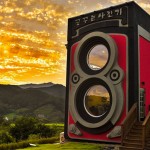
Photo Finished: 9 Snappy Camera-Shaped Buildings

28 Apr

[ By Steve in Architecture & Offices & Commercial. ]
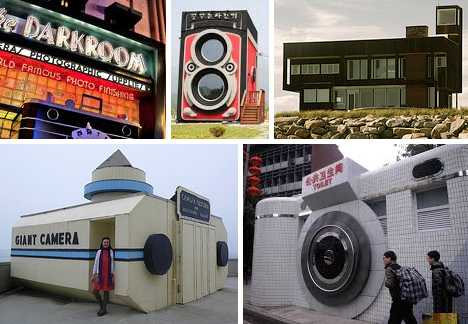
camera-shaped buildings
Yo dawg, these 9 camera-shaped buildings allow you to take selfies with your camera in front of buildings built to look like cameras. Now say “cheesy”!

The Big Camera – Perth, Australia
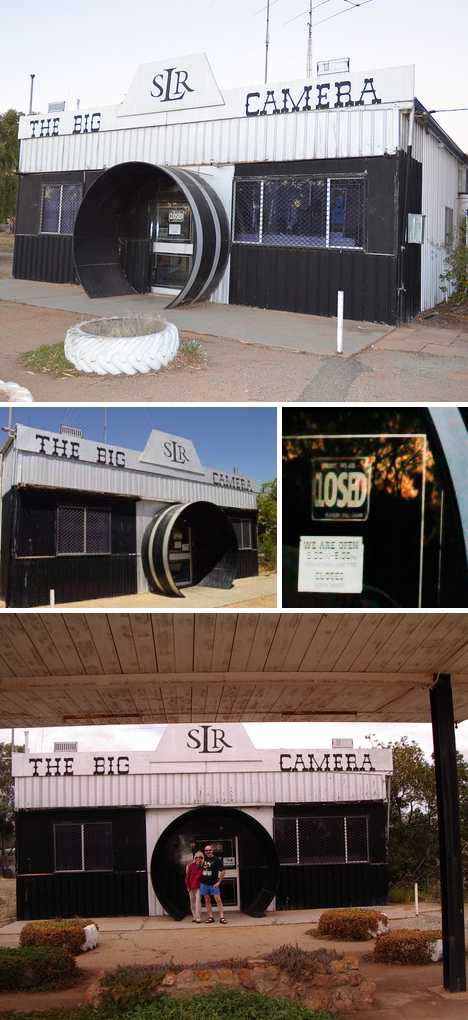
The Big Camera Meckering Australia(images via: Sascha Grant, About Australia, Philip Gostelow and Crosby Family)

The Big Camera, located about 130km (80-odd miles) east of Perth in Meckering, claims to be “the only museum, totally dedicated to photography, open to the public anywhere in Western Australia.” Well, mostly open. A note to trivia fans: Meckering’s original name was Beebering, and Baby are we glad they changed it!
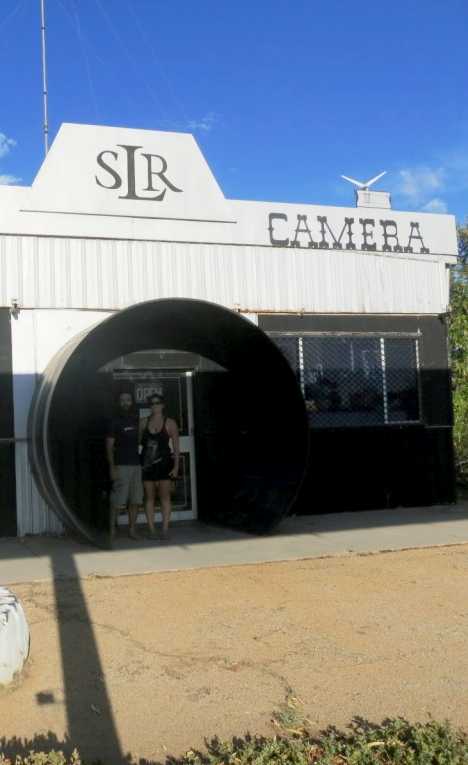
The Big Camera Meckering Australia (image via: Our Naked Australia)

In addition to displaying unique items of photographic memorabilia dating back to before the invention of photography itself, The Big Camera exhibits information relating to the 6.9 magnitude Meckering Earthquake of 1968 that destroyed most of the town’s buildings. We’re not sure if The Big Camera itself was built before the terrible tembor but if so, it must be shockproof.

Picture Perfect Nail Salon – Marion, NC, USA
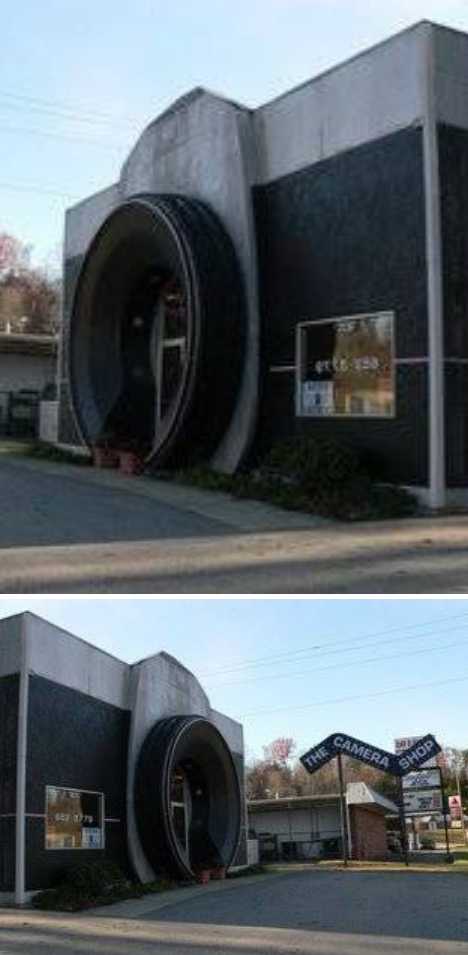
Picture Perfect Nail Salon Marion NC camera (images via: Topix)

Step 1: Design your camera store in Marion, North Carolina to look like a big ‘ol camera. Step 2: Spend too much money on construction and end up selling your nifty camera-shaped store before it even opens. Step 3: Profit? Well, two out of three ain’t bad. Hopefully the “Picture Perfect Nail Salon”, which moved into the nearly completed building just after the images above were taken, is looking after Step 3 by raking in dough hand over fist.

The Darkroom – Hollywood & More
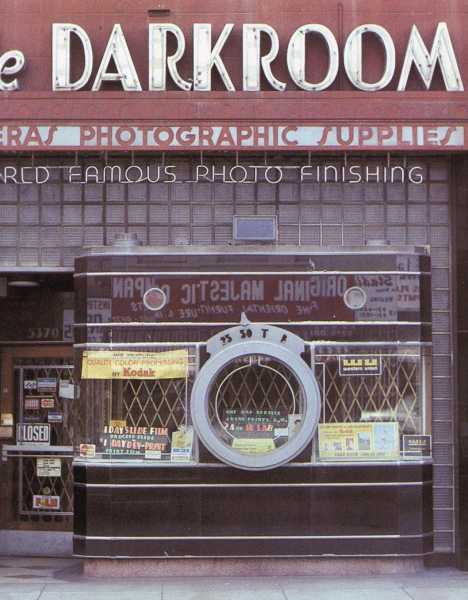
The Darkroom Los Angeles camera store(image via: Sheridan ATV Film Festival)

The Darkroom, located at 5370 Wilshire Boulevard on Los Angeles, California’s Miracle Mile, opened in the mid-to-late 1930s. The store featured a nine foot tall black glass facade and window that aped the look of a period Argus 35mm camera.
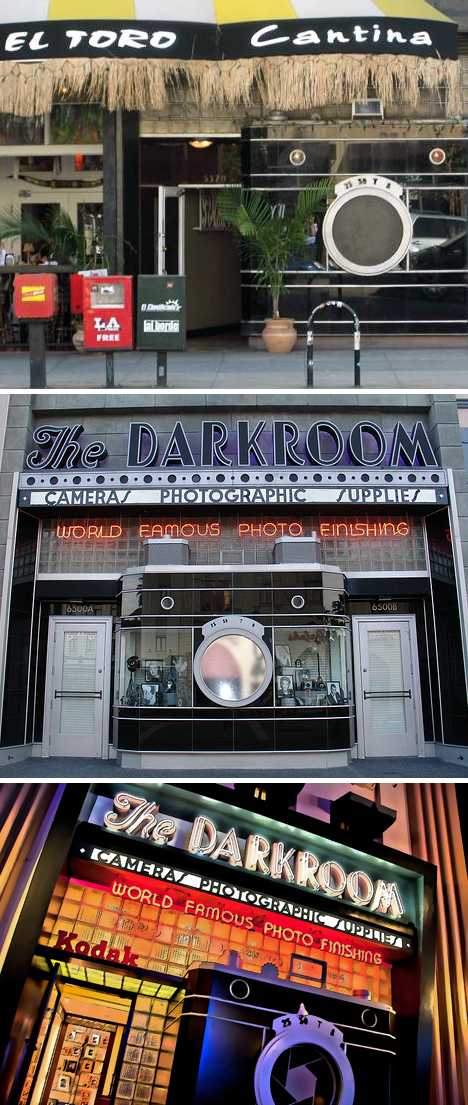
The Darkroom camera store Disney(images via: Yesterland, Topazladygem and AllEars.net)

After the store shut (or shuttered) its doors for good, the location re-opened as a Mexican restaurant whose cosmetic exterior refinements couldn’t hide The Darkroom’s original humungous camera lens. Fans of programmatic architecture shouldn’t shed too many tears, however. The Disney company has perpetuated The Darkroom’s unique look by incorporating extensive elements of the design into its wholly-owned camera & photography supply stores located in Disney theme parks around the world.

Diego Castillo Roa’s Art Decal
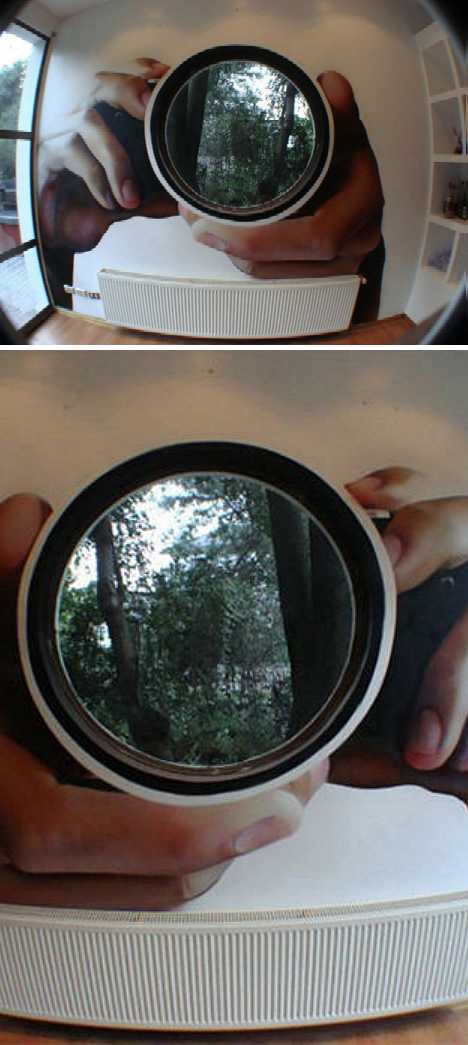
Diego Castillo Roa camera decal window(image via: PetaPixel)

Ever wonder what would happen if you turned a camera-shaped building inside out? Us neither but Chilean artist Diego Castillo Roa has done the next best thing: turned a circular window into a jumbo camera lens that, in the words of the Boomtown Rats, is “always looking atcha ah-ah-ah-ah!” Roa’s purely decorative concept saves tons’o’bucks by not requiring your home to actually look like a camera, though at least one big round window is one firm requirement. Not being perturbed by living in a fishbowl is another.

Next Page – Click Below to Read More:
Photo Finished 9 Snappy Camera Shaped Buildings

Share on Facebook


[ By Steve in Architecture & Offices & Commercial. ]

[ WebUrbanist | Archives | Galleries | Privacy | TOS ]


WebUrbanist

 
Comments Off on Photo Finished: 9 Snappy Camera-Shaped Buildings

Posted in Creativity


Dissected Buildings: Sliced Facades are All Appearances

01 Apr

[ By Steph in Art & Photography & Video. ]

Ghostly Building Facades 1

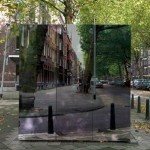
Ghostly building facades seem to have been sliced right off the buildings that should be attached to them, their skinny silhouettes rising from street level against the laws of physics. These structures are an architectural interpretation of the term ‘all style, no substance,’ presenting buildings as they look at first glance without the parts that you would see if you were to walk around the sides and back.

Ghostly Building Facades 2

Ghostly Building Facades 4

The ‘Façades’ series by French photographer Zacharie Gaudrillot-Roy wondered what a city would look like if architecture was only scenery, with no actual places for people to carry out their daily lives. The building facades were isolated in Photoshop, the backgrounds filled in with other shots taken nearby.

Ghostly Building Facades 3

The resulting images are all the more eerie for the hints of life they still contain, like satellite dishes, bicycles and laundry draped on balcony railings.

Ghostly Building Facades 5

“This series offers a vision of an unknown world that would only be a picture, without intimate space, with looks as the only refuge,” says Gaurdillot-Roy.

Share on Facebook


[ By Steph in Art & Photography & Video. ]

[ WebUrbanist | Archives | Galleries | Privacy | TOS ]


WebUrbanist

 
Comments Off on Dissected Buildings: Sliced Facades are All Appearances

Posted in Creativity


Drowned Towns: 10 Underwater Ghost Cities & Buildings

10 Mar

[ By Steph in Global & Travel & Places. ]

Drowned Towns Main

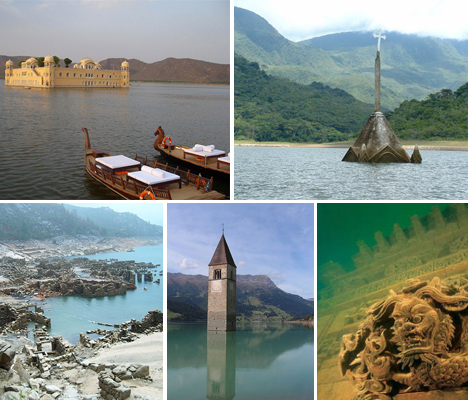
Mildewed crosses, lonely spires, barely-visible stone foundations and rusting bed frames are all that’s left to show for these 10 intentionally submerged towns and structures from India to Massachusetts. When additional water and power is needed to provide for growing populations, small villages often have to be sacrificed, and while some were demolished before their remains were flooded, others can still be seen as ghostly visions wavering beneath the surface.

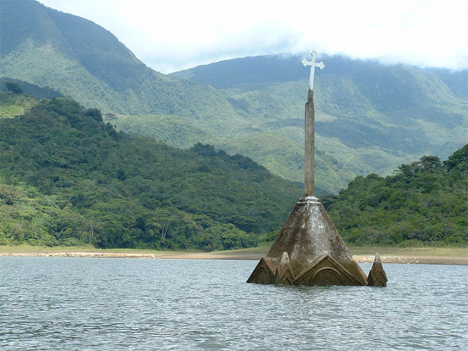
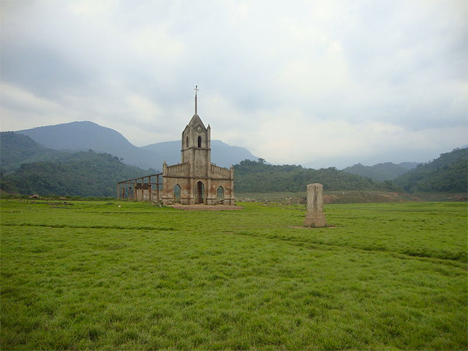
Potosi, Venezuela

Drowned Towns Potosi 1

Drowned Towns Potosi 2

Another town lost to the creation of a hydroelectric dam, Potosi was abandoned in 1985, its residents relocating and leaving their former homes to be filled with water. For 20 years, all that was visible of the Veneuzuelan town was a single mildewed cross topping a drowned church, but by the year 2010, the waters began to recede and the town slowly reappeared. The gothic church that was once submerged is visible again due to droughts and water shortages, erosion and water damage making it appear much older than it really is.

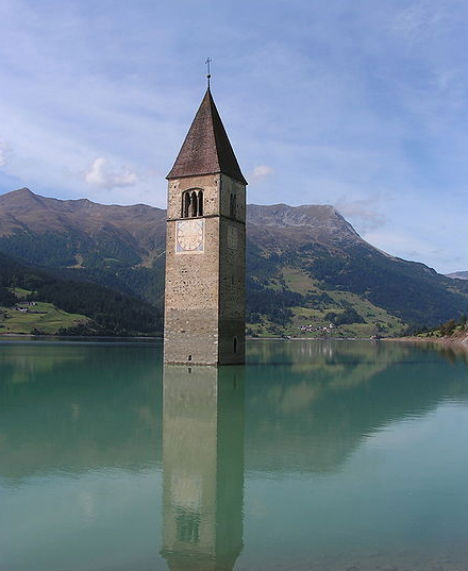
Steeple Tombstone: Curon Venosta, Italy

Drowned Towns Steeple Tomb 1

Drowned Towns Steeple Tomb 2

A single spire marks the location of an entire town lost beneath Lago di Resia. The alpine village of Curon Venosta was flooded soon after World War II when officials decided to merge three pre-existing lakes into one to create a hydroelectric dam. Before it was inundated, the town – which included 163 houses and nearly 1,300 acres of land planted with fruit – was filled with sand. The bell tower, which was built in the 14th century, was left intact as a memorial, and can be reached on foot in the winter when the lake freezes over.

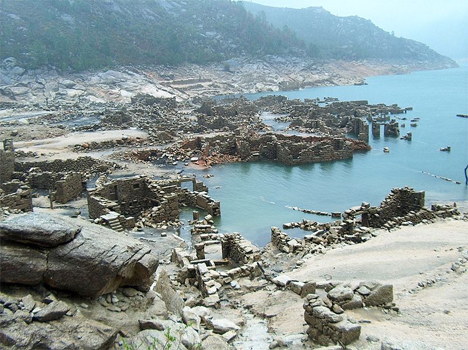
Vilarinho da Furna, Portugal

Drowned Towns Vilarinho da Furna

In 1972, the creation of a new dam meant the ancient Vilarinho da Furna was lost beneath the water. The Portuguese village, which dates back to Roman times, was home to almost 300 people inhabiting 80 houses before it was submerged; the property still belongs to their descendants, and reappears every now and then when the reservoir levels fall. The community was unique in that it had a communitarian social system with a council called the Junta made up of a single member from each family, a practice dating back to the Visigoths. When the villagers left they took as much as they could, creating their own road to transport things like rocks and roof tiles to their new homes. Some of those rocks were used to build a museum commemorating Vilarinho da Furna, which contains a collection of clothing, agricultural tools, and paintings depicting daily life in the village.

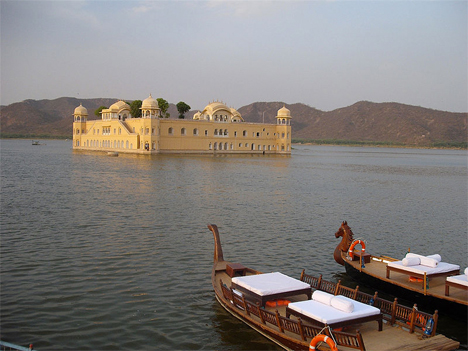
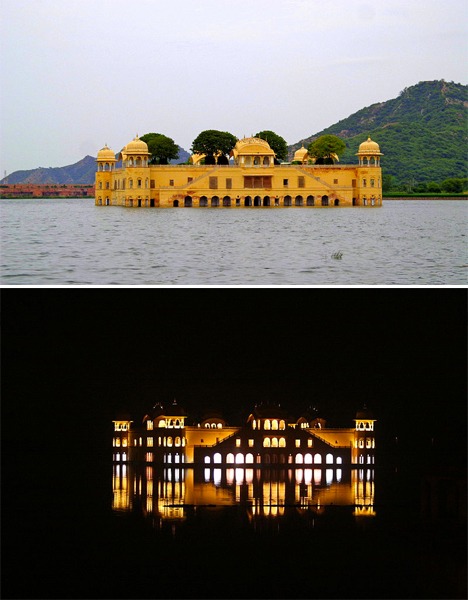
Jal Mahal, Jaipur, India

Drowned Towns Jal Mahal 1

Drowned Towns Jal Mahal 2

The Water Palace of Jaipur, India sits in the center of Man Sagar Lake. No one knows exactly when it was built, but it’s believed that the red sandstone structure is at least 300 years old and was constructed before damming created the lake, submerging its lower four stories. When the lake is full, only the top level can be reached, and only by boa. At night, the place is illuminated with floodlights like some kind of hallucinatory ghost structure. The palace was recently restored and is now open to visitors.

Next Page – Click Below to Read More:
Drowned Towns 10 Underwater Ghost Cities Buildings

Share on Facebook


[ By Steph in Global & Travel & Places. ]

[ WebUrbanist | Archives | Galleries | Privacy | TOS ]


WebUrbanist

 
Comments Off on Drowned Towns: 10 Underwater Ghost Cities & Buildings

Posted in Creativity


Altered Architecture: 12 More Abandoned Buildings as Art

30 Jan

[ By Steph in Abandoned Places & Architecture. ]

Abandoned Buildings Art Main

Abandoned places are brightened up, made even creepier and more atmospheric, or otherwise transformed into massive works of art with installations that use entire buildings as creative tools. Whether calling attention to blight in urban areas or making use of a structure before it’s demolished, these 12 (more!) abandoned building art projects make already-fascinating spaces even more of a visual delight.

Melting Facade

Abandoned Building Art Sliding Facade 1

Abandoned Building Art Sliding Facade 2

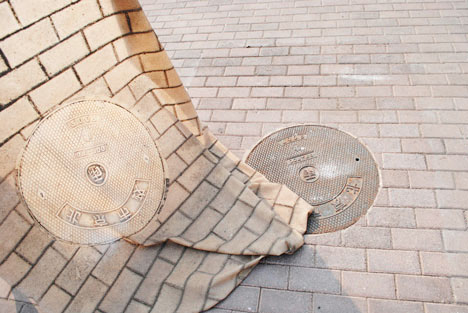
A curving brick facade gives an abandoned eyesore of a building a bit of a backwards facelift. With the new addition by artist Alex Chinneck, the abandoned building almost fits in with its neighbors – but not quite. As it slides down toward the street, it reveals the mess that remains on the top floor. The temporary installation turned an ugly building into a tourist attraction, calling attention to the need for restoration.

Deep North: Abandoned Cottage Frozen

Abandoned Buildings Art Frozen Cottage 1

Abandoned Buildings Art Frozen Cottage 2

Abandoned BUildings Art Frozen Cottage 3

A sad little shotgun cottage, filled with the former owner’s personal possessions, was left to rot, gaping holes in the walls letting in the elements. Artist Chris Larson spent a winter in sub zero temperatures pouring thousands of gallons of water onto the home to let the ice build up, and then created sculptures that are casts of actual shotgun blasts to honor the ‘shotgun house’ design of the cottage, in which all doorways and hallways are in one straight line.

Spider Web in Abandoned Stock Exchange Building

Abandoned Buildings Art Spiderweb Tape

A spider worthy of J.R.R. Tolkein’s imagination seems to have taken up residence in an abandoned stock exchange building. This stunning project by Viennese/Croatian design collective For Use/Numen is made of nearly 100 pounds of packing tape and includes a tunnel that’s strong enough for people to crawl through.

Perspective Illusions by Georges Rousse

Abandoned Buildings Art Georges Rousse 1

Abandoned Buildings Art Georges Rousse 2

Abandoned Buildings Art Georges Rousse 3

Master of perspective Georges Rousse creates incredible illusions in abandoned places that seem to cut out a geometric shape of the building and utterly transform it. Painted across various surfaces and angles, they look like random markings from most viewpoints, but stand in just the right spot and it all comes together.

Next Page – Click Below to Read More:
Altered Architecture 12 More Abandoned Buildings As Art

Share on Facebook


[ By Steph in Abandoned Places & Architecture. ]

[ WebUrbanist | Archives | Galleries | Privacy | TOS ]


WebUrbanist

 
Comments Off on Altered Architecture: 12 More Abandoned Buildings as Art

Posted in Creativity


Architectural Kaleidoscopes: Buildings Spun into Fractal Art

27 Dec

[ By WebUrbanist in Art & Photography & Video. ]

fractal building exterior dome

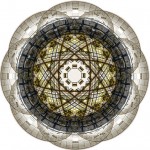
Reimagined, repositioned and recomposed, this photo manipulation series turns familiar elements of buildings into abstracted compositions that morph beyond architecture, bridging disparate worlds of design and art.

fractal tower windows

Canadian photographer Cory Stevens starts with exteriors, ceilings, walls and windows, then adds his artistic twist – a variation on the polar panoramic approach.

fractal architecture glass

While pattern recognition may persist in some cases, the rotation and multiplication in many of these pieces makes them increasingly abstract.

fractal building rotation progression

The symmetry of these fractal forms begin to make us see other patterns of nature, like snowflakes or star systems, in the shapes and materials of otherwise everyday towers, monuments, habitations, town squares and civic circles.

fractal circle town square

fractal glass facade

From the photographer: “Though my primary focus is on architecture and urban environments, I also like to indulge my love of the natural landscape. Digital abstracts have also become a growing segment of my work – inspired by my passion for design and the modern aesthetic.”

Share on Facebook


[ By WebUrbanist in Art & Photography & Video. ]

[ WebUrbanist | Archives | Galleries | Privacy | TOS ]


WebUrbanist

 
Comments Off on Architectural Kaleidoscopes: Buildings Spun into Fractal Art

Posted in Creativity


Intricate Ice Architecture: 17 Fantastic Frozen Buildings

26 Dec

[ By Steph in Art & Sculpture & Craft. ]

Ice Architecture Main

While you put the finishing touches on a lopsided snowman in your front yard, ice and snow artists around the world build life-sized ice castles, hotel rooms made of packed snow, and delicate ice sculptures stretching dozens of feet into the air. Illuminated at night, these amazing temporary structures built in some of the world’s coldest places each year look like something out of a winter fairy tale.

Hotel de Glace, Quebec

Ice Architecture Hotel de Glace 1

Ice Architecture Hotel de Glace 2

(images via: hôtel de glace)

The only true ice hotel in North America, Hotel de Glace opens each January with a new theme. In early 2013, that theme was “A Journey to the Center of Winter,” inspired by the Jules Verne novel “Journey to the Center of the Earth.” It had 44 guest rooms as well as a spa, restaurant, chapel and a bar made of ice.

China Snow World Festival

Ice Architecture China Snow World

(images via: inhabitat)

Incredible replicas of Renaissance architecture, classic Russian architecture and other impressive structures are recreated at China’s Jingyue Snow World Festival each year. While not quite life-sized, this ice and snow architecture often reaches heights of thirty to forty feet. They’re hand-carved using low-tech tools.

Castles at Sapporo Snow Festival, Japan

Ice Architecture Sapporo Japan 1

Ice Architecture Sapporo Japan 2

(images via: david mckelvey)

For just seven days each February, millions of visitors gaze upon intricately carved ice architecture and other large-scale sculptures for the Sapporo Snow Festival on the streets of Sapporo City. More than 10 teams compete in the International Snow Statue Contest to build structures reaching 50 feet tall and 150 feet wide, including life-sized dinosaurs. The largest structures can cost up to $ 100,000 to create, so they’re typically sponsored by countries or corporations.

Harbin Ice and Snow Sculpture Festival, China

Ice Architecture Harbin China

Ice Architecture Harbin China 2

(images via: wikimedia commons)

Harbin, China transforms into an ethereal showcase of ice architecture and sculptures illuminated in bright colors each January. The annual festival began as a traditional ice lantern garden party in 1963 and is now the largest snow and ice festival in the world, taking over virtually the entire city, with a unique theme each year.

Next Page – Click Below to Read More:
Intricate Ice Architecture 17 Fantastic Frozen Buildings

Share on Facebook


[ By Steph in Art & Sculpture & Craft. ]

[ WebUrbanist | Archives | Galleries | Privacy | TOS ]


WebUrbanist

 
Comments Off on Intricate Ice Architecture: 17 Fantastic Frozen Buildings

Posted in Creativity


Calling Home: 9 Nifty Smartphone Shaped Buildings

01 Dec

[ By Steve in Architecture & Offices & Commercial. ]

smartphone buildings
Does your high-rise apartment or office tower look like a mobile phone? These ones do, and you can bet smartphone users inside them get REALLY good reception.

Telefónica Chile Building – Santiago, Chile

Telefónica Chile Building Santiago(image via: Celebrate Big)

The Telefónica Chile Building (Torre Telefónica Chile) in Santiago was designed by architects Seismic A&E and while the firm doesn’t explicitly say so at their website, the structure was clearly intended to house a mobile telecommunications company – in this case, Telefónica Chile (known since 2009 as Movistar).

Telefónica Chile Building Santiago(images via: Chilling In Chile, Dijitalimaj and Wikimedia/Diego Sepulveda)

The 143 m (469 ft) tall tower’s design was an attempt to ape the appearance of state-of-the-art mid-1990s mobile phones… considering the building opened in December of 1995, we’d say the architects achieved their goal. It’s odd, however, that planners did not foresee the continuing evolution of mobile phone design through the Telefónica Chile Building‘s estimated lifespan and indeed, only a few short years after it opened the design was already looking quite dated.

Omniyat Properties iPad Building – Dubai, UAE

iPad Building Dubai(image via: WIRED)

Don’t let the name “iPad” fool you, this 23-story building concept from Omniyat Properties dates from 2007 and its design was intended to evoke Apple’s iPod MP3 player sitting atop a docking station. If the design doesn’t resemble an iPod upon first glance, keep in mind the edifice will lean back at a six degree angle.

iPad Building Dubai(images via: Roberta’s Blog and LandvestDubai)

Omniyat Properties suspended work on many of its planned building designs as the late-2000s world financial crisis bit into investment budgets, and the iPad was one of those to be put “on hold” until better days arrived. By 2010 the design had been re-named “The Pad” for obvious reasons and according to Omniyat Properties over 50 percent of payments required to re-start work on this and other outstanding projects had been nailed down.

Bic Camera Building – Tokyo, Japan

Bic Camera cellphone building Tokyo Ikebukuro(image via: Panoramio/alicemarotta)

The Bic Camera building in Tokyo’s Ikebukuro district is one of about 40 Bic Camera stores in Japan, though it’s the only one that looks like a cellphone. The building’s facade is actually functional in a way, as the number buttons match the building’s floors and include a short description of what products may be found there.

Bic Camera cellphone building Tokyo Ikebukuro Japan(images via: Spicykarma and Kirainet)

Oddly for a building shaped like a cellular phone, the Bic Camera building in Ikebukuro does not specialize in mobile phone sales. Instead, this particular location predominantly sells computers, parts, peripheral devices and the like.

Next Page – Click Below to Read More:
Calling Home 9 Nifty Smartphone Shaped Buildings

Share on Facebook


[ By Steve in Architecture & Offices & Commercial. ]

[ WebUrbanist | Archives | Galleries | Privacy | TOS ]


WebUrbanist

 
Comments Off on Calling Home: 9 Nifty Smartphone Shaped Buildings

Posted in Creativity


Aren’t We Nautical: 10 Swell Ship-Shaped Buildings

17 Nov

[ By Steve in Architecture & Cities & Urbanism. ]

ship-shaped buildings
From the fish out of water department: Landlubbers leery of getting their feet wet can live vicariously by visiting these 10 swell ship-shaped buildings.

Wanlihao Ship Building – Chengdu, China

Wanlihao Ship Building Chengdu China(image via: littledutchboy)

If the Wanlihao Ship Building was an attempt to make the Chinese city of Chengdu famous for something other than pandas and spicy food, then a hearty pat on the back goes to its designers. Ditto for Flickr user littledutchboy for capturing and posting the image above.

Wanlihao Boat Building Chengdu China(images via: Kevin Fitchard and SOSO, 55tuan)

This rather large waterfront edifice houses a number of businesses and services including several seafood restaurants and the exclusive-sounding Flagship Club… sounds like the kind of place Judge Smails and Thurston Howell III might hang out at. As for being just a tad gaudy and ostentatious, well, you oughta see it at night!

Public Restroom – Chennai, India

Chennai India ship public restroom(images via: Kevin Fitchard and Lydia Depillis)

If you were expecting a “poop deck” joke, forget abou… oh. Anyway, this public restroom in the city of Chennai, India doesn’t just look like a brick ship house, it’s built like one too. The top photo from iTravelnet dates from March of 2007 while the lower image from Lydia Depillis taken in the summer of 2012 shows significant deterioration. We’ll leave the state of the interior to your imagination.

Museum of Maritime Science – Tokyo, Japan

Museum of Maritime Science ship building Tokyo Japan(images via: Funegasuki and Home Designing Weblog, Penta-Ocean)

The Museum of Maritime Science (Fune-no-Kagakukan in Japanese) in Odaiba dates from 1974 and was one of the first buildings at that location constructed on land reclaimed from Tokyo Bay… perhaps the contractors were hedging their bets a bit. The scale of the building is highlighted by the 83-meter (273ft) long Antarctic icebreaker Soya moored just offshore.

Museum of Maritime Science Tokyo Japan Odaiba(image via: TKFuruse)

The ship-like styling is purely intentional; inside visitors will find a veritable 3D history book that takes one back to the era of the Shoguns, forward through the destructive Second World War and into the present era. Models of the Yamato – the world’s largest battleship – share space with those of civilian and military ships, submarines and seaplanes.

Huntington Ingalls Industries Building – Newport News, VA, USA

Huntington Ingalls Industries ship building Newport News(images via: HII and The Arts Adventurer)

Huntington Ingalls Industries (HII) is America’s largest shipbuilder and the ONLY one able to design and build the nation’s nuclear-powered aircraft carriers. The company’s headquarters building in Newport News reflects the firm’s long history (it was known until 2008 as Northrop Grumman Shipbuilding) and continuing focus on shipbuilding.

Next Page – Click Below to Read More:
Arent We Nautical 10 Swell Ship Shaped Buildings

Share on Facebook


[ By Steve in Architecture & Cities & Urbanism. ]

[ WebUrbanist | Archives | Galleries | Privacy | TOS ]


WebUrbanist

 
Comments Off on Aren’t We Nautical: 10 Swell Ship-Shaped Buildings

Posted in Creativity


Skinned Buildings: Latex Casts of Derelict Urban Surfaces

05 Nov

[ By Steph in Art & Installation & Sound. ]

Skinned Buildings Latex 1

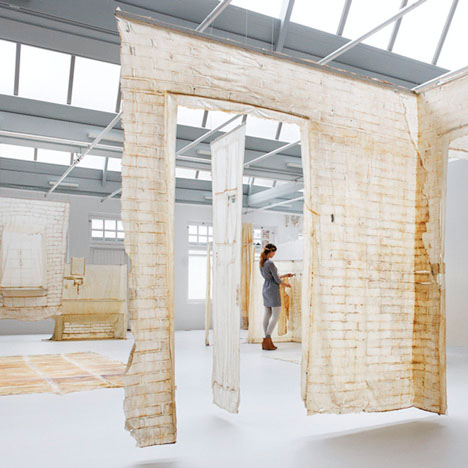
Draped like the macabre souvenirs of a serial killer, ghostly skins of old buildings billow on clotheslines, bearing the grime of the surfaces from which they were cast. Amsterdam design studio KNOL Ontwerp preserves the memory of cobblestone streets, brick walls, fireplaces and doors by coating them in latex to create a tactile impression of their surfaces.

Skinned Buildings Latex 2

Skinned Buildings Latex 3

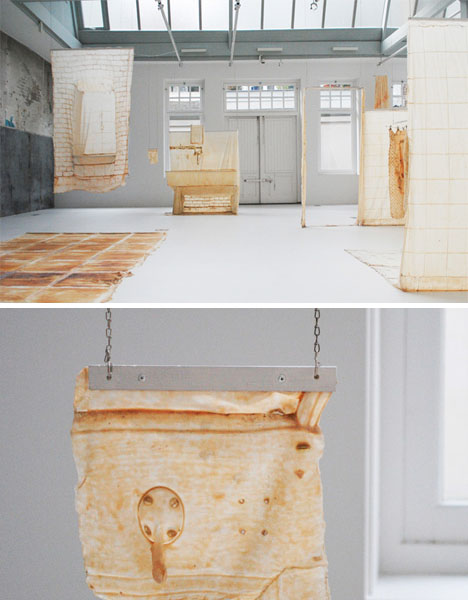
Installed at the Sandberg Institute of Amsterdam, ‘Skinned’ has these castings hanging like funeral shrouds from the gallery ceiling. The latex is fittingly translucent, almost immaterial, adding to the sense that each piece is just the faintest echo of the solid object from which it was taken. Most of the skins come from vacant buildings around Amsterdam.

Skinned Buildings Latex 4

Not only is the exact texture and shape of the original structure captured in great detail, but also some of the dirt. The designers made no effort to clean up any of the surfaces they cast, so when they peeled away the latex, a little bit of the structure’s history came off with it.

Skinned Buildings Latex 5

Skinned Buildings 6

“Like skin transplantations they can be taken to other spaces where they get a new spatial meaning. They take us to a wold in which places are no longer fixed to specific locations, but become nomadic or ‘liquid.’ When the skins are drawn out of their original context and are brought to a new one, their character changes. The impact on for example an abandoned office building is remarkable.”

Share on Facebook


[ By Steph in Art & Installation & Sound. ]

[ WebUrbanist | Archives | Galleries | Privacy | TOS ]


WebUrbanist

 
Comments Off on Skinned Buildings: Latex Casts of Derelict Urban Surfaces

Posted in Creativity


Live Between Buildings: Narrow Micro-Homes Fill City Gaps

05 Sep

[ By WebUrbanist in Architecture & Houses & Residential. ]

narrow home competition entry

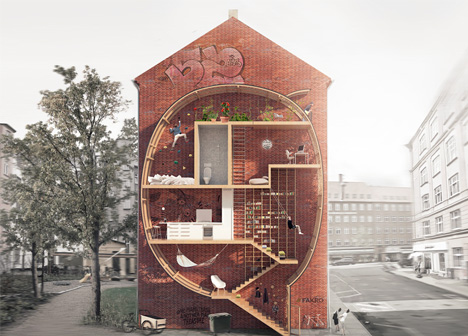
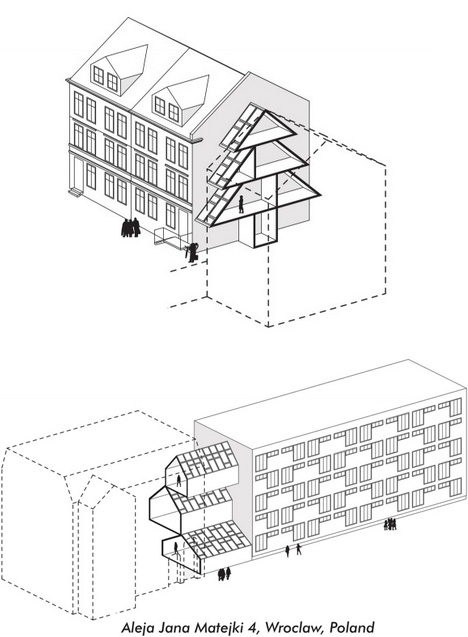
Playful yet thought-provoking, this project asks: what do we do with small leftover spaces in cities … particularly in urban areas where even a few square feet of real estate can cost a fortune?

narrow house competition winners

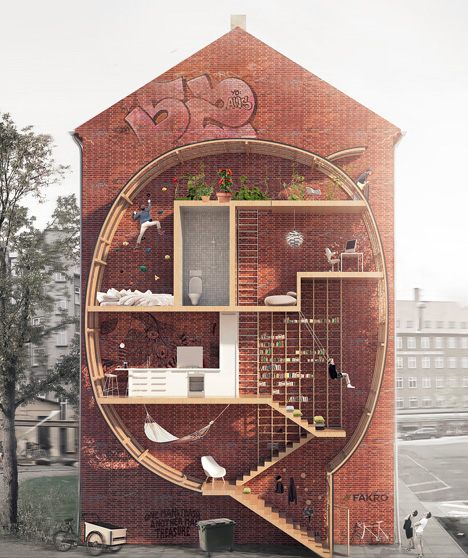
Live between Buildings by Ole Robin Storjohann and Mateusz Mastalski won first place in a Loft 2 competition held by FAKRO, which challenged contestants to rethink loft living and material efficiency without sacrificing light and space.

narrow interstitial house concept

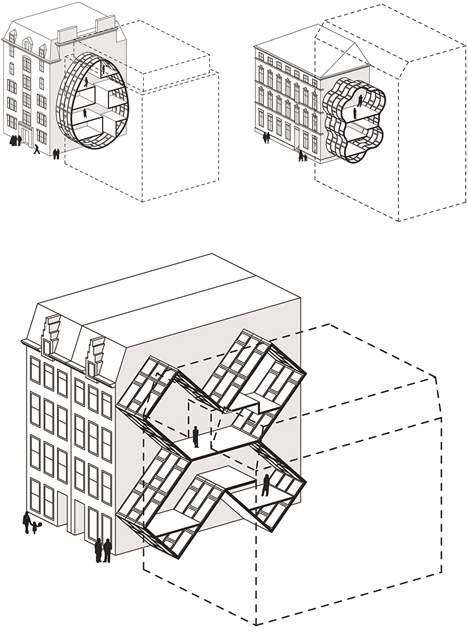
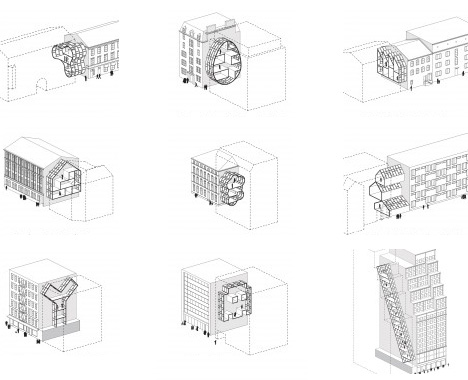
Their various prototype proposals have nearly no ground footprint, being instead suspended in part or entirely between existing structures. In testing the idea, they took actual buildings and voids, abstracted and simplified their forms, all to show how such interventions would work in major cities from New York and London to Amsterdam and Tokyo.

narrow home architectural entries

A wide selection of shapes suggests many possibilities using modular pieces, including half-serious and semi-practical suggestions, such as egg and X shapes, as well as outright silly ones, like a Christmas-tree home or cloud-bubble house, more intended just to illustrate the potential flexibility.

narrow home case studies

Out of a variety of compelling entries, just why did this pair win the award? “The Jury appreciated the way the basic idea – creating small infill-dwellings in-between existing buildings – has been worked out in extended research, thus providing models for various housing types in different cities. The plan can be realized entirely out of roof windows (with some technical adjustments) and offers an innovative idea for using empty spaces in urban fabric. The possibility of shapes is endless. The project was very beautifully drawn and communicated on a single sheet, the section describing both the architectural idea and the exciting occupation of the proposed building.””

Share on Facebook


[ By WebUrbanist in Architecture & Houses & Residential. ]

[ WebUrbanist | Archives | Galleries | Privacy | TOS ]


WebUrbanist

 
Comments Off on Live Between Buildings: Narrow Micro-Homes Fill City Gaps

Posted in Creativity