RSS
 

Posts Tagged ‘Building’

Blow-Up Building: Inflatable Concert Hall Tours Japan

26 Sep

[ By Steph in Global & Travel & Places. ]

INflatable concert hall Japan 1

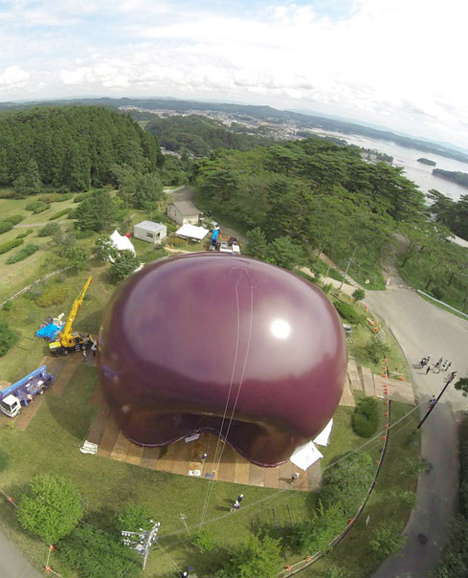
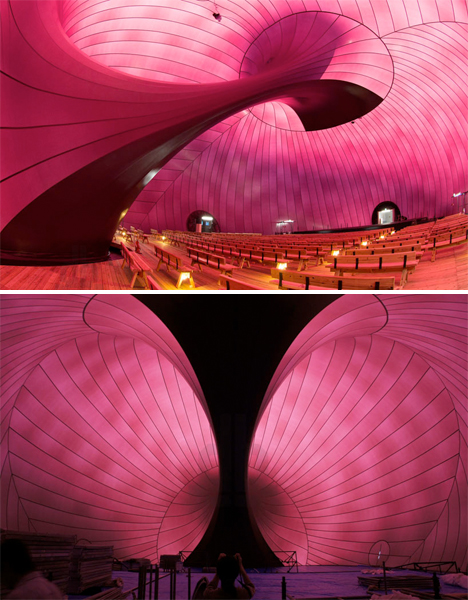
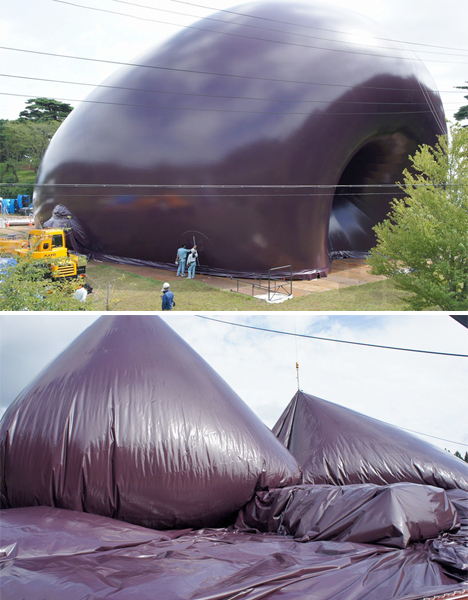
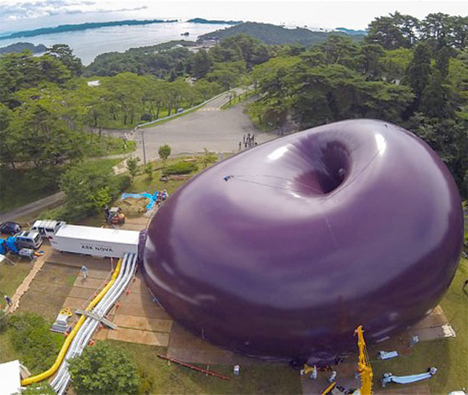
A giant purple bubble will rise from a pile of plastic to bring music, workshops and performance to Japan’s northeastern coast, which was devastated by an earthquake and subsequent tsunami in 2011. A collaboration between British sculptor Anish Kapoor and Japanese architect Arata Isozaki, the Ark Nova is the world’s first inflatable concert hall, and will tour the country for the Lucerne Festival Arknova 2013.

Inflatable Concert Hall Japan 2

Once fully inflated, the coated polyester structure measures nearly 60 feet in height and 115 feet in width. Its first stop is at a park in the town of Matsushima, which suffered serious damage to its many important cultural properties and artistic monuments, and lost thousands of residents.

Inflatable Concert Hall Japan 4

Wood from cedar trees that were damaged by the floods was used to create seating for 500 guests. The structure can easily be deflated, and will travel around the region to host events that organizers hope will help rebuild local culture and spirit.

Inflatable Concert Hall Japan 3

In addition to a range of modern concerts and performances, traditional Japanese culture such as kabuki theater will be celebrated. Children in the affected regions will also perform traditional arts and performances themed on the earthquake disaster.

Share on Facebook


[ By Steph in Global & Travel & Places. ]

[ WebUrbanist | Archives | Galleries | Privacy | TOS ]


WebUrbanist

 
Comments Off on Blow-Up Building: Inflatable Concert Hall Tours Japan

Posted in Creativity


Ghost Architecture: Unconscious Art of Building Demolition

20 Aug

[ By WebUrbanist in Art & Photography & Video. ]

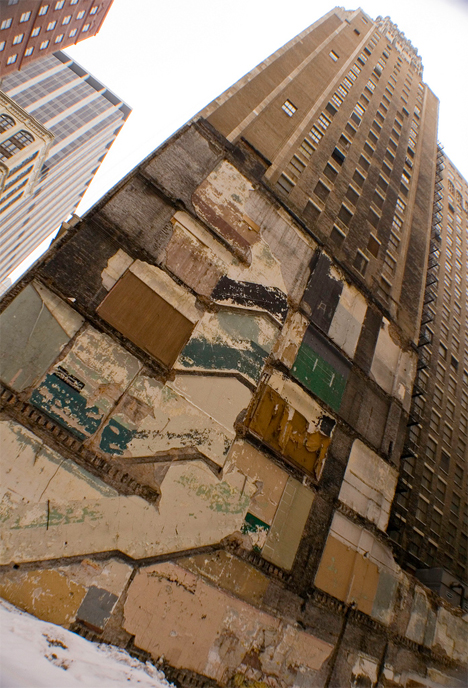
void building architectural photos

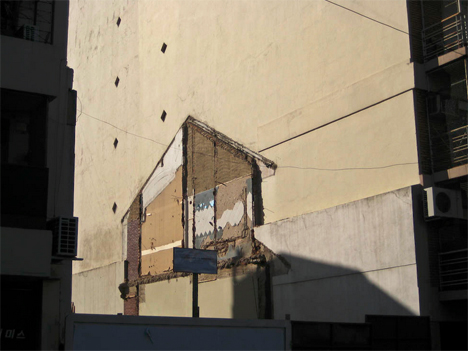
When a free-standing building is razed there is often little left to tell its story, but in places where structures directly abut one another there are sometimes amazing traces of not just buildings but floor plans, wall placements, staircases and even room contents.

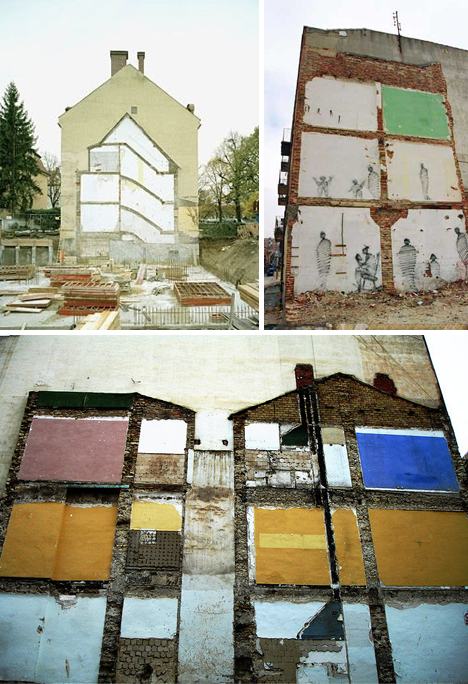
void building demolition art

Like architectural section drawings, remnant spaces can be extrapolated from two-dimensional clues, like material transitions, degree of weathering, surface shapes and color shifts. Occasionally, there are even three-dimensional fixtures still hanging on, like the showers, sinks and toilets in one of the pictures above.

ghost void building

The Unconscious Art of Demolition is a Flickr photography group that focuses on these accidental works of ghost architecture – leftover structural voids and the spaces they imply.

void structure implied volume

In the process of observing and photographing, these passers by and onlookers are turned into amateur documentarians and de facto archaeologists, discerning and (at least subconsciously) projecting patterns into ambiguous urban decay.

void architecture building examples

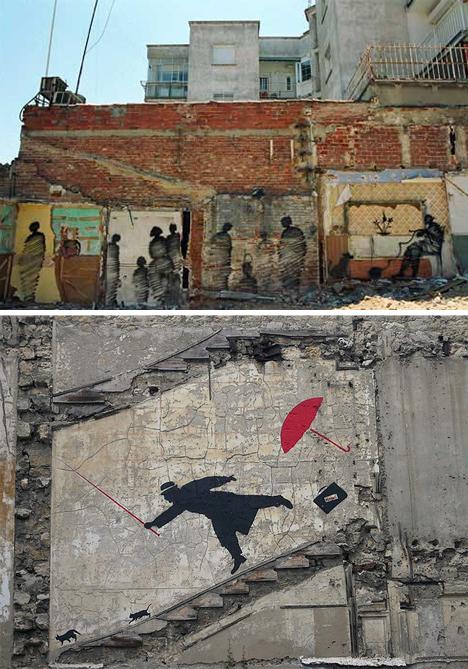
Some take an abstract approach, zooming in on the rich materials where parts of walls were left and other pieces ripped away. Others take a broader focus, highlighting building outlines and implied interiors. Still others capture works of street art placed within the flat landscapes one can imagine inside of these non-buildings.

void building street art

Images included here are by Steven Kunstler, Merrick Brown, Daniel Lobo, Thomas Hobbs, Dave Meyer and Xenmate, but many more can be found in the aforementioned Flickr group with over 500 images and members.

Share on Facebook


[ By WebUrbanist in Art & Photography & Video. ]

[ WebUrbanist | Archives | Galleries | Privacy | TOS ]


WebUrbanist

 
Comments Off on Ghost Architecture: Unconscious Art of Building Demolition

Posted in Creativity


5 Steps to Building More Powerful Images

10 Aug

A Guest Contribution by Dan Bailey

We photographers seem to have it easy. Whereas most artists spend anywhere from hours, to months to years to manufacture their creations, we can simply point, press and be done. However, that kind of convenience doesn’t necessarily translate into great imagery.

Shooting powerful photos that have lasting visual appeal requires more than just pointing and clicking; it takes applying some fundamental compositional methods that are designed to simplify your compositions and actively engage your viewers. Here are five steps that will help you strengthen the visual impact of your imagery.

1. Use Awesome Light

Photography is all about light, and it’s the first thing that will make or break the shot. Not matter what you’re shooting, any and every subject will look better in great light. When we think of good light, we often think of Magic Hour, or the stretches of time during sunrise and sunset. As a general rule, shooting during these times will usually give excellent results.

However, be open to shooting at other times of the day, or even using other lighting sources. Fog, diffused window light or a camera flash can all make for compelling illumination. If you become proficient at wrangling the light, you can create great photos under any conditions.

NFLD HIK 100A

2. Have an Identifiable Main Subject

First and foremost, your image should have have a main subject. Period. It needs to be about something. The most powerful photographs are built around a single element that serves as the focal point of the shot. As a photographer, your job is to draw your viewer into the frame, and if you don’t give them something to lock onto, their eyes will wander aimlessly around your picture trying to figure out what they’re supposed to see. If you don’t know what your picture is about, then your viewer won’t either and they’ll just move on.

DSC8929

3. Use Relationships to Tell the Story

A powerful photograph tells a story, which essentially means that it communicates some specific message or invokes an emotional response from the viewer. The best way to do build this story is to establish relationships between your main subject and the other elements inside the frame.

The job of these secondary elements is to compliment, reinforce or contrast the main subject in some way. An effective secondary subject can be as simple as a strong, out of focus background that gives a sense of place, or it can be two or three other things in the photo that give your subject something to play off of and help to establish the narrative of how your subject “fits” within the world of your frame.

Adding strong secondary elements to your photo also gives your viewer something else to explore as their eyes scan the image, and more importantly, it gives them something to think about. Anytime you activate your viewer’s brain, you’ve gone a long way towards creating a compelling image.

UTH 100

4. Create Tension Through Framing

Depending on how you place your subjects in the frame, you determine the experience by which your viewer scans and respond to what’s in your photograph. The human eyes and brain are hard wired to see and recognize patterns, colors and imperfections in the world; it’s how we evolved to identify our surroundings and spot things like food and danger.

By using a mix of hot and cool colors and by placing your subjects in seemingly random areas in the frame, you cause an inherent uneasiness in your viewers. Their eyes will scan your image, trying to find patterns and that may not exist, and so they’ll keep looking, tracking back and forth between your different subject elements, and darting across broad patches of negative space in order to make sense of the photo. By contrast, if your composition is too perfect, or too balanced, your viewer will quickly spot this nice, easy pattern and move on. That’s not what you want.

DSF0787

5. Don’t Show Everything

A common mistake with beginning photographers is to try and show too much. This leads to cluttered, boring images that do little to engage the viewer’s brain. As I said in number 2 above, in order to create a powerful photo, you need a main subject. However, I didn’t say that you had to show the whole thing.

Abbreviating your subjects can be a very powerful method towards creating a compelling shot. Especially if I they’re things that we’re all familiar with. If you only show part of a subject, you automatically activate your viewer’s imagination as they try to picture the rest in their mind. Photography is a two way street: You have creator and viewer, and if you bring your audience into the process, you invite them to become more connected to your shot.

Remember, good photography isn’t about perfectly reproducing your subject, it’s about creating a visual representation that communicates the ideas or emotions that you had about the scene right when you pressed the shutter.

DSC2259

Further Reading

Makingcover125For more creative photography tips, I invite you to check out my eBook Making The Image – A Conceptual Guide to Creating Stronger Images. I’ll even give you a special price! Use discount code DPS you can get eBook for 50% off.

Dan Bailey is a full time professional outdoor, adventure and travel photographer based in Alaska. When he’s not off exploring in the mountains, writing about photography, or flying his little yellow bush plane, he can sometimes be found lurking in the forums right here at DPS.

Check out his blog and find him on Facebook and Google+.

Post originally from: Digital Photography Tips.

Check out our more Photography Tips at Photography Tips for Beginners, Portrait Photography Tips and Wedding Photography Tips.

5 Steps to Building More Powerful Images


Digital Photography School
 
Comments Off on 5 Steps to Building More Powerful Images

Posted in Photography


Building Fragments: 20 Surreal Reconstructed Photographs

06 Aug

[ By WebUrbanist in Art & Photography & Video. ]

edited photoshopped crane tower

At first glance, they are nearly believable, these angled buildings with their curious corners. Closer inspection reveals Escher-esque optical illusions and impossible intersections, liminal hybrids of real details … reconstructed.

edited improbable building configurations

edited building multiple versions

Olivier Ratsi, a French visual artist, titles this series What You See is Not What You Get (WYSI*not*WYG). It collects then fragments urban landscapes, which he dubbs Anarchitecture, sorted by country and city, from around the world. The results are reassembled into something at once more disjointed yet (together) unified than the original constituent objects.

edited city structure korea

edited photo tower building

His final pieces are then printed and posted around towns and cities where one might normally find advertisements – a sort of subvertising campaign challenging people to stop, look and think about their urban environment.

Next Page:
Building Fragments 20 Surreal Reconstructed Photographs

Share on Facebook


[ By WebUrbanist in Art & Photography & Video. ]

[ WebUrbanist | Archives | Galleries | Privacy | TOS ]


WebUrbanist

 
Comments Off on Building Fragments: 20 Surreal Reconstructed Photographs

Posted in Creativity


Building Eraser: Smart Robot Scans & Deconstructs Concrete

17 Jul

[ By WebUrbanist in Conceptual & Futuristic & Technology. ]

building deconstructing robotic system

Whether the building is a bare-bones warehouse or five-star hotel, demolition is an equally messy business – but perhaps it does not have to be. What if demolition teams could precisely separate the component parts of the concrete forming the walls, floors and ceilings of a structure?

building erasing robot design

ERO is an award-winning robotic solution that strips concrete on-site and step-by-step, saving time, energy and copious amounts of water (used to reduce airborne particulates) in the deconstruction process. It parses the pieces back into cement, aggregate and water as it goes, literally erasing a building rather than demolishing it.

building demolition robot

The robot scans sections and identifies the best ways to break them down into constituent parts for reuse or recycling. This approach switches the literal sledgehammer with a proverbial scalpel – the latter taking the form of a concentrated high-pressure water jet that cracks the concrete and allows it to be more carefully removed.

building deconstruction smart system

In the end, the graywater is reused, the particulates turned into aggregate for fresh construction applications and the rebar cleaned and sorted as well. This systematic recycling saves materials not just for future uses but also reduces waste along the way by mitigating the need to actively blanket the building demo site with water and saves time in terms of sorting through the rubble.

building compact eraser robots

From the  2013 International Design Excellence Award (IDEA) awards page: “The challenge with this project was to separate materials concurrent with deconstruction. Concrete is usually reinforced with a metal mesh inside. Common techniques involve using brute force to pulverize the concrete, which creates a mixed mound of waste material that needs to be separated before it can be reused or sold as second-grade metal or as a filling material. In order to overcome later separation and ease the transport of materials, the process had to start with separation on the spot. It was a challenge to switch from brutal pulverizing to smart deconstruction.”

Share on Facebook


[ By WebUrbanist in Conceptual & Futuristic & Technology. ]

[ WebUrbanist | Archives | Galleries | Privacy | TOS ]


WebUrbanist

 
Comments Off on Building Eraser: Smart Robot Scans & Deconstructs Concrete

Posted in Creativity


20 Million Sq Ft: World’s Biggest Building Opens in China

16 Jul

[ By WebUrbanist in Architecture & Offices & Commercial. ]

biggest building record breaking

Night never comes to this massive complex newly constructed in China. Complete with its own artificial sun (as well as beaches and waves), the world’s largest structure is not a skyscraper but a building both horizontally and vertically vast.

worlds biggest building design

biggest building night view

The New Century Global Center in Chengdu, Sichuan, has offices, shops and five-star hotels as you might expect, but it also has simulated exterior spaces with LED screens depicting views of artificial horizons as well as theaters, amusement park rides and an Olympic-sized ice skating rink.

worlds biggest interior space

Its square footage is hard to fathom, even in meters (1.7 million square), so its creators have come up with another way to visualize the enormity of the space: you could fit 20 Sydney Opera Houses inside of it, 3 copies of the Pentagon or 329 football fields.

worlds largest building china

Critics call it boring and massive, but fans admire its relative simplicity and highlight its variegated interior experiences. Though basically minimal overall, a thick and wavy roof line helps define it and provides a way to brand and identify it as both a Chinese structure and potentially iconic symbol.

Share on Facebook


[ By WebUrbanist in Architecture & Offices & Commercial. ]

[ WebUrbanist | Archives | Galleries | Privacy | TOS ]


WebUrbanist

 
Comments Off on 20 Million Sq Ft: World’s Biggest Building Opens in China

Posted in Creativity


Nail House: Holdout Building Had Highway Built Around It

21 Jun

[ By WebUrbanist in Abandoned Places & Architecture. ]

nail house highway

China is full of strange stories of so-called ‘nail houses’ – homes of people who refuse to move to make way for a large development project. Still, this one was particularly unique: its owners held out while a whole major motorway was constructed on all sides.

nail house demolition ruins

Situated in Wenling, its owner Luo Baogen refused the compensation deal offered to him and the owners of over 400 nearby properties.  After a full year of waiting with his wife as they were hemmed in by highway, they finally accepted an improved offer from the government and moved.

nail house china mall

In another similar situation, owner and occupant Wu Ping refused an offer (one out of nearly 250 in that case) to move, and found herself surrounded by a sunken pit as shopping mall developers began excavating prior to constructing a new shopping center. Structures in this situation are dubbed ‘nail houses’  because, like a nail wedged deep into a board, they can be stubborn and difficult to remove.

Share on Facebook


[ By WebUrbanist in Abandoned Places & Architecture. ]

[ WebUrbanist | Archives | Galleries | Privacy | TOS ]


WebUrbanist

 
Comments Off on Nail House: Holdout Building Had Highway Built Around It

Posted in Creativity


GoGo & Multiplo: Modular Building Blocks for Kids & Adults

11 Jun

[ By WebUrbanist in Design & Furniture & Decor. ]

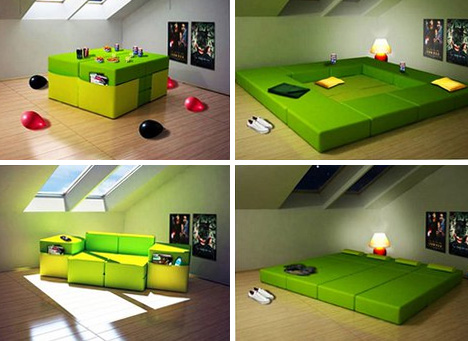
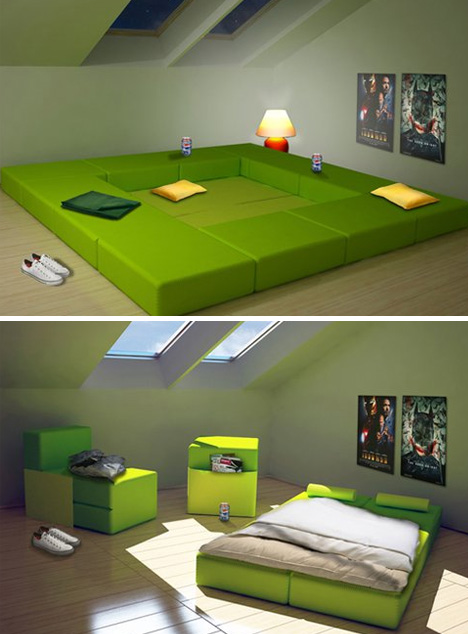
modular block bedroom set

Two very similar designs with somewhat different audiences, Multiplo emphasizes their kit-of-parts approach as a means toward making convertible adult furniture, while Gogo Blocks are presented as a way for children to build their own play spaces, forts and mazes.

modular blocks toys playspaces

Sinclair Smith designed the Blocks as a student project, and, when he came across Multiplo, celebrated and encouraged HeyTeam‘s development of its parallel project.

modular gogo blocks system

But the blocks can work as furniture too, writes Smith: “Gogo blocks are a children’s play system of foam pillows for building and imagining, and are specifically scaled to form a twin mattress for sleepover guests.”

modular blocks heyteam multiplo

As to Multiplo: users are welcome to invent their own configurations and transformations, but core starting suggestions include couches, beds and a square lounge pit for seating groups. Also, the color palette is a bit more passable for older users (at least: young adults), being somewhat less colorful than that of its cousin, Gogo.

Share on Facebook


[ By WebUrbanist in Design & Furniture & Decor. ]

[ WebUrbanist | Archives | Galleries | Privacy | TOS ]


WebUrbanist

 
Comments Off on GoGo & Multiplo: Modular Building Blocks for Kids & Adults

Posted in Creativity


Algae-Fueled Building: World’s First Bio-Adaptive Facade

02 May

[ By WebUrbanist in Architecture & Public & Institutional. ]

algae powered building

Bio-reactors and micro-algae sound like the stuff of science fiction, but this is the real deal: biomass built into panel glass is both generating heat and acting as a responsive light and sound barrier, all in one brilliant new building in Hamburg.

bio facade algae building

Arup has long been predicting incredible innovations in architecture, but they are also keen to show that their designers and engineers are actually working toward world-changing technologies.

algae biomass building design

Bright sunlight causes the bio-reactors to grow faster and supply more shade on demand. The resulting biomass captures solar heat as well, and can be harvested and used as a source of energy itself. It is, in essence, an architectural ecosystem in which all parts of the process are not only sustainable but multi-functional and fully integrated.

algae energy fuel source

There is always talk of futuristic building technologies, but few firms are able to break new ground in some of the most promising directions. If there is to be a new ‘living architecture’ movement involving micro-climates, bio-chemical processes and responsive materials, Arup continues to prove itself on the forefront of its exploration.

Share on Facebook


[ By WebUrbanist in Architecture & Public & Institutional. ]

[ WebUrbanist | Archives | Galleries | Privacy | TOS ]


WebUrbanist

 
Comments Off on Algae-Fueled Building: World’s First Bio-Adaptive Facade

Posted in Creativity


SEO For Photographers Part 3: 5 Great Link Building Strategies

06 Apr

Why are link building strategies important? This is a common question and the answer has everything to do with how much weight the search engines place on different aspects of our SEO activities. Although paying attention to your on-site search engine optimization is important, and it’s vital to select and use the right keywords for your photography business (see “SEO Continue Reading

The post SEO For Photographers Part 3: 5 Great Link Building Strategies appeared first on Photodoto.


Photodoto

 
Comments Off on SEO For Photographers Part 3: 5 Great Link Building Strategies

Posted in Photography