RSS
 

Posts Tagged ‘Building’

Architectural Magic: Big Stone Building Breaks Free & Floats

23 Nov

[ By WebUrbanist in Art & Installation & Sound. ]

architecture floating building magic trick

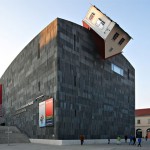
A work of art, genius and incredible effort, half of this replica structure appears to hang in mid-air, seeming at once a perfect aesthetic fit for its surroundings and completely disconnected from the laws of physics.

architecture covent garden installation

British artist Alex Chinneck and his crew spent over 500 hours and had to construct a 4-ton counterweight to balance this faux building in the sky – what appears to be solid stone is in fact a steel-framed copy of an historic structure also found at Covent Garden (the original is nearly 200 years old).

architecture floating building illusion

architecture draft plan model

Chinneck is well known for his architecture-centric optical illusions, with this particular piece created as a play on the area’s “performance culture” – its proximity to theaters and performance spaces.

architecture faux construction process

architecture cut slice pieces

The construction process required a painstaking attention to historical details and materials in addition to grafting the appearance of age, wear and tear onto the fake structure. Another significant challenge: the seemingly haphazard breaking and slicing of everything from stones to windows and their frames.

architecture hidden steel frame

architecture floating building magic trick

From the artist: “The hovering building introduces contemporary art to traditional architecture, performing a magic trick of spectacular scale to present the everyday world in an extraordinary way. My objective was to create an accessible artwork that makes a harmonious but breath-taking contribution to its historic surroundings, leaving a lasting and positive impression upon the cultural landscape of Covent Garden and in the minds of its many visitors.”

Share on Facebook


[ By WebUrbanist in Art & Installation & Sound. ]

[ WebUrbanist | Archives | Galleries | Privacy | TOS ]


WebUrbanist

 
Comments Off on Architectural Magic: Big Stone Building Breaks Free & Floats

Posted in Creativity


Deserted for Decades: Derelict Old Building Houses New School

10 Oct

[ By WebUrbanist in Architecture & Public & Institutional. ]

abandoned school reskinned

A remarkable example of architectural rehabilitation, this abandoned structure has been given a second life via a fresh facade that wrapping a rundown shell. The before-and-after shots illustrate the (realized) potential of even the most dilapidated-looking building, and in this case specifically: one that was exposed to the elements for over 20 years.

abandoned building before photo

abandoned building new view

abandoned building corner view

abandoned school other view

In the GELM annex, architect Víctor Díaz Paunetto AIA worked with a limited budget and existing building, effectively turning a stabilized ruin into the basis for a vibrant new structure boasting weathering steel and colorful accents. The building has already recieved Honor Awards from the AIA Puerto Rico Chapter in 2013, XIII Puerto Rico Architecture Biennale in 2013 and AIA Florida and the Caribbean in 2014.

abandoned school exterior skin

abandoned new stairway entry

abandoned building interior reuse

In alignment with the ecological focus of the school to be housed on the site, the client and designer agreed to maintain the existing structure at the core and to add exterior surfaces around it rather than demolishing it. Today, it is used for classes, meetings and gatherings as well as storage for the school and its students.

abandoned interior view back

abandoned building cut out

abandoned interior colors corten

From the designer: “This project aspires to be an example of how the recycling of existing structures can potentially serve as a vehicle for a sustainable development of our built environment. The challenges of demonstrating how adaptive reuse could be seen as a new model for redevelopment was intertwined with the challenges of a designer also working as the builder with an extremely limited budget and time for the execution of this project.”

abandoned building reused reskinned

abandoned building facade scheme

abandoned buiding site elevations

abandoned adaptive reuse

More about the design, site strategy, program and inspiration: “GELM Annex is a second commission of the joint Early Head Start and Pre-School Program of Guarderia Ecologica La Mina (GELM). The design solution for the rehabilitation of this existing structure dating back to the 1960’s and abandoned since the 1980’s had to strive for simplicity, uniformity and longevity. To this effect a corten steel skin perforated in a pattern derived from the abundant and extensive bamboo hedges that surround the site was designed in an effort to establish a dialogue with the immediate natural context. The skin becomes a sunscreen and jointly with the colored glass panels, introduced in reference to the existing pre-school the building serves, help bathe the interior space with filtered and colored light.”

Share on Facebook


[ By WebUrbanist in Architecture & Public & Institutional. ]

[ WebUrbanist | Archives | Galleries | Privacy | TOS ]


WebUrbanist

 
Comments Off on Deserted for Decades: Derelict Old Building Houses New School

Posted in Creativity


Rejected Starchitects: 8 Controversial Building Proposals

11 Sep

[ By Steph in Architecture & Offices & Commercial. ]

Rejected Starchitects Foster Airport 1

Even the world’s most famous architects, from Zaha Hadid to Frank Gehry, get rejected sometimes. When Norman Foster’s visionary proposal for a new London airport built right in the middle of the Thames estuary was rejected, the architect retorted that the decision lacked “courage,” and that does often seem to be the case, with cities balking at overly ambitious and futuristic designs. But sometimes, it just comes down to money – or the architect’s ego.

Floating London Airport by Norman Foster

Rejected Starchitects Foster Airport 2

Rejected Starchitects Foster Airport 3

Land-poor London needs a new solution for an airport that can grow along with the city in the decades to come, but adding new runways would just be a short-term fix. Architect Norman Foster’s solution is to build a four-runway airport on the Isle of Grain in the Thames estuary, linking to existing and new high speed train networks. The proposal would use land that’s not currently suited for anything else, and would also make it easy to transport good directly to Britain’s other container ports. But the proposal isn’t among the three that London city officials are moving forward with, leading Foster to comment that the decision is “sadly predictable.”

Eisenhower Memorial by Frank Gehry
Rejected Starchitects Gehry Eisenhower 1

Rejected Starchitects Gehry Eisenhower 2

Perhaps unsurprisingly, Frank Gehry’s design for the Eisenhower Memorial was deemed a bit too flashy by the former president’s family, leading to a series of re-designs before the architect’s proposal was finally scrapped. The Eisenhower family wanted a memorial that was “simple, sustainable, and affordable,” and while Gehry’s design seems uncharacteristically sedate compared to his usual work, it still included elements that the family and committee found to not be in keeping with Dwight Eisenhower’s humble character. Congressional budget cuts ultimately slashed the funds available to the project, and now it’s unlikely to break ground.

Kimball Art Center Extension by Bjarke Ingels
Rejected Starchitects BIG Kimball 2

Rejected Starchitects BIG Kimball 1

Rejected Starchitects BIG Kimball 3

BIG is an appropriate acronym for the Bjarke Ingels Group, as the firm typically designs innovative, futuristic architectural solutions that are sometimes so far outside the box as to be a bit mind-boggling. Often described as a ‘wonder kid,’ young architect Bjarke Ingels seems to think on a large scale, dreaming up mountain-shaped residences with walkable green roofs and other unexpected designs. In the case of the Kimball Art Center in Park City, Utah, one design after another has been rejected. The first, a twisting timber structure, got the axe for being out of character with the historic setting. The second, a large concrete volume that proved more popular with locals, was thrown out for failing to meet strict Old Town planning guidelines in the former mining town.

Neues Stadt-Casino by Zaha Hadid
Rejected Starchitects Hadid Casino 1

Rejected Starchitects Hadid Casino 2
Even Zaha Hadid, among the most celebrated of contemporary architects, has designs rejected every now and then. Hadid’s proposed design for the Neues Stadt-Casino for Basel, Switzerland won a competition four years ago, but Swiss tradition allows the public to have the final say on projects of this size that make use of public money. 62.5% of voters rejected the proposal, leading it to be scrapped.

Next Page – Click Below to Read More:
Rejected Starchitects 8 Controversial Building Concepts

Share on Facebook


[ By Steph in Architecture & Offices & Commercial. ]

[ WebUrbanist | Archives | Galleries | Privacy | TOS ]


WebUrbanist

 
Comments Off on Rejected Starchitects: 8 Controversial Building Proposals

Posted in Creativity


Time-Lapse Photography – a Quick Guide to Building Your Movie

11 Aug

Time-lapse photography shows you events that occur over an extended period that are captured on camera and shown in a relatively short time.

Time-lapse imagery is the capture of individual images of a subject at preset intervals over a preset duration. These individual images are then combined using software, thereby compressing the event into a much shorter time span.  If you were to witness an ice cube melting it would take an hour or more. With time-lapse the process from solid to liquid could be seen in seconds.

What do you need to do time-lapse photography?

Cameras

Though point-and-shoot cameras will do the job, digital single lens reflex cameras (DSLR’s) and mirror-less cameras allow for the most flexibility. They not only capture images that are of a higher quality but have features most suitable for time-lapse. In particular, they are capable of manual exposure and focus control. They also have an array of lenses to choose from and all the accessories required for capturing time-lapse sequences.

Lenses

All focal lengths are suitable based on the subject you select. A lens that has a manual aperture ring is best as the aperture blades do not open and close for each shot captured.

Intervalometer

The key to achieving a great lime-lapse sequence is a good intervalometer. This is a device capable of triggering your camera with accurate intervals and precise shutter actuations. It can be an external or internal device.

Tripod

Image Stabilization and Vibration Reduction are good but they are no substitutes for a good tripod for time-lapse photography. Use a solid tripod.

Batteries and/or AC Couplers

Because of the long duration of time-lapse sequences, the batteries in your camera may drain out before the sequence is completed. Here are a few tips to help you increase your battery life:

  • The single battery in your camera powers a number of functions. Many of these can be switched off for time-lapse capture or you can decrease their “on-time”.
  • A major drain on the battery is the LCD display and Live View. Use these screens only if it is imperative and then make certain that you lower the brightness using one of the custom functions. Also, limit the preview duration, keeping it to a minimum.
  • Don’t use your camera’s LCD screen for viewing and deleting images. Leave that activity to be performed on your computer after you have downloaded your images.
  • If you are shooting a sequence indoors you can use an AC coupler to power your camera.  An AC coupler is used in lieu of the camera battery.

Formula for Time-Lapse Capture

The typical frame rate for movies is between 24 and 30 frames per second. As a guideline, the greater the frames per second the smoother the playback.

When using a DSLR, you have all the control to create good time-lapse sequences. Selection of shutter speed, depth of field and the interval between shots can be set as desired. Just remember, the faster the movement of the subject or subjects within your project, the shorter the interval between images captured. However, you may be limited in low light situations.

Here is a guide for intervals:

1 Second

1 – 5 Seconds

15 to 30 Seconds

3 – 15 minutes

Air and Road Travel

Sunrise Sunset

Moon going across the sky

Growing Plants

City Scenes with Traffic

Crowd Scenes

Stars and Milky Way

Home Building Projects

Bicycle Rides

Slow Moving Clouds

A good starting point for any subject matter is to create your time-lapse with a shorter interval than you may think is appropriate. You can always discard alternate or irrelevant images from your final sequence if you want to speed up the action.  For example, if you decide to use a 30 second interval for a moon sequence, but want to be sure that the final sequence will be smooth, shoot at 15 second intervals. You can get back to your original plan by removing every alternate image for the final sequence.

Prepare your images

Using any software editing program, crop or size your captured images to a width of 1920 pixels and a height of 1080 pixels for a 1080p HD video (use 1280 pixels by 720 pixels for 720p video). Make sure your crop registration is identical for all the images.  If you are not comfortable doing this, use the automatic resizing provided by most time-lapse assembly software.

Now that the images of the sequence are ready, you can use one of the many free applications for Windows and Mac operating systems to create your video. Some of these are VideoVelocity from CandyLabs, Photolapse from Stephan van der Palen and Time-Lapse Assembler created by Dan Bridges. For under $ 30 Apple Quicktime Pro 7 can be used to create some excellent time-lapse video.

How to use Time Lapse Assembler for Mac

tla-1

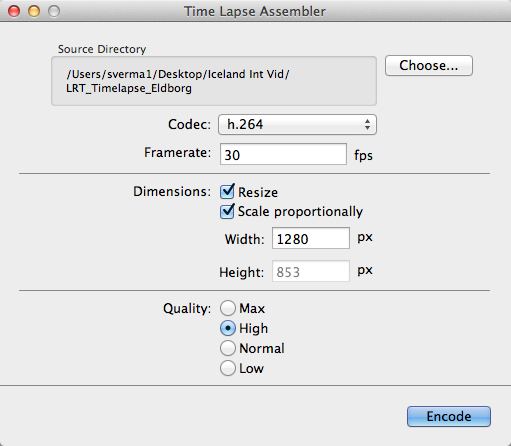
  1. Open Time Lapse Assembler
  2. Select the directory that contains the image sequence
  3. Select the codec. Use h.264 or mp4v for making .mov files or mp4v for making .mp4 movies
  4. Leave the frame rate at 30fps
  5. Set the dimension to resize
  6. Scale proportionately
  7. For HD video you can adjust the width to 1920 or 1280 (1920 for 1080P video and 1280 for 720p video)
  8. Select Quality High (you can always use Max but the rendering will take longer
  9. Click on Encode
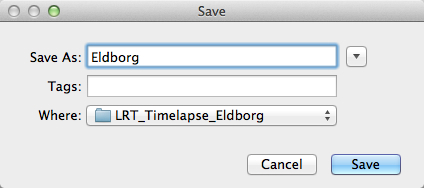
  10. You will be presented with a Save window. Name your sequence and click Save.

tla-2

The software will produce a Quicktime compatible movie file that can be viewed as is, or used for further editing in iMovie or any other video editing software.

See below an example of the video in very low resolution:

Here are the steps for Quicktime Pro 7

  1. Open Quicktime
  2. Go to the menu and under File – click on Open Image Sequence. Go to the directory where you downloaded your images (make sure you have only the images that belong in the sequence in this folder)
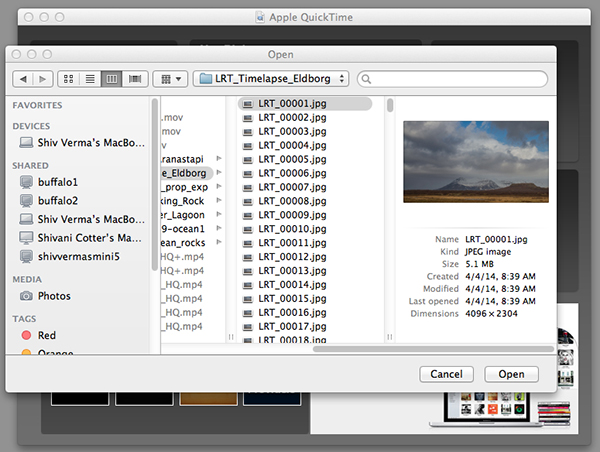
  3. Click on the first image of the sequence and click Open

    Select the Sequence

    Select the Sequence

  4. You will be presented with a choice for picking your frame rate – use 30 frames per second for a smooth sequence. Now click OK
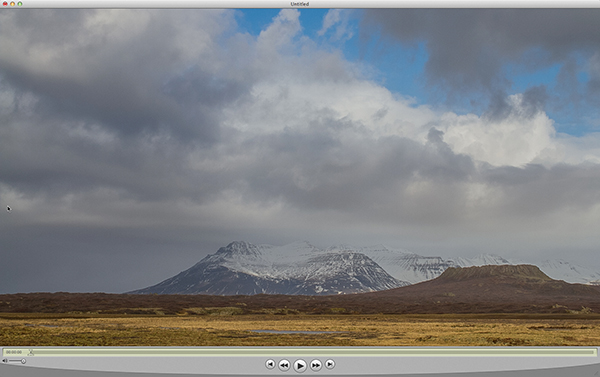
  5. Quicktime will import all the images in that folder and assemble them in their original sequence and at their original resolution. You probably will not be able to see the entire image as it is larger than the resolution of your screen but you can go to the Menu>View>Fit to Screen. You now have the first frame visible in its entirety.
    Assembled Sequence

    Assembled Sequence

    If you attempt to play this sequence you will not see the movie as you might like it to be. It will not be smooth and may pause for long periods. This is because the individual frames are very large and the video has not been rendered for playback.

  6. Save this sequence File>Save
  7. You will be presented with options as to where you would like to save the Quicktime file.
  8. Save the file in the same directory as the original images and name the file

The next steps will render a viewable video

  1. You will export this sequence File>Export
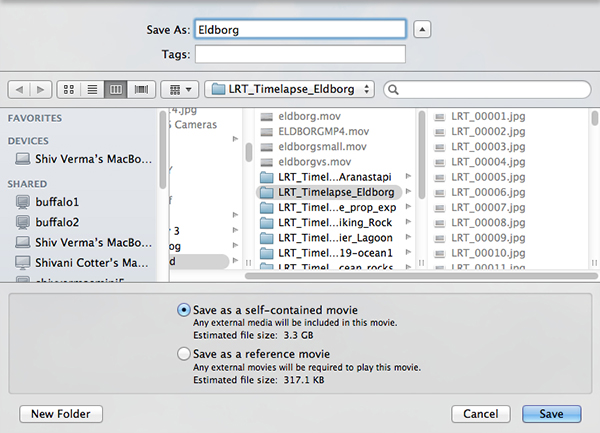
  2. You will get the typical “Save As” option and the “Where” option. Save the export in the same folder as the original files giving it a pertinent name.
    QT-3
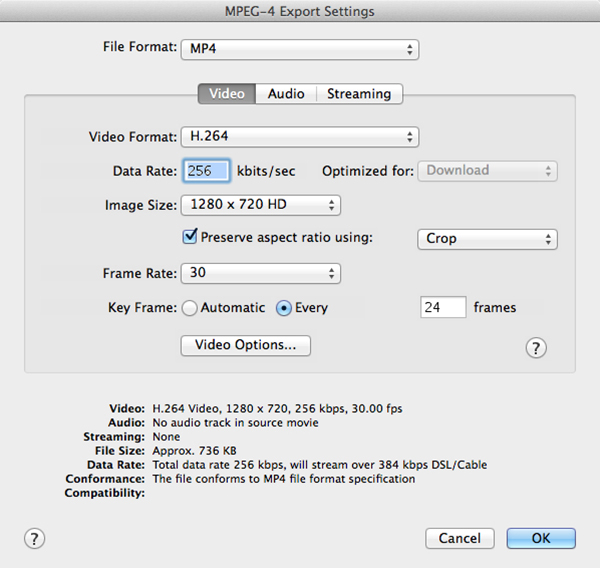
  3. There are two other sets of export criteria and an options button. For now, export the sequence as a QuickTime Movie and in the Options Section use H264.
    QT-4
  4. The export will take some time so be patient. Once the rendering and export is complete you will be able to watch the video. 

Have fun making your time-lapse – enjoy!

The post Time-Lapse Photography – a Quick Guide to Building Your Movie by Shiv Verma appeared first on Digital Photography School.


Digital Photography School

 
Comments Off on Time-Lapse Photography – a Quick Guide to Building Your Movie

Posted in Photography


City-Sized Artwork: Huge Building Mural Spans 99 Structures

10 Aug

[ By WebUrbanist in Art & Installation & Sound. ]

city sized aerial art

In his most ambitious and large-scale work to date, Felice Varini has created a perspectival piece that wraps around the entire historic core of Hasselt, Belgium, and can only be fully seen from above.

city perspectival art view

The work spans all sorts of downtown buildings, from the local cathedral to restaurants, stores and private residences, covering pieces of walls, roofs, sidewalks, and streets, all striped with white and playing a small part in the massive overall composition.

city spanning mural painting

city white painted stripes

The point of Trois Ellipses Ouvertes en Désordre is, in part, to create a public puzzle, causing people to wonder at the seemingly random components they see from any given perspective. The entire piece is only visible from the top of one local hotel, the Radisson Blu.

city sized art piece

To create the piece, light was projected on the buildings below at night. A team of painters then drew outlines around the resulting shadows and filled them in over the course of weeks using cranes to finish the work.

street art projected light

viewed from above

Varini is well versed in the art of view-specific installation pieces, some placed throughout interior spaces and others seen in open city streets.

Share on Facebook


[ By WebUrbanist in Art & Installation & Sound. ]

[ WebUrbanist | Archives | Galleries | Privacy | TOS ]


WebUrbanist

 
Comments Off on City-Sized Artwork: Huge Building Mural Spans 99 Structures

Posted in Creativity


Photocatalytic Concrete: Air-Cleaning Building Absorbs Smog

27 Jul

[ By WebUrbanist in Architecture & Public & Institutional. ]

smog canopy forest inspired

Featuring 100,000 square feet of smog-filtering surface area, this structural facade will break down harmful oxides in sunlight to improve air quality all around it.

smog absorbing building design

The building, designed by Italian firm Nemesi & Partners, is being created for an exposition in Milan themed around planet-friendly sustainable designs.

smog sucking facade exterior

The amorphous and organic form is both a reference to trees and other types of air-purifying plants but also a way to provide a maximum amount of exposed surface.

smog building interior shadows

Like a forest, this facade will cast complex shadows and provide shade in and around the building. Its form references both nature and man-made land art.

smog converting architectural facade

Rooftop solar panels tucked out of view will add a further but less-visible green dimension, generating electricity for the building below.

Share on Facebook


[ By WebUrbanist in Architecture & Public & Institutional. ]

[ WebUrbanist | Archives | Galleries | Privacy | TOS ]


WebUrbanist

 
Comments Off on Photocatalytic Concrete: Air-Cleaning Building Absorbs Smog

Posted in Creativity


5 Steps to Building Relationships to Help You Get More Photography Clients

01 Apr

How to Build Relationships to Get More Photography Clients

So you’re trying to make a go of it as a freelance photographer. Maybe you are just looking for a few paid gigs on the side, or perhaps you really want to go pro. But the problem is actual paying gigs are still few and far between, even though you’ve tried everything.

Shooting every day. Doing free portrait sessions for family or friends. Spent hours and hours editing photos in Photoshop or organizing images in Lightroom.

So what should you do? Well, I have some good news – it may not be your photography. In fact, you may be an excellent photographer. But here’s the rub: being a successful freelance photographer takes more than artistic skills and technical knowledge. It takes something most photographers would rather not acknowledge is important.

Hang tight, because what I’m about to say may shock you.

By thinkpanama

Successful Photographers Know the Value of Relationships

Really successful photographers are good at developing relationships. That’s right, I said it. You need to focus on relationships. (I realize this is a photography blog so you can burn me for witchcraft now.)

You need to build the right relationships with key individuals who can help you to achieve your freelance dreams.

Now, this may not sit well with you, especially if you consider yourself a little shy. But the good news is you don’t need to be the life of the party to be good at developing key relationship to support your freelance work.

You just need to have some discipline and focus your energies in the right direction.

How Cultivating Relationships Can Support Your Freelance Photography Career

There are many ways in which cultivating and maintaining key relationships can help your freelance career. For example:

  • Clients like to hire service professionals they already know, like and trust.
  • According to public opinion surveys, 45 percent of people find work through other people. Thus, keeping in touch with a wide network is crucially important for landing gigs.
  • By keeping in touch with editors, publishers and clients, you’ll be top of mind when new gigs come up.
  • You may find out about photography gigs and projects that are not advertised.

Now, let’s turn to how you can be proactive about identifying the people who you want to establish relationships with and then go about nurturing relationships with them.

By Zuhair A. Al-Traifi

How to Establish and Nurture Relationships to Grow Your Freelance Photography Career

Below, I have laid out five specific steps you can take to start establishing, and building relationships that will help your freelance photography career.

1. Create a list of key relationships

By Eric Heupel

One of the biggest mistakes I see aspiring freelance photographers make, is they fail to think in advance about the types of people they need to be meeting and getting to know better. In other words, they let their relationships evolve naturally and organically. That works well for friendships, but it’s a poor strategy for if you want to make a living using your photography skills.

A much better approach is to sit down and proactively make up a list of at least 50 people who you want to develop a deeper relationship with over the next 12 months. I call this list your “Conversations List” because that’s really all you’re aiming to do – to have an ongoing conversation with people who matter.

Who do you include on this list? Well, picture yourself five years from now as a famous and in-demand photographer. Who is in your ideal circle of contacts? Who are the photographers, editors, agents, publishers or bloggers who you’d like to count as friends and peers five years from now?

Whoever you picture being in this group, write them down. These are the people who you are going to focus on getting to know better.

2. Choose your relationship-building tools

By zzpza

Once you’ve identified who you want to focus on getting to know, the second step is to decide on what tools you plan to use to develop and nurture relationships. These tools may include:

  • Lunches and coffee meetings. One of the best sources of getting new gigs is the simplest. Invite a person off the list you created in Step 1 to lunch or coffee. Get to know one another. Repeat.
  • Interviews. I am a huge fan of using interviews to develop relationships. For example, dPS’s own managing editor Darlene Hildebrandt and I got to know one another better when I interviewed her for my podcast and when she interviewed me on photography and the law. You also generate useful content that can lead to new clients finding you.
  • Business meetings. There may be local business community meetings (such as Chamber of Commerce meetings) that present a good opportunity for you to meet and connect with others.
  • Industry Conferences. You should identify conferences where you can meet and get to know people from the list you created in Step 1.

Next, let’s talk about your mentality as you do begin to reach out to others.

3. Give to others long before you ask for anything
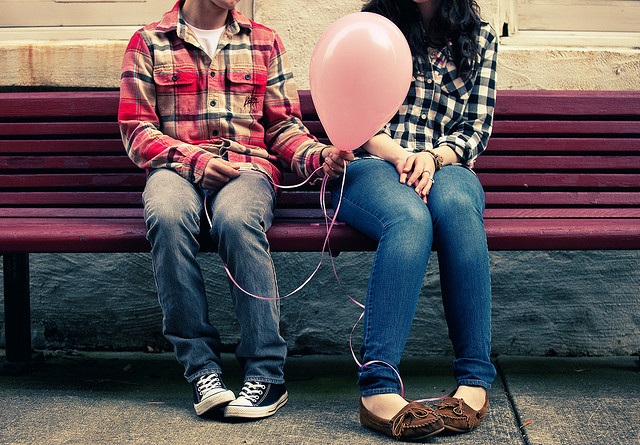
By Brandon Warren

Steps 1 and 2 are critical, but may not be as important as Step number 3, which is to provide value to others before asking for anything for yourself.

Dr. Ivan Misner, the founder of BNI (Business Network International) says you need to make deposits into the relationship bank before you can make withdrawals. In other words, you need to help others before you can ask for help for yourself.

Too often, people try to make withdrawals before they’ve made any deposits. They ask before they give. That’s a recipe for failure. What you “give” of value doesn’t need to be big. It can be simple suggestions or recommendations of a restaurant to try or a new TV show.

For example, let’s say you manage to get to know an editor at a publication or website which just purchased some of your photos. You want to sell them more photos in the future.

You should try hard to learn as much about that editor as you can, so you can be as helpful to him or her as possible. In other words, be human and be useful, helpful and giving. As a result, the editor will have a positive feelings for you because you were so giving, and they will be more likely to want to work with you again.

4. Create an easy follow-up system

By slackorama

So far, we’ve identified who you are going to connect with, talked about the tools you are going to use to connect with them, and discussed a philosophy of giving value first.

Now, the challenge is to keep it up over time. If you want your connections to think of you first when a freelance gig comes up, then you need to always be “top of mind” with that connection. And to be “top of mind,” you need to have a good system for following up.

What does that entail? A follow-up system is simply a dedicated means for checking in with people in your network.

You can create a manual follow up system, or put reminders on your calendar, but neither works well. I suggest using a simple CRM (customer relation management) system such as Insightly or SugarCRM. I use a system called Contactually. Whatever system you use, following up is an excellent way to manage your relationships, particularly with people you do not see often.

5. Revisit and revise your conversation lists annually

Around once a year, revisit your Conversation Lists and determine who you should cut out and who you should add. You will naturally meet new people over time. You may decide that certain people on your list are not a good fit for you. And you may even decide to take your photography career in a different direction. These are all perfectly fine.

By revisiting and updating your lists annually, you can make sure you are developing and nurturing the right relationships, proactively, to support your photography career.

Now get out there and start meeting people

Now it’s time to put these ideas to work. The last thing I want you to do after reading this far is to give up now without acting on what you’ve learned.

So sit down and write out your list of the 50 people who you want to get to know better. Then use your chosen relationship-building tools to start developing relationships with them. And have some fun.

How do you nurture relationships to support your freelance photography career? Share your tips in the comments!

The post 5 Steps to Building Relationships to Help You Get More Photography Clients by John Corcoran appeared first on Digital Photography School.


Digital Photography School

 
Comments Off on 5 Steps to Building Relationships to Help You Get More Photography Clients

Posted in Photography


‘Building Absence’: Stephen Tourlentes’ prison landscapes

23 Mar

Rawlins_WY_State_Death_House_Prison_2000_.jpg

Stephen Tourlentes started photographing prisons after a facility was built in his home town, in Illinois, USA. In his series of images entitled ‘Building Absence’, Tourlentes captures prisons at night, in the distance, their lights illuminating the landscapes in which they exist. By his own estimation he has photographed more than 100 prisons in 46 states, often from dead-end public roads and from within the communities that border the huge facilities. Click through for a look at his work. 

News: Digital Photography Review (dpreview.com)

 
Comments Off on ‘Building Absence’: Stephen Tourlentes’ prison landscapes

Posted in Uncategorized


Spiral Architecture: 12 Swirling Building & Bridge Designs

06 Feb

[ By Steph in Architecture & Offices & Commercial. ]

Spiral Architecture Main

Ubiquitous in nature and mathematics, spirals are beautiful to look at and provide a structure that’s strong and stable, so it’s no surprise that they turn up so often in architecture, too. Spiraling forms offer uninterrupted panoramas on observation towers, remove the obstacles of walls and floors in a creative interior, and enable unusual stacked configurations of living spaces in skyscrapers.

Evolver by Alice Studio

Spiral Architecture Evolver

The spiraling viewing platform in Zermatt, Switzerland by Alice Studio fuses beautiful design with a function that enables uninterrupted panoramas of the surrounding landscape. It was constructed by a group of students from the Ecole Polytechnique Fédérale de Lausanne (EPFL) and is made up of 24 wooden frames, with a tubular path offering a continuous 720-degree route to the top.

Arganzuela Footbridge

Spiral Architecture Arganzuela

A spiraling footbridge in Madrid’s Parque de la Arganzuela by Dominique Perrault Architecture links neighborhoods on the right and left banks of the Manzanares River, opening up in the center to allow access to a new urban green space. Built for both pedestrians and cyclists, the bridge is made up of two interlocking metal spirals ‘wrapped by a metallic ribbon.’

Mobius Buddhist Temple

Spiral Architecture Buddhist 2

Spiral Architecture buddhist 1

Based on a mobius strip, this Buddhist temple in Taichang, China integrates visual symbolism representing reincarnation with the basic design of the architecture interpreted as a path. Digital design and fabrication techniques enabled a building in which the entire shape is made up of two intertwined spirals, an ‘unstable’ configuration that places the beginning and ending of the worshipper’s path at the same point.

Mangal City Spiraling Skyscraper Pod

Spiral Architecture  Mangal City

Envisioned as an ‘urban ecological system,’ Mangal City is a concept that explores spiraling towers made up of individual pods. taking its design cues from systems in nature, such as mangrove roots. Of the project, Chimera says “The mangrove plant and its collective the mangal, provide examples of social associative principles as well as structural capacities and hybrid responses to environmental and contextual conditions.”

Next Page – Click Below to Read More:
Spiral Architecture 12 Swirling Buildings Bridges

Share on Facebook


[ By Steph in Architecture & Offices & Commercial. ]

[ WebUrbanist | Archives | Galleries | Privacy | TOS ]


WebUrbanist

 
Comments Off on Spiral Architecture: 12 Swirling Building & Bridge Designs

Posted in Creativity


Architectural Photography Tips to Make Any Building and Structure Look Fantastic

27 Jan

Architectural photography is for people who have an eye for buildings and structures. It’s the art of taking pictures of buildings as well as structures that are aesthetically welcoming and trustworthy representations of their subjects. Many of the best photographers who specialize in this discipline are normally well-trained in the use of both sophisticated equipment and methods. Architectural photography is Continue Reading

The post Architectural Photography Tips to Make Any Building and Structure Look Fantastic appeared first on Photodoto.


Photodoto

 
Comments Off on Architectural Photography Tips to Make Any Building and Structure Look Fantastic

Posted in Photography