Anhui ChangGeng Optical Technology Company Limited, a new Chinese lens manufacturer, has introduced a 60mm lens under the Venus Optics brand name that it says can deliver 2x magnification macro photography. The f/2.8 manual focus lens is designed to cover both full frame and APS-C sensors for macro work, but will introduce vignetting when used at normal focus distances with the larger format. Read more
Tag: Budget
-
Macro Photography on a Budget
This post is by Ed Verosky whose new Macro Photography eBook is 53% off today only.

Close-up and macro photography continue to be popular with shooters of all levels. Practical applications include product detail shots, food photography, and technical illustration (see image below). But the fun and artistic motivations are undeniable; flowers, insects, creative abstract, and the excitement of discovering the hidden worlds found in everyday objects.
If you’ve been interested in doing some close-up and macro work, but don’t quite know how to get started, this article will show you how, without blowing your budget. Macro, in particular, is often accomplished with high-end specialty lenses and equipment, but there are ways to take impressive close-up and macro shots with little more than the gear you already have.

Food and recipe images are featured in editorial as well as event photography. Here, a close-up shot of this delicious-looking cupcake provides context for the macro shot that follows. This shows how the power of close-up and macro can draw the viewer in and capture the imagination.
Here are three of my favorite low-cost techniques detailed in my new eBook, Introduction to Close-Up & Macro Photography:
Reverse Your Lens
If you’d like to get started right away, this technique works great and requires no extra investment. All you need is a camera that uses interchangeable lenses (most DSLRs do). Just remove the lens from the camera and hold it backward against the lens mount to get a high degree of magnification. Any lens will do, but a normal lens, or the lens that came with your camera will probably work best (e.g. 50mm or the 18-55mm kit lens).
Although this is an effective solution, you should be aware that your camera and lens won’t be able to communicate with each other when using this technique. That means no f-stop adjustments or automatic focusing. Fortunately, focusing won’t be a problem using this technique, and you can preset your lens to a specific f-stop using the aperture-locking trick I’ll detail below.
Here are the steps for using this technique:
- Press your camera’s lens release button to remove the lens from the
lens mount. - Turn the lens around in your hand so that the front of the lens is facing
the camera mount. - Carefully match up the front of the lens to the ring of the camera mount and hold it there when taking your shots as shown in the image below.
- As with many macro shooting solutions, the way you’ll focus on your subject is by moving the camera and lens toward, or away, from the subject, not by turning the focusing ring. You’ll be within two or three inchses of your subject (or less) when acquiring focus.

An 18-55mm lens held backward onto the camera’s lens mount.
Reversing Rings
You can also use an adapter called a reverse ring (or reversing ring) which will allow you to actually mount your lens onto your camera in the backward position. This inexpensive gadget (see image below) is made to screw onto the front of your lens, similar to a lens filter. The other side of the reversing ring fits onto your camera’s lens mount. Make sure to get a reversing ring that not only matches the filter size (thread diameter) of your lens, but also matches the lens mount of the type of camera you’re using.

Reverse (reversing) ring fits onto the front of this 18-55mm lens via the lens filter thread.
Aperture-Locking Trick
Whether you’re using the handheld reverse lens technique, or a reversing ring adapter, you can set a specific f-stop, even though your lens is not electronically coupled to your camera. This technique may not work with your particular camera and lens combination, but it works with all of the DSLRs that I’ve used:
- 1. With the camera powered on, and the lens mounted onto the camera in the normal way, set the f-stop.
- 2. Press and hold the depth-of-field preview button.
- 3. While still holding the DOF preview button down, press the lens release button and remove the lens. The aperture will remain stopped down as shown below.

Aperture locked-in at f/16 on this 85mm lens.
Other Budget-Minded Ways to Achieve Macro
Other ways to get good close-up and macro shots on a budget include the use of lens coupling rings, diopters, and extension tubes. Here’s an overview:
Coupling Rings:
A variation on the reverse lens technique is to use two lenses, connected front-to-front using another type of adapter called a coupling ring (below). In this case, one of the lenses is mounted to your camera normally, while the other is in the reverse orientation. The coupling ring features threading on both sides and fits on to the front of both lenses at the same time via the filter threads. Because coupling rings generally feature the same thread diameter on each side, the lenses you use with it will have to have the same filter diameter, or you’ll have to attach a step-up or step-down adapter to one or both lenses.

Coupling Ring: (A) 58mm diameter coupling ring. (B) Two lenses connected via the coupling ring. Either lens can be mounted to the camera.
Be aware that a heavy lens coupled to a camera-mounted lighter (or less solidly built) lens can result in damage to one or both lenses because of the weight and stress placed on their front ends. Also, your camera-mounted lens will maintain the electronic contact with your camera, but the reverse-coupled lens will not, so you’ll have nearly the same limitations as you would with a single reversed lens.
Diopters:
One of the easiest ways to magnify your subject is with a simple filter-like attachment called a diopter (below). You can think of a diopter as a magnifying glass for your lens. They’re very easy to use; just screw one or more diopters onto your lens just like you would with any lens filter. An inexpensive set of diopters (often available for under $ 15) will give you several magnification levels to choose from. You’ll have to move in very close to your subject to achieve focus, and optical quality won’t always be as good as some of the other options presented here, but you might be very pleased with the results. Because they don’t cost much, are easy to use, and take up very little room in your camera bag, you might consider a set. Make sure to purchase diopters that fit the filter thread diameter of the lens you’ll be using them with.

Diopters: (A) This set of Vivitar diopters was purchased for under $ 15. (B) The “10X Macro” diopter mounts just like a lens filter onto this 18-55mm kit lens.
Extension Tubes:
Finally, my favorite solution for macro on a budget; extension tubes. Your lens mounts to one end of an extension tube, while the other end of the tube mounts directly to your camera’s lens mount. Extension tubes effectively increase the focal length of your lens without adding any glass elements that might reduce optical quality. By doing so, your lens will be able to focus on small objects, at very close distances.
While a good set of extension tubes is going to cost significantly more than a cheap set of diopters, it’s still a bargain compared to an actual macro lens. Some sets feature manufacturer-specific electronic connectors that allow the camera and lens to communicate normally; this allows for aperture and focus control. Plus, your single set of extension tubes will work with all of your lenses; there’s no need for rings or adapters of different sizes for each lens diameter. Extension tubes can be purchased as a set with different lengths for varying degrees of magnification. The tubes can also be combined (stacked) for increased magnification as shown below.

Extension Tubes: (A) Three extension tubes (13mm, 21mm, and 31mm) stacked onto an 18-55mm lens. (B) Set of extension tubes. (C) 50mm lens mounted onto all three extension tubes which are mounted onto a DSLR.

The combination of colors, detail and depth-of-field of this photo, featuring a pollen covered anther of a flower, could have only been captured through macro photography. Extreme close-up and macro give you the opportunity to find amazing beauty in places your eyes might otherwise miss.
In this article, I’ve only provided a small sampling of the many ways to achieve quality close-up and macro images. I encourage you to explore the possibilities using one or more of these techniques, and to consider learning about other types of macro gear and lenses. The world of close-up and macro just might become your next photography obsession!
Get more great Macro Photography Tips from Ed by picking his new Close Up and Macro photography eBook with a 53% discount – today only.
googletag.cmd.push(function() {
tablet_slots.push( googletag.defineSlot( “/1005424/_dPSv4_tab-all-article-bottom_(300×250)”, [300, 250], “pb-ad-78623” ).addService( googletag.pubads() ) ); } );googletag.cmd.push(function() {
mobile_slots.push( googletag.defineSlot( “/1005424/_dPSv4_mob-all-article-bottom_(300×250)”, [300, 250], “pb-ad-78158” ).addService( googletag.pubads() ) ); } );The post Macro Photography on a Budget by Ed Verosky appeared first on Digital Photography School.
- Press your camera’s lens release button to remove the lens from the
-
Budget Mitakon 42.5mm f/1.2 offered by ZY optics for M43, Sony E and Fuji X systems
Chinese lens designer and manufacturer Shenyang ZhongYi Optical and Electrical Company has launched a new 42.5mm f/1.2 lens that is capable of covering an APS-C imaging sensor. Priced $ 359, and available initially in the Micro Four Thirds mount, the Mitakon 42.5mm f/1.2 appears to be aimed squarely at competing with Panasonic’s Leica DG Nocticron 42.5mm f/1.2 for its Lumix G bodies. Read more
-
Budget M43: Kodak Pixpro S-1 First Impressions Review
Kodak is arguably the most famous name of all in photography, but it ultimately failed to manage the transition from film to digital, and ended up exiting the consumer imaging business altogether in 2013. But now JK Imaging, which licenses the Kodak name, has created an interchangeable lens camera. The Pixpro S-1 is an entry-level model that’s designed to attract budding photographers who are buying their first system camera. Click through to read our first impressions.
-
Budget M43: Kodak Pixpro S-1 First Impressions Review

Kodak is arguably the most famous name of all in photography, but it ultimately failed to manage the transition from film to digital, and ended up exiting the consumer imaging business altogether in 2013. But now JK Imaging, which licenses the Kodak name, has created an interchangeable lens camera. The Pixpro S-1 is an entry-level model that’s designed to attract budding photographers who are buying their first system camera. Click through to read our first impressions.
-
Adorama Flashpoint Budget Studio Monolight Review

Offered in 160W ($ 70) or 300W ($ 100) power intensities, Adorama’s Budget Studio Monolights are geared toward studio photographers who are just starting out and are constrained by modest budgets. At a fraction of the price of professional heads, can the Flashpoint Budget Studio lights do the job? Find out in our review
-
A Look Inside the Bag of a Hobby Photographer on a Budget
We often get to see inside the bags of professional photographers. You know, the bag that we dream of having ourselves, filled with three full-frame bodies and six or more lenses with plenty of accessories to fill out every pocket the bag has to offer. Well, I’m not a pro – and today’s ‘inside the bag’ post might not be something to drool over, but it should give you an idea of what you can do on a reasonable budget if you’re planning to do some serious photography on the weekends.
Inside the bag of a hobby photographer on a budget
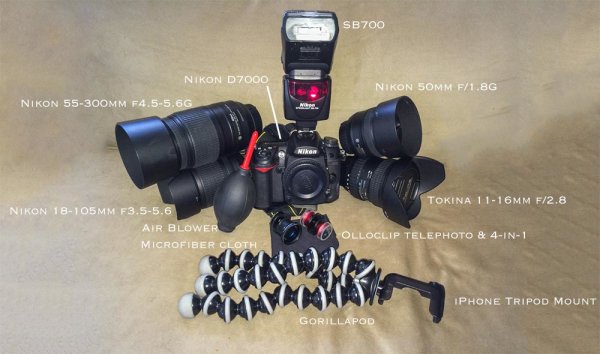
As you can see from the photo, I have a fairly well rounded collection of lenses that let me capture anything from ultra-wide to super close. I wouldn’t consider anything inside this bag “pro-level”, but the collection is very capable and allows for a wide range of subjects.
My camera body for the last three years has been the trusty Nikon D7000. I highly recommend this camera, or its bigger brother the D7100, to anyone who’s interested in getting into photography seriously. While it’s not an FX (full-frame) body it does have a lot of pro-like features, is very capable in low light situations and being marketed at the enthusiastic hobbyist it’s fairly affordable as well.
As far as lenses go I use the Tokina 11-16mm f/2.8 most frequently, followed closely by the Nikon 55-300mm f/4.5-5.6G. It really depends on the mood that I’m in but I tend to spend most of my time at the extremes of my focal length range. On occasion the Nikon 50mm f/1.8G and the Nikon 18-105 3.5-5.6G, which came with the D7000, will be used for specific shots. The Nikon SB700 speedlight featured in the photograph above is rarely used and is probably my greatest regret in terms of purchases (not that it’s a bad flash, just that I don’t use it nearly as much as it deserves).
On top of the DSLR stuff I do carry two Olloclip adapters (the telephoto + circular polarizer and the 4-in-1 kit) for my iPhone along with a Gorillapod with an iPhone mount attached to it. Sometimes I just enjoy the simplicity and creativity that the iPhone allows.
Other little things not pictured above include a wireless remote shutter release, 77mm circular polarizing filter, and a 77mm Hoya ND filter.
To support the main camera I use the Manfrotto 190XPROB aluminum tripod with the basic Manfrotto ball head. It does the job I need it to do, and has served me well for three years, but I do want to upgrade to a carbon fiber tripod in the future for the added strength.
What bag holds it all and how’s it packed?
I manage to fit all of this into a Lowpro Slingshot 102 AW which when fully packed it’s bursting at the seams. The bag itself is designed to fit a camera body with a small lens attached, two smaller lenses on either side, and has a couple other storage compartments for extras like filters, charging cables and cleaning supplies.
I almost never pack my flash as it’s not typically something I use, but if I do pack it, the 18-105mm is usually the lens that gets left at home. Here’s a couple photographs to show you the bag fully packed.
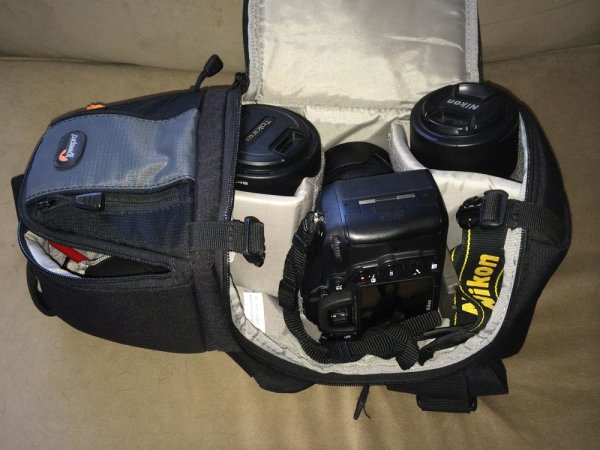
Main storage compartment from left to right: Tokina 11-16mm, Nikon D7000+18-105mm, 55-300mm.
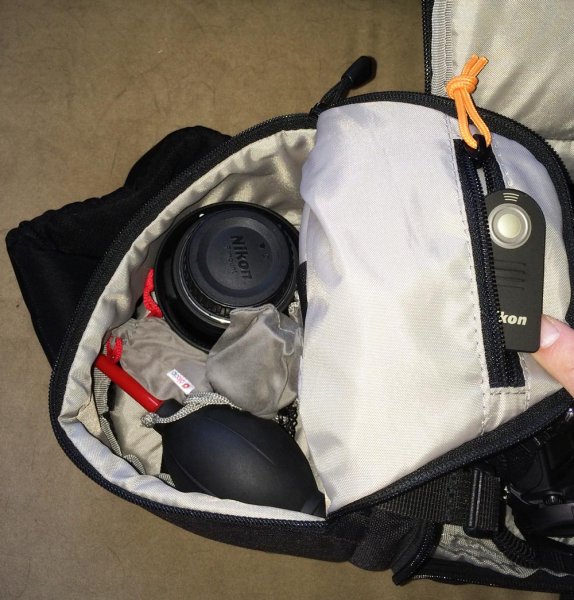
Secondary compartment – 50mm, Olloclips, cleaning supplies and remote trigger.
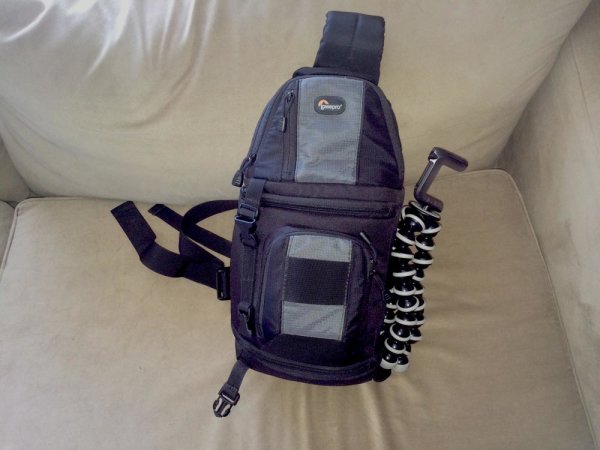
All closed up and ready for a shoot with Gorillapod attached to the side.
The filters and other little things that I may need can fit in the front compartment and if I want to bring the Gorillapod along I can attach it to the side of the bag using the built in tripod holder (which doesn’t really work well for anything larger than a Gorillapod anyway.
What do I use this kit for?
Whether it’s waterfalls, seascapes or the night sky; the D7000 plus the Tokina, supported by the Manfrotto, works like a charm. While I primarily shoot landscapes, the 55-300mm lens comes in handy when I want to capture a shot of some wildlife or simply looking for a change in perspective. I’ve also done some cityscape photography, a few portraits and one wedding (read: The Story of Photographing my First Wedding also Likely my Last to find out why I won’t do that again.)
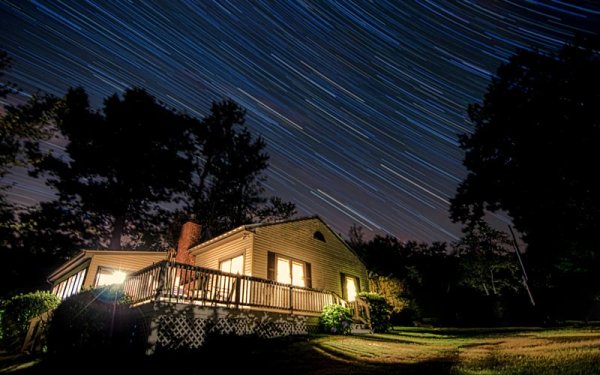
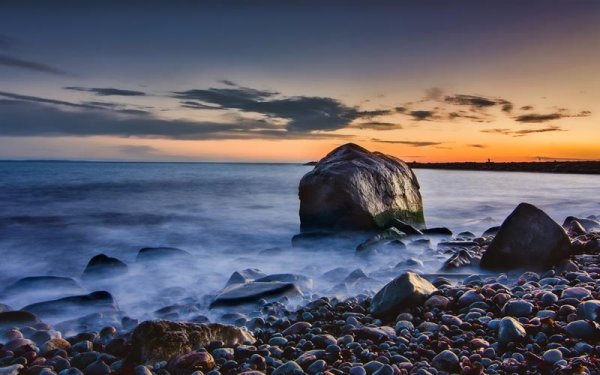
All in all I think it’s a pretty well rounded kit for someone who spends his weekends hiking through forests taking photos. Obviously there’s a lot more that I could add to the collection, and I plan to do just that when I have more money to invest into it. Currently on my ‘next to buy’ list is a macro lens and then it might be time to upgrade the body.
So that’s my bag – what do you think about it and feel free to share your own in the comments below.
The post A Look Inside the Bag of a Hobby Photographer on a Budget by John Davenport appeared first on Digital Photography School.
-
Budget lighting: Flashpoint 180 Monolight review

Adorama’s Flashpoint 180 Monolight is a battery-powered 180-watt strobe designed for on-location shooting in the middle of nowhere. The kit comes with everything needed to provide adequate fill light for scenes or soft key-light for portraits, minus the stand, which must be purchased separately. Despite its budget price tag, does the 180 Monolight have what it takes for professional use? Find out in our review
-
Shoot Pro Quality Videos (Without a Hollywood Budget)

Extra photos for bloggers: 1, 2, 3
Whether the Oscars inspired you to shoot like the greats, or displeased you to the point of “I could do better,” NOW is the time to step up your video shootin’ game!
Take up your trusty DSLR, a Focus Shifter, the Oh! Wow. Ring Light and start writing that acceptance speech.
The Oh! Wow. Ring Light surrounds your lens in LEDs that provide even light at three brightness settings. It has a constant mode (perfect for videos) and also flash mode for stills.
The Focus Shifter fits snug on any lens, giving you a handle for max control of your focus ring and a marker board to set your focus points before you shoot.
Just don’t forget to thank the Academy, your mom and Photojojo. 🙂
See more example pix from our Ring Light
$ 99 at the Photojojo ShopLearn More about the Focus Shifter
$ 49 at the Photojojo Shop
© laurel for Photojojo, 2014. |
Permalink |
No comment |
Add to
del.icio.us
Post tags:
-
OM-D on a budget: Olympus E-M10 First Impressions Review

The Olympus E-M10 wraps much of the E-M5’s feature set into a smaller, more compact body. It retains core OM-D features like twin dials, a built-in EVF and a 16 megapixel Four Thirds sensor, but manages to fit them into a body that’s more Stylus 1 than ILC. It sits below its E-M5 and E-M1 siblings in terms of both price and specifications, but with features borrowed from two very strong predecessors it’s potentially a very impressive camera in its own right. Take a look at our first impressions and sample gallery.