RSS
 

Posts Tagged ‘Black’

Black Eye launches its 4th-gen universal Pro mobile lenses in North America

08 Jan

European mobile camera lens company Black Eye has announced the launch of its fourth-generation universal Pro lenses for smartphones in North America. As of now, Black Eye’s portfolio features nine mobile lenses across three product series, as well as a new Travel Kit G4, an upcoming Pro Kit G4 bundle and new cases for the iPhone 7 and later.

Black Eye was founded by professional photographer Arto Ekman and professional snowboarders Fredu Sirviö and Eero Ettala. The company’s mobile lenses center around a simple universal attachment system that can be clipped onto most smartphones and similar mobile devices, such a laptop’s webcam.

Black Eye’s most recent product lineup includes the Pro-series Portrait Tele G4, Cinema Wide G4, and Fisheye G4 lenses, as well as the regular wide, macro and combo G4 lenses. The company also recently launched the Travel Kit G4, a bundle featuring a case and the Wide G4, Macro G4 and Pro Portrait Tele G4 lenses.

In addition to its existing products, Black Eye will release a new Pro Kit G4 in the first quarter of 2019. This kit features all three Pro-series G4 mobile lenses and a durable case for $ 249.99 USD. In Q1 2019, Black Eye will also release protective iPhone cases for the iPhone 7 and later models for $ 19.99 USD.

Articles: Digital Photography Review (dpreview.com)

 
Comments Off on Black Eye launches its 4th-gen universal Pro mobile lenses in North America

Posted in Uncategorized


Tips For Converting To Black & White Photography

22 Dec

When shooting black and white fashion photography, how you convert from full-color Raw


Fashion Photography Blog

 
Comments Off on Tips For Converting To Black & White Photography

Posted in Uncategorized


Black and White in the Outdoors: Learning to see in Monochrome

06 Dec

The post Black and White in the Outdoors: Learning to see in Monochrome appeared first on Digital Photography School. It was authored by David Shaw.

1 - Black and White in the Outdoors

To determine when black and white is the best option in nature photography, you need to learn to see your scene in black and white. Most beginner photographers arrive at their monochrome images by experimenting with post-processing. While this occasionally works, shooting with black and white in mind results in far better images.

In other words, you need to SEE in black and white.

Look for Contrast

Highlights

In color photography, there are almost unlimited options to juxtapose contrasting and complementary colors or to provide an attention-getting subject in a flashy tone. But in black and white, you lose the ability to use color in the traditional way and are instead left with shades of gray. Contrast, rather than color, is our compositional tool.

Most of us see the world in rich color and there is no saturation slider in our eyes or brains with which we can switch color on and off. But we can train ourselves to see contrasts.

As I’m writing this, I’m looking out my window onto the spruce trees in my front yard. The sun is shining on a layer of fresh snow which fell over the past few days. The limbs of the spruces are draped in white. Looking south, toward the low sun, I can see flashes of perfect white where the sunlight is illuminating fresh snow. Those bright highlights contrast sharply with the dark, shaded trunks and exposed branches of the trees. In fact, even in the shaded areas, the difference between the snow and the dark needles is remarkable. With little color in the scene to begin with, it doesn’t take much to “see” this scene in black and white.

Because I can “see” this scene clearly in black and white, I can recognize that images like this will translate well from color. Here, let me step outside for a few minutes and make a few photos, to show you what I mean.

(A few minutes later…)

I’m back. I’ve pulled a few images and did a quick black and white conversion in Lightroom. Here are a couple of shots; first color, and then black and white.

2 - Black and White in the Outdoors

3 - Black and White in the Outdoors

4 - Black and White in the Outdoors5 - Black and White in the Outdoors

This is a straightforward example. As most people can see, lacking many colors, the snowy trees were a likely subject for black and white. However, the next step is harder.

Color Contrast

I had another black and white shooting session a few months back when “seeing” in black and white was much more difficult.

Each fall, I make a pilgrimage from my home in Alaska’s interior to the Kenai Peninsula. This year, I spent a day exploring the forest and mountains of Kachemak Bay State Wilderness Park, across the bay from the town of Homer. I hiked for several miles through the wet forest making images of the rising autumn colors, and the fog-draped mountains. It was a sea of greens and yellows, red highlights, grays, and browns. Some images were perfect for color, others not so much. Telling the difference in the field was a game I played as I walked.

6 - Black and White in the Outdoors

Some black and white images were clear in the gloomy forest. The dull yellow, jagged leaves of Devil’s Club against the muted greens and browns of the forest floor were an obvious contrast that I knew would translate well into black and white.

Others, like the pale green of fern fronds, were less contrasty in the field, and yet translated beautifully into shades of gray.

7 - Black and White in the Outdoors

These ferns were dying back at the end of the season and were largely a dull brown. Kind of ugly really. However, the color doesn’t matter in black and white, and the contrast between the pale brown fronds, and the deeply shaded background worked.

8 - Black and White in the Outdoors

This patch of ferns was pale green and popped against the darker green background. This is my favorite image of the series. It was a shot that took me a moment to “see” in black and white.

Another shot of an autumn stalk of bright red fireweed, I thought would look good in black and white when I first made the image, but upon examination of the back of my camera in the field. There was actually little contrast in brightness between the greens and red. That image didn’t work quite as well.

9 - Black and White in the Outdoors

10 - Black and White in the Outdoors

Lighting Contrast

Later that same afternoon, bright sunlight started to filter through increasingly thin clouds. It wasn’t yet hard light, but it was bright enough to be directional. The sun came through the forest canopy in patches, illuminating and shading different areas.

And this brought about a third option for black and white: lighting contrast. In the differing light, even similar colors will contrast in black and white.

11 - Black and White in the Outdoors

Beyond Details

12 - Black and White in the Outdoors

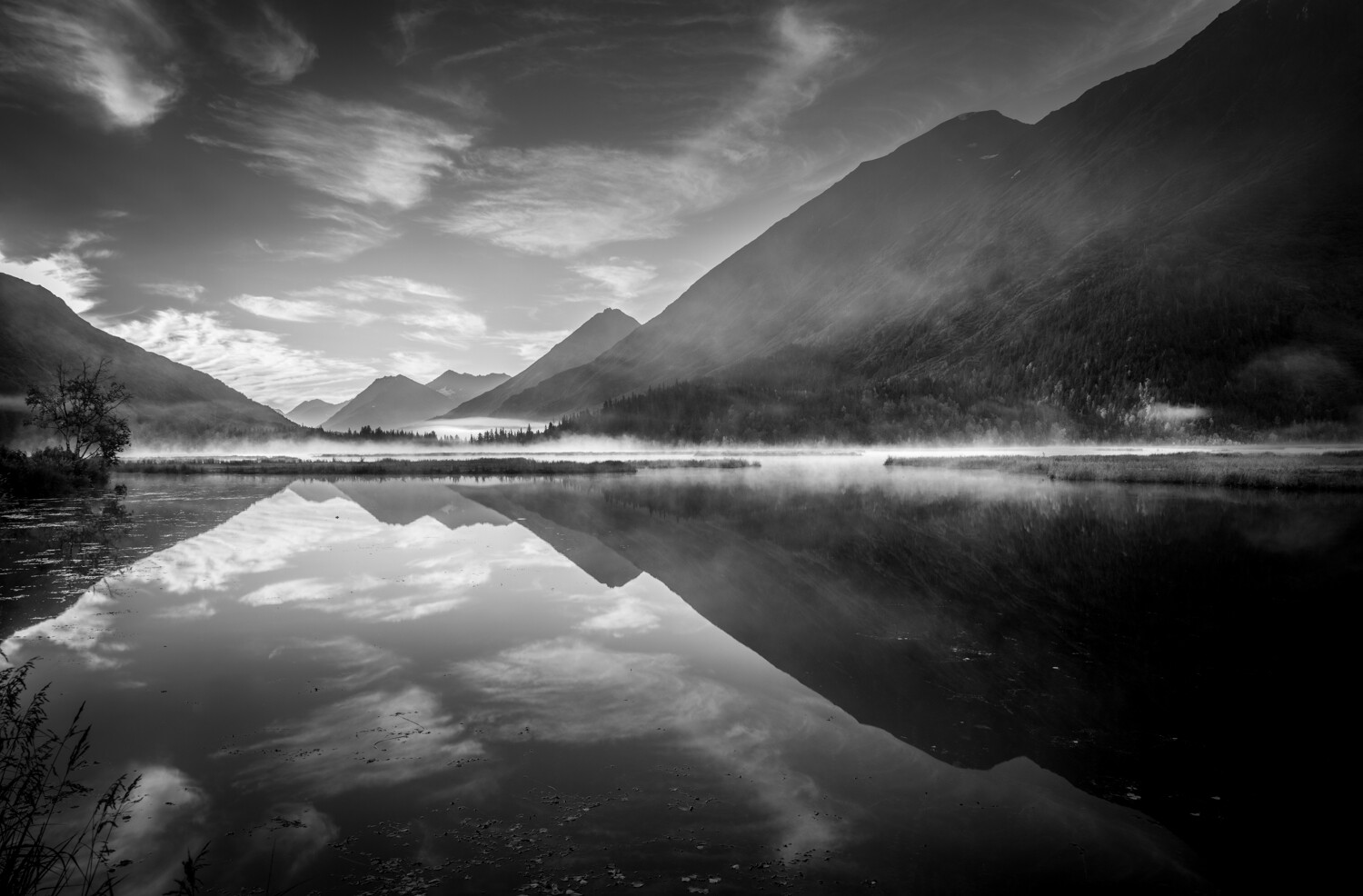
Seeing a large scene in black and white is the next step. I was photographing by a lake this fall. It was early in the day, the sun not yet far above the horizon, but any lingering sunrise color had faded. Most of the lake, some rising fog, and the surrounding mountains were in shadow. Aside from the sky, there wasn’t a lot of contrast. I was about to pack it in for the morning when the sun got high enough to illuminate a patch of fog, which flashed white in this scene of muted blues. Not much for color, I thought, but in black and white? That, I realized, would work.

13 - Black and White in the Outdoors

Terrible Light

At times, when photographing in harsh light, black and white can also salvage an otherwise impossible situation. A number of years ago, I was shooting in the altiplano of Bolivia. I arrived at mid-day at the spectacular and weird Laguna Colorado. It was savagely bright; cloudless skies, high elevation, middle of the day, and within a few degrees of the equator. Lighting conditions couldn’t have been worse.

While the landscape was uniformly drenched in harsh, ugly light, there was contrast in the colors of the desert. A polarizer darkened the sky and removed the worst of the glare. The resulting black and white conversion, was if not perfect, at least the best of a very bad situation.

14 - Black and White in the Outdoors

15 - Black and White in the Outdoors

Frequently traveling photographers find themselves in beautiful locations at bad times, and we don’t always have the freedom to return when the light is better. In such situations, consider black and white. It’s not a cure-all, by any means, but nasty light will often translate better into monochrome than full color.

The situation I described above was not unique on my trip through Bolivia. The sweet light of morning and evening lasted only minutes in the high desert, quickly replaced by glaring light. And yet contrasts in the landscape salvaged many a scene for me.

16 - Black and White in the Outdoors

Conclusion

If you can recognize a black and white subject in the field, it will open up your eyes to new compositions you may have previously ignored. Black and white photography is not simply the removal of color, it is a way of seeing.

When next you venture outdoors with your camera, look at the way colors and even shades contrast with one another. Look for lighting conditions that cause contrast to appear and embrace those situations in the form of black and white photography. Even on those days with rotten, bright light, consider how removing those washed out colors might help your final image, sometimes black and white can salvage an otherwise desperate moment.

Give it a try and then share your results in the comments below.

The post Black and White in the Outdoors: Learning to see in Monochrome appeared first on Digital Photography School. It was authored by David Shaw.


Digital Photography School

 
Comments Off on Black and White in the Outdoors: Learning to see in Monochrome

Posted in Photography


Black Friday and Cyber Monday Photography Deals

23 Nov
Black Friday Cyber Monday Photography Deals

It’s that time of the year – if you’re looking for a good deal, then you’re sure to be on alert for the next few days! We’re taking the opportunity to re-launch two of our popular courses for the year with some big savings and great bonuses.

31 Days to Becoming a Better Photographer Course – Save $ 200

This course only opens a few times a year and is currently our only instructor-supported course with a dedicated Facebook group. Students have direct access to photographer Jim Hamel for 3 months, and they love it!

I have taken other on-line courses and found them not to as comprehensive as 31 Days to Becoming a Better Photographer. Since I took this course may photography has reach a whole new level. I am more confident in my camera settings; I have learned how to look and analyze the scene before I take the shot and not to be afraid to experiment. The concept of doing a daily photo after each lesson helps to put into practice what you have just learned. Jim Hamel is a wonderful instructor and I like that he is available for questions and answers back quickly. I have recommended this course to others that are just beginning. I also love the Facebook Group. It is such a supportive place for not just beginners but for photographers of all levels as we can always learn from each other.

Bett Cox

Canada

Usually $ 199, we are repeating the original launch special of just $ 49. And, if you buy in the next few days you’ll also get a $ 50 credit to spend on our Landscape & Nature Photography course below. But you don’t have to spend it now, because we know you’ll want to do the 31 Days course first – so we’re letting you claim it up until the 31st of March 2019. 

Act quickly if you want to get into the next intake of 31 Days to Becoming a Better Photographer because the will doors close for registration in less than two weeks. It’s one of the best ways to get your photography kickstarted for 2019.

Learn More?

Ready for something a little more challenging now? 

Landcape & Nature Photography Course – $ 237 in Bonuses

This was another popular video course we launched earlier this year with some great bonuses offered by instructor Johny Spencer. 

Exactly what I was looking for. Johny has a unique Aussie way about him and his enthusiasm comes through. Easy to follow and I can take all the information in during my own time. Good length individual segments. My equipment and photographic knowledge is vastly improved now I’m ready to get out there and try with confidence. A very worthwhile investment.

Bill Vincent

Now the bonuses are even better with the addition of 15 landscape and nature video masterclasses worth $ 150 (previously only available via his community membership). But you’ll need to be quick to grab this and two other bonuses during the Black Friday and Cyber Monday sale. And if the bonuses were not enough, we’ve also taken $ 50 off the course fee too.

Learn More?

Looking for Photography Gear Deals?

We took a quick look at what Amazon is offering. We get a commission if you buy anything through our links below, at no extra cost to you.

There is a big sale happening in their Camera, Photo and Video section. Their specials are changing all the time so do check back later to see what else they’ve added. Or take a look at our most popular digital cameras and gear page for some hints as to what others are buying. Many of the cameras listed there are currently on sale at Amazon too.

The post Black Friday and Cyber Monday Photography Deals appeared first on Digital Photography School.


Digital Photography School

 
Comments Off on Black Friday and Cyber Monday Photography Deals

Posted in Photography


What I Learned From 30 Days of Black and White Photography

08 Nov

Color is an amazing phenomenon.

Most of us can appreciate color, even if we don’t understand the complex nature of light. Color Illuminates the landscape of our daily lives, and naming them is one of the first things we learn in childhood. We use them as a language and a way of expressing emotion. They affect both our brain and our bodies and fill our world with variation and even the occasional surprise.

So why would I ditch color for black and white for an entire month?

Up until the mid-1930s, color photography wasn’t widely accessible. And color printing wasn’t an affordable option until the 1960s. Pioneer photographers such as Ansel Adams and Henri Cartier Bresson set the standard in black and white photography. They emphasized composition and the controlled use of light without color, revealing the artistic merits of black and white photography that resonate to this day.

As a photographer, I shoot predominantly in color. But with such a wealth of modern photographic history steeped in black and white photography, I thought it would be interesting to prioritize monochrome instead.

So, I set myself a challenge: to photograph in black and white with my digital rig at least once a day for a month.

Here’s how it went.

Getting Started

Setting the Camera to Monochrome Mode

Okay, first things first. I wanted to shoot black and white images in-camera, so I needed to put my camera in Monochrome mode. In this mode, the camera records photos in black and white when photographing in JPEG. The LCD also previews photographs in black and white in Live View and the gallery.

While shooting in this mode does encourage a bit of ‘chimping’ (checking the photo after every shot), being able to review your pictures in black and white is very useful. It helps your eyes adjust to seeing your surroundings in black and white.

I’m using a Canon 5D MKII, so in ‘Shutter Priority’ mode (‘Aperture Priority’ and ‘Manual’ work too, depending on your preference) I selected the ‘Picture Styles’ tab on the main menu.

I then selected the ‘Monochrome’ (or M) option from the ‘Picture Styles’ menu.

Pressing the ‘Info’ button with ‘M’ selected in the ‘Picture Style’ screen allows further adjustments to ‘Monochrome’ mode such as ‘Sharpness,’ ‘Contrast,’ ‘Filters,’ and ‘Toning.’ I increased the Contrast parameters a tad, as using the Monochrome Mode by itself can make the images seem a little flat.

For Nikon or other camera brands, check the manual to find out how to set your camera to Monochrome mode.

Changing Your Quality Settings

The next step was to set my camera to photograph in dual RAW and JPEG modes. Why? Because even in Monochrome mode a RAW file will revert to color when uploaded to the computer. Whereas, a JPEG file retains the monochromatic scheme used in-camera.

Unfortunately, a JPEG retains less quality than a RAW file. So what do we do? We shoot both! If you take a fantastic black and white shot as a JPEG, you’ll also have the quality RAW file to edit in post-production.

But make sure you have some decent space on your memory card.

On my Canon 5D MKII, I set dual RAW and JPEG mode by selecting the ‘Quality’ tab on the main menu.

I adjusted my settings with the ‘Main’ and ‘Quick Control’ dials so I had both RAW and JPEG selected, and pressed the ‘Set’ button.

Again, for Nikon or other camera brands check the manual to find out how to change the Quality settings.

Ready, Set, Go

With my camera settings sorted, I was ready to begin my 30-day challenge. Here are a few things I learned during my ‘Month of Monochrome.’

Adding a New Layer of Interest

One thing I quickly realized was the power a stripped back color scheme has in lending a unique atmosphere to an image.

Having worked in black and white before (both with film and digitally), I know how evocative an excellent black and white image can be. But working digitally in black and white with no other option was new and refreshing. It hammered home the way a black and white photograph can separate the everyday world and its portrayal. This separation presents subjects in a new and thought-provoking light that generates a significant connection between the viewer and the image.

Minimizing Distraction

When you work in ‘Monochrome’ mode, you appreciate the dominance color can have over a photograph. While confining myself to black and white photography, I could experiment within a gradient, free from the distraction of color. Black and white photography strips an image back to the basics of composition and light. Without the color distraction, I had space to hone in on what makes a compelling story – creating a visual study of a subject.

Learning How Light Behaves

A lot of photography is about observation: watching people, landscapes, light, and shadows. And most photographers have a basic knowledge of how light behaves from these observations.

But black and white photography highlights the fragility of light in every environment with higher acuity than a lot of color photography.

The way an image gets read is affected by degrees of light. Hard light creates a highly contrasted image with dark, hard-edged shadows. It emphasizes drama and immediacy. Soft light is more subtle, rendering a soft, lower-contrast image.

Black and white is all about degrees of light versus shadow. My 30-day challenge encouraged me to take more notice of the light. In each environment, I embraced different lighting situations as a chance to test out my skills and experiment.

Seeing Differently

After the fourth day of my 30-day black and white challenge, I started scrutinizing everyday things with more of a photographic eye. Walking down my street, I began noticing plant life that would look interesting in black and white. The texture on the path I was dawdling along stood out. Because I deliberately made time for my photography each day, my mind started working creatively to seek out more photographic opportunities.

I felt more inspired. There was a greater impetus to hang out to get the best shot rather than the most shots. I felt in the zone.

Conclusion

Photographing in black and white for 30 days was a fun and rewarding challenge. It helped me to rediscover a freshness in photography and inspired me to experiment.

Sure you can convert any photograph to black and white in post-production, but to go out and photograph in black and white in the moment is a different process.

If you ever find yourself in a photographic rut, why not challenge yourself to a month of black and white photography? You never know what you might discover.

Do you have some black and white photography you’d like to share? If so, put them in the comments below.

The post What I Learned From 30 Days of Black and White Photography appeared first on Digital Photography School.


Digital Photography School

 
Comments Off on What I Learned From 30 Days of Black and White Photography

Posted in Photography


How to Use a Black and White Filter to Improve Your Photos

24 Oct

In photography, you’re always looking for that extra percentage improvement in your work. One of the best ways you can quickly get this improvement is by using a black and white filter.

Those interested in black and white photography should know about the various filter options available to them. In this article, you’ll discover how to get more dramatic photos simply by changing the color of light coming into your camera.

So read on and find out which filters those are, and when and where best to use them. Now you’ll know all there is to know about the black and white filter options!

How to Use a Black and White Filter to Improve Your Photos 1

Using yellow, orange or red filters on a partially cloudy day will give you good results.

The Classic Black and White Filter Group

The workhorse filters for black and white photography are undoubtedly the red, orange and yellow filters. These filters can add more punch and drama to your scene, so let’s take a look at what they do and why they’re important.

Yellow Filter

Adding this filter to the front of your lens will add more contrast, which will lead to a more dramatic look. The main way this happens is that the yellow filter will darken the skies while keeping the clouds white. To get the most out of this you’ll need to be photographing on a partially cloudy day. The filter will also add more contrast to the foliage for your nature landscapes. Now, if you’re a cityscape photographer those darker skies will make a skyscraper building jump out of the frame more. This filter will reduce the amount of light coming into the camera, so be aware of this and compensate by increasing the exposure value if needed.

How to Use a Black and White Filter to Improve Your Photos 2

Buildings will stand out more against the sky when you use filters.

Orange Filter

You may have guessed that using orange as opposed to yellow will in effect dial up all of the effects that the yellow filter makes. Whether you want to darken those skies more is an artistic choice, but it’s always worth having an orange filter in the bag to give you that option. This filter further reduces the amount of light coming into the camera by about 1 stop.

Red Filter

Using this black and white filter gives your photo a dark foreboding look, and makes the viewer sense an incoming storm. It does this because the blue skies become black when you use this filter, so the clouds have a lot of mood and drama to them. Whether your an urban or nature photographer, this filter ensures that those particular elements jump out of the frame much more. Again, as you dial up the contrast that a red filter applies, you reduce the amount of light coming into the camera. You’ll lose around 2 stops of light with a red filter on your lens.

How to Use a Black and White Filter to Improve Your Photos 3

The use of a red filter will give a really moody foreboding look. In this photo, you can see Sinabung volcano in the background.

Other Filter Options For Black and White Photography

There are plenty of other filters. Indeed, circular polarizing filters and neutral density filters work just as well for black and white photography. This article looks to concentrate on filters specific to black and white photography. So beyond the prominent red, orange and yellow filters, what else is out there? The answer is more colored filters – green and blue.

  • Green filter – Use this filter when photographing foliage, it brightens those areas of the image that contain green.
  • Blue filter – This filter works in almost the opposite way of red, orange and yellow filters. It darkens the warm colors and is used to separate images that have a mixture of colors. Another application for this filter is when there is mist or fog. In these scenes, using this filter adds even more mood to your photo.
How to Use a Black and White Filter to Improve Your Photos 4

Street photography is an area that’s popular for black and white photographers.

Using Graduated Filters

The use of graduated filters for landscape photography is still very popular, even with the dawn of post-processing in photography. The aspiration to get the photo right in camera is still very much alive, and it’s great to cut down on extra post-processing if you can. In black and white photography you can use neutral density filters to balance the light out across the frame. There are also sunset filters that can be used to add reds and oranges to the top half of an image. These filters can also be used in black and white photography to selectively add the filter color effect to certain parts of the photo, giving you a little more creative control over your final result.

Screw-on Filters, or a Stacking System?

Filters come in broadly two types; Circular-shaped filters that screw onto the front of your lens and square or rectangular-shaped filters that attach to a bracket. So which system is the best for you? Those looking to use one filter at a time might find the screw-on filters work better. These filters are made of glass and are also more resilient as a result. The stacking option gives you a choice to line up several filters, one in front of the other, and to adjust the horizon line for any graduated filters you may have. So what’s the best system? There are advantages to both, but if pressed, the stacking system is a nice option.

How to Use a Black and White Filter to Improve Your Photos 5

The use of the correct black and white filter can add more mood to a scene.

How About Post-Processing?

These days you can produce an excellent black and white photo through post-processing. There is less need to use filters, and unless you’re using film, the use of physical filters is somewhat redundant. While this is true in some areas of photography, the pervading mantra is it’s better to get your photo right in-camera.

Nik Silver Efex

There is still a place for post-processing though, and one of the best programs out there for this is Nik Silver Efex. This program has a range of filters as well – though not the circular or screw on variety! You can use the program to add either red, orange or yellow to your image. Beyond that are filters like push-process that add contrast and punch to your photo. Finally, you can color cast your photo and add a vignette to it. All the effects you could create in a dark room, are now possible with post-processing.

How to Use a Black and White Filter to Improve Your Photos 6

Of course, you can use programs like Silver Efex to create black and white photos during post-processing.

Try Out a Black and White Filter!

Many people who like photography will no doubt be familiar with these black and white filter options. Which ones do you find the most effective? We’d love to hear your opinions in the comments section.

Those who are new to black and white photography, have you considered using filters? Which are you more likely to use; digital versions or a filter you can attach to your lens? Once again, please share your experience of filters with the community!

Now all that’s left is to go out and make some stunning black and white photos!


The post How to Use a Black and White Filter to Improve Your Photos appeared first on Digital Photography School.


Digital Photography School

 
Comments Off on How to Use a Black and White Filter to Improve Your Photos

Posted in Photography


GoPro launches new HERO7 Black, Silver, and White models with HyperSmooth stabilization

22 Sep

GoPro has announced its new collection of HERO7 action cameras, which includes three individual devices: the Hero7 Black, HERO7 Silver and HERO7 White. The three models are set to go on sale next week for $ 399, $ 299 and $ 199, respectively.

If it’s a dramatic redesign you’re looking for with this new generation of GoPro action cams, this isn’t the upgrade for you. On the outside, all three models look almost identical to their respective HERO6 counterparts. The only notable differences are new paint jobs for the HERO6 Silver and HERO6 White to match their respective namesakes and a new logo on the lens-side of the action cams denoting what model you have.

HERO7 Black

The GoPro Hero7 Black is the flagship model in the collection. As with on the outside,, not much has changed inside the camera. GoPro says the Hero7 Black has the same internal components as the HERO6 Black, but notes the custom-built GP1 chip inside has been reworked and an extra bump of RAM has been added (although GoPro doesn’t disclose how much RAM has been added).

The Hero7 Black shoots 4K at 60 frames per second, 2.7K at up to 120 FPS, and 1080p up to 240 FPS. It captures 12-megapixel still images and has built-in RAW and a ‘SuperPhoto’ HDR mode. It also has Wi-Fi and GPS connectivity for geolocation and wireless networking.

The big change this year comes from the software and processing side of things. New this year is an improved stabilization mode GoPro calls HyperSmooth. In GoPro’s own words, ‘HyperSmooth is the best in-camera video stabilization ever featured in a camera. It makes it easy to capture professional-looking, gimbal-like stabilized video without the expense or hassle of a motorized gimbal.’ HyperSmooth even works underwater and in rough, windy environments.

If GoPro’s verbiage sounds like hyperbole, you can check out their claims in the demo video below. A single video montage isn’t much to go off of in terms of real-world use, but from what’s shown, it looks impressive.

There’s also a built-in hyperlapse mode GoPro calls TimeWarp. This feature smooths out timelapse footage to give what GoPro calls a ‘magic carpet ride’ aesthetic. Another new feature is the ability to livestream to online services like YouTube, Twitch, Vimeo and Facebook when connected to a smartphone’s cellular connection.

HERO7 Silver

Externally, the HERO7 Silver looks similar to the Hero7 Black, with the exception of the silver paint job (it’s really more of a gunmetal grey) and the absence of the front-facing settings display.

Internally, the HERO7 Silver appears to be a revamp of the HERO6 Black. It captures 4K video, but only at 30 FPS, and 10-megapixel stills instead of the 12-megapixels of the Hero7 Black. Slow-motion video is also capped at 2x instead of 8x.

Feature wise, the HERO7 Silver lacks the HyperSmooth stabilization, live-streaming and instead of high dynamic range (HDR) images, it only captures wide dynamic range (WDR) images. It still offers the ruggedized, waterproof design, voice control, Wi-Fi and GPS connectivity.

HERO7 White

On the budget-end of things, the HERO7 White keeps it simple. It shoots 10-megapixel stills and 1080p video at 60 FPS — no 4K capture. It lacks the wide dynamic range (WDR) capture mode and also loses the GPS connectivity of its more powerful counterparts.

Pricing and pre-orders

The HERO7 Black, HERO7 Silver and HERO7 White are available for pre-order starting today for $ 399, $ 299 and $ 199, respectively. They are expected to be available at various retailers starting September 30, 2018.

Articles: Digital Photography Review (dpreview.com)

 
Comments Off on GoPro launches new HERO7 Black, Silver, and White models with HyperSmooth stabilization

Posted in Uncategorized


Black and White Fashion Photography: The Set Up

24 Aug

Black & white photography: from training the eye to choosing your models, make up,


Fashion Photography Blog

 
Comments Off on Black and White Fashion Photography: The Set Up

Posted in Uncategorized


Weekly Photography Challenge – Creative Black and White

28 Jul

This week it’s time to get creative and work on your black and white photography.

Bland and white photography of a Kayaw girl

Image by dPS author Kevin Landwer-Johan

Get some help here:

  • 9 Quick Tips for Better Black and White Photos
  • A Guide to Black and White Conversion in Photoshop
  • A Guide to Black and White Conversion in Lightroom
  • Rekindling the Romance of Black and White Photography
  • 5 Reasons Why You Might Want to Try Black and White Photography
  • How to Make Brilliant Black and White Photos with Dramatic Composition

And have a look at our dPS ebook: THE ESSENTIAL GUIDE TO BLACK AND WHITE PHOTOGRAPHY

Weekly Photography Challenge – creative black and white

Creative use of shadows

Look for light and shapes – black and white photography is better with a play of light and shadow!

Simply upload your shot into the comment field (look for the little camera icon in the Disqus comments section) and they’ll get embedded for us all to see or if you’d prefer, upload them to your favorite photo-sharing site and leave the link to them. Show me your best images in this week’s challenge. Sometimes it takes a while for an image to appear so be patient and try not to post the same image twice.

Share in the dPS Facebook Group

You can also share your images in the dPS Facebook group as the challenge is posted there each week as well.

The post Weekly Photography Challenge – Creative Black and White appeared first on Digital Photography School.


Digital Photography School

 
Comments Off on Weekly Photography Challenge – Creative Black and White

Posted in Photography


9 Quick Tips for Better Black and White Photos

28 Jul

Here’s an 11-minute video from Jamie Windsor that is filled with 9 quick tips that you can use to improve your black and white photos in an instant.

?

“For most of us these days, black and white is an after-thought,” says Windsor. “It’s a creative filter that we have on Instagram.”

But Windsor points out that black and white photography is “much more than an editing technique” – and he would be right!

To make strong, powerful monochromatic images, it is important to approach the shot knowing that it will be the final result. It allows you to think differently, adapt your creative techniques, and see the scene in front of you in a different light.

Once you’ve finished watching the video, make sure to check out dPS’s own black and white photography eBook for further tips and tricks!

Summary of the 9 tips for better black and white photos:

  1. Plan to shoot in black and white
  2. Look for the abstract shots
  3. Shoot in RAW or use Color Filters
  4. Use long exposures
  5. Utilize the Dodge and Burn Tool
  6. Understand how light is affected
  7. Try Using HDR (High Dynamic Range)
  8. Emphasize the mood
  9. Shoot black and white photos that should be in color

Have you shot any black and white images lately? Show us in the comments below!

The post 9 Quick Tips for Better Black and White Photos appeared first on Digital Photography School.


Digital Photography School

 
Comments Off on 9 Quick Tips for Better Black and White Photos

Posted in Photography