RSS
 

Posts Tagged ‘Back’

5 Life-Saving Tips on How to Back Up Photos

24 Jul

Everyone’s heard the horror stories about people who’ve lost their photos, and everyone knows that – no matter what they’re of or what they’re for – losing your pictures can be devastating. Whether it’s a folder of precious family photos, a portfolio, or a project for a client, replacing what was lost can be time consuming, expensive, and even impossible Continue Reading

The post 5 Life-Saving Tips on How to Back Up Photos appeared first on Photodoto.


Photodoto

 
Comments Off on 5 Life-Saving Tips on How to Back Up Photos

Posted in Photography


All 7 Photography Deals Back – 24 Hours Only

14 Jul

If you missed out on any of the amazing offers over the last 7 Days of our Summer Sale, today’s your final chance to grab a bargain.

fb-all_deals_are_back_3_1024

As in previous years we’ve received a few sad messages from readers who missed out on deals along the way, asking if there was any way to get them.

As a result, today we’re opening all 7 deals back up again for one last chance.

So if there’s a deal you regret missing or if you missed one of our emails – you’re in luck.

Just to recap, here’s what’s available for the next 24 hours:

  1. The Complete Portraits Pack (71% Off)
  2. Lightroom Rapid Editing System for Travel Photography (72% Off)
  3. Landscape Photography Ebooks & Video (Save $ 400)
  4. The Essential Guide to Black And White Photography (Just $ 6)
  5. Photo Nuts Courses Bundle (70% Off)
  6. The Complete Photography Tutorial eBook (61% Off)
  7. The Ultimate Post Production Photography Bundle ($ 5000 worth for $ 79)
  8. See all 7 deals over at our Summer Sale page!

googletag.cmd.push(function() {
tablet_slots.push( googletag.defineSlot( “/1005424/_dPSv4_tab-all-article-bottom_(300×250)”, [300, 250], “pb-ad-78623” ).addService( googletag.pubads() ) ); } );

googletag.cmd.push(function() {
mobile_slots.push( googletag.defineSlot( “/1005424/_dPSv4_mob-all-article-bottom_(300×250)”, [300, 250], “pb-ad-78158” ).addService( googletag.pubads() ) ); } );

The post All 7 Photography Deals Back – 24 Hours Only by Darren Rowse appeared first on Digital Photography School.


Digital Photography School

 
Comments Off on All 7 Photography Deals Back – 24 Hours Only

Posted in Photography


5 Life-Saving Tips on How to Back Up Photos

07 Jul

Everyone’s heard the horror stories about people who’ve lost their photos, and everyone knows that – no matter what they’re of or what they’re for – losing your pictures can be devastating. Whether it’s a folder of precious family photos, a portfolio, or a project for a client, replacing what was lost can be time consuming, expensive, and even impossible Continue Reading

The post 5 Life-Saving Tips on How to Back Up Photos appeared first on Photodoto.


Photodoto

 
Comments Off on 5 Life-Saving Tips on How to Back Up Photos

Posted in Photography


Great Gear that’s Back in Stock

20 Jun

What did the camera gear say when it found itself in a pot of soup, again?

We’re back in stock!

A few of our favorite goodies are back in action in the Photojojo Shop. Grab ‘em while we’ve got ‘em!

(…)
Read the rest of Great Gear that’s Back in Stock (0 words)


© laurel for Photojojo, 2016. |
Permalink |
No comment |
Add to
del.icio.us

Post tags:


Photojojo

 
Comments Off on Great Gear that’s Back in Stock

Posted in Equipment


To St. Helens and Back: Olympus TG-Tracker Shooting Experience

30 May

Olympus has been in the rugged camera business for a very long time, with its first model, the Stylus 720SW, released way back in 2006. Ten years later the company has made the leap to action cams. 

The TG-Tracker is a camcorder-shaped device that can capture 4K/30p and 1080/60p video as well as timelapses. The F2 lens has a whopping 204° field-of-view ‘on land’ and 94 degrees when you take it diving with its included underwater lens protector. It features a 7.2MP, 1/2.3″ BSI CMOS sensor paired with the company’s latest TruePic VII processor. (If 7.2 Megapixels sounds a bit low for 4K, you’re right – the camera has to interpolate in order to produce 4K as well as 8MP stills.)

The TG-Tracker captures every data point you could possibly want from an action cam.

Design-wise, there are two things that stand out. First is the camera’s flip-out (but non-articulating) 1.5″ LCD, which is mainly used for menu navigation. Second is what Olympus calls a built-in ‘headlight,’ capable of projecting up to 60 lumens of light.

What really makes the TG-Tracker unique, as its name implies, is tracking. It records location, altitude or water depth, temperature, orientation, and acceleration. All of this data is shown on graphs in the app, allowing you to see the pictures you took at a certain altitude or in a specific area of the map.

There are two other neat tricks the camera can do thanks to all these sensors. First, if the accelerometer detects a sudden change in equilibrium, it will put a chapter marker in your videos. Also, the TG-Tracker can detect when the camera goes underwater and switch the switch to the appropriate white balance setting.

All of this metadata is viewable in the Olympus Image Track app, which is where you can preview your photos and videos and then transfer them to your mobile device (save for 4K video)

To see how the TG-Tracker functions in the real world, we sent it to Mount St. Helens, an 8363 foot-tall stratovolcano most famous for its major eruption in 1980. But before we get into that, let’s take a look at the design and what it’s like to use this action camera.

Articles: Digital Photography Review (dpreview.com)

 
Comments Off on To St. Helens and Back: Olympus TG-Tracker Shooting Experience

Posted in Uncategorized


Back in Stock, and Better than Ever

27 May

These gizmos were too popular for their own good, and they ran right out.

Whelp, they’re back, for now, so order ‘em up quick before they fly off our (internet) shelves.

Turn your phone into a light meter, create a photo print masterpiece, eat your favorite camera and more. There’s a reason these gadgets are so well-loved.

(…)
Read the rest of Back in Stock, and Better than Ever (0 words)


© laurel for Photojojo, 2016. |
Permalink |
No comment |
Add to
del.icio.us

Post tags:


Photojojo

 
Comments Off on Back in Stock, and Better than Ever

Posted in Equipment


Back to the action: Nikon D500 Review

25 May

The Nikon D500 is a 21MP APS-C DSLR capable of shooting at up to 10 frames per second and featuring an autofocus system derived from the one in the D5. In other words, it’s exactly the kind of high-end DX format body that appeared to have become extinct with the D300S.

The six-and-a-half years that have passed since the D300S’ launch have seen the camera market move on considerably but the D500 does much to reclaim the position as one of the pre-eminent APS-C camera on the market.

As you might expect, much of the improved capability of the camera centers around sports and high-speed shooting, with significant upgrades to the shooting rate and autofocus system, but there are also major upgrades to the viewfinder, video capabilities and connectivity options which expand its utility beyond one particular niche.

Key Features

  • 20.7 MP APS-C (DX Format) sensor
  • 153 point AF module with 99 cross-type points
  • 180,000 pixel RGB sensor for metering and subject recognition
  • AF point joystick
  • 10 fps shooting for up to 200 shots (lossless compressed 14-bit Raw to XQD card)
  • 4K (UHD) video from 1.5x crop of sensor
  • 100% coverage viewfinder with 1.0x magnification
  • 2.36m dot tilt up/down touchscreen
  • Wi-Fi and Bluetooth connectivity with NFC for setup
  • Mic and headphone sockets
  • USB 3.0 connector
  • Anti-flicker option for working under artificial lighting

A good sport

Much of the D500’s capability is built around the ability to focus and shoot very quickly. Its 153-point AF module offers near full-width coverage and is linked to a 180,000 pixel RGB metering sensor to further improve its AF tracking capabilities. Interestingly, and like the D5, the D500’s AF system now offers two parameters for fine-tuning the autofocus tracking behavior, letting the user specify the type of subject movement and the correct response to another object blocking the targeted subject. Existing Nikons only let you specify duration, suggesting Nikon is trying to expand the range of shooting situations for which the AF system can be optimized.

Only 55 of the camera’s AF points can be directly selected and the D500 gains both a joystick and a touchscreen to make it as fast as possible to select the point you want to use. Add to this the ability to shoot up to 200 Raw frames before slowing down (if you use an XQD card), and it becomes obvious that the D500 is intended as a high-speed pro/semi-pro camera in a way the D7000 series never was.

How’s that for coverage? The D500 doesn’t just boast a lot of autofocus points, it also offers them across most of the width of the frame, which is useful whether you’re manually selecting a point or letting the camera track your subject.

The D500 also gains an anti-flicker option designed to ensure the camera shoots in-sync with the brightest point in the flickering cycle of artificial lights. It’s a feature we first saw on the Canon EOS 7D Mark II and we’d expect it to be particularly valuable for shooting indoor sports such as basketball.

Another sign that this is a true high-end camera is the inclusion of a larger viewfinder. Like previous DX00 class cameras it has 100% coverage but it also offers 1.0x magnification, which is the largest optical viewfinder we can remember seeing in an APS-C camera (electronic viewfinders are a different matter, since size and brightness isn’t constrained by sensor/mirror size).

The D500 can also shoot 4K video and includes both an input for using an external mic and a headphone socket for audio monitoring. The camera also offers a flat picture profile to provide more post-processing flexibility, on-screen highlight warnings and power aperture control that allows you to select and change the aperture when in movie mode. There’s no focus peaking option, though, and you can’t zoom-in while you record to confirm or adjust focus as you record.

Connectivity

One of the other big features Nikon is touting is its Snapbridge system that uses Bluetooth LE (a low-power variant of Bluetooth also known as Bluetooth Smart), and Wi-Fi to maintain a connection between the camera and a smart device. This includes the ability to auto-transfer images from the camera, as well as initiating the Wi-Fi connection for remote shooting or manual image transfer.

Context

To show where the D500 sits in the lineup, here are the major feature differences between it and the less expensive D7200, along with a comparison back to the D300S – not because we expect anyone to be choosing between them, but to show how much of a step forward the camera represents.

   Nikon D500 Nikon D7200 Nikon D300S
Sensor Resolution 21MP 24MP 12MP
AF points 153 (99 cross type) 51 (15 cross-type) 51 (15 cross-type)
Max frame rate 10 fps
  • 6 fps
  • 7 fps in 1.3x crop mode
  • 7 fps
  • 8 fps with battery grip
Buffer depths 200 lossless compressed 14-bit Raw

~17 14-bit Raw
~28 12-bit Raw

30 lossless compressed 14-bit Raw
Shutter durability rating 200,000  150,000  150,000
Viewfinder
  • 1.0x magnification
  • 100% coverage
  • 0.94x mag
  • 100% coverage
  • 0.94x mag
  • 100% coverage
Rear screen
  • 2.36m dots 3.2″
  • Tilting
  • Touch sensitive
  • 1.23m dots 3.2″
  • Fixed
  • 920k dots 3.0″
  • Fixed
Video Resolution
  • UHD/30p
  • 1080/60p
  • 1080/60p
  •  720/24p
Mic/Headphone? Yes/Yes Yes/Yes Yes/No
Wi-Fi? Yes (and Bluetooth) Yes No
Built-in flash? No Yes Yes
AF-On Button? Yes No Yes
Body construction Magnesium Alloy + Carbon fiber composite Magnesium Alloy + Carbon fiber composite Magnesium Alloy
Battery Life (CIPA) 1240 shots/charge 1100 shots/charge 950 shots/charge
Weight (Body Only) 760g 675g

840g

Review History

Review History
26 April 2016 Studio scene and Raw dynamic range published.
16 May 2016 Introduction, Body and Handling, Operation and Controls, Wi-Fi and Connectivity and Video pages published
25 May 2016 Autofocus, Loose Ends and Conclusion pages added. Review Finalized

Articles: Digital Photography Review (dpreview.com)

 
Comments Off on Back to the action: Nikon D500 Review

Posted in Uncategorized


Hasselblad offers no-loss trade-up on H6D to those waiting for 100MP back

21 May

With the Hasselblad 100c 100MP back delayed by the after effects of the Japanese earthquake the company has introduced a trade-up deal for photographers who want to get their hands on the new H6D medium format body sooner rather than later. The deal allows photographers to buy the camera with the 50c 50MP back now and then trade-up without financial penalty later when the higher resolution back becomes available.

Those trading up will only have to pay the difference in recommended sales price between the two backs, so Hasselblad will effectively take the 50c back for the same amount that was paid for it. This means those who are waiting for the 100c to become available before buying the H6D can start using the new, improved camera now.

The sensor used in the 100c back is made by Sony at its plant in the Kumamoto region of Japan. The factory was badly damaged in the recent earthquakes and is only just getting production underway now, so there will be quite a delay before Hasselblad can get its 100c into the stores. The sensor in the 50c back is also made by Sony, but as it has been in production for longer the company had a stock-pile before the earthquakes struck.

For more information visit the Hasselblad website.


Press release:

H6D-50c to H6D-100c Trade-Up Promotion

Purchase the H6D-50c now and trade-up to the H6D-100c for the difference in price!

The H6D has become an instant success with orders received worldwide and has far exceeded our expectations. The engaging media coverage and encouraging comments from our current and new users has been phenomenal!

Unfortunately due to the recent devastating earthquakes in Kumamoto, Japan, the suppliers of some components, including the 100MP sensor, have been affected.
To get the H6D into the hands of eager customers Hasselblad are offering a fantastic H6D-50c Trade-Up promotion.

Purchase the all new H6D-50c at the standard price and you will have the option to trade-up that camera to the H6D-100c for the difference in the recommended sales price (MRSP).

The H6D has a brand new electronic platform boasting super-fast image processing and faster shooting rates that can be sustained for longer than ever before. The 100MP option, delivers unmatched image quality and the ability to resolve the finest detail with all our HC & HCD lenses.

This unique offer of getting started with our all new H6D-50c applies to both new and previous H6D-50c customers, and will be valid until 31st October 2016.

Articles: Digital Photography Review (dpreview.com)

 
Comments Off on Hasselblad offers no-loss trade-up on H6D to those waiting for 100MP back

Posted in Uncategorized


Are You Obsessed with Shooting Wide Apertures – Here’s Why You Might Want to Hold Back

24 Mar

There’s a scene in the original Jurassic Park movie, that almost perfectly describes one lesson I have learned when documenting the world around me with my camera. In this scene Dr. Ian Malcolm, a brilliant mathematician who is visiting the prehistoric park, expresses severe reservations about the idea of resurrecting long-extinct species during a conversation with John Hammond, the director of the park. Hammond is gleefully explaining the incredible genetic breakthroughs that his scientists have achieved. “Our scientists have done things which nobody’s ever done before.” Incredulous, Malcolm responds with equal fervor and says, “Your scientists were so preoccupied with whether or not they could, they didn’t stop to think if they should.” The same holds true for camera lenses. Just because you can shoot wide open at f/1.4 or f/1.8, doesn’t mean you should.
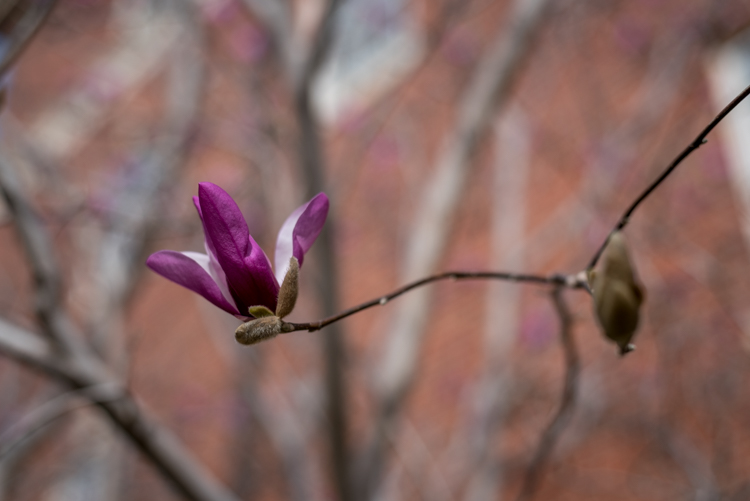
ultra-wide-apertures-purple-flower

When I first got into serious photography work, I was amazed at the power and light-gathering ability of my 50mm f/1.8 lens. It opened up a whole new world of photographic possibilities, that I continue to explore today, and was capable of producing incredible images, even on my humble little Nikon D200. Unfortunately, like the scientists in Jurassic Park, I did not spend years in the trenches learning my trade and honing my skills in order to learn how to truly utilize the power of such wide apertures, and went through a phase where I shot everything wide open because of things like low light photos, depth of field, and of course bokeh. Always with the bokeh. Now it’s important to note that I don’t regret any of those early lessons but I do want to offer youa few simple things I’ve learned over the years, and a couple reasons why you might want to reign things in a bit and not shoot wide open with that fancy prime or ultrafast zoom lens just yet.

1. Depth of field can be way too shallow

I shoot most of my photos with three prime lenses: a 35mm f/1.8, a 50mm f/1.8, and my favorite, an 85mm f/1.8, that I call my supermodel lens. (Seriously, you could just about point that lens at a moldy old scarecrow, and get a portrait worthy of Vogue magazine.) Each of these lenses has its own set of unique advantages and limitations, but as you can probably already tell, the one thing they all have in common is a super wide maximum aperture. Certainly there are plenty of lenses available with even bigger apertures, like the Nikon 58mm f/1.4 or Canon 85mm f/1.2, but when push comes to shove an f/1.8, or even f/2.8 lens, is no slouch either. Wielding one of these ultra-wide beasts can be a bit like riding a tyrannosaurus rex, in that the sheer amount of power at your disposal is kind of insane. But, one advantage of fast primes like this, an ultra-shallow depth of field, can also be somewhat of a curse if not used properly.

I’m not going to lie, it’s a ton of fun to shoot things with your lens wide open but it took me a while to learn, that just like the scientists of Jurassic Park, maybe I should have held back a bit. This portrait of a college student is yet another time in which I had no good reason to shoot wide open, but did anyway, and the result was a photo that simply could not be used. Due to the wide f/1.8 aperture, and my proximity to the subject, it left me with a depth of field consisting of just a few centimeters. Her left eye (on the right side of the photo) is perfectly in focus while the other side of her face is blurry, and the result is a strange-looking picture that I had to discard. Thankfully, I quickly realized my mistake and got some other perfectly usable images by shooting at f/2.8 and f/4. But, this was one of those situations in which I thought it would be super cool to get the way awesome background blur of an f/1.8 aperture, but did not realize how I nearly destroyed the portrait in the process.

85mm, f/1.8, 1/750 second, ISO 400

85mm, f/1.8, 1/750 second, ISO 400

Here’s another example from when I first got my 50mm lens, and thought it was so cool to go around shooting all my pictures at f/1.8 – because my warped sense of logic told me that no depth of field could ever be too thin. As a result this picture of some crocuses contains an ugly streak across the center where one flower and a lot of dead grass is in focus while the rest of the image is a blurry mess. Shooting at a smaller aperture would have given me a smooth transition between in-focus and out-of-focus areas and a much more pleasing image overall.
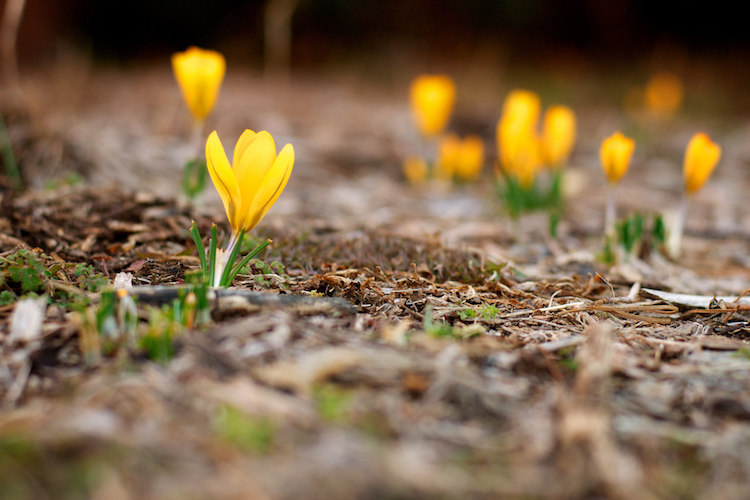
50mm, f/1.8, 1/500 second, ISO 400

50mm, f/1.8, 1/500 second, ISO 400

2. Bokeh and background blur can get out of hand

This is a bit subjective, and open to interpretation on the part of both the photographer and the viewer, but over the years I have found that shooting at the widest possible aperture in order to get the most possible bokeh, or background blur, things can go from artistic and interesting, to messy and incomprehensible very quickly. Bokeh is nice and can certainly be used to add an artistic flair to an image, but when overused, it can overpower the subject and ruin the picture. The following photo of a purple flower sticking up from a bed of grass shows this phenomenon in action.

ultra-wide-apertures-purple-flowers

The flowers are so removed from the background it’s almost like they are hovering in midair, and the effect is somewhat disconcerting, and borders on upsetting. Blowing out the background so much has removed any sense of place and context for the subject, and what’s left is a green and purple mess, that is neither artistically interesting, nor aesthetically pleasing.

3. Vignetting, chromatic aberration, and other optical oddities

Before I say too much on this subject perhaps I need to add a bit of a preface. Less expensive lenses can behave strangely when you shoot with them wide open, but more expensive glass is usually much better at this sort of thing. With that disclaimer out of the way, it’s important to understand some of the optical abnormalities such as vignetting, chromatic aberration, and softness, that often show up when your lens is opened up as far as it will go.

Vignetting is when the edges of your image look a bit darker than the rest of the picture, due to how light is manipulated inside your lens before it hits the image sensor inside your camera. It’s not too big of a problem on cameras with smaller sensors like APS-C or micro four thirds models, but it is certainly there, and even more so on full frame cameras.
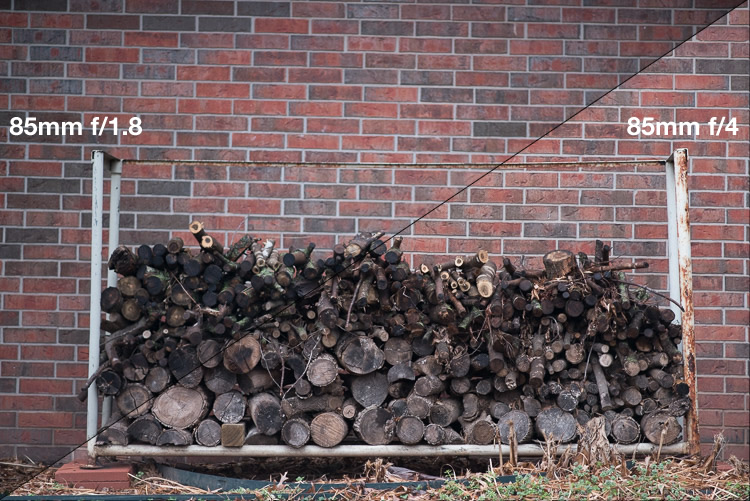
Vignetting can be a major issue when shooting wide open. Notice how the centers of both images are equally exposed but the corners are much darker at f/1.8.

Vignetting can be a major issue when shooting wide open. Notice how the centers of both images are equally exposed but the corners are much darker at f/1.8.

If you shoot in RAW, you can use Lightroom, Photoshop, or other such applications to mitigate most of the effects of vignetting if you want. Of course another solution is to use a smaller aperture, which tends to eliminate most vignetting altogether. Vignetting is not always a dealbreaker, and many photographers, myself included, actually prefer the subtle effects of a well-used vignette. You may find that you fall into this camp, in which case go right ahead and shoot at f/1.8 or f/1.4 to your heart’s content.

The other optical abnormality that often rears its ugly head at wide apertures is chromatic aberration, which might be a much bigger problem if you are not ready for it. This usually manifests itself as purple or green outlines or fringes, around places in your pictures with harsh contrast between dark and light. For example the image below was shot at f/1.8, and upon first glance, looks perfectly usable.

50mm, f/1.8, 1/3000 second, ISO 100

50mm, f/1.8, 1/3000 second, ISO 100. It looks Okay on first inspection, but all is not well up close.

Take a closer look and you will notice a big problem around the edges of most of the dry stalks of grass. Ugly green halos show up all over the place, and this is a direct result of shooting wide open, due to how the incoming light is transformed by the lens on its way to the camera. Here’s a 100% crop of the image next to the exact same picture shot at f/8.
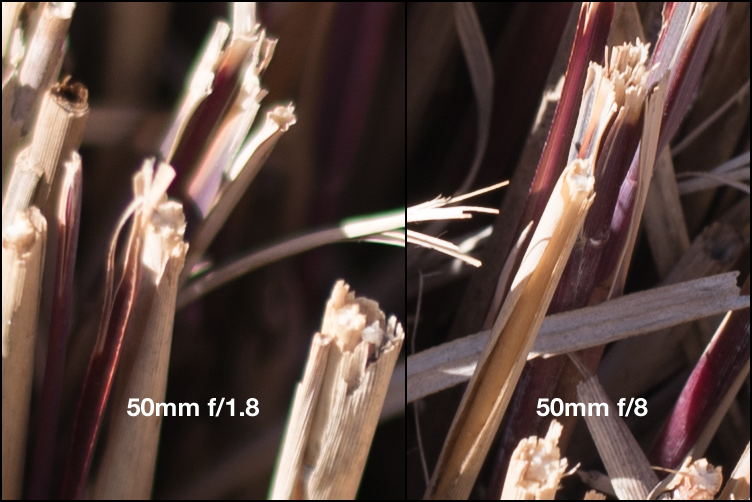
Green outlines abound on the left side while stopping down to f/8 eliminates them entirely.

Green outlines abound on the left side while stopping down to f/8 eliminates them entirely.

This optical imperfection can often be mitigated somewhat in Lightroom, by using its: Remove Chromatic Aberration option in the Develop panel. But even then the results are not ideal, and you will often be left with images that still show some green or purple artifacts, or lose a bit of color from other parts of your picture. Rather than mess around with fixing these issues in post-production, I like to just avoid it from the start and shoot at a slightly smaller aperture. It usually fixes the problem, and still leaves me with the same overall composition I would have had with a wider aperture.

The last weird characteristic of most lenses at their widest apertures might not be that big of a problem unless you are painstaking examining your pictures on a per-pixel basis, but it’s something you should know about nonetheless. Almost all lenses are a bit softer when used at their widest apertures, which can result in pictures that are not quite what you want. The picture below was shot at f/1.8 and looks decent upon first glance, but a closer inspection reveals a very different story.

50mm, f/1.8, 1/125 second, ISO 100

50mm, f/1.8, 1/125 second, ISO 100. Seems decent but once again a closer look reveals a much different story.

Zooming in on the exact center of the image, the point at which I locked focus, shows two very different pictures when this is put next to the very same picture shot at f/8.
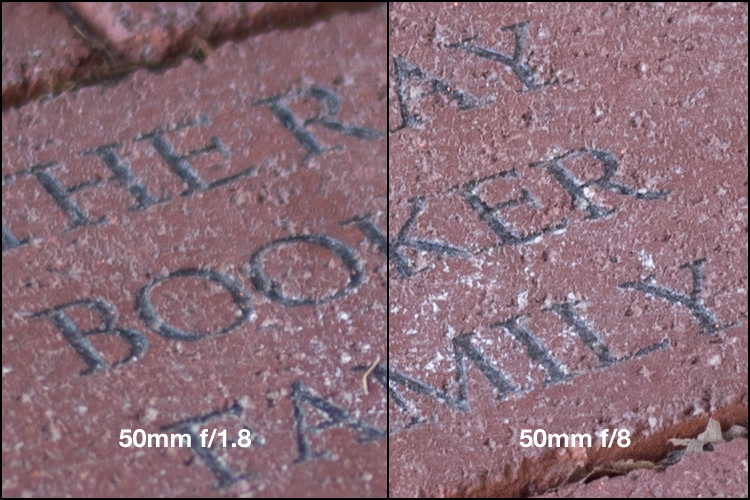
Focus was locked precisely on the letter "K" and yet the image on the left, shot at the widest aperture on my lens, is much less sharp.

Focus was locked precisely on the letter “K” and yet the image on the left, shot at the widest aperture on my lens, is much less sharp.

Once again this sharpness problem can be corrected to some degree in post-production, but my ideal solution is to avoid shooting at f/1.8 unless I specifically need the light-gathering ability, background blur, or other effects that such a wide aperture offers. Photography is all about tradeoffs, and while closing down the aperture on my lens resulted in a picture that was sharper, it also gave me an image that had much wider depth of field, which made the overall composition less pleasing.

4. Use wide apertures sparingly to maximize their impact

The Roman philosopher Marcus Tullius Cicero once said, “Never go to excess, but let moderation be your guide.” This nugget of wisdom is applicable not only to life in general, but also speaks volumes about how to approach photography. I like to treat the widest aperture on my lenses like flooring the gas pedal on my car. It’s fun, but if I went around driving full speed everywhere I went, it would quickly lose its appeal. (Though in my 1998 Toyota sedan I would probably lose a race to a skateboarder, but you get the point.)

Your lenses have wide apertures for a reason and they are meant to be used to get good images, particularly if you are aware of some of the quirks and idiosyncrasies of using them like this. If you like shooting wide open, and don’t mind some of the potential tradeoffs like a bit of vignetting and chromatic aberration, then go for it! However, my own personal rule of thumb is to only use f/1.8 when I really need it, otherwise the creamy backgrounds and bokeh balls start to lose a bit of their luster. When I’m doing a portrait session I keep f/1.8 in my back pocket for when I really need it, otherwise I shoot most pics at f/2.8, f/4, or smaller.
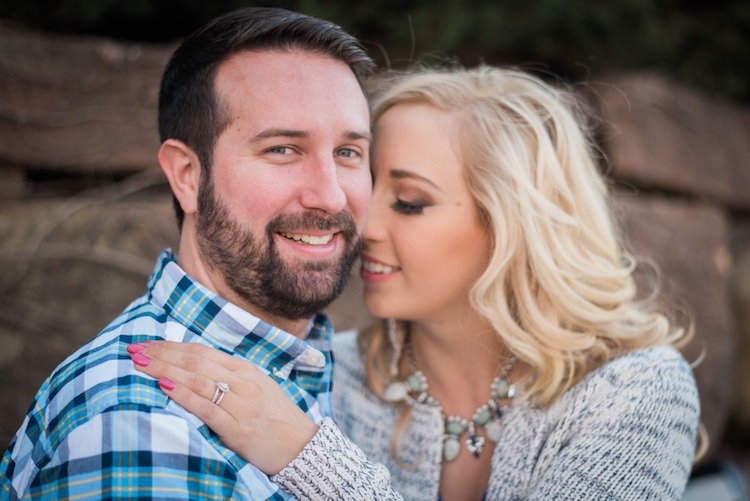
I took most photos of this couple at smaller apertures, which made this one at f/1.8 really stand out.

I took most photos of this couple at smaller apertures, which made this one at f/1.8 stand out among the rest.

After hearing this list of reasons to hold back a bit when shooting wide open, I almost feel like I should write a similar article about the benefits of taking photos at the largest aperture possible. I don’t want to give the impression that you should never use your equipment to the fullest of its capabilities, just that there are a few things to know before you go around taking all your pictures at the widest possible aperture your lenses can use. You might end up with a few problems, just like the ill-fated scientists of Jurassic Park, but hopefully yours won’t be quite as lethal, and along the way you could very well manage to take some incredible photos too.

I’d like to know what your thoughts are on all of this, and if you have any favorite shots taken at not-quite-wide apertures, please post them in the comments below!

googletag.cmd.push(function() {
tablet_slots.push( googletag.defineSlot( “/1005424/_dPSv4_tab-all-article-bottom_(300×250)”, [300, 250], “pb-ad-78623” ).addService( googletag.pubads() ) ); } );

googletag.cmd.push(function() {
mobile_slots.push( googletag.defineSlot( “/1005424/_dPSv4_mob-all-article-bottom_(300×250)”, [300, 250], “pb-ad-78158” ).addService( googletag.pubads() ) ); } );

The post Are You Obsessed with Shooting Wide Apertures – Here’s Why You Might Want to Hold Back by Simon Ringsmuth appeared first on Digital Photography School.


Digital Photography School

 
Comments Off on Are You Obsessed with Shooting Wide Apertures – Here’s Why You Might Want to Hold Back

Posted in Photography


Phase One adds the IQ3 100MP back to its A-series system

09 Feb

$ (document).ready(function() { SampleGalleryV2({“containerId”:”embeddedSampleGallery_1625945477″,”galleryId”:”1625945477″,”isEmbeddedWidget”:true,”standalone”:false,”selectedImageIndex”:0,”startInCommentsView”:false,”isMobile”:false}) });

Danish camera manufacturer Phase One has expanded its range of A-Series offerings to include the new 100MP IQ3 digital back. The A-Series kits consist of an Alpa 12TC camera body with one of three lenses and a choice of IQ3 backs in 50-, 60-, 80- and 100-million-pixel resolutions. The A-Series is particularly interesting as the cameras have no mirror, so vibrations are kept to a minimum at the time of exposure.

Images have to be composed on the rear touchscreen using the 30 fps live view feature, though the Wi-Fi functionality of the back allows connection to Apple iPod and iPhone devices via the Capture Pilot app for remote viewing, control and capture. The IQ3 backs also offer USB 3 and HDMI ports for tethered shooting to a computer running the Capture One Pro 9 software application, or for streaming live view content to a TV or field monitor.

Each lens is calibrated with the body in the factory, so there should be no need for users to create custom color correction profiles themselves. The calibrations are stored in the IQ3 back, and users just have to select the matching menu item when changing lenses.

The IQ3 100MP back in the kits is the standard model, and can also be used with the Phase One XF DSLR camera.

The kits come with the Rodenstock ALPAR F4.0 35mm, but an ultra-wide Alpagon 23mm F5.6 and a ‘standard’ Alpagon 70mm F5.6 are also available. The A-series IQ3 100MP system is available now, and is priced at $ 56,000 with the 35mm lens. It comes with a 5-year warranty and personalized 24/7 support.

For more information visit the Phase One website.


Press release:

Phase One introduces the A-series 100MP camera system

COPENHAGEN, February 3, 2016 — Phase One today introduced the A-series IQ3 100MP medium format camera system. In collaboration with ALPA, Phase One is pleased to offer this highly-integrated and specialty calibrated, precision camera system – one created to meet the needs of the world’s most demanding fine art photographers.

The A-series IQ3 100MP joins existing Phase One A-series models (the A-series IQ3 50MP, A-series IQ3 60MP and A-series IQ3 80MP) offering both the precision integration with the ALPA platform and complete compatibility with the Phase One XF camera system.

Based on the ALPA 12TC mirrorless camera body, all specially calibrated Phase One medium format IQ3 A-series digital backs offer unprecedented quality and integration. Each model comes with the 35mm Rodenstock Alpar lens. Two optional lenses are available, including the ultra-wide 23mm, and the all-round 70mm, ALPA HR Alpagon – both offering perfect edge-to-edge sharpness and the ability to resolve full frame medium format sensors.

Exclusive to the Phase One A-series system are factory configured in-camera lens calibrations (FLC), making the need to create and apply color cast correction profiles (LCCs) optional. One can simply attach an A-series lens and start shooting.

Availability and Pricing
Shipping immediately, the A-series IQ3 100MP Camera System is available through Phase One photography partners worldwide: www.phaseone.com/partners.

The A-series IQ3 100MP Camera System comes with Phase One’s unique 5-year warranty and uptime guarantee including personalized 24/7 support and assistance.

The price of the Phase One A-series IQ3 100MP Camera System (with Rodenstock Alpar 35mm lens) is 56,000 USD.

For a demo of the Phase One A-series IQ3 100MP Camera System, please sign up here: www.phaseone.com/demo

Articles: Digital Photography Review (dpreview.com)

 
Comments Off on Phase One adds the IQ3 100MP back to its A-series system

Posted in Uncategorized