RSS
 

Posts Tagged ‘Architecture’

Parasitic Architecture: 15 Precariously Perched Structures

26 Aug

[ By Steph in Architecture & Cities & Urbanism. ]

Parasitic Architecture main

These parasitic buildings commandeer wasted urban space, often siphoning utilities from their host buildings. Some are additions that make no attempt to blend into the original structures, some are serious solutions for making the most of existing space, and others make artistic statements on fringe society and sustainable growth, but all illustrate that there are still many corners and crevices of our cities that could be put to use.

ParaSITE Inflatable Shelters
Parasitic Architecture Inflatables

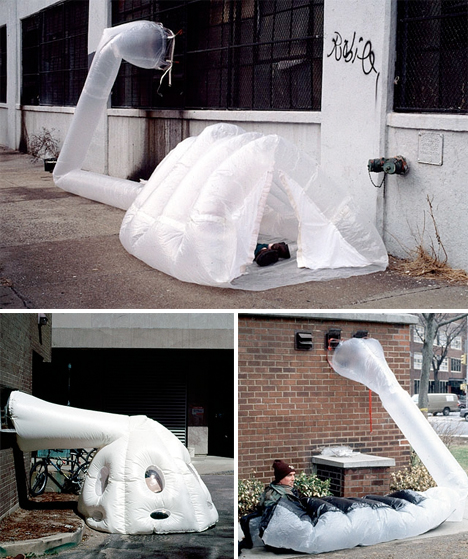
Michael Rakowitz creates inflatable ‘paraSITE shelters’ for the homeless, often specifically designed to suit individual needs, which narrowly fit within the definitions of legal temporary structures since they’re not much larger than a sleeping bag. They’re often made on a budget of less than five dollars using trash bags, ziploc bags and clear waterproof packing tape, and attached to the ventilation systems of adjacent buildings. One man, for example, requested as many windows as possible, because “homeless people don’t have privacy issues, but they do have security issues. We want to see potential attackers, we want to be visible to the public.”

Urban Tree Huts by Tadashi Kawamata
Parasitic Architecture Tadashi Tree Huts

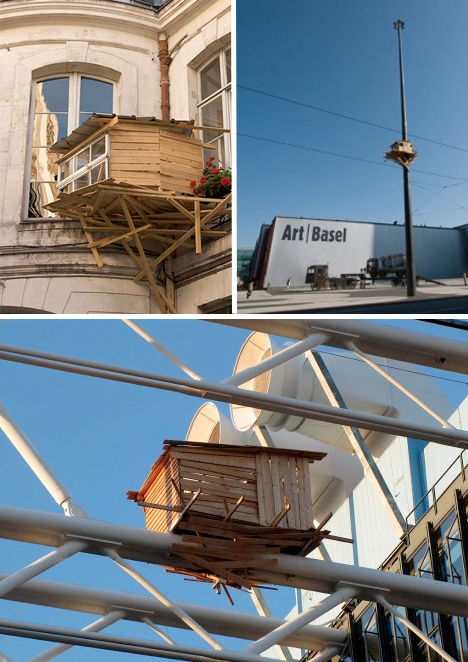
Tadashi Kawamata’s rustic pine tree houses are normally found where you would expect them – in trees (though sometimes in unexpected places, like New York City’s Madison Square Park.) But sometimes, they’re attached like man-made bird nest to urban locations, like lamp posts, bridge trusses, scaffolding and luxury apartment buildings.

Stone Villa  on Top of a Chinese Condo Tower
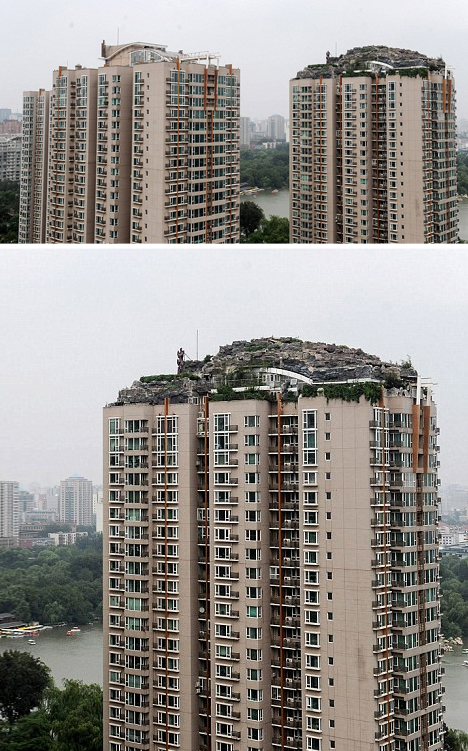
Parasitic-architecture-stone-mountain

An eccentric Chinese man spent six years creating his very own mountain paradise – on top of a Beijing high-rise – illegally. It has everything you’d expect from a luxury residence including boulders, trees, gardens, winding paths, viewing platforms and pools, hauled up through the building to adorn his private penthouse retreat. Unsurprisingly, other residents in the 26-story building have complained about construction noise and even flooding. The Chinese government has ordered the professor to remove the 800-square-meter villa.

Prefab Parasite

Parasitic Architecture Calder

Empty vertical surfaces could become the basis of parasitic living spaces made out of prefab panels. The dwellings could be affixed to any wall or pylon strong enough to support them using a mountain plate. This particular design, by Lara Calder Architects, features paneling made of compressed bamboo and recycled paper. It measures about 400 square feet, and features an open-air rooftop terrace. A combination staircase and service shaft connecting the home to power, sewer and water is the only part touching the ground.

Excrescent Utopia: Parasite Architecture for the Homeless

Parasitic Architecture Homeless Utopia

British architecture graduate Milo Ayden De Luca envisions parasitic structures for the homeless that could cling to the sides of lamp posts . Made of cheap and readily available materials like pulleys, nylon and rope lines, the structures are translucent and nearly weightless.

Next Page:
Parasitic Architecture 15 Precariously Perched Structures

Share on Facebook


[ By Steph in Architecture & Cities & Urbanism. ]

[ WebUrbanist | Archives | Galleries | Privacy | TOS ]


WebUrbanist

 
Comments Off on Parasitic Architecture: 15 Precariously Perched Structures

Posted in Creativity


Ghost Architecture: Unconscious Art of Building Demolition

20 Aug

[ By WebUrbanist in Art & Photography & Video. ]

void building architectural photos

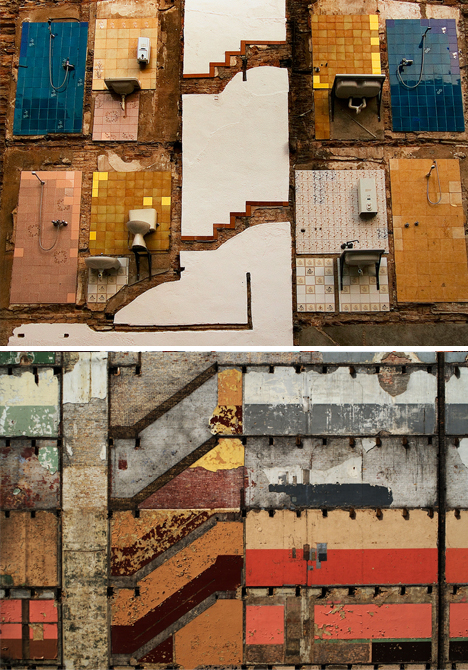
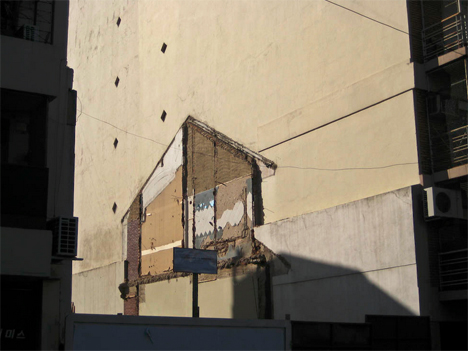
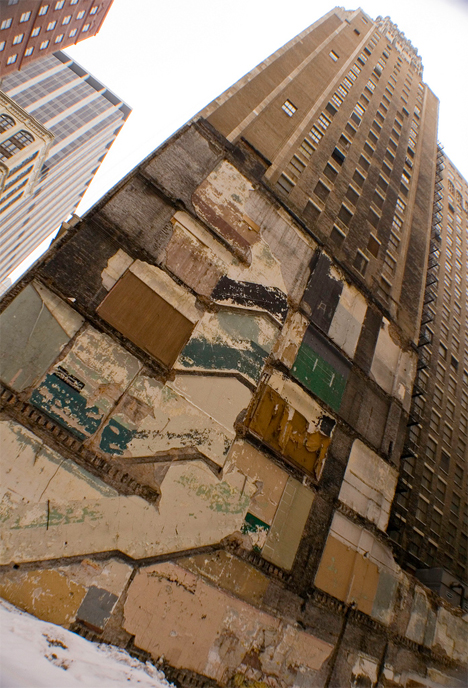
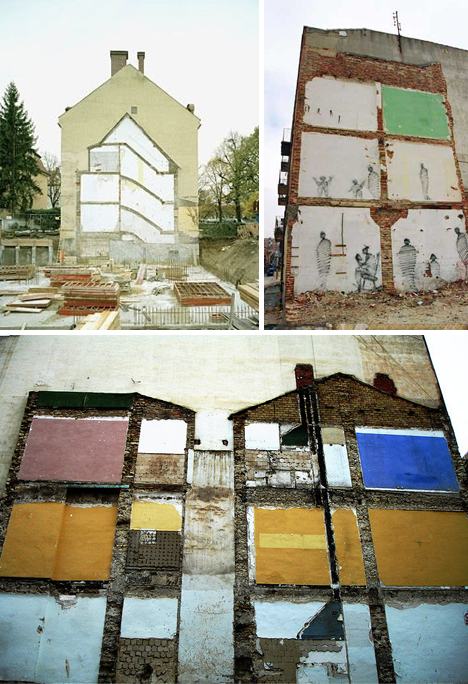
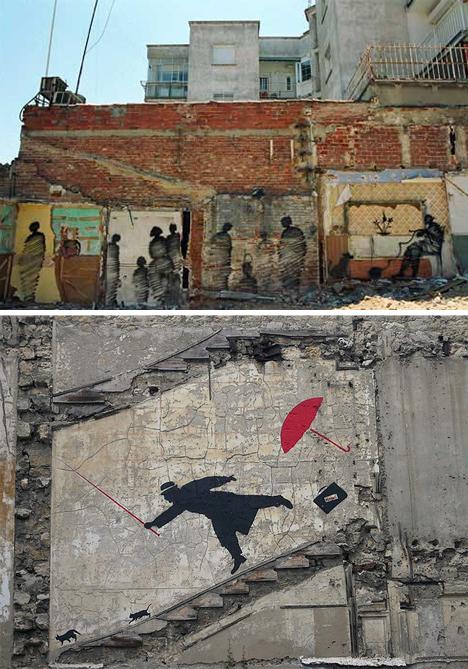
When a free-standing building is razed there is often little left to tell its story, but in places where structures directly abut one another there are sometimes amazing traces of not just buildings but floor plans, wall placements, staircases and even room contents.

void building demolition art

Like architectural section drawings, remnant spaces can be extrapolated from two-dimensional clues, like material transitions, degree of weathering, surface shapes and color shifts. Occasionally, there are even three-dimensional fixtures still hanging on, like the showers, sinks and toilets in one of the pictures above.

ghost void building

The Unconscious Art of Demolition is a Flickr photography group that focuses on these accidental works of ghost architecture – leftover structural voids and the spaces they imply.

void structure implied volume

In the process of observing and photographing, these passers by and onlookers are turned into amateur documentarians and de facto archaeologists, discerning and (at least subconsciously) projecting patterns into ambiguous urban decay.

void architecture building examples

Some take an abstract approach, zooming in on the rich materials where parts of walls were left and other pieces ripped away. Others take a broader focus, highlighting building outlines and implied interiors. Still others capture works of street art placed within the flat landscapes one can imagine inside of these non-buildings.

void building street art

Images included here are by Steven Kunstler, Merrick Brown, Daniel Lobo, Thomas Hobbs, Dave Meyer and Xenmate, but many more can be found in the aforementioned Flickr group with over 500 images and members.

Share on Facebook


[ By WebUrbanist in Art & Photography & Video. ]

[ WebUrbanist | Archives | Galleries | Privacy | TOS ]


WebUrbanist

 
Comments Off on Ghost Architecture: Unconscious Art of Building Demolition

Posted in Creativity


Learn Modern Architecture Principles with New LEGO Kit

01 Aug

[ By Steph in Design & Products & Packaging. ]

LEGO Architecture Studio 1

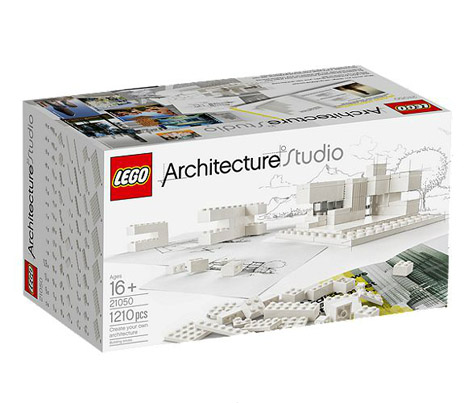
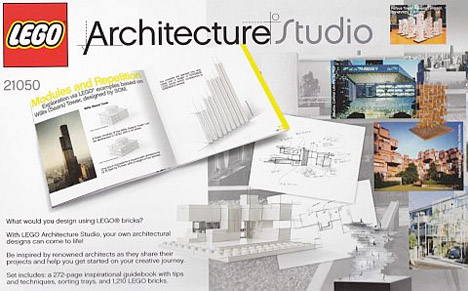
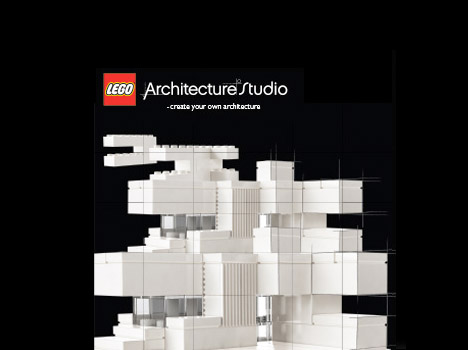
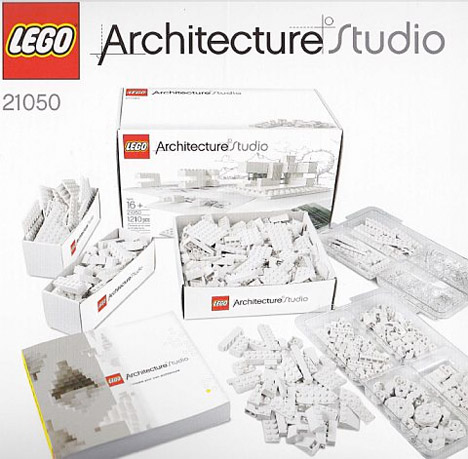
If you’ve always wanted to design modern buildings, but don’t have any plans to attend architecture school, LEGO has just the tool you’re looking for. The toy company has revealed a LEGO Architecture Studio kit aimed at adults with an interest in design, which includes over 1,200 white and transparent blocks in 73 shapes along with a 272-page guide book full of architecture designs and tips from leading contemporary architects.

LEGO Architecture Studio 2

LEGO Architecture Studio 3

Endorsed by REX Architecture, Sou Fujimoto Architects, MAD Architects, Tham & Videgård Arkitekter and Safdie Architects, the set features techniques, examples and hands-on exercises to strengthen your design sensibilities. It could also be used by working architects to build models.

LEGO Architecture Studio 4

While there are some sample designs in the book, the idea is for you to put your imagination to work and come up with your own masterpieces. Among the topics explored in the book are modules and repetition, creating surfaces, working in a context, mass and density, and symmetry.

Lego Architecture Studio 5

The set retails at $ 149.95 and will be available for purchase on the LEGO website on August 1st.

Share on Facebook


[ By Steph in Design & Products & Packaging. ]

[ WebUrbanist | Archives | Galleries | Privacy | TOS ]


WebUrbanist

 
Comments Off on Learn Modern Architecture Principles with New LEGO Kit

Posted in Creativity


Animated History of Western Architecture in Just 15 Minutes

25 Jul

[ By WebUrbanist in Art & Photography & Video. ]

design in a nutshell

These six super-short videos are an architectural tour de force for visual learners bent on absorbing as much as possible in as little time as needed. Narrated by actor Ewan McGregor, the Design in a Nutshell series (all playable below) presents whole history of Western architecture (and related design fields). This historical tour is highly engaging, thanks to lovely animations and engaged narration complete with famous examples and dynamic illustrations.

design architectural history series

Diagrams and dramatic descriptions will carry you through from Gothic Revival to Arts & Crafts and Bauhaus, then onto Modernism and Postmodernism. For the design-inclined, these educational mini-films should be enough to whet your appetite, leaving you to want more on each of these movements. But meanwhile, since you may be in a hurry, let us forgo further description and get started below:

Created by The Open University, a distance-learning institution based in the United Kingdom, these are by no means exhaustive, but they are a great introduction to thinking about architecture. Visually, they can begin to help you when it recognizing and understanding time-specific and universal themes, and start to connect what you see in cities around you to design theories and historical contexst. Or, if you already know the basics, simple share these with friends you want to get excited about built environments instead!

Share on Facebook


[ By WebUrbanist in Art & Photography & Video. ]

[ WebUrbanist | Archives | Galleries | Privacy | TOS ]


WebUrbanist

 
Comments Off on Animated History of Western Architecture in Just 15 Minutes

Posted in Creativity


Wooden Skyscraper: 34 Stories of Stick-Framed Architecture

04 Jul

[ By WebUrbanist in Architecture & Houses & Residential. ]

wood skyscraper tower design

If accepted and completed, this design would be the tallest wood-frame structure in the world. Counter-intuitive as it may seem, sustainable timber framing can be more eco-friendly than steel-and-concrete construction, which is also precisely the premise behind this competition entry that pitches wood as the primary building material.

wooden skyscraper building top

C. F. Møller (in partnership with Dinell Johansson and Tyréns) notes that wood is renewable and lighter, thus costing less in both money and fuel to transport. Many non-architects also do not realize that wood can perform better than steel in a fire – steel heats up and buckles, while wood first loses its water weight, then chars and resists the flames.

wood skyscraper exterior interior

Everything visible both inside and out celebrates the use of wood, from pillars and beams to ceilings, walls and window frames on each floor and in each unit. In turn, large exterior windows would also show off these wooden details to external viewers. At the building’s center, either wood or concrete could be used to form the service core. From the designers: “Wood is one of nature’s most innovative building materials: the production has no waste products and it binds CO2. Wood has low weight, but is a very strong load-bearing structure compared to its lightness.”

wooden skyscraper systems diagram

As a mixed-use development, “Social and environmental sustainability [are] integrated into the project. Each apartment will have an energy-saving, glass-covered veranda, while the building itself will be powered by solar panels on the roof. At street level there is a café and childcare facility. In a new community centre, local people will be able to enjoy the benefits of a market square, fitness centre and bicycle storage room. A communal winter garden will provide residents with an opportunity to have allotment gardens.”

Share on Facebook


[ By WebUrbanist in Architecture & Houses & Residential. ]

[ WebUrbanist | Archives | Galleries | Privacy | TOS ]


WebUrbanist

 
Comments Off on Wooden Skyscraper: 34 Stories of Stick-Framed Architecture

Posted in Creativity


Living Architecture: Evolving Pavilion Made by Silk Worms

06 Jun

[ By Steph in Art & Sculpture & Craft. ]

Silk Worm Pavilion 1

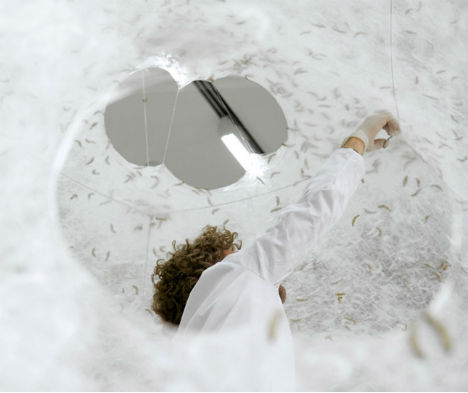
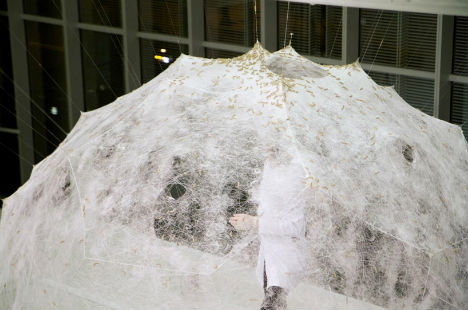
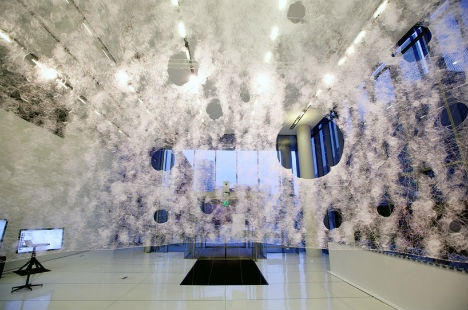
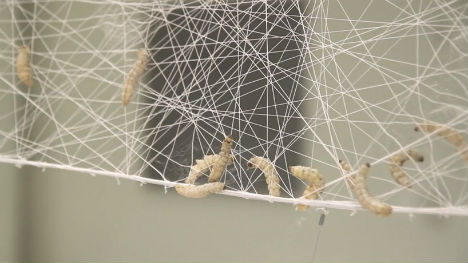
Growing and transforming like a living organism, the Silk Pavilion created by the MIT Media Lab is a collaboration between digital and biological fabrication. The basis of the pavilion is a network of silk threads made by a CNC machine, which has become a cloud-like structure with the addition of natural netting from the dozens of silk worms that squirm all over its surfaces.

Silk Worm Pavilion 2

Twenty-six polygonal panels with silk thread stretched between them form a sort of scaffolding that enables the silk worms to work their magic of naturally produced architecture. The geometry of the base structure was created using an algorithm that routes a single continuous thread across the open sections to provide varying degrees of density.

Silk Worm Pavilion 3

The silkworms were deployed as a biological ‘printer’ to create the secondary structure. If the sculpture, which is installed at MIT, were allowed to remain in place indefinitely, the moths could produce 1.5 million eggs with the potential of constructing up to 250 additional pavilions.

Silk Worm Pavilion 4

“Affected by spatial and environmental conditions including geometrical density as well as variation in natural light and heat, the silkworms were found to migrate to darker and denser areas. Desired light effects informed variations in material organization across the surface area of the structure. A season-specific sun path diagram mapping solar trajectories in space dictated the location, size and density of apertures within the structure in order to lock-in rays of natural light entering the pavilion from South and East elevations.”

Silk Worm Pavilion 5

“The central oculus is located against the East elevation and may be used as a sun-clock. Parallel basic research explored the use of silkworms as entities that can “compute” material organization based on external performance criteria. Specifically, we explored the formation of non-woven fiber structures generated by the silkworms as a computational schema for determining shape and material optimization of fiber-based surface structures.”

via design boom

Share on Facebook


[ By Steph in Art & Sculpture & Craft. ]

[ WebUrbanist | Archives | Galleries | Privacy | TOS ]


WebUrbanist

 
Comments Off on Living Architecture: Evolving Pavilion Made by Silk Worms

Posted in Creativity


Amphibious Architecture: Foundations Float Above Floods

11 May

[ By WebUrbanist in Architecture & Houses & Residential. ]

floating homes

Floodwaters rise, drench homes, then recede, leaving disaster in their wake – a temporary change renders many structures permanently uninhabitable. But what if houses could ride out the storms, rising with the tides, then settling back down to the ground when the water is gone?

floating adaptive aquatic architecture

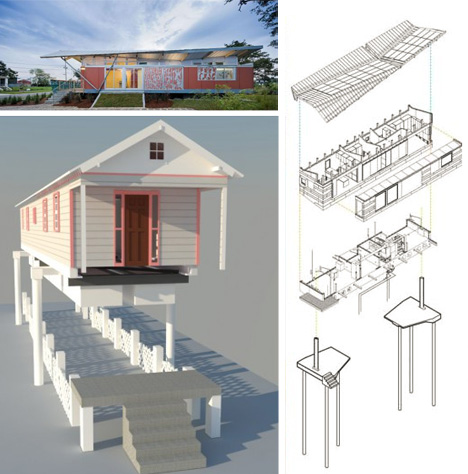
Based on the tragedy of Hurricane Katrina in New Orleans, Morphosis (along with Brad Pitt’s Make it Right Foundation) has designs for new adaptive architecture, while the Bouyant Foundation Project proposes a system for retrofitting existing homes. Each approach would allow structures to do lift off the ground in an emergency and uses regional shotgun-style dwellings as their baseline typology.

floating flood disaster design

BFP outlines a process that involves attaching buoyancy blocks below the home, connecting them to the sub-frame, and installing four corner guideposts to keep the building in place along horizontal axes while allowing it to lift (and settle) vertically on demand.

Connections to utilities (gas, water, power and so forth) would be either severable or extendable, so they could detach and reattach or simply expand and contract as needed. In plan, nothing changes – in elevation, predictable but periodic disasters are accommodated.

Share on Facebook


[ By WebUrbanist in Architecture & Houses & Residential. ]

[ WebUrbanist | Archives | Galleries | Privacy | TOS ]


WebUrbanist

 
Comments Off on Amphibious Architecture: Foundations Float Above Floods

Posted in Creativity


Origami Shelter: Instant Flat-Pack Architecture on Demand

19 Apr

[ By WebUrbanist in Architecture & Public & Institutional. ]

origamic architecture

Take a structure, strip away all of the non-essentials, and squeeze out every last unused bit of air space, and what do you get? Something a lot like a folded sheet of paper.

origami inspired instant architecture

This folding shelter designed by Doowon Suh is as elementary as it gets – a series of sheets that unfold like origami to form a robust but basic building.

origami example

Like nesting paper cranes, in its most compact form, each module can be stacked on its siblings, making it easy to pack and ship in containers or store until deployed.

origami flat pack buildings

The modules are bare bones for maximum adaptive capability – they can emergency homes or hospital pods, temporary stores or community rooms.

Share on Facebook


[ By WebUrbanist in Architecture & Public & Institutional. ]

[ WebUrbanist | Archives | Galleries | Privacy | TOS ]


WebUrbanist

 
Comments Off on Origami Shelter: Instant Flat-Pack Architecture on Demand

Posted in Creativity


Performance Architecture: 10 Dramatic Opera Sets & Stages

10 Apr

[ By Steph in Architecture & Public & Institutional. ]

Amazing Opera Stages Main

Magnificent, surreal stages rise from the depths of Austria’s Lake Constance, rotating, glowing, rising and falling in time with the plots of famed operas, plays and musicals. Unparalleled in their scale and complexity, these stages are built every two years for the Bregenz Opera Festival, which began in 1946. With each season that passes, the sets get even more impressive. Here are 10 standouts.

Andre Chenier

Amazing Opera Stages Andre Chenier

AMazing Opera Stages Andrew Chenier 2

Amazing Opera Stages Andre Chenier 3

Looking like the remains of some fallen civilization, a statue emerges from the lake, its head draped. Then the fabric begins to fall away, revealing a set of stairs that lead right up to the figure’s eye. This interactive set for Andre Chenier, an opera set during the French Revolution, grows even more amazing as the night goes on: the neck of the statue is severed, the head falling back to reveal an additional set.

A Masked Ball

Amazing Opera Stages A Masked Ball

Amazing Opera Stages A Masked Ball 2

A massive skeleton looms over an open book as the scene for A Masked Ball, an opera by Guiseppe Verde. One of the Bregenz Festival’s most iconic sets, this one from 1999 is fairly simple compared to the amazingly complex ones seen in more recent years.

Tosca

Amazing Opera Stage Tosca

Amazing Opera Stages Tosca 2

Puccini’s Tosca played out against this unforgettable backdrop, which featured a giant eye with an iris that actually rotates to reveal a hidden room. Scenes for the James Bond movie Quantum of Solace were filmed in the front of the building and in the audience while this stage was still active, in 2008.

La Boheme

Amazing Opera Stages La Boheme

The 2001-2002 seasons of the Bregenz Festival featured three giant bistro tables and chairs for Puccini’s La Boheme, one of the world’s most popular operas.

Aida

Amazing Opera Stages Aida

Life-sized replicas of the Statue of Liberty – or at least, bits and pieces of it – made a dramatic setting for a contemporary adaptation of Verdi’s Aida, symbolic of the breakdown of human rights. The pieces were mounted to cranes, and seemingly floated up into the sky at various points in the opera.

Carmen

Amazing Opera Stages Carmen

Though not as surreal as many of the other sets,  the 1991-1992 stage for Georges Bizet’s Carmen was no less epic.

West Side Story

Amazing Opera Stages West Side Story

Abstract representations of a rather futuristic-looking city rose and curved as a surprising stage for Leonard Bertstein’s musical West Side Story in 2003.

The Magic Flute

Amazing Opera Stages Die Zauberflote

Last seen at Bregenz nearly twenty years ago with this magnificent rocky stage, The Magic Flute (Die Zauberflote, presented in German with English subtitles) will return for 2013 and 2014 with a new set.

The Troubadour

Amazing Opera Stages Troubadour

Il Trovatore, or The Troubadour, had a very industrial-looking stage – a recreation of an oil refinery in stark red, which spewed fire from those smokestacks during its run in 2005.

Fidelio

Amazing Opera Stages Fidelio

A prison rears up right amidst a life-sized Cardiff street as the set for Fidelio, an Italian opera about insidious evil in the world.

Share on Facebook


[ By Steph in Architecture & Public & Institutional. ]

[ WebUrbanist | Archives | Galleries | Privacy | TOS ]


WebUrbanist

 
Comments Off on Performance Architecture: 10 Dramatic Opera Sets & Stages

Posted in Creativity


Future Architecture: 7 Surreal Award-Winning Skyscrapers

09 Apr

[ By WebUrbanist in Conceptual & Futuristic & Technology. ]

skyscrapers futuristic

The first skyscrapers were impossible drawings at the times they were imagined, yet today glass towers that scale to the skies are everyday structures.  On land, by sea, in the air (or in one case: outer space), these entries are daring and visionary, defying convention, technology and at times even gravity.

skyscraper polar umbrella project

First, the winner of the 2013 Evolo Skyscraper Competition, the Polar Umbrella (by Derek Pirozzi), a buoyant skyscraper that protects and regenerates the polar ice caps. The umbrella helps shade the ice below it, which is, in turn, rebuilt via water frozen by energy generated “through an osmotic (salinity gradient power) power facility housed within the building’s core.”

skyscraper first place award

It can much more than just a remote outpost: “Through its desalinization and power facilities, this arctic skyscraper becomes a floating metropolis equipped with NOAA (National Oceanic and Atmospheric Administration) research laboratories, renewable power stations, dormitory-style housing units, eco-tourist attractions, and ecological habitats for wildlife.”

skyscraper flying light park

From the sea we shift our sights to the sky, where a high-flying design (third-place winner) aims to supplement dense cities with much-needed recreational and green space. Capped with a helium balloon and supported by solar-powered propellers, Light Park (by Ting Xu and Yiming Chen) is a floating skyscraper.

skyscraper sky park diagrams

Lofted greenery helps clean the air above urban centers, and the plan balances program and structure: “Programmatic platforms that host parks, sports fields, green houses, restaurants, and other uses are suspended from the top of the structure by reinforced steel cables; the platforms fan in different directions around the spherical vessel to balance its weight. These slabs are also staggered to allow for maximum exposure to sunlight on each level.”

skyscraper space gravity grid

Before we get to a few back on the ground,  we have covered sea, sky and the next step? Space. That’s where the Stratosphere Network of Skyscrapers comes in – a bold idea by a Chinese team to create a skyscraper grid in space. The Buckminster-Fuller-worthy hex network of globe-spanning architectural infrastructure is mind-boggling in its implications. Independently, these incredible towers are impossible to support, but as a network, they reinforce one another, and are mutually suspended above the Earth.

skyscraper futuristic network diagrams

If is a tall order in practice, but a brilliant concept in theory: “In this case the network of buildings and bridges connected to each other, covering the entire circumference of the earth, will no longer need structural ground support and can be suspended in the air by the effect of the earth gravity. The elevated bridges and buildings that relate the grid can reach any height with out worrying about overturning, earth-quakes, floods and any other natural disasters.”

Next Page:
Future Architecture 7 Surreal Award Winning Skyscrapers

Share on Facebook


[ By WebUrbanist in Conceptual & Futuristic & Technology. ]

[ WebUrbanist | Archives | Galleries | Privacy | TOS ]


WebUrbanist

 
Comments Off on Future Architecture: 7 Surreal Award-Winning Skyscrapers

Posted in Creativity