RSS
 

Posts Tagged ‘Added’

How to Use Angle of Light in People Photography for Added Punch

12 Sep

This may be something that you have already heard from landscape photographers. It is very important to be aware of the angle of the light (where does the light come from) to be able to get the best of a scene, and the best exposure for your image. Also, when using a polarizing filter, it is more effective when used at a 90 degrees angle to the sun for better blue sky results.

Angle of light – people photography

But when it comes to people photography I couldn’t find a lot mentioning the angle of light online. So here is what I think about it.

Keep the light behind you

When photographing people, it is also very important to be aware of the direction of the light. As I mention when teaching about composition, you should try, as much as possible, to keep the light behind you (or avoid facing the light). If the light remains behind you, the general exposure has more chance of being better, avoiding under and over exposed elements in the image.

JB 4997

Keeping the light behind you ensures a better general exposure through the whole image. Hoi An, Vietnam.

When facing the light, there are two options when it comes to people photography. You can either create a silhouette of your subjects while exposing for the brighter background. Or you can try to find a middle exposure, thus avoiding over exposing your background too much and keeping some details on the subject. This last method works very well in the early morning and late afternoon.
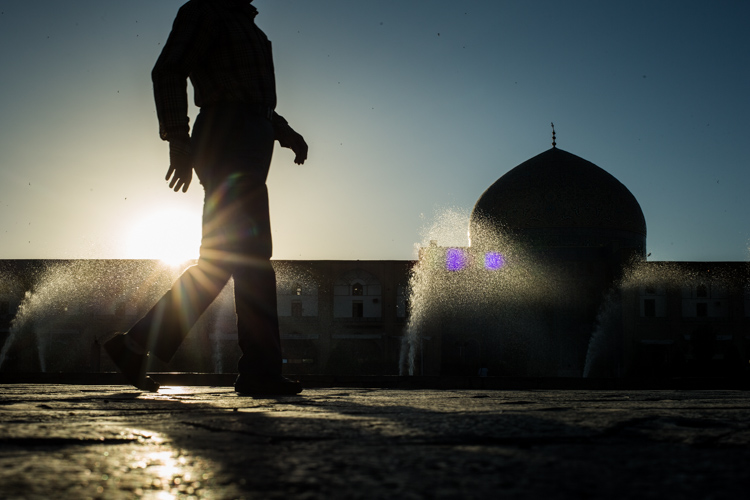
JB 8191
A silhouette created by directly facing the light. Isfahan, Iran.

The third option would be to expose for your subject and completely overexposing your background. I personally do not believe it looks that good though.

JB 6890

Finding a middle exposure between background and subject while facing the light works very well in the early morning and late afternoon. Kandovan, Iran.

Side light is magic

But when you put the light at a 90-degree angle, there is something magic that happens. When the light is softer and more colorful (at sunrise and sunset) it is possible to come up with some type of semi-silhouetted images. The part of your subject exposed to the light will be exposed correctly. The other part will be much darker (still preserving some details). That is going to create a more contrasty image, with a little more punch.

If you take an image which is slightly overexposed, there are no blacks in it and the histogram is slightly shifting to the right. As soon as the exposure goes down, some darker pixels will appear and add contrast to the image, making it instantly more powerful.

This is what a 90 degrees light will do to your subject: shadowing part of it and adding contrast and power to the image.

JB 4802

The light being on the right side, the back of this man is underexposed (in shadow), thus creating more contrast in the image. Hoi An, Vietnam.

For close-up portraits, the angle of the light has some superb effects on skin tones. Mostly when the tones are darker and more keen to reflect the light, this angle will enhance these tones. Because, as mentioned above, a part of your subject (the part which is not directly into the light) will be darker, the brighter parts will be enhanced.

Let’s compare

Here are two images of the same man, taken two minutes apart from each other. As you can see in the first one, the light is more even throughout the picture.

JB 2969

In this second image, there are some much darker areas on the left, adding contrast and punch to the image. The details on the skin tones are also much more interesting.

JB 4933

I hope that gives you some ideas for using the direction or angle of light to add punch to your people photography. Know where the light is coming from and make a conscious choice how to use it to your advantage.

Please share your people photos in the comments below.

googletag.cmd.push(function() {
tablet_slots.push( googletag.defineSlot( “/1005424/_dPSv4_tab-all-article-bottom_(300×250)”, [300, 250], “pb-ad-78623” ).addService( googletag.pubads() ) ); } );

googletag.cmd.push(function() {
mobile_slots.push( googletag.defineSlot( “/1005424/_dPSv4_mob-all-article-bottom_(300×250)”, [300, 250], “pb-ad-78158” ).addService( googletag.pubads() ) ); } );

The post How to Use Angle of Light in People Photography for Added Punch by Etienne Bossot appeared first on Digital Photography School.


Digital Photography School

 
Comments Off on How to Use Angle of Light in People Photography for Added Punch

Posted in Photography


Canon EOS 5D Mark IV added to studio scene comparison

30 Aug

As soon as our Canon EOS 5D IV test unit arrived we put it straight to work, both out and about in Seattle and in the studio. The EOS 5D IV has just been added to our studio test scene comparison tool, so you can easily compare it to its peers. Our dynamic range test results will be following shortly.

For now, check out how the EOS 5D IV compares to its peers and competitors in our studio by clicking on the link below.

Canon EOS 5D Mark IV studio test scene

*Raw images have been processed with an early beta build of Adobe Camera Raw. Image quality may not represent the final version of the plugin, but is likely to be close.

Articles: Digital Photography Review (dpreview.com)

 
Comments Off on Canon EOS 5D Mark IV added to studio scene comparison

Posted in Uncategorized


Pentax K-70 added to studio test scene

25 Aug

The Pentax K-70 features a 24MP sensor with, for the first time in a Pentax, hybrid AF in live view. It also brings Pentax’s impressive Pixel Shift Resolution mode down to the mid-level DSLR segment. Take a look at how it fares against its competition in our studio test scene.

Raw support is still in progress, so note that we will be adding Raw Pixel Shift shots in the future as support is released. This also means Raw conversions were done with the ‘Embedded’ camera profile, and will be updated once the ‘Adobe Standard’ profile is available.

Articles: Digital Photography Review (dpreview.com)

 
Comments Off on Pentax K-70 added to studio test scene

Posted in Uncategorized


Canon G7 X Mark II added to studio scene

05 Jul

$ (document).ready(function() { ImageComparisonWidget({“containerId”:”reviewImageComparisonWidget-49064581″,”widgetId”:379,”initialStateId”:null}) })

JPEG Performance

One of the obvious changes to the G7 X Mark II’s image processing is with sharpening$ (document).ready(function() { $ (“#imageComparisonLink2662”).click(function() { ImageComparisonWidgetLink(2662); }); }). For the G7 X Mark II, the large radius sharpening has been increased, which does enhance certain types of detail$ (document).ready(function() { $ (“#imageComparisonLink2664”).click(function() { ImageComparisonWidgetLink(2664); }); }), but ultimately emphasizes lower frequency detail$ (document).ready(function() { $ (“#imageComparisonLink2676”).click(function() { ImageComparisonWidgetLink(2676); }); }) over high frequency detail. A significant downside of large radius sharpening is more pronounced sharpening halos$ (document).ready(function() { $ (“#imageComparisonLink2663”).click(function() { ImageComparisonWidgetLink(2663); }); }) compared to the G7 X, which can look particularly egregious$ (document).ready(function() { $ (“#imageComparisonLink2675”).click(function() { ImageComparisonWidgetLink(2675); }); }) next to the more refined sharpening the RX100 IV demonstrates (pay attention to the edges of the color patches).

Noise reduction has also changed. When we took the G7 X Mark II to Sasquatch! music festival, we noticed noise reduction at base ISO was fairly strong. Compared to the G7 X$ (document).ready(function() { $ (“#imageComparisonLink2672”).click(function() { ImageComparisonWidgetLink(2672); }); }), we can see the stronger algorithm in action, especially when compared to the amount of detail visible in Raw$ (document).ready(function() { $ (“#imageComparisonLink2671”).click(function() { ImageComparisonWidgetLink(2671); }); }) mode. The excessive noise reduction combined with the large radius sharpening we mentioned earlier mean that fine detail isn’t as well preserved in the JPEG as it could be.

The benefit of both the sharpening and NR parts of the new engine is better detail retention at higher ISOs$ (document).ready(function() { $ (“#imageComparisonLink2670”).click(function() { ImageComparisonWidgetLink(2670); }); }), with an ISO 1600 shot from the G7 X Mark II shot showing as much detail as an ISO 800 shot from the G7 X. At the highest ISOs, 6400$ (document).ready(function() { $ (“#imageComparisonLink2668”).click(function() { ImageComparisonWidgetLink(2668); }); }) and 12800$ (document).ready(function() { $ (“#imageComparisonLink2674”).click(function() { ImageComparisonWidgetLink(2674); }); }), the image engine oddly remains unchanged.

Raw Performance

Raw high ISO performance in low light remains largely the same as the G7 X$ (document).ready(function() { $ (“#imageComparisonLink2677”).click(function() { ImageComparisonWidgetLink(2677); }); }), which is right where we expect image quality to be from the Sony sensor used across many 1-inch type cameras$ (document).ready(function() { $ (“#imageComparisonLink2678”).click(function() { ImageComparisonWidgetLink(2678); }); }). 

These improvements come with many other changes for the G7 X Mark II, which will be covered in our full review. Stay tuned!

Articles: Digital Photography Review (dpreview.com)

 
Comments Off on Canon G7 X Mark II added to studio scene

Posted in Uncategorized


DxOMark Mobile Report added to our LG G5 review

15 Jun

We have added DxOMark’s Mobile Report to our camera review of the LG G5. The report includes DxO Lab’s usual industrial-quality scientific measurements. Its imaging experts have analyzed 14 aspects of mobile imaging including detailed image quality assessment, flash performance, autofocus reliability and more to calculate a final score. Click below to read our LG G5 review and go to page 9 for the DxO Mark mobile report.

Articles: Digital Photography Review (dpreview.com)

 
Comments Off on DxOMark Mobile Report added to our LG G5 review

Posted in Uncategorized


Three’s a charm: Sony RX10 III added to studio scene comparison tool

02 Jun

The Sony Cyber-shot RX10 III has impressed us so far. Its new 24-600 F2.4-4 lens has impressed us on the trail and in our initial testing, but it does come at a pretty price. We put it in the studio for a more controlled lens, and image quality test. See how it stacks up against its nearest competitors.

Articles: Digital Photography Review (dpreview.com)

 
Comments Off on Three’s a charm: Sony RX10 III added to studio scene comparison tool

Posted in Uncategorized


Digging into the Fujifilm X-Pro2: Studio analysis and full-production sample gallery added

25 Jan

Our Fujifilm X-Pro2 First Impressions just got a significant update. With a production-ready camera in hand, we’ve been able to send it through our studio scene and dynamic range tests, make some judgements about image quality from its new 24MP X-Trans image sensor and put together a fresh sample gallery. Compare the X-Pro2 to its peers and take another look at what Fujifilm’s newest flagship can do.

Articles: Digital Photography Review (dpreview.com)

 
Comments Off on Digging into the Fujifilm X-Pro2: Studio analysis and full-production sample gallery added

Posted in Uncategorized


DxOMark Mobile Report added to our iPhone 6s Plus review

23 Dec

DxOMark has just released its full report into the technical ins and outs and real-world performance of the iPhone 6s Plus’s 12MP camera. We’ve added DxO’s findings into our previously-published in-depth review of the iPhone 6s Plus and you can read the whole thing over at connect.dpreview.com

Articles: Digital Photography Review (dpreview.com)

 
Comments Off on DxOMark Mobile Report added to our iPhone 6s Plus review

Posted in Uncategorized


DxOMark Mobile Report added to our iPhone 6s Plus review

22 Dec

DxOMark has just released its full report into the technical ins and outs and real-world performance of the iPhone 6s Plus’s 12MP camera. We’ve added DxO’s findings into our previously-published in-depth review of the iPhone 6s Plus and you can read the whole thing over at connect.dpreview.com

Articles: Digital Photography Review (dpreview.com)

 
Comments Off on DxOMark Mobile Report added to our iPhone 6s Plus review

Posted in Uncategorized


Sony Cyber-shot RX1R II added to studio test scene

18 Nov

The Sony RX1R II is the kind of camera that turns heads. With a full-frame 42.2MP sensor, fixed 35mm F2 lens, optical variable low pass filter and a 399-point phase-detect AF system that’s much improved over its predecessor, it’s just about in a class of its own. We’ve had a full-production model for a few hours – just enough time to get it into the studio to see how it handles our test scene. Read more

Articles: Digital Photography Review (dpreview.com)

 
Comments Off on Sony Cyber-shot RX1R II added to studio test scene

Posted in Uncategorized