RSS
 

Posts Tagged ‘About’

Happy Mother’s day! Metaphor about our consumer society

03 Jan

A few nice visual art images I found:

Happy Mother’s day! Metaphor about our consumer society
visual art
Image by Pierre Marcel
Catch Fish, his valentine’s NEST
Pink cat – fish, mother’s nest.
Valentine’s original painting by Pierre Marcel
2010,
Acrylic on canvas, 27 1/2 x 27 1/2 inches ( 70 x 70 cm)
Description sur cgi.ebay.fr/ws/eBayISAPI.dll?ViewItem&item=330737568943
Happy Mother’s day!
Caricaturist visual about our families in our modern world, this Pierre Marcel "nest painting" is a metaphor about our consumer society.

Anne Goldthwaite, American painter and printmaker, 1869-1944
visual art
Image by Smithsonian Institution
Description: Anne Goldthwaite established herself as one of the South’s most important regionalist artists. Born during the Reconstruction era in Montgomery, Alabama her primary subject through her career was the South and southerners. She was also and advocate of women’s rights and equal rights for other minority groups.

Creator/Photographer: Peter A. Juley & Son

Medium: Black and white photographic print

Dimensions: 8 in x 10 in

Culture: American

Date: 1930

Persistent URL: http://photography.si.edu/SearchImage.aspx?id=5824

Repository: Smithsonian American Art Museum, Photograph Archives

Collection: Peter A. Juley & Son Collection – The Peter A. Juley & Son Collection is comprised of 127,000 black-and-white photographic negatives documenting the works of more than 11,000 American artists. Throughout its long history, from 1896 to 1975, the Juley firm served as the largest and most respected fine arts photography firm in New York. The Juley Collection, acquired by the Smithsonian American Art Museum in 1975, constitutes a unique visual record of American art sometimes providing the only photographic documentation of altered, damaged, or lost works. Included in the collection are over 4,700 photographic portraits of artists.

Accession number: J0001675

Bashka Paeff, American sculptor, 1893-1979
visual art
Image by Smithsonian Institution
Description: Bashka Paeff was known as the "Subway sculptor" for the pieces she modeled at the Park Street T station while working her way through art school at the Boston Museum School. She was especially known for realistic animal sculptures, war memorials, fountains and portraits which she created in the classical tradition.

Creator/Photographer: Peter A. Juley & Son

Medium: Black and white photographic print

Dimensions: 8 in x 10 in

Culture: American

Persistent URL: http://photography.si.edu/SearchImage.aspx?id=5817

Repository: Smithsonian American Art Museum, Photograph Archives

Collection: Peter A. Juley & Son Collection – The Peter A. Juley & Son Collection is comprised of 127,000 black-and-white photographic negatives documenting the works of more than 11,000 American artists. Throughout its long history, from 1896 to 1975, the Juley firm served as the largest and most respected fine arts photography firm in New York. The Juley Collection, acquired by the Smithsonian American Art Museum in 1975, constitutes a unique visual record of American art sometimes providing the only photographic documentation of altered, damaged, or lost works. Included in the collection are over 4,700 photographic portraits of artists.

Accession number: J0040128
 
Comments Off on Happy Mother’s day! Metaphor about our consumer society

Posted in Photographs


What Everybody Ought to Know About Landscape Photography [Best of dPS 2012]

26 Dec

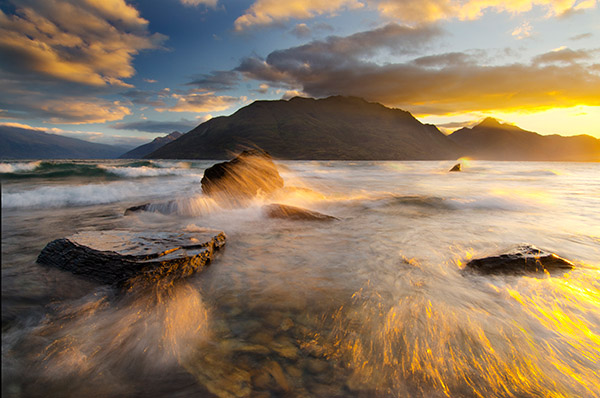
Some of the most popular posts on dPS this year have been those covering the topic of Landscape photography.

From the post ‘Composing Dynamic Landscape Images’ by Todd Sisson

So as part of our ‘best of 2012′ series I thought I’d look back on the hottest landscape tutorials for the year gone by.

Here they are – in no particular order.

  1. Composing Dynamic Landscape Images
  2. 5 Tips for Shooting Landscapes with Greater Impact
  3. Seascape Photography Tips
  4. 10 Tips for Landscape Photographers
  5. 8 Tips for Long Exposure Photography
  6. Aspect Ratios in Landscape Photography
  7. Tips for Great HDR Sunsets
  8. 15 Tips for Low Light Landscape Photography
  9. How to Photograph Reflections in Water
  10. 4 Tips for Shooting Drop Dead Gorgeous Waterfalls

Post originally from: Digital Photography Tips.

Check out our more Photography Tips at Photography Tips for Beginners, Portrait Photography Tips and Wedding Photography Tips.

What Everybody Ought to Know About Landscape Photography [Best of dPS 2012]


Digital Photography School

 
Comments Off on What Everybody Ought to Know About Landscape Photography [Best of dPS 2012]

Posted in Photography


12 Myths About Photography And Photographers

16 Dec

Myth #1 “I’m not going out to shoot today because the light is bad.”

There is no such thing as bad light. As long as there is light, there is opportunity to make amazing images. There is also no reason to limit yourself to the golden hours on each end of the day. The most adverse weather conditions are perfect for making the most beautiful pictures. So get out there!

Myth #2 “I need to bring several lenses with me on my photo walk, just in case…”

Well, that’s fine if you don’t mind carrying around heavy equipment all day “just in case.”  Depending on what you shoot, if you limit yourself to just one lens for the day you can improve your skills, especially if you decide on a fixed focal length lens such as a 50mm. This simple decision will slow you down which will help you see better and allow you to compose more carefully. Plus you won’t miss the shot while you’re busy switching lenses.

Myth #3 “I shoot 1,000 frames in a day so that I increase my chances of having a lot of keepers!”

The ‘spray and pray’ approach sounds like a good idea, but it is no guarantee that you’ll have more keepers at the end of the day. Instead, pretend you are shooting film and limit yourself to a 24 or 36 exposure that day. You will quickly discover the creative power of limitation.  Shoot with intent, make every single frame count, and you will have plenty of keepers at the end of the day with the added benefit of not having so many images to process.

There is no bad light. Foggy days are my favorite days to shoot landscapes.

Myth #4 “I can’t shoot, I forgot my tripod.”

The tripod is a useful tool, but can also become a bit of a crutch. Unless you are on a paid job assignment that requires a tripod, liberate yourself and shoot hand held. There are other ways to stabilize your camera if necessary, you can use a wall or a boulder for example. Tripods are definitely useful, but the problem is that photographers tend to set them once and rely on them to shoot everything from the same level.  Be creative and shoot your subject from different perspectives. Unless you are shooting long or multiple exposures or macro, liberate yourself from that tripod once in a while and try new perspectives.

Myth #5 “I‘m in a creative rut, I need to go to an exotic location to get out of it.”

Everyone gets into a rut. One solution is to learn to see the extraordinary in the ordinary, see the new in the familiar. Go out into your own backyard and see it with fresh eyes.  Give yourself an assignment such as a photo-a-day project for a month or a year.  Create a theme for your photo walk and it becomes a treasure hunt. Shoot with fellow photographers. Give a camera to a child and see the world “fresh” through their eyes. Once you get out there and use your imagination, you’ll be free from that rut!

Myth #6 “I would take better pictures if only I had a better camera.”

Okay, I’m not going to give you a lecture here. It’s true that more expensive equipment, when used skillfully, will yield better images than a point and shoot camera. The mistake, however, is upgrading before using your current gear to its full potential. Believe me, gear lust is easy to catch, yet most of us never outgrow our equipment. Invest into education, attend a photo workshop or go on a vacation instead of spending thousands on the latest and greatest gear. If you can do both, that’s terrific, but it’s not always necessary. Also, there is a lot of bad photography made with very expensive gear and some stunning images shot with iPhones… Food for thoughts!

Myth #7 “I’m too old to learn how to use a digital camera.”

If you have the strength to hold a camera and press the shutter, you can learn to use a digital camera.  Photography is a life long passion. It’s never too early or too late to start!

Myth #8 “I’m making money with my photography. I learned everything there was to learn about the craft.”

Nothing could be further from the truth! Once you think you know it all, you will stop growing. The world of photography is so exciting and is changing at the fastest pace ever. All you have to do is to keep current with the latest technology and embrace it.

Myth #9 “I need hundreds of pictures in my portfolio before I can show my work to clients.”

This is just not true. What is true, and important, is to be discerning about your selection, show only your best work. Quality over quantity is your guideline here.

Myth #10 “Being a photographer is a glamorous job.”

Maybe in the movies, but not in real life.  Most photographers don’t realize at first how much nitty gritty work is required once you turn your passion into a profession. For most of us, it’s 80% business and 20% shooting. This is true for just about any artist, so you need to be realistic.

Myth #11 “All you need to be successful as a pro is talent.”

Wouldn’t that be nice? Ever heard of the expression “starving artist?”  Talent is definitely an important ingredient, but solid business skills are also important. Business and marketing are a vital part of being a successful working photographer, but if that’s not your forte, be sure to get help or hire someone for that.

Myth #12 “Pro photographers are better than amateurs.”

Just because some photographers make money with their pictures doesn’t make them better shooters. A successful pro will be able to offer quality and consistency. I see the work of so-called amateur photographers every day that far exceeds the work of many pros. Actually, pro photographers run the risk of losing the passion for their craft if the work becomes a routine and this can adversely affect the quality of their work. It is very important for pro photographers to make time for personal projects in order to keep their passion alive.

The list could go on! Feel free to add a myth or two in the comment section.

Post originally from: Digital Photography Tips.

Check out our more Photography Tips at Photography Tips for Beginners, Portrait Photography Tips and Wedding Photography Tips.

12 Myths About Photography And Photographers


Digital Photography School

 
Comments Off on 12 Myths About Photography And Photographers

Posted in Photography


Lesson 1 – Aperture (Tutorial about Photography)

13 Dec

This is a first lesson about photography for beginners. In this lesson I will explain in details what aperture means and how it is used. We will also talk about F-stops and DOF (Depth of Field). I hope you will enjoy my photography tutorials and can learn how to use your camera better. Music: Kevin MacLeod. (Licensed under Creative Commons “Attribution 3.0”)
Video Rating: 4 / 5


Steve McCurry talks to WordPress.com about his work, and why he blogs

13 Dec

sharbat_gula_on_national_geographic_cover.jpeg

Steve McCurry, the award-winning photographer responsible for the iconic ‘Afghan Girl’ portrait for National Geographic, has given an interview about his work and why, despite his fame, he maintains a blog of his latest images. In the interview, on the official WordPress blog, McCurry explains how photography as a career has changed over the course of the past few decades, and the vital role now played by the Internet. Click through for extracts and a link to the full interview at blog.wordpress.com, and to Steve’s own blog. 

News: Digital Photography Review (dpreview.com)

 
Comments Off on Steve McCurry talks to WordPress.com about his work, and why he blogs

Posted in Uncategorized


Tell us About the Best Shot You Never Got Due to Malfunction & WIN a JOBY UltraFit Sling Straps

12 Dec

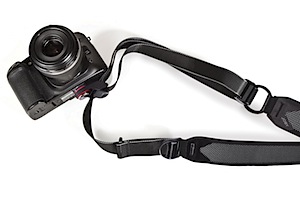
UltraFit_SlingStrap_iso.jpgI’m excited today because one of our sponsors – and good friends – JOBY are offering to give 5 of our readers 2 of their UltraFit Sling Straps in a competition today.
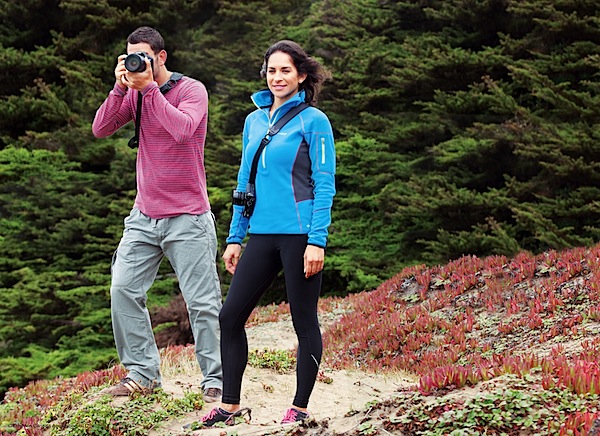
To win all you need to do is to leave a comment below telling us about:

The Best Shot You Never Got Due to a Malfunction with your Gear.

That’s right – if you’re mourning a shot you never got due to a dead battery, a lens cap not taken off, a broken camera or a camera strap that got in the shot now is the time to get some pay back!

Our friends at JOBY have launched their revolutionary UltraFit Sling Strap that adapts from cinched to shooting so you never miss a shot and now they are offering it for you.


UltraFit_SlingStrap_Family_0185.jpg

To win the prize of 2 straps (1 for you and 1 for a friend) simply tell us about your photography malfunction in 50 words or less in comments below and JOBY will provide YOU with the straps for the holidays.

About JOBY UltraFit Sling Strap

Never miss a shot with the new UltraFit Sling Strap from JOBY that makes your photography comfortable, quick and more fun.  The SpeedCinch system allows for easy extension and quick ability to cinch to your body for stability; you can also lock the strap in cinched position for added security. The comfort is all in the design; male and female straps with the UltraFit Layered Pad Technology and S-curve designed specifically for the female body.  The strap easily and securely attaches to your DSLR or CSC camera with the LockSafe ¼”-20 Attachment™. See it in action.

Check out a demo of the straps by JOBY in this video:

UltraFit Sling Strap for Women by JOBY from JOBY Inc on Vimeo.

The Prize and Conditions of Entry

5 dPS readers will be chosen from the comments left below. Each winner will receive 2 UltraFit Sling straps. One for them and one to give to a photography loving friend! To enter leave a comment below telling us about the shot you missed due to a gear malfunction before midnight US Eastern time on Friday 21st December. JOBY will choose the winners and we’ll publish their names here on the dPS blog in the following week.

Conditions: There is one entry per person and entries are open to our global audience (we’ll get your prize shipped to you anywhere in the world).

So get to it – in comments below tell us about the best shot you never got due to a Malfunction with your gear! Good luck!

Post originally from: Digital Photography Tips.

Check out our more Photography Tips at Photography Tips for Beginners, Portrait Photography Tips and Wedding Photography Tips.

Tell us About the Best Shot You Never Got Due to Malfunction & WIN a JOBY UltraFit Sling Straps


Digital Photography School

 
Comments Off on Tell us About the Best Shot You Never Got Due to Malfunction & WIN a JOBY UltraFit Sling Straps

Posted in Photography


Steve McCurry talks to WordPress.com about his work, and why he blogs

06 Dec

sharbat_gula_on_national_geographic_cover.jpeg

Steve McCurry, the award-winning photographer responsible for the iconic ‘Afghan Girl’ portrait for National Geographic, has given an interview about his work, and why, despite his fame, he maintains a blog for his latest images. In the interview, on the official WordPress blog, McCurry explains how photography has changed over the course of his career, and the vital role now played by the Internet. Click through for extracts and a link to the full interview at blog.wordpress.com, and to Steve’s own blog. 

News: Digital Photography Review (dpreview.com)

 
Comments Off on Steve McCurry talks to WordPress.com about his work, and why he blogs

Posted in Uncategorized


Eric Weber talks about headshot photography. Session 1

30 Nov

Eric Weber is one of the best headshot photographer’s working in the industry today. With over 30 years of experience, he has learned a secret or two about capturing you at your very best. This Denver Film and Digital Webcast is the first in a series highlighting Eric and his unique approach to headshot photography. To learn more, visit Eric at eweber.com.

 
Comments Off on Eric Weber talks about headshot photography. Session 1

Posted in Photography Videos


5 Things to Know About Photoshop Brushes

13 Nov

5 things to know about photoshop brushes opener

Brushes are used a lot in photo editing from removing blemishes and smoothing skin to dodging and burning and painting on masks. Here are five important features of the brush tool in Photoshop.

1. Adjust Size, Opacity and Hardness from the Keyboard

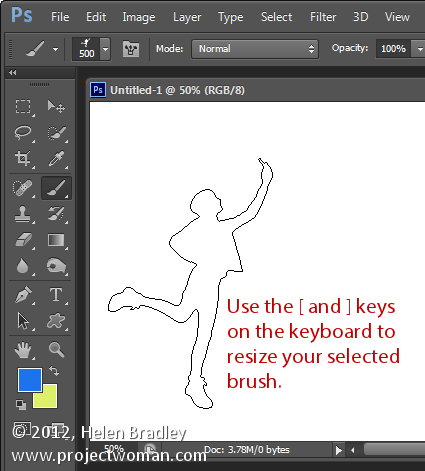
When a brush is selected you can adjust its size without having to open the Brushes palette by clicking the [ and ] keys on your keyboard.

Provided a brush is selected you can change its Opacity by typing a number. For example, type 5 to set Opacity to 50%, type 1 for 10% and 0 for 100%.

To adjust the hardness of the brush hold the Shift key as you tap either the [ or ] keys on the keyboard. Each tap increases or decreases the hardness by 25% in the range 0%-100%. The results of doing this are harder to see as there is no hardness indicator on the tool options bar. However, if you have the Painting Cursor set to Normal Brush Tip in preferences you will see a difference in the brush size as you do so

5 things to know about photoshop brushes 1

2. Save the Brush

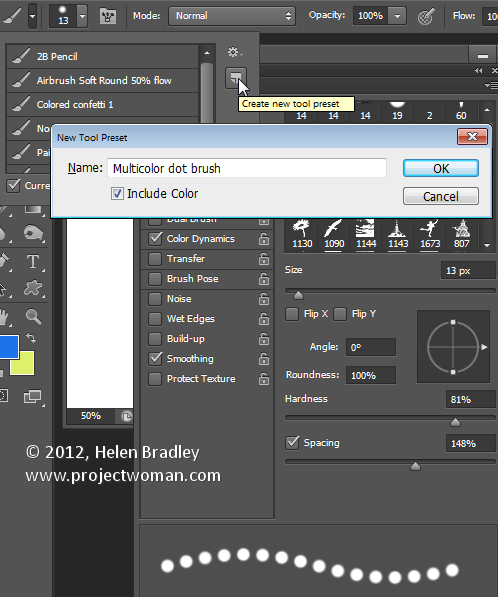
When you have a brush configured with your preferred settings, save it as a Tool preset. To do this from the Brush Preset list in the top left of the screen click the Create New Tool Preset button and type a name for the preset. Click Ok.

In future you can select this saved preset from the list and just start painting with it.

5 things to know about photoshop brushes 2

3. Disappearing Brushes

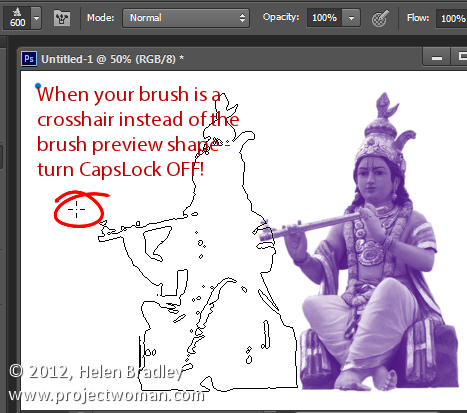
One of the very annoying things that will happen to most of us at one time or another is to have the brush appear to disappear. Instead of the regular brush cursor which shows the size and style of the brush you will see a crosshair cursor.

The issue is not with the brushes themselves but is with the Caps Lock key. If you disable Caps Lock on your keyboard the more visual brush cursor will reappear.

5 things to know about photoshop brushes 3

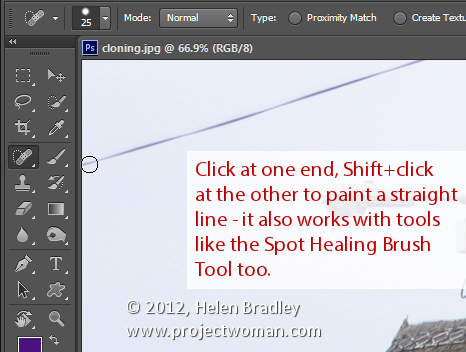
4. Paint a Straight Line

To paint in a straight line, click at one end of the line, hold the Shift key and click at the other end of the line. This draws a continuous brushstroke between both points.

If you adjust the spacing of your brush by using the Brush panel Spacing option to make it more than 100% you can create a line of dots this way.

This can also be used to remove power lines with the Spot Healing Brush Tool. Click at one end of the power line, Shift + Click at the other end to paint a straight line over the power line and it will be removed automatically.

5 things to know about photoshop brushes 4

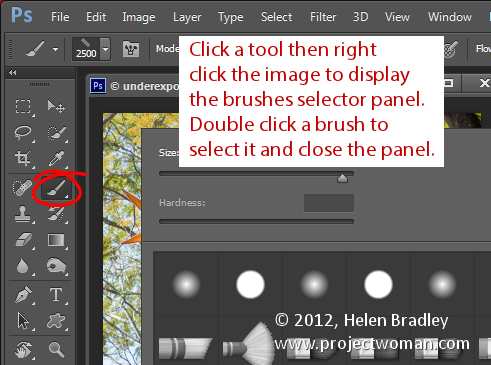
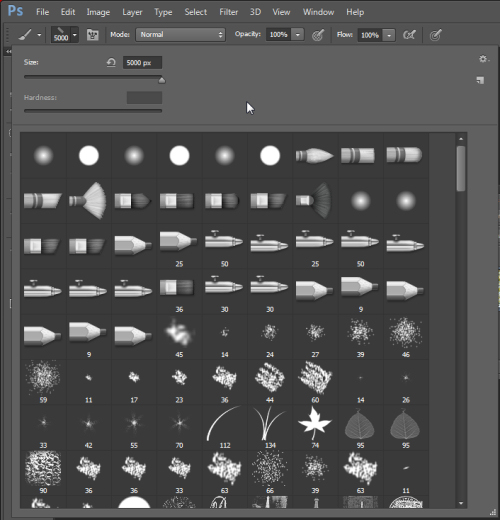
5. Quickly Show the Brush Panel

You can quickly show the Brush panel so you can choose a brush to use by first selecting a tool that uses a brush such as the Brush Tool, Dodge, Burn, Eraser tool and so on.

Then right click on the image and the brush panel appears automatically. To select a brush and exit the panel in one step, double click the brush to use.

5 things to know about photoshop brushes 5

And now it is over to you. What other features of Brushes do you think are valuable for photographers to know?

Post originally from: Digital Photography Tips.

Check out our more Photography Tips at Photography Tips for Beginners, Portrait Photography Tips and Wedding Photography Tips.

5 Things to Know About Photoshop Brushes


Digital Photography School

 
Comments Off on 5 Things to Know About Photoshop Brushes

Posted in Photography


Focus on Chris Porsz ~ It’s All About The People

11 Nov

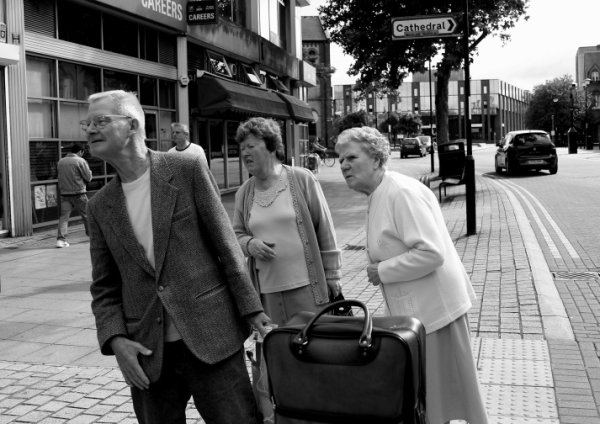
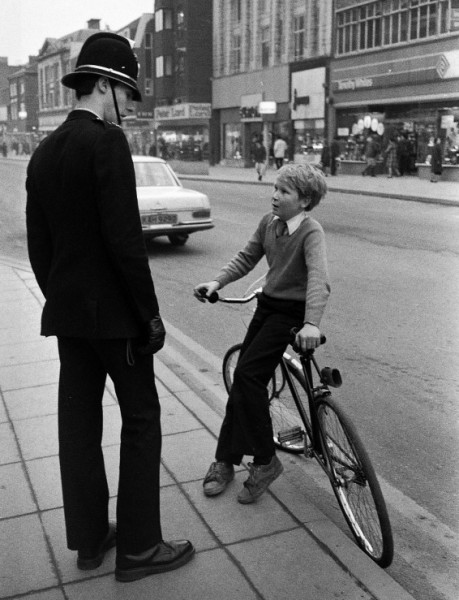
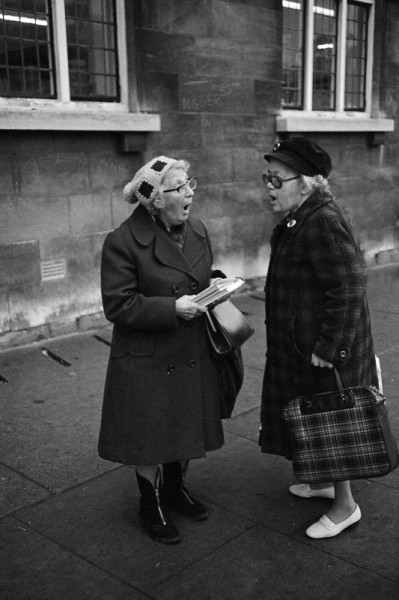
I’ve had the pleasure to shoot with UK street photographer Chris Porsz in London and, more recently, in Paris. He met up with my group during my week long Paris photo workshop last month and enjoyed sharing his love for street photography with my students. Chris has a true passion for people and for capturing the moment . He can roam the streets of any city tirelessly for days with his camera. Paramedic by day (or night), street photographer the rest of the time, let me introduce you to Chris Prosz.

1- When and why did you start photographing people in the streets?

Over three decades ago some creative urge drove me to roam the streets of my city, recording everyday life. I cannot draw or paint but found it very easy to a press a button and, by some magical process, capture posterity in a fleeting expression on a face.  I am not technical and not good at formal studio work with flash and posing people so I like  the blank canvas of the streets. I set my stage and wait for the right characters to walk on. You will rarely see a picture of mine devoid of people as buildings bore me on their own while people bring them alive and give a sense of scale.  I was a university dropout who became a hospital porter and found this a very satisfying and relaxing outlet. For over twenty years I have been a paramedic which involves approaching total strangers, engaging and reassuring them. Ideal for street photography.

2- You spend hours every week walking the streets of your hometown, how do you keep things ‘fresh’?

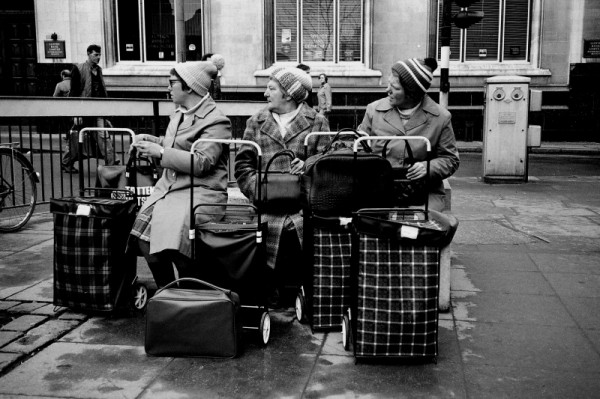
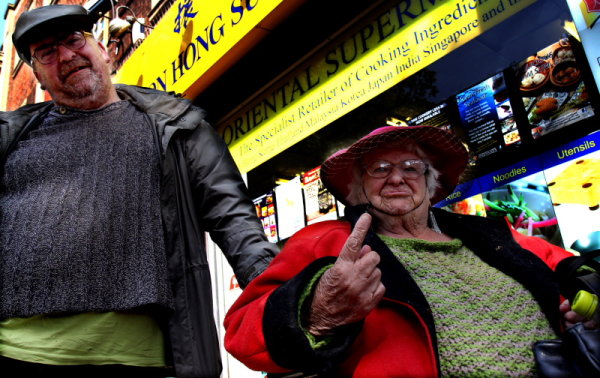
I think the very nature of street photography ensures that it stays’ fresh.’ I love the total unpredictability and spontaneity of people and never knowing what is around the next corner. You walk for miles and get average shots but just occasionally you capture something special. I am always looking out for someone unusual who stands out from the crowd, pink hair or the elderly battling against the elements with a Zimmer frame. I look out for situations with people interacting and wait to see what develops.

3- What other cities have inspired you the most photographically and why? 

Out of my comfort zone I visited many large English cities to be inspired and I was overwhelmed by the potential. I also wanted a more international flavour so I made a trip to New York City. It was also wonderful to be involved in Valerie Jardin’s Paris photo workshop. Amsterdam, Berlin and Prague are on the list to capture. Every city has its iconic buildings but the challenge is to capture them in a unique way and for me that has to be through its people.

4- What was your most memorable experience as a street photographer and have you had any close-calls, such as people becoming aggressive, etc.? 

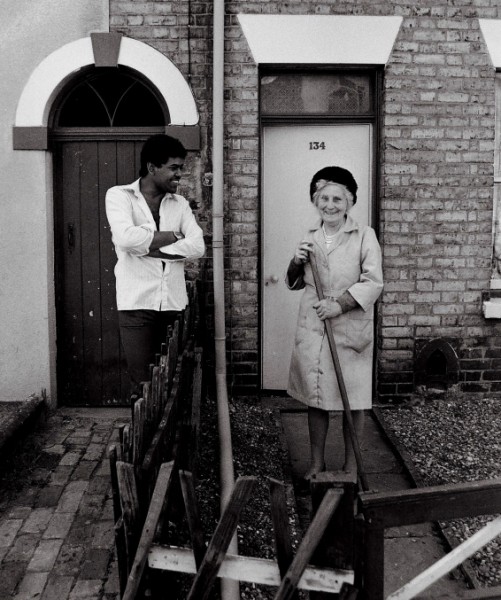
I think it was at 2:00 am when a man called an emergency ambulance for help and, through his oxygen mask, he told me I had taken his picture over thirty years ago. This led to one of my reunion pictures which can be quite emotional and immensely satisfying.

A man in his seventies who looked like Santa Claus was sitting in an armchair in the middle of our Cathedral Square when he spotted me and my camera. Wearing only a white bath robe, boots and a red bobble hat he chased me down the road. What a picture and fortunately no one was around to take it.

In 1980 a recluse was murdered and the only picture available was one I took of him walking the streets. It helped to capture his assailants.

I have occasionally been threatened by drunks and accused of all sorts but usually a smile and an explanation go a long way.

5- Is there one shot you absolutely want to get and will continue hunting for until it’s in your memory card? 

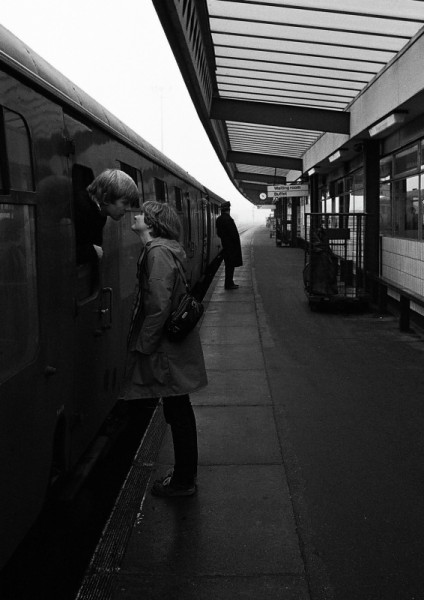
I have my railway kiss picture but I am still searching for that Doisneau lovers’ embrace on say the escalators. Or some exclusive photo journalist type dramatic image. So always carry a camera and keep it primed ready. Nothing worse than capturing a great moment that is blurred and out of focus.

6- What #1 tip would you give someone starting out as a street photographer?

Take Robert Capa’s advice and “If your photographs are not good enough then you are not close enough.” I have ditched the artificial compression of telephoto and almost exclusively use a wide angle where the viewer feels part of the picture.

I also try to follow Dave Beckerman’s maxim “Street photography is 90% perspiration and 10% inspiration.” So walk miles, take plenty, be very self critical and post just the best. Back up your images three times as I have learned the hard way and lost precious memories.

7- You’ve exhibited your work in various galleries in Peterborough, England. What is your next project? 

My book New England is out this month and contains my favourite images from the seventies and eighties, many which have never been seen before. It reflects a typical English city of that era. I have been invited to record the life of a large country Park through its staff and visitors during the four seasons. I will employ my street style but with beautiful backdrops instead.

8- Which photographers have inspired you the most?

The list is endless but one of my heroes is Don Mc Cullin a modest, compassionate, brave, honest photographer with his haunting Vietnam images. I was a lousy printer and ruined many but his dark, rich, gritty monochrome printing influenced me.

His colleagues too, Eddie Adams and Phillip Jones Griffiths The ‘gentle eye’ of Jane Bown and the reportage of Chris Steele-Perkins

Over the pond the humour of Elliot Erwitt and Vivian Maier’s newly discovered treasure trove. Jo Wigfall, Dave Beckerman, James Mayer and Eric Kim. They are generous with their time, support and encouragement. Thank you too Valerie for kindly helping me and now sharing my work with your readers.

Find out more about Chris and his work by visiting his website.

Chris Porsz


Post originally from: Digital Photography Tips.

Check out our more Photography Tips at Photography Tips for Beginners, Portrait Photography Tips and Wedding Photography Tips.

Focus on Chris Porsz ~ It’s All About The People


Digital Photography School

 
Comments Off on Focus on Chris Porsz ~ It’s All About The People

Posted in Photography