RSS
 

Posts Tagged ‘About’

Thinking about buying a Fujifilm GFX 50S? Read this first

21 Mar

Fujifilm’s GFX 50S announcement has turned a lot of heads, and for good reason. We love Fujifilm cameras. It’s hard not to – they offer excellent ergonomics with a level of direct control that photographers itch for, and Fujifilm’s color science renders images that harken back to the days of film, while retaining all the advantages of digital. Meanwhile, the X-Trans color filter array (CFA) offers a number of advantages compared to traditional Bayer CFAs, showing decreased false color and a slight noise advantage due to a (relatively) greater proportion of green pixels.

Ultimately, though, the image quality of Fujifilm’s best cameras was limited by their APS-C sized sensors, which simply cannot capture as much light as similar silicon in larger sizes. And if you’ve kept up with our recent technical articles, you’ll know that the amount of total light you’ve captured is arguably the largest determinant of image quality.

‘Fujifilm skipped the arguably saturated full-frame market and went straight to medium format.’

That left many of us wondering when Fujifilm would step up to full-frame (35mm). But Fujifilm went one better – they skipped the arguably saturated full-frame market and went straight to medium format. In a rather compact, lightweight mirrorless form-factor at that. That made a lot of sense especially when you consider Fujifilm’s heritage in medium format film cameras, and its experience making medium-format lenses for other brands.

So, finally, here comes the GFX 50S: Fujifilm ergonomics and colors, but with all the advantages offered by larger sensors. But while heads turn, eyes widen, and colleagues fight over who gets to take the camera out for a shoot, personally I’m in need of a little convincing. And think you should be too, if you’re thinking about plopping down a fat wad of cash for this seemingly drool-worthy system.

But what’s not to like, you ask? Bear with me…

Theoretical advantages of larger sensors

The potential advantages of larger sensors can broadly be split into four areas: noise in low light, dynamic range, subject isolation (shallow depth-of-field), and resolution. But zoom into the following 36MP at 100% – are any of those lacking?

ISO 64 on a Nikon D810 gets me medium format-esque signal:noise ratio (image cleanliness), along with subject isolation I can’t get on medium format just yet, not at this focal length anyway (which would require a non-extant 44mm F2.5 MF lens. The incredible sharpness of this lens means I get good use out of those 36MP even wide open at F2. Photo: Rishi Sanyal (Nikon D810 | Sigma 24-35mm @ 35mm F2)

The question is: does the GFX 50S currently deliver on all, or any, of these advantages over what the best of full-frame has to offer? Let’s look at each separately.

Low light (noise) performance

For the same f-number and shutter speed (or ‘focal plane exposure’), a larger sensor is exposed to more total light. The same light per unit area is projected by the lens, but the larger sensor has more area available capturing it. An image made with more light has less relative photon shot noise (the noise that results from the fact that light arrives randomly at the imaging plane). The more light you capture, the more you ‘average’ out these fluctuations, leading to a cleaner image (that’s the laymen’s description of it anyway; read about it more in-depth here).

That’s why a full-frame camera generally gives you cleaner images than your smartphone.* So if more light means better images, that’s a clear win for the GFX 50S, right?

Not so fast…

No, literally, not so fast. The lenses available for the GFX format simply aren’t as fast as those offered by full-frame competitors. The fastest lens on Fujifilm’s GFX roadmap is F2, which in full-frame equivalent terms is F1.56** (the concept of equivalence is out of scope for this article, but you can read about it in-depth here; for now, just remember the GFX has a reverse crop factor, relative to full-frame, of 0.79x). And most of the current MF lenses hover around F2.8 of F4, or F2.2 and F3.2 equivalent, respectively. That means that if they had the exact same underlying silicon technology (or sensor performance), a full-frame camera with a F2.2 (or F3.2) lens should do just as well as the GFX 50S with its F2.8 (or F4) lens. Even if were were to think ahead to the MF 100MP sensor Sony provides in the Phase One cameras, its 0.64x crop factor at best yields a F1.3 full-frame equivalent lenses from the one F2 lens announced, still not beating out the Canon 85/1.2, and barely beating out the plethora of available F1.4 full-frame lenses. So even if the newly announced G-mount lenses cover the wider medium format image circle (which I’d sure hope they would), things still aren’t so exciting.

But full-frame can do better than that: F1.4 and F1.8 lenses are routinely available for full-frame cameras, typically for less money too. An F1.4 lens projects twice as much light per unit area than a F2 lens, and 4x as much as a F2.8 lens, amply making up for the 1.7x smaller sensor surface area of full-frame.

That means full-frame cameras can capture as much, or more, light as the GFX 50S simply by offering faster lenses. But wait, it there’s more…

$ (document).ready(function() { ImageComparisonWidget({“containerId”:”reviewImageComparisonWidget-32306977″,”widgetId”:489,”initialStateId”:3472}) })

Companies like Sony have poured a lot of R&D into their full-frame (and smaller) sensors, and the a7R II uses a backside-illuminated design that makes it more efficient than the sensor used in the 50S. It also offers a dual-gain architecture that flips the camera into a high gain mode at ISO 640, allowing it to effectively overcome any noise introduced by the camera’s own electronics. In other words, the a7R II’s sensor is better able to use the light projected onto it, relative to the MF sensor – ironically a sensor made by Sony itself – in the G50S (or Pentax 645Z, or Hasselblad X1D). This allows it to match the low light noise performance of the larger sensor Pentax 645Z even at the same shutter speed and f-number. See our studio scene comparison widget above.

‘The Sony a7R II’s sensor is better able to use the light projected onto it, relative to the MF sensor’

So if we start with parity, guess what happens when you open up that aperture on the a7R II to an f-number simply unavailable to any current medium format system? You guessed it: you get better low light performance on full-frame. Whoa.

Dynamic Range

Although the same f-number and shutter speed give a larger sensor more total light, they receive the same amount of light per unit area. Most sensors of a similar generation have broadly similar tolerance for light per unit area (technically: similar full well capacity per unit area). But a larger sensor devotes more sensor area to any scene element, so can tolerate more total light per scene element before clipping. That means that for the same focal plane exposure, despite clipping highlights at a similar point, a larger sensor will render shadows (whose noise levels define the other limit of dynamic range) from more total light. And the same logic that applies to low light noise applies here as well: more total light = less relative shot noise and less impact of any noise from camera electronics. That means cleaner shadows, and more dynamic range.

So another clear win for the larger sensor GFX, no? Well, no. Because someone poured a lot of R&D into the Nikon D810 sensor (noticing a trend here?), giving it higher full-well capacity per unit area than any other sensor we’ve measured to date: its ISO 64 mode. Each pixel can hold more total charge before clipping, relative to equally-sized pixels on any other sensor in a consumer camera. That means it can tolerate a longer exposure at ISO 64, longer enough (at least 2/3 EV, or 60% more light) to capture as much total light as the 68% larger sensor in the GFX 50S exposed at its base ISO (100). Don’t believe us? Check out our real-world dynamic range comparison of the Nikon D810 vs the Pentax 645Z, which ostensibly shares the same sensor as the GFX 50S:

$ (document).ready(function() { ImageComparisonWidget({“containerId”:”reviewImageComparisonWidget-36789467″,”widgetId”:479,”initialStateId”:3427}) })

In this shoot-out, we exposed each camera to the right as far as possible before clipping a significant chunk of pixels in the brightest portion of the Raw (in the orange sky just above the mountains). The D810, in this case, was able to tolerate a full stop longer exposure***, which allows its (pushed) shadows to remain as clean as the 645Z. That’s the (scientific, not baloney) reason we claimed the Nikon D810 to have medium format-like image quality. Because its dynamic range and overall signal:noise performance at ISO 64 rivals many current medium format cameras their base ISOs (though not the huge new 100MP MF Sony sensor in the new Phase One). Just look at its massive SNR advantage (read: image cleanliness) for all tones at ISO 64 over the Canon 5DS R at ISO 100 – we intend to plot the Fujifilm GFX 50S on the same graph, and don’t expect it to show any advantage to the D810. Because science.

Read about this all more in-depth in our D810 review here, and check out Bill Claff’s quantitative data that shows a 0.22 EV base ISO dynamic range difference between the D810 and 645Z – hardly noticeable, much less something to write home about.

‘OK but it’s not fair to compare ISO 64 to ISO 100!’

Fair enough, there’s a little more to the story. ISO 64 does require more exposure than ISO 100, either via a brighter lens, or longer exposure time. But one might argue that under circumstances where you care about dynamic range – i.e. high contrast scenes – you’re typically not light-limited to begin with, and can easily give the camera as much light as needed. Either because you’re shooting on a tripod, you’re using studio lights and can just crank them up, or because there’s so much light to begin with (it is a high contrast scene, right?) You’re working at or near base ISO anyway, so you shouldn’t have trouble adding 2/3 EV exposure by opening up the lens or lengthening the shutter speed a bit.

‘You’re working at or near base ISO anyway, so you shouldn’t have trouble adding 2/3 EV shutter speed’

But, yes, if you’re in a light-limited situation (i.e. you’re not shooting at base ISO) and it’s high enough contrast that you care about dynamic range (have to expose for highlights then push shadows), then the GFX 50S will have the upper hand here. But dare I say, that’s quite the niche use case: keep in mind that most situations demanding higher ISOs tend to be in lower light, where you care more about general noise performance, not dynamic range (since low light scenes tend to have lower contrast). And if that’s what you care about, there’s the a7R II which, although it may clip highlights a bit earlier, can give you as good, or better, low light noise performance… [link back to Noise section above].

But I’ll concede – if you want both the base ISO dynamic range of the D810, and the low light noise performance of an a7R II (albeit with F2 or slower lenses), then the GFX might be your ticket.

Shallow Depth-of-Field

As we calculated in our ‘Low light (noise) performance’ section above, the fastest lens on Fujifilm’s roadmap is ~F1.6 full-frame equivalent, with most current available lenses being F2.2 equivalent or slower. Since full-frame routinely has F1.4 (equivalent) lenses available, you actually get more subject isolation, and blurrier backgrounds, with full-frame than with medium format.

And, no, the ‘but larger formats have more compression because you use longer focal length lenses for the same field-of-view’ argument is false. Just say no to the compression myth. For equivalent focal lengths/apertures, there’s no extra compression. Compression is relative only to equivalent focal length and subject distance (or subject magnification), and its relative distance to the background. Not the format you’re shooting on. Don’t believe us, have a look for yourself:

46mm F2.8 on APS-C is roughly equivalent to 70mm F4.3 on full-frame – meaning the two shots above should be virtually identical. And they are, save for a tiny bit more DOF in the full-frame shot because F4.5 was the closest I could get to F4.3. Now, of course, you can get shallower DOF on full-frame, for example by shooting at F2.8. But that’s because those faster lenses are available for full-frame.

They’re not in Fujifilm’s lineup, which includes two F2.8 lenses, one F2 lens, and a few F4 lenses – which are equivalent to F2.2, F1.6, and F3.2 in full-frame terms, respectively.

Without brighter lenses, there’s just no reason to get excited about medium format for subject isolation and blurry backgrounds. If you’re a bokeh fanatic, full-frame’s arguably the sweet spot.

Resolution

OK, finally, some good news. Well, theoretically anyway.

If you have two differently sized sensors with the same pixel count, the smaller one will be more demanding on its lens (it samples the lens at more lines per mm for the same scene frequency). Manufacturing larger lenses is also slightly easier, since the same relative tolerance level can be achieved, despite a larger absolute variance.

So if you’re looking for true 50MP of detail across the frame, you’re more likely to get it with the GFX 50S than with a comparable 50MP full-frame sensor, simply because of the realities of lens design and tolerances. That said, we’ve been told that some of the newer full-frame lens designs were designed with 80 to 100MP in mind, on full-frame sensors. And with the eye-popping performance of some of the newest full-frame lenses we’ve seen, from varied manufacturers, we’re not inclined to disagree. We’ve seen some 50MP files from the 5DS R paired with truly stellar lenses where we simply can’t imagine anything better, resolution-wise. In fact, at ~F5.6-6.2 equivalent, I’m not seeing a major resolution advantage of the medium format cameras over the full-frame cameras in our studio scene comparison tool, and the 50MP full-frame image below isn’t exactly starved for resolution, is it?

50MP Canon 5DS R image, shot with a Sigma 24-35mm F2 lens at F2. At F2 full-frame equiv., this image would literally have been impossible to shoot on the Fujifilm GFX 50S, without a 44mm F2.5 lens, anyway, which doesn’t exist, nor is on the roadmap, for the Fujifilm. Photo: Rishi Sanyal

Put another way: if you’re seeing eye-popping resolution at F2 above and here and here (and even at F1.4 on some new lenses) when viewing a Canon 5DS R 50MP full-frame file at 100% (do click on the above image and view at 100%), do you want or need a truer 50MP? Or do you want even more than 50MP, particularly if it’ll come at the cost of more depth-of-field, since there are hardly any F2 equivalent lenses that’ll give you the subject isolation and background bokeh you see in the full-frame shot above?

Only you can answer that question, but it is true that physics being physics, larger sensors will always tend to out-resolve smaller sensors with equivalent glass. And so this is the area where we most expect to see an advantage to the Fujifilm system, especially over time as we approach 100MP, and beyond. It’s probably easier for a F1.8 prime paired with the GFX 50S to out-resolve a F1.4 prime on a 5DS R when both systems are shot wide open, but whether that will be the case (or if Fujifilm will even make a F1.8 or brighter prime for the system) remains to be seen. I certainly don’t think it would be a cheap combination.

Thanks, DPR, for saving me my money / killing my hopes and dreams

Still excited about the Fujifilm GFX 50S and Hasselblad X1D? Perhaps you still should be. You get Fujifilm ergonomics and color science in a body capable of far better image quality that Fujifilm’s APS-C offerings. But remember you can emulate much of that color science in Raw converters with proper profiles (we’re looking into a separate article on this). More importantly, remember that equivalence tells us that a F1.8 medium format prime is what the GFX 50S actually needs to at least match the performance from modern full-frames paired with F1.4 lenses, from the perspective of noise and shallow depth-of-field. And that’s before you consider the advanced silicon technologies we’ve seen in different full-frame (and smaller) sensors that we haven’t yet seen in any medium format sensor. These advances have, for example, allowed a Nikon D810 to catch up to the dynamic range of the Pentax 645Z at base ISO, and the BSI, dual-gain a7R II sensor to catch up to the GFX 50S in low light noise performance.

Still, as I’ve said, physics is physics. For equivalent apertures and final output resolutions, we do expect medium format to yield a slight resolution advantage, thanks to its lower demands on resolving power of lenses. But the extent of this advantage, especially given some of the tremendous progress we’ve seen in recent lens designs, remains to be seen: I’m not starving for eye-popping detail at 1:1 viewing of 50 and 42MP files when pairing a 5DS R or a7R II with stellar modern prime lenses.

‘as medium format evolves, the same gains we see in full-frame over smaller sensors might find their ways into the format.’

Of course, as medium format evolves, the same gains we see in full-frame over smaller sensors might find their ways into the format. But this will require both the silicon to keep up, and for the development of faster lenses. At least as fast as the fastest lenses full-frame offers. One thing does make us hopeful – recent conversations with our forum extraordinaire Jim Kasson have alerted us to the fact that certain full-frame lenses, like the Zeiss Otus primes, actually project an image circle large enough for Fujifilm’s new MF format. That would essentially get you high quality F1.1 equivalent glass on the GFX 50S. OK, that’s cool. If you can focus it, anyway 🙂 But if we see more and more fast full-frame lenses able to cover the image circle of the GFX G50S, then we’re more likely to actually experience the benefits of the larger sensor format.

Else, the potential advantages may be outweighed by the disadvantages: the extra weight, heft, price and severely lacking autofocus. And the GFX 50S has given up some of the noise and false color advantages their X-Trans cameras show…

For now, we hope that looking at the problem through the lens of equivalence at least gives you an idea of how big (or small) you can reasonably expect the differences to be. Maybe it even saves you a dime or two. Or makes you want to yell at us for bringing up equivalence, again.

But at the end of the day, equivalence has made me rather equivocal about the GFX 50S. What about you? Let us know in the comments below.


Footnotes:

* It’s also why ‘multi-shot’ modes yield cleaner images than single shots: these modes essentially capture more total light, averaging out shot noise. It’s also why brighter scenes generally look cleaner than low light scenes: more light = more photons captured = less relative shot noise = higher signal:noise ratio (SNR, or ‘cleanliness’ in laymen terms).

** The GFX 50S’ 44x33mm sensor has an effective 0.78x crop factor, so you can multiply the MF lens’ f-number by 0.78 to get the equivalent full-frame f-number.

*** We don’t control for T-stop, which could partially explain the drastic exposure difference. This doesn’t affect our experiment though, as we applied well-vetted ‘Expose to the Right’ (ETTR) principles for a fair comparison

Articles: Digital Photography Review (dpreview.com)

 
Comments Off on Thinking about buying a Fujifilm GFX 50S? Read this first

Posted in Uncategorized


Interview: Fujifilm talks GFX, X100F and getting serious about video

24 Jan
 Makoto Oishi, Billy Luong and Yuji Igarashi from Fujifilm

Following the launch of the GFX 50S, the X100F and the X-T20, we spoke to Fujifilm executives about their models, their ambitions and what we might be able to expect in the future in terms of medium format, the XE range and video. 

We spoke to Makoto Oishi, manager of Fujifilm’s Sales and Marketing Group, Optical Device and Electronic Imaging Products division, Yuji Igarashi, general manager of Fujifilm’s Electronic Imaging Division, and Billy Luong, Manager for the Technical Marketing and Product Specialist Group. They answered our burning questions as best they could: Will the GFX series gain phase detection AF? Will it ever have a fixed lens model? How is the X-E series faring?

GFX 50S: who is it for, and what’s next?

As you’d expect, we started by discussing the GFX 50S and who it’s for. ‘Fashion, commercial and landscape photographers are the main targets,’ says Oishi. ‘And especially when it comes to landscape, it’s not just professional photographers, but also amateur photographers.’

‘The tonality and dynamic range also mean it’ll appeal to wedding photographers,’ adds Luong. ‘And architecture,’ says Oishi: ‘But you can see from the weather sealing that we want landscape and outdoor photographers to feel confident using this camera.’

Consequently, these users groups will direct which lenses the company creates for the system. ‘We’ve already announced our first six lenses but we’re thinking about what comes next,’ says Oishi: ‘We have some ideas but haven’t decided yet. For example maybe a wide-angle zoom for landscape photographers or maybe something like a 200 or 250mm and so on. We want more feedback from users about what to make next.’

Image quality and autofocus

In the early days of the X-mount system, the company said it had chosen to prioritize image quality even if it that meant using a design with slightly slower focus. This compromise wasn’t necessary with the GFX, Oishi says: ‘The first priority must be image quality, of course. After our experience with the X-series we’ve developed a series of technologies in lens design as well as autofocus motors.’

The GFX 50S is designed to be relatively small and swap easily from being a studio camera to a field camera. The 50mm-equivalent 63mm F2.8 lens focuses pretty quickly despite the absence of phase-detection elements or a linear motor to drive focus.

‘Some of the first [GF] lenses have linear motors, whereas the 63mm has a different motor, more like the one used in the 23mm F2. The autofocus speed is already very good: we haven’t had any complaints. Instead we’ve had some users surprised by how fast the contrast-detection system is.’

This doesn’t mean the GFX series will never have phase detection, though. ‘This is our first development of this sensor,’ says Oishi: ‘we’d have needed more time to develop on-sensor phase detection. The image quality of medium format is our first priority. From a technical point of view, maybe in the future we might incorporate phase-detection pixels. On the other hand, we’re already developed advanced CDAF algorithms.’ There’s no image quality cost to using phase detection, he says.

‘We’re designing all our GF lenses to work with 100 megapixels, so there’s just as much of a challenge of resolution’ – Makoto Oishi

This need for optimal image quality got us wondering: which is more difficult to design, an F1.4 lens for APS-C or an F2.8 lens with the IQ expectations but less dense sensor of medium format? ‘The fundamental design doesn’t change,’ says Oishi: ‘things like the availability of an appropriate autofocus motor to deal with bigger, heavier lenses in medium format always adds problems. They’re both difficult, both to design and manufacture.’

‘The medium format lens is physically bigger which seems like it should be easier to manufacture but you have to pay just as much attention to how sensitively each element is aligned. I’d say they’re both difficult. Differently difficult.’

‘One thing to remember is that we’re designing all our GF lenses to work with 100 megapixels, so there’s just as much of a challenge of resolution.’

‘As the sensor becomes bigger, that means chromatic aberration becomes bigger: it’s proportional to the size. In GFX we’ve minimized aberrations optically and the used digital compensation only to refine the final result, and it depends on lens.’

Makoto Oishi shows-off the GFX 50S’s 44x33mm sensor

As with the X series, Fujifilm has decided not to use in-body image stabilization. ‘Some of the lenses we’ve already announced have OIS built in,’ Oishi points out: ‘but basically our image circle is perfect for the 44 x 33mm sensor size.’

The undeniable appeal of the X100 series

The discussion then turned to the X100 series and its role in the company’s lineup, now that a 23mm F2 lens is available for the X-mount system.

‘Of course using the 23mm F2 on one of our X-mount cameras, you get the same sensor, the same processor, but they’re two different things,’ says Oishi. ‘The X100 lens and sensor are optimized to work together, [whereas] on the ILCs, the sensor has to work with every lens. This means the X100’s image quality can be very good but the lens remains small. The 23mm F2 [XF] lens is also good, the size is a bit bigger but the autofocus can be a bit faster. Then, of course, the X100 series has the optical viewfinder.’

‘A good proportion of our customers are saying the X100 brought back their passion for photography’ – Billy Luong

‘The X100 also has a leaf shutter and built-in ND filter, which make a big difference,’ says Luong: ‘The faster sync speed is an important difference for anyone using flash. Then there’s the silent operation.’

But the appeal is about the format, as much as the specs, suggests Oishi: ‘The X100 series presents a great opportunity: the body size means it works as a second camera for anyone: not just Fujifilm users. If they fall in love with your system then maybe they’ll consider your cameras in future.’

Luong concurs: ‘It’s an iconic shape, it has a distinctive style. Some customers are at the point where they’re done with interchangeable lens camera, they just want the one focal length.’

 ‘The X100 series continues to perform well. In the US, each generation has sold better than the last,’ says Yuji Igarashi.

So who is the X100 series customer? ‘Normally 30% of buyers are people who already use an X100 series camera. But we’re always attracting new customers, too,’ says Oishi.

‘We look at how we retain our customers,’ says Luong: ‘the X100 is often photographers’ first foray into the Fujifilm system. The size, the weight, the image quality. A good proportion of our customers are saying the X100 brought back their passion for photography. That type of person is very much part of the equation.’

Could these same benefits be applied to medium format, we asked. ‘Of course it could be an idea for medium format,’ says Oishi: ‘it depends on demand and the market. The GFX 50S is one style: the ‘S’ means ‘SLR-style.’ Another way to do it would be a rangefinder style camera. Maybe an ‘R’ could be a rangefinder: we’re always considering other options and possibilities.’

‘If mirrorless interchangeable lens camera is too big as a rangefinder style, a fixed lens camera could be smaller, like the GF670.’

X-T20: putting X-T2 image quality in a smaller body

The SLR-style has wide appeal, Luong explains: ‘The SLR style targets a wider audience. We find pro and enthusiast photographers gravitate towards the SLR-style camera. Back to the GFX camera, that’s why we went with the SLR style.’

What does this tell us about the X-T20 target customer, then?

‘There will be a lot of X-T2 and X-T1 users wanting a second body,’ says Luong. ‘Then, of course, there’ll be people wanting X-T2 image quality in a more compact body. It could be a step up from the X-A series or a step over from an entry-level DSLR to a mirrorless type camera.’

‘We wanted to expand the range of users with the X-T10,’ says Oishi. ‘The X-T20 has more capability than ever before, in autofocus, for instance. For casual users, AF speed is important, especially compared with other cameras, such as DSLRs.’

Touchpad AF

However, the X-T20 doesn’t offer the increasingly popular ‘touchpad’ function to control the AF point with the camera to your eye. Mr Oishi explains why: ‘It’s possible. We know some people have difficulty with their nose operating the focus. We think our eight-way joystick is better in many circumstances but we’ll listen to feedback about a camera like the X-T20.’

The FujiFilm X-T20 offers X-T20 image quality in a smaller body. Despite having a touchscreen, it can’t offer touchpad AF control. For now…

This makes us wonder how the company decides which models feature touchscreens and which don’t. ‘It’s a question of the customer response,’ Oishi says. ‘The X100 has an optical viewfinder so it doesn’t make sense to put a touchscreen behind that. Maybe the joystick is better. With the X70, though, it’s a much smaller camera and you have to use the screen so it made sense to control with the screen.’

‘On the X-T20, we were trying to keep the camera small, so there wasn’t room for a joystick. So it depends on the product. It’s not about whether it’s seen as professional or not: the GFX has one.’

‘Product design for each model is focused on certain priorities,’ explains Luong: ‘X100 is about design. Even making it a couple of millimeters thicker to incorporate a touchscreen or tilt screen would make a big difference. It could change the design completely.’

‘We always think about the real target user’s priorities,’ says Oishi. ‘What does the target user want to use?’

Don’t count the X-E series out

The release of three SLR-style cameras in a row (X-T2, X-T20 and GFX 50S) doesn’t mean the company is abandoning the rangefinder style, though. ‘XE is an important series for us,’ Oishi says: ‘There are so many XE1, 2 and 2S users in the world. We are always thinking about the next model, whether that’s XT, XE or X-Pro. Obviously we can’t confirm anything at this point but we are aware there are many requests for this type of camera.’

Unmet needs?

With the X-series lineup looking increasingly mature, both in terms of lenses and bodies, what unmet needs remain?

‘Video is a big growth area for us,’ acknowledges Luong: ‘Our latest cameras such as the X-Pro2 and X-T2 show there’s a lot we’ve learned.’

 The Fujifilm X-T2 is a significantly more capable video camera than we were expecting.

And there’s an audience for video, he says: ‘If you look at who’s producing material, there’s a generation of YouTube content providers. People are increasingly watching content on their computers, on YouTube, rather than traditional TV.’

‘In Japan the developers worked very closely with production studios. A lot of their feedback shaped the outcome of the X-T2’s video quality and the way it operates.’

‘Features like Film Simulation, taking them from stills to video they found really useful but things such as bitrate, file format and compression, that came from us listening to feedback.’

‘Video is a big growth area for us, the X-Pro2 and X-T2 show there’s a lot we’ve learned’ – Billy Luong

There are challenges, though, says Oishi: ‘Movie AF is very difficult: it depends on the subject. Sometimes you want it to be quick, other times you want it to be slower and smooth.’

‘Whether it’s an algorithm that recognizes a tap on the screen should be a smooth focus pull, or potentially a custom setting, we’re very serious about getting it right,’ says Luong.

Does this mean we could expect an even more video-centric camera, given that all the X-series lenses are essentially in the Super 35 format?

‘We already have cinema lenses that are Super 35,’ Luong reminds us. ‘We’re continuing to develop video features, so we’ll continue to investigate.’

‘There’s a market there,’ Luong says.

Listening to customer feedback

Since the idea of user feedback had come up so often in the discussion, we ended by asking what the company’s process was for collecting feedback.

‘Our X Photographers: professionals who use the camera day in, day out, that’s the first line of feedback,’ says Luong: ‘It’s quite a large group. With the GFX we had something like 50 photographers around the world using pre-production cameras.’

‘We also monitor the comments on our YouTube channel and I personally scour through DPReview and try to work out which things are a must and which are ‘would be nice’.’

‘We don’t systematically seek feedback from our existing users,’ says Igarashi: ‘but we try to listen to everyone and evaluate those opinions.’

Articles: Digital Photography Review (dpreview.com)

 
Comments Off on Interview: Fujifilm talks GFX, X100F and getting serious about video

Posted in Uncategorized


New 2016 Annual dPS Reader Survey – Tell Us More About You

16 Nov

At dPS we value you, our readers, above all else. We want to help you take better pictures.

By doing this survey you will be helping dPS serve you better. By knowing what kinds of things are you struggling with, and the types of articles you want to see we can work toward providing more of what you need to move your photography forward.

We value your time, and you, as our regular reader and always strive to improve – you will help us by completing this form, for which we will be especially grateful.

Click on this link, or the image below to start the survey.

FEAT.-JOHN-SMITH.-CREATIVE-DIRECTOR..png


Thank you for your continued support and being a dPS reader. We wish you all the success on your photography journey.

The dPS Management Team

googletag.cmd.push(function() {
tablet_slots.push( googletag.defineSlot( “/1005424/_dPSv4_tab-all-article-bottom_(300×250)”, [300, 250], “pb-ad-78623” ).addService( googletag.pubads() ) ); } );

googletag.cmd.push(function() {
mobile_slots.push( googletag.defineSlot( “/1005424/_dPSv4_mob-all-article-bottom_(300×250)”, [300, 250], “pb-ad-78158” ).addService( googletag.pubads() ) ); } );

The post New 2016 Annual dPS Reader Survey – Tell Us More About You by Darlene Hildebrandt appeared first on Digital Photography School.


Digital Photography School

 
Comments Off on New 2016 Annual dPS Reader Survey – Tell Us More About You

Posted in Photography


‘It’s about sharing your beautiful experience’: Nikon Photokina interview

26 Oct

Photokina 2016 gave us a chance to speak to Nikon about the models it’s showing, where the market is going and the challenges it faces.

It was a relatively quiet show for Nikon, with three KeyMission lifestyle cameras taking up as much space as the recently announced D3400 and 105mm F1.4 lens. We took the opportunity to speak to Naoki Kitaoka, Department Manager, Marketing Department and Masahiko Inoue, Group Manager, Marketing Group 2, to see how the company sees the market. Please note the following interview has been slightly edited for clarity and flow.

What’s the key mission of KeyMission?

We started by asking whether they foresaw DSLRs and other dedicated cameras returning to being the niche product they were at the end of the film era and where KeyMission fits in:

‘We don’t want to change our policy,’ said Kitaoka: ‘We will keep offering the best DSLR to the customer. On the other hand, smart devices are getting popular: almost everyone has one or two or three devices in their pocket. In the mobile era, we have to offer new solutions that are fit for the mobile era. We want to be the end to end solution for consumers. The KeyMission is one of our solutions I think.’

The KeyMission range, including the KeyMission 360 are aimed at ‘immediate immersive storytelling,’ the company says.

KeyMission, then, is intended as a way of bringing Nikon’s expertise to new customers, Inoue explains: ‘Our competence is high quality imagery. So we will continue to keep that our core competence and apply it into the KeyMissions.’

‘For instance, the lens in the KeyMission 360 has a very wide angle of view. But this kind of category needs the size to be wearable. Using our competence and some new techniques, we managed to keep the quality and realize the miniaturization.’

‘It’s a very wide-angle view. Very fast lens: F2.0. Very bright and very wide, normally that kind of lens is larger optical design but we try to do the miniaturization.’

As well as image quality and size, simplicity is another aim for the camera, says Kitaoka: ‘It is not just an action camera. With the KeyMission series, we are bringing to market the ultimate tools for immediate immersive storytelling. They also demonstrate the role Nikon technology can play in the exciting new field of VR.’

‘The concept is about sharing your beautiful experience.’ Inoue concurs.

This means making it easy to share a wide variety of content types, Kitaoka says: ‘We believe every single model, every single customer has a different image of sharing. We have expanded the categories we cover to include KeyMission so you can find your best camera, from KeyMission to DSLR. Additionally, different types of consumers with different purposes need different types of cameras for every mission. We don’t want to interrupt your adventure.’

The value of sharing

This need for simple sharing underpins the company’s plan to introduce a version of its SnapBridge sharing system across its entire model range: ‘Easy means setting up between camera and smartphone,’ says Kitaoka: ‘We launched the WMU app so we had kind of experience for this setup process. We tried to improve, to make the setting easier. But still some of you might feel it’s quite difficult. Now three or four steps are needed to connect camera to mobile phone. We are trying to reduce steps from four to one, and finally zero.’

‘Now three or four steps are needed to connect camera to mobile phone. We are trying to reduce steps from four to one, and finally zero’

The company has chosen the technology it thinks will help. ‘We use Bluetooth Low Energy so it can realize smart link,’ says Kitaoka. There’s a benefit to this technique, despite its low bandwidth, he explains: ‘If we use Bluetooth you can use Wi-Fi at the same time. Once you can shoot your story and then camera automatically sends your story to smartphone. Your Wi-Fi can stay connected to the internet: you don’t need to switch Wi-Fi from the camera to Internet. We wanted to make your steps easier.’

The future of Nikon 1

Moving on, we asked about the future of the Nikon 1 series and what role it now plays in expanding Nikon’s audience. Despite a dearth of releases, the cameras featured prominently on Nikon’s booth and both men spoke positively about the system’s future.

‘The Nikon 1 concept is fit for some customers,’ says Kitaoka: ‘For now we’ll keep Nikon 1 as usual.’ The sudden focus on KeyMission doesn’t take away from this, he explains: ‘as I told you before, the action category getting popular. [The] market [is] always changing so we launched KeyMission series to expand our customers.’

It’s been nearly two-and-a-half years since Nikon last released a Nikon 1 V-series body but we’re told the system is still part of the company’s plans.

Inoue elaborates: ‘Some manufacturers have tried to enter the DSLR market with their mirrorless camera or something. Our standpoint is different. Because our product mix covers full-frame and APS-C DSLR and the Nikon 1, these three product categories mean we offer to the full lineup and we receive each customer’s good reactions.’

‘And then we’re not seeing cannibalization between the DSLR and the Nikon 1: the customer is completely different.’

Totally different, but with an overlap

While this distinction is clear for the J and S models, we wondered whether this also applied to V series customers. ‘The J, S and V models are different categories, says Kitaoka: ‘the V series is sort of special, people they well know about DSLR, what is a photograph, they understand these ideas.’

The smaller size of the cameras provides a benefit for these customers, Kitaoka explains: ‘Sometimes you get work from a client that requires you to travel for the job and maybe go back to shoot more. In that kind of situation, sometimes the photographer doesn’t get enough money from their clients to carry their whole equipment because of the baggage costs of the airline.’

‘V3 helped them a lot. The telephoto lenses are smaller. Just in case, they use V series for second camera at the same time, so they can reduce the size of their systems.’

‘One of the most important features of the V series is the high frame rate and accuracy of autofocus. It’s fit for professional photographers’ demand. It’ll never be the main camera for a photographer but it can help them a lot.’

Neither man would be drawn on whether Nikon intends to concentrate on one of these 1 series user groups over the other. ‘We really recognize the mirrorless type of camera, the possibility and we always study [the market],’ says Inoue: ‘but sorry, we won’t be able to comment on future products.’

1V vs DL

On the topic of future products, we also weren’t able to get clarification on when to expect the much-delayed DL compacts, so we asked how these users were distinct from the Nikon 1 V series customer:

‘DL’s concept and target is users of the D800 series,’ says Inoue: ‘Of course the D800 is a very nice camera but the DL… Anytime and anywhere [you can] take a high quality picture by using the DL. It’s a very good second camera for that kind of user. Therefore the switching and the menu, the GUI, is in accordance with the DSLR equipment. That kind of DSLR customer can use the DL without any stress. Even the power switch is in the same position as on DSLR. Zooming dial right here.’

There’s still no news on when Nikon’s delayed DL series of 1″-type sensor compacts will arrive.

‘[They] borrow technology from Nikon 1 and DSLR. Of course the one inch sensor, on-sensor phase detection autofocus and high frame rate continuous shooting, everything from the Nikon 1, but the high quality images and the user interface and the Picture Quality control from our D series. Also the lens quality. You know, the DL has fast lenses with the nano crystal coating, but in a compact type of camera. This is the first time we’ve used that kind of technology in a DSC.’

Who uses video?

Finally, and continuing the theme of making models for more than one type of customer, we asked about the importance and challenges of video for Nikon.

‘There are two types of high end users [using video]’ explains Kikaota: ‘those who started [their careers] shooting still pictures, but also there are a lot of customers who started with video. In our company we have two types of customer. It’s difficult to make one solution to fit for both of them.’

‘I think that line between movie photographer and stills photographers has gone. The client wants to you to shoot the both of them at the same time to reduce costs’

Shooting video with current cameras can often be quite complicated, we suggested. ‘[This] complicated operation is fit for the customer they started shooting from video. On the other hand there are professional [stills] photographers: they are not yet used to using video, their demand is easy operation. So there are two types of people. It’s a big problem.’

‘We are trying to make a solution fit for both of them. One solution is Flat Picture Control. Flat Picture Control is well suited for the professional photographer, who started shooting pictures and now find they have to shoot some video, too.’

‘They are not necessarily so familiar with video editing or modifying video. With Flat Picture Control they can understand from stills point of view.’

‘Now we have an exact solution right now, but we will keep considering [whether to make] a separate product or [if it should] go into the one product.’

Nikon recognizes the challenge of adding video features that both stills and video shooters will appreciate.

‘I think that line between movie photographer and stills photographers has gone. The client wants to you to shoot the both of them at the same time to reduce the costs.’

Kitaoka then expanded on the demands they’re hearing from customers: ‘First of all, quality of the movie is a basic demand so we have to answer that, second frame rate, then lens quality and autofocus, also, [the challenges of] movie AF and still AF totally different.’

‘Movie autofocus needs to be smooth, sometimes fast, sometimes slower, depends on the situation. Movie shooters want to [be able to] choose high speed autofocus or natural speed autofocus.’

‘Actually we equip the autofocus system fit for the movie but a lot of people [are finding it difficult to use] autofocus between still photo and movie. But we keep trying to [provide the] best movie autofocus in [our] DSLRs and across every single category.’

Articles: Digital Photography Review (dpreview.com)

 
Comments Off on ‘It’s about sharing your beautiful experience’: Nikon Photokina interview

Posted in Uncategorized


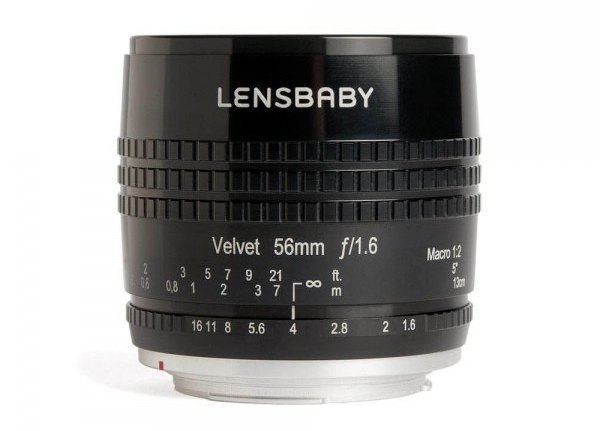
What’s special about the Lensbaby Velvet 56 and is it for you?

17 Oct

Usually, when you buy a new lens you are trying to get a wider angle or maybe more of a telephoto view, but with some lenses, you are trying to get more of a special effect. The Lensbaby Velvet 56 lens (price it out on Amazon.com or B&H Photo) is one of those. You can almost get normal images, but it is far better for giving you soft focus ones, not to mention some great blurred backgrounds, or to give you the bokeh effect.

lensbaby-velvet-1

The Lensbaby Velvet 56

A portrait lens and more

If you look around at reviews you see it described everywhere more as a portrait lens, but it can be used for so much more. It is a 56mm fixed lens with manual focusing and you basically get a lens very similar to a 50mm, but with some differences.

There is a range of apertures from f/1.6 to f/16 and each one creates a different effect. When you use the widest, f/1.6, you get very soft images, and the more you close it down the sharper it gets. The wider settings help you get that soft focus and bokeh look.

leanne-cole-lensbaby-velvet56-02

Flower from the garden.

Size and quality

It is reasonably compact, though made from metal it is heavier than other lenses in the same range. My Nikon 50mm f/1.8 lens is much lighter than the Velvet 56 f/1.6. You can tell when you are holding it that there is quite a bit of metal in it, as it ‘s cold to the touch. It is bigger than the Nikon lens, but not by much. It also has a very cool metal lens cap.

Painterly effects

Without a doubt, this lens is known for its effects and one that is highly desirable is the painterly result. The wide apertures give images that look as though they were painted. Some say they can get the same type of image in Photoshop, but it would never have the same softness.

leanne-cole-lensbaby-velvet56-06

A flower shot with a wide aperture giving it a very soft focus look.

Works on a full frame or cropped sensor

It is a lens for a full frame camera, but that doesn’t mean you can’t use it with your cropped sensor if that is what you have. If you do have the latter, in theory, you should be able to get closer to your subject as well.

It is also available for a number of different mounts, so whether you have a DSLR or a mirrorless camera you can find it for your model.

The different apertures

As stated, each aperture gives you a different effect to your image. Play around with those. As you start changing them and closing down the aperture, the image in the viewfinder does start to get darker. It is because not as much light is coming through, however, it doesn’t affect your final image, as long as you have the correct exposure.

Your camera won’t recognize the lens and you will have to change the aperture the old fashioned way, with the aperture ring on the lens. This also means that when you look at your metadata on your computer you will have no idea what setting you used. If it is important then you should record it as you take photos.

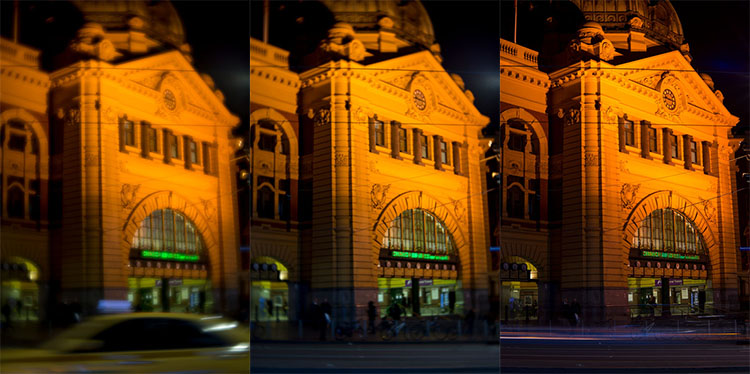
leanne-cole-lensbaby-velvet56-03

Flinders Street Station, with a wide aperture, then around f/8 and the third at f/16. See how the image slowly comes into focus.

Manual focusing

One of the aspects that a few people seem concerned about is that it’s a manual focus lens. Perhaps it is just the people that I hang around with, and as we are getting older our eyesight is affected. But having to manually focus is one thing that is (or seems) much harder.

It does take some getting used to, but it gets easier the more you do it. With most macro lenses you always seem to get the best results when you manually focus, though, so perhaps that shouldn’t be considered an issue.

When you are using wide apertures, even with macros, you are going to get very soft images which will mean you will never get very sharp images with this lens. In some ways, that can make it a lot easier to focus as the sharpness isn’t as important. This is how you get the painterly effect.

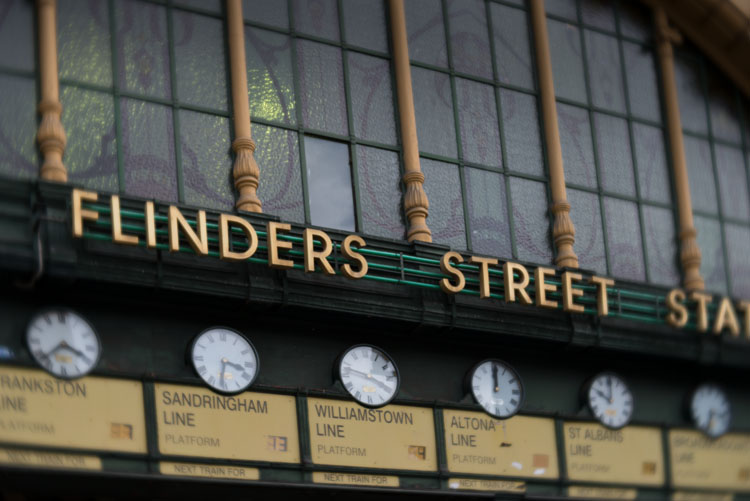
leanne-cole-lensbaby-velvet56-07

A close up image of the clocks and sign of Flinders Street Station in Melbourne.

Landscapes

Doing distance shots can be tricky as everything can appear too blurry. You really need to play around with the aperture to get the best effect. However, as stated previously if you play around with them you can get more in focus. The downside is once you close it down you lose the special effect of the lens and the softness it creates.

In reality ,you wouldn’t really use this lens for landscapes or architecture. I would use it mostly for macro, it really shines for that. It is too soft for landscapes and architecture if you ask me. But people do it, and you get some great effects, but it is never going to work like a normal lens, which is the point I suppose.

What would you use the Lensbaby Velvet 56 for?

For many, it is a great lens for portraits. Photographing people and getting great bokeh behind the subject is very desirable. As most portraits are done in an intimate environment, meaning the photographer is very close to the subject, the softness of the lens can enhance that and add an artistic feel to the images.

Like portraiture, macro photography is another great use for the Lensbaby Velvet 56. You can get very close to flowers and can create some very painterly images using different apertures. The lens is also suitable for attaching extension tubes and close-up filters to use with it. I’ve used the extension tubes on it. Plus, from time to time, I put on a 5+ close-up filter on to allow me to get even closer.

When you are focusing on a subject, if it is further away than  3-4 meters (9.8-13.1 feet) then the lens will be focused at infinity. So you don’t have to worry about focusing for landscape or architecture shots, just twist the focus ring all the way to the right so it is on infinity and shoot. It is only when your subject is closer that you need to start manually focusing the lens more critically.

It is good to use the soft focus look on subjects up close. But it doesn’t look as good when objects are further away, like large buildings, though that may be something that you like, so it’s your call.

leanne-cole-lensbaby-velvet56-05

Using the aperture to focus on one part of the image, in this case, the lock and chain.

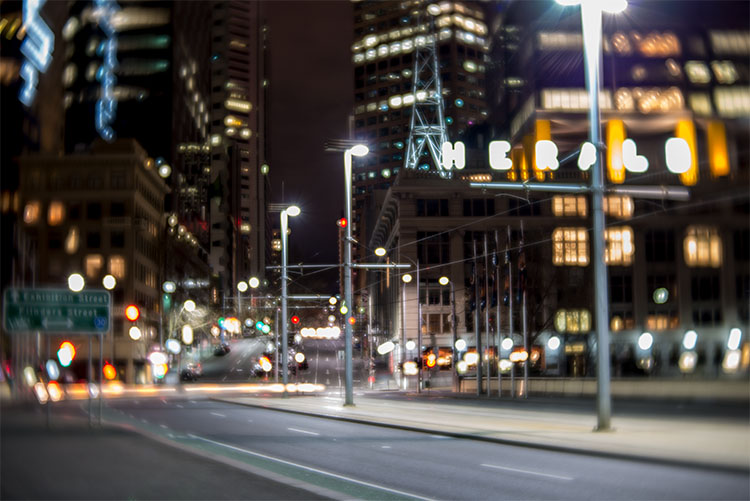
One of the things I have found with architecture and city shots it that while it does a great blurred effect, it can make the images seem busier than normal. While some may not like that, you could make it work for you. If you keep trying you can get some interesting images. You might even get images that give everything a tilt-shift look, so the city looks miniature.

It is about experimenting, trying on different subjects to see what works best for you and which you like the best.

leanne-cole-lensbaby-velvet56-04

A night view of the city with the aperture opened up a little gives it an almosttilt-shiftt look.

The price

The price of most 50mm lenses are around two to three hundred dollars, whereas the Velvet 56mm is a bit more expensive, selling for around $ 500 USD. However, if you like the specific types of photography mentioned in this article, then the money spent on it would be worth it.

Is it for you?

There is no doubt that you have to get used to it, but most people will fall in love with the lens straight away. It is good to play and experiment with and the more you do, the more you will discover. It could be a great way to add something new to your photography. I think it is amazing, and I love using it for macro photography.

leanne-cole-lensbaby-velvet56-01

A flower photographed with the Velvet 56.

Have

googletag.cmd.push(function() {
tablet_slots.push( googletag.defineSlot( “/1005424/_dPSv4_tab-all-article-bottom_(300×250)”, [300, 250], “pb-ad-78623” ).addService( googletag.pubads() ) ); } );

googletag.cmd.push(function() {
mobile_slots.push( googletag.defineSlot( “/1005424/_dPSv4_mob-all-article-bottom_(300×250)”, [300, 250], “pb-ad-78158” ).addService( googletag.pubads() ) ); } );

The post What’s special about the Lensbaby Velvet 56 and is it for you? by Leanne Cole appeared first on Digital Photography School.


Digital Photography School

 
Comments Off on What’s special about the Lensbaby Velvet 56 and is it for you?

Posted in Photography


How Birds Can Help You Learn About Your Photography Journey

05 Oct

When you feel like you don’t know what to do, what’s the next step? Frustrating, isn’t it? I think wisdom is found anywhere, from renaissance statues to butterflies, and even birds. Speaking of which, here’s a weird photography insight that I got by observing them.

Photography Journey

Why birds are amazing

Birds are really awesome. Well, I guess they are, depending on what aspect you are looking at. I mean, we all know they can litter a lot, right? But one thing that has always amazed me is how birds can reach their destination halfway around the world, without ever having been there nor knowing how to get there. Take the Arctic Tern, for example, it’s a bird that goes from Greenland all the way to Antarctica. They make the trip without ever knowing where it is.

Life will find a way?

There’s this scene in Jurassic Park where raptors that were not supposed to reproduce ended up making babies on their own. That’s when Jeff Goldblum said, “Life will find a way”. That is weird but it is true. Birds fly miles upon miles, butterflies too and even turtles. They all reach their destinations without knowing how to get there.

Now, call me crazy but I think that the same hand that made them also made me and you. And if these animals have an internal GPS, I am sure I have one too and so do you. A GPS that allows us to reach our destination as a photographer, wherever that may be. I don’t think any of us have any problem with that GPS concept. But between where we are and where we want to be is a big, scary gap, it’s called process. And if there’s something I’ve learned from nature, it is to embrace it.

Photography Journey

Embrace the process

Try to think like the birds think (don’t worry it’s not that hard with your brain not being larger than theirs). They probably feel a strong urge to go in a certain direction, and I am pretty sure that’s it. They can’t possibly know 100% how to get to their destination for sure because they’ve never been there. All they did was start, and also began embracing the process of life.

Normally when someone talks about the process of photography, they usually refer to stuff like exposure and the making of photographs. But what I would like to talk about here is more about the overall process of photography. I think it is all about accepting where you are and knowing paths will open up along the way. It is up to us to be open to it, and to be brave enough to take step after step, just like millions of birds, butterflies, and turtles.

Photography Journey

Just start even if you don’t know the end yet

But unlike birds, sometimes our destination is not as we expected when we started, that’s where we need to be open. I remember a while back, when I was thinking of what to do with my life, I had no idea what to do next. I accepted that and felt that I would end up figuring it out somehow. I started with the lowest hanging fruit: Video Games. At first, I wanted to go into Video Games, then I realized what I really liked were the graphics. I did not want to spend all that time learning about art, so I entered Graphic Design. From there I got a camera on an impulse and started photography.

When I started with photography, I had no idea what I would do, nor did I have an idea of what I needed to do. All I knew was I needed to start, even if I knew not what I was doing. I had all of the intent of being a wedding shooter but now I am more a street photographer more than anything!  You see, I think photography in an overall sense works that way. Decide to be a photographer, start right now, then be open to other paths that are in front of you. Providence will take care of you. Embrace the process.

Getting past road blocks

Of course, at every turn there are frustrations. No one said this stuff would be easy! But the thing is, you can recognize that you are in the middle of a process so that you can learn to embrace it.

  • Learning your exposure is frustrating you? Embrace the process.
  • Keep missing shots? Embrace the process.
  • Still not where you want to be? Embrace the process.
  • Have no clients knocking at your door? Embrace the process.

Embracing the process is simply accepting the fact that you are where you are supposed to be right now. Once it is time for you to move on, you will. But you will never be able to move any step further if you do not accept the process. Say no clients are knocking at your door, you haven’t gone trough the process of marketing your work yet. It’s pretty simple really, your situation will probably never outgrow your own skills.

Photography Journey

Conclusion

I don’t know where you are, reading this. But I’m pretty sure you know what you want out of photography. Will you trust your inner GPS and take the first step? God only knows what’s in store for you.

All I know for sure is that you can always figure things out along the way. Embrace the Process. Be yourself, stay focused and keep on shooting. Please share your experiences in the comments below as well.

googletag.cmd.push(function() {
tablet_slots.push( googletag.defineSlot( “/1005424/_dPSv4_tab-all-article-bottom_(300×250)”, [300, 250], “pb-ad-78623” ).addService( googletag.pubads() ) ); } );

googletag.cmd.push(function() {
mobile_slots.push( googletag.defineSlot( “/1005424/_dPSv4_mob-all-article-bottom_(300×250)”, [300, 250], “pb-ad-78158” ).addService( googletag.pubads() ) ); } );

The post How Birds Can Help You Learn About Your Photography Journey by Olivier Duong appeared first on Digital Photography School.


Digital Photography School

 
Comments Off on How Birds Can Help You Learn About Your Photography Journey

Posted in Photography


Fujifilm goes medium format: What you need to know about the GFX 50S

20 Sep

Meet the digital medium format Fujifilm GFX 50S

Forget full-frame, Fujifilm is diving head first into the world of digital medium format and we’re frankly pretty excited. The GFX 50S will make use of a 51.4MP CMOS sensor and X-Processor Pro imaging processor. In terms of surface area, the sensor is 43.8 × 32.9mm or about 4 times the size of sensors used in the company’s APS-C cameras (and 1.7x larger than a full-frame sensor.) And if 51.4MP sounds familiar, that’s because it’s the same pixel count as the Pentax 645Z and Hasselbled X1D (though Fujifilm says their sensor is newly developed.)

Meet the digital medium format Fujifilm GFX 50S

The GFX 50S is a mirrorless camera and the body itself looks a bit like a jumbo-sized XT-2. Set to launch in early 2017, several accessories will be available including a pretty cool clip-on accessory EVF ‘prism’ that can be tilted and rotated once affixed.

Meet the digital medium format Fujifilm GFX 50S

Other accessories include a vertical battery grip, which adds an additional shutter release for use in the vertical orientation, control wheel and additional power. Like the camera, the grip is weather and dust-sealed by design. The camera is also freezeproof down to 14°F. Though we’ve yet to hold it, Fujifilm claims the GFX 50S is much lighter than traditional digital medium format cameras and also a good bit smaller. 

Meet the digital medium format Fujifilm GFX 50S

The GFX 50S’ default aspect ratio is 4:3, however the camera can be set to shoot in a variety of other aspect ratios including: 3:2, 1:1, 4:5, 6:7 and 6:17. 

Meet the digital medium format Fujifilm GFX 50S

New sensor size, new lens mount: The GFX 50S uses Fujifilm’s new G-Mount, which has a flange distance of 26.7mm. When the camera launches (sometime in early 2017), three G-Mount lenses will be available. The GF 63mm F2.8 WR, shown above, is one of them. It offers a 50mm equiv. field-of-view (due to a 0.79x crop factor). There’s a possibility Fujifilm will kit that lens with the camera body and according to Fujifilm reps, that kit should cost ‘well under $ 10,000.’

Meet the digital medium format Fujifilm GFX 50S

Also in early 2017, Fujifilm will be releasing a GF 32-64mm F4 LM WR wide to normal zoom with about a 25-50mm equiv. field-of-view. Like the 63mm F2.8 WR (and actually all G mount lenses) the 32-64mm is weather-resistant.

Meet the digital medium format Fujifilm GFX 50S

The third lens to ship around the same time as the camera is the GF 120mm F4 Macro R LM OIS WR lens (bottom, left of center). It offers a 95mm equiv. field-of-view and optical image stabilization.

It’s obviously no small task launching an entirely new system with new lens mount. But as far as glass is concerned for the GFX 50S, a normal fast prime, wide to normal zoom and a macro lens feels like a good start. And there are other lenses that will be coming later in the year, more on that on the next page…

Meet the digital medium format Fujifilm GFX 50S

In mid 2017, Fujifilm hopes to ship the GF 23mm F4 R LM WR and GF 110mm F2 R LM WR lenses. The former offers an 18mm equiv. field-of-view and the latter an 87mm equiv. Also, in late 2017, the company will release the GF 45mm F2.8 R WR lens with a 35mm equiv. field-of-view.

That’s all we’ve got for now. We’ll update this article with more information and images once available. But for now, what do you think, is the Fujifilm GFX 50S a camera you’d buy?

Articles: Digital Photography Review (dpreview.com)

 
Comments Off on Fujifilm goes medium format: What you need to know about the GFX 50S

Posted in Uncategorized


So, you don’t care about the iPhone 7? Here’s 10 reasons why you should

10 Sep
The iPhone 7 has a newly designed 12MP camera with a six-element, optically stabilized lens. As well as stills it can shoot 4K video at up to 30p, and the iPhone 7 Plus offers a twin-lens camera providing 28mm and 56mm focal lengths. 

Another year, another iPhone, the usual chorus of Internet commenters going to great lengths to tell the world how little they care. But we’d be foolish to ignore the world’s most popular camera – and so would you.

Here’s why.

$ (document).ready(function() { SampleGalleryV2({“containerId”:”embeddedSampleGallery_5515118563″,”galleryId”:”5515118563″,”isEmbeddedWidget”:true,”standalone”:false,”selectedImageIndex”:0,”startInCommentsView”:false,”isMobile”:false}) });

Official iPhone 7 sample photos, courtesy Apple

1: 12MP is good enough

Ok, most DSLRs and high-end compacts offer 20MP+ but if we’re being honest, 2MP is good enough for Facebook, 3MP is good enough for a magazine cover, 6-8MP is good enough for a large-ish wall print and anything more than that is a bonus, most of the time. In short, the chances are that 12MP is good enough for you. 

2: It shoots Raw

It was only a matter of time before Apple added a Raw capture option to its iPhone series, and the day has come. As such, the iPhone 7 and 7S are arguably more enthusiast-friendly than the majority of low-end zoom compact cameras, and almost all tough cameras.

Adding Raw capture to the iPhone gives photographers a lot more creative freedom, and should allow them to mitigate – if not entirely overcome – some of the limitations of shooting with a control-limited device and a small sensor format. Raw shooting is coming to older iPhones soon too, with the upcoming release of iOS 10.

3: The iPhone 7 Plus has a proper zoom. Kind of.

The iPhone 7 and 7 Plus feature 12MP imaging sensors – most likely a 4.9 x 3.7mm BSI-CMOS which gives an equivalent crop factor of around 7X. The 7 Plus has two of them, which form twin cameras shooting at 28mm and 56mm equivalent. Their F1.8 and F2.8 apertures are equivalent in depth of field terms to ~F12 and ~F22 respectively.

The iPhone 7 Plus features a twin-camera design, which comprises 28mm F1.8 and 56mm F2.8 equivalent prime lenses. A forthcoming update will enable a computationally-derived bokeh simulation effect.

A 28-56mm two-step zoom might not set your heart ‘a flutter, but for the average beginner, or keen smartphone photographer, the added versatility of a proper choice of optical focal lengths is a serious selling point of the iPhone 7 Plus over every other phone on the market. A true optical zoom would be hugely complicated, but Apple’s approach makes sense. One lens for landscapes, one for portraits.

5: The iPhone 7 Plus can do bokeh. Kind of. 

We’ve seen attempts to blur out backgrounds using software before, but they don’t tend to end well. Typically, in the devices which offer some kind of algorithmic background blur feature, the effect is inconsistent. Even when it works, it doesn’t hold up well to critical examination.

We won’t be able to properly test the iPhone 7 Plus’s bokeh simulation effect for a while, but early samples look very encouraging indeed. 

Apple seems to be doing two things a little differently. The first is that the feature only works in ‘Portrait’ mode (when the iPhone 7 Plus’s 56mm equivalent lens is employed), and the longer focal length probably gives it a bit of a head-start in terms of baseline background blur for portraits compared to a bog-standard wideangle cellphone lens.

The second is that rather than just identifying your subject, making a mask, then blurring everything which looks like it probably isn’t your subject, the iPhone 7 Plus’s software makes a very complex depth map of the scene, and selectively applies blur based on the calculated distance of the background from your intended subject. For now, we only have Apple’s sample images to go by, but it seems to work impressively well.

6: It’s optically stabilized

Here’s an exploded view of the iPhone 7’s camera, showing its six-element construction.

This is old news in the mainstream camera market, but optical stabilization still isn’t included in some fixed-lens cameras. Optical I.S. will make the iPhone 7 and 7 Plus cameras more useful in poor light, extending the potential of the products for social and environmental photography.

7: It’s quick, and powerful

Modern smartphones incorporate an incredible amount of processing power, and compared to most cameras they’re capable of churning through much more data. With the cameras activated, the iPhone 7 and 7 Plus are constantly sampling a scene in preparation for exposure. So effectively, when you tap the shutter button, they’ve already taken the picture. On-sensor phase-detection autofocus using dedicated pixels means there’s virtually no hunting for focus, either.

Apple claims that the iPhone 7/Plus’s imaging processor manages more than 100 billion operations every time a picture is taken. Think about that the next time you take a photo of your cat.

8: It shoots 4K

Maybe you think you don’t care, but trust us – even if you’re not a filmmaker, the ability to capture 8MP frames at up to 30fps can be pretty handy.

9: It’s water-resistant

You can take the iPhone 7 and 7 Plus out in the rain, or drop them in the bath without worrying. How many photographers can say the same thing about their ‘proper’ cameras?

Supposedly, the iPhone 6S was almost water-sealed, but not quite. With the removal of the headphone jack, the iPhone 7 and 7 Plus have been made fully water resistant, and are both capable – apparently – of being submersed for up to 30 minutes without damage. 

10: Good iPhone cameras lead to better ‘proper’ cameras.

Even if you’re one of those people who has an almost religiously-held indifference to cellphones (and I know you exist because I get emails from you), consider this:

The greater the public’s expectations of the cameras in their cellphones, the more they expect of ‘proper’ cameras, if and when they buy one. There is certainly an argument to be made that the only reason we have things like beautiful high-resolution touch-screens, wireless connectivity, GPS and 4K video in cameras now is the iPhone. That ten years ago, Apple kicked off a smartphone revolution with the original iPhone which lead to the inclusion of these features in cameras becoming an expectation on the part of smartphone upgraders.

Habitual iPhone photographers won’t put up with laggy low-resolution touch-screens on DSLRs, or the omission of features like 4K video and wireless connectivity that they’re used to from their phones. This drives camera manufacturers to add more features to their products, and we all benefit. Right?

10.5: It’s an iPhone camera.

This is an obvious point, but bear with me. Remember what I just wrote about this being the ‘world’s most popular camera?’ Apple has been phenomenally successful when it comes to putting its devices in people’s pockets. More people are taking photographs now than ever before, and the iPhone, in its various versions, is the most popular picture taking device (or strictly speaking, series of devices) in the world.

What that means is that like it or not, when Apple does something, even if it didn’t do it first, it tends to have a certain significance. It’s safe to assume that there are a lot of people talking about the words ‘Bokeh’ and ‘Raw’ today who had never heard the terms before Apple’s launch event this week. Maybe I’m just a misty-eyed optimist, but I think that’s kind of cool. 

Articles: Digital Photography Review (dpreview.com)

 
Comments Off on So, you don’t care about the iPhone 7? Here’s 10 reasons why you should

Posted in Uncategorized


5 Things Newbies Should Know About Getting Started in Photography

01 Sep

Getting started in photography can be quite scary. We all start by investing in a DSLR, and think we are going to take amazing images. In reality it is a bit more difficult, because if it was easy… well everybody would sell prints, quit their day job, and live off photography.

Just like any art, photography has to be learned, and practiced – a lot. It is a trial and error process, we all start at the bottom and build our way up.

5 tips photography 1

If your images do not look like you imagined them, then try a different approach. Just do something. Einstein said that the definition of insanity was doing the same thing over and over and expecting different results.

#1 – Gather information and knowledge

Photography is the best hobby you could have, but it is a lot of hard work. I personally don’t believe in talent. The first tip I can give you is to absorb as much information as possible. How do you do that ? Well you have so many free resources on the internet, the only need to take advantage of it. Since you are reading this, then you’re on the right track.

By resources, I mean articles online, magazines, and YouTube tutorials. You can learn so much in less than 30 minutes. One other tip I can also give is to check multiple resources for the same topic.

5 tips photography 2

Read photography magazines. They have amazing stories and tutorials.

For example you want to learn how take portraits – don’t read or watch only one tutorial. The more you research, the more you will learn, because sometimes one article won’t give you all the answers to your questions, but another article will.

You should also anticipate. What I mean by that, is to learn about it, before trying to do something.

For example, say you want to buy a new DSLR. You should learn how to use it before you actually buy it, read reviews and tutorials. If you are planning a trip to the sea, then learn seascape photography before travelling.

5 tips photography 3

Photography is spending hours and hours on research.

#2 – Try all kinds of photography

This brings me to my second tip: don’t focus on only one type of photography. Of course, if you like portrait photography then do that. What I’m trying to say, is that you should explore all the possibilities, before focusing on only one type of photography. Try to add variation by learning about macro photography, landscapes, portraits, wildlife, etc.

5 tips photography 4

Try super sports car photography. It’s so fun, just protect your ears.

You may be surprised by the results you get, and if you never try, you will never know if you actually like photographing birds or not. From my experience, the more you learn, the more you’ll be able to do things. It’s better knowing how to do five things than only one. Starting photography and only wanting to take portraits is not the right mindset. It’s just like food, if you don’t try new food, you will never know if you like it or not.

#3 – Photography is an investment

The third thing you should know is that photography is a big investment. You will need to buy lenses, camera bodies, tripods, and filters, which will end up being quite expensive. If you are not smart with your decisions, then your bank account can end up in tears.

It may seem confusing when I tell you to try different types of photography, but then warn you about buying too much gear. If you want to try macro photography, don’t buy a macro lens right away. Just buy extension tubes (or close-up filters) until you know if you are serious about macro. They cost a lot less, and increase your focusing distance dramatically.

5 tips photography 5

A very inexpensive $ 30 ND Filter.

For filters, you can buy $ 20 Neutral Density filters for your landscape photography. Of course they won’t have the same quality as the professional ones, but it’s a good place to start.

I started photography with a phone, then moved up to an entry level DSLR, and now I own a full frame camera. But, it took me four years to go from my phone to full frame, so don’t go out and buy the best DSLR ever, find something that will suit where are you starting first.

5 tips photography 6

Phone photography

Make smart decisions, a normal kit lens is enough to get started in landscape photography.

#4 – Post-processing is a good thing

The fourth tip is about post-processing. Most beginner photographers underestimate the power of post-processing. It can make or break an image, that’s why my first point is important. You have to learn and fail in order to succeed – once you learn how to master software like Lightroom and Photoshop, your photography will become more like a process, because you will automatically think about post-production.

5 tips photography 7 5 tips photography 8

For post-production, I also recommend learning about the same topic from different sources. There are a lot of different ways to do the same thing, you just have to find which way works the best for you. It doesn’t matter how you do it, the important thing is the end result.

For example, for dodging and burning an image I prefer using a curves layer with a mask, but that doesn’t mean I don’t know how to dodge and burn using grey layers.

Post-production can be quite scary because there are so many tools, but once you master a certain software, you will be able to work on your worst shots and get the best out of them.

I would say that post-production is almost indispensable. There are a lot of photographers who want natural photography, but that doesn’t exist. Your colours will get interpreted anyway, it’s up to you to decide if you want your camera to do it automatically, or if you want to take control over everything.

5 tips photography 9

Simple snapshot with my own interpretation of colors.

#5 – Good photographers create depth in their images

The last thing you should know is that photography is all about creating depth. There are many ways of creating depth; you can do it with light and contrast, colours, movement, a solid composition, and with depth of field.

You should aim to have at least one of these elements in your images. If you can mix all these elements in one image, then your result will be even better.

With light and contrast you can play around with shadows, and dodging a burning. The main purpose is to have uneven lighting on purpose – try to avoid flat lighting. Some area should be lighter than others, and some darker. You also want to know which lighting conditions will give you the best results. For example, if you like shooting landscapes then you will want to know that you get the best light during the magic hour (blue hour).


Composition is the most important thing, try to use a foreground, middle ground and a background. The rule of thirds is also really useful to frame your subject in a pleasing way.

5 tips photography 10

With colours, the main purpose is to have tones that go together. Always look at your colour palette and see what works best. This is quite difficult to do, but one tip I can give you, is that when the colours do not look good, convert your image to black and white.

For movement, try long exposures, they are a good way to create a surreal images.

The last thing is depth of field. This is very important if you’re taking portraits, the amount of background blur can completely change an image. If you want to learn about it here’s another article I wrote: How to Achieve Background Blur or Bokeh where I explain three easy ways to achieve a nice bokeh.

IMAGE 2

Summary

So if you’re just getting into photography, consider these five things as you begin your journey. Learn everything you can from multiple sources, try different kinds of photography to see what you like, don’t get caught in gear envy, don’t be afraid of post-processing and remember to add depth to make more interesting images.

Are you further along in photography? What other advice would you offer to new photographers? Please share in the comments below.

googletag.cmd.push(function() {
tablet_slots.push( googletag.defineSlot( “/1005424/_dPSv4_tab-all-article-bottom_(300×250)”, [300, 250], “pb-ad-78623” ).addService( googletag.pubads() ) ); } );

googletag.cmd.push(function() {
mobile_slots.push( googletag.defineSlot( “/1005424/_dPSv4_mob-all-article-bottom_(300×250)”, [300, 250], “pb-ad-78158” ).addService( googletag.pubads() ) ); } );

The post 5 Things Newbies Should Know About Getting Started in Photography by Yacine Bessekhouad appeared first on Digital Photography School.


Digital Photography School

 
Comments Off on 5 Things Newbies Should Know About Getting Started in Photography

Posted in Photography


World record camera collector now has over 4500 – and a short film about himself

20 Aug

Indian Dilish Parekh has once again beaten his own world record for having the largest camera collection, with his personal museum now housing 4500 exhibits. In August 2013 DP Review reported that he had 4425 cameras, but in the intervening three years he has grown his hoard by 75 more models.

Filmmaker Dheerankur Upasak visited Dilish, who has held the Guinness Book of World Records title since 2003, at his home in Mumbai to make a short about the man and some of the models in his collection. Dilish says that he started collecting in 1970 when his grandfather gave him cameras as gifts – and things went from there. He never spends more than $ 15 on a camera, but has still managed to accumulate quite a number of rare and expensive bodies, such as the Leica Reporter GG 250. Only 950 were made and one sold with a motor drive at the ‘100 Years of Leica’ Westlicht auction for €576,000 in 2014.

The collection spans only the years between 1890 and 1960 and includes all of Canon’s rangefinder models. Dilish isn’t for selling the collection, though he says he gets lots of offers, and he has instructed his sons not to sell once he passes away.

Dheerankur filmed the piece on a Canon EOS 5D III with Pentax 50mm f/1.2, Tamron 90mm macro and Tair 11-133mm f/2.8 lenses.

Articles: Digital Photography Review (dpreview.com)

 
Comments Off on World record camera collector now has over 4500 – and a short film about himself

Posted in Uncategorized