RSS
 

Posts Tagged ‘50mm’

New normal: Sony FE 50mm F1.8 real-world samples

02 Apr

Sony recently updated its FE line, which now offers 20 full-frame lenses for Sony’s E-mount Alpha cameras. Among the new lens introductions is the FE 50mm F1.8, what you might call Sony’s ‘nifty fifty’. We spent some time shooting with it in San Francisco this weekend, paired with the unforgiving 42MP of the Alpha 7R II. See how the lens holds up in our real-world samples gallery.

Articles: Digital Photography Review (dpreview.com)

 
Comments Off on New normal: Sony FE 50mm F1.8 real-world samples

Posted in Uncategorized


Hands on: Sony FE 50mm F1.8 and 70-300mm F4.5-5.6

30 Mar

Hands on: Sony FE 50mm F1.8 and 70-300mm F4.5-5.6

Sony’s already had a busy year, and it just got even busier with the announcement of an update to its RX10 series and two new FE lenses: the 50mm F1.8 and 70-300mm F4.5-5.6 OSS. We got to take a first look at them at a press event in San Francisco. 

Hands on: Sony FE 50mm F1.8 and 70-300mm F4.5-5.6

The FE 70-300mm F4.5-5.6 is the first full-frame E-mount lens to reach 300mm. It offers SteadyShot stabilization, as evidenced by the OSS on/of switch seen here. 

Hands on: Sony FE 50mm F1.8 and 70-300mm F4.5-5.6

The 70-300mm offers a minimum focus distance of 0.9m/2.9ft, a zoom locking mechanism and dust and moisture resistance. It’s fairly compact when used at the wide end…

Hands on: Sony FE 50mm F1.8 and 70-300mm F4.5-5.6

…and extends quite a bit to reach that 300mm mark. For the extremely curious, we noted that the lens maintains its widest F4.5 aperture until the 85mm mark, when F5 becomes the widest option. This changes again at 157mm, at which point it stops down to F5.6.

Hands on: Sony FE 50mm F1.8 and 70-300mm F4.5-5.6

Sony has posted MTF charts for the 70-300mm, and they show that this lens might be a cut above the typical telezoom. The 70-300 will go on sale in May for $ 1200.

Hands on: Sony FE 50mm F1.8 and 70-300mm F4.5-5.6

And now, something a little different: the Sony FE 50mm F1.8. At $ 250 it’s going to be a much more wallet-friendly option than its 55mm F1.8 Zeiss-branded counterpart.

Hands on: Sony FE 50mm F1.8 and 70-300mm F4.5-5.6

The 50mm features a 7-blade circular aperture and offers a 0.45m/1.45ft minimum focus distance. Sony emphasizes its compact and lightweight design and indeed, the lens weighs in at a svelte 186g/6.6oz.

Hands on: Sony FE 50mm F1.8 and 70-300mm F4.5-5.6

Here’s another view of that 7-blade aperture. The lens comprises six elements in five groups, including one aspherical element. Like the 70-300mm, it’s expected to ship in May. 

Articles: Digital Photography Review (dpreview.com)

 
Comments Off on Hands on: Sony FE 50mm F1.8 and 70-300mm F4.5-5.6

Posted in Uncategorized


Sony announces 50mm F1.8 and 70-300mm F4.5-5.6 full-frame lenses

29 Mar

Sony today announced a pair of FE-mount full-frame lenses for its Alpha and NEX mirrorless cameras. The first is an FE 50mm F1.8 prime lens, giving photographers a considerably less expensive option compared to the Zeiss 55mm F1.8 currently on the market. This compact and lightweight lens is priced at $ 249 and will ship in May.

The other lens is the 70-300mm F4.5-5.6 G OSS, which is the longest FE-mount tele-zoom available. It features four aspherical and two ED elements, optical image stabilization, and a Nano AR coating to reduce flare and ghosting. The lens offers a minimum focus distance of 0.9m/3ft, and uses a linear actuator for smooth and silent autofocus. The 70-300 will also be available in May at a price of $ 1199.


Press release:

Sony Bolsters Full-Frame FE Lens Lineup with New 70-300mm High-Resolution Zoom and 50mm F1.8 Prime Lenses

New FE 70-300mm F4.5-5.6 G OSS Telephoto Zoom and 50mm F1.8 Prime Lens Extend Sony ? Shooting Possibilities

SAN FRANCISCO, Mar. 29, 2016 – Sony Electronics, a worldwide leader in digital imaging and the world’s largest image sensor manufacturer, has today introduced two new full-frame lenses for their E-mount camera system, the FE 70-300mm F4.5-5.6 G OSS telephoto zoom and 50mm F1.8 prime lens. 

The new FE 70-300mm F4.5-F5.6 G OSS zoom lens represents the first Sony ? E-mount lens to reach a 300mm focal length, featuring high resolution and excellent overall optical performance throughout the entirety of its range.  The new 50mm F1.8 prime lens is extremely compact, lightweight and affordably priced, making it an ideal choice for those looking to explore the benefits of a large aperture prime lens at a reasonable cost. 

            “We’re continuing to build out our FE lens lineup, offering more variety than ever for today’s imaging enthusiasts,” said Neal Manowitz, Vice President of Digital Imaging at Sony Electronics.  “Representing two of the most requested focal lengths by our customers, the new 70-300mm zoom and 50 F1.8mm prime become ideal choices for those looking to expand and enhance their Sony ? kits.

New FE 70-300mm F4.5 – 5.6 G OSS Telephoto Zoom Lens

Sony’s longest reaching E-mount lens to date, the new FE 70-300mm F4.5 – 5.6 G OSS telephoto zoom lens (model SEL70300G) features a state-of-the-art optical design including four aspherical glass elements, two ED (Extra-low Dispersion) glass elements and Sony’s Nano AR coating, which all work together to effectively suppress spherical aberration, distortion, and chromatic aberration.  This ensures beautiful high-resolution results for both still and video shooting.

The new telephoto zoom lens also features class-leading close-up performance, with a minimum focusing distance of less than 3 feet (0.9m) and a maximum magnification of 0.31x, making it an ideal choice for tele-macro photography.  This outstanding close-up performance also factors into the lens’ excellent corner-to-corner sharpness.

The versatile zoom lens includes built-in Optical SteadyShot image stabilization that helps to reduce camera shake, making it easier to capture clear images when shooting handheld.  Additionally, the new SEL70300G model has a linear actuator that allows it to achieve fast, smooth and quiet autofocus and is also dust and moisture resistant1 to ensure reliable operation in harsh outdoor conditions.

New FE 50mm F1.8 Prime Lens

Weighing in at less than 7 oz (192 g), the new lightweight FE 50mm F1.8 “normal” prime lens (model SEL50F18F) delivers an outstanding blend of performance, compactness and value, making it a perfect choice for hobbyist photographers and videographers looking to experience the benefits of a wide aperture prime lens at an attainable cost.

The lens features a new optical design with an aspherical element that effectively compensates for all forms of aberration, resulting in beautiful, crisp imagery.   Additionally, it has a circular aperture with a maximum of F1.8, producing beautiful ‘bokeh’ in images that allows the subject to stand out against a smoothly defocused background.  For extended durability, the new prime lens is built with a solid metal mount.

Pricing and Availability

The new FE 70-300mm F4.5 – 5.6 G OSS telephoto zoom lens will be available in May for about $ 1,200 US and $ 1,700 CA, respectively. 

The new FE 50mm F1.8 prime lens will also be available in May for about $ 250 US and $ 350 CA, respectively. 

Both of the new FE interchangeable lenses will be sold at a variety of Sony authorized dealers throughout North America.   

A variety of exclusive stories and exciting new content shot with the new lenses and other Sony ? products can be found atwww.alphauniverse.com , Sony’s new community site built to educate, inspire and showcase all fans and customers of the Sony ? brand. 

Content is also available for viewing at the sony.com product pages for the FE 70-300mm F4.5 – 5.6 G OSS telephoto zoom lens and the FE 50mm F1.8 prime lens.

Articles: Digital Photography Review (dpreview.com)

 
Comments Off on Sony announces 50mm F1.8 and 70-300mm F4.5-5.6 full-frame lenses

Posted in Uncategorized


Writer’s Favorite Lens – Canon 50mm f/2.5 Compact Macro

20 Dec

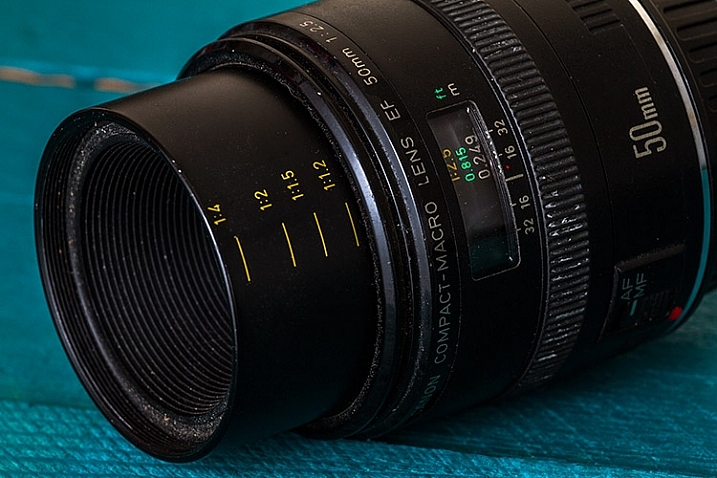
Canon 50mm f/2.5 Compact Macro

Sometimes, picking a favorite is hard. If you ask me to choose a favorite song or movie, it just can’t be done. Lenses; however, are different beasts. Ask most photographers what their favorite lens is, and you’ll probably get little hesitation before they start gushing and waxing lyrical.

At least that’s how I am, and when it comes to picking my favorite, all you have to do is ask which lens is probably on my camera body right now. That is almost always the Canon 50mm f/2.5 Compact Macro.

This lens is a gem that offers great quality in terms of sharpness, ease of use, durability and versatility, and even though I’ve acquired some fairly serious glass since I bought it 12 years ago, it’s still my go-to lens.

Making the choice

Regarding lens choice, one of the most common things new photographers are told is to start with a 50mm f/1.8, often referred to as “thrifty fifties”. The logic here is more or less irrefutable. These lenses are cheap, reliable, versatile, and their large aperture makes them much faster than anything else in that price range. Their versatility makes them perfect for portraits and most other subjects outside of the extremes such as landscapes, which favor wide-angle lenses, and sports, which favor telephoto lenses.
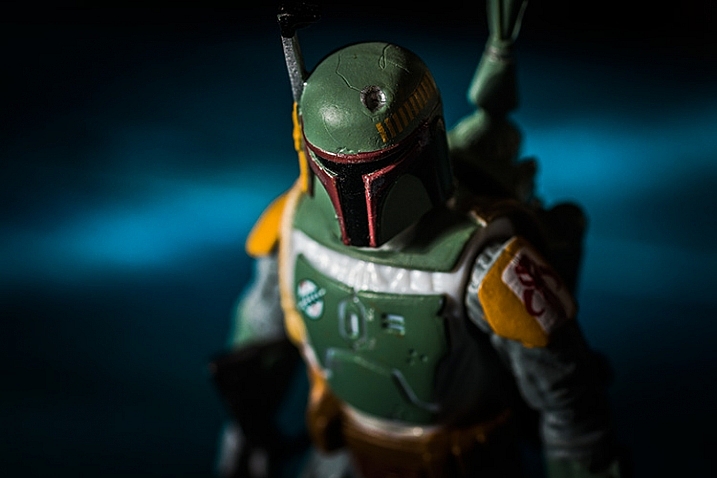
Boba

When I was starting out, I spent a lot of time photographing things like food, flowers, toys, and other small things with fine details. I had little interest in other types of photography, and no interest in portraiture.
As such, the biggest limitation I got from my kit lenses was the focusing distance. I was forever trying to get closer to my subjects using the long end of kit lenses, and falling short every time.

When it was time to consider upgrading that first lens, research made it clear that neither the thrifty fifty nor the 85mm f/1.8 would do much good towards those aims. On the other hand, a dedicated 100mm macro lens was far out of my price range. Because of all this, I put off upgrading my kit lenses for a long time.

It was only by chance that I eventually found the 50mm Compact Macro while browsing through Canon lenses on a retailer’s site. To be honest, there wasn’t a lot of research involved. I saw the lens, the price, and the focusing distance of nine inches, and I bought it within the week.

Pros and cons

The Canon 50mm Compact Macro is the workhorse of my camera bag and it’s certainly been put through its paces over the past decade. For my purposes, there are no flaws; however, it does have a few qualities that may make it unsuitable for some photographers.

Pro – Build quality

It can’t be helped that the first thing you notice about this lens is the build quality. This is particularly true if your previous experiences are with kit lenses. The solid metal casing makes it feel sturdy and the extra weight feels great in your hand.

It may be worth mentioning that when I did get to use a 50mm f/1.8 a few years ago, I thought that I was being handed a Holga lens. This isn’t in any way an attempt the demean the 50mm f/1.8, but rather as an illustration of how far apart these lenses are in terms of build quality.

Pro – Durability

favourite-lens-canon-50mm-macro-2081

Durability may fall under build quality, but experience makes me feel it’s worth mentioning separately.

This lens has been dropped on concrete, cobble stone, and Tarmac, and it has been in the ocean. It has been in ash storms, torrential rain, hail storms, and there was one terrifying incident where it was left to stew in a half litre puddle of shower gel for a few hours. Despite all of this, this lens has not once shown any performance issues.

Pro – Sharpness

As should be expected from a lens created for the purpose of macro photography, the Canon 50mm f/2.5 Compact Macro cannot be faulted in terms of sharpness. While I’m unable to compare it to the other 50mm offerings from Canon, I can compare it with the excellent 85mm f/1.8 and 70-200 f/4 L IS USM. The differences are almost indistinguishable.

Pro – Large aperture

The compact Macro may have a smaller aperture than Canon’s other 50mm lenses, but it is still a fast lens and works well in all but the dimmest of settings.

In terms of background blur, if you take into account that depth of field is also affected by the distance of the camera from the subject (the closer you are, the shallower the depth of field) you can see that you will achieve a comparable amount of blur to the faster lenses.

Pro – Focusing

Whether it’s in auto focus or manual focus, it’s really hard to find fault with this lens. In normal situations, the auto-focus is fast and accurate. The large aperture of f/2.5 allows for a bright image in the viewfinder, making manual focus easy and quick.

Pro – Focus distance
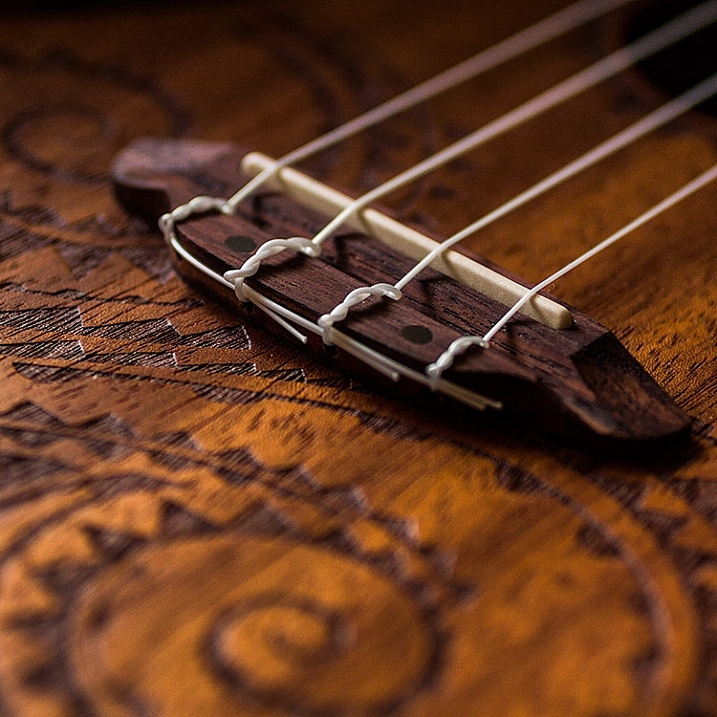
Uke

With a focusing distance of just nine inches (23cm), you can get extremely close to your subjects. Yes, this may be the sole reason for this lens’ existence, but the versatility this adds is wonderful. For example, you are able to take a close-up of someone’s eye, then move a few steps back and take a normal 50mm portrait seconds later.

Cons

As mentioned, it wasn’t easy to come up with any negative aspects of this lens. There are; however, a few considerations that could mean this may not fit your specific photographic needs.

Con – Weight

At 9.88 ounces (280 grams), the Compact Macro weighs more than twice as much as Canon’s 50mm f/1.8 lens (4.6 ounces/ 130g). If you’re trying to keep your kit bag as light as possible, and the macro functionality isn’t that important, then you may want to consider the alternatives.

Con – Price

While I will attest that this lens offers tremendous value for the money, at $ 299 it is a big jump in price from the 50mm f/1.8 at $ 125. If you’re just starting out, and do not yet know what subjects you’re interested in, or whether or not you will stick with photography for long, it may be worth considering a more wallet friendly option.

Editor’s note: at the time of this article the 50mm f/2.5 Compact Macro lens is listed on Canon’s site as Out of Stock. You may be able to find it used on Amazon.com or go for the even higher priced 60mm f/2.8 Macro at $ 419 USD.

Con – Light

There is a slight downside to the lens’ closest focusing distance. When you’re standing that close to your subject, you and the camera effectively block any light coming from the front. Often, this is easily countered with side lighting techniques, or by using a dedicated macro ring flash, but it can be tricky to overcome at other times.

Con – Magnification

What may be considered as a deal breaker for a lot of photographers is that the 50mm f/2.5 Compact Macro is not a true macro lens. With a magnification ratio of 1:2, it only creates images at half life-size. This can be rectified with a converter that allows for 1:1 magnification.

favourite-lens-canon-50mm-macro-5347

In the end

I know I’ve been gushing quite a bit, but my experiences with this lens have been outstanding, despite the heavy use and torture I put it through. If you’re in a position where you’re deciding to buy a 50mm, and you like the idea of getting really close your subjects, do consider the Canon 50mm f/2.5 Compact Macro. It really is a treat.

googletag.cmd.push(function() {
tablet_slots.push( googletag.defineSlot( “/1005424/_dPSv4_tab-all-article-bottom_(300×250)”, [300, 250], “pb-ad-78623” ).addService( googletag.pubads() ) ); } );

googletag.cmd.push(function() {
mobile_slots.push( googletag.defineSlot( “/1005424/_dPSv4_mob-all-article-bottom_(300×250)”, [300, 250], “pb-ad-78158” ).addService( googletag.pubads() ) ); } );

The post Writer’s Favorite Lens – Canon 50mm f/2.5 Compact Macro by John McIntire appeared first on Digital Photography School.


Digital Photography School

 
Comments Off on Writer’s Favorite Lens – Canon 50mm f/2.5 Compact Macro

Posted in Photography


My Favorite and ONLY Lens: The Canon EF 50mm f/1.2 L USM

09 Dec

I operate my photography business on a shoe string budget. This started out of necessity, but continued because it became abundantly clear to me early on, that I would rather spend the money I earn from photography towards black t-shirts, home décor, five dollar lattes, and bills. Mainly bills, but no sense in pretending the other indulgences don’t factor into my take-home pay.

lynseymattingly2

I started my portrait business with a Canon Rebel, kit glass, and a prayer. As my business grew I invested in a 30D, and later a 5D. One particularly good tax refund, and a little generosity from my mother around my birthday, found me the proud new owner of a Canon 50mm L-series lens. I didn’t even know what the L stood for (to be honest, I still don’t), I just knew that all the photography blogs I read at the time called it the end-all, be-all lens. The It Lens. The Portrait Lens. I also had a seasoned pro tell me that I should spend as much money as possible on good glass, and it doesn’t get any better than this one.

It’s also important to mention that I was at a place with both photography, and my confidence, that I would listen to just about anyone who even pretended they knew what they were talking about. Had she told me that my pictures would be better if I carried a frog in my pocket, I would have carried two, and a lizard in my shoe just in case.

lynseymattingly7

I am going to tell you all a secret. I am going to answer the question I always get asked when I pull out my big, fancy lens that is mounted to my camera body, which to be clear is the Canon 5D model from 4 models ago: does that snazzy lens make photos better? Brace yourselves because, yes. Yes, it does. So much so in fact that I don’t even own another lens.

I had a fixed 24mm lens for a few years, but it did nothing more than take up space in my bag. Space that I prefer to give to gum and bug spray. So I sold it to increase my coffee and black yoga pants budget. Zoom lenses have never been my favorite, so that narrows down my choices considerably, and a 50mm just feels like the right length for me—I’m close to my subjects but not breathing in their face, even if my breath is minty fresh from my bulk gum purchases.

lynseymattingly4

Can you live without a lens that costs three times what my first car did? You bet. But I’ll tell you another thing—you can live without an entire bag of lenses just as easily. A back-up body and lens is nice—some may even say essential (particularly if you are a wedding photographer), and I suppose if you do certain types of photography, you may need a few different lenses. But I am here to tell you that I have operated a very successful portrait and wedding photography business with my one, albeit super fancy, lens and done just fine, thank you very much. I can count on one hand the times I’ve needed a different lens, and each time it was easy to either borrow or rent, and much more cost effective.

lynseymattingly1

I know my 50. I named my 50, if we are being honest (its name is Seth—it work well with Nancy my MacBook, and Monte my iMac). At this point it just feels like an extension of my arm, or eyeball. I know what I will see in the viewfinder by the time I get my camera to my face. Since my feet are the zoom, I know exactly where I need to stand to get the frame I want.

Prime lenses are fast and sharp. If this means I have to walk around a bit more, then I can call it my exercise for the day (okay, fine: week) as well. The bulk of my business is photographing kids, so no matter what, I am going to be on the move. I’d just rather know that upfront, than mess with a zoom and continuously risk less than tack-sharp focus. This isn’t even counting the fact that by not spending a great deal on equipment I am able to be well caffeinated on expensive coffee during shoots, and sit at a very pretty desk while I edit.

lynseymattingly3

The other plus of counting on one great lens for everything? I invest my money back into my business in other places, beyond expensive equipment. Places that I feel reach farther than a bag full of stuff. I have a bold website and eye-catching business cards. My clients get their images in top-of-the-line professional packaging. I have a ShootSac and buy lollipops in bulk. I wear the most expensive contact lenses on the market, and you should see my hair tie-back selection.

I can only afford these things because I’m not up to my expensive contact lens-wearing eyeballs in debt over fancy equipment. Additionally, my fees are not so outrageous that my client base is only a select few. My overhead being lower than average, allows me to continue photographing the families that supported my business when I was just starting. Families that otherwise may not be able to afford my services if I was dealing with extraordinary costs.

lynseymattingly6

My mom taught me to buy quality; to save my money and buy a good pair of jeans, instead of the cheapest pair that fit. Sadly this lesson didn’t stick and at this very moment I am dressed head to toe in Target. However, it’s true here; buy the nicest lens you can afford and make it work for you. It’s your paintbrush, your potters wheel, your knives (I’ve heard big-time chefs bring their own knives to everything); make it the best possible one and make it the only one you need.

lynseymattingly5

Have you invested in top quality lenses or “glass”? What is your go-to lens and why?

googletag.cmd.push(function() {
tablet_slots.push( googletag.defineSlot( “/1005424/_dPSv4_tab-all-article-bottom_(300×250)”, [300, 250], “pb-ad-78623” ).addService( googletag.pubads() ) ); } );

googletag.cmd.push(function() {
mobile_slots.push( googletag.defineSlot( “/1005424/_dPSv4_mob-all-article-bottom_(300×250)”, [300, 250], “pb-ad-78158” ).addService( googletag.pubads() ) ); } );

The post My Favorite and ONLY Lens: The Canon EF 50mm f/1.2 L USM by Lynsey Mattingly appeared first on Digital Photography School.


Digital Photography School

 
Comments Off on My Favorite and ONLY Lens: The Canon EF 50mm f/1.2 L USM

Posted in Photography


SLR Magic announces CINE 50mm F1.1

18 Nov

Hong Kong-based SLR Magic has announced a 50mm F1.1 CINE lens for Sony E mount. Planned for early December 2015 availability, the FE lens will cover a full-frame sensor. Read more

Articles: Digital Photography Review (dpreview.com)

 
Comments Off on SLR Magic announces CINE 50mm F1.1

Posted in Uncategorized


Comparing a 24mm Versus 50mm Lens for Photographing People

11 Nov
photographing-people-2

Image taken with Canon 60D and Canon 24mm EF-S lens.

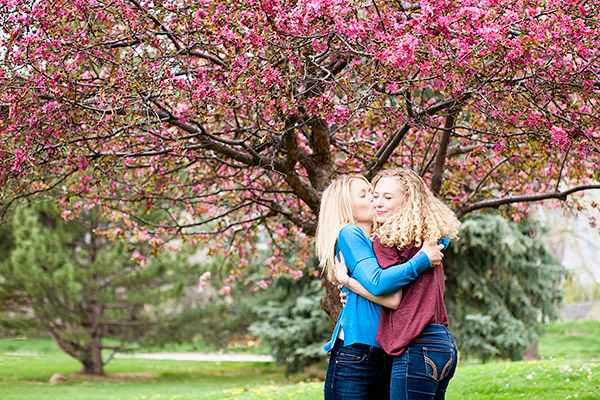
A number of dPS readers have recently been asking about the Canon 24mm EF-S pancake lens, and how it compares to a 50mm lenses for photographing people. Both are great options, given the price point, but they do have slightly different strengths when it comes to people photography. In this article, I’ll show you several different images of the same model, location, and posing, photographed with both a 24mm and a 50mm lens. This will provide a good visual of the difference between the two lenses, as well as give you insight as to when you might want to reach for each one.

photographing-people-50mm-1

Image taken with Canon 60D and 50mm lens.

For continuity, all images in this post were taken with a Canon 60D, and either the Canon 24mm f/2.8 or the Canon 50mm f/1.8 lenses. The 60D is an APS-C sensor (cropped sensor) camera, so first you need to multiply the focal length of each of your lenses by 1.6x in order to determine the functioning focal length of them on this camera (if you use Nikon it may be 1.5x, check your manual). So on a cropped sensor camera, the 24mm lens functions roughly as a 38mm lens, and the 50mm lens functions as an 80mm lens. In other words, the 50mm lens is great for head-and-shoulders portraits, while the 24mm lens is great for photographing people in the context of their surroundings. In the above example, you can see that the 50mm lens provided a tight shot of these two sisters, with a blurred background that keeps all the attention on their faces.

However, the context for this session is also important, in that it took place at a family vineyard, and the clients wanted to be sure that the grapes were also visible in the background of some of the images. As you can see above, the grapes really weren’t visible in the portrait taken with the 50mm lens, nor would closing down the aperture really give the perspective of the vineyard that my clients were looking for. So, after taking a few portraits with the 50mm, I switched over to my 24mm lens in order to capture a few wider shots.

photographing-people-24mm-1

Image taken with Canon 60D and Canon 24mm EF-S lens.

Same girls, same exact location, very similar pose. The only real difference here is that with the switch to the 24mm lens, you can see more of the girls and the the area around them. In some instances, you may want to minimize the area around your subject, in which case the 24mm lens would not be ideal. However, in this case it allowed for the images that highlighted both the girls and the vineyard, which was what the clients were after.

Bonus tip: Photographing sibling sets with a 24mm lens also allows you to see the height differences between siblings more easily with the wider angle shot, which is something that a lot of parents really enjoy.

photographing-people-50mm-3

Image taken with Canon 60D and 50mm lens.

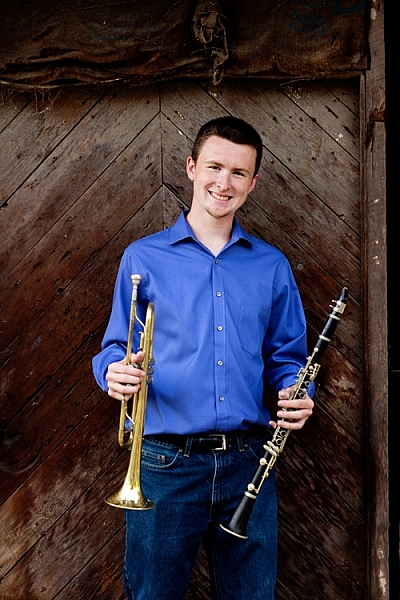
Another thing to consider, besides the contents of the background in your images, is the coloring of the background. In the image above, the deep colored wood background brings a moodiness to the image that could be appropriate for a musician. However, the interesting thing is that the overall feeling of the image changes quite a bit when you look at it from the 24mm angle of view.

photographing-people-24mm-3

Image taken with Canon 60D and 24mm EF-S lens.

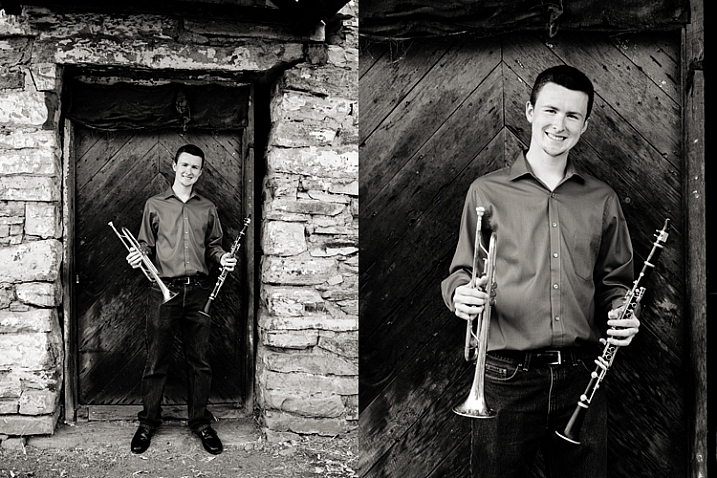
The second image, though in the same location, feels a lot less moody and dramatic than the first. The lighter stonework around the door brings a sense of balance to the image that just wouldn’t be achieved as well with the 50mm lens in this location. In my experience, this balance is especially important when it comes to converting images to black and white.

photographing-people-1

As you can see in the left image, the lighter stonework, around the darker door, serves as a frame for the subject, and naturally draws your eye in towards him. In addition, the increased contrast and texture provide some of the key ingredients for black and white images, which makes the image more aesthetically pleasing than the image on the right.

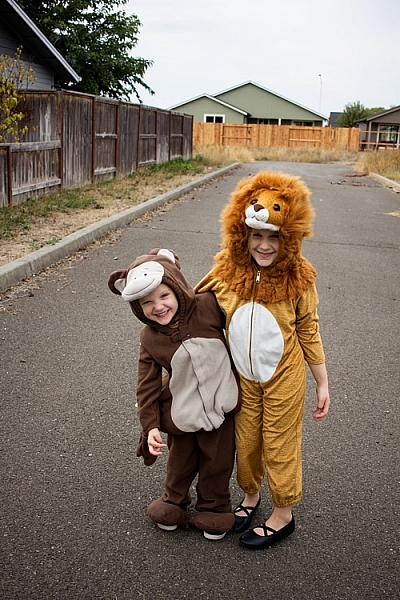
Overall, while there may be instances in which the content or coloring of your background may cause you to reach for one of these two lenses over the other, I’m very much in favor of using both of them whenever possible. Here’s a quick example from my own life to explain why both are so great for their own reasons. I recently photographed my girls in their Halloween costumes. I started with the 50mm lens because it’s my favorite.

photographing-people-50mm-4

Image taken with Canon 60D and 50mm lens.

I love this image of both girls (above) – the 50mm lens really lets you see their faces and expressions well, and the bokeh of the 50mm f/1.8 helped soften the literal construction site in the background of the image. However, the closer crop also means that only a small portion of their costumes were visible.

So, I switched over to my 24mm lens to take a full-length photo (below) of my little monkey and my lion as well. Now, I can really see them from head to toe. I can see the little fake feet of the monkey costume that freaked my youngest daughter out so much that she begged her sister to switch costumes with her. I can see the height difference between the two of them. I can see the black flats that my oldest daughter is so proud of, and wears to any event that she deems remotely “fancy”. Those are all things that I want to look back on, and remember. I love both images for different reasons, and am so happy to have them both, thanks to my trusty 24mm and 50mm lenses.

photographing-people-24mm-4

Image taken with Canon 60D and 24mm EF-S lens

I hope this has given you a good idea of how these two focal lengths compare when photographing people.

Have you tried the Canon 24mm EF-S lens? How do you use it? Do you have a nifty-fifty and do you use it for people photography? Which is your favorite? Please share your comments and images below.

googletag.cmd.push(function() {
tablet_slots.push( googletag.defineSlot( “/1005424/_dPSv4_tab-all-article-bottom_(300×250)”, [300, 250], “pb-ad-78623” ).addService( googletag.pubads() ) ); } );

googletag.cmd.push(function() {
mobile_slots.push( googletag.defineSlot( “/1005424/_dPSv4_mob-all-article-bottom_(300×250)”, [300, 250], “pb-ad-78158” ).addService( googletag.pubads() ) ); } );

The post Comparing a 24mm Versus 50mm Lens for Photographing People by Meredith Clark appeared first on Digital Photography School.


Digital Photography School

 
Comments Off on Comparing a 24mm Versus 50mm Lens for Photographing People

Posted in Photography


Rokinon introduces new 50mm F1.2 and 21mm F1.4 mirrorless camera lenses

22 Sep

Rokinon has introduced 21mm F1.4 and 50mm F1.2 fast prime lenses, both of which are up for pre-order now. These new lenses flesh out the maker’s existing offerings for mirrorless cameras. Read more

Articles: Digital Photography Review (dpreview.com)

 
Comments Off on Rokinon introduces new 50mm F1.2 and 21mm F1.4 mirrorless camera lenses

Posted in Uncategorized


SLR Magic unveils HyperPrime Cine 50mm T0.95 lens and Magic-Rangefinder Cine Adapter

04 Jun

SLR Magic has introduced its HyperPrime Cine 50mm T0.95 standard lens for Micro Four Thirds cameras. The HyperPrime Lens gives a 100mm equivalent focal length and offers a T0.95 maximum aperture, black anodized finish and weighs 620g/1.4lb. Also introduced is the SLR Magic-Rangefinder Cine Adapter with an integrated focus ring. Read more

Articles: Digital Photography Review (dpreview.com)

 
Comments Off on SLR Magic unveils HyperPrime Cine 50mm T0.95 lens and Magic-Rangefinder Cine Adapter

Posted in Uncategorized


Canon EF 50mm F1.8 STM real-world samples gallery

02 Jun

The EF 50mm F1.8 STM is Canon’s newest iteration of its classic ‘nifty fifty’ lens. It’s a fast, inexpensive normal lens on a full frame DSLR, but also functions as an 80mm equivalent lens on Canon’s APS-C bodies. How does it perform in real-world use?  We’ve been using the lens for a few days and put together a gallery of samples. We took quite a few shots at wide apertures to see how the lens performed, but have also included photos taken at smaller apertures. See photos

Articles: Digital Photography Review (dpreview.com)

 
Comments Off on Canon EF 50mm F1.8 STM real-world samples gallery

Posted in Uncategorized