Month: October 2017

  • SanDisk launches ultra-reliable industrial memory cards that can handle extreme temperatures

    Western Digital is working on a line of ultra-reliable, ultra-tough SanDIsk memory cards meant for automotive and industrial applications. There will be an automotive SD card for use in vehicles and drones, and three industrial cards in SD, microSD and XI formats, all of which are designed to withstand extreme temperature ranges and provide even better reliability than the manufacturer’s standard cards.

    It’s safe to say you’ll have to encounter some pretty extreme climatic conditions to bring these cards to their metaphorical knees. The Industrial SD and microSD cards can be used in temperatures ranging from -13°F to 185°F, while the Industrial XI and Automotive SD cards can take temperatures between -40°F and 185°F.

    At 80MB/s and 50MB/s, the cards also offer decent read/write speeds and come with a Status Monitor tool and a number of data protection features. According to a report on AnandTech, samples of the cards are in the process of being distributed to manufacturers. We’re just hoping the cards will also be available through retail channels at some point in the nearer future… photographers operating in extreme conditions would definitely appreciate this extra layer of reliability.

    Articles: Digital Photography Review (dpreview.com)

  • Tips for Shooting in Low Light Without a Full-Sized Tripod – Video Tutorial

    Shooting in low light without a full-sized tripod can be tricky to do and get a sharp image. In this short video from Adorama TV, Gavin Hoey goes over several things you can do to help you in this situation.

    Low light photography tips

    Some of the things he mentions in the video include:

    • Using image stabilization
    • Use a large aperture
    • Choose a higher ISO
    • Making the camera stable
    • Using the self-timer

    Editor’s note: Ironically, I was just in London in May and got a pretty similar shot to what Gavin shows in the video. I did, however, use a full-sized tripod. But notice how both his shots and mine are really purple? Interesting, thought it was just the light that night – apparently, London is purple. 

    Darlene’s image of London bridge, taken with a tripod.

    If you want more tips for shooting in low light check out these dPS articles:

    • How to Shoot in Low Light – 9 Commonly Asked Questions
    • Low Light Photography: How to Shoot Without a Tripod
    • 5 Tips for Better Concert Photography in Low Light Conditions
    • 5 Tips for Photographing Wildlife in Low Light Conditions
    • 6 Tips for Getting Consistent Results Shooting in Low Light

    The post Tips for Shooting in Low Light Without a Full-Sized Tripod – Video Tutorial by Darlene Hildebrandt appeared first on Digital Photography School.


    Digital Photography School

  • The Nikon D850 is the best camera DxOMark has ever tested, first to hit score of 100

    Forget all of those DxOMark Mobile scores, it’s time to talk about “real” cameras again. DxOMark just completed their review of the Nikon D850 and, not entirely surprising, it is officially the best camera DxOMark has ever tested. In fact, it’s the first camera ever to reach a score of 100, pushing the Sony a7R II into second place with its score of 98.

    As it stands now, the camera rankings put the Nikon D850 and its predecessor, the D810, in the number 1 and 3 spots.

    While the D850 isn’t the best camera DxO has tested across the board, it nevertheless put in top notch performance in every category. “The D850’s key strengths are its outstanding color and dynamic range at base ISO, where it again ranks as the number one among all commercially available cameras we’ve tested for these attributes,” explains DxOMark. If it falls even slightly short in any regard, it’s in the low-light ISO category where its higher resolution starts to sting.

    That said, you can’t help but go wide-eyed reading DxOMark’s conclusion. As they say, this camera is “in a class of its own for image quality.”:

    The introduction of the first BSI sensor in a full-frame Nikon DSLR with a super-high 45.7Mp resolution puts the Nikon D850’s image quality on par with, and often better than, medium-format cameras. The first DSLR to hit 100 points — rather apt for Nikon’s hundredth anniversary year — puts the Nikon D850 in a class of its own for image quality. At base ISO, it’s unrivaled for color in the DSLR class, and its headline dynamic range score is outstanding, too.

    To read the full conclusion—the full review, for that matter—and see how the D850 compares to the competition from Sony and Canon, head over to DxOMark.

    Articles: Digital Photography Review (dpreview.com)

  • Weekly Photography Challenge – Worm’s Eye View

    Last week you had to get up high and look down. Now it’s time to get down low, right on the ground if you can – and shoot from the ant’s perspective.

    Photo by Sebastian Unrau on Unsplash

    Weekly Photography Challenge – Get Down!

    This is sometime’s called a worm’s eye view (opposite bird’s eye view). The world looks different from down there. Check it out. Keep in mind looking straight up also works for this challenge. So don’t make it overly hard on yourself to do this.

    Share your images below:

    Simply upload your shot into the comment field (look for the little camera icon in the Disqus comments section) and they’ll get embedded for us all to see or if you’d prefer, upload them to your favorite photo-sharing site and leave the link to them. Show me your best images in this week’s challenge. Sometimes it takes a while for an image to appear so be patient and try not to post the same image twice.

    Share in the dPS Facebook Group

    You can also share your images on the dPS Facebook group as the challenge is posted there each week as well.

    The post Weekly Photography Challenge – Worm’s Eye View by Darlene Hildebrandt appeared first on Digital Photography School.


    Digital Photography School

  • Pixelmator 3.7 update adds High Sierra and HEIF support

    Pixelmator has released version 3.7 Mount Whitney of its comprehensive image editing app for Mac. The update brings support for macOS High Sierra and the new HEIF (High Efficiency Image File Format) image format that was introduced with the iPhone 8 series and iPhone X.

    In addition, Pixelmator can now directly be launched from the Photos app and any edits you make within the more powerful editor will be saved to the original image in the Photos library as well. The option to edit with Pixelmator will appear in the Photos Image menu as soon as the app has been installed or updated to the latest version.

    “People love using Pixelmator on the Mac, and one of the biggest reasons is its extensive integration with macOS,” said Saulius Dailide, one of the founders of the Pixelmator Team. “And with Pixelmator 3.7 Mount Whitney, we think users are really going to love the much more seamless experience of launching Pixelmator right from the Photos app and automatically saving changes back to the same image in the Photos library.”

    The update also includes improvements to the Repair Tool to make it faster and more accurate, as well as improved support for PSD images. The updated Pixelmator can be downloaded from the App Store for $ 30.

    Articles: Digital Photography Review (dpreview.com)

  • Nine things you should know about the Google Pixel 2

    Nine things you should know about the Google Pixel 2

    With all the hype surrounding the release of the Google Pixel 2 and Pixel 2 XL and their “world’s highest rated smartphone camera,” it’s easy to lose the forest for the trees. What’s important about this new phone? Where did Google leave us wanting more? How is this phone’s camera better than its predecessor? And why should photographers care about the technology baked into Google’s new flagship?

    After covering the launch in detail and spending some time with the Pixel 2 in San Francisco, we’re setting out to answer those questions (and a few others) for you.

    Dual Pixel AF

    The new Pixel phones sport a very clever feature found on higher-end Canon cameras: split left- and right-looking pixels behind each microlens on the camera sensor. This allows the camera to sample left and right perspectives behind the lens, which can then be used to focus the camera faster on the subject (it’s essentially a form of phase-detect AF).

    It’s officially called dual pixel autofocus, and it has the potential to offer a number of advantages over the ‘focus pixels’ Apple phones use: every pixel can be dedicated to focus without any impact to image quality (see this illustration). We’ve been impressed with its implementation on the Samsung Galaxy S7 and on Canon cameras. So we’re expecting fast autofocus for stills, even in low light, as well as very smooth autofocus in video with little to no hunting. Given how good the Pixel 2’s stabilized 4K video is, you might even make some professional-looking clips from these new phones.

    Dual pixel + machine learning driven portraits

    The split pixels have another function: the left-looking and right-looking pixels underneath each microlens essentially sample two different perspectives that are slightly shifted from one another. Google then build a rudimentary depth map using this set of separated images and some help from its machine learning algorithms.

    Clever. However, the stereo disparity between the two images are likely to be very small compared to a dual camera setup, which is likely to make it difficult for the Pixel 2 cameras to distinguish background from subject for more distant subjects. This might explain the poor results in DXO’s comparison, but better results in the image above where Allison is much closer to the camera.

    On the plus side, Portrait mode now renders full resolution 12MP files (you only got 5MP files on the original Pixels), and the ‘lens blur’ Google uses is generally more pleasing than Apple’s more Gaussian blur. Out of focus highlights are rendered as more defined circles compared to Apple’s results. This comes at a cost though: the blurring algorithm is computationally intensive so you’ll generally wait a few seconds before seeing the result (and you can’t see it in real time as you can with Apple).

    Hardier hardware

    Unsurprisingly if you’ve been following the rumor mill, the hardware specs on the new Pixel 2 phones didn’t particularly impress any more than what we’ve seen from other phones. They’re nice devices, and both are far more durable with IP67 ratings (a huge step up from the poor IP53 ratings of the previous Pixel phones, which were prone to quick wear and tear), but hardware-wise there’s not too much to be excited about.

    We’ve lost the headphone jack but gained stereo speakers in the front. The XL has less of a bezel, but it’s still not as bezel-less as Samsung phones. No dual-cameras. RAM and processor are what you get in other Android phones. You can invoke the Assistant with a squeeze, but… well…

    Nothing really stands out. But wait, there’s more to the story.

    AI First

    If there’s one point Google CEO Sundar Pichai continuously makes in his presentations, it’s that we’re moving from a ‘Mobile First’ to an ‘AI First’ world. He’s referring to the move away from thinking of mobile devices simply as pocketable computation devices but, instead, intelligent devices that can adapt to our needs and make our lives easier. And Google is a leader here, thanks to the intelligence it acquires from its search services and apps like Maps and Photos.

    AI is increasingly being used in many services to make them better, but often transparently. CEO Pichai recently cited an example of the Fitness app: every time he opens it he navigates to a different page. But rather than have the app team change the default page, or add an option to, he figures AI should just learn your preference transparently.

    What’s that mean for photography and videography? We’re purely speculating here, but, imagine a camera learning your taste in photography by the way you edit photos. Or the photos you take. Or the filters you apply. Or the photos you ‘like’. How about learning your taste in music so when Google Assistant auto-builds videos from your library of photos and videos, they’re cut to music you like?

    The possibilities are endless, and we’re likely to see lots of cool things make their way into the new Pixel phones, like…

    Google Lens

    Sundar Pichai first talked about Google Lens at the I/O Developer Conference earlier this year. It marries machine vision and AI, and is now available for the first time in the Photos app and within Google Assistant on the new Pixel phones. Google’s machine vision algorithms can analyze what the camera sees, and use AI to do cool things like identify what type of flower you’re pointing your camera at.

    This sort of intelligence is applicable to photography as well: Pichai talked about how AutoML has improved Google’s ability to automatically identify objects in a scene. Anything from a fence to a motorbike to types of food to your face: Google is getting increasingly better at identifying these objects and understanding what they are – automatically using reinforcement learning.

    And once you understand what an object is, you can do all sorts of cool things. Remove it. Re-light it. Identify it so you can easily search for it without every keywording your photos. The Photos app can already pull up pictures of planes, birthdays, food, wine, you name it. We look forward to seeing how the inclusion of Google Lens in the new phones makes Photos and Assistant better.

    Maybe intelligent object recognition could even fix flare issues by understand what flare is… though this may not be necessary for the new phone…

    Goodbye ugly lens flare

    Thankfully, the nasty flare issues that plagued the first-gen Pixel phones appear to be remedied by lifting the camera module above the glass backing, which has also been reduced and streamlined to fit flush with the rest of the phone.

    The camera unit is raised from the back ever-so-slightly though, but that’s a compromise we’re willing to accept if it means the camera isn’t behind a piece of uncoated glass – a recipe for flare disaster. The only flare we’ve seen so far with our limited hands-on time is what DXO witnessed in their report: the lens element reflections in corners you sometimes see even in professional lenses. That’s something we’ll gladly put up with (and that some of us even like).

    If flare bugged you on the previous Pixel phones (it certainly bugged me), consider it a non-issue on the new phones.

    Incredibly smooth video

    When the original Pixel launched, Google claimed its camera beat other cameras with optical image stabilization (OIS) despite lacking OIS. It claimed its software-based stabilization approach allowed it to get better with time as algorithms got better. Omitting OIS was also crucial to keeping the camera small such that it fit within the slim body.

    Google is singing a different tune this year, including both OIS and electronic image stabilization (EIS) in its larger camera unit that extends ever-so-slightly above the back glass. And the results appear to be quite impressive. The original Pixels already had very good stabilization in video (even 4K), but combining OIS + EIS appears to have made the video results even smoother. Check out the video from Google above.

    For low light photography, OIS should help steady the camera for longer shutter speeds. You should also get better macro results and better document scanning. Hey, that’s worth something.

    Equally as important as what the new phones offer is what the new phones don’t offer…

    Color management? HEIF?

    Notably absent was any talk about proper color management on the new phones. The previous Pixels had beautiful OLED displays, but colors were wildly inaccurate and often too saturated due to lack of any color management or proper calibrated display modes.

    iPhones have some of the most color accurate screens out there. Their wide gamut screens now cover most of DCI-P3 but, more importantly, iOS can automatically switch the screen’s gamut between properly calibrated DCI-P3 and standard gamut (sRGB) modes on-the-fly based on content.

    This means you view photos and movies as they were intended. It also means when you send an image from your iPhone to be printed (using a service that at least understands color management, like Apple’s print services), the print comes back looking similar, though perhaps a bit dimmer.*

    The Samsung Galaxy S8 also has calibrated DCI-P3 and sRGB modes, though you have to manually switch between them. The new Pixel phones made no mention of calibrated display modes or proper color management, though Android Oreo does at least support color management (though, like Windows, leaves it up to apps). But without a proper display profile, we’re not sure how one will get accurate colors on the Pixel 2 phones.


    *That’s only because prints aren’t generally illuminated as much as bright backlit LCDs that these days reach anywhere from 6 to 10 times the brightness prints are generally viewed at.

    HDR display?

    Sadly there was no mention of 10-bit images or HDR display of photos or videos (using the HDR10 or Dolby Vision standards) at Google’s press event. This leaves much to be desired.

    The iPhone X will play back HDR video content using multiple streaming services, but more importantly for photographers it will display photos in HDR mode as well. Remember, this has little to do with HDR capture but, instead, the proper display of photos on displays—like OLED—that can reproduce a wider range of tones.

    To put it bluntly: photos taken on an iPhone X and viewed on an iPhone X will look more brilliant and have more pop than anything else you’re likely to have seen before thanks to the support for HDR display and accurate color. It’s a big deal, and Google seems to have missed the boat entirely here.

    HDR displays require less of the tonemapping traditional HDR capture algorithms employ (though HDR capture is still usually beneficial, since it preserves highlights and decreases noise in shadows). Instead of brightening shadows and darkening bright skies after capture, as HDR algorithms like the Pixel 2’s are known to do post-capture (above, left), leaving many of these tones alone is the way to go with high dynamic range displays like OLED.

    In other words, the image above and to the right, with its brighter highlights and darker shadows, may in fact be better suited for HDR displays like that of the Pixel 2, as long as there’s still color information present in the shadows and highlights of the (ideally 10-bit) image. Unfortunately, Google made no mention of a proper camera-to-display workflow for HDR capture and display.

    Articles: Digital Photography Review (dpreview.com)

  • RED unveils Monstro 8K VV full-frame sensor with 17+ stops of dynamic range

    RED has just announced its new Monstro 8K VV full-frame sensor for Weapon cameras. The device features a 35.4MP 40.96mm x 21.60mm sensor and is able to record at a full 8K/60fps resolution. RED explains that the Monstro 8K VV replaces its existing DRAGON 8K VV sensor, and that anyone who has ordered the DRAGON 8K VV will be offered the Monstro as of October 5th.

    The Monstro 8K VV sensor has full support for RED’s IPP2 image processing pipeline, as well as an “unprecedented dynamic range [of 17+ stops] and breathtaking color accuracy,” according to RED President Jarred Land. When coupled with the Weapon 8K VV, the device can simultaneously record Redcode RAW and either Avid DNxHD/HR or Apple ProRes, likewise offering data speeds up to 300MB/s. The sensor’s full technical spec sheet is insane, and available for your viewing pleasure here.

    Existing carbon fiber Weapon customers have the option of upgrading for $ 29,500, while the new Weapon with the full-frame Monstro sensor is priced at $ 79,500. New orders for the device will start shipping to customers in early 2018.

    Press Release

    RED ANNOUNCES THE NEW MONSTRO 8K VV

    Today RED announced a new cinematic Full Frame sensor for WEAPON cameras, MONSTRO™ 8K VV. MONSTRO is an evolutionary step beyond the RED DRAGON 8K VV sensor with improvements in image quality, including dynamic range and shadow detail.

    This new camera and sensor combination, WEAPON 8K VV, offers Full Frame lens coverage, captures 8K full format motion at up to 60 fps, produces ultra-detailed 35.4 megapixel stills, and delivers incredibly fast data speeds of up to 300 MB/s. Like all of RED’s DSMC2 cameras, WEAPON shoots simultaneous REDCODE RAWand Apple ProRes or Avid DNxHD/HR recording and adheres to RED’s dedication to OBSOLESCENCEOBSOLETE—a core operating principle that allows current RED owners to upgrade their technology as innovations are unveiled as well as move between camera systems without having to purchase all new gear.

    “RED’s internal sensor program continues to push the boundaries of pixel design and MONSTRO is the materialization of our relentless pursuit to make the absolute best image sensors on the planet,” says Jarred Land, President of RED Digital Cinema. “The Full Frame 8K VV MONSTRO provides unprecedented dynamic range and breathtaking color accuracy with full support for our IPP2 pipeline.”

    The new WEAPON will be priced at $ 79,500 (for the camera BRAIN) with upgrades for carbon fiber WEAPONcustomers available for $ 29,500. MONSTRO 8K VV will replace the current RED DRAGON 8K VV sensor in RED’s lineup, and customers that had previously placed an order for a RED DRAGON 8K VV sensor will be offered this new sensor beginning today. New orders will start being fulfilled in early 2018.

    RED has also announced a comprehensive service offering for WEAPON carbon fiber camera owners called REDARMOR-W. RED ARMOR-W offers enhanced and extended protection beyond basic RED ARMOR, and also includes one sensor swap each year.

    “‘Good’ has never been ‘good enough’ for RED,” says Land. “We put ourselves in the shoes of our customers and see how we can improve how we can support them. RED ARMOR-W builds upon the foundation of our original extended warranty program and includes giving customers the ability to move between sensors based upon their shooting needs.”

    Additionally, RED’s enhanced image processing pipeline (IPP2) is now available in-camera for all cameras with HELIUM and MONSTRO sensors through today’s v7.0 release firmware update. IPP2 offers a completely overhauled workflow experience, featuring enhancements such as smoother highlight roll-off, better management of challenging colors, an improved demosaicing algorithm, and more.

    Articles: Digital Photography Review (dpreview.com)

  • Billingham introduces the tiny ‘72’ for premium compacts and small mirrorless kits

    Premium British bag manufacturer Billingham has launched a new small shoulder bag called the Billingham 72, aimed at users of fixed lens premium cameras and those with small mirrorless bodies. The Billingham 72 features a new padding design that puts a double layer of high-density foam all around the body of the bag in a continuous form that leaves no spaces between the sides and the base.

    Traditional Billingham canvas or FibreNyte finishes are available, both of which are weather, water and heat resistant for the entire life of the bag. All fittings are made from leather and brass, and a quick release catch allows easy access to the cover whether the bag is over the shoulder or attached to your belt.

    The bag is available in a choice of five color combinations that will go on sale in the UK tomorrow for £100. Sales in the USA are expected to begin after Christmas.

    For more information visit the Billingham website.

    Press Release

    Small and perfectly formed. Billingham announces the ‘72’

    High quality, lightweight, compact bag with dense foam padding offers outstanding protection for fixed prime lens and small system cameras

    Designed for owners of fixed prime lens cameras and the growing range of small mirrorless and compact systems, Billingham has today announced the Billingham 72. The new, high quality, lightweight bag will be available to view and order for the first time at the Digital Splash 17 exhibition in Liverpool, 7-8 October.

    The Billingham 72 will come in five colour combinations and will cost £100 inc. VAT:

    • Sage FibreNyte & Chocolate Leather
    • Khaki Canvas & Tan Leather
    • Burgundy Canvas & Chocolate Leather
    • Black Canvas & Tan Leather
    • Black FibreNyte & Black Leather

    At 150 x 130 x 190mm (WxDxH), the Billingham 72 is the ideal size for premium fixed lens cameras such as the Leica Q, Fujifilm X100 range or Sony DSC-RX1R series, and many small mirrorless system cameras with one standard lens, such as the Fujifilm X-T2, Olympus OMD E-M series, Leica M rangefinders or Canon EOS M kits. The bag itself, with shoulder sling attached, weighs just 0.46kg.

    Made in England at the Billingham factory, the 72 offers extensive protection thanks to a newly-designed arrangement of structured, highly dense foam in a continuous double layer around the whole body of the bag. This special fortified padding safeguards the entire camera and lens, keeping all edges and corners fully protected.

    Heavier camera bodies with small lenses fit perfectly into the Billingham 72 interior with the grip facing upwards. A padded inner lid over the main compartment completely covers the top end of the camera, but allows the photographer quick access to their equipment when required. Ideal for travelling, or when working in large crowds, the equipment is shielded on all sides from any knocks or bumps.

    With an outer body constructed of either Billingham canvas or FibreNyte, the Billingham 72 offers the ultimate in water resistance and provides full defence against inclement weather conditions. Both materials are hard-wearing yet lightweight and never require reproofing, remaining moisture- and heat-resistant for their entire life. FibreNyte is an extra-rugged material that is colour-fast, and delivers exceptional durability and protection against wear and tear.

    The bag’s Quick Release System comprises a strong leather tab and brass ClogBall, enabling fast opening with one hand to retrieve the camera, while securing the equipment in transit. Each model is reinforced with the finest top-grain leather, and all fittings are made from solid brass.

    For maximum versatility, the Billingham 72 comes with a comfortable, detachable shoulder sling made of extra strong, shuttle-woven spun polyester, which is long enough to be worn across the body. It also incorporates a wide belt loop for those who prefer to keep their camera a little closer.

    A precisely-formed removable foam base and a vertical padded divider attached with Velcro® are included with the Billingham 72, enabling the photographer to configure the bag and adjust it to fit their individual requirements. A small pocket on the front provides storage for a spare battery, lens cap or memory cards.

    As with all Billingham bags, the 72 is manufactured with extreme precision, meeting meticulous technical standards. Once it has passed Billingham’s strict quality controls, each bag is adorned with a laser-engraved woven label containing an individual 10-digit barcoded serial number as part of the company’s Unique Identifier (UI) system, allowing the bag to be registered, identified and tracked throughout its life.

    Harry Billingham, director at M. Billingham & Co, said, “The idea for the Billingham 72 was conceived by our newly formed in-house design team, following extensive research into the market. They identified a need for a secure but lightweight bag to protect smaller systems or fixed lens cameras, particularly those with heavier bodies, that also gives photographers immediate access to their equipment. It makes a perfect addition to our range, providing owners of small premium cameras with a smart, reliable and robust way of protecting their valuable kit from the elements and daily wear and tear.”

    The Billingham 72 comes with a 5 year manufacturer’s guarantee.

    A collection of leather accessories is available for all Billingham bags, including fine leather luggage tallies and shoulder pads, to complement the colour and style of each model.
    More information on the Billingham range can be found at www.billingham.co.uk.

    Billingham 72 technical specifications:

    • External dimensions: 150 x 130 x 190mm (WxDxH)
    • Internal dimensions: 110 x 90 x 140mm (WxDxH)
    • Capacity: 1.38 litres
    • Weight: 0.33 kgs (without shoulder sling) / 0.46 kgs (with shoulder sling)
    • Sling: Adjustable between 99cm and 172cm in length
    • Front pocket: 110 x nominal x 120mm (WxDxH)

    Availability

    The Billingham 72 is available to order now from Billingham stockists in the UK.

    Articles: Digital Photography Review (dpreview.com)

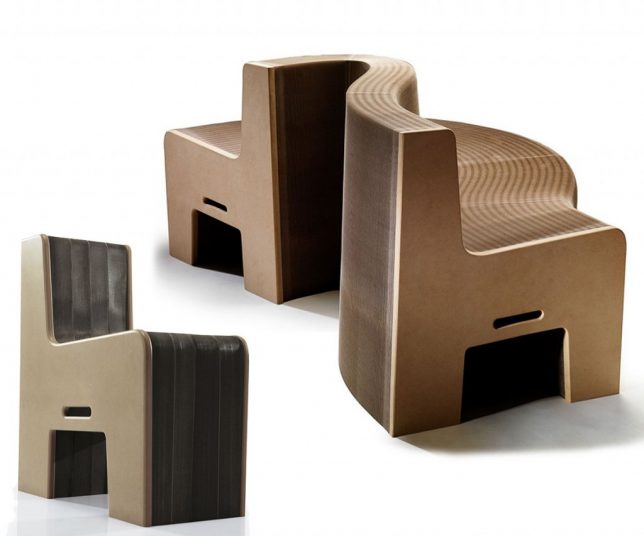
  • Slinky Chairs: Accordion-Style Transforming Furniture Stretches & Bends

    [ By SA Rogers in Design & Furniture & Decor. ]

    What starts as a flat, stackable, highly portable package expands more than ten times its original size when you pull on either end, bending and curling to become a sofa for a group. The Flexible Love Sofa and Chair are made from 100% recycled paper, yet they’re surprisingly strong, with the longer sofa holding up to 4,232 pounds at once when fully expanded. Designed in Taiwan, the series is available in ‘marble’ white, ‘lava’ black and ‘earth’ brown, and measures just over 5 inches across when collapsed.

    The Flexible Love company shows off what the seats can do in a series of videos, so you can see it in action. It looks remarkably easy to manipulate, and somehow stays in place when you curl it into an S-shape or bend one end to the ground. If you’re skeptical that it can really hold as much weight as the company claims when expanded to its full 30-foot width, they’ve provided several images in which a group of people all stand on the seat at once.

    With furniture like this, you’d never need to worry about accommodating extra guests again. It’s fun to see the different ways in which it can be arranged around tables. Each piece is hand-crafted of FSC-certified materials, assembly-free, recyclable and made with non-toxic finishing. Though the Flexible Love website is currently down for maintenance, you can purchase both the sofa and chair model at Expand Furniture in the meantime, with prices starting at $ 380.

    Share on Facebook


    [ By SA Rogers in Design & Furniture & Decor. ]

    [ WebUrbanist | Archives | Galleries | Privacy | TOS ]


    WebUrbanist

  • On1 Photo RAW 2018 announced: Adds HDR processing, advanced masking and more

    $ (document).ready(function() { SampleGalleryV2({“containerId”:”embeddedSampleGallery_1486583421″,”galleryId”:”1486583421″,”isEmbeddedWidget”:true,”standalone”:false,”selectedImageIndex”:0,”startInCommentsView”:false,”isMobile”:false}) });

    On1 just released the newest version of its stand-alone RAW photo manager and non-destructive editor: On1 Photo RAW 2018. Put another way, there’s now yet another alternative to Lightroom out there, and with this new update the program is more capable than ever, adding features like HDR merge and panorama stitching, advanced masking capabilities, and more.

    You can get a decent overview of the new features in the 2018 version in the video below:

    The main additions to this version of On1 Photo RAW are On1 HDR, panorama stitching, new advanced masking options like Feather and Density that allow you to alter a mask globally, Color range masking, versioning, selective noise reduction, and an updated UI that On1 characterizes as “clean and modern.” There’s also a new “Paint with Color Brush” that allows you to either paint with a solid color or leave the luminosity of the underlying layer intact to change things like eye or hair color.

    You can get a full breakdown of these and other new features on the On1 blog.

    The app is being released as a free Beta on Friday, with an official release slated for the end of October. The full app—which promises ‘much more’ when it arrives after the beta period—will cost $ 120 for new users, while current On1 users will have the option to upgrade for a discounted price of just $ 80 (usually $ 100). Both the full version and upgrade package are already available for pre-order.

    To learn more about the app or pre-order your copy, head over to the On1 blog by clicking here.

    Articles: Digital Photography Review (dpreview.com)