RSS
 

Archive for August, 2017

Throwback Thursday: the iPhone 4S

10 Aug
Credit: Gabriele Barni

Late 2011 was a period of big changes for me. I had just finished up college, an internship, and landed my first ‘big boy’ job at Puget Sound Energy doing photo and video for their communications department. It was also around this time that I got my very first smartphone, an act which would forever change my perspectives on photography.

Okay, well, it was my second smartphone that did that. My first was a Blackberry Bold, which was a Puget Sound Energy company phone, and I very briefly thought that it was amazing. I was wrong. You see, wanting to keep my work and personal life somewhat separate, I figured I should purchase my own smartphone for personal use. So I picked up a just-released iPhone 4S, and the Blackberry felt prehistoric in comparison.

With a decent camera in my pocket at all times, I of course started an Instagram account and promptly put a photo of a bagel sandwich up for all the world to see. Yes, this is literally the first image on my Instagram profile, and it’s probably damaging my credibility to this day.

A lot of people credit cell phone cameras with the death of the compact camera, but I think the iPhone 4S was one of the first cell phones with quality that could really rival the PowerShots and Coolpix’s of the day. In high school, VGA camera phones were all the rage, but a lot of us still carried around a dedicated compact camera for ‘real’ photos.*

But with the iPhone 4S, you got an 8MP sensor, a reasonably fast F2.4 lens, 1080p HD video recording and a Retina high-density display that was probably the best display I’d ever seen up until that point. Suddenly, for an average consumer to get appreciably better image quality, you had to step up to a reasonably high-end camera, and that’s why I think the iPhone 4S was the final nail in the compact camera’s coffin.**

Of course the Sony RX100 came out the following summer and, though it did inspire eventual competition and somewhat stemmed the hemorrhaging sales of compact cameras, the $ 650 MSRP was a sign that dedicated photography tools capable of truly better output than a phone were going to be pushing ever further up-market. In other words, further out of the reach of average consumers, reinforcing for those consumers that a camera someone already has on his or her phone is going to be good enough.***

For the benefit of mankind and my personal friendships, I got over my strange obsession with posting images of my meals, and started taking pictures of other things. Cropped to taste.

In any case, I was lucky enough to have a DSLR at the time for more serious work, but whenever I didn’t want to lug that around, the iPhone 4S was there. I even ended up preferring the phone to an original Olympus Pen Mini for casual photography because of its speed, overall image quality and the ability to quickly share images to the web. Without Google Drive or Wi-Fi pairing, it was an ordeal to get images onto the iPhone from any source other than the internal camera.

In fact, looking back on my own photos from early on with the 4S, I’m struck by how often I thought that an Instagram filter was an improvement, when really, some more careful framing and more conservative editing would have been better advised. But maybe there’s more to it. I can see now that the iPhone 4S’s camera was good enough that it wasn’t the limiting factor for me at the time, it was just my own skill and taste (or in this case, a lack thereof).

This is one of the less egregious crooked horizons and ‘filter jobs’ I could find on the early days of my Instagram account, but it still looks darn overcooked to me these days.

Something about how most of the images I can find from this camera are uploaded and super compressed and all that.

As I grew in my career and as a photographer, I ended up getting a cheap Moto G when the iPhone 4S started to feel a little dated. I should have known better. I had become absolutely addicted to having at least a decent camera in my pocket at all times, and images from the Moto G just looked washout out and ‘cheap’ in comparison to the iPhone, despite having the same 8MP resolution.

That ‘addiction’ to a decent camera is something that has reached epidemic proportions throughout the world. For better or for worse, photography has been democratized and commoditized, and there just isn’t any going back – and while yes, we can thank smartphones in general for that, the iPhone 4S was one of the more influential players in changing the way that we view smartphone cameras and smartphone photography.

Photo by Scott Everett

* ‘Real’ photos usually included my 1980 Datsun 210, or trying to perfectly time the shooting of an unopened soda can with a bow and arrow. You know. High school kid stuff.

** The advent of 1080p video capture in phones is also probably why Flip and other pocket camcorders disappeared seemingly overnight.

*** After having gotten used to the iPhone 4S, I still thought for a while I had a need for a cheap, carry-everywhere camera, maybe with an optical zoom. So I got a Canon PowerShot A1200 at Costco, and the photos were absolutely horrible in comparison to the phone. For a long while, I swore off ever having a camera that lay somewhere between my iPhone and my D80.

Articles: Digital Photography Review (dpreview.com)

 
Comments Off on Throwback Thursday: the iPhone 4S

Posted in Uncategorized


Instagram and Snapchat expected to hit $10B and $3B in revenue by 2019

10 Aug

Instagram and Snap Inc., the company behind Snapchat, are expected to see massive revenue growth over the next couple years, according to a research note released by Citi Research. If Citi’s predictions pan out, Instagram will reach almost $ 10 billion in revenue by 2019, while the smaller but highly popular Snapchat may hit the $ 3 billion mark. The reasons for each apps’ growth differ, however.

As far as Instagram goes, the company enjoys a massive user base of about 500 million, which is largely behind the anticipated growth. Snapchat, by comparison, boasts a much smaller user base of about 170 million, but those users spend much more time on the app than Instagram’s users. According to Citi, Snapchat users are spending more than 30 minutes on the app per day on average.

Both companies are facing an increasing number of competitors, Snapchat in the form of cloned features like Facebook and Instagram Stories, whereas Instagram is competing with the likes of VSCO, EyeEm, and similar platforms. Still, for now it doesn’t look like either of these photo sharing behemoths have anything to fear but… well… each other.

Articles: Digital Photography Review (dpreview.com)

 
Comments Off on Instagram and Snapchat expected to hit $10B and $3B in revenue by 2019

Posted in Uncategorized


Capturing the ‘Cape’: A beautiful piece of Iceland you probably haven’t seen

10 Aug

$ (document).ready(function() { SampleGalleryV2({“containerId”:”embeddedSampleGallery_7577516957″,”galleryId”:”7577516957″,”isEmbeddedWidget”:true,”standalone”:false,”selectedImageIndex”:0,”startInCommentsView”:false,”isMobile”:false}) });

In 2013 I was accepted for a one month artist in residence at the Baer Art Center in northern Iceland. After a wonderful month the other four artists and myself were taken on a boat trip up the coast, right past where we were staying, to the see “Cape” just north of Hofsos, a large land mass of mostly stone with a huge cliff at one end. I don’t know that I’ve been the same since.

Although I’d been told to bring what gear I had I was totally unprepared for what we saw that day. The geological phenomena of these rock columns of basalt being thrust up in ancient times from a violent volcano was just unbelievable, both beautiful and horrific at the same time.

I am writing this for DPReview while back in Iceland, as I was asked back by Baer to teach a photo workshop. Last week we repeated the boat trip up the coast of the fjord and I found myself again in front of the remarkable cliff face of the “Cape”. It was magic once again.

The job was, vey simply, not to screw up. Working to hold the camera steady on a rocking boat, to keep shutter settings fast enough, to make sure I was focused best for my subject and aperture setting and to “get everything”, as there was no going back that day.

To get to the Cape you’ll need to hire an excursion boat in the harbor in Hofsos, in northern Iceland.

Not to be missed.


Neal Rantoul is a career artist and educator. After 10 years teaching at Harvard and 30 years as head of the Photo Program at Northeastern University in Boston, he retired from teaching in 2012. You can find out more about him and see more of his work by visiting his website.

Articles: Digital Photography Review (dpreview.com)

 
Comments Off on Capturing the ‘Cape’: A beautiful piece of Iceland you probably haven’t seen

Posted in Uncategorized


Splitting Bricks: Architectural Art Installation Tears a London Building Apart

10 Aug

[ By SA Rogers in Art & Sculpture & Craft. ]

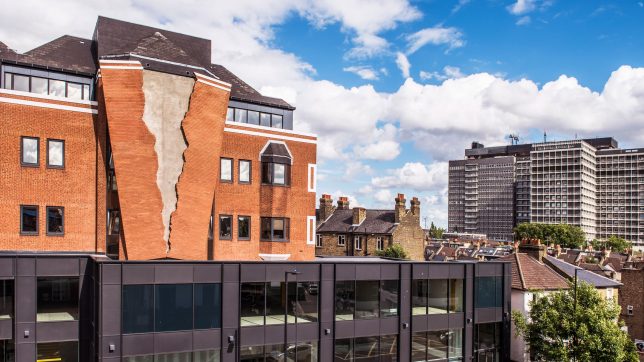
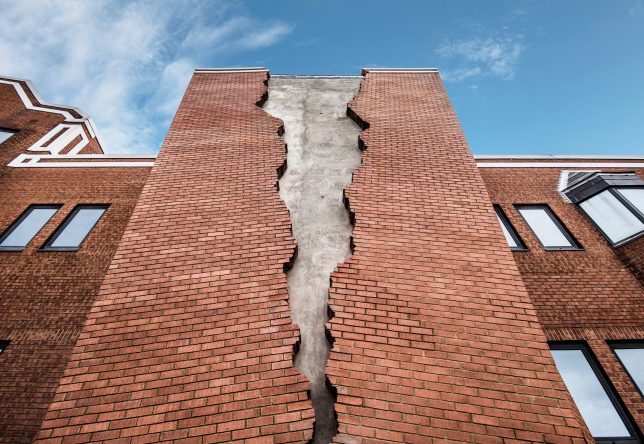
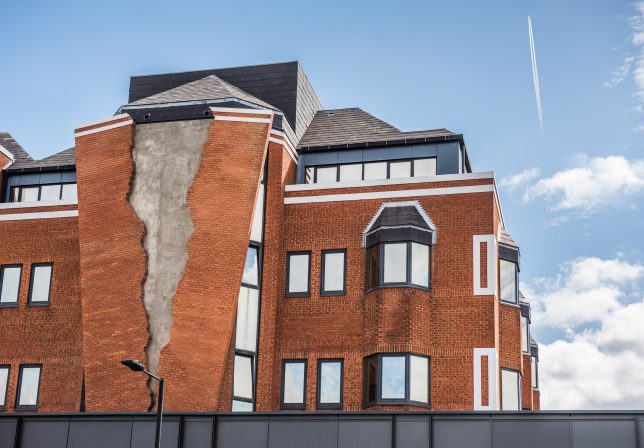
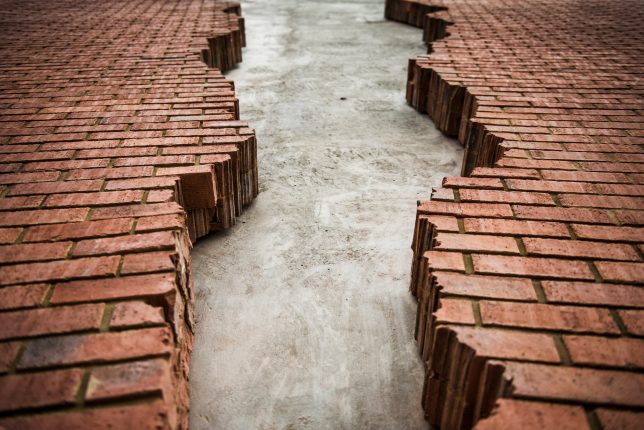
A London building appears to have fallen victim to an earthquake tremor or foundation collapse, with a jagged section of its brick facade split in half and threatening to collapse altogether. But the deteriorating appearance of this otherwise pristine structure isn’t quite what it seems. Artist Alex Chinneck used 4,000 bricks to create the effect of a ripped piece of paper to create ’Six Pins and a Half Dozen Needles,’ a nearly 66-foot tall sculpture outside a mixed-use complex known as Assembly London.

With the paper reference, the artist pays tribute to the site’s former life as home to the publishing company Hammersmith. Chinneck says he spent months scanning torn sheets of paper to find just the right pleasing edge for the split. The sculpture blends into the main building behind it, partially obscuring a few windows, and its elevated position makes it a real eye-catcher. It’s two bricks deep, and took 14 months to complete, with the help of structural engineers, steelworkers and brick makers. Its stainless steel framework is bolted and welded to the building behind it.

Chinneck previously dropped jaws and raised eyebrows in London with two particularly dramatic installations: an upside-down car clinging to a curling piece of pavement outside the Southbank Centre, and a brick facade sliding off the front of a building in Kent. Unlike these previous works, however, ‘Six Pins’ is permanent.

“The work was onceived to engage people in a fun and uplifting way,” says Chinneck. “Although we use real brick, it was designed with a cartoon-like quality to give the sculpture an endearing artifice and playful personality. I set out to create accessible artworks and I sincerely hope this becomes a popular landmark for London and positive experience for Londoners.”

Share on Facebook


[ By SA Rogers in Art & Sculpture & Craft. ]

[ WebUrbanist | Archives | Galleries | Privacy | TOS ]


WebUrbanist

 
Comments Off on Splitting Bricks: Architectural Art Installation Tears a London Building Apart

Posted in Creativity


NPPA says LA public park photography ban is unconstitutional

10 Aug
LA instituted a blanket ban on photography in Pershing Square during the Downtown Stage summer concerts, but the NPPA, ACLU, and others say the ban is unconstitutional. Photo: Visitor7

A photography ban that is being ‘strictly enforced’ in a Los Angeles public park during a series free concerts has been branded ‘unconstitutional’ by city and national media and public liberties groups.

The picture-taking ban was put in place by the Los Angeles Department of Recreation and Parks at the request of the performers of the Pershing Square Downtown Stage summer concerts that are being held in the Pershing Square public park. However, freedom groups including the American Civil Liberties Union (ACLU) have complained the ban is at odds with the First Amendment of the American Constitution.

As the park is a public space, the City is acting unlawfully by restricting the rights of citizens and the media to record the events, and it doesn’t have the power to overrule constitutional rights, according to lawyers working for a group of bodies fighting the ban.

The National Press Photographers Association, Society of Professional Journalists/Los Angeles Chapter, Society of Professional Journalists/National, California Broadcasters Association, Electronic Frontier Foundation, American Photographic Artists, American Society of Media Photographers, Digital Media Licensing Association, Freedom of the Press Foundation, Professional Photographers of America, Radio and Television Digital News Association, and Reporters Without Borders have got together with the ACLU to prepare a letter that was sent to the City department in which the collective protests the ban and states why it is unlawful.

The group specifically objects to a clause in the terms and conditions of the concerts that states that even photography and videography made on iPads will not be allowed:

(1) Cameras/Photography: At the request of the artist/performer, video, photo and audio devices are prohibited at Pershing Square’s Downtown Stage Saturday concerts. This includes Pro cameras, monopods, tripods, selfie sticks, iPads or professional photography/video equipment of any type. This policy will be strictly enforced due to contractual agreement.

“There should be no restrictions on photography and videography in Pershing Square during the Summer Concert Series or at any other time,” reads the letter. “Even assuming the photography ban is being applied in a content-neutral manner, the rule is still unconstitutional.”

“Unfortunately, the NPPA sees these type of onerous restrictions far too often nationwide,” Mickey Osterreicher, the general counsel for the National Press Photographers Association, said in a statement. “It is still extremely difficult to understand how the City of Los Angeles and its attorneys could believe they had the authority to contractually agree to a request barring photography and recording along with audio-visual devices from a traditionally public forum such as Pershing Square during certain events.”

The restrictions at the events also cover the ability of attendees to record audio and to distribute leaflets, which are also considered to be unconstitutional considering the freedoms that are inherent in public forums.

For more information see the NPPA and ACLU websites.

You can read the full letter, which the NPPA helped to draft, sent from the ACLU to the Los Angeles Department of Recreation and Parks below:

August 3, 2017

Via E-Mail
Mr. Mike Feuer
Los Angeles City Attorney
James K Hahn City Hall East, Suite 800
Los Angeles, CA 90012

Mr. Michael A. Shull
Los Angeles Dept. of Rec. and Parks, General Manager
221 N Figueroa St., 3rd Floor, Suite 350
Los Angeles, CA 90012

Dear Messrs. Feuer and Shull:

I am writing on behalf of the National Press Photographers Association, Society of Professional Journalists/Los Angeles Chapter, Society of Professional Journalists/National, California Broadcasters Association, Electronic Frontier Foundation, American Photographic Artists, American Society of Media Photographers, Digital Media Licensing Association, Freedom of the Press Foundation, Professional Photographers of America, Radio and Television Digital News Association, and Reporters Without Borders about City rules and policies that apply to Pershing Square, particularly to the Summer Concert series, that violate the First Amendment. Because Pershing Square is a public forum, any restrictions on First Amendment activities there must be content-neutral, reasonable time, place, and manner restrictions. The existing policies providing for a total ban on photography/videography and an arbitrary permitting scheme for circulating pamphlets at the Downtown Stage Summer Concert Series are facially unconstitutional, as will be shown below.

Accordingly, I request that these policies be modified to comport with the United States Constitution. Namely, there should be no restrictions on photography and videography in Pershing Square during the Summer Concert Series or at any other time. Additionally, distribution of pamphlets, flyers, or other printed, non-commercial materials is a protected First Amendment right and should not be limited either.

The Summer Concert Series Policies at Issue
The ACLU’s First Amendment concerns relate to the stated policies of the Los Angeles Department of Recreation and Parks listed on the department’s website1. The specific policies at issue are as follows:

(1) Cameras/Photography: At the request of the artist/performer, video, photo and audio devices are prohibited at Pershing Square’s Downtown Stage Saturday concerts. This includes Pro cameras, monopods, tripods, selfie sticks, iPads or professional photography/video equipment of any type. This policy will be strictly enforced due to contractual agreement.

(2) Flyers/Handouts/Product Samples: The distribution of promotional items, flyers or printed materials is not permitted without written permission of Pershing Square. The sampling and distribution of products is prohibited without a venue permit.

When contacted about the specifics of the second policy, the Department of Recreation and Parks redirected the ACLU to the Pershing Square office to answer questions regarding permitting criteria. An employee of the park later informed the ACLU that “in general” distribution of expressive materials is not allowed at Pershing Square at any time. When asked what authority governed this rule, that same employee vaguely referred the ACLU to a “post order” issued by the local police department. The ACLU has since contacted the Central Community Police Station and requested the “post order” but has yet to receive a response.

Legal Standard
Governmental restrictions on expressive activity like photography and leafletting are subject to the most searching scrutiny when they apply in public fora. See Perry Education Assn. v. Perry Local Educators’ Assn., 460 U.S. 37, 45 (1983) (“[In the public forum,] the rights of the state to limit expressive activity are sharply circumscribed.”) Courts engage in “forum analysis” to determine the validity of speech restrictions applied to a given piece of government owned or controlled property. See Walker v. Texas Div., Sons of Confederate Veterans, Inc., 135 S.Ct. 2239, 2250 (2015) (recognizing that “‘forum analysis’ [is applied] to evaluate government restricts on purely private speech that occurs on government property.”) Federal courts classify government-owned property into three categories for purposes of forum analysis(1) traditional public forums; (2) public forums by government designation (areas opened for limited expressive use; and (3) nonpublic forums (which, by tradition or design are not appropriate platforms for unrestrained communications; e.g., military installations and federal workplaces). See Perry, 460 U.S. 37 at 43–47.

Public parks have long been deemed public forums by the United States Supreme Court. See Perry, 460 U.S. 37 at 45 (“[A]t one end of the spectrum are streets and parks which ‘have immemorially been held in trust for the use of the public.”). Governmental actors may only restrict expressive activity in a public forum through reasonable time, place, and manner regulations. Id. However, when the government seeks to enforce a content-based prohibition in these spaces, its regulations must be narrowly-tailored to further a compelling state interest. Id. Pershing Square is a public forum, and remains one during the Summer Concert Series. The Park does not suddenly become a non-public forum even if the City in some way yields control of the park to a concert promoter or other private party during the concerts, contrary to the City’s belief and practice. See Rule 1 on Cameras/Photography (“This policy will be strictly enforced due to contractual agreement”).

Numerous courts have rejected the argument that private contracting over traditional public forums abrogates the government’s First Amendment obligations. The Second Circuit, for instance, has held that a publicly-funded stadium managed by a private company under a long-term lease was still a public forum. See Paulsen v. County of Nassau, 925 F.2d 65, 69–70 (2d Cir. 1991) (pointing to the intent of the government in creating the forum, the fact that the private contractor was to “operate[] [the stadium] in the interests of the County,” and the history of consistent practice of allowing the enjoyment of First Amendment rights, parades, political rallies, speeches, etc., as objective evidence that stadium was a public forum by government designation). The Tenth Circuit has similarly held that a public sidewalk sold by Salt Lake City to a church organization was still considered a public forum, even while technically owned by the church. First Unitarian Church of Salt Lake City v. Salt Lake City Corp., 308 F. 3d 1114, 1123-24 (10th Cir. 2002).

Because the City retained an easement on the sidewalk and because of the property’s objective characteristics, the Tenth Circuit rejected the argument that the sale of the land transformed the sidewalk into a non-public forum where First Amendment activities could be absolutely restricted. Id. at 1124–25. The objective characteristics the court looked to in determining whether the sidewalk was a public forum were (1) whether the property shares “physical similarities” with more traditional public forums; (2) whether the government has permitted broad public access to the property; (3) whether expressive activity would “tend to interfere in a significant way with the uses to which the government has as a factual matter dedicated the property”; and (4) whether the property has traditionally been open to the public. Id. at 1125 (internal quotation marks and citation omitted). Here, factor one is met because even during the concert series – the park maintains its typical physical characteristics, mirroring other public parks across the City.

Factor two is met; indeed, the concert series is free and open to the public. Factor three is met as well; the concert itself is actually devoted to expressive activity, the playing of music, the sharing of ideas through sound. Therefore, the activity that the government seeks to restrict here would not interfere with the temporary use that the park is devoted to, it is instead part-and-parcel with that use. Lastly, factor four is met; Pershing Square has been open to the public for more than one-hundred years and according to the park’s website, its role as a location for expressive activity dates back to 1918.2 Thus, Pershing Square is a public forum during the Summer Concert Series.

Analysis
Because the park is a public forum, the question becomes whether the rules at issue, enforced by the Los Angeles Department of Recreation and Parks are reasonable time, place, and manner restrictions.

Video/Photo/Audio Device Prohibition
Private citizens have a First Amendment right to record film/audio and take photographs in public. See Turner v. Driver, 848 F.3d 678, 689 (5th Cir. 2017) (recognizing that the First Amendment’s protects “the right to film”.); Am. Civil Liberties Union of Illinois v. Alvarez, 679 F.3d 583, 595 (7th Cir. 2012) (“The act of making an audio or audiovisual recording is necessarily included within the First Amendment’s guarantee of speech and press rights as a corollary of the right to disseminate the resulting recording. The right to publish or broadcast an audio or audiovisual recording would be insecure, or largely ineffective, if the antecedent act of making the recording is wholly unprotected, as the State’s Attorney insists.”); Fordyce v. City of Seattle, 55 F.3d 436, 439 (9th Cir. 1995); Crago v. Leonard, 2014 WL 3849954 at *3 (E.D. Cal. 2014) (“As early as 1995, the Ninth Circuit has recognized a ‘First Amendment right to film matters of public interest.’”); see also Fields v. City of Phila., 2017 WL 2884391 (3d Cir. 2017) (clarifying that the First, Fifth, Seventh, Ninth, and Eleventh Circuit Courts of Appeals have recognized a First Amendment right to record police activity in public)’

Thus, the government may only regulate photography and recording at the Summer Concert Series via reasonable time, manner, and place restrictions. To sustain a time, place, and manner restriction on First Amendment activities, the government must show that the restriction (a) is content-neutral, (b) is narrowly tailored to serve a significant government purpose, and (c) leaves open ample alternative channels of communication. See Ward v. Rock Against Racism, 491 U.S. 781, 789 (1989).

Even assuming the photography ban is being applied in a content-neutral manner, the rule is still unconstitutional. For one, the government does not have a clear, significant interest in a blanket ban on photography and videography at free, public concerts. Perhaps the City believes that the ban serves to protect the copyright interests of performers. If so, the ban is unconstitutionally overbroad because it prohibits a large range of activities that do not violate copyright law. First, many people will use their cameras, iPhones, etc. to take selfies, or to share video clips with friends on Facebook, with no intent to use them for commercial purposes. These uses are generally lawful “fair uses” Similarly, freelance and media photographers or critics may

take photographs or video for inclusion in media outlets. Journalistic and critical uses do not violate copyright law either, even if the freelance photographer is paid by a media outlet, or the media outlet publishes them in a newspaper that is sold. In the event that an individual goes beyond the bounds of “fair use” and violates the rights of a performer, copyright law provides a more than adequate remedy. See, e.g., CAL. CIV. CODE. § 3344(a) (West 1984). Thus, a blanket ban on recording is not narrowly tailored to satisfy this – or any other – important interest.

Flyer/Handout/Product Sample Prohibition

The distribution of expressive materials in public is also protected by the First Amendment. See Hague v. Comm. For Indus. Org., 307 U.S. 496 (1939) (deeming facially unconstitutional a municipal ordinance that prohibited leafletting on “any street or public place” without a permit); Klein v. City of San Clemente, 584 F.3d 1196 (9th Cir. 2009) (affirming preliminary injunction against law banning leafletting on parked cars); Foti v. City of Menlo Park, 146 F.3d 629 (9th Cir. 1998) (deeming facially unconstitutional a municipal ordinance in California that banned signs placed on vehicles parked in public roadways designed to “attract the attention of the public”). Therefore, the same standard used to analyze the validity of the video/photo/audio device prohibition applies here: any regulation must be reasonable as to time, place, and manner and comport with the standard established under Ward v. Rock Against Racism, 491 U.S. at 789.

As is the case for the photography/videography ban, the City will be unable to demonstrate that the ban on leafletting without permission is consistent with the First Amendment for two reasons. First, the permitting system in place is so arbitrary that it invites discrimination and thus, is facially unconstitutional. The current rule, as written on the Pershing Square website3, contains no criteria whereby officials decide whether to allow or reject a permit application. Nor does that website provide a link to download or submit a permit application. Officials at the Los Angeles Department of Recreation and Parks also report that there is “no uniform department policy on how permits are issued” and that “case-by-case permitting decisions are made on site [at the Summer Concert Series].” The lack of a permitting policy from the Department results in a “standardless discretion” possessed by the government, which is clearly inconsistent with the First Amendment. See Forsyth County, Ga. v. Nationalist Movement, 505 U.S. 123, 140 (1992).

Second, if the City were to simply ban leafletting without effectuating its arbitrary permitting system, that ban is overbroad, even if the City were to assert valid interests it is trying to further through the ban. See generally Klein v. City of San Clemente, 584 F.3d 1196, 1202 (9th Cir. 2009) (“As both this court and the Supreme Court have repeatedly emphasized, ‘merely invoking interests … is insufficient. The government must also show that the proposed communicative activity endangers those interests.’”) (citation omitted).

Examples of possible legitimate interests for a restriction on distribution of expressive materials are relieving overcrowding, expediting traffic flow, and maintaining the privacy and quiet enjoyment of civilians. See Saieg v. City of Dearborn, 641 F.3d 727, 736 (6th Cir. 2011); City of Watseka, 796 F.2d 1547, 1550 (1986). But courts are highly unlikely to conclude that a leafletting ban is narrowly tailored to those asserted interests. Concerts are inherently noisy and crowded; thus, the government cannot claim to have a legitimate interest in maintaining privacy, relieving overcrowding, or expediting traffic flow because such an interest would cut against the natural and foreseeable results of the government’s own actions here, putting on the Summer Concert Series. Nor can the City justify its ban by asserting a desire to prevent littering because there are obvious, far less restrictive means to solve the problem, e.g., enforcing the city’s littering laws, which undercut the government’s position. See e.g., Schneider v. State of New Jersey, Town of Irvington, 308 U.S. 147, 163 (1939) (“There are obvious methods of preventing littering. Amongst these is the punishment of those who actually throw papers on the streets.”). Moreover, the City does not ban people attending the concert series from bringing food, coffee, newspapers, and other materials to the Summer Concert series, and it is hard to believe that leafletting would add significantly to the amount of litter the City is already prepared to deal with. See Klein, 584 F.3d at 120-2-03.

Conclusion
In sum, neither the photography/videography ban nor the arbitrary permitting scheme for distribution of expressive materials will be upheld in court as valid time, place, and manner restrictions on the First Amendment. In fact, the City of Los Angeles has already lost at the Ninth Circuit on one of these issues. See Gerritsen v. City of Los Angeles, 994 F.2d 570, 575–77 (9th Cir. 1993) (holding a similarly restrictive “handbill-distribution scheme” in El Pueblo Park unconstitutional). Though the United States Constitution and the Supreme Court’s jurisprudence are clear on this issue, the decision from the Ninth Circuit in Gerritsen sent a striking message to the City of Los Angeles: local government may not arbitrarily infringe upon its citizens’ First Amendment rights in public parks. The fact that the City has chosen to promulgate and enforce rules that violate these rights for the second time in just over twenty years makes it likely that a court would deny qualified immunity if anyone who was prohibited from leafletting or taking pictures were to bring a suit for damages. Accordingly, the ACLU urges the City to eliminate its rules restricting First Amendment activity in Pershing Square or, at the very least, modify them to comport with the United States Constitution.

Please contact me within the next 10 days to ensure that steps are being taken to solve these problems. If the City intends to stand by these restrictions, the ACLU will consider all appropriate action to address these constitutional violations.

Sincerely,

Peter J. Eliasberg
Chief Counsel/
Manheim Family Attorney
For First Amendment Rights

Articles: Digital Photography Review (dpreview.com)

 
Comments Off on NPPA says LA public park photography ban is unconstitutional

Posted in Uncategorized


Underground Art: 11 Subterranean Galleries & Installations Delve Deep

10 Aug

[ By SA Rogers in Art & Installation & Sound. ]

Often mysterious, somber and a little otherworldly, subterranean spaces add a sense of depth (no pun intended) to the art installations and performances held within them. Abandoned subway platforms, tunnels beneath old psychiatric hospitals, cisterns, ice wells, bunkers and even manholes invite us to descend beneath the surface of the earth to experience art on another level.

The Water at The Cisterns by Hiroshi Sambuichi

Damp and dreary yet monumental, with the proportions of a cathedral, this former underground water reservoir in Copenhagen was once an unknown beauty beneath the city, but now functions as ’The Cisterns,’ an unusual art venue. Japanese architect Hiroshi Sambuichi delicately transforms the space while paying respect to all of these qualities with ‘The Water,’ a subterranean landscape installation taking viewers on “a journey through an underground sea of light and darkness.” Natural light, moss and an icy glass cube play with the humidity and moisture levels of the space, making it feel a bit like a secret underground forest.

JFK Figurine Hidden in a Desert Bunker

You’re hiking through the unforgiving plains of the California desert when you come upon a mysterious black hatch. Against your better judgment, you open it and climb down the ladder into a huge metal pipe that appears to be part of some kind of bunker. Inside, what you find is more bizarre than pretty much anything you could have imagined: a statue of John F. Kennedy perched on a stool, casually crossing his legs. Artist Will Boone based his sculpture on a figure from a hobby kit, scaling it up to life-size. To him, the installation “speaks not just to all those things that have been driven underground since the extinguished optimism of the sixties but to those same fears – nuclear attack and the invasion of the other – that have been so vividly resurrected in recent times.”

Secret Sculptural Installations Beneath Paris

Artist Radouan Zeghidour descended into the many subterranean spaces beneath Paris to illegally install secret art installations, each one often requiring many hours of investigative preparation both to access the space, avoid getting caught and keep the art undisturbed for as long as possible, though he’s gone to jail once or twice. The installations themselves often feel like reverent tributes to the people who occupy liminal spaces in society, evoking camps where homeless people and refugees often live.

Repurposed Oil Tanks at the Tate Modern in London

Repurposed by the firm Herzog & de Meuron, the enormous underground oil tanks of a former power station now act as a dramatic backdrop for performances, interactive art and video installations at London’s Tate Modern. “No longer generating electricity, the Tanks generate ideas, creative energy and new possibilities for artists and audiences,” says the museum. “These raw, industrial, subterranean spaces, each measuring over thirty meters across and seven meters high are the world’s first museum galleries permanently dedicated to exhibiting live art, performance, installation and film.” [Middle photo by Ray Tung/Rex Features.]

D.C.’s Dupont Underground Arts Space

The 75,000-square-foot east platform of Washington D.C.’s subterranean trolley station Dupont Underground is now a visual art and performance space hosting revolving exhibitions as well as performances, permanent murals and other programming. Lying beneath the city’s Dupont Circle about a mile from the White House, this underground space was closed off in 1962 when the city’s streetcar system shut down, and remained empty until the new arts space opened in 2015. Among the installations it has hosted is ‘Whimsical Invasion’ by Hyuntek Yoon and Youngeun Kwun, consisting of over 650,000 plastic balls in nylon netting.

Next Page – Click Below to Read More:
Underground Art 11 Subterranean Galleries Installations Delve Deep

Share on Facebook


[ By SA Rogers in Art & Installation & Sound. ]

[ WebUrbanist | Archives | Galleries | Privacy | TOS ]


WebUrbanist

 
Comments Off on Underground Art: 11 Subterranean Galleries & Installations Delve Deep

Posted in Creativity


Inspiration: All the reasons why you shouldn’t be a photographer

09 Aug

If you’ve ever felt down, defeated, unmotivated, uncertain and unsure whether you should go on being a photographer, then this video is for you. And since all of us, at one time or another, have felt this way; this video is for all of us. Put together by visual artist Simon Cade of DSLRguide, it tackles the most common insecurities and uncertainties that make any artist, photographers included, want to just give up and quit.

There’s real power in voicing these insecurities, in letting other photographers and creatives know that they’re not alone. And over the course of two and a half minutes Cade hits just about all of them.

  • “I don’t have the money to make what I want to make.”
  • “I don’t have the time to make what I want to make.”
  • “I don’t have the talent.”
  • “I don’t have the work ethic.”
  • “I don’t have the creativity.”
  • “I’ll never be as good as the greats.”

How many times have thoughts like this run through your head? If you’re a creative in any respect—be it an amateur with dreams of shooting professionally, or a successful professional experiencing one of those periodic ruts we all find ourselves in from time to time—chances are good the answer is “all the freaking time.”

Cade’s hope, what he’s trying to inspire us all to do with this short, poignant video, he expresses at the end of the video:

“One day, I hope to ignore my insecurities, set aside my doubts of fine art, have the backbone to push through all of those reasons why not. But most of all, one day I’d like to be as carefree as a child painting a page with delight. Because kids don’t worry themselves with the reasons why not. They throw paint at the page just to see what the colors do… cause, why not?”

Articles: Digital Photography Review (dpreview.com)

 
Comments Off on Inspiration: All the reasons why you shouldn’t be a photographer

Posted in Uncategorized


Photographer travels around the globe to photograph all her Facebook friends

09 Aug
Ahna Anomaly, San Francisco, California

Social networks have changed the meaning of friendship. They might be called Facebook ‘friends,’ but we might not have seen some of these people in a long time, or even met them in person. With this paradigm in mind, photographer Tanja Alexia Hollander decided to take friendship back out of the virtual and into the real world, by visiting and photographing all of her 626 Facebook friends.

Since 2011 she has been traveling around the USA and to countries as far as the UK, Belgium, France, Greece, and Malaysia to meet her friends in their homes, take their portrait and share real-life experiences with them.

Shannon Lam and Maury Browning, Sungai Long, Malaysia

According to MASS MoCA in North Adams, MA, where Hollander’s Are you really my friend? is currently on display, the project turned from a personal documentary on friendship into,

“…an exploration of contemporary culture, relationships, generosity and compassion, family structure, community-building, storytelling, meal-sharing, the economy and class, the relationship between technology and travel in the 21st century, social networking, memory, and the history of the portrait.”

Mary Bok with Surely and Honey the dogs, Camden, Maine

You can see all the images and learn more about Are you really my friend? on the project website. You can also follow Tanja Alexia Hollander on Instagram, Facebook and Twitter to find out about her ongoing work.


All images courtesy of Tanja Hollander and MASS MoCA, used with permission

Articles: Digital Photography Review (dpreview.com)

 
Comments Off on Photographer travels around the globe to photograph all her Facebook friends

Posted in Uncategorized


Vintage lens shootout: three lenses, one model

09 Aug

Vintage lens enthusiast Mathieu Stern took a break from coughing up fake blood in the name of dispelling lens myths this week to compare some of his favorite vintage lenses in a shootout. Stern went out for a single photo shoot with one model and three vintage lenses: the Canon FD 50mm f/1.4 S.S.C., the Soligor 21mm f/3.8, and the Helios 103 53mm f/1.8 (modified for tilt focusing).

The video is the first in a new video series that will help highlight the unique qualities of vintage glass by comparing three lenses at a time.

Definitely don’t expect ultra-sharp photos that’ll compare with the best (technically speaking) glass of today. But you should expect unique and interesting looking photos that might just inspire you to pick up some of these cheap old lenses on eBay and have some fun. Here’s a sample photo captured with each lens:

$ (document).ready(function() { SampleGalleryV2({“containerId”:”embeddedSampleGallery_9952767520″,”galleryId”:”9952767520″,”isEmbeddedWidget”:true,”standalone”:false,”selectedImageIndex”:0,”startInCommentsView”:false,”isMobile”:false}) });

If you’re into the vintage look, the nice thing about these lenses is that they usually don’t cost you much to try out for yourself. Just do a quick eBay search and you’ll see that you can grab a Helios 103 53mm f/1.8 for less than $ 40, a Canon FD 50mm f/1.4 S.S.C. for about $ 80, and the most expensive of the bunch, the Soligor 21mm f/3.8, for $ 275.

For more vintage lens reviews and other oddball videos, check out Mathieu’s YouTube Channel.

Articles: Digital Photography Review (dpreview.com)

 
Comments Off on Vintage lens shootout: three lenses, one model

Posted in Uncategorized


Amazon sells an AmazonBasics flash for Canon and Nikon DSLRs for just $28

09 Aug

$ (document).ready(function() { SampleGalleryV2({“containerId”:”embeddedSampleGallery_5138648754″,”galleryId”:”5138648754″,”isEmbeddedWidget”:true,”standalone”:false,”selectedImageIndex”:0,”startInCommentsView”:false,”isMobile”:false}) });

If you’re looking to get into artificial lighting for dirt cheap, there’s a new ‘most affordable’ option in town. It turns out Amazon sells what looks to be a clone of the already cheap (~$ 70) Godox VT560 for the rock bottom price of just 28 bucks through the AmazonBasics brand.

PetaPixel spotted the speedlight earlier today, and the response has been pretty positive so far. Sure, the “AmazonBasics Electronic Flash for DSLR Cameras” can’t be radio triggered and doesn’t feature useful options like TTL metering, but at $ 28 nobody in their right mind would expect it to.

Instead, what you’re getting is a Canon and Nikon compatible speedlight with three modes (Manual, Slave 1, Slave 2), PC sync port for firing your flash off-camera without a master, 8 levels of power control, and a guide number of 33. Reviews so far are decent at an average of 3.9 our of 5 stars, with some calling the flash “unbeatable for the money,” although at least one reviewer said the flash failed on-location after working fine at home.

To find out more about the ultra-affordable speedlight, or if you want to pick it up for yourself, click here.


*FULL DISCLOSURE: dpreview.com is a wholly-owned but editorially independent subsidiary of Amazon.

Articles: Digital Photography Review (dpreview.com)

 
Comments Off on Amazon sells an AmazonBasics flash for Canon and Nikon DSLRs for just $28

Posted in Uncategorized