RSS
 

Archive for July, 2017

The Apprehension Engine: Machine Makes Disturbing Horror Movie Music

11 Jul

[ By SA Rogers in Design & Products & Packaging. ]

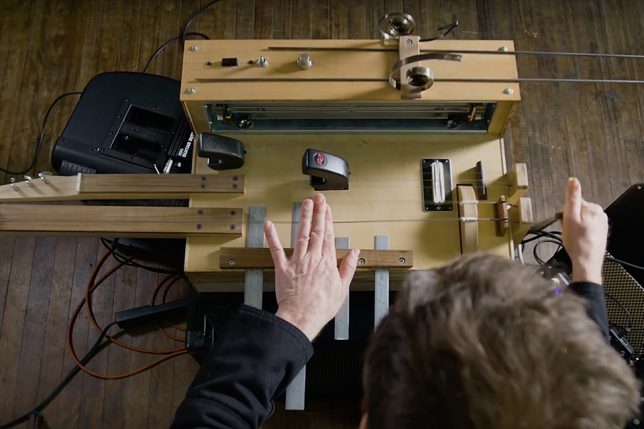
Is this the most terrifying musical instrument ever made? If you just take a quick glance at it, you’ll likely say no – it’s an unassuming (albeit rather strange) jumble of strings, rods, reverbs and metal rulers attached to a boxy wooden base. But just you wait until composer Mark Coven, whose work includes the stunning score for the 2016 horror film The Witch, sits down at it and starts to play. The sounds that emerge from the ‘Apprehension Engine’ are designed to give you the creeps, and they’re quite effective.

Korven, who has scored a number of feature films over the years, was sick of using the same old digital samples to get the signature scraping, creaking, squealing and rumbling sounds that help provide a hair-raising atmosphere. The world of creating analog sound effects in audio post-production is pretty fascinating, and foley artists use all sorts of weird objects to create many of the sounds you hear in an average movie or TV show.

But Korven wanted something very specific, all together in a single instrument, so he turned to his friend Tony Duggan-Smith, a guitar maker, to help him craft it. In this video, Korven demonstrates to Great Big Story how the Apprehension Engine works as he plucks, wiggles, flicks, thumps and runs a bow across the various objects connected to the instrument.

Share on Facebook


[ By SA Rogers in Design & Products & Packaging. ]

[ WebUrbanist | Archives | Galleries | Privacy | TOS ]


WebUrbanist

 
Comments Off on The Apprehension Engine: Machine Makes Disturbing Horror Movie Music

Posted in Creativity


Federal Court confirms (again): Police can be photographed in public

11 Jul

Following in the footsteps of the US’s First, Fifth, Seventh, Ninth and Eleventh Circuit Courts of Appeals, judges for the Third Circuit Court of Appeals have unanimously ruled that individuals have a First Amendment right to photograph and video record police officers in public. The decision follows multiple cases involving law enforcement retaliation against individuals who were recording police activity in public.

The ruling, which was filed on July 7, 2017, details two cases in which Philadelphia police officers interfered with individuals who were recording public law enforcement activity.

The first case involved Amanda Geraci, who was filming the arrest of an anti-fracking protester when an officer ‘pinned’ her against a pillar, blocking her ability to record the arrest. The second case involved Richard Fields, who was arrested after refusing to stop recording public police activity.

On behalf of the court, and per the document filed last week, Judge Thomas Ambro wrote, “Simply put, the First Amendment protects the act of photographing, filming, or otherwise recording police officers conducting their official duties in public.”

There may be exceptions to this right, the judge notes, such as times when a “recording interferes with police activity.” However, in the absence of that concern, the Court finds that “under the First Amendment’s right of access to information, the public has the commensurate right to record—photograph, film, or audio record—police officers conducting official police activity in public areas.”

Articles: Digital Photography Review (dpreview.com)

 
Comments Off on Federal Court confirms (again): Police can be photographed in public

Posted in Uncategorized


7Artisans unveils range of low cost, fast lenses for mirrorless cameras

11 Jul

Chinese optical manufacturer 7Artisans has introduced a collection of four lenses that are intended to provide low-cost alternatives to branded optics. The lenses are all designed for mirrorless cameras, and the company intermittently provides mounts for Sony E, MFT, Fujifilm X and Canon EOS M users, as well as one lens for Leica M cameras.

The lenses are all manual focus, feature a copper core with an aluminum exterior and some of them come in a choice of black or silver finish. There isn’t much information on the company website but the Amazon sales pages reveal some of their specification.

25mm f/1.8 | Sony E/Fujifilm X/MFT | $ 70

This lens was designed for APS-C and Micro Four Thirds sensors, and boasts an aperture range of f/1.8-16. It uses seven elements in five groups, has 12 iris blades and offers a 46mm filter thread.

35mm f/2 | Sony E/Fujifilm X/Canon EOS M | $ 156

A lens capable of covering a full frame sensor, this 35mm f/2 uses a 10-bladed iris and has a minimum aperture of f/16. It is constructed with seven elements arranged in five groups and offers a 43mm filter thread.

50mm f/1.1 | Leica M | $ 369

Designed for the Leica M family, this standard focal length uses 12 iris blades to form its click-less f/1.1- f/16 aperture range. The company says it has used a Sonnar design and high-refractive index glass to optimize the lens for use at the widest apertures. The lens has seven elements arranged in six groups.

The current version isn’t compatible with the Leica M4 and M4A, but models from September onward will be.

7.5mm f/2.8 | Sony E/Fujifilm X/MFT | $ 139

This is a fisheye lens that the company claims offers a maximum angle of view of 180°. It has 11 elements that are arranged in eight groups, and the 12-bladed iris closes to f/22.

Articles: Digital Photography Review (dpreview.com)

 
Comments Off on 7Artisans unveils range of low cost, fast lenses for mirrorless cameras

Posted in Uncategorized


Acclaim for the Reclaimed: 14 Cool Upcycled Architecture Projects

11 Jul

[ By SA Rogers in Architecture & Houses & Residential. ]

Going beyond simple stacks of shipping crates and ripped-apart pallets, these creative upcycled architecture projects reclaim stuff like corrugated iron, 5-gallon water bottles, old doors and even junk left over from the London Olympics as building materials and truly elevate them to new heights. These projects offer some fresh ideas, use the materials in new ways or demonstrate how recycled and upcycled architecture integrate into modern designs.

Stedsans in the Woods: Upcycled Permaculture Farm in Sweden

This permaculture farm and retreat nestled in the woods of southern Sweden will function as a “lab for discovering better ways to eat, live and connect with nature,” including a farm-to-table restaurant and a collection of beautiful treehouse-like cabins made of waste wood, fragments of old barns and glass from abandoned greenhouses.

Rising Moon Pavilion Made of Recycled Water Bottles

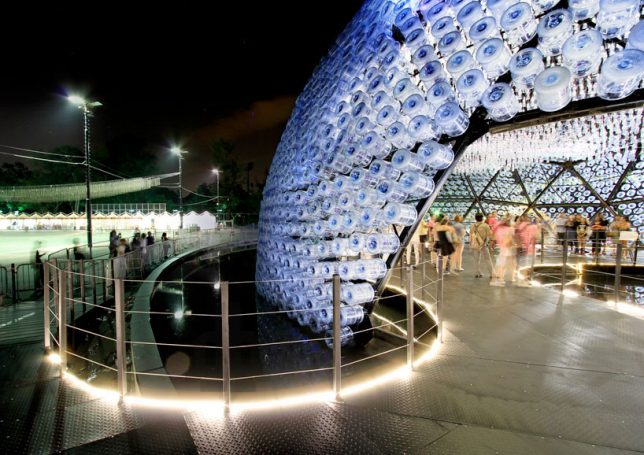
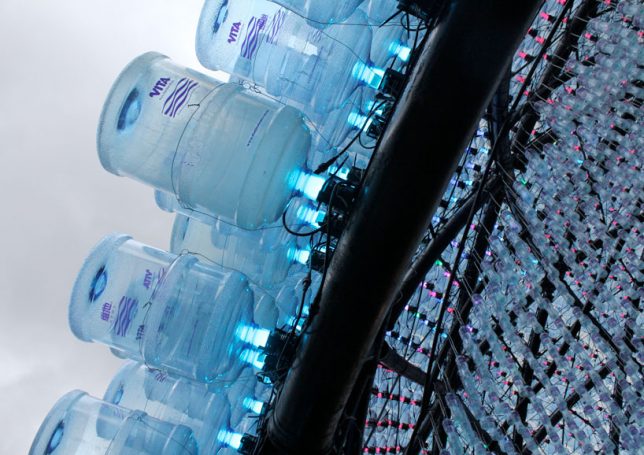
Reflecting itself into a perfect sphere on the surface of a still pool, ‘Rising Moon’ by Hong Kong-based studio Daydreamers Design is a geodesic dome fitted with 4,800 five-gallon polycarbonate water bottles, each acting as a lantern to help the structure glow. At night, they transmit light from inside out, while during the day, the interior is illuminated by the sun. LED torches are attached to pre-fabricated triangular modules with the bottles fitted over them, and an additional 2,300 bottles hang from the ceiling.

Parasitic Student Residences Made of Pallets for Paris

French architect and graffiti artist Stephane Malka proposes ‘Ame-Lot,’ a series of parasitic structures made of upcycled pallets and other reclaimed materials that attach to existing architecture. The pallets fold and unfold to let more light into the interior, and the structures can be constantly rearranged and added to as necessary for growth, becoming a visual meter of consumption in the city.

Collage House Made of Recycled Doors by S+PS Architects

Over a dozen reclaimed doors and windows salvaged from demolished houses in the city make up a highly unusual and creative collage-style facade for a Mumbai residence by S+PS Architects. This double-height curtain wall makes for some seriously striking curb appeal, and sets the tone for the living room as well. The architects also incorporated other found materials into the home, like metal pipe leftovers pieced together like bamboo to form a ‘pipe wall,’

K Valley House Clad in Reclaimed Iron by Herbst Architects

Rusted corrugated iron sheets resembling the sheds often seen in the New Zealand countryside contrast beautifully with the greenery of the Kauaeranga Valley in ‘K Valley House’ by Herbst Architects. “We positioned the form straddling the ridgeline, engaged with the slope at the high end and floating above the land as it falls away,” they say.

Next Page – Click Below to Read More:
Acclaim For The Reclaimed 14 Cool Upcycled Architecture Projects

Share on Facebook


[ By SA Rogers in Architecture & Houses & Residential. ]

[ WebUrbanist | Archives | Galleries | Privacy | TOS ]


WebUrbanist

 
Comments Off on Acclaim for the Reclaimed: 14 Cool Upcycled Architecture Projects

Posted in Creativity


Time-lapse captures thousands of fireworks going off over LA on July 4th

10 Jul

Photographer and creative director Dylan Schwartz may have shot the viral fireworks time-lapse of the year this July 4th. Over the course of three hours, Schwartz captured thousands of fireworks going off above LA from his vantage point at Mount Wilson Observatory.

Schwartz shared the story behind the timelapse with Time, telling the magazine, “Everything is spread out in L.A. To really see what L.A. does for the Fourth of July, you have to see the whole thing.” Even with this wide shot captured from 5,700+ feet above LA, Schwartz still says he only captured “a slice.”

According to Time, the final time-lapse is a composite of nearly 250GB of stills and video shot with 4 different cameras. Schwartz used a Sony a9 (he’s a Sony ambassador) with a 70-200mm lens to capture both video and stills of the widest perspective, another camera for video exclusively, and two more were shooting stills of various key locations.

Six hours of editing later, the time-lapse above was ready for posting on social media, where it immediately took off. Here’s an even closer crop posted to Schwartz’ Instagram account. Enjoy.

A post shared by Dylan Schwartz (@dylan.schwartz) on


Articles: Digital Photography Review (dpreview.com)

 
Comments Off on Time-lapse captures thousands of fireworks going off over LA on July 4th

Posted in Uncategorized


Nikon issues battery recall: Overheating batteries from 2012 still causing problems

10 Jul

If you purchased a Nikon D800, D800E, D7000 or Nikon 1 V1 and are still shooting with the original EN-EL15 battery, or if you’ve ever purchased a spare EN-EL15 off the shelf, listen up. There’s a small chance you’re using a defective battery that could pose a danger to yourself and your camera body.

In an update to a recall first announced all the way back in 2012, Nikon is asking owners of certain EN-EL15 batteries to get in touch with the company about getting a complimentary replacement.

“The [affected] battery pack can experience a short circuit causing it to overheat and possibly causing the outside casing to become deformed, posing a potential hazard to consumers,” writes Nikon. “There have only been seven (7) confirmed reports of incidents of the problem worldwide, and while no injuries have taken place, Nikon Inc. has initiated this recall of the affected lot numbers as a reflection of its commitment to safety and product quality.”

Affected batteries can be identified by the serial number. If the 9th number of the serial on the back is either an “E” or an “F” your battery is affected, and you should reach out to Nikon Inc. through this form to get a replacement. Do not dispose of the battery in the trash. You’ll need to give the defective battery to the UPS guy who brings you the new battery in exchange.

You can read the full recall text below:

EN-EL15 Rechargeable Li-ion Battery Pack Recall

UPDATED EN-EL15 SERVICE ADVISORY AS OF JUNE 20, 2017. Technical Service Advisory for users of the EN-EL15 rechargeable lithium-ion battery pack.

Nikon Inc. is asking your cooperation in connection with a voluntary recall of certain lot numbers of its Nikon Model EN-EL15 rechargeable lithium-ion battery pack. The battery pack can experience a short circuit causing it to overheat and possibly causing the outside casing to become deformed, posing a potential hazard to consumers. There have only been seven (7) confirmed reports of incidents of the problem worldwide, and while no injuries have taken place, Nikon Inc. has initiated this recall of the affected lot numbers as a reflection of its commitment to safety and product quality. We are asking that owners of the affected battery pack contact Nikon Inc. to initiate a free product exchange.

The Nikon EN-EL15 battery pack is provided as a supplied accessory with the purchase of Nikon’s digital SLR D800, D800E, D810A, D810, D610, D600, D7200, D7100, D7000, D500 cameras and the Nikon 1 V1 advanced camera with interchangeable lens. However, EN-EL15 batteries supplied with D810A, D810, D610, D600, D500, D7200, D7100 are not included in this voluntary recall. It is also sold separately at retail under Nikon’s model number 27011. The EN-EL15 battery pack involved in this recall was first distributed by Nikon in March 2012 and is still being sold at retail.

No other Nikon battery packs are involved in this recall.

Nikon’s digital SLR D800, D800E, D810A, D810, D610, D600, D7200, D7100, D7000, D500 cameras and the Nikon 1 V1 advanced camera with interchangeable lens as well as any other Nikon cameras are also not subject to this recall.

What you should do:

1.) Determine if your EN-EL15 battery pack is affected
This voluntary recall is limited to EN-EL15 battery packs in lots E and F. First, please confirm that “EN-EL15” is printed on the label of your battery pack. Then, please locate the 14-digit lot number beside the recycle symbol, as shown on the photo below.

  • If the 9th character of the lot number is E or F, your battery is among those being recalled.
  • If the 9th character of the lot number is any other letter, your battery is not affected by this recall.

Click here to use our lot number lookup tool.

2.) If your EN-EL15 battery pack is affected

  • Immediately remove the battery from your camera or camera bag, but please do not dispose of it.
  • Complete the Nikon’s online EN-EL15 battery exchange form by clicking this link.
  • Once your request is processed Nikon will send a confirmation email.
  • On the day of your battery exchange, UPS will contact you by phone and email notifying you of the delivery.
  • A UPS courier will then deliver your new battery pack(s) AND collect the recalled battery pack(s).
  • Someone needs to be present for this exchange. If you need to make special arrangements, please contact UPS.

3.) If your EN-EL15 battery pack is not affected

No further action is needed. Please continue using your EN-EL15 battery pack as usual.

Nikon is committed to safety and to providing to its customers only the highest quality products. We regret any inconvenience this matter may cause you and appreciate your continued support of Nikon and its products.

If you have any additional questions or concerns, please contact Nikon at 1-800-645-6687.

Articles: Digital Photography Review (dpreview.com)

 
Comments Off on Nikon issues battery recall: Overheating batteries from 2012 still causing problems

Posted in Uncategorized


Nokia is teaming up with Zeiss to deliver the “ultimate imaging experience”

10 Jul

Nokia’s 808 and Lumia 1020 are still regarded by some as the best camera smartphones ever made. The devices’ outstanding image quality was the result of a collaboration between the Finnish handset-maker and lens manufacturer Carl Zeiss. But things have changed a lot since the 808 was launched in 2012, and HMD Global now has the exclusive rights to Nokia’s brand name.

Fortunately, it seems we are going to see Nokia smartphones with a Zeiss badge once again in the near future.

HMD Global and Zeiss have announced a partnership to deliver the “ultimate imaging experience possible on a smartphone” and set “new imaging standards within the smartphone industry.”

“Collaborating with ZEISS is an important part of our commitment to always deliver the very best experience for our customers,” says Arto Nummela, CEO of HMD Global. “Our fans want more than a great smartphone camera, they want a complete imaging experience that doesn’t just set the standard but redefines it. Our fans expect it and, together with ZEISS, we’re delivering it—co-developed imaging excellence for all.”

This year HMD Global has already launched the Nokia 3, Nokia 5, and Nokia 6 smartphones, which are aimed at the entry-level and mid-range segments of the market—we have not seen a high-end model yet.

It appears the Zeiss lenses and imaging technologies will be reserved for the upcoming Nokia 9 flagship. If the rumors are true, we should see a 13MP dual-camera in the 9.

Articles: Digital Photography Review (dpreview.com)
 
Comments Off on Nokia is teaming up with Zeiss to deliver the “ultimate imaging experience”

Posted in Uncategorized


Sigma updates MC-11 Sony adapter, adds support for 24-70mm Art lens and more

10 Jul

Sigma continues to add compatibility to its MC-11 adapter, allowing more Sigma SA and EOS mount Sigma lenses to be used on Sony E-mount cameras. And the latest round of updates adds compatibility with one of Sigma’s most anticipated and exciting Art lenses.

The MC-11 comes in two variations—the MC-11 SA-E for Sigma-mount lenses, and the MC-11 EF-E for Canon mount lenses. The new firmware makes the converters compatible with Sigma’s new 14mm f/1.8 HD HSM | Art and the long-awaited 24-70mm f/2.8 DG OS HSM | Art lenses. The MC-11 EF-E also becomes compatible with Sigma’s Cine Lens 14mm T2 FF and 135mm T2 FF in the Canon EF mount.

The company has also released new firmware for its 100-400mm f/5-6.3 FG OS HSM | Contemporary telephoto zoom lens. The update improves AF speed in all cases, but it also improves functionality when mounted via MC-11 SA-E adapter. According to Sigma, focusing features are enhanced in the adapter-mounted lens, and the optical stabilization system becomes operational more quickly.

All firmware can be downloaded for free from Sigma’s download page, or through the Sigma USB dock. To update the MC-11 mount converter, simply plug it in to your PC and run the SIGMA Optimization Pro app.

Articles: Digital Photography Review (dpreview.com)

 
Comments Off on Sigma updates MC-11 Sony adapter, adds support for 24-70mm Art lens and more

Posted in Uncategorized


Canon 7D Mark II torture test: See a shutter fail in real time

10 Jul

YouTube channel ContinueCrushingTech recently had that chance to ‘crush’ something of interest to us: a Canon EOS 7D Mark II. The camera was broken and awaiting a service appointment with Canon anyway, so the channel’s host decided now was the good time to push the 7D to its literal breaking point.

Specifically, he shot the camera continuously for hours, until the shutter finally gave up its mechanical ghost and displayed the Canon screen of death: Err 20.

The experiment isn’t exactly complex. Using a remote trigger and a clamp, ContinueCrushingTech set the 7D Mark II to continuous mode and shot at 10fps for as long as it took to kill the camera’s shutter.

Under normal use, the 7DII’s shutter should last about 200,000 actuations, according to Canon. That means, under continuous use at 10fps, the camera has to shoot for 5+ continuous hours before it hits that theoretical breaking point.

So how long did it take for CCT’s camera to give up and die already?


Spoilers incoming


Unfortunately, the poor little camera didn’t quite live up to its manufacturer’s expectations. It passed away just shy of the 200K number, after 199,591shots:

But more interesting than the number itself is getting to see a shutter fail in real time with your own eyes—seeing how it starts behaving erratically after 190K actuations, freezing more and more frequently as it approaches that fated 200K failure.

Finally, at exactly 199,591 (according to FreeShutterCounter) Err 20 emerged and the 7DII would shoot no more.

You can watch the whole thing for yourself up top. And if you like this torture test, you can find more feature tests, reviews, and other gear-related videos on the ContinueCrushingTech YouTube channel.

Articles: Digital Photography Review (dpreview.com)

 
Comments Off on Canon 7D Mark II torture test: See a shutter fail in real time

Posted in Uncategorized


Red just launched a $1200 smartphone with a 5.7″ holographic display

10 Jul

Cinema camera maker Red has announced its first foray into the smartphone market with Hydrogen One, an Android device with a 5.7″ display. That screen is the center of attention in the limited information Red has provided, emphasizing its ability to switch from a traditional 2D display to a 3D/VR/AR/holographic display thanks to ‘nanotechnology.’

Red states that the Hydrogen One will integrate with its family of professional video cameras as a monitor and user interface for Scarlet, Weapon and Epic cameras. It will also offer a proprietary algorithm to convert stereo sound into ‘multi-dimensional audio,’ a microSD card slot and USB-C charging.

The Hydrogen One will be able to host modular accessories a la Moto mods, as mentioned in the announcement and evidenced by the contacts pictured in the image above. Red mentions that this will be a means by which the device will be able to capture ‘higher quality motion and still images as well as Hydrogen format holographic images.’ No details are provided about an on-board camera at this time.

The Red Hydrogen One is being offered in Aluminum for $ 1195 and Titanium for $ 1595 as special pre-order prices. Shipping is planned for Q1 of 2018; Final pricing for the device has yet to be determined.

Articles: Digital Photography Review (dpreview.com)

 
Comments Off on Red just launched a $1200 smartphone with a 5.7″ holographic display

Posted in Uncategorized