RSS
 

Archive for May, 2017

Free Castles & Villas: Italy is Giving Away Over 100 Historic Properties

19 May

[ By WebUrbanist in Boutique & Art Hotels & Travel. ]

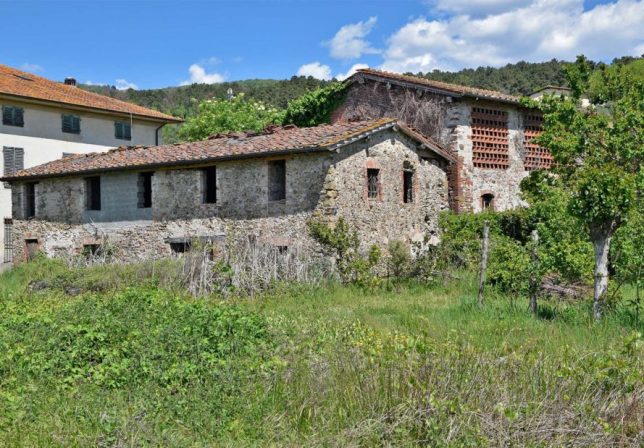
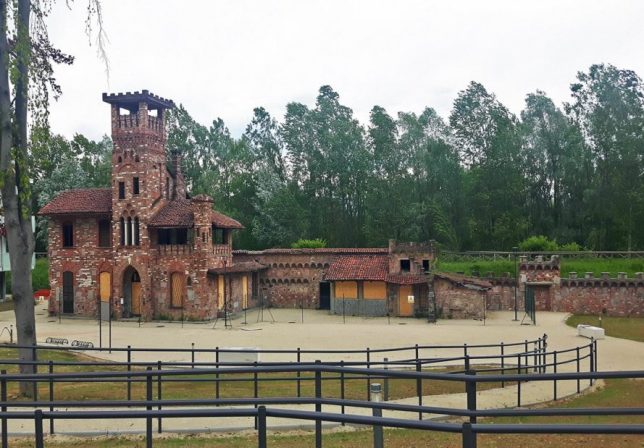
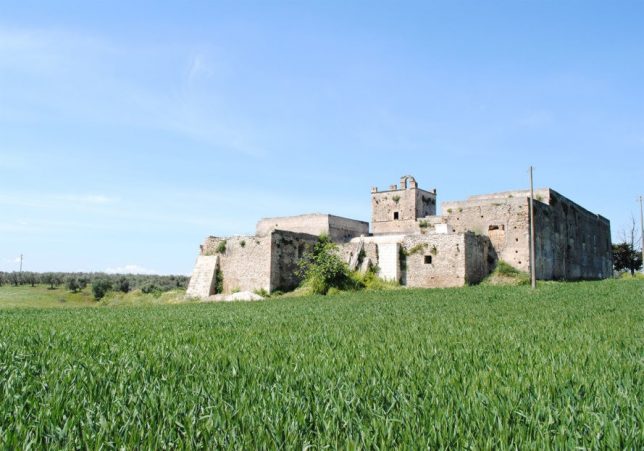
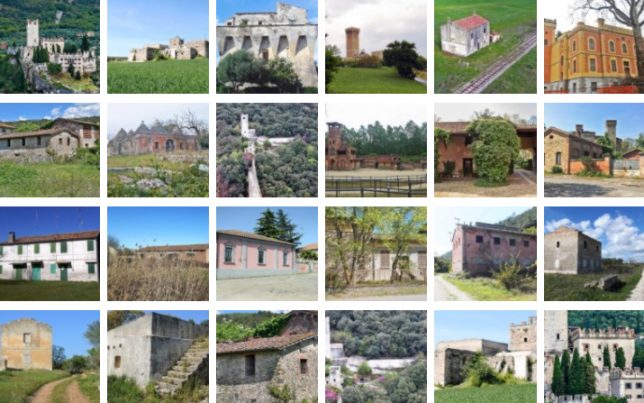
Anyone who has dreamed of retiring from the rat race to run a grand estate hotel, rural farmhouse bed and breakfast, quaint inn or remote monastery spa could see their wish come true in this unprecedented giveaway from the Italian government.

As part of its Strategic Tourist Plan, Italy is offering up 103 historic sites to those with the will and means to renovate them back into use for tourism purposes. And this is just the initial offering: 200 more are slated to be given away over the coming years.

The State Property Agency and Ministry of Cultural Heritage are leading the project, aiming to draw visitors to beautiful areas with currently disused architecture. In some cases, a lot of work is needed, but that’s the nature of centuries-old structures.

State employee Roberto Reggi says “The project will promote and support the development of the slow tourism sector. The goal is for private and public buildings which are no longer used to be transformed into facilities for pilgrims, hikers, tourists, and cyclists.”

The country has previously auctioned off historic properties, including dozens of lighthouses, with similar goals in mind, but this time they are making it all free, banking on the long-term prospects of the renovations to raise funds for local businesses and the national economy (via Inhabitat).

Share on Facebook


[ By WebUrbanist in Boutique & Art Hotels & Travel. ]

[ WebUrbanist | Archives | Galleries | Privacy | TOS ]


WebUrbanist

 
Comments Off on Free Castles & Villas: Italy is Giving Away Over 100 Historic Properties

Posted in Creativity


Lighting 103: Greg Heisler on Light and Color

18 May

Abstract: Chromatically complex light adds much more realism to your lit photos.

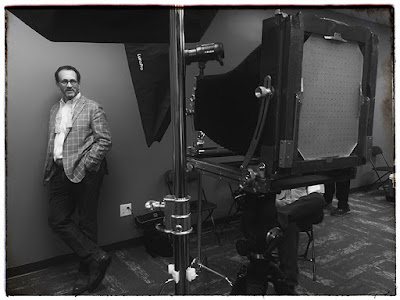
Today’s Lighting 103 post features excerpts from a bar conversation with Greg Heisler. It's just as if we cornered him at a conference (which I did) and he agreed to have a drink and talk color (which he did).

This is roadmap stuff. It's above and beyond the specific info he includes with each of the assignments in his book, 50 Portraits, the companion text to L103.Read more »
Strobist

 
Comments Off on Lighting 103: Greg Heisler on Light and Color

Posted in Photography


Throwback Thursday: Olympus C-8080 Wide Zoom

18 May

Announced in 2004, the Olympus C-8080 Wide Zoom wasn’t the first camera with a focal range starting at 28mm, nor was it the highest resolution camera at the time with its 8 megapixel CCD. What made the C-8080 interesting was the amount of work that Olympus put into the lens, claiming that it was designed to be on par with the Zuiko Digital lenses found on its DSLRs.

The lens had an equivalent focal length of 28-140mm and an impressive maximum aperture range of F2.4-3.5. It used three ED glass elements to reduce chromatic aberration, something not normally found on a compact camera. In DPReview’s testing, seeing CA in the real world was a rarity. The lens was threaded and supported both telephoto and wide conversion lenses. One bummer about the lens was that the zoom was electronically controlled, rather than mechanically, a feature found on the Minolta DiMAGE A2 and Sony DSC-F828 at the time.

Those are who are familiar with the Olympus E-10 will definitely notice some similarities with the control layout and LCD/viewfinder placement.

The C-8080WZ wasn’t the smallest camera out there, but there’s a lot of glass plus an EVF and tilting LCD that you’ll see in a moment. It was made of magnesium alloy that Phil Askey said was ‘heavier grade than we’re used to seeing.’ Phil also complimented the well-designed front and rear grips.

Something worth pointing out is that the camera had an external phase detection sensor (to the left of the Olympus logo). Phil’s review praised the fast AF speeds of the camera, though he was less keen about how quickly the lens zoomed and that there were only five ‘stops’ along the way.

The C-8080’s 1.8″ LCD could be pulled away from the body and tilted up or down. The resolution of 134k wasn’t great, but hey, it was 2004 (the user interface from back then is worth a look, as well). There’s also a pretty big electronic viewfinder, which had 240k dots. 

The camera had two memory card slots: one for CompactFlash and the other for – you guessed it – xD Picture Cards. Sadly, despite all of the semi-pro features on the C-8080WZ, it only had one control dial.

So what about photo quality? The C-8080WZ tied for the best resolution among a group of five 8MP cameras, with low noise at high ISOs. The lens had very little barrel distortion but some unexpected pincushion distortion, though Phil noted that it was unlikely that you’d notice this in the real world.

In the end, the C-8080 Wide Zoom earned a coveted ‘highly recommended’ award, due in large part to its lens. The main negatives were the aforementioned zoom speed and number of stops issues as well as camera lockup while Raw images are saved and an aging menu system. 

Do you have fond memories of the C-8080 Wide Zoom? Share them in the comments below. And let us know if you have suggestions for future Throwback Thursday articles!

Olympus C-8080WZ Sample Gallery

$ (document).ready(function() { SampleGalleryStripV2({“galleryId”:”7875368385″}) })

Sample photoSample photoSample photoSample photoSample photo

Articles: Digital Photography Review (dpreview.com)

 
Comments Off on Throwback Thursday: Olympus C-8080 Wide Zoom

Posted in Uncategorized


Sony a9: all that speed appears to have dynamic range cost

18 May

The Sony a9 is a powerhouse of technology, particularly when it comes to speed and autofocus. But does its image quality stack up? We’ve taken an initial look at Raw and JPEG image quality and have come away impressed, but how does the a9 stack up in terms of dynamic range?

At the recent launch in New York City, I had a chance to shoot our standard ISO-invariance test but on a real-world scene (our studio scene isn’t so portable…). Have a look at the performance below.

$ (document).ready(function() { ImageComparisonWidget({“containerId”:”reviewImageComparisonWidget-19343974″,”widgetId”:522,”initialStateId”:null}) })

It’s immediately obvious the a9 is not ISO-invariant (what is ‘ISO-invariance’?). This means the camera is adding a fair amount of read noise that results in noisy shadows, limiting dynamic range at base ISO. That’s why, for the same focal plane exposure, performing analog amplification by increasing ISO in-camera gets you a cleaner image than performing that amplification (or brightening) in post-processing.

It’s not the typical performance we’ve come to expect from Sony sensors and we suspect the higher readout speed is leading to greater noise. In other words, it appears this sensor was likely optimized for speed at the expense of low ISO dynamic range.

This sensor was likely optimized for speed at the expense of dynamic range

Ultimately, this limits the exposure latitude of a9 Raws so, much like with older Canon DSLRs, you’ll have limited ability to expose high contrast scenes for the highlights, then tonemap* (raise) shadows in post. You can check the effect of changing the Drive mode in the widget (EFCS = electronic first curtain, S = single, C = continuous), but there’s not much difference between them.

Effect of Drive mode

There is little to no difference in base ISO dynamic range in different drive modes. So the good news is that the drop to 12-bit in continuous drive comes at no cost. The bad news is that the 14-bit Raws aren’t any better than the 12-bit ones. Click here to load the above as a widget.

As we mentioned above, there’s no difference in shadow noise as you change Drive mode. This is particularly interesting because all Single drive modes, including fully electronic, support full 14-bit Raw (we shot uncompressed). The Continuous drive modes, however, switch the sensor into a 12-bit** readout mode which, by definition, means files with no more than 12 stops of dynamic range.

This indicates that even the 14-bit Raws have at most 12 EV of dynamic range at the pixel level, placing our estimates of base ISO dynamic range almost a full stop behind the a7, and likely further behind the a7R II at equivalent viewing size (normalized).

‘Dual Gain’ helps improve high ISO dynamic range

In our widget up top, you may have noticed that noise suddenly starts increasing once you fall below ISO 640 (how’s that for sounding completely back-to-front?). Below you’ll see this more clearly: shadow noise dramatically clears up as you go from an ISO 500 image (with a 3.7 EV push) to an ISO 640 image (with 3.3 EV push):

$ (document).ready(function() { ImageComparisonWidget({“containerId”:”reviewImageComparisonWidget-12344692″,”widgetId”:521,”initialStateId”:null}) })

Things clean up at ISO 640 (as with the a7R II) because of the sensor’s ‘dual gain’ architecture, where the camera increases the conversion gain (effectively amplification) at the pixel-level during readout, helping overcome the camera’s relatively high (for a Sony design) read noise.

Above ISO 640, the camera is fairly ISO-invariant, since it’s overcome most of its downstream read noise, but there’s still some benefit to increasing ISO to keep noise levels low if your scene demands it. Below ISO 640, the lower conversion gain means that you’ll start to see read noise if you push shadows.

Take home

The good news is that those worried about the camera dropping to 12-bit readout in continuous shooting needn’t worry: there’s no decrease in quality, since a 12 bit file can contain all its dynamic range. The bad news is that this is because the a9 doesn’t appear to have more than 12 EV pixel-level dynamic range to begin with, putting its base ISO dynamic range well behind that of the a7R II. By high ISO, general image quality catches up as the higher downstream read noise is overcome by the sensor’s (similar to the a7R II) dual gain architecture. Take a look at this ISO 51,200 comparison with the a7R II:

ISO 51,200 comparison of a7R II vs a9. Not much difference at all. In fact, normalized signal:noise ratio (SNR) measurements place the two neck-to-neck: 1.82 vs. 1.48 for the a7R II and a9 at the dark patches here, respectively. At ISO 25,600, the normalized SNR is exactly the same.

This means that if you’re shooting in conditions demanding high ISO, for any given focal plane exposure you may wish to at least increase in-camera amplification to ISO 640 to get most tones above the noise floor, if your scene demands the extra amplification to get a usable image. Dropping below ISO 640 to preserve highlights, and then raising shadows afterwards, will come at a greater noise cost than, say, Sony’s own a7R II.

Interestingly, this means there’s little advantage to those large (47MB) uncompressed 14-bit Raw files, save for the lack of compression artifacts. In a perfect world, Sony would have offered a 12-bit Raw mode with a lossless compression curve (without that second stage of localized compression that leads to edge artifacts) for smaller file sizes with minimal loss in quality.


Footnotes:

* There’s a very specific reason I like to use the word ‘tonemap’ instead of ‘raise the shadows’. We’re forced to raise shadows of high contrast Raw files exposed for the highlights today because of the limited brightness of most current displays. Future displays capable of far higher brightnesses (perhaps even ten-fold) will need less shadow pushing, or tone-mapping, to make visible what you currently see as ‘shadows’ in such traditionally underexposed Raw files. For example, shadows you currently push +4 EV will likely be visible without any pushing at all on a 4,000 nit-capable display. 

** We confirmed that continuous modes were in fact 12-bit, while single modes were in fact 14-bit, by comparing histograms of respective Raw files. The 14-bit single drive files do, in fact, have 14-bits of data compared to the 12-bit files (the histogram shows the latter missing levels 1, 2, and 3, in between 0 and 4, but the 14-bit files do have pixels with these values).

Articles: Digital Photography Review (dpreview.com)
 
Comments Off on Sony a9: all that speed appears to have dynamic range cost

Posted in Uncategorized


The Sky’s The Limit: 14 Promising New Advancements in Solar Power

18 May

[ By SA Rogers in Gadgets & Geekery & Technology. ]

Even while it feels like certain things are moving backward, efforts to power the world with solar energy instead of fossil fuels continue to reach for the sky, innovating advancements that make a renewable future more achievable. Tesla’s Solar Roof tiles are about to become commercially available, flexible solar panels are cheaper and more efficient than ever, we’re several steps closer to transparent solar power-producing windows and there’s even a product so thin and tiny it’s called ‘solar glitter.’

Solar Blinds by SolarGap

Designed with apartment-dwellers in mind, these smart solar blinds are inexpensive, easy to install, and work best when the blinds are open. If you have a window that gets a little too sunny at some point in the day, these could be an ideal gadget to reduce your electricity costs by up to 70 percent. They work best on the outside of your window, producing up to 100 watts of electricity, which is enough for one window to charge your laptop. You can use a smart app to control the blinds and monitor how much power they’re producing.

Plug and Play Smart Flower Solar Device

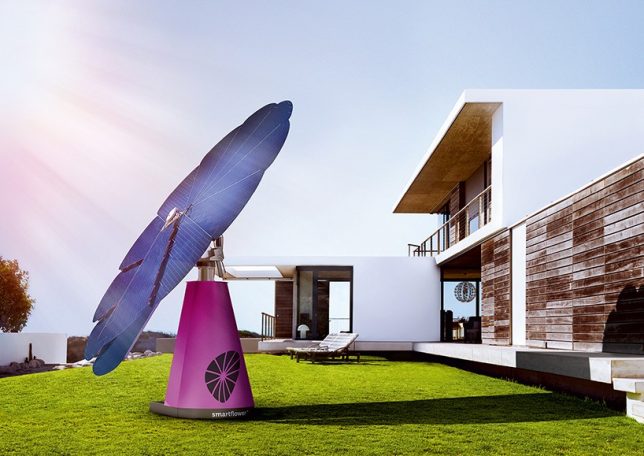
The Smart Flower features solar panel ‘petals’ that unfurl at sunrise, automatically directing themselves toward the sun and continuing to move throughout the day for optimal placement to produce 40 percent more energy than a static solar panel setup. Taking its inspiration from the shape of a sunflower, the smartflowerPOP will juice you up with 3,400 to 6,300 KWH per year.

World’s Largest Solar Storage Facility Works 24/7

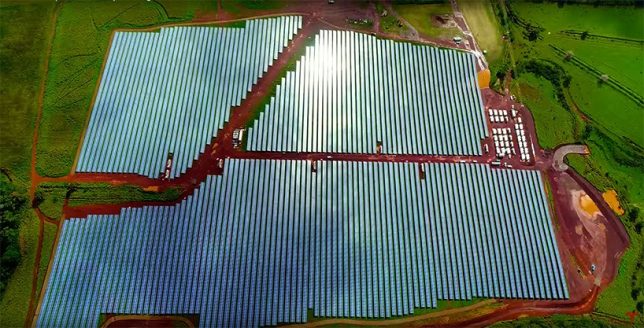
Tesla and SolarCity opened a 13 MW solar far in Kauai, Hawaii featuring 54,978 solar panels and a 52 MWh battery bank, large enough to run twenty-four hours a day and provide up to 44 percent of the island’s power, compared to its 92 percent dependence on fossil fuel in 2011.

Wattway: The World’s First Solar Panel Road

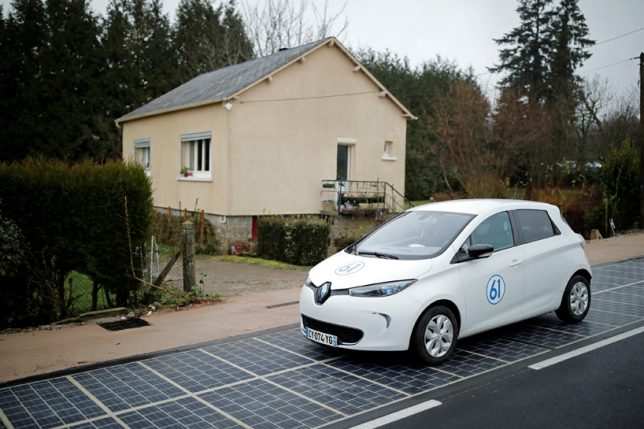
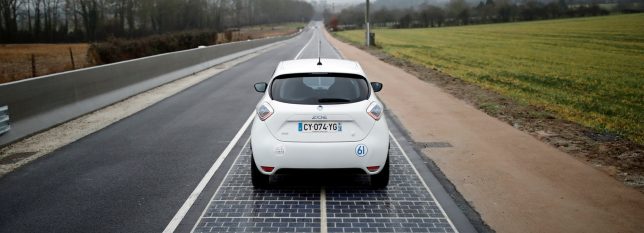
There are a lot of reasons to be skeptical of a solar panel roadway, the first and foremost being that integrating an emerging technology into infrastructure may not be the best idea for long-term success. Solar power is rapidly changing, and the tech used for France’s ‘Wattway’ and similar projects will likely soon be obsolete, not to mention the probability of the panels being damaged. But The idea could still have weight for some applications, and Wattway is expected to generate 280MWh per year.

Solar Glitter Can Make Almost Anything Solar-Powered

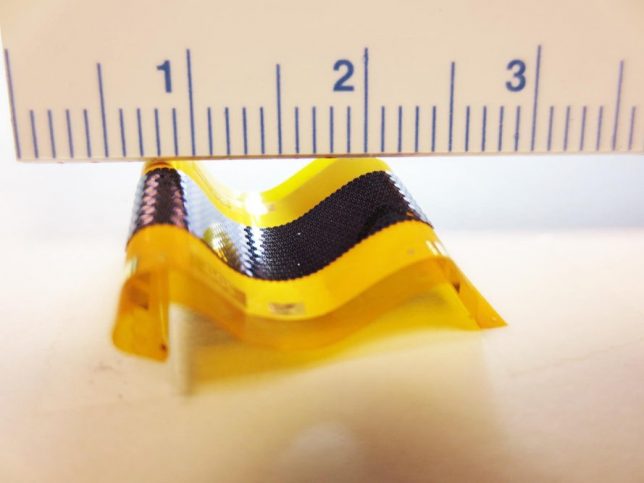
An innovation called Dragon SCALEs by Sandia National Laboratories acts like solar glitter, shrinking solar panels down to tiny, flexible snowflake-inspired cells that could theoretically be applied to just about anything. Making use of recent advancements in micro design and micro fabrication, the panels can be folded like paper, rapidly and cheaply installed, and turn just about any object into a solar power generator.

Next Page – Click Below to Read More:
The Skys The Limit 14 Promising New Advancements In Solar Power

Share on Facebook


[ By SA Rogers in Gadgets & Geekery & Technology. ]

[ WebUrbanist | Archives | Galleries | Privacy | TOS ]


WebUrbanist

 
Comments Off on The Sky’s The Limit: 14 Promising New Advancements in Solar Power

Posted in Creativity


Google Photos update encourages sharing, adds photo book creation

18 May

Google’s I/O conference today included some information about updates for the company’s photo organization app. Google Photos will use machine learning to analyze who’s in your photos and automatically suggest photos to share. Suggestions will appear in the sharing tab on the Photos apps for Android, iOS and web ‘in the coming weeks.’ You’ll also be able to set up shared libraries to automatically send photos to designated people – with the ability to share everything, or just photos of certain people, for example.

Google also announced it will allow you to create photo books from your Photos library, streamlined by a largely automated photo selection process. They’ll be available to US users only at launch, and will start at $ 10 for a softcover book and $ 20 for hardcover.

Articles: Digital Photography Review (dpreview.com)
 
Comments Off on Google Photos update encourages sharing, adds photo book creation

Posted in Uncategorized


10 cool DIY photography techniques that anyone can do

18 May
Are you in a creative rut? Do you need some ideas to break out and do something different? This short video by COOPH highlights ten cool photography techniques that anybody can do.
Do you have a favorite DIY technique that’s not in the video? Share it with us!

Articles: Digital Photography Review (dpreview.com)

 
Comments Off on 10 cool DIY photography techniques that anyone can do

Posted in Uncategorized


City Hack: Cyclists Create DIY Bike Lane with 120 Glued-On Plungers

18 May

[ By SA Rogers in Design & Guerilla Ads & Marketing. ]

When the government fails to meet the needs of its citizens, the citizens will go around them and produce their own solutions, whether they’re legal or not. That might mean occupying an alleyway with temporary housing, using cheap materials to create new public seating and other street furniture, or turning a disused city square into a park. In the Omaha neighborhood of Aksarben this week, it meant cyclists rounding up 120 toilet plungers and transforming them into a DIY bike lane barricade on one of the city’s more dangerous streets.

The group, calling itself PSA, or Plungers for Safer Aksarben, wrapped the plungers’ handles with reflective tape and glued them to the street without asking permission from the city. They knew their installation wouldn’t stay up forever, but hoped it would remain in place for at least 36 hours to call attention to a growing problem, since this bike lane has been the site of multiple accidents. City workers came by to take them down after just three hours.

Todd Pfitzer, the deputy director for transportation for the city of Omaha, told KETV “You just can’t decide one day to go out and do something on a public street, which is owned by taxpayers, that could create a dangerous situation without at least working with Public Works and getting a permit for it.” But he also said the city wouldn’t have approved a permit anyway.

Well, actually, Todd, you can do that, if the city fails to take necessary action. Just ask your fellow Midwestern city of Wichita, Kansas. Members of a tactical urbanism group calling themselves the Yellowbrick Street Team installed their own makeshift bike lane safety barricade using plungers, reflective tape and masonry adhesive back in March with the same goal, and city officials ultimately agreed that a more permanent solution was needed. Since then, they put up real barriers in the plungers’ place.

Images via the Omaha World-Herald, Todd Ramsay and Jaime Green of The Wichita Eagle

Share on Facebook


[ By SA Rogers in Design & Guerilla Ads & Marketing. ]

[ WebUrbanist | Archives | Galleries | Privacy | TOS ]


WebUrbanist

 
Comments Off on City Hack: Cyclists Create DIY Bike Lane with 120 Glued-On Plungers

Posted in Creativity


Drone footage helps scientists understand how narwhals use their tusks

18 May

Narwhals are famous for their long ivory tusks, which reach lengths of up to nine feet. Documentary filmmaker Adam Ravetch and Fisheries and Oceans Canada used video captured by drones to discover a previously unknown use for the tusk: it’s used to tap and stun fish before eating them.

Articles: Digital Photography Review (dpreview.com)

 
Comments Off on Drone footage helps scientists understand how narwhals use their tusks

Posted in Uncategorized


Hasselblad launches A6D 100MP aerial camera

18 May

Hasselblad has updated its aerial camera offering with a new model that features a 100MP sensor. The A6D appears to have replaced the A5D series, which had a number of sensor options, with a single body using the company’s highest resolution back. The new model has many features similar to the previous incarnation and allows synchronization of up to eight cable-connected bodies with a delay of just 20 microseconds.

The use of the 100MP sensor increases the system’s dynamic range from a maximum of 14 to 15 stops, and the company has installed a slot for CFast 2.0 memory media.

Hasselblad has nine H lenses that have been adapted especially for aerial use. With focal lengths from 24mm to 300mm the system offers angles of view of 96-10.2° and a new top shutter speed of 1/4000sec. Hasselblad says that because its lenses use leaf shutters they are less exposed to issues of the plane’s movements than focal plane shutter systems that can only compensate for motion in a single direction – usually forward.

The A6D will be available with or without an infrared cut filter so it can be used with sensitivity to extended wave lengths of 750-1000nm. For more information see the Hasselblad website.

Warning: sample image is 68MB

Press release

Hasselblad Introduces a 100 Megapixel Aerial Camera System

Aerial photography delivers better results today than ever before and Hasselblad continues to grow its presence in the market, introducing more advanced products and applications for the aerial photographic industry. This is reflected in the Hasselblad A6D-100c, the latest evolution of Hasselblad aerial cameras.

Hasselblad cameras are developed by building on the shoulders of the previous generation of models which enables all of the prior advancements and branch-demanding features to be automatically included. This process allows Hasselblad to continually enhance and develop models. The A6D heralds a technological improvement that is noticeably greater than earlier generations.

The A6D Aerial camera includes a feature that allows up to eight cameras to be synchronized within 20 ?s. A simple bus-type cable connection is required between all cameras in the set-up. This feature completely eliminates any issues in post-production caused by un-synchronized exposures.

Product Manager Bjarne Hjörlund commented, “Available in 100 megapixel resolutions, the A6D camera combines the world’s best optics and sensors with a modern, compact design, resulting in a system that will ensure you attain the highest possible image quality. Hasselblad aerial cameras provide a range of important features that help deliver your imaging requirements”.

Nine H System lenses are available in aerial versions with secure locking mounts to minimize vibration and flexing which guarantees the image plane and sensor stay parallel at all times. These units ship with their focus precisely adjusted and fixed at infinity. The focal length range from 24 to 300mm of these lenses results in a horizontal AFOV of 96° to 10.2° covering most applications. The new generation of leaf shutters for the H lenses has an extended lifetime, which ensures reliability during flight.

In addition, the exposure time for the aerial lenses has been improved up to 1/4000 of a second, for sharp and crisp images. Traditionally, FMC systems typically only compensate for movement in a single direction, but the fast leaf shutter-based exposure time can both compensate for ground speed and the roll and pitch of the plane.

Near Infra-Red Photography
The A6D camera is available with or without Infra-Red filter for infra-red captures from 750nm to 1000nm to serve the needs of aerial analysis, such as environment surveying and crop management. NDVI, CIR and NIR imaging is possible with third party software.

Phocus SDK by Hasselblad
To facilitate the development of user specific software, Hasselblad offers a complete Software Developers Kit (SDK) which allows full control of camera and image processing from the user’s own software. To quickly get started using the A6D aerial cameras for photography, Hasselblad has created a simple but effective PC sample application which can capture and store RAW files coming from the camera. All source code for this application is supplied to allow the user to adapt to special individual requirements.

Technical Data Sheet:
Key Features

  • Medium format 100 Megapixel resolution
  • The A6D Aerial includes a feature that allows up to 8 cameras to be synchronized within 20 microseconds.
  • 9 of the H System lenses are available in aerial versions
  • The exposure time for the aerial lenses is increased up to 1/4000 of a second
  • The A6D camera is available with or without Infra-Red filter to allow infra-red captures from 750nm to 1000nm

Additional Features

  • Reduced foot print designed to fit existing POD mountings
  • Up to 15 stops Dynamic
  • Improved external connectivity via stable LEMO connections
  • Fits plane power with a power requirement of 12 – 24 volt DC
  • FMS and multiple camera synchronization
  • Secure camera mounting via 4 x M4 screws
  • Lens locking mechanism with additional lens protector
  • Onboard fast 500+ Mbytes/sec CFast2.0 storage with a capacity of up to 512 GByte
  • External storage interface via locked USB3.0 type C-connection
  • Fully mechanically fixed system to minimize effects of vibrations

Articles: Digital Photography Review (dpreview.com)

 
Comments Off on Hasselblad launches A6D 100MP aerial camera

Posted in Uncategorized