RSS
 

Archive for April, 2017

Canon will add C-Log to the EOS 5D Mark IV for $99

20 Apr

Canon has announced it will make C-Log available to current EOS 5D Mark IV owners by way of a $ 99 feature upgrade. The update, which includes an unspecified hardware change, will be available at Canon’s service centers in the US starting July. C-Log will also be pre-installed in new 5D Mark IV bodies starting July, retailing for $ 3599.

The camera’s internal capture and output remain 8-bit 4:2:0, so it is unlikely to match the degree of gradability that’s possible with the 10-bit 4:2:2 footage captured cameras such as the C700. We’re told the Log curve is the same across both cameras, though, to make it easy to match footage.

Rumors that Canon was going to offer 4K video from a larger region of the sensor seem unfounded. Given how significant the 5D IV’s rolling shutter already is, this always seemed fanciful to us.

Press Release

CANON U.S.A. ANNOUNCES CANON LOG FEATURE UPGRADE FOR THE EOS 5D MARK IV CAMERA

MELVILLE, N.Y., April 20, 2017 – In a move to help meet the demands of professional filmmakers, Canon U.S.A., Inc., a leader in digital imaging solutions, today announced the availability of a feature upgrade for the EOS 5D Mark IV DSLR camera that will add the ability to record with Canon Log. With this upgrade, the EOS 5D Mark IV can achieve a cinematic look similar to what can be achieved using Cinema EOS cameras, allowing it to serve as a second camera on a Cinema EOS shoot or to stand alone as a cinema camera. Current EOS 5D Mark IV camera owners can have the Canon Log feature upgrade installed for $ 99 at any of the Canon service centers across the U.S. starting in July. The camera will also be available for sale (body only) with the feature upgrade pre-installed starting in July, with an estimated retail price of $ 3,599.00*.

Canon Log uses the image sensor’s characteristics in a way that allows for a wide dynamic range, minimal loss of detail in shadows and highlight areas and an increased range of choices when color grading. Color grading options available with Canon Log include optimized color saturation, accurate colors with minor color bias, visual continuity and accurate skin tones.

Canon Log also works with and complements several EOS 5D Mark IV camera features including 4K shooting, Dual Pixel CMOS AF, high speed 119.9p shooting in HD and 59.94p shooting in Full HD. Additional features include Movie Servo AF allowing the camera to focus on a subject even when the shutter button is not used, the ability to register custom shooting modes in Canon Log and movie shooting in Canon Log on a compatible iOS® or Android™ device using the free Canon Camera Connect app1.

To learn more about the feature upgrade and how to get it installed, please visit usa.canon.com/canonlog5d4.

The EOS 5D Mark IV camera with Canon Log will be shown at the NAB show in Las Vegas, NV, April 24-27, in the Canon U.S.A., Inc. Booth #C4325 in the Central Hall of the LVCC. Follow Canon throughout the show on Instagram at @CanonUSA and Twitter at @CanonUSApro.

* Availability, prices and specifications are subject to change without notice.

1 Compatible with iOS® versions 8.0/8.1/8.2/8.3/8.4/9.0/9.1/9.2/9.3, Android™ smartphone and tablet versions 4.1/4.2/4.3/4.4/5.0/5.1/6.0. Data charges may apply with the download of the free Canon Camera Connect app. This app helps enable you to upload images to social media services. Please note that image files may contain personally identifiable information that may implicate privacy laws. Canon disclaims and has no responsibility for your use of such images. Canon does not obtain, collect or use such images or any information included in such images through this app.

Articles: Digital Photography Review (dpreview.com)

 
Comments Off on Canon will add C-Log to the EOS 5D Mark IV for $99

Posted in Uncategorized


Fractal Fruit: Produce Carved into Elaborate Geometric Patterns

20 Apr

[ By SA Rogers in Art & Sculpture & Craft. ]

S

The mathematical precision of the patterns cut into raw fruits and vegetables is almost too perfect to be real, but on top of that, Japanese artist Gaku has to work as rapidly as possible to capture a photo of the finished product before it starts to turn brown. Imagine how hard that is with apples and avocados! ‘Mukimono’ is the Japanese art of food carving based in the idea of taking time to appreciate food before it’s consumed. But while many people are dazzled by the elaborate carvings, others are disturbed.

Clearly, it takes a practiced eye and a steady hand to deftly carve out each temporary masterpiece, especially considering that the patterns are so perfectly sized and spaced, they could be computer generated. Gaku says he learned the art five or six years ago, and that he’s a chef by trade, but rarely gets to use his carving skills at work.

You could say it’s too beautiful to eat – or maybe you’d say it’s terrifying. Buzzfeed rounded up a bunch of hilarious Twitter reactions to the work, ranging from “This kind of pisses me off and I don’t know why” to “I want to punch this food.” Perhaps these folks have undiagnosed cases of trypophobia (irrational fear of holes), intensified by the fact that it’s something you’re supposed to put in your mouth?

See more of Gaku’s work on his Instagram.

Share on Facebook


[ By SA Rogers in Art & Sculpture & Craft. ]

[ WebUrbanist | Archives | Galleries | Privacy | TOS ]


WebUrbanist

 
Comments Off on Fractal Fruit: Produce Carved into Elaborate Geometric Patterns

Posted in Creativity


Throwback Thursday: The DSLR-A900, Sony’s first full-frame camera

20 Apr

Prior to September 2008, the only options for owners of Konica Minolta Alpha-mount lenses were APS-C DSLRs like Sony’s DSLR-A700 (Sony acquired KM’s camera business in 2006).

Then came the DSLR-A900, Sony’s first full-frame DSLR, which had an expansive feature set for the relatively low price of $ 3000. The A900, whose large magnesium alloy body could practically drive nails, had a 24.6MP full-frame CMOS sensor paired with two Bionz processors. That combination gave users a fully expanded ISO range of 100-6400 and burst shooting that topped out at 5 fps.

The A900 with its optional battery grip. As you can see, even the grip is full of buttons.

The A900 was one of those cameras with buttons for everything. Heck, there was even a switch for turning its in-body image stabilization system on and off. It also had a joystick which you could use to set the focus point – something that’s a big new feature on the a9. Back then the A900’s 9-point AF system was pretty exciting, though it pales in comparison to what you’ll find on a modern camera. Still, my colleague Rishi would be pleased that the A900 had AF micro-adjustment way back in 2008.

As you can see above, the A900 had a large pentaprism optical viewfinder, with 100% coverage and a magnification of 0.74x. The specs for its 3″, 921k-dot fixed LCD are the same as you’d see today. For those wondering: no, the A900 did not have live view.

The A900 had CompactFlash and Memory Stick Duo (groan) card slots.

Being a Sony camera of that era, the A900 had a few quirks. It had two memory card slots (good), but one of them was for Memory Stick Duo cards. The A900 carried over Minolta’s proprietary hot shoe, so if you wanted to use a flash with standard connectors, you’d need to use an adapter.

The A900 sits between its full-frame peers: the Canon EOS 5D and Nikon D700

As far as image quality goes, I think this quote from our review speaks for itself:

The Alpha 900 sets a new standard for resolution, edging past the EOS-1Ds Mark III by a whisker, and leaving its 12-ish megapixel competitors in a cloud of dust. Next to the Canon models the output looks soft, but in terms of sheer detail capture it’s now the one to beat in the full-frame DSLR market.

The main downsides were that the camera applied noise reduction to its Raw images and that things got pretty noisy once you passed ISO 400.

Despite that, the Sony A900 was quite a camera for Sony’s first attempt at a full-frame DSLR. It fell behind some of its competitors in some areas, such as autofocus speed, but that wasn’t enough to keep it from earning a ‘Highly Recommended’ award.

Have any fond memories of the A900? Share them below in the comments. If you have any ideas for a future TBT, be sure to let us know!

Read our Sony Alpha DSLR-A900 review


$ (document).ready(function() { SampleGalleryV2({“containerId”:”embeddedSampleGallery_5185531339″,”galleryId”:”5185531339″,”isEmbeddedWidget”:true,”standalone”:false,”selectedImageIndex”:0,”startInCommentsView”:false,”isMobile”:false}) });
Articles: Digital Photography Review (dpreview.com)

 
Comments Off on Throwback Thursday: The DSLR-A900, Sony’s first full-frame camera

Posted in Uncategorized


Finally! Sony NPA-MQZ1K Multi-Battery Adaptor Kit provides power for E-mount users

20 Apr

Announced alongside the a9 is an accessory that should excite existing E-mount camera owners, particularly videographers: the NPA-MQZ1K Multi-Battery Adaptor Kit. It comes with two of the new NP-FZ100 batteries and has space for another two. The kit not only works as a charging station for up to four Z type batteries, but also has a dummy battery that allows it to be used as an external power pack.

The unit is compatible not only with the a9 but also with the a7, a7R, a7S, a7 II, a7R II, a7S II, a6000, a6300, a6500, a5000, a5100 and RX10 III, providing up to 8x their current battery capacity. It includes tripod-style mounting sockets for attachment to a video rig.

The dummy battery is the same shape as the a9’s new ‘Z type’ battery but has an outer shell that can be removed, revealing a ‘W type’ adapter, which can slot into cameras that use the NP-FW50 battery.

Articles: Digital Photography Review (dpreview.com)

 
Comments Off on Finally! Sony NPA-MQZ1K Multi-Battery Adaptor Kit provides power for E-mount users

Posted in Uncategorized


Sony a9 first look videos

20 Apr

With an all-new and world’s first stacked CMOS full frame sensor, the Sony a9 looks to be a force to be reckoned with. Check out our first look video to get yourself up to speed on Sony’s latest sports shooter in our brief first look video.

We got some additional time with the camera, and captured some through-the-viewfinder video showing the new AF system in action. We start off showing Lock-On: Flexible Spot M in action, which does a seemingly improved job of sticking to our intended (initial) subject. Sony claims much improved subject tracking; our initial impressions confirm this, though Lock-on still experiences a delay in initially locking on to your subject. We then take a critical look at AF joystick usage: while responsive, it often misregisters a directional push for a downward one, which activates a completely different function (Center AF-S, by default).

Lastly, we look at the newly added ability to tie a specific AF mode (with or without AF activation) to custom buttons, which is potentially game changing when it comes to quickly adapting to changing scenarios. Unfortunately, you can only ever switch to one other AF mode; but quickly switching back-and-forth between two AF area modes is still fantastic, and one of the things we truly enjoy and use when shooting high-end Canon/Nikon DSLRs.

If you don’t see closed captioning, please enable it for the below video.

Articles: Digital Photography Review (dpreview.com)

 
Comments Off on Sony a9 first look videos

Posted in Uncategorized


Visionary High-Rises: Winners of the 2017 eVolo Skyscraper Competition

20 Apr

[ By SA Rogers in Architecture & Cities & Urbanism. ]

The way we design and engage with our built environments will rapidly change as we grapple with climate change and develop new technological innovations, and in some cases, radical new ideas will be required. The annual skyscraper design competition held by eVolo recognizes visionary ideas for high-rise projects that challenge our understanding of vertical architecture and its relationship with both nature and existing cities. Here are this year’s winners along with 7 honorable mentions, including an Antarctic skyscraper attempting to reverse global warming, research facilities housed in the trunks of Sequoia trees, and vertically stacked factories sharing smart waste disposal and recycling techniques.

First Place: Mashambas Skyscraper

Based on the Swahili word for ‘an area of cultivated land’ often including the dwelling of the farmer, ‘Mashambas’ by Polish designers Pawel Lipinksi and Mateusz Frankowski aims to bring the green revolution of expanded harvests to the poorest people so they can produce surplus food for themselves and their neighbors, helping to eradicate poverty and hunger in their communities. The skyscraper itself is a “movable educational center” providing education, training on agricultural techniques, cheap fertilizers, modern tools and a local trading area, and it’s made of simple modular elements that can expand or disassemble as needed.

Second Place: Vertical Factories in Megacities

In decades past, prior to a round of improvements that made them far less noisy and polluting, factories were often relegated to land outside cities, requiring workers to commute long distances or move to suburban areas. But we don’t exactly want them taking up valuable square footage in urban areas, either. This concept by Tianshu Liu and Linshen Xie stacks them on top of each other like a towering sandwich so they can all take advantage of the same modern technologies for waste removal, potentially even transforming those waste products into clean heat, electricity, fertilizer and water.

Third Place: Espiral3500

In ‘La Albufera,’ a coastal area of Spain located within a natural agricultural park, a rapid increase in tourism during the summer has led to speculation-based development, threatening the very characteristics that make it so attractive in the first place. Population increases up to 1000% in some areas during high tourist season, and they empty out in winter. The Espiral3500 concept aims to meet the needs of tourists while protecting the natural resources of the territory via vertical growth, packing private and public spaces into a skyscraper with an ‘inverted street’ system. Visitors can wind their way up to the top, enjoying a wide range of shops, restaurants and hotels while taking in the view.

Honorable Mention: Arch Skyscraper

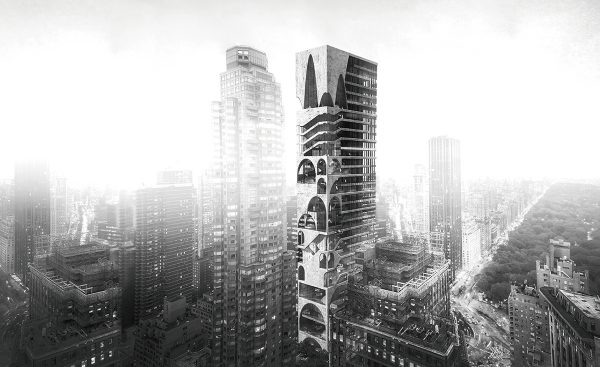
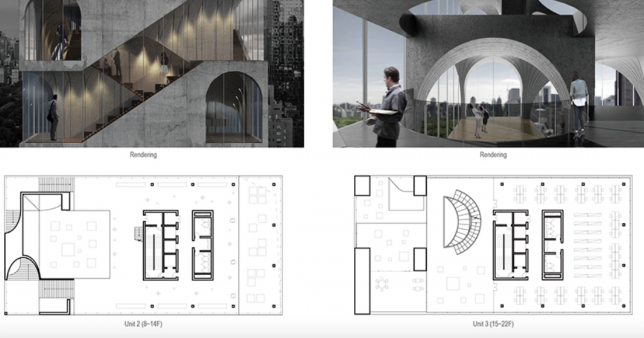
The basis of the Arch Skyscraper is envisioned as “an arch that undergoes transformations through the changes of light, human behavior, and other factors to form different spaces/units, which overlap one another vertically to form the final design.” Double-layer arches inspired by those found in medieval cathedrals and ancient Chinese pagodas are combined with vertical transportation, creating a series of vaulted spaces that are fun to explore.

Honorable Mention: The Forgotten Memorials

Noting that in the past, older architecture was often demolished to make way for the new in the constant cycle of urbanization, the designers of The Forgotten Memorials skyscraper concept propose requiring every generation to construct new buildings underneath the older ones. This could help preserve the past while accommodating the future on limited land. “They gradually, generation by generation, penetrate the clouds and become memorials beyond the sky.”

Next Page – Click Below to Read More:
Visionary High Rises Winners Of The 2017 Evolo Skyscraper Competition

Share on Facebook


[ By SA Rogers in Architecture & Cities & Urbanism. ]

[ WebUrbanist | Archives | Galleries | Privacy | TOS ]


WebUrbanist

 
Comments Off on Visionary High-Rises: Winners of the 2017 eVolo Skyscraper Competition

Posted in Creativity


Panasonic GH5 gets 10-bit 4:2:2 1080 video in first of promised firmware updates

19 Apr

When Panasonic introduced the Lumix DC-GH5, it made the bold promise that it would release not one, but two firmware updates that would significantly increase the performance of the camera. The first was to arrive in April and the second a bit later in ‘Summer 2017.’

True to its word, Panasonic has announced firmware v1.1 for the GH5, bringing 4:2:2 10-bit Full HD video capture and a series of enhanced capture options for anamorphic shooters.

The firmware brings 4:2:2 10-bit IPB capture at 100Mbps to 1080/59.97p resolution. Anamorphic shooters also get 10-bit 4:2:2 IPB capture but with the larger, 3328 x 2496 shooting region encoded at 150Mbps. The update also includes two minor bug-fixes.

Higher resolution anamorphic video capture, along with 400Mbps All-I capture for 4K and 200Mbps All-I capture for Full HD will follow in the summer release.


Press Release

DC-GH5 Firmware Update Service Ver.1.1 for Expansion of 4:2:2 10-bit Video Recording Mode

Panasonic is announcing the new firmware update program Ver.1.1 for DC-GH5 to further enhance its performance. The new firmware Ver.1.1 enables 4:2:2 10-bit video recording in either FHD [MP4(LPCM)] / [MOV] and Anamorphic (4:3) mode, in addition to the existing 4K video recording mode.

4:2:2 10-bit FHD [MP4(LPCM)] / [MOV]

Item

System frequency

Size

Frame rate

Bit rate

YUV/bit

Image compression

[FHD/10bit/100M/60p]

59.94Hz

(NTSC)

1920 x 1080

59.94p

100 Mbps

4:2:2/10 bit

Long GOP

[FHD/10bit/100M/30p]

1920 x 1080

29.97p

100 Mbps

4:2:2/10 bit

Long GOP

[FHD/10bit/100M/24p]

1920 x 1080

23.98p

100 Mbps

4:2:2/10 bit

Long GOP

[FHD/10bit/100M/50p]

50.00Hz

(PAL)

1920 x 1080

50.00p

100 Mbps

4:2:2/10 bit

Long GOP

[FHD/10bit/100M/25p]

1920 x 1080

25.00p

100 Mbps

4:2:2/10 bit

Long GOP

[FHD/10bit/100M/24p]

24.00Hz

(CINEMA)

1920 x 1080

24.00p

100 Mbps

4:2:2/10 bit

Long GOP

?When [Miniature Effect] is selected for Creative Control Mode, you cannot select the items used for 4:2:2/10 bit motion pictures.

4:2:2 10-bit Anamorphic (4:3) mode

Item

System frequency

Size

Frame rate

Bit rate

YUV/bit

Image compression

[4K/A/150M/30p]

59.94Hz

(NTSC)

3328 x 2496

29.97p

150 Mbps

4:2:2/10 bit

Long GOP

[4K/A/150M/24p]

3328 x 2496

23.98p

150 Mbps

4:2:2/10 bit

Long GOP

[4K/A/150M/25p]

50.00Hz

(PAL)

3328 x 2496

25.00p

150 Mbps

4:2:2/10 bit

Long GOP

[4K/A/150M/24p]

24.00Hz

(CINEMA)

3328 x 2496

24.00p

150 Mbps

4:2:2/10 bit

Long GOP

?[Anamorphic(4:3)] is available only when the camera is set to Creative Video Mode.

The firmware version 1.1 also includes following firmware fixes that reflect customer feedback:

  • A problem in which the exposure adjustment did not operate properly during live view standby under specific conditions using [Variable Frame Rate].
  • A problem in which afterimages appeared when recording video under high ISO sensitivity settings in using [V-LogL]

The new DC-GH5 firmware Ver 1.1 is scheduled to be released on 24 April, 2017 at the following LUMIX Customer Support website: http://panasonic.jp/support/global/cs/dsc/

Articles: Digital Photography Review (dpreview.com)

 
Comments Off on Panasonic GH5 gets 10-bit 4:2:2 1080 video in first of promised firmware updates

Posted in Uncategorized


Fujifilm’s SQ10 Instax Square camera is an instant/digital hybrid

19 Apr

$ (document).ready(function() { SampleGalleryV2({“containerId”:”embeddedSampleGallery_2146233705″,”galleryId”:”2146233705″,”isEmbeddedWidget”:true,”standalone”:false,”selectedImageIndex”:0,”startInCommentsView”:false,”isMobile”:false}) });

Fujifilm’s first square format Instax camera is here, and it’s a half-digital, half-analog beast with a $ 280 price tag.

The SQ10 uses a 1/4″ CMOS sensor to capture 3.6MP color images, and offers a 3″, 460k-dot LCD for composition and camera operation. It’s a departure from the all-analog cameras in Fuji’s current Instax lineup, but provides benefits of digital capture like adding filters in-camera and saving files to microSD. Auto exposure control, facial recognition and autofocus are also offered.

Images are printed in 1:1 format on 86 x 72mm film, which will sell for $ 17 for a pack of 10 sheets. The camera and its film go on sale in May.

Press Release

FUJIFILM ANNOUNCES THE NEW INSTAX SQUARE SQ10, A HYBRID INSTANT FILM CAMERA

SQ10 gives users a simultaneous digital and traditional print photo experience that instantly changes how we take pictures today

Valhalla, N.Y., April 19, 2017 – FUJIFILM North America Corporation today announced the all-new INSTAX® SQUARE SQ10, a sophisticated square format hybrid instant film camera that combines digital imaging technology with square film prints. The SQ10 uses a new INSTAX SQUARE Film format that delivers exceptional image quality with numerous artistic expressions. This new system takes the image quality of INSTAX to the next level and allows everyone to add a creative, artistic edge to their photography with an intuitive interface designed especially for the SQ10.

Hybrid-powered Beautiful Image Quality
The SQ10 is the first camera in the INSTAX series to be equipped with the newly developed hybrid INSTAX system – a digital image sensor and image processing technology integrated with the existing INSTAX system. These technologies allow the SQ10 to take brighter photos in low-light conditions (indoor and night scenes) and close-up shots from a distance as close as 4 in cm with new functions including automatic exposure control, facial recognition, and auto-focus.

Simply Stunning Design
The SQ10 has an iconic design and a thin, round, symmetrical shape for easy holding. It has a dual shutter system with two shutter buttons – one on the right and one on the left (buttons also work as function buttons to switch shooting modes). The lens ring is made with shaved metal, and specific areas add a sense of depth and texture throughout the solid black camera body.

The SQ10 is simply designed to let users take fun, easy and creative pictures anywhere. The SQ10 allows simple operation with a 3” TFT color LCD monitor (460K dots), operation dial and buttons on the back of the camera. Three buttons arranged at the top of the operation dial correspond to the main functions — ten different filters, vignette control, and brightness adjustment. Users will see a live display of all operations throughout the composition during shooting, editing, processing and printing on the LCD monitor. This new interface enables photographers to edit and process photos with a simple and intuitive operation. Users may also choose to select and edit (e.g. zooming, cropping and filters) the image before printing. This is particularly useful when sharing multiple prints with a number of people.

After a picture is taken, users can print, or save the image to the SQ10’s internal memory, save to the micro SD \ microSDHC card, or transfer from the camera to a computer using a micro-USB for ultimate flexibility.

Stir Your Creativity with New Shooting Modes
The SQ10 lets users shoot in various modes with several filters for outputting creative and trendy square photos. Ten different color filters, saturation and dramatic vignetting effect can be adjusted for truly artistic pictures.

The vignette effect is especially suitable for portraits or still life images as it highlights the photographic subject at the center of the photo. The SQ10 features special shooting modes including, Double Exposure that can overlap two images onto one print by pushing the shutter twice, Bulb Exposure function for night scenes and creating pictures with dramatic light streaks, Division mode for putting up to nine images on one print, and Micro mode for photography as close as 4 in cm.

New INSTAX SQUARE Film Format
The SQ10 uses a brand new INSTAX SQUARE Film format with a 1:1 aspect ratio that has been especially popular with photo enthusiasts and mobile app shooters. All INSTAX film features excellent color reproducibility, taking full advantage of Fujifilm’s long-standing research on photographic film manufacturing and image design technology.

An INSTAX Generation
Since INSTAX cameras were originally launched in 1998, they have proven to be extremely popular with users all over the world, with cumulative shipment volumes reaching over 25 million units. This has made INSTAX the leader of the world’s instant photography market over the past several years.

Fujifilm is committed to offering new products and services that meet various consumer needs by leveraging innovative technological advancements. The company is also dedicated to enhancing the enjoyment of photography worldwide, and encouraging users to experience the value of shooting, preserving, displaying and gifting photo images that deliver the message of “enriching your life with photographs.”

INSTAX SQUARE SQ10 Key Features:

  • FUJIFILM INSTAX Square SQ10 with all-new hybrid INSTAX system
  • 3” TFT color LCD monitor with 460K dots resolution
  • ¼” CMOS image sensor with primary color filter
  • 1920×1920 recorded pixels
  • Rechargeable Li-ion battery (NP-50) for up to 160 images per charge
  • Images taken and edited / processed can be saved in the internal memory (up to about 50 images) or on microSD \ microSDHC card slot (sold separately)
  • 28.5mm fixed focal length (in 35m format equivalent)
  • F2.4 aperture
  • Micro USB for internal battery recharging
  • JPEG image file format
  • Print from internal memory or micro SD \ microSDHC card
  • Tripod mount
  • New INSTAX SQUARE Film format (color) sold in 10 sheets per pack
    o Screen size – 62mm×62mm (L×W)
    o Film size – 86mm×72mm (L×W)

For a full list of specifications, visit INSTAX SQUARE SQ10.

Availability and Pricing
The INSTAX SQUARE SQ10 will be available in May 2017 in the U.S. and Canada for USD $ 279.95 and CAD $ 369.99.

INSTAX SQUARE Film will also be available in May 2017 in the U.S. and Canada for USD $ 16.99 and CAD $ 15.99.

Articles: Digital Photography Review (dpreview.com)

 
Comments Off on Fujifilm’s SQ10 Instax Square camera is an instant/digital hybrid

Posted in Uncategorized


Upcoming Fujifilm GFX 50S firmware update promises to improve AF, exposure compensation

19 Apr

In addition to announcing a handful of new medium format GF lenses, Fujifilm also unveiled plans for the first major firmware update for the GFX 50S medium format camera. According to the Fujifilm press release:

“Fujifilm will release a free firmware update for the FUJIFILM GFX 50S later this spring, adding new functionality and improving operability. New functions include computer tethering via Wi-Fi and improved operability in exposure compensation and autofocus performance in difficult scenes.”

We recently reviewed the Fujifilm GFX 50S and while we gave the camera a gold award, it was noted that AF speed and reliability was one area ripe for improvement. We also were disappointed in the lack of a dedicated exposure compensation button, so perhaps this update will make accessing that functions less annoying. Furthermore, the addition of a Wi-Fi tethering feature should go a long way to making the GFX 50S appeal to studio shooters.

Articles: Digital Photography Review (dpreview.com)

 
Comments Off on Upcoming Fujifilm GFX 50S firmware update promises to improve AF, exposure compensation

Posted in Uncategorized


Fujifilm releases GF 23mm and 110mm lenses, updates roadmap

19 Apr

$ (document).ready(function() { SampleGalleryV2({“containerId”:”embeddedSampleGallery_0692535267″,”galleryId”:”0692535267″,”isEmbeddedWidget”:true,”standalone”:false,”selectedImageIndex”:0,”startInCommentsView”:false,”isMobile”:false}) });

Fujifilm has released a pair of G-mount lenses for its GFX 50S medium format camera, an adapter for using legacy Fujifilm large format lenses and information about future GF lenses.

The GF 23mm F4 R LM WR, equivalent to 18mm when mounted on the GFX 50S, has a linear focus motor, a nine-blade circular aperture, ED, super ED and aspherical elements, and a Nano GI coating. It’s also weather-resistant and functions down to -10°C/+14°F. It’ll ship in late June for $ 2599.

Also coming in June is the GF 110mm F2 R LM WR, which also has a nine-blade aperture, weather-sealing, and a linear motor. It has three ED and one super ED elements and is equivalent to 87mm when mounted on the GFX 50S. It will be priced at $ 2799.

Fujifilm also released a roadmap for future medium format lenses. Coming later this year is a 45mm F2.8 R WR (equivalent to 36mm), followed by a telephoto prime and teleconverter.

Lastly, the company will soon be offering the ‘View Camera Adapter G,’ which allows you to use the GFX 50S with 4×5 format view cameras. The adapter allows the GFX 50S to be used on a standard Graflok-style mount camera, enabling the use of large format Fujinon lenses, such as the CM series.

Press Release

GFX MEDIUM FORMAT MIRRORLESS CAMERA SYSTEM ADDS TWO NEW GF LENSES FOR PORTRAITS TO PICTURESQUE SCENES

FUJINON GF110mmF2 R LM WR and GF23mmF4 R LM WR Lenses expand the GFX user experience; updated GF lens roadmap announced and new GFX firmware coming soon

Valhalla, N.Y., April 19, 2017 – As the leader in innovation for photographers, FUJIFILM North America Corporation today announces two new GF lenses for the FUJIFILM GFX 50S medium format mirrorless digital camera system, the GF110mmF2 R LM WR (equivalent to 87mm in 35mm format) and the GF23mmF4 R LM WR (equivalent to 18mm in 35mm format). A new GF lens roadmap is released today, along with plans for a new FUJIFILM GFX 50S firmware update this spring.

FUJINON Lenses Guarantee Image Perfection

As part of the GFX system, Fujifilm is launching newly developed, ultra-high resolution FUJINON GF lenses. Taking advantage of the mirrorless system’s structure, the G Mount has a short flange back distance of just 26.7mm that reduces the back focus distance as much as possible. This prevents vignetting and achieves edge-to-edge sharpness. All FUJINON GF lenses have been designed to support sensors of over 100MP.

New Lenses Deliver Image Excellence

The FUJINON GF110mmF2 R LM WR is a medium telephoto lens perfect for portraits. With a focal length equivalent to 87mm in the 35mm format, it achieves a brightness of F2.0 when used wide open to deliver stunning bokeh.

The FUJINON GF23mmF4 R LM WR has a focal length equivalent to 18mm in the 35mm format and is expertly suited for landscape and architectural photography. Despite the super-wide angle of view, distortion is kept to a minimum, and with the high-resolution performance extending all the way to the edges, sharp depiction as if looking at an actual landscape is achieved.

Both new lenses feature fast and quiet autofocus (AF) by using a linear motor, are dust and weather resistant, and are capable of operating in environments as cold as 14°F / -10°C. The lenses combine high performance and reliability for professionals looking for the ultimate in photography tools.

Current Lens Lineup

  1. GF63mmF2.8 R WR (equivalent to 50mm in 35mm format)
  2. GF32-64mmF4 R LM WR (equivalent to 25-51mm in 35mm format)
  3. GF120mmF4 Macro R LM OIS WR (equivalent to 95mm in 35mm format)

Coming Later in 2017

  1. GF45mmF2.8 R WR (equivalent to 35mm in 35mm format)

FUJINON GF110mmF2 R LM WR Key Features

  • FUJIFILM G Mount is compatible with the FUJIFILM GFX 50S
  • Weather-resistant design capable of operating at temperatures as low as 14°F / -10°C
  • 14 elements in 9 groups, including 4 ED lens elements
  • Super ED lens and three ED lenses for suppressed chromatic aberration and high resolution performance all the way to the edges
  • 9 blade aperture creates smooth and circular bokeh

FUJINON GF23mmF4 R LM WR Key Features

  • FUJIFILM G Mount is compatible with the FUJIFILM GFX 50S
  • Weather-resistant design capable of operating at temperatures as low as 14°F / -10°C
  • 12 groups and 15 elements construction using two aspherical lenses, one super ED lens, and three ED lenses
  • 9 blade aperture creates smooth and circular bokeh
  • Nano GI coating suppresses ghosting and flare

The GFX 50S and FUJINON GF lenses culminate to create a new camera system capable of creating the world’s highest level of photographic expressions by combining the thorough incorporation of knowledge regarding camera operation, optical design, image capture, and image processing.

New FUJINON GF Lens Development Roadmap

Fujifilm has publicly announced six lenses for the G Mount lens lineup this year. After the release of the GFX 50S and three G Mount lenses, Fujifilm is now unveiling a new roadmap with the additions of a telephoto prime lens and tele converter, in order to expand products covering telephoto ranges, an area with many requests from users.

With the addition of the two new lenses, the G Mount system lineup has been expanded to a total of eight lenses, achieving a fulfilling lineup to correspond to a wide range of user needs.

Also coming in June 2017 is a new View Camera Adapter G that can be used when shooting with the GFX 50S when using previous FUJINON large format camera lenses, such as the CM FUJINON. The adapter is mounted in the film camera loading position of the view camera which adopts the film format of the 4×5 size.

New Firmware Update Planned

Fujifilm will release a free firmware update for the FUJIFILM GFX 50S later this spring, adding new functionality and improving operability. New functions include computer tethering via Wi-Fi and improved operability in exposure compensation and autofocus performance in difficult scenes.

Availability and Pricing

The GF110mmF2 R LM WR will be available in Late June, 2017 for USD $ 2,799.95 and CAD $ 3,599.99 and the GF23mmF4 R LM WR will be available in Late June, 2017 for USD $ 2,599.95 and CAD $ 3,399.99.

The FUJIFILM GFX 50S Medium Format Camera Body is available now in the U.S. and Canada for USD $ 6,499.95 and CAD $ 8,499.99.

Fujifilm GF 23mm F4 R LM WR / 110mm F2 R LM WR specifications

  Fujifilm GF 23mm F4 R LM WR Fujifilm GF 110mm F2 R LM WR
Principal specifications
Lens type Prime lens
Max Format size 645
Focal length 23 mm 110 mm
Image stabilization No
Lens mount Fujifilm G
Aperture
Maximum aperture F4 F2
Minimum aperture F32 F22
Aperture ring Yes
Number of diaphragm blades 9
Aperture notes Rounded blades
Optics
Elements 15 14
Groups 12 9
Special elements / coatings 2 aspherical, 3 extra-low dispersion, 1 super ED 4 extra-low dispersion elements
Focus
Minimum focus 0.38 m (14.96) 0.90 m (35.43)
Maximum magnification 0.09× 0.16×
Autofocus Yes
Motor type Linear Motor
Full time manual Yes
Focus method Internal
Distance scale No
DoF scale No
Physical
Weight 845 g (1.86 lb) 1010 g (2.23 lb)
Diameter 90 mm (3.54) 94 mm (3.7)
Length 103 mm (4.06) 126 mm (4.96)
Sealing Yes
Filter thread 82.0 mm 77.0 mm
Hood supplied Yes
Tripod collar No

Articles: Digital Photography Review (dpreview.com)

 
Comments Off on Fujifilm releases GF 23mm and 110mm lenses, updates roadmap

Posted in Uncategorized