RSS
 

Archive for March, 2017

ExoLens Case for iPhone 7 supports Zeiss lenses while protecting phone

30 Mar

ExoLens has announced the launch of its new ExoLens Case for iPhone 7, a case designed to protect the phone while also supporting the company’s ExoLens PRO with Optics by Zeiss accessory lenses. The case is made from clear impact-resistant materials that, says the company, offer ‘high-end aesthetics’ while keeping a low profile. The case can be used with and without the Zeiss PRO lenses.

ExoLens PRO owners are able to switch between the line’s various lenses without removing the case, the latter of which is described as ‘ultra durable’ with soft Black TPU material along the outer edges. ExoLens has launched the case for the iPhone 7 ($ 49.95 USD) on its website and through select global retailers, and will launch a version for the iPhone 7 Plus model later on in 2017.

Via: ExoLens

Articles: Digital Photography Review (dpreview.com)

 
Comments Off on ExoLens Case for iPhone 7 supports Zeiss lenses while protecting phone

Posted in Uncategorized


Datacolor updates Spyder5 calibration software to add auto ambient light switching

30 Mar

Calibration company Datacolor has updated the Spyder5 software package that accompanies its Spyder5 monitor calibration devices for Pro and Elite customers. The update sees the packages renamed Spyder5Pro+ and SpyderElite+ to indicate that both now feature automatic ambient light switching and what the company calls 1-Click Calibration. The ambient light feature relies on the Spyder5 calibration device recognising that the lighting conditions in the monitor room have altered to trigger a different monitor profile. In previous versions users had to remember to make the adjustment manually.

The new 1-Click Calibration system is really a 1-click solution for monitors that have already been calibrated by the device before, and allows the re-calibration with a single click without having to go into the menu system. Both versions of the software also provide more in-depth control of saved profiles through an extra profile management tool.

The Elite package additionally offers a better soft-proofing workflow as well as Enhanced StudioMatch which helps users to calibrate multiple monitors so they all look the same.
For more information, including pricing for upgrades for each of the packages, see the Datacolor website.

Press release

Datacolor Announces Spyder5+ Software Upgrade with Enhanced Display Calibration Features

Datacolor®, a global leader in color management solutions, today announced the release of Spyder®5+, the next generation software expertly designed to build upon its popular color calibration tools for photographers, designers, videographers and imaging professionals.

“Spyder5 is already an amazing tool for getting the best color out of your display. With the Spyder5+ upgrade, Datacolor has added several really nice features that are an absolute no-brainer for the price,” said David Cardinal, professional photographer and Datacolor Friend with Vision. “I’ve been using the new capabilities and am really pleased with how much time they’ve saved me, as well as the additional productivity they’ve provided.”

The software upgrade is now available for all existing and new Spyder5 customers, with the option to purchase Spyder5PRO+ or Spyder5ELITE+. Spyder5+ adds unique features to the Spyder5 calibration tools by enhancing users’ digital color workflow, including:

* Automatic Room Light Switching ensures users’ monitor profile changes as the room light conditions shift, with no user interaction required
* 1-Click Calibration streamlines a user’s workflow with a single click to start the calibration without having to re-select saved settings
* Profile Management Tool gives users the ability to edit, remove, rename, locate, and activate each display profile for ultimate control and flexibility

Users who purchase the Spyder5ELITE+ upgrade will have access to all of the above features, in addition to:

* Spyder SoftProof improves “Screen-to-Output” matching with a new workflow to simulate how photos will look on any printer or device – including home printers, online or retail printers, and certain mobile/tablet devices
* Enhanced StudioMatch verifies precise monitor matching and takes the guess work out of making all connected displays look the same – including a new visual verification step that assists you by fine tuning your results

“We’re very excited to add this upgrade to our Spyder5 product line. This new software offers unique tools to ensure color management across all devices, so our customers can remain confident in their decision to choose Datacolor for their color calibration needs,” said Stefan Zrenner, Director Global Sales & Marketing Imaging, Datacolor. “With a competitive set of features, Spyder5+ is the perfect tool for creatives that rely on consistency in their work.”

New and existing Spyder5 customers wishing to purchase the Spyder5+ software add-on can find out more and buy via the Datacolor website. Upon software purchase, customers will receive a software serial number and a step-by-step guide for easy download.

Articles: Digital Photography Review (dpreview.com)

 
Comments Off on Datacolor updates Spyder5 calibration software to add auto ambient light switching

Posted in Uncategorized


Wild Wood: 28 Temporarily Tamed Tree-Based Designs Branch Out

29 Mar

[ By SA Rogers in Design & Furniture & Decor. ]

pontus willfors main

Trees seem to temporarily allow humans to form them into a new shape and give them a different purpose before reclaiming their wild nature and going on with their tree-business in these wild wood designs. Taking a modern approach to branch-based furniture, decor and sculpture, they celebrate the natural qualities of the materials, allowing them to shine in a way that makes them feel truly alive.

Spaghetti Benches by Pablo Reinoso

spaghetti bench 1

spaghetti bench 2

pablo reinoso 3

The slats of a wooden bench just keep growing as if they’re still alive, tangling together and climbing up walls, in Pablo Reinoso’s ‘Spaghetti Bench’ series. It’s almost like the tree the wood came from allowed itself to serve a purpose as seating only temporarily, and then decided to go about its life. The artist extends the same technique to other objects, like picture frames.

Fusion Frames by Darryl Cox

darryl cox 1

darryl cox 2

fusion frames 3

fusion frames 2

fusion frames

darryl cox 4

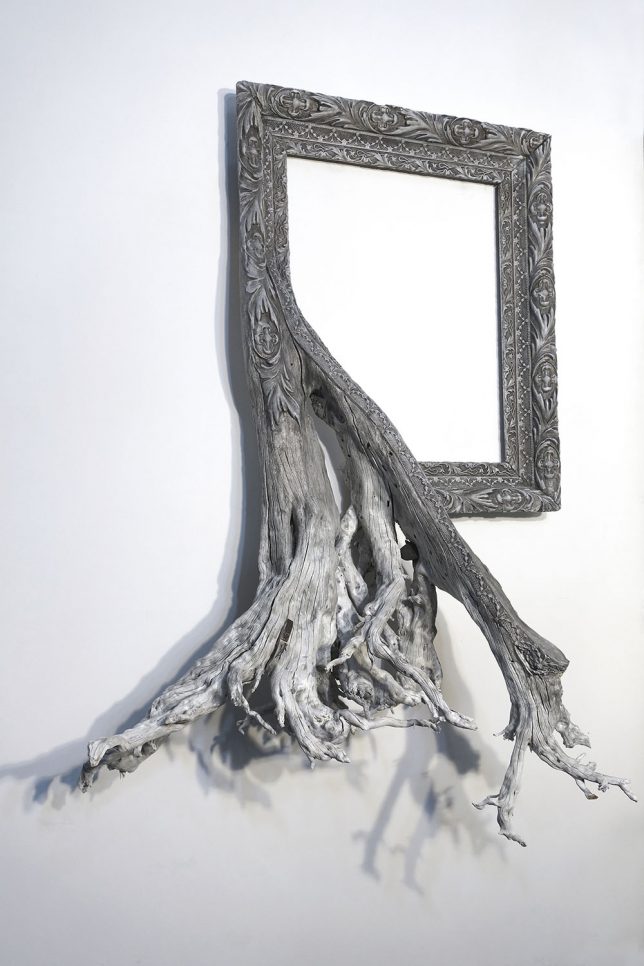
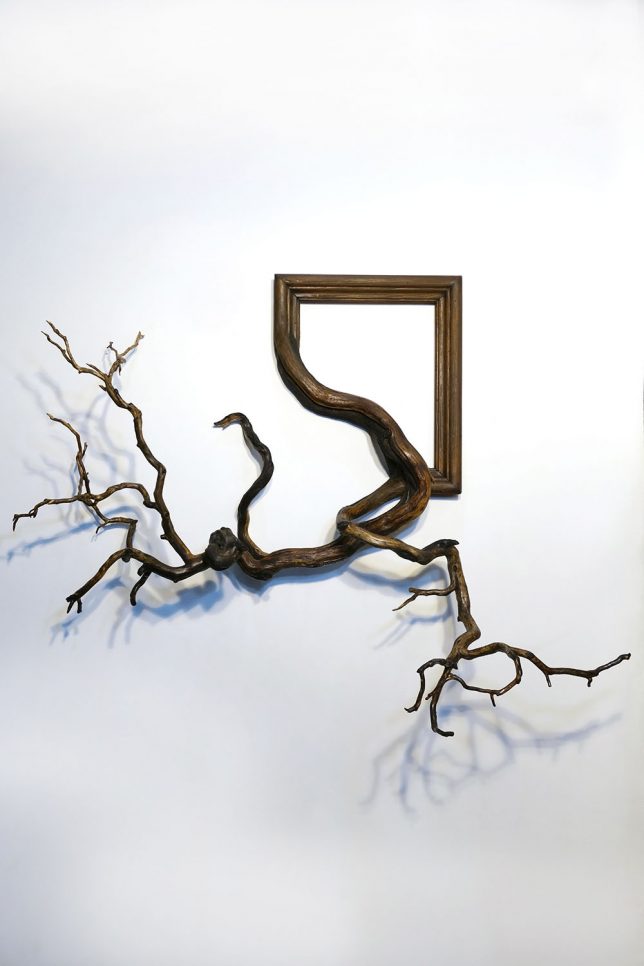
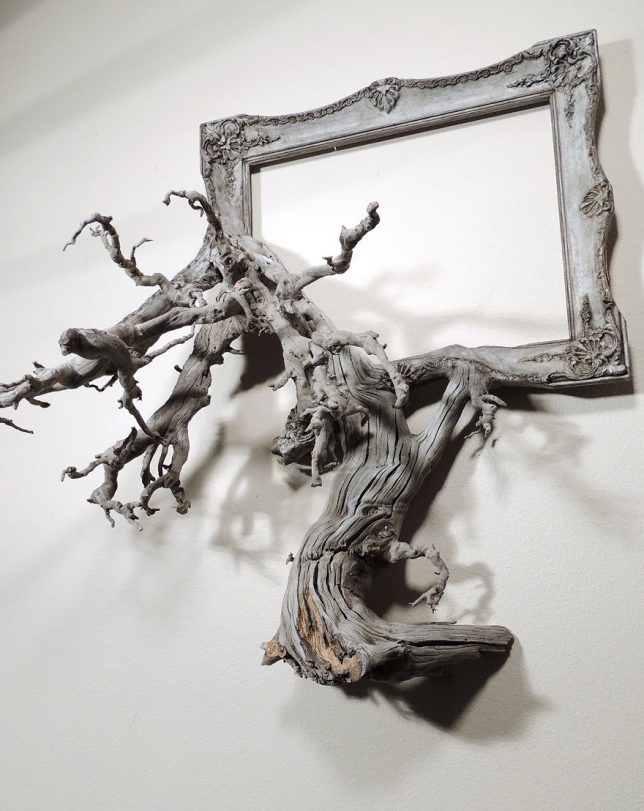
These hybrid frames by Oregon-based artist Darryl Cox start out as two separate objects – the reclaimed roots of manzanita, aspen and juniper trees, and a carefully matched picture frame. The artist carefully matches the tone and texture of the two objects and painstakingly blends them together with carving tools and paint. Look closely and you’ll find that the seams are virtually undetectable.

Sprouting Furniture by Pontus Willfors

pontus wilfors 1

pontus wilfors 2

pontus wilfors 3

The temporarily tamed wood that’s been crafted into chairs and other functional items starts to rebel before you can even sit down in this series by artist Pontus Willfors. It’s almost as if the trees have decided they have no patience for human attempts to turn them into something unnatural.

Fallen Tree Bench by Benjamin Graindorge

fallen tree bench

fallen tree bench 2

This bench by Benjamin Graindorge can’t hide its origins, the smooth surface giving way to stripped branches and then bark. ‘Fallen Tree Bench ‘ is fully supported on one side by a tangle of branches as if we caught it in mid-morph.

Driftwood Coffee Table & Side Table by Bernardo Urbina

bernardo urbina

bernardo urbina 2

bernardo urbina 3

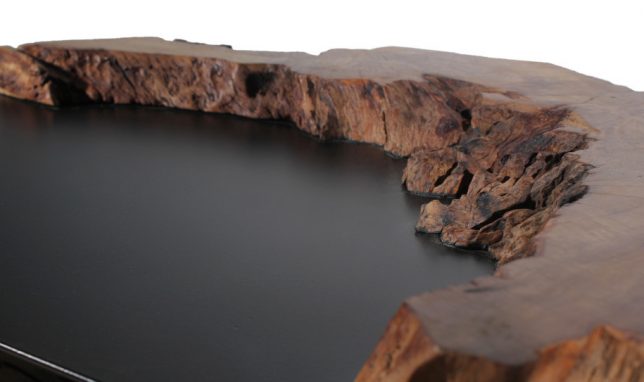
Designer Bernardo Urbina blends unexpected upcycled materials together into minimalist tables and other objects. For these two tables, he chose wrap Traviesa and Tugas wood around a black folded metal base.

Next Page – Click Below to Read More:
Wild Wood 28 Temporarily Tamed Tree Based Designs Branch Out

Share on Facebook


[ By SA Rogers in Design & Furniture & Decor. ]

[ WebUrbanist | Archives | Galleries | Privacy | TOS ]


WebUrbanist

 
Comments Off on Wild Wood: 28 Temporarily Tamed Tree-Based Designs Branch Out

Posted in Creativity


Resolution, aliasing and light loss – why we love Bryce Bayer’s baby anyway

29 Mar

It’s unlikely Kodak’s Bryce Bayer had any idea that, 40 years after patenting a ‘Color Imaging Array’ that his design would underpin nearly all contemporary photography and live in the pockets of countless millions of people around the world.

It seems so obvious, once someone else has thought of it, but capturing red, green and blue information as an interspersed, mosaic-style array was breakthrough.
Image: based on original by Colin M.L Burnett

The Bayer Color Filter Array is a genuinely brilliant piece of design: it’s a highly effective way of capturing color information from silicon sensors that can’t inherently distinguish color. Most importantly, it does a good job of achieving this color capture while still capturing a good level of spatial resolution.

However, it isn’t entirely without its drawbacks: It doesn’t capture nearly as much color resolution as a camera’s pixel count seems to imply, it’s especially prone to sampling artifacts and it throws away a lot of light. So how bad are these problems and why don’t they stop us using it?

Resolution

There’s a limit to how much resolution you can capture with any pixel-based sensor. Sampling theory dictates that a system can only perfectly reproduce signals at half the sampling frequency (a limit known as the Nyquist Frequency). If you think about trying to represent a single pixel-width black line, you need at least two pixels to be sure of representing it properly: one to capture the line and another to capture the not-line.

Just to make things more tricky, this assumes your pixels are aligned perfectly with the line. If they’re slightly misaligned, you may get two grey pixels instead. This is taking into consideration by the Kell factor, which says that you’ll actually only reliably capture resolution around 0.7x your Nyquist frequency.

A sensor capturing detail at every pixel can perfectly represent data at up to 1/2 of its sampling frequency, so 4000 vertical pixels can represent 2000 cycles (or 2000 line pairs as we’d tend to think of it). This is a fundamental rule of sampling theory.

But, of course, a Bayer sensor doesn’t sample all the way to its maximum frequency because you’re only sampling single colors at each pixel, then deriving the other color values from neighboring pixels. This lowers resolution (effectively slightly blurring the image).

So, with these two factors (the limitations of sampling and Bayer’s lower sampling rate) in mind, how much resolution should you expect from a Bayer sensor? Since human vision is most sensitive to green information, it’s the green part of a Bayer sensor that’s used to provide most of the spatial resolution. Let’s have a look at how it compares to sampling luminance information at every pixel.

Counter-intuitive though it may sound, the green channel captures just as much horizontal and vertical detail as the sensor capturing data at every pixel. Where it loses out is on the diagonals, which sample at 1/2 the frequency.

Looking at just the green component, you should see that a Bayer sensor can still capture the same horizontal and vertical green (and luminance) information as a sensor sampling every pixel. You lose something on the diagonals, but you still get a good level of detail capture. This is a key aspect of what makes Bayer so effective.*

Red and blue information is captured at much lower resolutions than green. However, human vision is more sensitive to luminance (brightness) information than chroma (color) information, which makes this trade-off visually acceptable in most circumstances.

It’s a less good story when we look at the red and blue channels. Their sampling resolution is much lower than the luminance detail captured by the green channel. It’s worth bearing in mind that human vision is much more sensitive to luminance resolution than it is to color information, so viewers are likely to be more tolerant of this shortcoming.

Aliasing

So what happens to everything above the Nyquist frequency? Well, unless you do something to stop it, your camera will try to capture this information, then present it in a way it can represent. A process called aliasing.

Think about photographing a diagonal black stripe with a low resolution camera. Even with a black and white camera, you risk the diagonal being represented as a series of stair steps: a low-frequency pattern that acts as an ‘alias’ for the real pattern.

The same thing happens with fine repeating patterns that are a higher frequency than your sensor can cope with: they appear as spurious aliases of the real pattern. These spurious patterns are known as moiré. This isn’t unique to Bayer, though, it’s a side-effect of trying to capture higher frequencies than your sampling can cope with. It will occur on all sensors that use a repeating pattern of pixels to capture a scene.
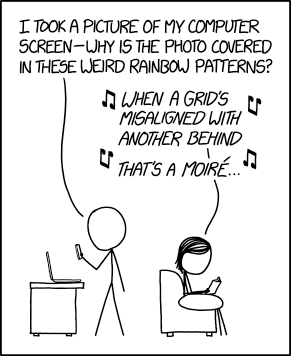
Source: XKCD

Sensors that use the Bayer pattern are especially prone to aliasing though, because the red and blue channels are being sampled at much lower frequencies than the full pixel count. This means there are two Nyquist frequencies (a green/luminance limit and a red/blue limit) and two types of aliasing you’ll tend to encounter: errors in detail too fine for the sensor to correctly capture the pattern of and errors in (much less fine) detail that the camera can’t correctly assess the color of.

‘the Bayer pattern is especially prone to aliasing’

To reduce this first kind of error most cameras have, historically, included Optical Low Pass Filters, also known as Anti-Aliasing filters. These are filters mounted in front of the sensor that intentionally blur light across nearby pixels, so that the sensor doesn’t ever ‘see’ the very high frequencies that it can’t correctly render, and doesn’t then misrepresent them as aliasing.**

The point at the center of the Siemens star is too fine for this monochrome camera to represent, so it’s produced a spurious diamond-shaped ‘alias’  at the center instead. This image second was shot with a very high resolution camera, blurred to remove high frequencies, then downsized to the same resolution as the first shot. It still can’t accurately represent the star, but doesn’t alias when failing.

These aren’t so strong as to completely prevent all types of aliasing (very few people would be happy with a filter that blurred the resolution down to 1/4 of the pixel height: the Nyquist frequency of red and blue capture), instead they blur the light just enough to avoid harsh stair-stepping and reduce the severity of the false color on high-contrast edges.

With a Bayer filter, you get a fun color component to this aliasing. Not only has the camera tried to capture finer detail than its sensor can manage, you get to see the side-effect of the different resolutions the camera captures each color with. Again, if you compare this with a significantly over-sampled image, blurred then downsized, you don’t see this problem. However, look closely you can still see traces of the false color that occurred at the much higher frequency this camera was shooting at.

This means that, a camera with an anti-aliasing filter, you shouldn’t see as much false color in the high-contrast mono targets within our test scene, but it’ll do nothing to prevent spurious (aliased) patterns in the color resolution targets.

Even with an anti-aliasing filter, you’ll still get aliasing of color detail, because the maximum frequency of red or blue that can be captured is much lower. This image was shot at the same nominal resolution but with red, green and blue information captured for each output pixel: showing how the target could appear, with this many pixels.

Light loss

At the silicon level, modern sensors are pretty amazing. Most of them operate at an efficiency (the proportion of light energy converted into electrons) around 50-80%. This means there’s less than 1EV of performance improvement to be had in that respect, because you can’t double the performance of something that’s already over 50% effective. However, before the light can get to the sensor, the Bayer design throws away around 1EV of light, because each pixel has a filter in front of it, blocking out the colors it’s not meant to be measuring.

‘The Bayer design throws away
around 1EV of light’

This is why Leica’s ‘Monochrom’ models, which don’t include a color filter array, are around one stop more sensitive than their color-aware sister models. (And, since they can’t produce false color at high-contrast edges, they don’t include anti aliasing filters, either).

It’s this light loss component that may eventually spell the end of the Bayer pattern as we know it. For all its advantages, Bayer’s long term dominance is probably most at risk if it gets in the way of improved low-light performance. This is why several manufacturers are looking for alternatives to the Bayer pattern that allow more light through to the sensor. It’s telling, though, that most of these attempts are essentially variations on the Bayer theme, rather than total reinventions.

The alternatives

These variations aren’t the only alternatives to the Bayer design, of course.

Sigma’s Foveon technology attempts to measure multiple colors at the same location, so promises higher color resolution, no light loss to a color filter array and less aliasing. But, while these sensors are capable of producing very high pixel-level sharpness, this currently comes at an even greater noise cost (which limits both dynamic range and low light performance), as well as struggling to compete with the color reproduction accuracy that can be achieved using well-tuned colored filters. More recent versions reduce the color resolution of two of their channels, sacrificing some of their color resolution advantage for improved noise performance.

‘The worst form… except all those others that have been tried’

Meanwhile, Fujifilm has struck out on its own, with the X-Trans color filter pattern. This still uses red, green and blue filters but features a larger repeat unit: a pattern that repeats less frequently, to reduce the risk of it clashing with the frequency it’s trying to capture. However, while the demosaicing of X-Trans by third-party software is improving, and the processing power needed to produce good-looking video looks like it’s being resolved, there are still drawbacks to the design.

Ironically, devoting so much of the sensor to green/luminance capture appears to have the side-effect of reducing its ability to capture and represent foliage (perhaps because it lacks the red and blue information required to render the subtle tint of different greens).

Which leaves Bayer in a situation akin to Winston Churchill’s take on Democracy as: ‘the worst form of Government except all those other forms that have been tried from time to time.’

40 not out

As we’ve seen before, the sheer amount of effort being put into development and improvement of Bayer sensors and their demosaicing is helping them overcome the inherent disadvantages. Higher pixel counts keep pushing the level of color detail that can be resolved, despite the 1/2 green, 1/4 red, 1/4 blue capture ratio.

And, because the frequencies that risk aliasing relate to the sampling frequency, higher pixel count sensors are showing increasingly little aliasing. The likelihood of you encountering frequencies high enough to cause aliasing falls as your pixel count helps you resolve more and more detail.

Add to this the fact that lenses can’t perfectly transmit all the detail that hits them, and you start to reach the point that the lens will effectively filter-out the very high frequencies that would otherwise induce aliasing. At present, we’ve seen filter-less full frame sensors of 36MP, APS-C sensors of 24MP and Four Thirds sensors of 16MP, all of which are sampling their lenses at over 200 pixels per mm, and these only produce significant moiré when paired with very sharp lenses shot wide-enough open that diffraction doesn’t end up playing the anti-aliasing role.

So, despite the cost of light and of color resolution, and the risk of error, Bryce Bayer’s design remains firmly at the heart of digital photography, more than 40 years after it was first patented.


Thanks are extended to DSPographer for sanity-checking an early draft and to Doug Kerr, whose posts helped inform the article, who inspired the diagrams and who was hugely supportive in getting the article to a publishable state.

* Unsurprisingly, some manufacturers have tried to take advantage of this increased diagonal resolution by effectively rotating the pattern by 45°: this isn’t commonplace enough to derail this article with such trickery, so we’ll label them ‘witchcraft’ and carry on as we were.

** The more precocious among you may be wondering ‘but wouldn’t your AA filter need to attenuate different frequencies for the horizontal, vertical and diagonal axes?’ Well, ideally, yes, but it’s easier said than done and far beyond the scope of this article.

Articles: Digital Photography Review (dpreview.com)

 
Comments Off on Resolution, aliasing and light loss – why we love Bryce Bayer’s baby anyway

Posted in Uncategorized


Samsung planning to sell refurbished Galaxy Note 7 units

29 Mar

It’s probably fair to say its Galaxy Note 7 flagship has been an absolute disaster for Samsung. After a number of devices caught fire Samsung eventually made the decision to discontinue the model and, after an internal investigation, announced that the fires had been caused by design and manufacturing errors on the Note 7 batteries. 

In a press release, the South Korean company has now laid out how it will recycle and dispose of the hundreds of thousands of Note 7 units that had already been produced and partly sold. According to the statement, ‘devices shall be considered to be used as refurbished phones or rental phones where applicable.’ This is dependent upon consultations with regulatory authorities and carriers and local demand, which probably means it’s unlikely any refurbished units would make it to Europe or the US.

For remaining devices, reusable components, such as semiconductors and camera modules, ‘shall be detached by companies specializing in such services and used for test sample production purposes.’ For anything that is left after the first two steps, ‘Samsung shall first extract precious metals, such as copper, nickel, gold and silver by utilizing eco-friendly companies specializing in such processes.’

Meanwhile, Samsung’s new high-end phone, the Galaxy S8, is expected to be launched tomorrow at events in New York and London. Hopefully it’ll have more success than its ill-fated cousin.

Articles: Digital Photography Review (dpreview.com)

 
Comments Off on Samsung planning to sell refurbished Galaxy Note 7 units

Posted in Uncategorized


Sony World Photography Awards Open categories and National winners announced

29 Mar

$ (document).ready(function() { SampleGalleryV2({“containerId”:”embeddedSampleGallery_9794723210″,”galleryId”:”9794723210″,”isEmbeddedWidget”:true,”standalone”:false,”selectedImageIndex”:0,”startInCommentsView”:false,”isMobile”:false}) });

The winners of the ten Open categories of the Sony World Photography Awards have been announced alongside National Award winners from 66 countries. The Open competition consists of ten themed categories so there are ten winners in total, each receiving a Sony a7 II kit, who will go on to compete for the overall prize of $ 5000 and a trip to the awards ceremony in London next month.

$ (document).ready(function() { SampleGalleryV2({“containerId”:”embeddedSampleGallery_3685180831″,”galleryId”:”3685180831″,”isEmbeddedWidget”:true,”standalone”:false,”selectedImageIndex”:0,”startInCommentsView”:false,”isMobile”:false}) });

Once the 105,000 entries to the Open section had been judged in their themed categories the total entry was re-judged according to nationality so the best images from each of 66 countries could be found. The names of the photographers in the best three from those countries have also been announced today. Winners from these awards will be displayed alongside the Open winners and the winners of the Professional categories at an exhibition to be held in London’s Somerset House from the 21st April to 7th May.

The winners of the Professional categories, and the overall winner of the Open section, will be revealed on April 20th at the awards ceremony. Martin Parr will be presented with the Outstanding Contribution to Photography prize at the event and will be exhibiting a collection of images in the main exhibition.

For more information and to see all the National Awards winners visit the Sony World Photography Awards website.

Press release

The world’s best single photographs revealed by 2017 Sony World Photography Awards 

  • World’s largest photography competition announces winners of its Open categories and National Awards programme
  • Open category winners competing to win trip to London and $ 5,000 (USD) cash prize

28th March, 2017: Ten extraordinary photographs from across the globe are today revealed as the winners of the Open categories of the 2017 Sony World Photography Awards, the world’s largest photography competition.

The winners were selected from more than 105,000 entries to the Awards’ Open competition, with the expert panel of judges looking for the best single photographs across ten categories.

The ten Open category winners are:
* Architecture – Tim Cornbill (UK)
* Culture – Jianguo Gong (China)
* Enhanced – Lise Johansson (Denmark)
* Motion – Camilo Diaz (Colombia)
* Nature – Hiroshi Tanita (Japan)
* Portraits – Alexander Vinogradov (Russia)
* Still Life – Sergey Dibtsev (Russia)
* Street Photography – Constantinos Sofikitis (Greece)
* Travel – Ralph Gräf (Germany)
* Wildlife – Alessandra Meniconzi (Switzerland)

Each of the ten winning photographs display huge photographic talent and creativity, from a stunning wildlife shot of flamingos in Walvis Bay, Namibia (Alessandra Meniconzi) to the ice blue and white of winter (Hiroshi Tanita) and a beautifully simple portrait (Alexander Vinogradov). Scale is used to stunning effect to capture more than 1300 people practicing Tai-Chi in China (Jianguo Gong) and architecture in Berlin (Tim Cornbill) while a crucial goal-scoring moment in an underwater rugby match is photographed by Camilo Diaz. A subtle palette of color is used in both the Enhanced (Lise Johansson) and Travel (Ralph Gräf) category winners while black and white photography is the choice for the Street Photography winner (Constantinos Sofikitis).

Each winning photographer receives a Sony ?7 II with lens kit and will now compete to win the prestigious Sony World Photography Awards’ Open Photographer of the Year title, a trip to the winners’ awards ceremony in London in April and $ 5,000 US dollars in cash prizes. The overall winner will be announced on the 20th April alongside the winners of the Professional competition (judged on a body of work).

Chair of the Open competition, journalist and photographer Damien Demolder, said of the winning Open images: “It has been a pleasure and an inspiration to be exposed to such a volume of great work, and a privilege too that I could share in the personal moments, the joys, tears, life and losses of photographers from all around the globe who recorded their experiences through their pictures.”

National Awards
The winners of the Sony World Photography Awards National Awards, a global program to find the best single photographs taken by local photographers in 66 countries, were also announced today.

Now in its fourth year, the National Awards is unique in both scope and reach and opened up to photographers from Cambodia, Nepal, Pakistan, Qatar, Saudi Arabia, Sri Lanka and the United Arab Emirates for the first time this year.

Winners and runners-ups across all 66 National Awards were announced today, and can be viewed here.

Exhibition
The winners of the Open categories and the National Awards will all be shown at the Sony World Photography Awards & Martin Parr – 2017 Exhibition at Somerset House, London which opens on the 21st April and runs until the 7th May.

The exhibition will include all the winning, shortlisted (top 10) and commended (top 50) photographs drawn from more than 227,000 entries from 183 countries to the 2017 Sony World Photography Awards. It will also feature a special dedication to British photographer Martin Parr, recipient of the Awards’ Outstanding Contribution to Photography prize.

Sony World Photography Awards
Produced by the World Photography Organisation, 2017 sees the 10th anniversary of the Sony World Photography Awards and a decade-long partnership with its headline sponsor, Sony. The Awards recognise and reward the very best contemporary photography captured over the last year, and incorporate four competitions – Professional, Open, Youth and Student Focus. The overall winners of the 2017 Sony World Photography Awards will be announced on the 20th April.

About World Photography Organisation
The World Photography Organisation is a global platform for photography initiatives. Working across up to 180 countries, our aim is to raise the level of conversation around photography by celebrating the best imagery and photographers on the planet. We pride ourselves on building lasting relationships with both individual photographers and our industry-leading partners around the world. We host a year-round portfolio of events including: the Sony World Photography Awards (the world’s largest photography competition, marking its 10th anniversary in 2017), various local meetups/talks throughout the year, and PHOTOFAIRS, International Art Fairs Dedicated to Photography, with destinations in Shanghai and San Francisco.

About Sony Corporation
Sony Corporation is a leading manufacturer of audio, video, imaging, game, communications, key device and information technology products for the consumer and professional markets. With its music, pictures, computer entertainment and online businesses, Sony is uniquely positioned to be the leading electronics and entertainment company in the world. Sony recorded consolidated annual sales of approximately $ 72 billion for the fiscal year ended March 31, 2016. Sony Global Web Site: http://www.sony.net/

Articles: Digital Photography Review (dpreview.com)

 
Comments Off on Sony World Photography Awards Open categories and National winners announced

Posted in Uncategorized


Fujifilm Instax Mini 9 launches with selfie mirror and close-up lens attachment

29 Mar

Fujifilm has announced the Instax Mini 9, a new instant camera that has launched in five colors: Lime Green, Flamingo Pink, Smoky White, Ice Blue, and Cobalt Blue. The Instax Mini 9 builds upon the company’s Instax Mini 8, bringing with it a selfie mirror as well as a new close-up lens attachment enabling photographers to snap photos as close as 35cm / 14in.

Fujifilm says the ‘popular’ features from the previous model are rolled over into the Instax Mini 9, including auto exposure. The camera chooses the optimal brightness setting for any given snapshot, highlighting the chosen setting by illuminating one of four lights corresponding the following settings: Indoors, Cloudy, Sunny (overcast), and Sunny (bright). The user then manually switches the dial to that setting.

Other features include a 0.37x viewfinder with target spot, an automatic film feeding system, flash with an effective range from 0.6m to 2.7m, and support for two ordinary AA batteries. A pair of AA batteries can power the camera through approximately 10 Instax Mini film packs before needing replaced.

The Instax Mini 9 will launch in the U.S. and Canada next month for $ 69.95 USD and $ 99.99 CAD, and then in the U.K. in May for £77.99.

Articles: Digital Photography Review (dpreview.com)

 
Comments Off on Fujifilm Instax Mini 9 launches with selfie mirror and close-up lens attachment

Posted in Uncategorized


Ming Thein joins Hasselblad as Chief of Strategy

29 Mar

Hasselblad has announced that commercial photographer and blogger Ming Thein has been appointed its Chief of Strategy. Thein is known for his popular blog, and is no stranger to Hasselblad as a former ambassador for the company. In addition to his photography chops, Thein brings a degree in Physics from Oxford and years of experience working in finance and private equity firms to Hasselblad. Plus, we think he’s got some good ideas about how cameras should function.

Hasselblad has been going through a transitional period lately – the company never denied reports that DJI became a majority stakeholder, and recently announced the departure of CEO Perry Oosting. Certainly Oosting had a hand in modernizing the company’s offerings and righting the ship after some unfortunate missteps. There’s more work ahead, however, as the company works to meet demand for its X1D mirrorless camera.

Articles: Digital Photography Review (dpreview.com)

 
Comments Off on Ming Thein joins Hasselblad as Chief of Strategy

Posted in Uncategorized


Autonomous Trap: Artist Uses Ritual Magic to Capture Driverless Cars

28 Mar

[ By WebUrbanist in Art & Installation & Sound. ]

car trap

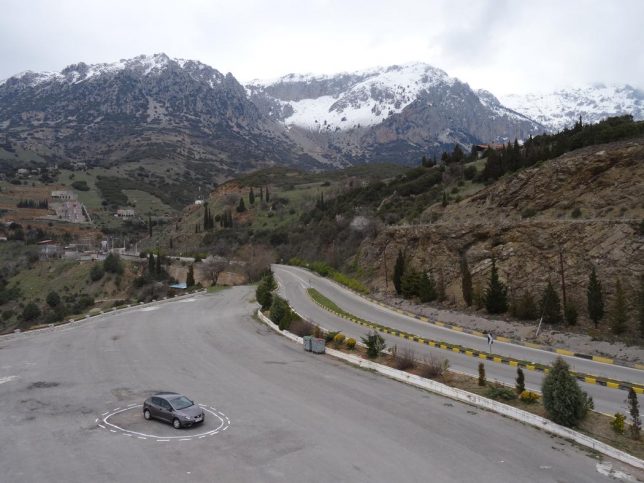
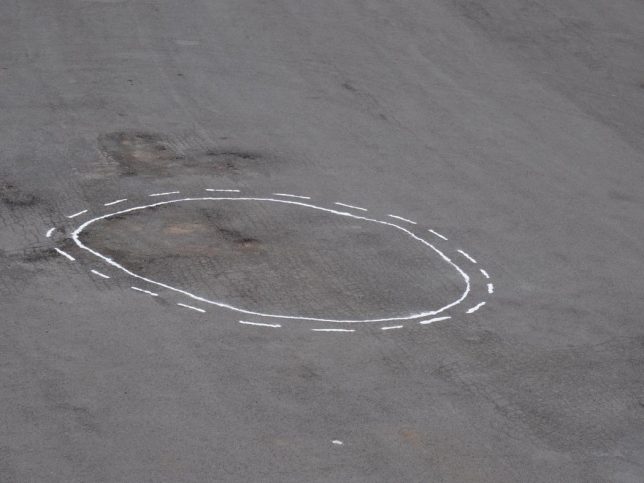
Somewhere between pagan magic, modern science and quirky satire, this installation project uses salt circles but also the logic of traffic lines to lure in and ensnare unsuspecting autonomous vehicles.

salt trap car

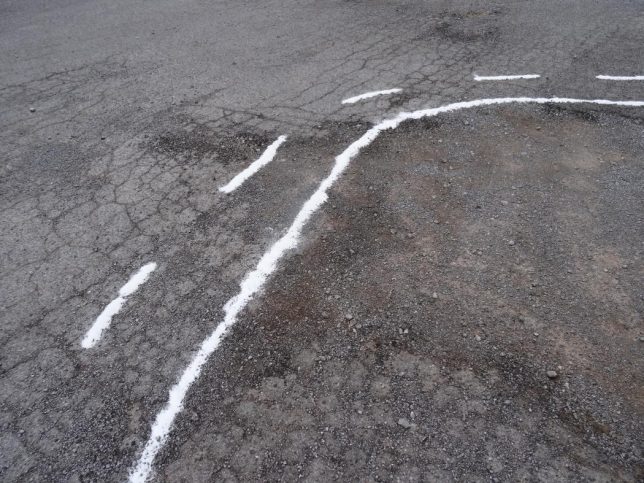
James Bridle‘s Autonomous Trap 001 employs familiar street markings found on divided highways – per the rules of the road, cars can cross over the dotted line but not back over the solid line. It sounds a bit absurd, but consider: driverless cars with various degrees of autonomy are already hitting the streets, and these do rely on external signals to determine their course. As these technologies gain traction, it is entirely likely that serious attempts will be made to spoof and deceive their machine vision algorithms.

“What you’re looking at is a salt circle, a traditional form of protection—from within or without—in magical practice,” explains Bridle. “In this case it’s being used to arrest an autonomous vehicle—a self-driving car, which relies on machine vision and processing to guide it. By quickly deploying the expected form of road markings—in this case, a No Entry glyph—we can confuse the car’s vision system into believing it’s surrounded by no entry points, and entrap it.”

autonomous vehicle trap magic

“The scene evokes a world of narratives involving the much-hyped technology of self-driving cars,” writes Beckett Mufson of Vice. “It could be mischievous hackers disrupting a friend’s self-driving ride home; the police seizing a dissident’s getaway vehicle; highway robbers trapping their prey; witches exorcizing a demon from their hatchback.” It has elements of cultural commentary that stem from acute awareness of real conditions, bordering on the absurd but also quite sobering.

mountain pass

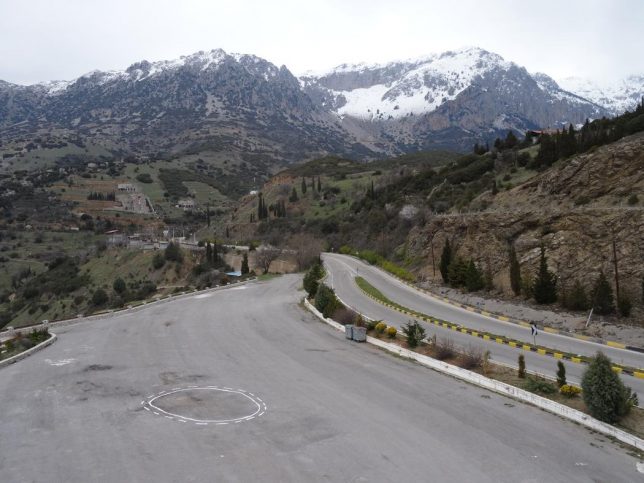
In fact, Bridle made his trap while training his own DIY self-driving car software near Mount Parnassus in Central Greece. “Parnassus feels like an appropriate location,” he says, because “as well as [having] quite spectacular scenery and [being] wonderful to drive and hike around, it’s the home of the Muses in mythology, as well as the site of the Delphic Oracle. The ascent of Mount Parnassus is, in esoteric terms, the journey towards knowledge and art.” Meanwhile, Bridle continues to work on other pieces related to contemporary technology, tackling subjects from machine vision and artificial intelligence to militarized tech and big data.

Share on Facebook


[ By WebUrbanist in Art & Installation & Sound. ]

[ WebUrbanist | Archives | Galleries | Privacy | TOS ]


WebUrbanist

 
Comments Off on Autonomous Trap: Artist Uses Ritual Magic to Capture Driverless Cars

Posted in Creativity


Pentax KP Review

28 Mar

The Pentax KP is a 24MP APS-C DSLR with styling and controls lifted largely from the full-frame K-1. Sold as a body only at a price of $ 1099, it includes standard Pentax features like full weather-sealing and in-body five-axis Shake Reduction, and includes all the interesting features enabled by the aforementioned system, including ‘Pixel Shift Resolution’. It also offers interchangeable front grip system as part of its rather pretty design.

On the face of it, the Pentax KP is a confusing proposition. It launches at the same price as their APS-C flagship the K-3 II did over a year ago, while trading useful K3 features like GPS in favor of the extra control dial, swappable grips, and a built-in flash.

Key Features:

  • 24MP APS-C CMOS sensor with max ISO of 819,200
  • 27-point AF sensor with 25 central cross-type points
  • 86,000-pixel RGB metering sensor aids subject tracking and exposure
  • PRIME IV Processor
  • In-body ‘SR II’ 5-axis image stabilization
  • 7 fps continuous shooting
  • Interchangeable grips
  • Improved ‘Function Dial’ from the K-1
  • Electronic shutter up to 1/24,000 sec through the viewfinder
  • Wi-Fi communication

The surprisingly petite pentaprism-equipped camera borrows styling cues and controls from the full-frame K-1, and even shares some in common with Nikon’s retro-reborn Df. JPEG image quality has received some massaging courtesy of the new PRIME IV processor, expanding the KP’s high ISO capabilities all the way to the ludicrous value of 819,200.

  Pentax KP Pentax K-3 II Nikon D7200
Price $ 1099 (body only) $ 1099 (body only) $ 1199 (body only)
Resolution 24MP 24MP 24MP
ISO Auto, 100-819200 Auto, 100 – 51200 Auto, 100 – 25600
Image Stabilization Yes (in-body) Yes (in-body) In-lens only
Focus Points 27 (25 cross-type) 27 (25 cross-type) 51 (15 cross-type)
AF Point Selection Shared with direction pad Shared with direction pad Shared with direction pad
Viewfinder Magnification 0.95x 0.95x 0.94x
Continuous Drive 7 fps 8.3 fps 7 fps
Battery Life 390 720 1110
GPS Optional Built-in Optional

When compared to the outgoing K-3 II and long-in-the-tooth D7200, we see that with some features like burst rate and battery life the KP is a step backwards. On the other hand, we see a better control layout, higher ISO capabilities, and the new SR II system. It omits GPS, and takes a hit in areas like battery life and burst rate. The addition of the K-1’s Function Dial means the top plate LCD screen is lost from the K-3 II as well. 

These changes indicate that maybe the KP wasn’t designed solely with outdoing the competition, or even the K-3 II, in mind. It certainly doesn’t seem like an outright replacement, but instead a different lineup aimed at being a bit more portable for enthusiasts or casual shooters.

In some ways, the KP reminds us of the PEN-F: a combination of distinctive looks and improved image quality in a compact, premium body. While looks alone may not sell it for some, there are parts of the KP’s design that are excellent, possibly even market leading. Let’s take a closer look at what is right with the KP.

Articles: Digital Photography Review (dpreview.com)

 
Comments Off on Pentax KP Review

Posted in Uncategorized