RSS
 

Archive for February, 2017

Save 96% On The Ultimate Photography Bundle – 41 Training Resources That Will Transform Your Photography

23 Feb

Unspecified

This is a post I’ve been looking forward to publishing for months now because it has the potential to transform your photography and take average photos to great!

googletag.cmd.push(function() {
mobile_slots.push( googletag.defineSlot( “/1005424/_dPSv5topic-rhs(300×250)”, [300, 250], “pb-ad-124310” ).addService( googletag.pubads() ) ); } );

googletag.cmd.push(function() {
mobile_slots.push( googletag.defineSlot( “/1005424/_dPSv5topic-rhs(300×250)”, [300, 250], “pb-ad-124309” ).addService( googletag.pubads() ) ); } );

Today dPS is proud to be part of putting together one of the most unbelievable bundles of photography teaching that has ever been assembled – it’s called the Ultimate Photography Bundle.

Now I don’t claim that this bundle is “unbelievable” lightly. When you see what’s included you’ll see what I mean.

It’s got so many photography training resources including 10 courses, 16 eBooks, 4 sets of video training and 11 interactive tools – all bundled together at 96% off the regular cost of buying them all individually.

This bundle is worth over $ 4100 but today you can grab it for just $ 147.

Here’s just some of the teaching you’ll get in this bundle:

  • Master Your DSLR by David Molnar (normally $ 297)
  • Family Session with Family Posing Guide by Angie Monson (normally $ 129)
  • Photograph the Everyday Understanding Light and Composition by Courtney Slazinik (normally $ 199)
  • Master Editing in Lightroom by David Molnar (normally $ 297)
  • Milky Way Mastery by Joshua Dunlop (normally $ 147)
  • 6 Weeks to 6 Figure Business Course by Zach and Jody Gary (normally $ 599)

And that’s just a few of the resources you’ll get – there’s so much more included, including our very own ‘Going Pro’ eBook (one of our most popular guides).

Check out the full list of included resources here.

But pleasez don’t wait – the Ultimate Photography Bundle is available for six days only – so grab it before it disappears.

PS: as with all the photography training we promote – this one comes with a 30-day happiness guarantee – so there’s no risk at all.

googletag.cmd.push(function() {
tablet_slots.push( googletag.defineSlot( “/1005424/_dPSv4_tab-all-article-bottom_(300×250)”, [300, 250], “pb-ad-78623” ).addService( googletag.pubads() ) ); } );

googletag.cmd.push(function() {
mobile_slots.push( googletag.defineSlot( “/1005424/_dPSv4_mob-all-article-bottom_(300×250)”, [300, 250], “pb-ad-78158” ).addService( googletag.pubads() ) ); } );

The post Save 96% On The Ultimate Photography Bundle – 41 Training Resources That Will Transform Your Photography by Darren Rowse appeared first on Digital Photography School.


Digital Photography School

 
Comments Off on Save 96% On The Ultimate Photography Bundle – 41 Training Resources That Will Transform Your Photography

Posted in Photography


Instagram carousel-style posts are finally here for everyone

23 Feb

Instagram has started rolling out a new feature to all accounts: an option to include multiple photos and videos in a single post. Starting with version 10.9 for iOS and Android, users can now select up to ten photos and videos to assemble slideshow-style posts. 

Creating slideshows is simple. Start a new post and instead of choosing one image, tap the ‘select multiple’ option to begin selecting images. You’ll be able to drag and drop to re-order images before finalizing the post. In your Instagram feed, blue dots on the bottom of the post are your cue that a post is flippable. 


Around town with the Panasonic GX850.

A post shared by Allison (@allisonjo1) on

Instagram users will recognize slideshows, since they’ve been an option for advertisers for a couple of years. It wasn’t clear until recently whether Instagram would offer the feature to regular schmoes like us, but here we are. One gripe photographers may have though is that the feature forces the 1:1 crop on all slideshow content, unlike individual photo posts.

Are you looking forward to using multiple-photo posts on Instagram? Let us know in the comments.

Articles: Digital Photography Review (dpreview.com)

 
Comments Off on Instagram carousel-style posts are finally here for everyone

Posted in Uncategorized


First Look: Fujinon MK18-55mm T2.9 cine lens

23 Feb

First look: Fujinon MK18-55mm T2.9 cine lens

The new Fujinon MK18-55mm T2.9 cine lens is the first of the company’s new line of ‘MK’ series Fujinon lenses aimed at the ’emerging production’ market. These lenses are designed to meet the needs of cinematographers who require features generally found on cinema lenses, who often work in the Super 35 format, and can’t justify the cost of lenses costing tens of thousands of dollars more than their cameras.

According to Fujifilm, the MK lenses are basically a smaller version of its Cabrio series of cinema lenses, which typically cost $ 20,000 or more. The two lens lines share the same coatings and general mechanical design for moving lenses and groups. Between the 18-55mm and the already-announced MK50-135mm lens, the MK line covers the very useful 18-135mm range for Super 35 shooters.

Perhaps the most interesting feature, however, is Fujifilm’s use of Sony’s E-mount standard, which we’ll look at next.

First look: Fujinon MK18-55mm T2.9 cine lens

So why Sony E-mount? Fujifilm already builds high-end lenses for the PL mount favored by film and broadcast studios. But the company wants to address the burgeoning market of independent filmmakers, small production houses, and other professionals using the Super 35 and APS-C formats. Sony has a huge presence in this market, with many professionals using the Sony FS7, FS5, and even a-series cameras. However, there are few dedicated cinema lenses for E-mount, with many shooters using EF-mount lenses via adapters.

This means there’s a huge potential market of professional videographers who can be targeted. Also, since these lenses are built to mount so close to the sensor, they can’t be adapted to mount on PL mount cameras, meaning that Fujifilm doesn’t risk cannibalizing sales of their HK, ZK, and XK range of cine lenses.

First look: Fujinon MK18-55mm T2.9 cine lens

One difference between cinema lenses and most modern photography lenses is that cinema lenses use an all mechanical design. There’s no ambiguity of movement, such as focus mechanisms that keep turning when they reach the end of their range.

Additionally, gearing on lens elements allows the use of accessories such as a follow focus (a geared control that allows fine-grained, smooth control over focus, often relocated to a more convenient position). The gearing also allows motorized control of any of theses rings, if the lens itself is buried too deeply in a rig or placed on a shoulder mount or Steadicam, where direct access is not practical.

The Fujinons both use the industry-standard 0.8 gear pitch, which allows them to be used with the broadest range of existing accessories.

First look: Fujinon MK18-55mm T2.9 cine lens

An important aspect of cinema lenses is that lens sets are often matched so that lenses are the same (or very similar) size and weight, which facilitates easy switching and doesn’t require the entire camera rig to be modified or rebalanced when a lens change occurs. This way, it’s easy to switch lenses while keeping things such as matte boxes, follow focus, or stabilization systems in place. 

Lenses in a set typically have the same T-stop to insure perfectly consistent exposure when switching lenses, as well as producing the same color and contrast.

The MK lenses appear to achieve this. The MK18-55mm and MK 50-135mm lenses have the exact same weight, dimensions, front diameter, and filter size, which should make it easy to switch between them without issue.

First look: Fujinon MK18-55mm T2.9 cine lens

The MK18-55mm lens, as well as the upcoming MK50-135mm version, are both T2.9 lenses. Unlike F-stops, which are based on the physical aperture size of a lens, T-stops indicate the actual amount of light transmission for the lens. This makes it possible to switch lenses with the confidence that all lighting and exposure settings will be consistent when a lens change occurs, and that all footage can be matched very closely.

First look: Fujinon MK18-55mm T2.9 cine lens

The focus system of this lens is designed to meet the needs of cinematographers. It has 200 degrees of focus rotation, allowing for very precise focus adjustments using a follow focus system. Additionally, the focus mechanism has hard stops at the end of its range, making it possible to do things like mark positions for a focus pull with no ambiguity about where focus will occur. In contrast, most DSLR or mirrorless lenses continue rotating even after reaching the end of their focus range, making this extremely difficult.

The lens also includes precise distance marks. This may not be a big deal to still photographers, who typically focus through the lens or on an LCD screen, but it’s important if you have a separate focus puller who’s trying to follow the action in a ‘blocked’ scene, where all the action takes place at prearranged distances.

First look: Fujinon MK18-55mm T2.9 cine lens

Another feature that is hugely valuable for video work, yet not generally important for stills, is a parfocal design.

Parfocal zooms maintain focus at the same distance, even when you change the focal length. This is of little value in the autofocus world of stills shooting: it’s trivial to get the lens to refocus after a zoom and before you fire the shutter. But in the realm of video shooting, where the process of zooming the lens may be part of the final product, you can’t afford for the footage to drop out of focus, mid shot.

The parfocal design means, for instance, you can frame a wide-shot of a two-person interview and then zoom-in on one of the subjects, without them dropping out of focus. Both of the Fujinon lenses exhibit parfocal behavior. Zoom can be adjusted using the included lever or via the lens gearing.

First look: Fujinon MK18-55mm T2.9 cine lens

In addition to parfocal design, another desirable property of cinema lenses is that they don’t exhibit lens breathing, a phenomena in which adjusting the focus of a lens slightly changes the field of view at the same time.

As with parfocal design, this isn’t a big issue for most still photographers as only the ‘decisive moment’ is being captured. For cinematographers, however, adjusting focus during a shot is very common (racking between two subjects, for example), and it’s distracting to the audience when this also causes the field of view to shift. As such, the MK18-55mm is designed to suppress lens breathing during focus operations.

First look: Fujinon MK18-55mm T2.9 cine lens

In addition to regular shooting, the MK18-55mm also includes a macro function that makes it possible to focus within a few inches of the front lens element. It’s probably not something most people will use all the time, but if you need a macro shot in your production it allows you to capture the footage without bringing in a non-standard lens.

Additionally, and consistent with being developed alongside studio-quality lenses, the MK lenses feature an adjustment flange to correct back focus. In video circles, ‘back focus’ refers to the distance at which the lens is attempting to focus its image: and perfect performance can require very slight adjustment to correct for any manufacturing tolerances. Studio cameras often allow tiny movements of their mount to ensure the correct lens to sensor distance. Since the MK lenses are likely to be used on cameras without this correction, it’s included in the lens, instead.

First look: Fujinon MK18-55mm T2.9 cine lens

One of the most exciting aspects about the Fujinon MK lenses requires taking another look at why these are going to be E-mount lenses.

In addition to a potential market of E-mount videographers, and Sony’s willingness to share its E-mount specification, there’s another reason we suspect Fujifilm has gone with E rather than EF or PL: the similarity to its own X mount. While the details differ, the flange-back distances of the two mounts vary by only 0.3mm, meaning that any optical design that works for the E-mount should work similarly well for Fujifilm’s X-mount.

In fact, Fujifilm has already announced that X-mount versions of these lenses are being developed for launch later this year, which raises the question: is Fujifilm really expecting owners of current X-mount cameras to spend $ 4000 on video-specific lenses? Or does this lens, and all the work done on developing the X-T2’s 4K capabilities, herald a more substantial entry for Fujifilm into the semi-pro video space?

Articles: Digital Photography Review (dpreview.com)

 
Comments Off on First Look: Fujinon MK18-55mm T2.9 cine lens

Posted in Uncategorized


Inhabitable Nomadic Shelters: Designs Address LA’s Homelessness Crisis

23 Feb

[ By SA Rogers in Architecture & Cities & Urbanism. ]

Screen Shot 2017-02-22 at 3.15.52 PM

The problem of homelessness is a complex one rooted in gross stratification of wealth, and while addressing it in full means addressing poverty itself, temporary portable housing can save lives in the meantime. Many cities are implementing transitional housing programs that make use of inexpensive, easy to move structures in interstitial urban spaces. The Martin Architecture and Design Workshop (MADWORKSHOP) teamed up with students from the University of Southern California School of Architecture (USC) to come up with some creative examples of these structures.

LA homeless shelter designs 13

LA homeless shelter designs 14

homeless transitional structure

‘The Homeless Studio’ is an organization aiming to address LA’s homelessness crisis through design. Students built a series of full-scale, inhabitable nomadic shelters ranging from contraptions that fit onto shopping carts to more comfortable structures that wouldn’t be out of place in a tiny house village. Most of the materials were scavenged from around Los Angeles, and the designs had to be collapsible and suitable for a variety of locations.

LA homeless shelter designs 2

LA homeless shelter designs 3

LA homeless shelter designs 1

The results are sometimes more artistic than they are practical – like a hut clad in retail mannequin displays – but in many cases, the interiors are cozy and well-lit by windows and skylights, and one design even has a roof deck.

LA homeless shelter designs 4

LA homeless shelter designs 6

LA homeless shelter designs 7

The aim of actually addressing homelessness didn’t just consist of building a few weird-looking structures and calling it a day. The students worked with city officials, local agencies, artist and activists to come up with a holistic solution in a city where nearly 47,000 people live on the streets. They’re making repeated visits to local agencies like the Skid Row Housing Trust and the Downtown Women’s Center, speaking to people experiencing homelessness to get firsthand information about their needs.

LA homeless shelter designs 5

LA homeless shelter designs 12

They’ll also be taking the hands-on skills and knowledge they gained through this project and applying it to a larger solution, designing a 30-bed modular shelter for women for Hope of the Valley Rescue Mission in San Fernando Valley. Their efforts over the course will be documented and compiled into a publication set for publishing by the USC School of Architecture in 2017.

Share on Facebook


[ By SA Rogers in Architecture & Cities & Urbanism. ]

[ WebUrbanist | Archives | Galleries | Privacy | TOS ]


WebUrbanist

 
Comments Off on Inhabitable Nomadic Shelters: Designs Address LA’s Homelessness Crisis

Posted in Creativity


How to Introduce Lifestyle Photography to Families

23 Feb

Firstly, what exactly is lifestyle photography? Most people are familiar with a family photo shoot, where they go to a studio and get a nice group shot of the family, all smiling in front of the camera. While this is perfectly nice, it feels rather static. Enter lifestyle photography.

googletag.cmd.push(function() {
mobile_slots.push( googletag.defineSlot( “/1005424/_dPSv5topic-rhs(300×250)”, [300, 250], “pb-ad-124309” ).addService( googletag.pubads() ) ); } );

Here, the photo shoot is mostly done at their home and the idea is to capture candid moments in their lives, without getting them to pose specifically for the camera. This helps in getting natural expressions and renders the photos a lot more memorable. Of course, there will still be a few certain posed shots, but the look will be more natural and easy-going. The problem is that most families have not been exposed to the idea of “Lifestyle Photography”, so it is important to understand a few things before you go ahead.

lifestyle photography

Whether you’re an amateur with a point-and-shoot or a professional photographer, getting families to pose during a photography session can be a real challenge!

Let’s consider a typical situation. You are off for a family photo shoot, well equipped with your camera, a nice set of portrait lenses, a couple of off-camera lights, and a few props (hats, jackets, plastic balls, Frisbees, etc.). The shoot is scheduled at their home. You have informed the family to be ready with the right colored clothes. It’s a regular family with the husband and wife, their parents, two kids, and a dog. You have decided to shoot early in the morning to get the magical golden light, having allocated three hours for the photo shoot, allowing for three clothing changes and three locations.

Once you enter, you realize that the living room and the backyard are in a mess, the color coordination of their clothes is off, and the kids are groggy. There is hardly any safe space to set up your lights with the kids and a dog around. What do you do?

lifestyle photography

Well, there are a few things that can be taken care of initially, so that such a situation can be easily handled. Here is what you can do to make it easier for you and the family you are photographing.

1. PLANNING

It’s very important to sit with all the members of the family and discuss what you intend to do, well before the shooting day. Tell them why you intend to start so early in the morning, or maybe reschedule the shoot for late afternoon. This is also a great way to get to know all the family members and for them to get to know, and be comfortable, with you. This is especially helpful in the case of kids and pets.

2. SCOUTING

This is something that is almost always overlooked, but the importance can never be overemphasized. Go to their place and have a look at all the spaces available. This will help you identify the best locations to shoot, considering the best light available and the best settings. You will also be able to find secure places to set up your equipment and make sure it is out of reach of the kids and pets. Plus, it will also help you plan your equipment in a more efficient way.

lifestyle photography

3. CLOTHES

You need the right colored clothes to create the mood you wish to show in the photos. This needs to be communicated to the client in specific terms. If the client is comfortable, you may even have a look at their wardrobe and select clothes for each member of the family. Allow enough time for at least three changes. You can even think of going for coordinated colors for the family, but don’t select matching ones, as it may not look natural.

4. PROPS

Not a requirement, but you can carry a few non-imposing props like toys or clothing accessories, especially for the kids and any pets.

lifestyle photography

Almost all kids love their pets and making them pose with their pet will get you better expressions most of the time. The car bonnet is a way better location to get natural expressions than a living room sofa!

5. LENSES

Considering it’s a family portrait shoot, you will need fast lenses for a shallow depth of field, and depending on the space available, you will have to make your choice between a 35mm, 50mm, 85mm or at the most a 100mm. Aperture needs to be wider than f/2.8 for a couple reasons – better indoor photos and shallower depth of field.

Note: make sure, however, that you have enough depth of field to cover everyone in the photo especially when doing groups.

6. LIGHT

Natural light works best, especially if the house has large windows and big reflecting walls. But not every situation is ideal, and you might be stuck in a place without decent light. In this case, you can consider using off-camera flash, or bouncing it off the ceiling to get nice diffused light, spread evenly across the room. It’s better not carry a lot of equipment as it can feel imposing for the family members.

lifestyle photography

Backlighting can work wonders! This was shot in the late afternoon, and we had nice golden light behind the subjects.

7. POSING

Not everybody is going to be comfortable posing for the camera. Consider that as a given. You will have to work at making the family comfortable to capture more candid moments. You will get the best candid moments before and after the posed shots.

If you still want to try formal poses, go ahead and give it a shot. But you will get some lovely shots when no one is posing, while they’re having a conversation, sharing a joke, or sipping coffee. So be sure you are ready with your camera every single moment.

lifestyle photography

A children’s play area can be an out-of-the-box location for a family pose, but it sure makes for a nice candid moment, and most importantly, makes the children comfortable.

8. KIDS

The kids, especially younger than five, will almost never be comfortable posing. If there is more than one kid, it will be easier to photograph them while they are playing with each other. If it is just one, you can use toys as props, or make the parents, or better still the grandparents, play with them. Chocolates, ice cream, and candies could be used as props (ask the parents first), and you are sure to get some nice expressions of joy and delight on their faces. You can even have the kids play some games, like a running race or even hide-and-seek, to capture natural expressions.

lifestyle photography

A great way to capture candid photos of children is to let them play. If the location has a garden or a backyard, that’s the place to be.

IMG 0357 IMG 0431

9. POST-PROCESSING

A tricky thing, but I believe that every photo needs cleaning-up and a little bit of enhancement. Photo manipulation is debatable, but removing that distracting cable, a piece of paper or some lens spots is perfectly fine. Use warmer tones in White Balance and go slightly soft on clarity.

Conclusion

So if you want to do something a bit different for your family portrait sessions, consider trying lifestyle photography. Please share your images and comments below.

googletag.cmd.push(function() {
tablet_slots.push( googletag.defineSlot( “/1005424/_dPSv4_tab-all-article-bottom_(300×250)”, [300, 250], “pb-ad-78623” ).addService( googletag.pubads() ) ); } );

googletag.cmd.push(function() {
mobile_slots.push( googletag.defineSlot( “/1005424/_dPSv4_mob-all-article-bottom_(300×250)”, [300, 250], “pb-ad-78158” ).addService( googletag.pubads() ) ); } );

The post How to Introduce Lifestyle Photography to Families by Dhananjay Kulkarni appeared first on Digital Photography School.


Digital Photography School

 
Comments Off on How to Introduce Lifestyle Photography to Families

Posted in Photography


World’s fastest SD cards hit 299MB/s write-speed according to Sony

23 Feb

Sony has announced what it is describing as the world’s fastest SD memory cards with the launch of the new SF-G series. The three cards under the new label are capable of reading out at a rate of 300MB/s, but more significantly for camera performance they can accept data at a write speed of up to 299MB/s. Such speeds equip them to receive high resolution video as well as to cope with the new wave of extreme frame rates in DSLR and mirrorless cameras – such as that produced by the Olympus OM-D E-M1 ll.

Sony says that it isn’t just the physical properties of the cards that assist getting long bursts of high resolution images recorded, as the company has also developed a new algorithm that it says ‘prevents loss of speed in data writing even after repeating burst shooting, and contributes to the camera’s speed of burst shooting’.

Sony will launch three different capacities in the SF-G range; 32GB, 64GB and 128GB, and says the very high read rates possible will reduce the time it takes users to copy large amounts of data from the cards – so long as a suitable card reader is used. Conveniently then, Sony has also announced a new card reader that uses USB 3.1. The MRW-S1 is claimed to be the fastest card reader in the world too, due to its adoption of SuperSpeed USB and a direct, cable-free connection between the reader and the PC’s USB port.
No pricing has been released with the news, but the SF-G cards are due to go on sale in March while the card reader is expected for April.

It’s interesting to note, however, that the card is still rated as U3 speed class, meaning that it’s only guaranteed to be able to sustain a writing speed of 30MB/s, which is significant if you’re attempting to shoot video (30MB/s is 240 Mbps). It’s unclear whether this is because the card can’t dependably write fast enough to earn a V60 rating or if Sony simply hasn’t fully adopted the SD 5.0 standard yet.

For more information visit the Sony memory card website.

Press Release

Sony launches the World’s Fastest SD card, the SF-G series

World’s fastest SD Card for writing speeds up to 299MB/s, for burst mode shooting and 4K video with DSLR

Faster reading speeds up to 300MB/s, for quick file transfer
File rescue software to recover accidentally deleted photos and videos

Faster than ever before

Sony has applied years of experience in professional media to expand the current high performance memory card line up with an ultra-fast speed model that will maximise your camera performance. Introducing the world’s fastest SD card, the SF-G series is the perfect accompaniment for your high-performance DSLR or mirrorless camera, offering up to 299MB/s write speeds, contributing to longer high-speed continuous burst mode shooting for high-resolution images with cameras supporting UHS-II.

Available in 32GB, 64GB or 128GB storage capacity, this memory card’s blazing-fast write speed also allows for a shorter buffer clearing time, making sure you will never miss those life-changing moments or shots.

A Sony developed algorithm prevents loss of speed in data writing even after repeating burst shooting, and contributes to the camera’s speed of burst shooting – this is an SD card you can rely on.

Another brilliant feature of this SD card is the ultra-fast read speed of up to 300MB/s. Paired with a memory card reader, the cards can transfer large volumes and file sizes to a computer very quickly, contributing to a more efficient workflow for professionals.

“As the continuous shooting of higher-resolution images and adoption of 4K video with DSLR and mirrorless camera increases, the inherent need for larger, faster and more reliable cards becomes apparent. Thanks to the SF-G series, we continue to show our commitment to providing a full range of extremely high performance media devices to professional photographers and enthusiasts, maximising their camera performances” said Romain Rousseau, European Product Marketing Manager.

The perfect back-up

Sony’s SD products are highly reliable and durable and offer such features as water proofing and anti-static protection which help keep your precious contents safe. But when you are out all day shooting fast with time at a premium, accidental deletion of images can happen. With Sony’s free downloadable File rescue software, you can quickly recover deleted images or videos, including RAW images and 4K XAVC-S video files.

MRW-S1, the fastest card reader for SF-G series

In conjunction with SF-G series, Sony is introducing a new memory card reader, model MRW-S1, the perfect solution to drastically improve workflow efficiency after shooting by quickly transferring large data from SF-G series SD cards to a PC. This compact card reader offers an in-built SuperSpeed USB (USB3.1 Gen.1) standard A port for cable-free PC connection, so that your files can be copied faster than copying through the SD slot on a PC.

The new SF-G series SD cards will be available in stores in March 2017 and the MRW-S1 card reader will be available in stores in April 2017.

For more information on Sony’s SD card lineup, including the SF-G series, please visit; https://www.sony.co.uk/electronics/storage-devices/t/sd-cards

Articles: Digital Photography Review (dpreview.com)

 
Comments Off on World’s fastest SD cards hit 299MB/s write-speed according to Sony

Posted in Uncategorized


This CMOS sensor with 3D-printed microlenses is designed to mimic predator vision

23 Feb

A research team at the University of Stuttgart, Germany has proposed utlizing a 3D printer with ultra-short pulse laser-technology to print multi-component microlenses directly onto the surface of a CMOS image sensor. Doing so would create a ‘foveated’ imaging system: one with greater resolving power in the center, similar to the vision of predators in the animal kingdom.

In the research project, lens groups consisting of one of four types of tiny doublet lenses were printed directly onto the chip, after some functional layers like the existing microlenses and the color filters had been scratched off. The individual lenses come with 35mm equivalent focal lengths of 31, 38, 60 and 123mm which together give the system a field of view of approximately 70 degrees but with extra resolution at the center.

The footprint of the optics on the sensor is less than 300 x 300µm and the height of the lenses is 200µm, allowing for the design of highly miniaturized cameras that could be used in areas such as endoscopy, optical scientific instruments, optical sensing, camera drones or security.

Improvements to the current version could include anti-reflective coatings on the lenses, the use of triplets or more lens elements for aberration correction and the inclusion of absorbing aperture stops.

The paper by Simon Thiele, Kathrin Arzenbacher, Timo Gissibl, Harald Giessen, and Alois M. Herkommeris is titled ‘3D-printed eagle eye: Compound microlens system for foveated imaging’ and can be read in its entirety on Science Advances. 

Abstract:

We present a highly miniaturized camera, mimicking the natural vision of predators, by 3D-printing different multilens objectives directly onto a complementary metal-oxide semiconductor (CMOS) image sensor. Our system combines four printed doublet lenses with different focal lengths (equivalent to f = 31 to 123 mm for a 35-mm film) in a 2 × 2 arrangement to achieve a full field of view of 70° with an increasing angular resolution of up to 2 cycles/deg field of view in the center of the image. The footprint of the optics on the chip is below 300  × 300 um, whereas their height is less than 200 um. Because the four lenses are printed in one single step without the necessity for any further assembling or alignment, this approach allows for fast design iterations and can lead to a plethora of different miniaturized multiaperture imaging systems with applications in fields such as endoscopy, optical metrology, optical sensing, surveillance drones, or security.

Articles: Digital Photography Review (dpreview.com)

 
Comments Off on This CMOS sensor with 3D-printed microlenses is designed to mimic predator vision

Posted in Uncategorized


4 Simple Ways to Get Sharper Photos

23 Feb

If I were to ask you what the best way to make sharper photographs is, your mind might instantly jump to something like, “Get a better lens.” While the quality of your lens glass certainly does play a huge role in overall image sharpness, it is not an absolute guarantee.

googletag.cmd.push(function() {
mobile_slots.push( googletag.defineSlot( “/1005424/_dPSv5topic-rhs(300×250)”, [300, 250], “pb-ad-124309” ).addService( googletag.pubads() ) ); } );

There are many other factors that come into play when discussing image sharpness or lack thereof. I’ve even said things myself like, “If I only had this lens or that lens, I could make better photos.” But have you considered the other reasons why your images seem to lack that wonderful sharpness we all chase?

4 Simple Ways to Get Sharper Photos

Let’s face it, not all of us can afford the top of the line lenses that we believe will deliver the utmost clarity in our photographs. But there are so many other things that can be done to make sure you don’t stand in the way of even your kit lenses of delivering the best images possible. Here a few easy tips you can use right now to make sure you get the most out of whatever glass you might have on hand…or rather, on camera – and get help you get sharper photos.

#1 – Ye’ Olde Tripod

Here it comes. That same old practice that I’ve always implored you to do – use a tripod. There’s simply no escaping the fact that the more steady your camera is the sharper your images will be. Read: 5 Tips to Get Sharp Photos While Using a Tripod for more on this.

4 Simple Ways to Get Sharper Photos

The truth is, excuses for not using a tripod are becoming slimmer and slimmer. Lightweight travel-style tripods (like the Vanguard tripod I wrote about here) are becoming more readily available. These are small and light options that fit in your camera bag without dragging you down. While not always practical, of course, a tripod (even a monopod) is the single best option you have for steadying your camera while making a photo. But when a tripod isn’t possible there are still ways to physically steady your camera for the capture. Like these…

#2 – How to Hold Your Camera Steady

There isn’t a set way to place your hands for each and every camera you may encounter. But there are some basic principles to follow that can help you to keep your camera physically stable when shooting handheld.

The most important thing to remember is that the further your camera moves away from your center of gravity, the more inherent possible camera shake will become. This means that whenever possible you should hold your arms close to your body and avoid putting distance between yourself and the camera.

4 Simple Ways to Get Sharper Photos

Arms out making the camera unsteady.

4 Simple Ways to Get Sharper Photos

Arms and elbows tucked in, this is much more stable.

Furthermore, the manner with which you hold the camera in your hands becomes important. Keep a comfortable yet firm grip with your shutter hand while your left hand remains beneath the lens close to the camera body, all the while still being capable of adjusting the lens focus or zoom ring. Your left hand should be pressing slightly backward in opposition to your shutter hand.

4 Simple Ways to Get Sharper Photos

Hold the camera and lens firmly but stay flexible. Notice the left hand is under the lens.

This will allow more steady control of the entire setup to reduce shake. Again, experiment with different configurations of the same grip so that you become the most comfortable. Just remember to keep those elbows tucked in close to your body, with your left hand cradling the lens firmly underneath close to the camera. Your right hand should be gripping the camera equally as firmly with opposing forward pressure to your left hand.

If you want to test yourself, take in a deep breath before each shot and exhale half way before you click the shutter. These little nuances may seem somewhat neurotic but can help you to get sharper photos when the odds are against you.

#3 – The Importance of Shutter Speed

Much like the idea of preventing camera shake, the faster the shutter speed you can use the better it is in terms of making your images sharper. Motion is always your enemy. Unless you purposefully want to impart motion to your photograph the more helpful arresting it in your frame will be. One of the most helpful methods you will find to reduce both camera shake and subject blur when shooting handheld is something called the Reciprocal Rule. Which really, is more of a guideline than a rule.

The Reciprocal Rule is simply a calculation based on whatever focal length lens you happen to be using. Just take the focal length in millimeters and make it a fraction. If you’re shooting a 50mm lens your maximum shutter speed should not be slower than 1/50th of a second. If you’re shooting a 24mm lens then the shutter speed should be at least 1/24th second; a 300mm lens would need 1/300th, and so forth. If the exact shutter speed isn’t available just round up to the nearest speed (or faster).

Here are a couple of examples of the improved sharpness based on an increase in shutter speed according to the Reciprocal Rule:

4 Simple Ways to Get Sharper Photos

Shot at 1/40th of a second with 85mm lens – notice how it’s not quite sharp. Usually when you see a sort of  double image like this – it’s due to the shutter speed being too slow. 

Now notice the reduction in motion blur once the shutter is increased to 1/100th second.

4 Simple Ways to Get Sharper Photos

Shot at 1/100th of a second with an 85mm lens

This is an easy and quick way to prevent your images from suffering sharpness robbing blur due to camera shake. While not perfect, the Reciprocal Rule will become your best friend in the field.

#4 – What’s a Sweet Spot Anyway?

Regardless of the lens you happen to be using, it has what is often referred to as a sweet spot. This is the aperture range of your lens that will produce the sharpest images. This range varies even between lenses of the same make and model, so personal experimentation is a must in order to determine where the sweet spot of your particular lens may be. Read: How to Identify Your Lens’s Sweet Spot

4 Simple Ways to Get Sharper Photos

Begin at the largest aperture (smallest f-number like f/4) and make photos at each aperture up to the minimum aperture (largest f-number like f/22 or f/32) of your lens. Adjust shutter speed and ISO as you go to normalize the exposure. Then examine each image throughout the frame, especially at the corners, to see which apertures give you the best sharpness. This is a somewhat tedious process, but I assure you it will pay off in more ways than you might imagine.

When in doubt, always place the subject of your photo towards the middle of the frame. The center of the lens glass will virtually always be the sharpest area. So, regardless of the aperture you happen to employ the more important aspect of your photo will benefit from the most physical sharpness possible.

Summing Up

  • When you can, use a tripod. A tripod really is your best friend.
  • Practice good camera holding techniques. Keep those elbows tucked in with your left hand firmly (yet still maneuverable) cradling the lens from underneath. Use your right hand to tightly grip the camera body in opposition to your left hand.
  • Use the fastest shutter speed allowable for your image effect. If you need to figure a maximum shutter speed quickly use the Reciprocal Rule (one over the focal length of your lens).
  • Learn the sweet spot of your lenses. Figure out the optimum sharpness aperture for each. If conditions don’t allow you to use that particular setting, then place your subject as close to the center of the frame as possible.

Have more tips that help you achieve sharper images? Please let us know in the comments please.

googletag.cmd.push(function() {
tablet_slots.push( googletag.defineSlot( “/1005424/_dPSv4_tab-all-article-bottom_(300×250)”, [300, 250], “pb-ad-78623” ).addService( googletag.pubads() ) ); } );

googletag.cmd.push(function() {
mobile_slots.push( googletag.defineSlot( “/1005424/_dPSv4_mob-all-article-bottom_(300×250)”, [300, 250], “pb-ad-78158” ).addService( googletag.pubads() ) ); } );

The post 4 Simple Ways to Get Sharper Photos by Adam Welch appeared first on Digital Photography School.


Digital Photography School

 
Comments Off on 4 Simple Ways to Get Sharper Photos

Posted in Photography


Catch them all: high resolution poster shows every Pentax SLR ever produced

23 Feb

Ricoh has released two posters charting the history of Pentax cameras, both in downloadable high-resolution PDF formats. These posters join the company’s existing online Pentax History website, serving as large visual aids to complement the site’s extensive product-by-product details.

The first of the two posters is dubbed the ‘Pentax Archives,’ and it shows camera models over the years starting with the Asahiflex I from 1952. Many of the cameras are accompanied by descriptions detailing the notable aspects of the model. The other poster shows every Pentax SLR from 1952 to 2017.

You can download them here:

  • Pentax Archives
  • Every Pentax SLR from 1952 to 2017

Those interested in additional information can view the brand’s history archives sorted by year, film and digital categories here.

Via: PentaxRumors

Articles: Digital Photography Review (dpreview.com)

 
Comments Off on Catch them all: high resolution poster shows every Pentax SLR ever produced

Posted in Uncategorized


Reclaiming Urban Food Production: 12 Smart Designs for Farms & Gardens

23 Feb

[ By SA Rogers in Architecture & Cities & Urbanism. ]

urban garden main

Most urban environments aren’t lacking in sunlight – it’s a lack of square footage and healthy soil that makes it hard to use these spaces to grow food. While many a high-tech concept design has envisioned vertical skyscraper farms or entire cities built from scratch, we need low-cost solutions that can be implemented into disused urban spaces, easily assembled and moved when necessary. These smart urban farming and gardening ideas reclaim pallets, cardboard tubes, shipping containers and bicycle wheels, and many take advantage of sunny available spaces on rooftops, in abandoned buildings or along stretches of hot concrete walls.

The Growroom: IKEA Flat-Pack Spherical Garden

space10 garden

ikea urban garden 1

ikea urban garden 2

ikea urban garden 3

Developed by IKEA’s external innovation hub, Space10, the Growroom is a spherical structure that makes it easy to grow lots of food in a compact space thanks to its unique design. Since shipping the structure around the world would be too expensive and negate some of the benefits of local food sourcing, IKEA decided to offer the structure as an open-source design built with plywood, a CNC milling machine and a rubber hammer.

Floating Gardens in an Abandoned Chinese Factory

floating gardens 1

floating gardens 2

floating gardens 3

floating gardens 4

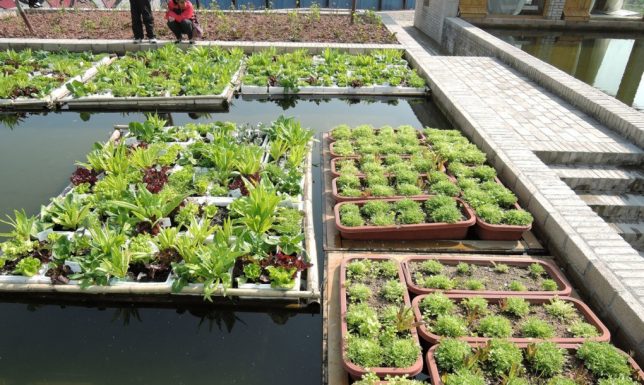
This area along the Pearl River Delta in Shenzhen was once a thriving community relying on fish ponds and water-based commerce, but most of that has since vanished in the face of rapid urbanization, leaving many abandoned structures behind. ‘Floating Fields’ occupies this space and makes it useful again as an aquaponic garden. Created for the Urbanism\Architecture Bi-City Biennale, the installation is an experiment in water-based gardening, algae cultivation, sustainable food production and water filtering in an underutilized urban environment.

Recycled Cardboard Tube Garden

recycled cardboard tube garden 1

recycled cardboard tube garden 2

Water-resistant, recyclable cardboard tubes provide the basis for a modern pop-up garden in Sydney by Australian design studio Foolscap. The tubes were used to build the walls of a temporary outdoor recreation space, taking inspiration from the formwork used to cast concrete columns in a nearby Sydney neighborhood. In addition to an outdoor theater, food and co-working areas, ‘Wulugul Pop Up’ had its own edible garden full of native plants.

Grid Garden on Wheels

grid garden on wheels

grid garden on wheels 2

grid garden on wheels 3

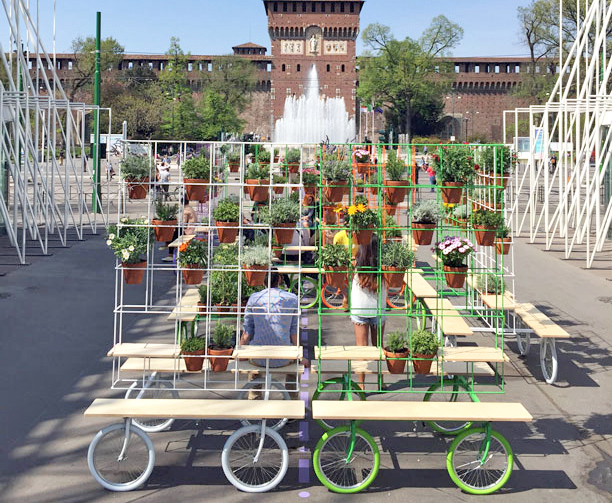
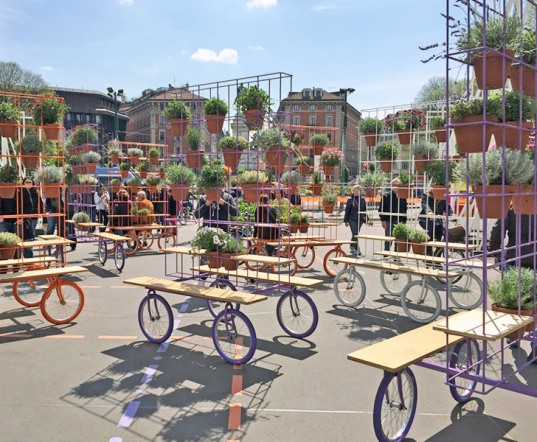
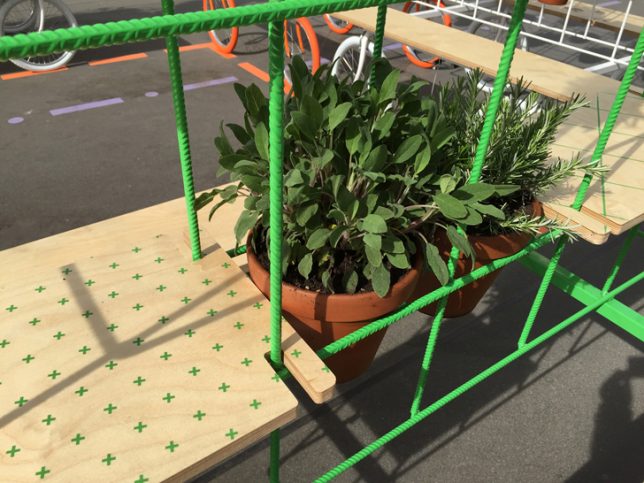
This clever portable garden rests on reclaimed bicycle wheels and features an open gridded design so sunlight can reach tiered plants. The ‘Why not in the garden?’ installation by A4A Rivolta Savioni Studio was literally rolled out into a Milan city square to demonstrate how concrete urban spaces can be temporarily used for food production.

Next Page – Click Below to Read More:
Reclaiming Urban Food Production 12 Smart Designs For Farms Gardens

Share on Facebook


[ By SA Rogers in Architecture & Cities & Urbanism. ]

[ WebUrbanist | Archives | Galleries | Privacy | TOS ]


WebUrbanist

 
Comments Off on Reclaiming Urban Food Production: 12 Smart Designs for Farms & Gardens

Posted in Creativity