RSS
 

Archive for February, 2017

How to do Multiple Exposures In-Camera

08 Feb

Combining two or more exposures into a single image is a technique that almost certainly began as an accident (much like photography itself). When using early film cameras, it was all too easy to press the shutter button while forgetting to change the plate – a faux pas that was generally rewarded with an overexposed jumbled mess. When roll films became popular, camera manufacturers thought it prudent to build a mechanical interlock into the film advance mechanism to prevent accidental multiple exposures (unless you used a special override button).

Most digital cameras carried on the tradition of discouraging such mischief by simply not providing the facility at all. As a consequence, a distinctive style of this sometimes serendipitous art began a steady decline – until recently. Today, the thirst for retro styles is gaining popularity and many photographers are once again experimenting with this old technique.

Traditional multiple exposure methods

If you cannot do the electronic equivalent of resetting the shutter without winding the film, how can you achieve this effect? Unless your camera offers you special multiple exposure options, you’re limited to doing everything during one long exposure so that your image can accumulate on the sensor.

One method is to build up your image by firing a flash several times during a long exposure, under low ambient light. This technique is often used by cave photographers as it allows them to create what appears to be a floodlit underground chamber by popping off a number of flashes in different parts of the scene. The disadvantage is that you need a dark environment, but the technique can be effective – particularly when using a flashgun set to produce a rapid burst of flashes in strobe mode to capture fast-moving action.

In normal daylight conditions, the only way to achieve a long exposure is to employ a neutral density filter, which will allow you to achieve an exposure time of ten seconds or more. During this time, you can cover and uncover the lens as needed to superimpose a series of still images.

Since both of these methods rely on accumulating more and more light on the sensor from different subjects during a long exposure, it’s easy to produce a result that’s overexposed unless you carefully compensate by underexposing each shot in the sequence. It’s also somewhat tricky to see how your composite image is turning out until the exposure is complete.

New possibilities

Some digital cameras now offer a multiple exposure function, that not only provides a simple means to recreate the traditional effect but also extends the creative possibilities by using more sophisticated blend modes. In addition, the technology is not limited to just high-end DSLRs. Now even smartphone users can enjoy making multiple exposure images using apps such as Multiple Exposures for the iPhone or Photo Blender for Androids.

Photo #1

Photo #2

Combined using the Photo Bender app.

If you have a recent camera model, it’s increasingly likely that it will sport some form of multiple exposure feature. Check your camera user manual for details. The specific facilities on offer will vary from one camera model to another, but all those that have this feature will be able to simulate the original technique. So let’s start with a simple double-exposure example using a Canon 5D Mark III.

Double-take

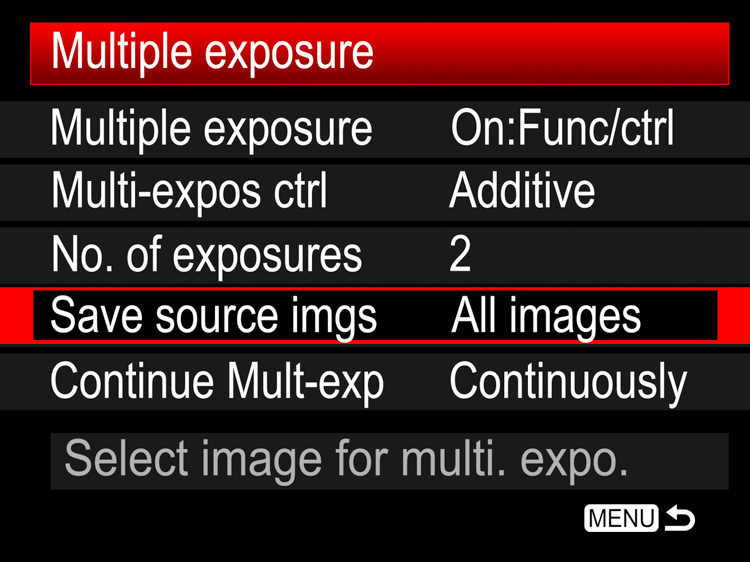
In this technique, both images are exposed normally and then added together. This means that the brightest parts of the final image will be made from the brightest parts of either of the two component images, a fact which can effectively be used to make each image cut out the other. Set the camera’s multiple-exposure setting to take two photos and blend them in the Additive mode, as shown here for the 5D Mk III:
In camera multiple exposures 01

Shooting the images

For the best results, you will need two images with light backgrounds. In this example, my subject was photographed indoors against a fairly light background (below left). If your subject is outdoors, it’s often useful to position yourself low down so that your subject is against the sky.

In camera multiple exposures 02 In camera multiple exposures 03

For the second image, look for a high contrast subject that has white areas where you want the first image to be cut-out. In this case, I chose to photograph a tree against the sky (above right), remembering to use the camera in portrait mode but rotating it such that the tree was inverted.

When the images are added in the camera, the light pixels around the subject’s head overwrite the dark pixels from the tree. In the same way, the light pixels from the lower left and right corners of the tree image overwrite the pink feather boa in the first image. Depending on how light the background is in each image, this pixel addition will produce something between a faint high-key effect to a full blown-out white wherever the two subjects don’t overlap.

In camera multiple exposures 04

Camera settings

By default, the multiple exposure setting is disabled. When it is activated on the 5D Mk III, it can be set to either allow you to review and change some settings between exposures or just fire away continuously without slowing down to review images. For this example, I chose the “On:Func/ctrl:” option to allow me time to compose the next shot. One big advantage of selecting that option with Canon cameras is that it enables you to switch to “LiveView where you can see an overlay of your previous shot to help you line up the next one.

Using a previous image

Canon cameras allow you to combine a photo taken the conventional way, with an exposure taken in the multiple exposure mode. To try this, choose the “Select image for multi.expo” option. If you’ve set the total number of exposures to two, you now only have to shoot one extra exposure in multiple exposure mode to complete your composite.

Nikon cameras take this a step further by allowing you to select any two images from the camera’s media card and combine them using a feature Nikon called “Image Overlay”. This is particularly flexible because you can simply keep combining pairs of images and applying exposure adjustments as needed to make your composite raw image.

Auto exposure compensation

If you shoot in this Additive mode and don’t want to exploit the cut-out effect, then you need to reduce the exposure of the individual images according to the number of shots you include in your composite. For example, you should underexpose each shot by one stop if you’re combining two images, or by two stops if you’re combining four images. Alternatively, you can leave the adjustment to the camera. Since you’ve already told the camera how many exposures you wish to combine, it can work out how much exposure compensation to apply in order to create a composite that still retains details in the highlights.

To apply this compensation automatically, simply select “Average” instead of the “Additive” option and set your camera to either aperture or shutter priority mode. If you want to experiment with overlaying textures and making abstract patterns, Average is a good initial blend mode.

Bright and dark

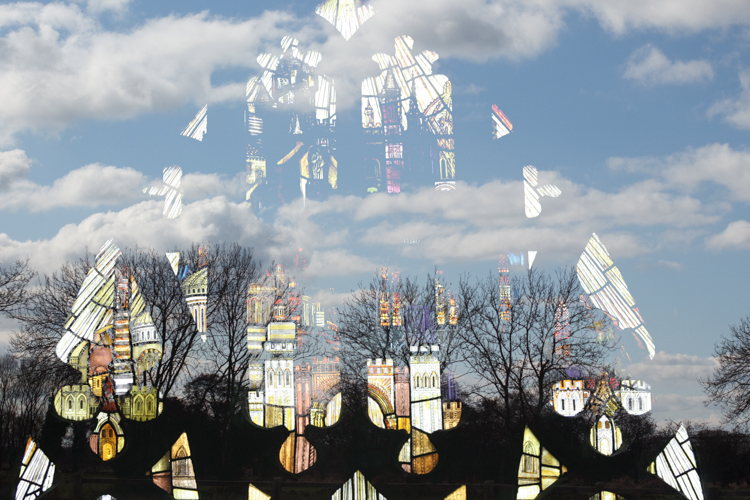
Both the Additive and Average options effectively just accumulate one image on top of another with optional exposure adjustment, so these modes are not that different to conventional film multiple exposures. However, thanks to the increased computing power on some DSLRs, you’re no longer limited to just overlaying images by simply adding their brightness values. Images can also be combined by taking pixels from either one source image or the other, based on which one is brightest (or darkest). To show how this works, consider this combination of window and clouds.


In camera multiple exposures 05

In camera multiple exposures 06

Selecting the Bright mode gives priority to the clouds, which will appear in front of the window at the top of the composite. The dark trees will be excluded in favour of the brighter parts of the window at the bottom of the composite.
In camera multiple exposures 07

If you select Dark, then the darkest pixels win and the clouds appear behind the window in this rather more subtle version.

In camera multiple exposures 08

Other creative techniques

Having tried out the various blend modes your camera has to offer, it’s worth considering what changes you might want to introduce between shots. As long as you don’t turn the camera off, you could swap lenses, filters or even countries between shots so that you could combine, for example, a macro image with a landscape. Since cameras invariably allow you to combine a live image with one previously stored on the card, there’s a great deal of scope for creatively combining images. Here are two simple examples you might want to try.

Layering a landscape

Zoom lenses provide a very convenient way to create a layered effect from a simple skyline. In this example, I combined four shots of different parts of the horizon and also adjusted the camera’s white balance for each exposure to simulate a distance haze.

In camera multiple exposures 09

To produce this effect, follow these steps:

1. Set up your camera to take four exposures in Average multiple exposure mode using either aperture or shutter priority.

2. Set the white balance to 2500ºK to produce a strong blue tint and zoom out for a wide-angle shot. Position the horizon in the top quarter of the viewfinder and take the first photo in the sequence.

3. Turn on LiveView and zoom in slightly so that you can see the magnified overlay which will become your next nearest line of hills. Pan the camera to a different part of the horizon to create some topographic variety and tilt the camera up to position the next horizon just below the previous one. Set the white balance to 4000ºK to create a less intense blue bias and take the second photo.

4. Reposition the horizon lower still on the LiveView screen. Zoom in a little more and with the white balance set to 5500ºK, take the third photo.

5. Finally, zoom in fully, pan the camera again for some foreground interest and position the horizon near the bottom of the screen. Increase the white balance to 7000ºK and take the final photo.

Focus effects

Most of the time, we strive to achieve a sharp focus in our pictures, perhaps with some creative background blur. Shooting multiple exposures enables you to combine a pin-sharp image with a soft out-of-focus one of the same subject to smooth out highlight details or make it glow with an unusual soft-focus effect. Here are the steps used to make a highlight-smoothed image:

1. Set the camera on a tripod and set the multiple-exposure blend mode to Dark.

2. Take a sharply focused photograph of the subject. In this case, some roses were set against a dark background to give them more definition in the final image.

In camera multiple exposures 10

3. Defocus the image (set the lens focus to manual to stop it refocusing on the next shot). In this example, I’ve defocused rather drastically to illustrate the effect.

In camera multiple exposures 11

4. Take the second photo.

Since the highlights are blurred, they become darker. In the Dark blend mode, these darker tones make it to the final image instead of the original highlights. The dark background from the sharper image also takes priority over the fuzzy edges in the defocused image, resulting in a composite image that’s well defined against the dark background but with highlight details smoothed out.

In camera multiple exposures 12

For a more traditional soft-focus effect, it’s necessary to preserve the highlight detail and add the highlight blur around it. You can achieve this effect by simply selecting the Bright blending mode to produce a soft glow, as shown here.

In camera multiple exposures 13

Action shots

In the techniques considered so far, the camera has been set up to review the image after each shot in the sequence and if your camera allows, to store each component image to the media card. This is useful to help line up each new image with the previous one.

But for fast-action shots, this takes too much time to process in-camera. If you want to take a composite photo of someone jumping over a fence, (then apart from arranging for a bull to be located in the same field as the subject) these are the basic steps to follow:

1. Set the multiple exposure mode such that it doesn’t display the image after each shot or write to the card. On the 5D Mk III, this is achieved by setting the Multiple Exposure menu item to “On:ContShtng” for continuous shooting.

2. Set the number of exposures according to the speed of the action you’re anticipating (more exposures for faster action) and set the shutter speed and aperture to values that will be able to capture a sequence of sharp images.

3. Set the camera on a tripod and pre-focus at the distance where the action is to take place. Set the lens focus to manual to ensure the focus doesn’t change during the shoot.

4. Set the drive mode to continuous high speed burst.

5. When the action takes place, press and hold the shutter button to ensure that all the individual exposures are taken.

Blend modes

If you leave the blend mode set to Average, you’ll get a solid background with a number of ghostly overlays corresponding to the various exposures. This is because the exposure of each image in the sequence is automatically reduced to prevent the accumulating image from becoming too bright, but the results can be rather thin and disappointing, like this shot of a Canon camera swinging against a light background.

In camera multiple exposures 14

If you set the blend mode to Dark when using a light background, the results will be much more defined like this:

In camera multiple exposures 15

It follows that the converse is also true. When you are shooting a lighter colored object moving against a darker background, the best results are obtained by selecting the Light blend mode:

In camera multiple exposures 16

Slowing down

Not all multiple exposure action shots need to be frantic. This image was made using an EOS 6D in multiple exposure mode set to take nine exposures in the Bright blend mode. One image was taken every two minutes.

In camera multiple exposures 17

Look for future image material

Much more sophisticated multiple exposure techniques can be achieved by using dedicated editing software such as Adobe Photoshop. At the moment, you may only be interested in combining some images in-camera, but bear in mind that you might want to experiment on your computer in the future. Even if you’re not familiar with powerful desktop editing software just yet, it’s always worth getting together the raw material you can process on a rainy day.

The next time you’re out and about with your camera, think about photographing interesting textures, silhouettes, and fast-action sequences, instead of just taking single photos. You’ll soon be on your way to creating some eye-catching multiple exposure photos.

googletag.cmd.push(function() {
tablet_slots.push( googletag.defineSlot( “/1005424/_dPSv4_tab-all-article-bottom_(300×250)”, [300, 250], “pb-ad-78623” ).addService( googletag.pubads() ) ); } );

googletag.cmd.push(function() {
mobile_slots.push( googletag.defineSlot( “/1005424/_dPSv4_mob-all-article-bottom_(300×250)”, [300, 250], “pb-ad-78158” ).addService( googletag.pubads() ) ); } );

The post How to do Multiple Exposures In-Camera by Dave Baxter appeared first on Digital Photography School.


Digital Photography School

 
Comments Off on How to do Multiple Exposures In-Camera

Posted in Photography


Panasonic Lumix GH5 shipments may be delayed due to high number of pre-orders

08 Feb

Update: Panasonic US has clarified that this announcement is intended for customers in Japan, and availability will vary by country. The GH5 is slated for March 30th availability in the US.

Panasonic Japan has announced that customers who have ordered a Lumix GH5 may face a longer wait due to the high number of pre-orders. The camera is scheduled for release on March 23, and Panasonic is prioritizing pre-order shipments. The GH5 was officially announced at the beginning of January, and Panasonic targeted a ‘late March’ shipping timeframe in its initial announcement.

Via: Photo Rumors

Articles: Digital Photography Review (dpreview.com)

 
Comments Off on Panasonic Lumix GH5 shipments may be delayed due to high number of pre-orders

Posted in Uncategorized


Manfrotto introduces Xume magnetic holder system to make switching filters easier

08 Feb

Accessory manufacturer Manfrotto has launched a new filter suite that features a magnetic adapter and filter holders that it says make fitting and removing filters quicker and easier. The new Xume system uses a magnetic adapter ring that screws into the front of the lens, while the filter itself screws into a metal filter holder. The two parts then connect securely when they are held close together and can be separated just by pulling them apart. The system removes the part of the attaching-a-filter process where the filter is screwed onto the front of the lens.

The filter holders and lens adapters are available now in eight sizes: 49mm, 52mm, 58mm, 62mm; 67mm, 72mm, 77mm and 82mm and are priced from $ 10.99 to $ 34.99.

For more information see the Manfrotto website.

Press release

Manfrotto Launches Innovative Lens Filter Suite

Providing precision and ease to capture every shot

Manfrotto, a leading global innovator and manufacturer of premium photo, video and lighting support products and accessories, has launched a new, groundbreaking Manfrotto Lens Filter Suite, a combination of Manfrotto’s successful high-quality lens filters and innovative Manfrotto XUME magnetic adapters.

The new Manfrotto Lens Filter Suite enables professional and amateur photographers and videographers to avoid the hassle and frustration of changing filters while subjects wander or light slips away. With the Manfrotto Filter Suite, photographers instantly and precisely connect the filter to their lens so that they never miss the perfect shot.

The Manfrotto Lens Filter Suite is comprised of a Manfrotto Lens Filter, a Manfrotto XUME Lens Adapter and Filter Holder plus an optional Cap (available only for 77mm diameter). It is the perfect choice for long exposures, wedding photography, macro, architectural photography, fine art photography – any style requiring the use of filters.

Manfrotto’s camera lens filters are built to the highest quality standards. They feature flawless multi-coating which minimizes reflection and maximizes light transmission, consistently delivering the effects photographers wish to achieve. Each filter is provided with a practical, reusable storage case, ensuring the highest level of protection off-camera. Depending on the model, Manfrotto filters feature reliable water-repellent, oil-repellent and anti-static characteristics.

  • UV filters block out UV light, preventing it from entering the lens, reducing blurring, haziness and blue casting.
  • Circular Polarizer filters enhance color, contrast and saturation as well as removing undesirable reflections from non-metallic surfaces.
  • Neutral Density filters help control exposure times by reducing the amount of light hitting the camera sensor without altering the color of the scene.
  • Protect filters provide maximum protection against scratches, oil and moisture, without affecting overall image quality.

Manfrotto XUME Adapters are the revolutionary magnetic solution which securely locks filters onto lenses, quickly and easily. Photography gear stays safe in-use with the filter magnetically secured to the lens. Manfrotto XUME accessories are safe for the lens’ focus mechanism, media cards, drives or other electronics.

Unique to the market, Manfrotto’s XUME Adapters:

  • Install in an instant.
  • Are secure; no moving parts and completely safe to use.
  • Have very low profile rings and are completely unobtrusive.

Manfrotto XUME Filter Holders and Manfrotto XUME Lens Adapters are now available nationwide in eight sizes: 49mm, 52mm, 58mm, 62mm; 67mm, 72mm, 77mm and 82mm. The Manfrotto XUME CAP is available only for the 77mm size. Manfrotto Filters range in price from $ 19.99 to $ 134.99 and Manfrotto Xume Adapters range in price from $ 10.99 to $ 34.99.

The Manfrotto Lens Filter Suite will be on display at WPPI in Las Vegas, Feb. 7–9, at the Manfrotto Distribution booth, No. 349.

Articles: Digital Photography Review (dpreview.com)

 
Comments Off on Manfrotto introduces Xume magnetic holder system to make switching filters easier

Posted in Uncategorized


Winter Carousels: Circular Spinning Ice Islands Carved with Chainsaws

08 Feb

[ By WebUrbanist in Culture & History & Travel. ]

ice carousels

Ice fishing huts and art shanties allow people to enjoy peaceful winters and creative expression on frozen lakes, but for those with something more dynamic in mind: rotating DIY islands of ice are also an option.

ice

Ice circles have been known to form naturally, particularly in streams where a current can round the edges of a free-floating chunk and keep it spinning. The ice circle below captured by Kaylyn Messer is one such example, found this winter in the Snoqualmie River near Seattle, Washington.

ice circle

These kinds of formations happen on their own at times in Scandinavian and American rivers, water currents slowly shaping the ice. Lakes with fully-frozen surfaces are another matter — creating ice islands on their surface requires a bit more ingenuity (or at least: labor and machinery).

winter spinning ice

Once created, these may or may not move on their own, depending on currents below the surface — in some cases they have to be helped along by an outboard motor. Seating and shelters can be brought out to make them more homey (small fires can even be lit if the intended use is temporary).

Fair warning, though: if you plan to light your ice circle on fire at the end of a festival or gathering, be sure to stay far back from the flames and warming ice.

The best part is that there is no waste in the making of these things nor assembly required. And if your first attempt fails (assuming you don’t go down with the island), you can always carve out more.

Share on Facebook


[ By WebUrbanist in Culture & History & Travel. ]

[ WebUrbanist | Archives | Galleries | Privacy | TOS ]


WebUrbanist

 
Comments Off on Winter Carousels: Circular Spinning Ice Islands Carved with Chainsaws

Posted in Creativity


Sony announces 100mm F2.8 STF G Master and FE 85mm F1.8 lenses

07 Feb

$ (document).ready(function() { SampleGalleryV2({“containerId”:”embeddedSampleGallery_4333384997″,”galleryId”:”4333384997″,”isEmbeddedWidget”:true,”standalone”:false,”selectedImageIndex”:0,”startInCommentsView”:false,”isMobile”:false}) });

Sony has taken the wraps off of two full-frame new mid-telephoto prime lenses. The company is making big claims about bokeh produced by the FE 100mm F2.8 STF OSS GM, which it says is improved by the use of an apodization (APD) element. The optical design is said to minimize vignetting, and the lens offers an 11-blade aperture. A macro switching ring engages the lens’ close focus capabilities for shooting subjects as near as 0.57m/1.87ft (0.25x magnification). The lens includes Sony’s built-in optical stabilization, and like other G Master lenses, it’s dust- and weather-resistant.

100mm F2.8 GM MTF chart via Sony. Lens configuration via Sony.

Also new is the non-G-Master FE 85mm F1.8, a relatively compact and lightweight portrait prime for the E-mount system. It uses a 9-blade circular aperture, ‘double linear motor system,’ and is also dust- and moisture-resistant. The lens does not offer built-in stabilization.

85mm MTF chart via Sony. Lens configuration via Sony.

Both lenses are expected to ship in March. The FE 100mm F2.8 STF GM OSS will cost $ 1500, while the FE 85mm F1.8 will sell for $ 600.

Press Release

Sony Introduces 100mm F2.8 STF G Master™ with Highest Ever Quality Bokeh for an ? Lens

New Full-frame 85mm F1.8 Mid-telephoto prime lens and Compact Radio-Controlled Flash announced as well

LAS VEGAS, Feb. 7, 2017 – Sony Electronics, a worldwide leader in digital imaging and the world’s largest image sensor manufacturer, has today introduced two new lenses for their popular line of E-mount interchangeable lens cameras.

Sony’s new lenses include one of their flagship G Master Series – an FE 100mm F2.81 STF GM OSS mid- telephoto prime lens (model SEL100F28GM) built to deliver breathtaking bokeh with a unique STF™ (Smooth Trans Focus) design, and a new compact, lightweight FE 85mm F1.8 mid-telephoto prime lens (model SEL85F18) that is a welcome addition to the bag of any hobbyist or enthusiast photographer looking to create amazing portraits.

They have also introduced a new powerful, compact flash (model HVL-F45RM) with radio-controlled wireless communication that is ideal for professional shooting with Sony’s lineup of ?7 full-frame cameras.

FE 100mm F2.81 STF GM OSS Telephoto Prime Lens

A specially designed mid-telephoto, full-frame prime lens, the new 100mm STF is built to produce truly unique, magnificent and beautiful bokeh while maintaining the exceptional standard of resolution that is showcased by Sony’s entire line of flagship G Master series lenses, making it a powerful photographic tool for any portrait, fashion, nature or wedding photographer.

These impressive defocus capabilities are made possible by the lens’ advanced optical structure, as it features a newly designed 11-bladed aperture and a unique optical apodization lens element. Similar to a neutral density filter that increases in density towards the edges, the apodization element creates beautiful transitions of in-focus to out-of-focus areas within an image, making for exceptionally soft, smooth bokeh that adds depth and dimensionality. This allows the subjects to stand out against beautifully defocused elements in both the foreground and background, producing an image that is naturally pleasing to the eye. The design of the lens also ensures that vignetting is kept to an absolute minimum, ensuring optimum image quality.

Additionally, the new 100mm lens supports both contrast AF and focal-plane phase detection AF2, and has a high-precision, quiet direct drive SSM (Super Sonic Motor) system that ensures exceptionally fast and accurate AF performance. The SEL100F28GM also offers up to 0.25x close-up capabilities with a built-in macro switching ring, built-in Optical SteadyShot™ image stabilization, a customizable focus hold button, AF/MF switch, aperture ring and more. It is dust and moisture resistant as well3.

FE 85mm F1.8 Telephoto Prime Lens

The new 85mm F1.8 mid-telephoto prime lens offers an extremely versatile, lightweight and compact telephoto prime lens solution for a variety of Sony camera owners ranging from working professionals to emerging enthusiasts that have stepped up to full-frame or APS-C cameras for the first time. With its wide F1.8 aperture, it can produce impressive, exceptionally sharp portraits with soft background defocus that take advantage of its 85mm focal length and wide F1.8 maximum aperture.

The new prime lens features a 9-bladed circular aperture mechanism that ensures smooth, natural looking bokeh, and a double linear motor system to allow for fast, precise and quiet focusing. It also has a focus hold button that can be customized and assigned together with functions in the camera body like the popular Eye AF feature. There is a smooth, responsive focus ring and AF/MF switch as well, and the lens is also dust and moisture resistant 3.

New Compact Radio-controlled Flash

Sony’s new HVL-F45RM flash enhances the radio-controlled lighting system capabilities of their growing system, offering a compact professional shooting solution when combined with the currently available wireless remote controller FA-WRC1M and receiver FA-WRR1.

The new flash, which is designed to complement the compact bodies of Sony’s E-mount camera lineup including full-frame ?7 models, produces a maximum lighting output as expansive as GN45 4. This ensures sufficient illumination even when shooting with bounce lighting or high-speed-sync (HSS) flash. The radio capabilities of the HVL-F45RM allow it to be used as a transmitter or a receiver at up to 30m (approx. 98 feet5), making it an ideal fit for creative lighting with multiple flashes. Additionally, unlike optical flash systems, radio-control flashes do not require a direct line-of-sight between components to function properly, while also minimizing any impact that bright sunlight has on signal transmission and control.

The HVL-F45RM flash has an impressive battery life of up to 210 bursts, and can tilt up to 150o vertically, a complete 360o horizontally and up to 8o downward to maximize versatility. Usability has been maximized with a new large, bright and highly visible LCD display, an LED light, dust and moisture resistant design3 and a revamped menu system that mimics those of Sony’s newest camera systems.

Pricing and Availability

Both of the new lenses and the new flash unit will ship to authorized dealers throughout North America.

The new FE 100mm F2.8 STF OSS GM Telephoto Prime Lens will ship this March for about $ 1,500 US and $ 2,050 CA.

The new FE 85mm F1.8 Mid-Telephoto Prime Lens will ship this March for about $ 600 US and $ 800 CA.

Replacement lens hoods for each of the new models will also be available for purchase as well.

The new HVL-F45RM flash will ship this May for about $ 400 US and $ 550 CA.

Articles: Digital Photography Review (dpreview.com)

 
Comments Off on Sony announces 100mm F2.8 STF G Master and FE 85mm F1.8 lenses

Posted in Uncategorized


Urine for a Beautiful Day: Street Gardens Double as Public Pissoirs

07 Feb

[ By SA Rogers in Design & Fixtures & Interiors. ]

Screen Shot 2017-02-06 at 4.58.27 PM

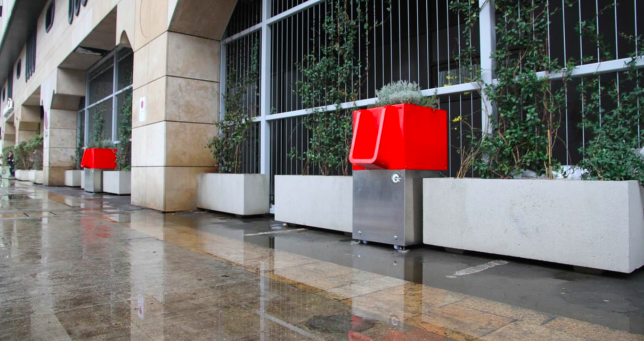
‘Piss in peace’ is the tagline for the Urintrottoir, a recent addition to the streets of Paris that’s part urinal, part composter, part mini garden. City officials are hoping that offering these urinals right out in the open will be a viable way to get men to stop peeing all over everything in sight, especially at night when they’ve had a few drinks. It would be cool if our cities could smell a little nicer, guys.

Screen Shot 2017-02-06 at 4.57.31 PM

The problem is, most of us don’t want to stare at urinals as we’re walking down the sidewalk. The Urintrottoir design attempts to find a way around that and make use of waste products at the same time, by making each unit into a planter full of herbs and flowers. The top bins contain straw and sawdust, which help break down the urine into relatively neutral-smelling soil for the plants.

urine garden 1 urine garden 2

Larger versions of the device could potentially absorb the urine of 600 people before needing to be emptied. Two smaller versions are currently located near the Gare de Lyon station in Paris, and if the test is successful (and men really do choose to pee in them instead of in alleys or in the doorways of shops,) additional units will be rolled out to other stations in France.

Screen Shot 2017-02-06 at 4.58.36 PM

Some European cities already offer public ‘pissoirs’ that are considerably less decorative, but there’s not always a recycling component involved. This option makes lemonade out of lemons, so to speak (sorry, that metaphor is almost too perfect.) Now, if only there were similar options designed for people with different equipment.

A previous effort to prettify public urinals came in the form of a rose-tinted marble fountain by Portuguese architecture firm Bureau A, attempting to make public pissing into an artistic act.

Share on Facebook


[ By SA Rogers in Design & Fixtures & Interiors. ]

[ WebUrbanist | Archives | Galleries | Privacy | TOS ]


WebUrbanist

 
Comments Off on Urine for a Beautiful Day: Street Gardens Double as Public Pissoirs

Posted in Creativity


Samyang launches XEEN 20mm T1.9 video-cine lens

07 Feb

Samyang Optics has announced the XEEN 20mm T1.9 video-cine lens. The latest model is part of the company’s XEEN cinema lens lineup, bringing the total number of lenses up to eight. The new XEEN lens will be available with PL, EF, F, E and MFT mounts, and will be offered with both metric and imperial units. 

The XEEN 20mm T1.9 video-cine lens features X-Coating technology, according to Samyang, as well as 11 aperture blades, a focus ring, and an iris gear ring. The company bills the new XEEN product as suitable for shooting video at 4K or greater resolutions, including in low-light settings. Samyang plans to launch the new model globally starting on March 7 for the price of €2,200 (about $ 2,365).

Via: Samyang Lens Global

Articles: Digital Photography Review (dpreview.com)

 
Comments Off on Samyang launches XEEN 20mm T1.9 video-cine lens

Posted in Uncategorized


Tamron announces 70-200mm F2.8 and 10-24mm F3.5-4.5 updates

07 Feb

$ (document).ready(function() { SampleGalleryV2({“containerId”:”embeddedSampleGallery_8028434815″,”galleryId”:”8028434815″,”isEmbeddedWidget”:true,”standalone”:false,”selectedImageIndex”:0,”startInCommentsView”:false,”isMobile”:false}) });

Tamron has announced updates to two of its zoom lenses. The full-frame Tamron SP 70-200mm F2.8 Di VC USD G2 improves on its predecessor with faster autofocus and better stabilization. Tamron claims its boosted Vibration Correction provides 5 stops of stabilization. The lens is moisture and dust-resistant, and has received a thorough overhaul of optical and mechanical designs. The new optical design consists of 23 elements in 17 groups, and includes extra low dispersion and low dispersion elements to reduce chromatic aberrations. Tamron claims the inclusion of two microcomputers and a new AF algorithm has improved focus speed and accuracy. Minimum focus distance is also improved, reduced to 37.4in from the previous model’s 50.7in. The 70-200 also supports Tamron’s 1.4x and 2x teleconverters/

Meanwhile, the Tamron 10-24mm F3.5-4.5 Di II VC HLD adds stabilization and refined optics to the company’s wide-angle zoom for APS-C introduced in 2008. It features LD, XLD, aspherical and hybrid aspherical elements, as well as a Broad-Band Anti-Reflection coating. Tamron was able to add Vibration Correction without increasing the size of the lens, and the company claims up to 4 stops of shake reduction. It also uses a new HLD (high/low torque-modulated drive) motor that allow for smooth control over the lens’ heavy elements. The lens is sealed against moisture and has a fluorine coating to keep oil and water off of the front elements.

Both of the new lenses use electromagnetic diaphragm control on Nikon mounts.

The Tamron 70-200mm F2.8 Di VC USD G2 is expected to arrive in March for $ 1299. The Tamron 10-24mm F3.5-4.5 Di II VC HLD is slated for availability this spring for $ 499.

Press releases:

TAMRON REDEFINES THE FAST TELEPHOTO ZOOM CATEGORY WITH THE INTRODUCTION OF THE NEXT GENERATION 70-200MM F/2.8 ZOOM

All-new optical design delivers a dramatically faster autofocus speed and image stabilization performance of 5 stops

SP 70-200mm F/2.8 Di VC USD G2 (Model A025) 

February 6, 2017, Commack, NY – Tamron, a leading manufacturer of optics for diverse applications, announces the launch of SP 70-200mm F/2.8 Di VC USD G2 (Model A025), a new telephoto zoom lens product for full-frame and APS-C DSLR cameras. Model A025 was developed by substantially enhancing the features of its predecessor.

These include a thorough review of the optical, mechanical and electronic designs to increase autofocus speed and precision, reinforce VC (Vibration Compensation) functions and to shorten the MOD. New features include eBAND Coating, Moisture-Proof and Dust-Resistant Construction, Fluorine Coating and compatibility with teleconverters. The lens design features a metal-based barrel for improved handling and ease-of-use. The result of this dramatic evolution is Model A025, a high-speed telephoto lens that widens the scope of expression for photography in a broad range of genres, such as portraits, landscapes, sports and photojournalism. The lens is expected to be available in the U.S. in March at $ 1299.

PRODUCT HIGHLIGHTS 

  1. Outstanding resolution and contrast reproduction performance, beautiful bokeh and full compatibility with Tamron teleconverters

Based on the current model (A009), the optical design has been revised and improved. Both the resolution and contrast reproduction performance far exceed the present levels. Bokeh has been enhanced and expanded to deliver outstanding background effects across the entire zoom range. Use of a circular diaphragm with nine blades further improves bokeh. The optical design of the new A025 consists of 23 elements in 17 groups. Optimum deployment of XLD (eXtra Low Dispersion) and LD (Low Dispersion) glass elements thoroughly eliminate chromatic aberrations, which tend to become particularly prominent in high-speed telephoto lenses, across the entire zoom range, while ensuring uniform, high-level image quality even on the periphery of the image plane.

The new lens is also fully compatible with the TELECONVERTER 1.4x (Model TC-X14) and TELECONVERTER 2.0x (Model TC-X20)1, which increase the focal length of the lens to 1.4 times and 2 times the original, respectively. Both teleconverters are carefully designed and constructed to provide outstanding high quality.

Changes in zoom range when used with SP 70-200 mm F/2.8 Di VC USD G2 (Model A025)


Mounted on full-frame DSLR camera

Mounted on APS-C format DSLR camera

Without tele converter

70-200mm

Approx. 109-310mm

With 1.4x tele converter*2

98-280mm

Approx. 152-434mm

With 2.0x tele converter*2

140-400mm

Approx. 217-620mm 

Changes in magnification ratio when used with SP 70-200mm F/2.8 Di VC USD G2 (Model A025)


Maximum Magnification Ratio

Without tele converter

1:6.1

With 1.4x tele converter

1:4

With 2.0x tele converter

1:3

Available focusing mode when used with SP 70-200mm F/2.8 Di VC USD G2 (Model A025)


When using viewfinder

When using live view mode

With 1.4x teleconverter

AF Possible

AF*2 Possible

With 2.0x teleconverter

AF Possible

AF*3 Possible 

  1. Improved VC system provides highest Vibration Compensation ability in its class3 (5 stops using CIPA standard compliant) and offers three situation-specific VC modes

Utilizing Tamron’s original VC (Vibration Compensation) system, which uses a moving coil mechanism, further reinforcement of the drive system power and control performance has now achieved the highest VC level in its class, with an image stabilization performance of 5 stops according to the CIPA standard (using VC Mode 3). 

Also, the VC system of Model A025 offers three VC modes, including one mode exclusively for panning. Photographers can freely choose between the different VC modes according to their shooting conditions. Even when telephoto shooting in low light, which tends to be severely affected by camera shake, photographers can now enjoy jitter-free handheld shooting with much greater flexibility. 

  • VC MODE 1 is the standard mode that strikes a great balance between the stability of the viewfinder image and the stabilization effects.
  • VC MODE 2 is exclusively used for panning.
  • VC MODE 3 prioritizes the stabilization of the captured images and forgoes the stabilization of the viewfinder image.

With the optional accessory TAMRON TAP-in ConsoleTM, you can customize the configuration of VC MODE 1. Choose the viewfinder view of either standard or image priority.

  1. Demonstratively improved autofocus speed and responsiveness

Model A025 is equipped with a USD (Ultrasonic Silent Drive) ring-type ultrasonic motor, whose outstanding responsiveness and control ensures accurate high-speed focusing. Incorporating two advanced, high-performance microcomputers and optimizing the algorithm has improved both the focusing speed and accuracy compared with SP 70-200mm (Model A009). Additionally, thanks to the Full-time Manual Focus override mechanism, photographers shooting with AF can instantaneously make fine focusing adjustments using MF without wasting time by switching the AF-MF mode back and forth.

  1. Focuses closer (shorter Minimum Object Distance, or MOD) for greater versatility

Improvements made to the focus cam and zoom cam inside the lens barrel have reduced the MOD from 50.7 inches in the older Model A009 to 37.4 inches for Model A025, which has a maximum magnification ratio of 1:6.1. The shorter MOD, coupled with the excellent optical performance of the SP 70-200mm (Model A025), allows photographers to further broaden their range of expression.

  1. Optimized and exclusively designed eBAND Coating

The new A025 features Tamron’s original eBAND (Extended Bandwidth & Angular-Dependency) Coating, a technology that combines a nano-structured layer with an extremely low refractive index with the conventional multiple-layer coatings. Optimized and exclusively designed for this new zoom, the eBAND Coating provides superior anti-reflection performance, effectively reducing any flare and ghosting. Even when taking backlit portraits, the new lens delivers flawless, crystal clear images. 

  1. Moisture-Proof and Dust-Resistant Construction

Ideal for use in outdoor photography, the new 70-200mm telephoto zoom has moisture-resistant construction because special sealants that are dust-resistant and moisture-resistant are used at every joint and seam. The sealant material helps to prevent the intrusion of any dirt, dust or water droplets, compared to conventional Moisture-Resistant Construction. 

  1. Fluorine Coating for greater protection

The front surface of the lens element is coated with a protective fluorine compound that is water- and oil-repellant. The lens surface is easier to wipe clean and less vulnerable to the damaging effects of dirt, dust, moisture and fingerprints.

  1. Electromagnetic diaphragm system now used also for Nikon-mount lenses

An electromagnetic diaphragm system, which has been a standard feature for Canon-mount lenses, is now available for Nikon-mount lenses4. More precise diaphragm and aperture control is possible because the diaphragm blades are driven and controlled by the motor through electronic pulse signals.

  1. Lightweight and easy-to-hold tripod mount is compatible with Arca-Swiss style quick release plates

A new textured grip and Arca-Swiss style tripod interface enhances both speed and utility. Because the tripod mount is made of lightweight magnesium, it is much easier to carry.

  1. Compatible with TAMRON TAP-in ConsoleTM, an optional accessory product

The optional TAP-in Console provides a USB connection to a personal computer, enabling users to easily update the lens firmware as well as customize features, including fine adjustments to the AF and VC. 

  1. Based on the rigorous quality standards worthy of the SP series, this new lens is manufactured with a thorough attention to details

For the SP series products in particular, Tamron has established rigorous design and quality standards. These standards apply to the optical design, mechanical design and the cosmetic appearance, as well as to such wide-ranging areas as the product’s robustness and improvements in the various individual functions. Tamron thoroughly reviews all of the design and manufacturing processes in order to offer products to customers with even-higher levels of precision and quality.

For the SP 70-200mm G2 (Model A025), the optical design was refreshed, mechanical parts were improved and a new exterior design was adopted. To maximize the optical performance intrinsic to this product, Tamron improved the accuracy of the component parts and increased the precision of the overall zooming mechanism.

1. For more detailed information about teleconverters, please refer to the Tamron website.

2. Subjects with low contrast and/or luminosity values can sometimes result in out-of-focus images.

3. Among 70-200mm F/2.8 interchangeable lenses for full-frame DSLR cameras (as of January, 2017; Tamron)

4. Available only with cameras compatible with the electromagnetic diaphragm (D3100, D3200, D3300, D3400, D5000, D5100, D5200, D5300, D5500, D5600, D7000, D7100, D7200, D300, D300s, D600, D610, D700, D750, D800, D800E, D810, D810A, D3x, D3s, D4, D4s, Df, D500, D5). (As of January, 2017; Tamron)

TAMRON INTRODUCES ULTRA-WIDEANGLE ZOOM WITH VIBRATION COMPENSATION

Compact, high-performance lens boasts the largest focal length range in its class

10-24mm F/3.5-4.5 Di II VC HLD (Model B023) 

February 6, 2017, Commack, NY – Tamron, a leading manufacturer of optics for diverse applications, announces the launch of 10-24mm F/3.5-4.5 Di II VC HLD (Model B023), a new ultra-wideangle zoom lens for APS-C DSLR cameras. The lens is expected to be available in the U.S. this Spring at $ 499.

Model B023 is a wideangle zoom lens that covers an exceptionally large range—the largest focal length range in its class1 (35mm equivalent is 16mm to 37mm). The lens is ideal for street photography, landscapes, group photos and casual everyday scenes. In 2008, Tamron launched the SP AF 10-24mm F/3.5-4.5 Di II LD Aspherical [IF] (Model B001) that provided an unprecedented focal length range in its class. Building on that lens’s popularity, the successor Model B023 has improved optical performance and new features. It embodies Tamron’s most advanced technologies, including the VC (Vibration Compensation) system, Moisture-Resistant Construction and Fluorine Coating, and the first implementation of Tamron’s new HLD (High/Low torque modulated Drive). Additionally, the Model B023 has a refreshing new design derived from the design of the new product lineup in the SP series.

PRODUCT HIGHLIGHTS 

  1. Inheriting the broadest focal length range in its class of ultra-wideangle zoom lenses

The new Model B023 achieves a broad focal length range of 10-24mm, the largest range among ultra-wideangle zoom lenses for APS-C DSLR cameras. This is the 35mm equivalent of covering a very wideangle of view, from 16mm ultra-wideangle to 37mm semi-wideangle. A photographer can enjoy diverse wideangle expressions with just this one lens, from dynamic landscapes far beyond the normal human field of vision to simple, casual snapshots. 

  1. Improved optical performance across the entire zoom range

The optical design of the new Model B023 consists of 16 lens elements in 11 groups. Special lens elements are utilized in an optimum configuration of one LD (Low Dispersion) lens element, one XLD glass element, one molded glass aspherical element, and one hybrid aspherical lens. While curbing an increase in the size of the optical system, the new lens very effectively compensates for a wide variety of aberrations in the entire zoom range, including transverse chromatic aberration, comatic aberration and distortions that tend to become more prominent with a wideangle lens.

Tamron’s highly regarded BBAR (Broad-Band Anti-Reflection) Coating and the optical design paying close attention to internal reflections in the lens barrel also curb the effects of harmful light rays that tend to occur with a wideangle lens, achieving excellent resistance against ghosting and flare seen in backlighting situations.

  1. 4-Stop Vibration Compensation that is especially useful in low light conditions

In response to the requests of many customers who have asked the company to equip a wideangle lens with image stabilization, we have now installed Tamron’s acclaimed VC (Vibration Compensation) on the new Model B023. Optimizing the actuator and the control algorithm has made it possible to incorporate the VC, while maintaining the compact design of the previous Model B001. The VC especially enhances the photographer’s freedom in handheld shooting at dusk or in a dimly lit room, and under other relatively low light conditions, as the mechanism proves particularly effective in the shooting conditions with slower shutter speeds.

  1. Equipped for the first time with the new HLD with outstanding driving power and stability

Tamron’s new HLD (High/Low torque modulated Drive) has been developed for use as the AF drive system for Model B023. With its outstanding driving power and stability, the HLD is capable of smoothly controlling the AF mechanism of the new Model B023 that is actually equipped with large focusing lens elements. When shooting in AF mode, the Full-time Manual Focus override allows you to instantly make fine focusing adjustments manually, without having to switch between modes.

  1. Compressed into a compact body with structural ingenuity

While enhancing image quality, adding new functions and substantially improving the basic performance, Model B023’s space-saving design has ensured an optimum configuration for components such as the VC and AF unit, thus successfully reducing overall length compared to the previous Model B001. The lightweight and compact body with outstanding ease of use will prove to be very well-balanced when attached to an APS-C DSLR camera.

  1. An even more user-friendly lens with Fluorine Coating and Moisture-Resistant Construction

The front surface of the foremost lens element is coated with a protective fluorine compound that is water- and oil-repellant. The lens surface is easier to wipe clean and is less vulnerable to the damaging effects of dirt, dust, moisture and fingerprints, allowing for much easier maintenance. For greater protection when shooting outdoors, leak-proof seals throughout the lens barrel help protect your equipment.

  1. Electromagnetic diaphragm system now used also for Nikon-mount lenses

An electromagnetic diaphragm system, which has been a standard feature for Canon-mount lenses, is now employed in Nikon-mount lenses2. More precise diaphragm and aperture control is possible because the diaphragm blades are driven and controlled by a motor through electronic pulse signals.

  1. Compatible with TAMRON TAP-in ConsoleTM, an optional accessory product

The optional TAP-in Console provides a USB connection to your personal computer, enabling you to easily update your lens’s firmware as well as customize features including fine adjustments to the AF and VC.

  1. External design placing importance on functionality and ease of use

While inheriting the design that makes use of a lot of organic curves and the delicately polished form down to fine details that characterize the SP lens series, the new Model B023 comes with a highly sophisticated design that also places much importance on the lens’s functionality and ease of use, featuring an overall form that faithfully encompasses the internal structures within, a slim Luminous Gold brand ring, the switch shape and the distance-scale window design.

1. Among ultra-wideangle zoom lenses for APS-C DSLR cameras (As of January, 2017; Tamron)

2. Available only with cameras compatible with the electromagnetic diaphragm (D3100, D3200, D3300, D3400, D5000, D5100, D5200, D5300, D5500, D5600, D7000, D7100, D7200, D300, D300s) (As of January, 2017; Tamron)

Specifications

  Tamron SP 70-200mm 2.8 Di VC USD G2 Tamron 10-24mm F3.5-4.5 Di II VC HLD
Principal specifications
Lens type Zoom lens
Max Format size 35mm FF APS-C / DX
Focal length 70–200 mm 10–24 mm
Image stabilization Yes (5 stops) Yes (4 stops)
Lens mount Canon EF, Nikon F (FX) Canon EF-S, Nikon F (DX)
Aperture
Maximum aperture F2.8–22 F3.5–22
Minimum aperture F2.8–22 F4.5–29
Aperture ring No
Number of diaphragm blades 9 7
Optics
Elements 23 16
Groups 17 11
Special elements / coatings eBAND and fluorine coatings
XLD, LD elements
Broad-band Anti-reflection & fluorine coatings
LD, XLD, aspherical, and hybrid aspherical elements.
Focus
Minimum focus 0.95 m (37.4) 0.24 m (9.45)
Maximum magnification 0.16× 0.19×
Autofocus Yes
Motor type Ring-type ultrasonic
Full time manual Yes
Focus method Internal
Distance scale Yes No
DoF scale No
Focus distance limiter Yes
Physical
Weight 1500 g (3.31 lb) 440 g (0.97 lb)
Diameter 88 mm (3.46) 84 mm (3.29)
Length 194 mm (7.63) 85 mm (3.33)
Sealing Yes
Colour Black
Zoom method Rotary (extending)
Power zoom No
Zoom lock Yes No
Filter thread 77.0 mm
Hood supplied Yes
Tripod collar Yes No

Articles: Digital Photography Review (dpreview.com)

 
Comments Off on Tamron announces 70-200mm F2.8 and 10-24mm F3.5-4.5 updates

Posted in Uncategorized


Pop-Up Car Tents: These 15 Rooftop Campers Are Like Portable Tree Houses

07 Feb

[ By SA Rogers in Design & Products & Packaging. ]

ikamper rooftop tent

Popping up from the rooftops of everything from rugged Jeeps to adorable BMW MINIs or extending from the sides of motorcycles and bicycles, these vehicle-based tents make shelter on the go as easy as it can be. Some cantilever dramatically over the ground so you feel like you’re hovering in midair, and others stretch surprisingly high into the sky, like your own personal portable ‘treehouse’ built right onto your car.

Overland Tacoma Habitat Levitating Tent

overland tacoma 1

overland tacoma 2

This pop-up tent by Nemo Equipment is custom-designed to fit the Toyota Tacoma pickup truck, using a hardtop as a base for a lightweight aluminum structural shell that opens and closes with the help of gas springs. When standing in the truck bed, users have an impressive 7 feet of headroom.

iKamper Skycamp & Hardtop One Rooftop Tents

ikamper rooftop tent

skycamp 2

skycamp 3

skycamp 4

The SkyCamp by iKamper is envisioned as a mobile treehouse experience that’s secured to the roof of a vehicle rather than a tree, complete with ladder access to the sleeping quarters. Nearly flat when not in use, the SkyCamp expands to impressive proportions, and add-ons can make the setup extend all the way to the ground for a lofted suite. The Hardtop One is a similar design, but expands vertically rather than diagonally.

Motorcycle Bivouac Exposed Camping

motorcycle bivouac

motorcycle bivouac 2

motorcycle bivouac 3

The ‘Bivouac’ by Exposed is designed to extend from a motorcycle to fit a single sleeper and their luggage, and pack up so tiny it can be mounted to the handlebars for transport. It may not be luxurious inside, but it’ll keep you and your motorcycle seat dry in the rain, and it’s perfect for the one-person explorer.

Prius Plus Hard Top Camper

camp inn camper 1

camp inn camper 2

camp inn camper 3

There’s something hilarious about the proportions of this hard-shell ‘Prius Plus’ camper, which is made to clamp right onto a Toyota Prius hybrid as a camper converter. It’s been described as a ‘saggy diaper,’ ‘tumorous growth’ and a ‘giant marshmallow from outer space,’ and it’s not hard to see why. But Japan-based manufacturer Camp Inn did pull off quite a feat in creating a full-height entry to the back of a compact vehicle, leading to enough space for for or five people to sleep. It’s not clear how it latches on, it probably causes a significant plunge in your fuel economy and it costs twice as much as the Prius itself.

Bike Tire Tent

bike tire tent

bike tire tent 2

bike tire tent 3

Cyclists can get in on the portable tent action, too, with ‘The Travel Tent’ by Chung-Jung Wu, Pei-Chun Chen & Li-Fu Chen. The design clips onto a bike wheel for easy portability while freeing up cargo space for other items, and extends into a pretty decently-sized one-person shelter.

Next Page – Click Below to Read More:
Pop Up Car Tents These 15 Rooftop Campers Are Like Portable Tree Houses

Share on Facebook


[ By SA Rogers in Design & Products & Packaging. ]

[ WebUrbanist | Archives | Galleries | Privacy | TOS ]


WebUrbanist

 
Comments Off on Pop-Up Car Tents: These 15 Rooftop Campers Are Like Portable Tree Houses

Posted in Creativity


Super Bowl Halftime lit up by choreographed drone show

07 Feb
Photo courtesy Intel

The Super Bowl is American football’s premier event, and the big game is traditionally paired with an equally big halftime performance. This year’s show featured pop star Lady Gaga, who began her set with a pre-taped segment featuring a fleet of 300 drones as part of a choreographed, aerial light show.

The drone fleet is known as Intel’s Shooting Star Drones and are specially designed for choreographed performances like the one we saw last night. Each vehicle has built-in LED lights, weighs 10oz/280g and can fly at up to 3 m/s (6.7 mph) during a light show. The show can be controlled by a single pilot, though Intel mentions that a backup pilot is always on hand.

So how do you choreograph 300 dancing drones? Intel says it takes ‘days or weeks’ to create the light show depending on the complexity.

‘Intel’s proprietary algorithims automate the animation creation process by using a reference image, quickly calculating the number of drones needed, determining where drones should be placed, and formulating the fastest path to create the image in the sky.’

This isn’t the fleet’s first show – Intel has also put on drone-powered light shows in Sydney and Orlando – but it is the first nationally televised event that it has participated in. You can check out the full performance below.

Articles: Digital Photography Review (dpreview.com)

 
Comments Off on Super Bowl Halftime lit up by choreographed drone show

Posted in Uncategorized