RSS
 

Archive for October, 2016

Attach a 1000 Watt LED panel to a drone and magic happens

20 Oct

Drone photography has become hugely popular in the past few years and people are finding new, creative ways to utilize drones. Photographer Daniel Riley attached a 1000 Watt LED light panel to his Freefly Alta-8 Drone and filmed the entire process. The results have us impressed – take a look for yourself.

Articles: Digital Photography Review (dpreview.com)

 
Comments Off on Attach a 1000 Watt LED panel to a drone and magic happens

Posted in Uncategorized


3 Tips for Creating Double Exposures In-Camera Using Flash

20 Oct

Have you ever wondered how double exposures are done in digital cameras? I have. Back in film days, we knew that to double expose a frame, all you needed to do is rewind it back to the frame you have just exposed, thereby taking two separate shots using one frame of the film. Nowadays with digital SLRs, there is no film to re-expose and no rewind mechanism to go back to a previous photo so you can re-shoot on top of it. However, double exposure and multiple exposures can be done in post-production quite easily. But this little tutorial will focus on how to take double exposure in-camera using a digital camera.

double-exposures-in-camera-tutorial

Equipment needed for double exposures

What you will need:

  • A tripod.
  • Your camera.
  • Remote trigger, receiver or transceiver.
  • Flash guns (speedlights) or strobes (one or two).
  • Some light modifiers (optional) such as umbrellas, softboxes, or octaboxes.
  • A backdrop or wall.

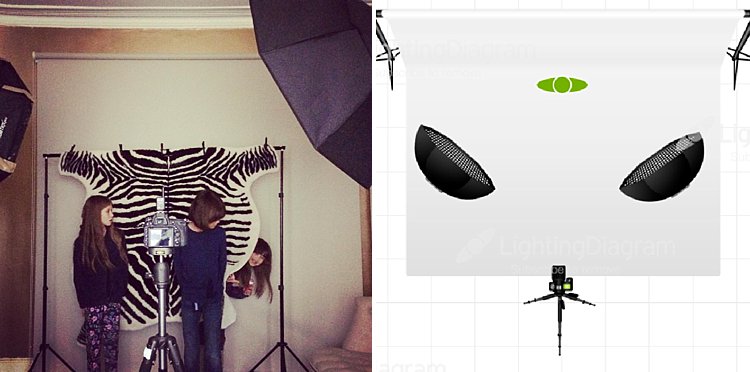
For my experiment below, I used two strobes mounted on stands and modified by gridded octaboxes. I used Paul Buff’s Cybersyncs for the wireless remote transceiver system. I also had three backdrops: one black, one beige and one patterned. See the image below for my studio setup and an iPhone picture of behind the scenes.

double-exposure-tutorial-in-camera

The camera and flash settings

The strobes were kept on a constant setting and I chose the lowest power. My ISO was also on the lowest setting (ISO 100) for most of the shots except for the f/16 ones where I cranked it up a little. The aperture varied between f/8 – f/16, depending on the look I was after and the length of my exposure. Shutter speed also varied between one second to a few seconds, to bulb. In other words, experiment until you get the look right.

How to take the double exposure

This is the trick. While the camera is exposing the image so that the shutter is open, keep triggering the flash. For these shots, I triggered the flash 2-4 times depending on the length of the exposure and how fast I could press the trigger button. The flash freezes the action so the more time the flash fires the more frozen actions you get on your image.

This leads us nicely to the first tip.

#1 Exaggerated movement is key

double-exposures-in-camera-tutorial

If your subject makes very small and minor movements, the likelihood is the images will sit on top of each other. This may result in one final image that looks like a blurry mess as in the photo above rather than many separate frozen images on a single photo as shown in the photo below. It is better to tell your subject to move distinctly away from the first position so the movements are separate. The camera still captures the trail of movement as a blur. But when you trigger the flash, that particular moment is rendered sharp and still.

double-exposures-in-camera-tutorial

I asked my kids to walk across the frame, counting each step and on a certain count to turn their heads. I would trigger the flash when they moved sideways or turned their heads. At other times I asked one of the children to only join the frame on the third flash so that there is only one of her that registers. I also got them to walk towards me (see photo at top of article). It was at that stage that I changed my aperture to the smallest my lens allowed, in this case, f/16 so that I could still get the head sharp at various depths of field.

double-exposures-in-camera-tutorial

In the photo below, I got my kids to shake their heads as fast and as many times as they could. I wanted the focus here to be the movement rather than their frozen faces. Don’t be afraid to experiment. The beauty of digital is that unlike film, you have an infinite number of frames at your disposal so can afford to make many mistakes until you get what you are looking for.

double-exposures-in-camera-tutorial

#2 A dark background is better

Compare the image above with the light background to the other images with the black background. The difference in the final image is vast. I prefer the dark background where my intention was to freeze several portraits and the lighter background where my focus was on capturing the trail of movements. Overall I shot and preferred more of the images with a dark background as the delineation between actions and the clarity of subjects are easier to see. Contrast between the skin and other lighter parts of the image was also easier to achieve compared to images shot with the beige background. In the photo below, I edited quite aggressively to get the contrast I wanted. I also added grain to simulate a film look.

double-exposures-in-camera-tutorial

#3 Experiment with materials and textures

Bring in other materials such as aluminum foil. This one here is an emergency blanket. Two of my kids stood on either side, held and waved the blanket up and down in front of the middle child so the slow shutter captured some of the movement of the foil. The kids also carried  a torch (flash light) and did some light painting. The problem I found with both photos was the blurry look of their faces. Because they did not do big movements with their bodies, hence the frozen photos captured by each flash just got stacked up in roughly the same spot. Other things you can use are glow sticks, flashing lights, moving lights, iPhone and iPad screens – pretty much anything that reflects or emits light.

double-exposures-in-camera-tutorial

double-exposures-in-camera-tutorial

Don’t be afraid to experiment with backgrounds too. In the photos below, I changed the background to a zebra striped black and white rug just because I wanted to see what would happen. I used the same movement techniques as above and the same camera and light settings but the results were very different and unique. The last image below was a happy accident. My third child popped her head up on the third flash, but she came closer to the camera than I had intended so the flash didn’t quite illuminate her face enough. However, I thought this looked really effective as it provided the gray tone of the image as well as a solid form in the middle thereby making the overall image more dynamic and interesting.

double-exposures-in-camera-tutorial

double-exposures-in-camera-tutorial

double-exposures-in-camera-tutorial

I hope you enjoyed this little tutorial on in-camera double exposures using flash. If you have more ideas, do share them here in the comments below!

googletag.cmd.push(function() {
tablet_slots.push( googletag.defineSlot( “/1005424/_dPSv4_tab-all-article-bottom_(300×250)”, [300, 250], “pb-ad-78623” ).addService( googletag.pubads() ) ); } );

googletag.cmd.push(function() {
mobile_slots.push( googletag.defineSlot( “/1005424/_dPSv4_mob-all-article-bottom_(300×250)”, [300, 250], “pb-ad-78158” ).addService( googletag.pubads() ) ); } );

The post 3 Tips for Creating Double Exposures In-Camera Using Flash by Lily Sawyer appeared first on Digital Photography School.


Digital Photography School

 
Comments Off on 3 Tips for Creating Double Exposures In-Camera Using Flash

Posted in Photography


Macphun announces Luminar photo editing app for Mac

20 Oct

Macphun, the company behind Aurora HDR, has announced Luminar, an all-in-one photo editing app for Mac. The photo editor was designed for users of all skill levels, and includes a user interface that can be tailored to each user’s specific needs.

Luminar includes a variety of tools for processing images, including native Raw processing, more than 35 photo filter sets including Photo Filter Emulation and Cross-Processing, presets, layers, brushes and masking, spot healing, noise reduction and ‘personalized darkrooms’ called Workspaces. Macphun also mentions a sky replacement tool to tease some of the other more advanced features the software will offer.

Macphun says it will open Luminar to pre-orders on November 2 with the official launch scheduled for November 17. New customers will pay $ 59, while existing customers will be charged less at $ 49. Those who pre-order the software will receive an exclusive video series dubbed Photography Essentials and Marketing Guide for Photographers by Will Burrad-Lucas.

Via: Macphun Blog

Articles: Digital Photography Review (dpreview.com)

 
Comments Off on Macphun announces Luminar photo editing app for Mac

Posted in Uncategorized


Fujifilm gives us a glimpse of its upcoming Instax Square camera

20 Oct

We’ve known for a while now that Fujifilm is developing a 1:1 format instant film, which measures 85.6mm x 72mm and provides a 62 x 62mm image, and an accompanying Instax camera. Unfortunately not much detail is known about the camera but now the Japanese manufacturer has released a teaser video on its Instax Square website that gives us at least a glimpse at some elements of the camera.

On the website you get to see some Instax Square sample images but unfortunately most of the video consists of trippy graphics that remind us of a 1990’s techno music video. So watch closely, you don’t want to miss the important parts.

Instant film fans will have to wait a little longer to get their hands on the new toy, as the release of both film and camera is scheduled for the Spring of 2017.

Articles: Digital Photography Review (dpreview.com)

 
Comments Off on Fujifilm gives us a glimpse of its upcoming Instax Square camera

Posted in Uncategorized


Leica re-launches the miniature Summaron 2.8cm F5.6 lens for the M system

20 Oct

$ (document).ready(function() { SampleGalleryV2({“containerId”:”embeddedSampleGallery_9516636456″,”galleryId”:”9516636456″,”isEmbeddedWidget”:true,”standalone”:false,”selectedImageIndex”:0,”startInCommentsView”:false,”isMobile”:false}) });

A modern version of the 1955 L-mount Summaron 2.8cm F5.6 lens is to be introduced by German camera manufacturer Leica. The new lens will be fitted for the current M series and will be named the Summaron-M 28mm F5.6. The company appears to have kept the optical design the same as was used in the original model – and indeed makes a feature of the vignetting – but has changed the mount and added 6-bit coding so the lens can communicate EXIF data to modern camera bodies. Internal mechanics remain as they were when the lens was first introduced, but the aperture ring and focusing knob have been redesigned to match the placement and feel of the current M series optics.

With such a small maximum aperture the lens itself is especially compact and lightweight – measuring 51mm across and extending 18mm. This makes it ideal for street and documentary work on occasions when the photographer wants to remain unnoticed. It seems though that at this stage the lens will only be available in silver chrome, like the original, with no black paint alternative for those with black cameras.

Leica says the focus throw is particularly long which should make focusing accurate, and the small aperture will deliver quite an extensive depth of field even when used wide open. The closest focus will be one meter and the smallest aperture will be F22.

The original Summaron 2.8cm F5.6 was produced between 1955 and 1963, and was made in relatively small numbers – so prices have remained high for these older models. It was introduced as a replacement for the even flatter Hektor 2.8cm F6.3 and bought with it that faster aperture.

There is no date for delivery yet for the new lens, but the company is asking users to pre-order due to ‘expected strong demand’. The price will be £1900.

For more information visit the Leica website.

Press release

The Return of a Classic:
The Ultra-Compact LEICA SUMMARON-M 28 mm f/5.6 wide-angle lens for Unobtrusive Reportage Photography with a Vintage Look

October 19, 2016 – With the Leica Summaron-M 28 mm f/5.6, Leica Camera expands the lens portfolio of the Leica M rangefinder system with the modern reincarnation of a classic Leica lens. First introduced as a screw mount lens in 1955, the predecessor of this new lens is still one of the most compact wide-angle lenses in the Leica M-System and is famed for its characteristic visual signature. The new Summaron-M 28 mm f/5.6 takes its lead from the classically compact construction of its ancestor and brings the unique, analog look of its pictures into the age of digital photography.

The optical design and mechanical construction of the Summaron-M 28 mm f/5.6 are identical to those of its predecessor, which was manufactured at the Leitz factory in Wetzlar until 1963. The perfect fusion of the latest optical developments, such as the highest quality finishing and manufacturing techniques, with this classic optical design make this new edition of the Summaron-M 28 mm f/5.6 much more than a reconstruction of an existing lens. While only slightly modernizing the shape and design of the lens, the new version of the Summaron-M 28 mm f/5.6 is reduced to the essentials but loses none of the character of its legendary ancestor. Its exceptionally short length of less than two centimeters makes it incredibly unobtrusive, and together with the inherent unassuming nature of a Leica M it is an ideal lens for street photography. The combination of a clearly laid out depth of field scale and long focus throw allow for very precise and easy zone focusing.

The optical design of 6 elements in 4 groups, arranged symmetrically around the iris of the new Leica Summaron-M 28 mm f/5.6, is identical to that of its ancestor. The historic optical design of the original lens has remained completely unchanged. When shot at wide-open aperture, the new Leica Summaron-M 28 mm f/5.6 renders subjects with rich contrast across nearly the entire image field. The combination of a large depth of field, natural contrast rendition, excellent resolution of details and a slight visible vignetting create a unique visual signature, and lend pictures a special classic look reminiscent of earlier days of analog photography.

The outward appearance of the new Leica Summaron-M 28 mm f/5.6 has been harmonized with the contemporary look and mechanics of the current portfolio of Leica M-Lenses. This is exemplified in the Leica M bayonet mount with 6-bit coding, the shape of the focusing lock button, the diameter of the aperture ring and the style of the knurling on the barrel and rings. The style and construction of the lens hood reflects the original, and recalls memories of the beginnings of rangefinder photography. It is machined from solid brass and finished in an elaborate manufacturing process.

As is the case for all other Leica lenses, the Leica Summaron-M 28 mm f/5.6 was designed and developed by the precision engineers and optical specialists in Wetzlar. As a product made to stand the test of time with enduring value, the lens is made in Germany from only the finest materials, and assembled entirely by hand. The combination of cutting-edge technologies and painstaking manufacturing processes guarantees consistently excellent quality and long-lasting reliability.

Customers wishing to purchase a Leica Summaron-M 28 mm f/5.6 lens must place a pre-order with a Leica Store, Boutique or Dealer. Deliveries will follow according to the sequence in which the orders are received. Due to the strong demand, long delivery times must be taken into account, especially in the first few months.


Articles: Digital Photography Review (dpreview.com)

 
Comments Off on Leica re-launches the miniature Summaron 2.8cm F5.6 lens for the M system

Posted in Uncategorized


Leica introduces ‘Titanium gray’ version of its Q compact camera

20 Oct

Leica has announced that it will release a new version of its Q (Typ 116) full-frame compact camera that will be finished in a gray paint instead of the usual black. The Leica Q ‘Titanium gray’ will be essentially the same camera as the black model, but its metal areas will be a light gray. The material body cover will be a dark gray. The company says that there are other ‘striking design features’ that make the camera different to the standard model, but all that’s evident is the distance scale markings on the lens are picked out in red paint, like the Rolf Sachs Summilux-M 35mm F1.4, instead of Leica’s usual yellow. The strap will also be made of a different material.

The ‘Titanium gray’ model will be available from the middle of November and will cost £3800. The black version usually sells for around £3200/$ 4250, but is rather short supply.
For more information see the Leica website.

Press Release

Leica Q ‘Titanium gray’

A perfect fusion of technology, design and style

Leica Camera has revealed the Leica Q ‘Titanium gray’, bringing a brand new, alternative design to its successful, high-performance compact camera, the Leica Q, which features a fixed fast prime lens and full-frame sensor.

In contrast to the discreet black of the body, lens and leather-style trim of the original Leica Q, this stunning new model offers a titanium grey paint finish on the top and base plate and back of the camera, combining the premium look of precious metal with classic black elements.

Elegant, yet extremely durable, the Leica Q ‘Titanium gray’ includes a series of striking design features not found on the standard model. For example, the distance scale in feet and the focal length on the lens are highlighted in red. Furthermore, the colour-coordinated carrying strap supplied with the camera has been manufactured from strong, robust material most commonly used to make climbing ropes.

Offering the same impressive performance and technical specifications of the black Leica Q model, the Leica Q ‘Titanium gray’ features intuitive handling and an exceptionally fast lens. The perfect camera for street, architectural and landscape photography, its Leica Summilux 28mm f/1.7 ASPH. lens makes the Leica Q ideal for available light shooting and has an angle of view that reproduces scenes with natural perspectives and proportions.

With a 24 MP, full-frame CMOS sensor precisely matched to its lens, the Leica Q ‘Titanium gray’ delivers richly detailed exposures with low noise at optimum quality, at ISO sensitivities of up to 50,000. This outstanding camera allows the greatest possible creative freedom for even the most demanding photographic ambitions, enabling the photographer to switch effortlessly between macro, automatic and manual focusing.

Ensuring the decisive moment is never missed, the Leica Q full-frame compact camera has the fastest autofocus in its class and offers precision focusing almost in real-time. Furthermore, its Leica ultra-fast Maestro II image processor enables continuous shooting at up to ten frames per second at full resolution. Allowing reliable control of subject composition at this speed, the Leica Q also features an integrated viewfinder with a resolution of 3.68 MP – displaying even the finest details without any perceptible lag, as soon as the camera is brought up to the user’s eye.

All functions of the camera are clearly laid out and logically placed, making it exceptionally ergonomic to use. The clear and logical menu provides rapid access to all essential functions and also enables photographers to programme their own personalised settings.

In addition, the Leica Q delivers movie recording in full-HD quality. Depending on the scene and subject, users can choose between 30 and 60 full frames per second for video recording in MP4 format. The camera also features an integrated Wi-Fi module for wireless transmission of still pictures and video to other devices, and remote control by WLAN from a smartphone or tablet.

The Leica Q app enabling these features can be downloaded free of charge from the Leica web site. As well as providing a remote release function and display of the viewfinder image, the app also allows the setting of parameters such as aperture and shutter speed from the device employed.

Full product specifications can be found at: uk.leica-camera.com.

Pricing and availability

The Leica Q ‘Titanium gray’ is scheduled to be available from mid-November 2016, at a suggested retail price of £3,800 including VAT.

Articles: Digital Photography Review (dpreview.com)

 
Comments Off on Leica introduces ‘Titanium gray’ version of its Q compact camera

Posted in Uncategorized


Paint it Black: 16 Mysterious Houses That Have Joined the Dark Side

20 Oct

[ By SA Rogers in Architecture & Houses & Residential. ]

black-houses-seven-gables-2

Most people can be divided into two pretty clear-cut categories: those who think black houses are creepy in a bad way, and those who love them for all their mysterious allure. Victorian houses in San Francisco, famously witchy mansions in Salem, modern homes in Japan and gingerbread houses in the woods of New York all get cool points when they’re painted top-to-bottom in shades of coal and pitch, though one abandoned black house in North Carolina looks legitimately scary in its dark disarray.

Black Ocean Firehouse, New York

black-houses-ocean

The black paint on this facade of a former New York City firehouse highlights all of the ornate neo-gothic architectural details, modernizing the 1890s structure for its new life as the headquarters for Black Ocean, a digital media company.

Haus in Schwarz, Germany

black-houses-schwarz-1

black-houses-schwarz-2

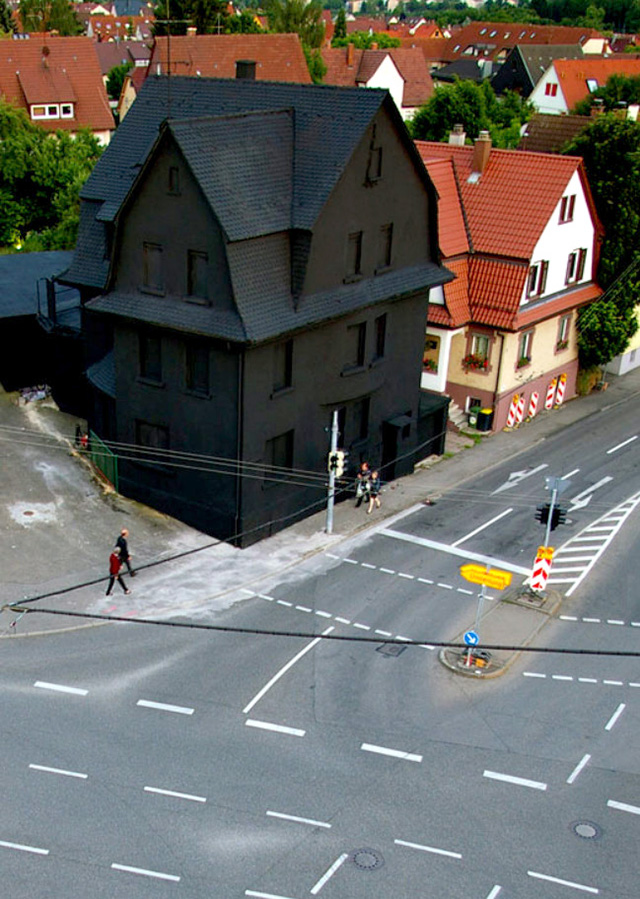
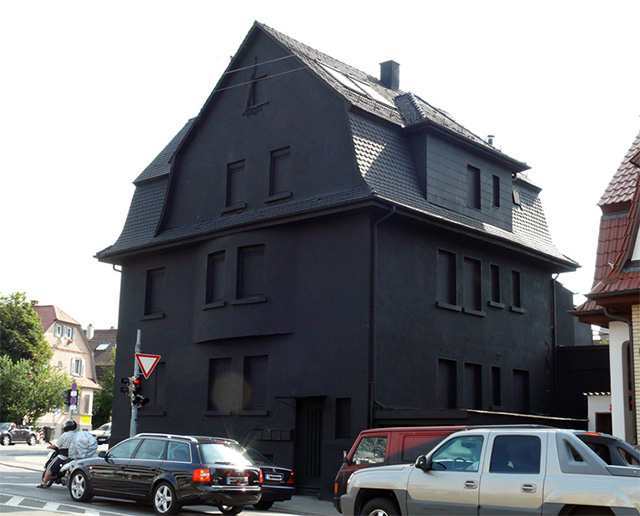
This house in Germany wasn’t painted pitch black all over until after it was condemned, as a sort of tribute before it was demolished, and that’s kind of a shame. It looks way cooler than its similarly-shaped neighbors on the same street. At night, it virtually disappears into the sky.

Shingle House by NORD

black-houses-shingle-1

black-houses-shingle-2

black-houses-shingle-3

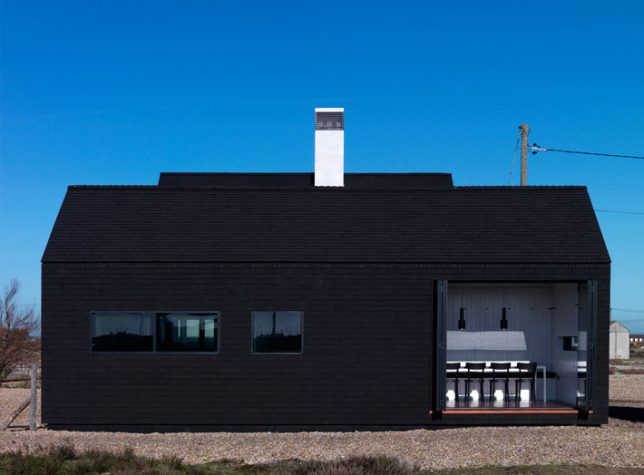
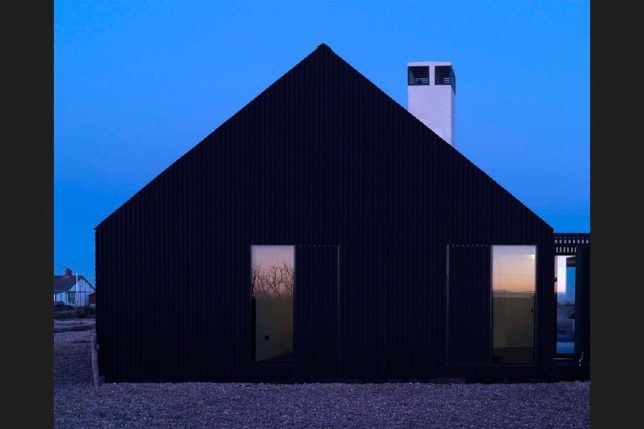
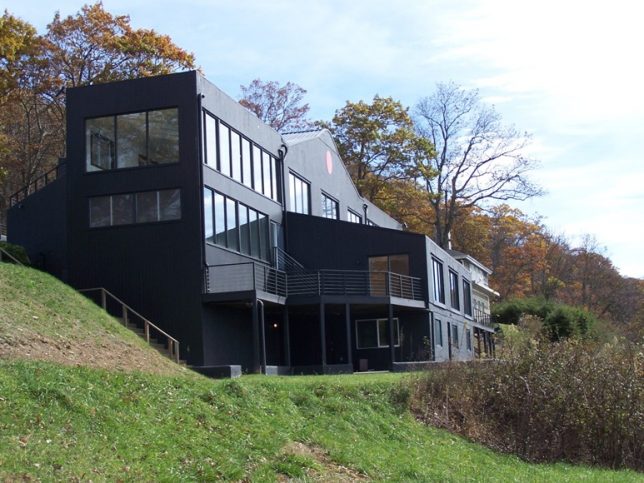
Located on the shingle beach of Dungeness, one of England’s most unique landscapes, this home by NORD stands out from a sea of fisherman’s huts with its pitch paint and tarred black roof. It’s available for rent as part of Living Architecture, a project offering vacations in striking works of modern architecture.

Abandoned Black House in North Carolina

black-houses-abandoned-1

black-houses-abandoned-2

black-houses-abandoned-3

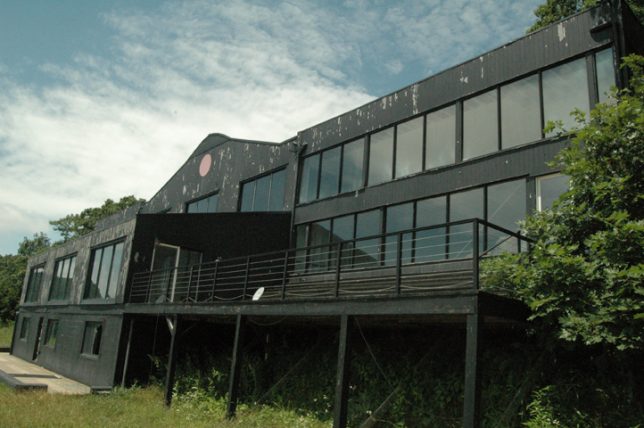
Unlike the other houses on this list, which simply don harmless black exteriors, this home on a peak in mountainous Western North Carolina is truly creepy. Located on Howard’s Knob in Boone, the home known as “The Cult House” has been abandoned for many years since its owners were went to prison, and has deteriorated after being broken into, vandalized and used as a party house. Once a million dollar home, it’s now peeling and crumbling.

Black-Fronted Residence for Park Place, London

black-houses-park-place

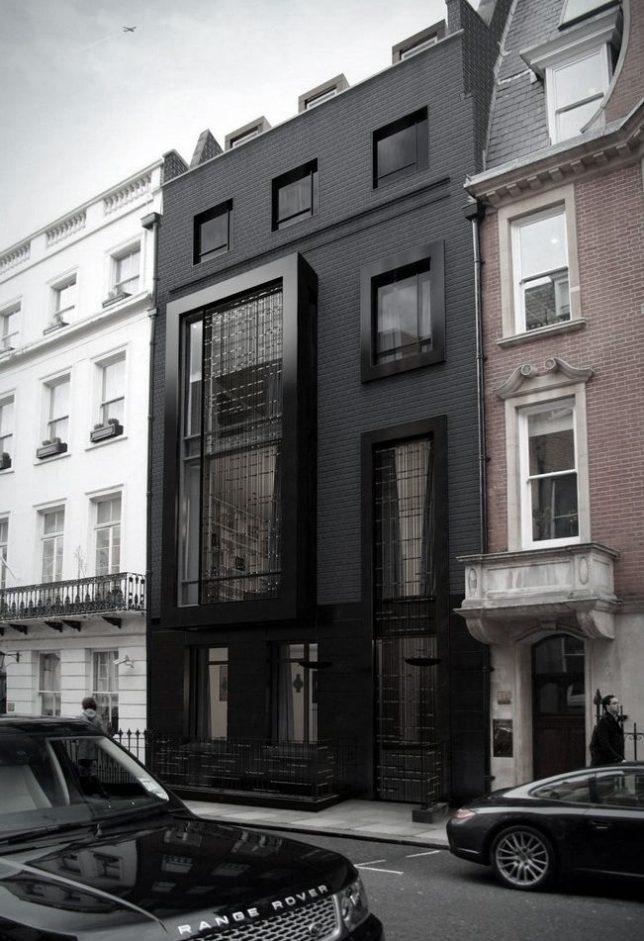
In London, SHH Architects won permission to convert a 1960s office into a home with a black facade. The original seven-story building was demolished and replaced with black brick, a double-story Oriel bay window with a decorative metalwork screen, and polished granite window frames.

Next Page – Click Below to Read More:
Paint It Black 16 Houses That Have Joined The Dark Side

Share on Facebook


[ By SA Rogers in Architecture & Houses & Residential. ]

[ WebUrbanist | Archives | Galleries | Privacy | TOS ]


WebUrbanist

 
Comments Off on Paint it Black: 16 Mysterious Houses That Have Joined the Dark Side

Posted in Creativity


Elevating X-Trans? Fujifilm X-T2 Review

19 Oct

The Fujifilm X-T2 is an updated version of the company’s top-level DSLR-shaped APS-C camera. It’s built around the same 24MP X-Trans sensor as the X-Pro2 but ends up being much more than an X-T1 with more pixels. Instead, the X-T2 is a camera that does much to address the X-System’s remaining weaknesses, which can only broaden its already considerable appeal.

Fujifilm X-T2 Key Features:

  • 24MP X-Trans CMOS III sensor
  • 325 AF points (169 of which offer phase detection)
  • AF point selection joystick
  • 2.36M-dot OLED EVF with 0.005 sec refresh time (60 fps or 100 fps in boost mode)
  • 3″ 1.04M-dot articulating LCD
  • 4K UHD video at up to 30 fps for up to 10 min (30 min with booster grip)
  • F-Log flat profile and 4K out over HDMI
  • 8 fps continuous shooting with AF (11 fps with booster grip)
  • 5 fps continuous shooting with live view updates between capture
  • Dual SD card slots (UHS-II compatible)
  • USB 3.0 socket

The X-Pro2 represented a good step forward for image quality within the system and the X-T2 gains all of that improvement, but there are also some considerable changes in terms of autofocus, video and flash control, suggesting Fujifilm wants its the X-T2 to be an all-round more capable camera than its predecessor, rather than just building on its existing strengths.

The body seems broadly unchanged at first glance but there’s a clever doubly-hinged flip-out screen that seems to offer many of the flexibility advantages of a fully articulated monitor while retaining the more compact form of a tilting screen.

There’s also a Performance Boost mode that speeds up several aspects of the camera’s behavior (at the expense of some battery life), but that really comes into its own when the optional ‘Power Boost Vertical Grip’ is added. None of these additions comes for free, though: at $ 1599, body only, the X-T2’s launch price has jumped $ 300, compared to its predecessors’.

Autofocus

Part and parcel of that 24MP sensor are the 169 phase-detection points that we saw in a large central square region of the sensor on the X-Pro2. Beyond this, the X-T2 now gains an extra two columns of 13 contrast-detection AF points down each side of the frame, widening its AF area and bringing it to a total of 325 AF points in total.

Fujifilm also promises a more powerful processor and revised algorithms, along with faster sensor read-out, to improve the camera’s speed, regardless of whether it’s using a combination of phase detection and contrast detection (Hybrid AF), or simply the latter alone.

To get the best-possible performance out of the newly refined AF system, the X-T2 introduces a use case-based AF-C setup system. Much like the one we’ve seen on high-end Canon DSLRs, this lets you specify the types of movement you’re expecting from your subject, so that the camera can try to respond appropriately.

Video

The X-T2 makes a bigger leap forward into video than we were expecting. There was much chatter around the time of the X-Pro2’s launch that the camera’s hardware was, theoretically, capable of 4K capture, but that the company hadn’t pursued its development for such a stills-orientated model. Well, it has now.

The X-T2’s movie capabilities are a big step forward for the system.

But Fujifilm has done more than just do enough to be able to emblazon the phrase ‘4K capable’ on the box: the camera also gains a mic socket and on-screen audio monitoring with the ability to assign mic volume to a Fn button. There’s also an ‘F-Log’ flat profile to give flexibility while color grading.

The good news is that our first shots of our test scene suggest the camera’s 4K footage is much more impressive than the 1080p that the first X-Trans cameras could muster. Fujifilm says its taken from an area 1.8x larger than the 4K UHD region, which suggests oversampling in each dimension. Combine this with 4K output over HDMI and the X-T2 looks like the first X-Trans camera that might appeal to shooters interested in shooting both stills and video.

Flash control

One of the missing pieces of an increasingly well fleshed-out XF mount system has been the lack of advanced flash control – something that the X-T2 is looking to address. Up until now, users have had to turn to third-party makers if they wanted to communicate TTL flash information to remote flash units.

The newly introduced EF-X500 flash allows high speed flash sync and remote TTL flash control for the first time, making it significantly easier to use the X-T2 with strobes.

Optional ‘Power Booster Grip’

Along with the X-T2, Fujifilm has introduced the VPB-XT2, a vertical battery grip that holds two extra batteries. As well as significantly extending the camera’s battery life, the grip also extends the camera’s ‘Boost’ mode. With the grip attached, this is able to draw power from multiple batteries, increasing the camera’s maximum continuous shooting rate, as well as extending its video recording time to 30 minutes.

The entertainingly-named ‘Vertical Power Booster Grip’ can house two addition batteries (without displacing the camera’s internal unit), helping increase capacity to around 1000 frames between charges. It also adds a headphone socket and a ‘Boost’ switch that improves responsiveness and ups the frame rate to 11 fps.

This grip features the same level of environmental sealing as the camera body and also plays host to a headphone socket for audio monitoring while shooting video.

Review History

Review History
6 July 2016 First Impressions, Studio Scene and Beta Gallery published,
based on pre-production camera running f/w 1.34
19 October 2016 Image Quality, Autofocus and Conclusion published,
based on production camera running f/w 1.00

Articles: Digital Photography Review (dpreview.com)

 
Comments Off on Elevating X-Trans? Fujifilm X-T2 Review

Posted in Uncategorized


Nikon announces ultra-wide PC Nikkor 19mm F4E ED tilt-shift lens

19 Oct

$ (document).ready(function() { SampleGalleryV2({“containerId”:”embeddedSampleGallery_4526415391″,”galleryId”:”4526415391″,”isEmbeddedWidget”:true,”standalone”:false,”selectedImageIndex”:0,”startInCommentsView”:false,”isMobile”:false}) });

Nikon has announced a new PC Nikkor 19mm F4E ED tilt-shift lens (which the company calls ‘Perspective Control.’) This ultra-wide lens offers 97° of coverage and can shift ±12mm and tilt ±7.5°. Unlike the company’s existing PC-E designs, the mechanism for tilt can be rotated independently from the mechanism for shift, allowing the tilt to be set either parallel or perpendicular to the shift.  The lens has three ED and two aspherical elements as well as Nano Crystal Coating.

The lens will be available next month with an MSRP of $ 3399.95.

Press release:

MASTER YOUR PERSPECTIVE WITH OPTICAL EXCELLENCE: NIKON ADDS TWO PRO-GRADE FX-FORMAT LENSES TO CELEBRATED NIKKOR LENS LINEUP

Extraordinary Next-Generation AF-S NIKKOR 70-200mm f/2.8E FL ED VR Sets a New Standard for Pro Telephoto Workhorse Lenses, While New PC NIKKOR 19mm f/4E ED is Nikon’s Widest Ever Tilt-Shift NIKKOR Offering 

MELVILLE, NY (October 19, 2016 at 12:01 A.M. EDT) – Today, Nikon Inc. has announced two exciting FX-format additions to the storied NIKKOR lens lineup, designed to achieve amazing optical performance for the most demanding professional and enthusiast photographers. An evolution of one of Nikon’s most versatile and popular pro-zoom lenses, the newly redesigned AF-S NIKKOR 70-200mm f/2.8E FL ED VR sports an updated optical formula capable of amazing image quality, while optimized for high-speed shooting. Also introduced today is Nikon’s widest perspective control lens to date, the PC NIKKOR 19mm f/4E ED tilt-shift lens, which helps photographers effortlessly control perspective when capturing architecture, interiors, fine art, product photography and landscapes.

“Nikon continues to raise the bar of optical excellence, and our newest FX-format NIKKOR offerings provide experienced photographers with powerful tools to help ensure brilliantly sharp images, whether capturing a high-speed photo finish or creatively framing an architectural marvel,” said Kosuke Kawaura, Director of Marketing and Planning, Nikon Inc. “While the new AF-S NIKKOR 70-200mm f/2.8E FL ED VR builds upon the success of its predecessors to offer a true all-around NIKKOR optic, the PC NIKKOR 19mm f/4E ED will provide fantastic perspective control for a variety of challenging wide-angle applications.”

The Ultimate Workhorse Lens for Seasoned Photographers

Long considered an essential lens in the bag of professional photographers, this updated AF-S NIKKOR 70-200mm f/2.8E FL ED VR sets a new benchmark for fast telephoto zoom lenses, taking image quality and handling to the next level. An indispensable and powerful tool for nearly any photographic scenario, the NIKKOR 70-200mm remains the professional’s choice with a wide f/2.8 constant aperture that is ideal for capturing sports, weddings, stunning portraits and more, even in low-light.

The next generation design of the lens helps ensure the very best in image quality, speed and low-light performance, while offering balance and handling that is nothing short of superb. Nikon’s new 70-200mm provides up to four stops1 of Vibration Reduction (VR) image stabilization, an improvement from its predecessor that helps users to eliminate blur and camera shake even when shooting handheld or in challenging light. During burst shooting, the lens takes advantage of an electromagnetic diaphragm for consistent auto-exposure control. Additionally, a Silent Wave Motor (SWM) enables ultra-fast and quiet AF operation with seamless manual focus override. Discerning photographers will also appreciate assignable function buttons on the lens barrel that offer customization, perfect for engaging pre-set autofocus or other focusing options.

A new optical formula consisting of six ED elements, one Fluorite element, a high refractive element and Nano Crystal Coat helps make for a lighter and more versatile lens, while reducing chromatic aberration and helping to all but eliminate distortion, ghosting and flare. Ready for even the most rugged of assignments, the magnesium alloy lens barrel features superior weather-sealing that achieves anti-dust and waterdrop-resistance, while Fluorine coating on both the front and rear glass facilitates easy cleaning. Whether shooting with a camera like the Nikon D5, D810, D750 or D500, capturing sports or weddings, the AF-S NIKKOR 70-200mm f/2.8E FL ED VR is a fantastic lens choice for experienced photographers. 

Seamlessly Control Perspective with the New Super-Wide PC NIKKOR Lens

Also new from Nikon is the latest perspective control lens (designated PC) in the NIKKOR lens lineup, the PC NIKKOR 19mm f/4E ED, a tilt-shift offering that will help photographers master perspective and depth-of-field. For storytellers who yearn to capture optically-challenging subjects like cityscapes and architecture, interiors or unique landscapes, this lens offers 97° of coverage – the widest focal length of any PC lens in the NIKKOR family. Tilt the lens to sharpen focus throughout a scene or create a miniature effect, or shift2 to adjust perspective in-camera, create panoramas or eliminate converging lines. For the first time with a NIKKOR PC lens, the direction of tilt operation can be made parallel or perpendicular to shift, offering users nearly unprecedented ability to control perspective, focus and depth-of-field, without having to lock and unlock to make adjustments. 

Sporting a super-wide 19mm focal length, the lens provides a unique perspective ideal for shooting horizontal or vertical panoramas, or even filmmaking. With this ultra-wide angle in mind, the latest FX-format NIKKOR offering was crafted with three ED and two aspherical elements that help combat distortion and glare, while virtually eliminating chromatic aberration and coma, even at the widest aperture settings. The lens also features core NIKKOR technologies such as Nano Crystal Coat to combat ghosting and flare, an electromagnetic diaphragm for fast auto-exposure control, as well as a Fluorine coat that helps resist dirt, water spots and smudges. Ready for a variety of challenging ultra-wide applications, the PC NIKKOR 19mm f/4E ED is a powerful tool for discerning photographers looking for full creative and perspective control. It joins three other Gold Ring Series PC lenses in Nikon’s line-up; the PC-E NIKKOR 24mm F3.5D ED, PC-E Micro NIKKOR 45mm f/2.8D ED and the PC-E Micro NIKKOR 85mm f/2.8D.

Price and Availability

Both the AF-S NIKKOR 70-200mm f/2.8E FL ED VR and PC NIKKOR 19mm f/4E ED will be available starting in November 2016 for suggested retail prices (SRP) of $ 2,799.95* and $ 3,399.95*, respectively. For more information on these new Nikon products and pricing for optional accessories, please visit www.nikonusa.com.

1 Based on CIPA Standard. This value is achieved when FX-format compatible lenses are attached to a FX-format digital SLR camera and zoom lenses are set at the maximum telephoto position.  

2 Depending on combination of shift and rotation, operation may be restricted by mechanical interference between the lens and camera when used with certain Nikon cameras.

  • Models that can be used without any limitation: D5, D4 series, D3 series, D810 Series, D500
  • Models that can be used with some limitations: Df, D800 series, D750, D610, D600, D300 series, D7200, D7100, D5500, D5300, D5200, D5100, D5000, D3400, D3300, D3200, D3100
  • Models that are not compatible with PC NIKKOR 19mm f/4E ED: D2 series, D1 series, D200, D100, D90, D80, D70 series, D3000, D60, D50, D40 series, film cameras, Nikon 1 series with FT-1

*SRP (Suggested Retail Price) listed only as a suggestion. Actual prices are set by dealers and are subject to change at any time.

Nikon PC Nikkor 19mm F4E ED specifications

Principal specifications
Lens type Prime lens
Max Format size 35mm FF
Focal length 19 mm
Image stabilization No
Lens mount Nikon F (FX)
Aperture
Maximum aperture F4
Minimum aperture F32
Number of diaphragm blades 9
Optics
Elements 17
Groups 13
Special elements / coatings 3 ED + 2 aspherical elements + fluorine & Nano Crystal coatings
Focus
Minimum focus 0.25 m (9.84)
Maximum magnification 0.18×
Autofocus No
Full time manual Yes
Focus method Internal
Distance scale Yes
DoF scale Yes
Physical
Weight 885 g (1.95 lb)
Diameter 89 mm (3.5)
Length 124 mm (4.88)
Sealing Yes
Other
Notes Can rotate 90 degrees in either direction, tilt up/down 7.5 degrees, shift left/right 12mm.

Articles: Digital Photography Review (dpreview.com)
 
Comments Off on Nikon announces ultra-wide PC Nikkor 19mm F4E ED tilt-shift lens

Posted in Uncategorized


Redesigned Nikon 70-200 F2.8 arrives with improved optics, electromagnetic diaphragm

19 Oct

$ (document).ready(function() { SampleGalleryV2({“containerId”:”embeddedSampleGallery_0289055049″,”galleryId”:”0289055049″,”isEmbeddedWidget”:true,”standalone”:false,”selectedImageIndex”:0,”startInCommentsView”:false,”isMobile”:false}) });

Nikon has released the latest iteration of its workhorse 70-200mm F2.8 lens. The AF-S Nikkor 70-200mm F2.8E FL ED VR, as it is known, has a new optical design, improved Vibration Reduction as well as an electromagnetic diaphragm.

The lens has a total of 22 elements, with 6 ED, 1 fluorite and 1 high refractive index element. A Nano Crystal Coat reduces flare and ghosting while fluorine coatings on the front and rear class helps prevent smudging. Vibration Reduction has been improved, now reducing shake by 4 stops (vs 3.5). The electromagnetic diaphragm allows for responsive adjustment and the ability to adjust the aperture in live view and movie mode on all camera bodies.

You’ll be able to pick up this 1.4 kg (3 lb) beast next month for $ 2799.95.

Press Release:

MASTER YOUR PERSPECTIVE WITH OPTICAL EXCELLENCE: NIKON ADDS TWO PRO-GRADE FX-FORMAT LENSES TO CELEBRATED NIKKOR LENS LINEUP

Extraordinary Next-Generation AF-S NIKKOR 70-200mm f/2.8E FL ED VR Sets a New Standard for Pro Telephoto Workhorse Lenses, While New PC NIKKOR 19mm f/4E ED is Nikon’s Widest Ever Tilt-Shift NIKKOR Offering

MELVILLE, NY (October 19, 2016 at 12:01 A.M. EDT) – Today, Nikon Inc. has announced two exciting FX-format additions to the storied NIKKOR lens lineup, designed to achieve amazing optical performance for the most demanding professional and enthusiast photographers. An evolution of one of Nikon’s most versatile and popular pro-zoom lenses, the newly redesigned AF-S NIKKOR 70-200mm f/2.8E FL ED VR sports an updated optical formula capable of amazing image quality, while optimized for high-speed shooting. Also introduced today is Nikon’s widest perspective control lens to date, the PC NIKKOR 19mm f/4E ED tilt-shift lens, which helps photographers effortlessly control perspective when capturing architecture, interiors, fine art, product photography and landscapes.

“Nikon continues to raise the bar of optical excellence, and our newest FX-format NIKKOR offerings provide experienced photographers with powerful tools to help ensure brilliantly sharp images, whether capturing a high-speed photo finish or creatively framing an architectural marvel,” said Kosuke Kawaura, Director of Marketing and Planning, Nikon Inc. “While the new AF-S NIKKOR 70-200mm f/2.8E FL ED VR builds upon the success of its predecessors to offer a true all-around NIKKOR optic, the PC NIKKOR 19mm f/4E ED will provide fantastic perspective control for a variety of challenging wide-angle applications.”

The Ultimate Workhorse Lens for Seasoned Photographers

Long considered an essential lens in the bag of professional photographers, this updated AF-S NIKKOR 70-200mm f/2.8E FL ED VR sets a new benchmark for fast telephoto zoom lenses, taking image quality and handling to the next level. An indispensable and powerful tool for nearly any photographic scenario, the NIKKOR 70-200mm remains the professional’s choice with a wide f/2.8 constant aperture that is ideal for capturing sports, weddings, stunning portraits and more, even in low-light.

The next generation design of the lens helps ensure the very best in image quality, speed and low-light performance, while offering balance and handling that is nothing short of superb. Nikon’s new 70-200mm provides up to four stops1 of Vibration Reduction (VR) image stabilization, an improvement from its predecessor that helps users to eliminate blur and camera shake even when shooting handheld or in challenging light. During burst shooting, the lens takes advantage of an electromagnetic diaphragm for consistent auto-exposure control. Additionally, a Silent Wave Motor (SWM) enables ultra-fast and quiet AF operation with seamless manual focus override. Discerning photographers will also appreciate assignable function buttons on the lens barrel that offer customization, perfect for engaging pre-set autofocus or other focusing options.

A new optical formula consisting of six ED elements, one Fluorite element, a high refractive element and Nano Crystal Coat helps make for a lighter and more versatile lens, while reducing chromatic aberration and helping to all but eliminate distortion, ghosting and flare. Ready for even the most rugged of assignments, the magnesium alloy lens barrel features superior weather-sealing that achieves anti-dust and waterdrop-resistance, while Fluorine coating on both the front and rear glass facilitates easy cleaning. Whether shooting with a camera like the Nikon D5, D810, D750 or D500, capturing sports or weddings, the AF-S NIKKOR 70-200mm f/2.8E FL ED VR is a fantastic lens choice for experienced photographers.

Seamlessly Control Perspective with the New Super-Wide PC NIKKOR Lens

Also new from Nikon is the latest perspective control lens (designated PC) in the NIKKOR lens lineup, the PC NIKKOR 19mm f/4E ED, a tilt-shift offering that will help photographers master perspective and depth-of-field. For storytellers who yearn to capture optically-challenging subjects like cityscapes and architecture, interiors or unique landscapes, this lens offers 97° of coverage – the widest focal length of any PC lens in the NIKKOR family. Tilt the lens to sharpen focus throughout a scene or create a miniature effect, or shift2 to adjust perspective in-camera, create panoramas or eliminate converging lines. For the first time with a NIKKOR PC lens, the direction of tilt operation can be made parallel or perpendicular to shift, offering users nearly unprecedented ability to control perspective, focus and depth-of-field, without having to lock and unlock to make adjustments.

Sporting a super-wide 19mm focal length, the lens provides a unique perspective ideal for shooting horizontal or vertical panoramas, or even filmmaking. With this ultra-wide angle in mind, the latest FX-format NIKKOR offering was crafted with three ED and two aspherical elements that help combat distortion and glare, while virtually eliminating chromatic aberration and coma, even at the widest aperture settings. The lens also features core NIKKOR technologies such as Nano Crystal Coat to combat ghosting and flare, an electromagnetic diaphragm for fast auto-exposure control, as well as a Fluorine coat that helps resist dirt, water spots and smudges. Ready for a variety of challenging ultra-wide applications, the PC NIKKOR 19mm f/4E ED is a powerful tool for discerning photographers looking for full creative and perspective control. It joins three other Gold Ring Series PC lenses in Nikon’s line-up; the PC-E NIKKOR 24mm F3.5D ED, PC-E Micro NIKKOR 45mm f/2.8D ED and the PC-E Micro NIKKOR 85mm f/2.8D.

Price and Availability

Both the AF-S NIKKOR 70-200mm f/2.8E FL ED VR and PC NIKKOR 19mm f/4E ED will be available starting in November 2016 for suggested retail prices (SRP) of $ 2,799.95* and $ 3,399.95*, respectively. For more information on these new Nikon products and pricing for optional accessories, please visit www.nikonusa.com.

1 Based on CIPA Standard. This value is achieved when FX-format compatible lenses are attached to a FX-format digital SLR camera and zoom lenses are set at the maximum telephoto position.

2 Depending on combination of shift and rotation, operation may be restricted by mechanical interference between the lens and camera when used with certain Nikon cameras.

  • Models that can be used without any limitation: D5, D4 series, D3 series, D810 Series, D500
  • Models that can be used with some limitations: Df, D800 series, D750, D610, D600, D300 series, D7200, D7100, D5500, D5300, D5200, D5100, D5000, D3400, D3300, D3200, D3100
  • Models that are not compatible with PC NIKKOR 19mm f/4E ED: D2 series, D1 series, D200, D100, D90, D80, D70 series, D3000, D60, D50, D40 series, film cameras, Nikon 1 series with FT-1

*SRP (Suggested Retail Price) listed only as a suggestion. Actual prices are set by dealers and are subject to change at any time.

Nikon AF-S Nikkor 70-200 F2.8E FL ED VR specifications

Principal specifications
Lens type Zoom lens
Max Format size 35mm FF
Focal length 70–200 mm
Image stabilization Yes (4 stops)
Lens mount Nikon F (FX)
Aperture
Maximum aperture F2.8
Minimum aperture F22
Aperture ring No
Number of diaphragm blades 9
Optics
Elements 22
Groups 18
Special elements / coatings 6 ED, 1 Fluorite, 1 HRI element + Nano Crystal & Fluorine coatings
Focus
Minimum focus 1.10 m (43.31)
Maximum magnification 0.21×
Autofocus Yes
Motor type Ring-type ultrasonic
Full time manual Yes
Focus method Internal
Distance scale Yes
DoF scale No
Focus distance limiter Yes
Physical
Weight 1430 g (3.15 lb)
Diameter 89 mm (3.48)
Length 203 mm (7.97)
Materials Magnesium alloy
Sealing Yes
Zoom method Rotary (extending)
Power zoom No
Zoom lock Yes
Filter thread 77.0 mm
Hood supplied Yes
Tripod collar Yes

Articles: Digital Photography Review (dpreview.com)

 
Comments Off on Redesigned Nikon 70-200 F2.8 arrives with improved optics, electromagnetic diaphragm

Posted in Uncategorized